

The Skopelos Mamma Mia trail gathers the real filming locations from the musical film Mamma Mia! into a single island route. Skopelos, the green heart of the Sporades. Supplied the two most recognised settings: the clifftop chapel of Agios Ioannis Kastri near Glossa and the pine-fringed sweep of Kastani beach on the southwest coast, where several central scenes were shot. Plan the whole trip with Greece Tours.
Following the trail means pairing these sites with the hillside village of Glossa, the dense pine forest that covers the island interior. The short boat rides that link the coast. Visitors reach the locations by hire car or on organised boat and minibus tours from Skopelos Town. Knowing which scenes belong to Skopelos and which to neighbouring Skiathos sets expectations before the drive begins.
What is the Mamma Mia trail on Skopelos?
The Skopelos Mamma Mia trail links the film locations used in the movie Mamma Mia!, chiefly the clifftop chapel of Agios Ioannis Kastri near Glossa and Kastani beach on the southwest coast, joined by Glossa village and pine scenery.
The Mamma Mia trail on Skopelos is an informal route that connects the spots on the island where the musical film Mamma Mia! was shot. Two locations anchor the trail: the whitewashed chapel of Agios Ioannis Kastri on its rock pinnacle near Glossa. Which became the wedding church. Kastani beach on the southwest coast, which stood in for the film’s beach and swimming scenes. Between these points the route takes in the village of Glossa, the port of Loutraki and the thick pine forest that covers much of the island. The trail has no marked path or signposts. Instead it is a loose itinerary that travellers assemble from a hire car.
A boat tour or a minibus excursion out of the main harbour of the island. Its two ends still fit into one day of easy driving.
The film paired Skopelos with the neighbouring island of Skiathos, and the production moved between the two across the Sporades. On Skopelos the crew concentrated on the northern chapel and the southwest beach, using the green hills and clear water as a backdrop. Because both islands appear in the finished film, the on-screen setting of the fictional island of Kalokairi is a blend of real places rather than one location. Travellers who understand this split plan a trip that either focuses on the Skopelos sites alone or adds a boat crossing to Skiathos to see the harbour and hillside scenes filmed there.
Keeping the two islands clear in mind avoids searching Skopelos for scenes that were actually shot on its neighbour across the strait to the west.
Skopelos itself gives the trail its character, since the island is one of the greenest in the Aegean. Pine forest runs from the ridgelines almost to the shoreline, and the roads that link the film sites wind through this woodland before opening onto the coast. The contrast of dark green pine, white chapel and turquoise sea is the image the film fixed in viewers’ minds, and it survives intact along the route today. The island belongs to the Sporades group off the eastern mainland, reached by ferry rather than by air. Its compact size means the northern chapel and the southwestern beach, though at opposite ends of the trail. Sit within a single day’s driving.
The whole route fits comfortably into one full outing without a long transfer between the two ends.
Most visitors treat the trail as a half-day or full-day excursion rather than a formal walking path. A common plan starts with the chapel in the cooler morning hours. Drops to a beach for a swim at midday. Ends with a meal in a village as the light softens. Independent travellers use a hire car for flexibility, while others join a guided boat or minibus tour that bundles the main stops together. Anyone building a wider itinerary can weave the trail into the broader list of things to do in Skopelos, since the film sites sit close to beaches, walking routes and the island’s two main settlements.
The trail rewards a relaxed pace, leaving room for swims and photographs between the marquee locations along the way.
Which Mamma Mia scenes were filmed on Skopelos and which on Skiathos?
Skopelos hosted the clifftop wedding at Agios Ioannis Kastri and the beach scenes at Kastani, including part of the Dancing Queen sequence. Skiathos provided the harbour, jetty and several village and hillside scenes used across the film.
The division of scenes between the two islands is the detail that most surprises first-time visitors to the trail. On Skopelos the production filmed the film’s emotional climax, the wedding. At the chapel of Agios Ioannis Kastri, using the rock, the carved steps and the small courtyard as the setting. The island also supplied the main beach scenes at Kastani, where the cast swam. Walked the sand and performed parts of the Dancing Queen sequence among the pines behind the shore. These two Skopelos locations account for some of the film’s most repeated images.
Which explains why the island markets itself so strongly around the movie despite sharing the production with its neighbour across the water to the west. Both spots stand only a short drive from the coast road that crosses the island.
Skiathos, the next island west and the gateway most travellers pass through, carried a large share of the film’s other scenes. The harbour, jetties and boat arrivals, along with hillside chapels and village lanes, were shot around Skiathos rather than Skopelos. Because the two islands lie close together and share the same pine-and-sea landscape, the finished film cuts between them without any visible seam. Viewers watching the movie see one imaginary island, Kalokairi, that in reality stitches together real coastlines from both. Travellers who want the full set of locations add a short ferry hop from Skopelos to Skiathos.
Turning a single-island trail into a two-island tour of the northern Sporades and doubling the number of recognisable spots on a single holiday spread across the two neighbouring islands.
Confusion often arises because the wedding chapel is so strongly linked with the film that some assume the entire story was shot on the one rock. In fact the chapel appears mainly in the closing scenes, while the beach at Kastani, the forest paths and other settings fill out the rest of the Skopelos footage. The interior shots seen in parts of the film were built as sets rather than filmed inside the tiny nave, which holds only a handful of people. Separating the exterior locations, which visitors can stand in, from the studio interiors, which they cannot, helps set realistic expectations.
The rock and the beach are genuine, but the wider spaces the camera suggests were created through sets, angles and careful editing in a studio.
For trip planning, the practical takeaway is that Skopelos delivers the two headline sites while Skiathos rounds out the rest. A visitor whose priority is the wedding church and the beach stays on Skopelos and sees both in a day, reaching them from Skopelos Town by car or boat. A fan set on tracing every recognisable frame plans an extra day for Skiathos, using the frequent sea link between the islands. Reading a full guide on how to get to Skopelos clarifies the ferry connections, since most routes to Skopelos pass through Skiathos anyway, making a combined visit to both film islands straightforward to arrange from either base.
A short crossing links the Skopelos harbour with Skiathos through the day, so adding the second island costs little extra time on a longer stay in the Sporades.
What is Agios Ioannis Kastri, the Mamma Mia wedding church on Skopelos?
Agios Ioannis Kastri is a small chapel on a rock pinnacle on the north coast of Skopelos near Glossa. It served as the clifftop wedding church in Mamma Mia! and is reached by about 110 carved steps.
Agios Ioannis Kastri is the single most famous stop on the Skopelos Mamma Mia trail. A compact whitewashed chapel perched on top of a tall rock that rises straight from the sea on the north coast near Glossa. The building appeared as the setting for the film’s wedding, and audiences worldwide came to know the white chapel against the open Aegean as the image of the island. The rock stands apart from the main cliffs, joined to the shore by a short spit. About 110 carved steps climb from the base to the courtyard at the top.
The chapel remains an active Greek Orthodox place of worship dedicated to Saint John, so it is a working church rather than a film set kept only for tourists.
The name Kastri means ‘little castle’, a nod to the fortress-like outline of the rock rather than any defensive building. The site sits below the coast road that links Skopelos Town with Glossa, so drivers first glimpse the pinnacle from above before descending to the small roadside parking area. From there a path drops toward the shore and then rises across the carved stairway to the chapel. The courtyard at the top holds only a small group at once, edged by low walls above a sheer drop to the water. The view runs across open sea toward neighbouring islands on clear days. This outlook.
More than the tiny building itself, is what draws travellers up the steps in a steady stream through the warmer season.
The site asks visitors for modest dress covering shoulders and knees, along with quiet, respectful behaviour near the nave. A priest celebrates the liturgy on the saint’s feast day, when residents from Glossa climb the steps for the service. There are no shops, cafes or toilets on the rock, and no ticket booth, so visitors arrive self-sufficient with water and sturdy footwear for the steep stone stairway. The interior keeps to the plain island style, with a modest iconostasis, oil lamps and hand-painted icons on whitewashed walls. Candles and simple offerings left by pilgrims show that the building still serves its original purpose.
A role the film’s fame has not displaced despite the numbers now climbing the rock.
For the trail, the chapel works best as an early stop before the crowds and midday heat build on the exposed rock. From the courtyard the connection to the film is immediate, since the setting matches the footage almost exactly, from the steps to the low courtyard walls. Travellers combine the climb with the village of Glossa just up the road and the port of Loutraki below it, filling the northern half of the trail. A dedicated guide to Agios Ioannis Kastri covers the climb, the pebble cove below and the practical detail in depth.
Pairing the chapel with the southwestern beach completes the two anchors of the Skopelos film route in a single day of relaxed driving across the island from north to south.
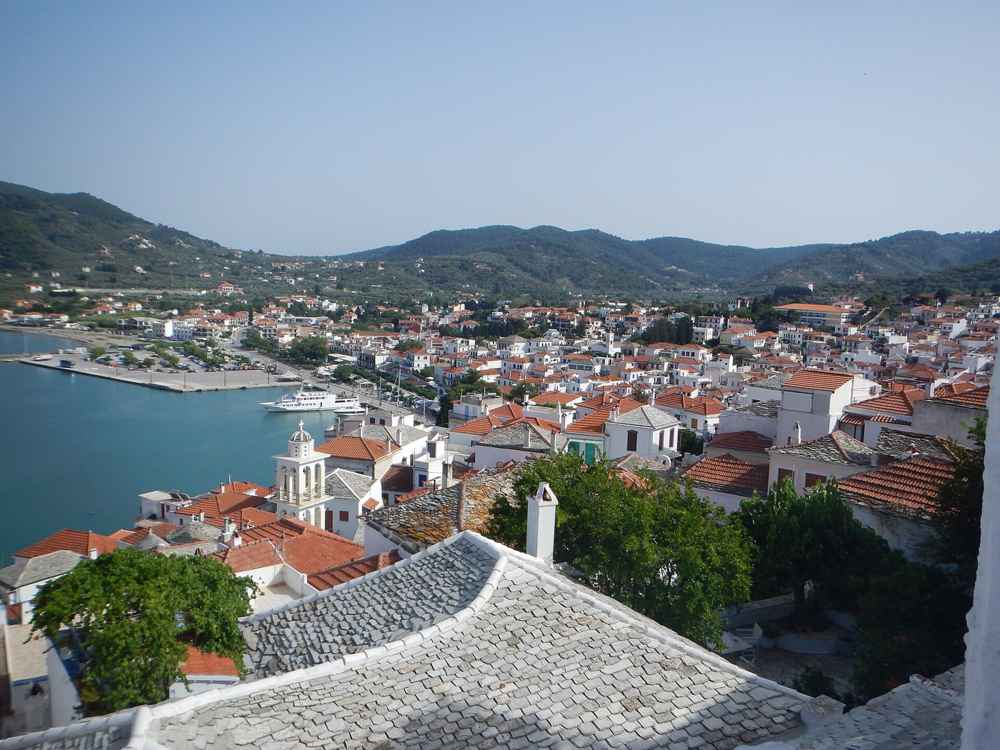
Why is Kastani beach central to the Mamma Mia trail on Skopelos?
Kastani beach on the southwest coast of Skopelos hosted the film’s main beach and part of the Dancing Queen scenes. The pine-backed pebble bay has a beach bar and taverna linked to the film, making it the trail’s southern anchor.
Kastani beach is the second pillar of the Skopelos Mamma Mia trail and the setting for much of the film’s beach action. The long pebble bay lies on the southwest coast. Backed by dense pine that runs down almost to the shoreline. It stood in for the island beach where the cast swam, walked and sang. Parts of the Dancing Queen sequence were filmed on and around this sand and among the trees behind it. Which is why the bay is so closely tied to the movie in visitors’ minds. Unlike the chapel, Kastani is a fully working beach with clear. Sheltered water.
Travellers combine the film connection with a genuine swim, turning a location stop into a relaxed hours by the sea.
The beach carries visible reminders of its film history. A beach bar and a taverna behind the shore trade on the connection, giving the bay a base for food, drinks and shade that the northern chapel entirely lacks. This makes Kastani a natural lunch or afternoon stop on the trail, a place to eat and rest between the drive and a swim rather than a quick photo halt. The pebble shore and the pine backdrop keep the setting close to how it appeared on screen, and the water stays clear over the stony seabed. Sunbeds and umbrellas are available in the main season near the taverna, though the ends of the beach stay quieter.
Visitors choose between serviced comfort and a more secluded patch of the shoreline away from the busier centre of the bay.
Reaching Kastani takes a drive of around 20 to 25 minutes from Skopelos Town along the southwest coast road, which threads through pine forest before dropping to the bay. The final stretch narrows and a parking area sits back from the sand. The southwest-facing aspect means the beach catches the afternoon and evening sun, and it can feel breezy when the summer winds pick up, so calm mornings suit swimming best. Because the bay sits on the same coast as several other beaches, it links easily into a wider beach day. The setting is exposed to the open water. On windy days the sea builds small waves.
And visitors check conditions before a long swim off the pebble shore, since the bay faces the open sea with no natural barrier.
On the trail, Kastani balances the solemn, religious character of the chapel with an easygoing seaside stop, which is why most itineraries include both. The beach appeals to travellers who want to do more than photograph a location, since it invites a swim in the same water that appears in the film. A detailed guide to Kastani beach covers the facilities, the drive and the best times to arrive. Those keen to see more of the coast can explore the island’s wider Skopelos beaches, several of which lie along the same southwestern shore. Setting the chapel in the morning and Kastani in the afternoon threads the two film anchors together with a natural rhythm across the day.
From the northern rock to the southern sand.
How does Glossa village fit into the Skopelos Mamma Mia trail?
Glossa sits on the hillside above the chapel of Agios Ioannis Kastri, making it the natural base for the trail’s northern half. The traditional village supplies tavernas, views over Skiathos and a stop close to the wedding church.
Glossa is the second-largest settlement on Skopelos and the village most closely tied to the northern end of the Mamma Mia trail. It sits high on a hillside above the sea, a short drive from the chapel of Agios Ioannis Kastri, and its terraces look across the water toward neighbouring Skiathos. Built in the traditional Sporades style, Glossa keeps stone houses, narrow stepped lanes and a quieter atmosphere than the busier main town on the far side of the island. For trail visitors the village works as the base for the chapel, a place to park, eat and rest before or after the climb.
Its position near the film’s most famous location makes it a logical anchor for the whole northern loop of the route.
The village offers the food and shade that the exposed chapel rock cannot. Tavernas along its lanes serve home cooking. Cafes on the terraces give visitors a spot to sit with a view over the Aegean toward Skiathos. The island that shares the film’s locations. Because Glossa stands away from the main tourist strip, prices and pace feel more local, and the streets stay calm outside the busiest hours. A slow wander through the lanes fills an hour, passing small churches, viewpoints and doorways framed by flowers.
This combination of authentic village life and proximity to the chapel is why guided tours and independent drivers alike fold Glossa into the trail rather than treating the wedding church as an isolated stop on the coast far from any village.
Below Glossa lies Loutraki, the small port that serves the western end of Skopelos and receives some of the island’s ferries. The harbour is lined with waterside tavernas and cafes. A short town beach offers a calm swim in sheltered water, an easier option than the exposed cove beneath the chapel. The steep road down from Glossa to Loutraki opens onto sea views as it descends in switchbacks. Adding Loutraki to the trail gives the northern loop a sea-level base to match the height of the chapel above. Fishing boats and the occasional ferry keep the port working rather than purely touristic.
It makes a relaxed end point after the climb and a wander through the village on the hillside high above the port.
For the trail as a whole, Glossa and Loutraki turn the chapel from a brief photo halt into a fuller half-day in the island’s northwest. A typical northern loop climbs the chapel steps early, moves up to Glossa for coffee or lunch, then drops to Loutraki for a swim before the return drive. A dedicated guide to Glossa covers the village lanes, tavernas and viewpoints in depth.
Travellers deciding where to base themselves for easy access to the film sites can weigh the options in a guide to where to stay in Skopelos, since a room near the western end shortens the drive to the chapel and lets visitors reach it in the quiet early hours before the tour traffic arrives from the main town.
How do you get around the Mamma Mia filming locations on Skopelos?
Visitors reach the Skopelos film locations by hire car or scooter, or on organised boat and minibus tours from Skopelos Town. The chapel lies about 35 to 40 minutes north; Kastani beach sits around 20 to 25 minutes southwest.
The most flexible way to follow the Skopelos Mamma Mia trail is by hire car or scooter, both available in the main town and at the ports. A car lets travellers set their own pace. Reach the chapel in the cool morning hours and move on to Kastani beach for the afternoon without waiting on a group schedule. The chapel of Agios Ioannis Kastri lies about 35 to 40 minutes north of Skopelos Town along the coast road toward Glossa, while Kastani sits around 20 to 25 minutes southwest on the opposite coast. The roads wind through pine forest and include bends and narrow sections, so a steady pace suits them.
Drivers fill up with fuel before setting out, since stations are limited on the quieter northern route toward Glossa and the western end of the island.
Organised boat tours offer an alternative that trades flexibility for an easy view of the coast from the water. Excursions leave from the harbour at Skopelos Town and cruise along the shoreline, passing beaches and coves that road traffic cannot reach, often with swimming stops built into the day. Some sea tours pass beneath or near the chapel rock, giving the view of Agios Ioannis Kastri that the film showed from the water. Boat trips suit travellers without a hire car or those who prefer to spend the day at sea rather than driving mountain roads. The exact route and stops vary by operator and season.
Visitors confirm the itinerary and what it includes before booking rather than assuming a fixed set of locations on every trip.
Minibus tours provide a third option, bundling the main film sites and villages into a guided land excursion from Skopelos Town. These trips typically link the chapel, a beach and a village such as Glossa in one loop, with a driver handling the winding roads and the parking. A guide adds context on the filming and the island, which appeals to visitors who want the story behind each stop rather than only the view. As with boat tours, the precise stops and timings depend on the operator and the time of year, so travellers check the route in advance.
This option suits those who prefer not to drive but still want to stand at the locations on land rather than see them only from the deck of a boat at sea.
Public buses run between Skopelos Town and Glossa along the north coast road. They do not stop directly at the chapel rock, so a short walk or taxi covers the final stretch. This makes buses workable for reaching Glossa and the general area, though less convenient for the chapel itself. Taxis are available for point-to-point trips and for travellers who want to reach a single location without driving. Choosing between car, boat, minibus and bus depends on budget, confidence on mountain roads and whether the priority is flexibility or a guided day.
Reading a full guide on how to get to Skopelos helps with the ferry links, since the island has no airport and most visitors arrive by sea through Skiathos or the mainland ports.
What do you need to know before visiting the Skopelos Mamma Mia church and beaches?
Agios Ioannis Kastri is an active church requiring modest dress covering shoulders and knees. The chapel has no facilities and steep steps needing sturdy shoes, while Kastani beach offers a bar, taverna and clear water for swimming.
The chapel of Agios Ioannis Kastri is the stop that calls for the most preparation, because it is a consecrated and active place of worship rather than a scenic viewpoint. Visitors dress modestly, covering shoulders and knees when entering the nave, and lightweight layers let swimmers cover up before stepping inside. Loud behaviour, eating and drinking are out of place in the chapel, and phones are best silenced near the altar. During a service, visitors wait quietly at the back or outside until it ends. These courtesies reflect the building’s continuing religious use and keep it welcoming for the pilgrims who still climb the steps to worship.
Preserving the calm that the film’s fame has not erased from the rock above the sea near the village of Glossa.
Footwear matters at the chapel more than at most island sights, since the roughly 110 carved steps are steep, uneven and sometimes slick. Trainers, walking shoes or grippy sandals give the security that flip-flops cannot, particularly on the descent when the sea fills the view ahead. The climb, though short at around ten minutes, raises the heart rate in warm weather, so a measured pace with a pause or two helps. A hat, sunglasses and sunscreen guard against the strong reflected light on the exposed stone. There is no shade, no toilet and no water on the rock. A full bottle for each person is the single most useful item to carry.
Especially in the heat of high summer along the northern coast of the island.
Kastani beach asks for far less planning, since it functions as a serviced bay rather than a bare rock. A beach bar and a taverna behind the shore supply food, drinks and shade, and sunbeds and umbrellas are available near the taverna in the main season. Visitors still bring water shoes for the pebble entry into the sea, which is more comfortable than bare feet over the stones. The southwest-facing bay can turn breezy when the summer winds rise, building small waves, so calm mornings suit longer swims. Because the beach sits below a narrow road, the parking area fills in the middle of the day.
Arriving earlier eases the search for a space and secures a spot in the shade behind the pines at the back.
Planning the two sites together makes the trail run smoothly. The usual pattern climbs the chapel in the cool morning, when the steps are quiet and the light is soft. Then drives to Kastani for lunch and a swim in the warmer afternoon. This order suits the facilities, since the chapel offers none and the beach provides food and shade for the middle of the day. Travellers carry water and sun protection for both stops and pack a small backpack rather than loose bags for the chapel stairway, leaving hands free for the rail. Combining a working church and a serviced beach in one day calls for both modest cover and swimwear.
Laying out clothing and footwear the night before avoids scrambling on the road in the morning.
When is the best time to follow the Mamma Mia trail on Skopelos?
Late spring and early autumn bring mild weather and thinner crowds, the easiest conditions for the trail. Within a day, early morning suits the chapel and its steps, while the afternoon suits swimming at Kastani beach.
The trail can be followed across the long Greek travel season, but late spring and early autumn stand out for comfort. In these shoulder months the temperatures stay moderate. The sea is warm enough for swimming at Kastani. Both the chapel steps and the beach are far less crowded than in high summer. The hills are green in spring after the winter rains, and the light is clear in autumn as the heat fades. Peak summer brings the largest crowds and the strongest sun on the exposed chapel rock, so the climb feels harder in July and August. Winter sees the fewest visitors, though ferry links thin out and services close.
Which complicates reaching the island and moving between the two film sites at the ends of the trail.
Within a single day, timing each stop to the sun and the crowds improves the experience. The chapel rewards an early start, when the steps are quiet, the stone is cool and the rising sun lights the eastern face of the rock. Kastani beach suits the afternoon, since its southwest aspect catches the later sun and the water warms through the day. Midday, by contrast, combines the heaviest tour traffic at the chapel with the harshest heat on the unshaded steps. Ordering the trail with the chapel first and the beach second follows this rhythm naturally, keeping the climb in the cool hours and the swim in the warm ones.
Travellers who reverse the order face the busiest, hottest window on the exposed rock near Glossa, and then reach the beach as the light begins to fade in the evening.
Weather shapes the trail as much as the season, since both anchor sites sit fully exposed to sun and wind. On calm, clear days the chapel view reaches its full extent and the sea at Kastani stays smooth for swimming. Strong northerly winds, common in high summer, make the upper chapel steps uncomfortable and build waves on the southwest beach, discouraging a long swim. After rain the carved steps turn slippery, so extra care or a short delay is wise until they dry. Checking the local forecast for wind and temperature before setting out helps in choosing the right day and the right hour.
A flexible plan that can shift by hours often lands the best conditions for both the climb and the beach across the whole span of the trail.
Managing the crowds along the trail comes down largely to timing, since neither site limits numbers. The chapel’s small courtyard and narrow steps become congested when several tour groups arrive together, and Kastani fills through the middle of the day. Independent travellers with a hire car hold the advantage, choosing the quietest hours rather than following a fixed tour schedule. Organised excursions tend to cluster around late morning, so avoiding that window eases the pressure at both stops. For deeper detail on the seasons, weather patterns and quieter months, a guide to the best time to visit Skopelos sets out what to expect across the year.
An early start remains the most reliable way to enjoy the trail with room to move at both ends, well ahead of the day-tripper wave.
What can you combine with the Mamma Mia trail on Skopelos?
The trail pairs with Skopelos Town, the island’s other beaches, forest walks and a boat crossing to Skiathos. Together these stops extend the film route into a full exploration of Skopelos and the wider Sporades.
The film trail forms the backbone of a Skopelos visit, but the island offers much more to fill the days around it. Skopelos Town, the main harbour and capital. Climbs the hillside in tiers of white houses topped by churches and a ruined castle. Its lanes hold tavernas, shops and a long waterfront. Because the town is the base for most hire cars and boat tours, travellers naturally spend time there between trail outings. A morning wandering its stepped alleys and a meal on the harbour balance the driving of the film route with a slower town day.
The capital sits roughly midway between the northern chapel and the southwestern beach, so it makes a practical hub for reaching both ends of the trail.
Beyond the two film beaches, Skopelos has a long coastline of bays worth adding to a trip. Panormos, Milia and Stafylos are among the better-known beaches, each with its own character, from organised sands with tavernas to quieter pebble coves. Several sit along the same southwest coast as Kastani, so a beach day easily strings two or three together with the film site. The clear water and the pine backdrop that made Kastani photogenic repeat along much of this shore.
Travellers who want a full survey of the options can browse the island’s Skopelos beaches and pick a mix of serviced and secluded bays to pair with the trail across their stay, matching the famous film beach with quieter coves along the same southwest shore.
The green interior of Skopelos supports walking and driving routes that show a different side of the island from the coast. Old monasteries stand on the hills above Skopelos Town, reached by short drives or footpaths, and stone tracks lead through the pine to viewpoints over the sea. The forest that framed the film’s beach scenes covers much of the island. Cooler inland walks suit the hotter parts of the day when the exposed chapel and beach are busy. Plum orchards, a local speciality, dot the countryside, and villages away from the coast keep a farming character.
Adding a half-day inland breaks up the coastal driving of the trail and shows the landscape that gave Skopelos its role in the film so clearly on screen.
For fans set on seeing every recognisable frame, a boat crossing to Skiathos completes the picture, since that island carried the harbour, jetty and hillside scenes. The frequent sea link between the two islands makes a day trip straightforward from Skopelos Town. Combining the two islands turns a single-island film trail into a broader tour of the Sporades. Travellers assembling a full itinerary can draw on the wider list of things to do in Skopelos to slot the trail among beaches, walks, tavernas and boat trips. Built out this way, the Mamma Mia route becomes the starting thread of a rounded Skopelos holiday, widening out into beaches.
Forest walks, village tavernas and a second island reached by a short boat crossing over the water to Skiathos.
Frequently Asked Questions
Was Mamma Mia! filmed on Skopelos or Skiathos?
The film Mamma Mia! was shot on both Skopelos and neighbouring Skiathos, with the production moving between the two islands across the Sporades. Skopelos supplied the two most famous locations: the clifftop chapel of Agios Ioannis Kastri near Glossa. Which became the wedding church. Kastani beach on the southwest coast, which hosted the main beach scenes and part of the Dancing Queen sequence. Skiathos provided the harbour, the jetties and several village and hillside scenes. Because the two islands share the same pine-and-sea landscape and lie close together, the finished film cuts between them to create one fictional island, Kalokairi, without any visible break.
Travellers who want to see all the recognisable locations visit both islands, using the frequent ferry link between them. Those focused on the wedding church and the beach can find both on Skopelos alone. Reachable in a single day by car or on an organised boat or minibus tour from Skopelos Town.
Where is the Mamma Mia church on Skopelos?
The Mamma Mia wedding church is Agios Ioannis Kastri, on the north coast of Skopelos near the western end of the island and close to the village of Glossa. The chapel sits on top of a tall, isolated rock that rises straight from the sea. Joined to the shore by a short spit and a stairway of about 110 carved steps. By road it lies around 35 to 40 minutes from Skopelos Town, following the main coastal route through pine forest toward Glossa and the port of Loutraki. A small parking area beside the road marks the access point, from which a path drops toward the shore and then climbs the steps to the chapel and its courtyard.
The setting matches the film almost exactly, from the carved steps to the low courtyard walls. Because it stands at the quieter western end, the church is usually visited as part of a loop that also takes in Glossa, Loutraki and the northern beaches rather than as an isolated stop.
Can you visit Kastani beach from the Mamma Mia film on Skopelos?
Kastani beach is open to visitors and functions as a working beach, not a closed film set, so anyone can walk, swim and eat there. The pine-backed pebble bay on the southwest coast of Skopelos hosted the film’s main beach scenes and part of the Dancing Queen sequence. It lies about 20 to 25 minutes by car from Skopelos Town along the southwest coast road. A beach bar and a taverna behind the shore trade on the film connection and supply food. Drinks and shade, while sunbeds and umbrellas are available near the taverna in the main season. The water is clear over a pebble seabed, and water shoes make entering more comfortable.
The southwest-facing bay catches the afternoon sun and can turn breezy when summer winds rise, so calm mornings suit swimming best. Most trail visitors combine Kastani with the chapel of Agios Ioannis Kastri, seeing the two anchor locations of the Skopelos film route in one day.
How do you follow the Mamma Mia trail on Skopelos in one day?
The Skopelos Mamma Mia trail fits into a single day because the island is compact and its two anchor sites, though at opposite ends, sit within one loop of driving. A common plan starts early at the chapel of Agios Ioannis Kastri on the north coast. About 35 to 40 minutes from Skopelos Town, climbing the steps while the site is cool and quiet. From there the route moves up to Glossa for coffee, then either drops to Loutraki or crosses the island to Kastani beach on the southwest coast. Around 20 to 25 minutes from the main town, for lunch and an afternoon swim.
Hire cars and scooters give the flexibility to set this pace, while organised boat and minibus tours from Skopelos Town bundle the main stops for those who prefer not to drive. Ordering the chapel first and the beach second keeps the climb in the cool morning and the swim in the warmer afternoon, matching each site to the day’s rhythm.
Do you need to dress modestly at the Skopelos Mamma Mia locations?
Modest dress is expected at the chapel of Agios Ioannis Kastri because it is a consecrated and active Greek Orthodox church rather than a film set. Visitors cover shoulders and knees when entering the nave. Lightweight layers work well, letting swimmers cover up before stepping inside after a visit to a beach. Loud behaviour, eating and drinking are out of place in the chapel. Phones are best silenced near the altar. During a service. Visitors wait quietly at the back or outside until it ends. These courtesies reflect the building’s continuing religious use and keep it welcoming for the pilgrims who still climb the steps.
The trail’s other main stop, Kastani beach, carries no such dress rule, since it is an ordinary serviced beach where swimwear is normal. Packing both modest cover for the church and beachwear for the sand lets travellers move between the two locations comfortably in a single day on the trail.
How steps lead up to the Mamma Mia church on Skopelos?
About 110 carved stone steps climb from the base of the rock to the chapel of Agios Ioannis Kastri and its courtyard at the top. The stairway is steep and uneven. Twisting with the shape of the pinnacle rather than running straight. A handrail follows much of the route to give support on the more exposed sections. Most visitors reach the top in around ten minutes, pausing along the way to look back at the widening view over the Aegean. The steps can become congested when several tour groups arrive together, which lengthens the climb, so an early or late visit keeps it quicker.
Sturdy footwear such as trainers or grippy sandals suits the worn stone, particularly on the descent when the sea fills the view ahead. The climb is not suitable for wheelchairs or pushchairs. There is no gentler alternative route, so visitors with limited mobility weigh the effort before starting the ascent to the film’s wedding church.
Are there guided Mamma Mia tours on Skopelos?
Organised tours that take in the Skopelos film locations run from Skopelos Town, in both boat and minibus form, though the exact routes, stops and timings vary by operator and season. Travellers confirm the itinerary before booking. Boat tours leave the harbour and cruise the coast, passing beaches and coves that road traffic cannot reach and often including swimming stops. With routes giving the view of the chapel rock from the water that the film showed. Minibus tours cover the sites on land, typically linking the chapel of Agios Ioannis Kastri. A beach and a village such as Glossa in one guided loop, with a driver handling the winding roads and the parking.
Both options suit visitors without a hire car or those who prefer a guided day to driving mountain roads. Independent travellers who want full flexibility use a hire car or scooter instead, setting their own pace between the chapel in the morning and Kastani beach in the afternoon.