

Glossa is the second-largest settlement on Skopelos, set on the northwest of this pine-covered Sporades island. The village rises amphitheatrically above the small port of Loutraki, its whitewashed and stone houses stacked up the slope facing Skiathos across the strait. Glossa keeps traditional lanes, grey-slate roofs and tavernas with open sea views, and stays quieter than the harbour capital. Plan the whole trip with Greece Tours.
Reaching Glossa takes about 30 to 40 minutes by car or the island bus from Skopelos Town, following the ridge road across the length of the island. Ferries and hydrofoils also call at Loutraki, the port directly below the village, linking Glossa with Skiathos, Alonissos and the mainland. The village sits close to the chapel of Agios Ioannis Kastri and the northern beaches, a practical base for the north.
What makes Glossa different from Skopelos Town?
Glossa occupies a high ridge on the northwest coast, while Skopelos Town wraps around the main harbour on the east. The northern village stays residential and quiet, with fewer shops, fewer visitors and a working, everyday rhythm.
Glossa and Skopelos Town anchor the two ends of the island’s inhabited spine. Skopelos Town, the capital, spreads across a natural amphitheatre above the eastern harbour, packed with churches, mansions and a dense grid of shops and tavernas. Glossa sits about 30 kilometres to the northwest, on a ridge roughly 250 metres above the sea. The contrast is immediate. Where Skopelos Town carries the island’s administration, ferry traffic and nightlife, Glossa keeps the pace of a farming and fishing village. Its lanes serve residents first and travellers second, so mornings pass with bakery deliveries and the sound of scooters rather than tour groups.
This difference draws visitors who want the north of the island without the density of the capital. It sets the tone for the rest of the northwest around the village.
The two settlements also differ in scale and function. Skopelos Town counts thousands of residents in high season and holds the island’s main port, bus terminus, banks and clinic. Glossa, with a population in the hundreds, works as the hub for the northwest, gathering the surrounding hamlets of Elios, Klima and Loutraki. Farmers from the terraced hills bring plums, almonds and olives down to Glossa, produce long tied to Skopelos and its prune-drying tradition. The village square, the kafeneia and the two or three grocery stores handle daily life for the whole northern district.
Visitors notice that Glossa answers to a local calendar of harvests and name-day festivals rather than to the ferry timetable that governs the busy quays of the capital at the other end of the island.
Architecture separates the two places as well. Skopelos Town shows the classic Sporades look of white cubic houses with blue and grey shutters tumbling toward the water. Glossa leans more to stone. Older houses here combine rough masonry with timber upper floors and grey schist-slab roofs, a build suited to the exposed, windier northwest. Most facades stay unpainted, showing the bare stone, while wooden balconies lean over lanes barely wide enough for a donkey. A destructive earthquake in the last century reshaped parts of the northwest and pushed families down to the newer coastal village of Neo Klima, also called Elios.
Glossa itself held its high ground, and its stepped streets still climb the slope in the old pattern. Walking between the districts, the change from painted plaster to bare stone marks the shift from capital to northern village.
The everyday experience of each place reflects these differences. In Skopelos Town, visitors move between waterfront cafes, boutique shops and the stepped Kastro district crowned by its old churches. In Glossa, the pull is slower: a coffee in the shaded square. A walk to the edge of the village for the view over Loutraki and Skiathos. A long lunch on a taverna terrace. Sunset arrives over the water in the west, a direction the east-facing capital never offers. Travellers often pair the two, staying in or near Glossa for calm and driving to the capital for the harbour and its restaurants.
Choosing between them depends on the trip: Glossa rewards those after quiet and open horizons, the capital those after services and constant movement along its busy waterfront.
Where is Glossa located on Skopelos?
Glossa sits on the northwest tip of Skopelos, on a ridge above the port of Loutraki. The village looks across a narrow strait to Skiathos and marks the far end of the island’s main road from Skopelos Town.
Glossa occupies the northwestern shoulder of Skopelos, the second-largest of the Northern Sporades after neighbouring Skiathos. The village is built on a ridge roughly 250 metres above sea level, high enough to catch the breeze and the long views that define it. Below and to the west lies Loutraki, its port, reached by a winding descent of about 3 kilometres. To the north the land drops toward the island’s remote beaches, while to the south the ridge road threads back through pine forest toward the centre of the island. This corner sits farthest from the capital, which is why Glossa functions as a distinct northern world with its own port.
Beaches and daily routine, rather than as a suburb of Skopelos Town at the far end of the road.
The strait between Glossa and Skiathos measures only about 5 kilometres. On clear days the outline of Skiathos. Its airport and even the mainland mountains behind stand out from the village edge. This closeness shaped Glossa’s history and its port. Loutraki has long served as the crossing point for the northwest, shortening the sea route to Skiathos and, beyond it, to the harbours of the Pelion coast. Skopelos as a whole belongs to a green, pine-clad chain that includes Alonissos and the islets of the National Marine Park to the northeast. Glossa faces the opposite way, toward Skiathos and the open channel. Its light, weather and sunsets differ from the sheltered.
East-facing setting of the capital across the island, and the village looks out to sea rather than back into a harbour.
Getting a sense of the layout helps in planning. The island’s single main road runs roughly northwest to southeast, linking Glossa and Loutraki at one end with Skopelos Town at the other, about 30 kilometres away. Along the way it passes the resort bays of Elios, Milia and Panormos and the inland pine ridges. Glossa stands at the road’s northern terminus, where it splits: one branch drops to Loutraki port, another continues on foot and by track toward Perivoliou and the northern shore. Because the village caps a ridge, its streets run as stepped lanes rather than a flat grid, and cars stop at the entrance while the core stays pedestrian.
Orientation is simple: uphill leads into the old village, downhill toward the port and the sea.
The position also explains Glossa’s climate and vegetation. The northwest catches the meltemi, the dry summer wind from the north. Which keeps the ridge cooler than the sheltered southern bays and makes long afternoons on the terraces bearable in high summer. Pine forest, olive terraces and plum orchards cover the slopes around the village. Part of the green cloak that gives Skopelos its reputation as one of the most wooded islands in the Aegean. Springs and old cisterns dot the hillsides, remnants of a farming economy built on almonds, olives and the island’s prized plums.
From almost anywhere in Glossa the sea is in view, framed by orchard walls and the grey roofs of the houses stepping down toward Loutraki and the Skiathos channel beyond.
How do you reach Glossa from Skopelos Town?
Buses and cars link Skopelos Town to Glossa in about 30 to 40 minutes along the island’s main road. Ferries and hydrofoils also dock at Loutraki, the port below the village, giving Glossa a sea route independent of the capital.
The road journey is the standard way in. From the bus terminus on the Skopelos Town waterfront, the island’s public bus runs the length of the island to Glossa and on to Loutraki. A trip of about 30 to 40 minutes depending on stops. The service is busiest in summer, when buses run through the day and call at the beach resorts of Panormos, Milia and Elios en route. Drivers cover the same 30-kilometre road, climbing through pine forest and over the central ridge before the descent toward the northwest. Fuller timetables and route notes appear in the how to get to Skopelos guide.
A hire car or scooter adds flexibility for reaching the northern beaches, which the bus does not serve directly from the village.
Arriving by sea puts you straight into the north. Loutraki, the port below Glossa, receives conventional ferries and faster hydrofoils on the routes that connect Skopelos with Skiathos. Alonissos. The mainland ports of Volos and Agios Konstantinos on the Pelion coast. Most sailings call first at Skopelos Town and then at Loutraki. Or the reverse. Travellers heading for the northwest can step off at the nearer quay and skip the cross-island drive. From the Loutraki waterfront, a road and an old stepped path climb the roughly 3 kilometres up to Glossa. Taxis wait at the quay for arrivals, and the village bus links the port with the settlement above.
Checking which port a given sailing uses avoids an unnecessary transfer across the island at either end of the journey.
Timing the connection rewards a little planning. Because Loutraki sits about 30 kilometres from the capital, a mismatch between your ferry port and your accommodation can add a long transfer at either end of the day. Travellers based in Glossa aim for sailings that call at Loutraki, while those staying near the capital use the Skopelos Town quay. The last bus of the day leaves earlier than travellers expect, so late ferry arrivals into Loutraki rely on a waiting taxi to reach the village or the beaches. For a first visit, arriving in daylight makes the ridge descent to Loutraki and the climb to Glossa far easier to read.
It opens up the long view across the strait to Skiathos on the way in.
Onward links from Glossa keep the north connected. From Loutraki, short ferry and hydrofoil hops reach Skiathos in well under an hour, putting the island’s airport within practical range for arrivals and departures. Day trips to Alonissos and the Marine Park run in summer, and water taxis and small boats work the northern coast for beaches that the road leaves out. Within the village, distances are short enough to cover on foot, and a single car or scooter handles trips to Agios Ioannis Kastri and the northern shore. Anyone weighing where to base themselves compares the trade-off directly: Glossa offers the quieter north and the Skiathos link, while the capital offers more sailings and services.
The choice shapes how much cross-island driving a stay involves.
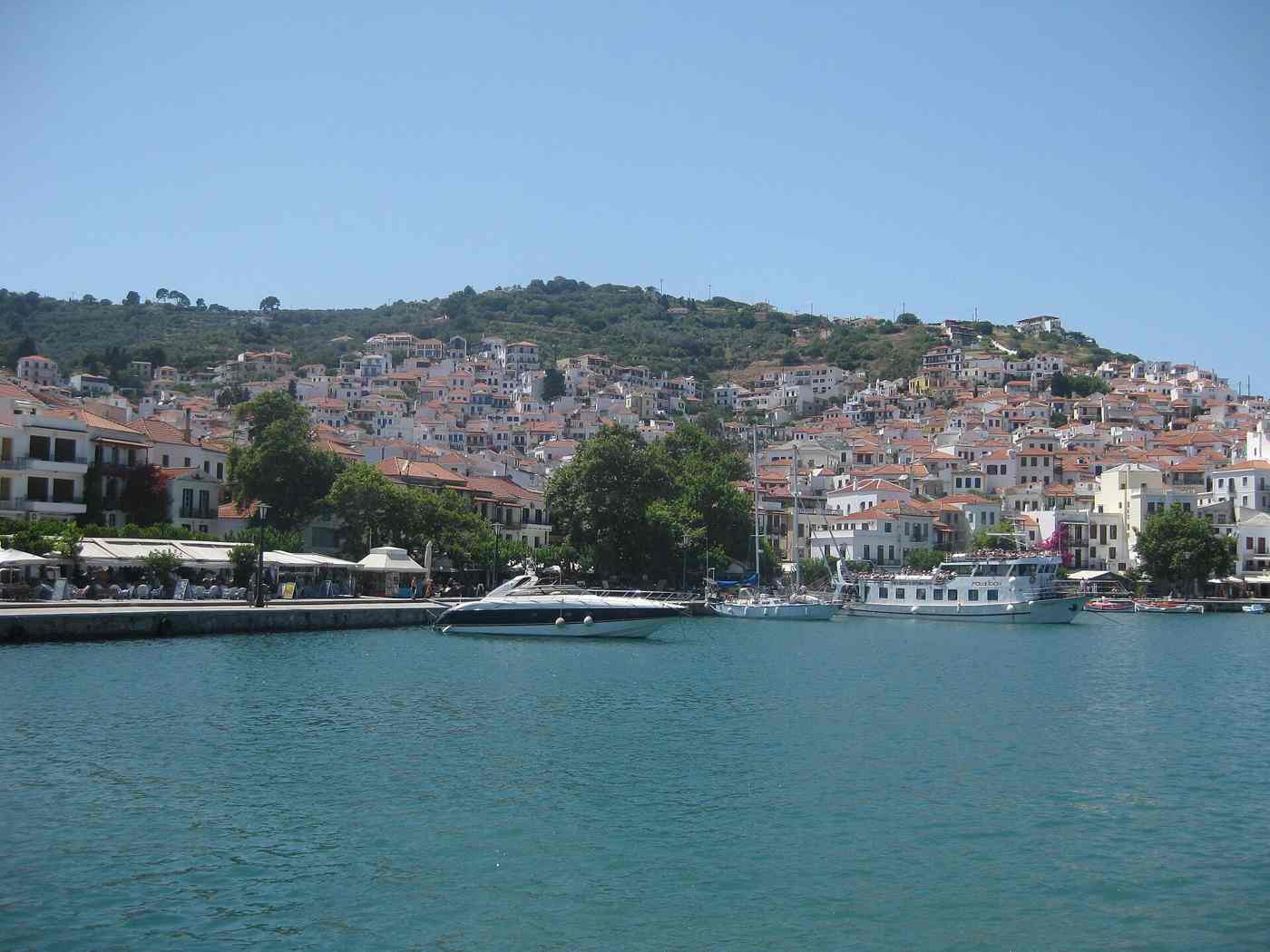
What is Loutraki, the port below Glossa?
Loutraki is the small coastal settlement and ferry port that serves Glossa, about 3 kilometres downhill on the northwest coast. Its quay handles ferries and hydrofoils, while a seafront of tavernas lines the harbour beneath the village.
Loutraki is Glossa’s window on the sea. The port lies about 3 kilometres below the village by road, a cluster of houses, tavernas and a beach strung along a sheltered northwest bay. The name, meaning little baths, points to antiquity: this shore was the harbour of ancient Selinous, one of the classical towns of Skopelos, and scattered remains recall that past. Today the working heart of Loutraki is its ferry quay, where the ramps of the Sporades boats swing down and foot passengers, cars and cargo move between island and mainland. The waterfront runs level and easy after the steep ridge above.
Visitors arriving by sea meet Skopelos first at this low-key harbour rather than at the busier capital. And the pace here stays slower than the eastern port.
The harbour front sets the tone. A row of tavernas and cafes faces the water, their tables close enough to the edge to watch caiques unload and the evening ferry come in. A pebble-and-sand beach runs beside the quay, shallow and calm, used by local families and by travellers waiting for a boat. Fishing still works out of Loutraki, and the day’s catch feeds the kitchens along the front. Behind the seafront, lanes climb a short way into the old part of the port settlement, where stone houses and a church mark the original core. The overall scale stays small: Loutraki is a place to eat. Swim and wait for a sailing rather than a resort.
It empties out once the last boat has gone for the day.
The link between port and village defines daily life here. Historically, everything landing at Loutraki, from goods to arriving relatives, made the climb up to Glossa, and an old cobbled kalderimi still connects the two on foot. The stepped path leaves the harbour and switchbacks up the slope through olive terraces. Gaining the roughly 250 metres to the village in a walk of about 40 minutes to an hour. Walkers trade the road’s traffic for open views back over the bay and across to Skiathos. Most visitors now drive or take the village bus up the paved road. The kalderimi survives as one of the north’s short heritage walks.
And it shows how port and ridge village functioned as a single community long before cars reached the island.
Loutraki also serves as a springboard for the wider northwest. From the quay, ferries and hydrofoils cross to Skiathos in under an hour and continue to Alonissos and the mainland, so the port doubles as the north’s transport hub. Small boats and water taxis run from here along the coast toward beaches that the road cannot reach easily. The bay itself gives safe, shallow swimming close to the tavernas, useful for families and for anyone filling the hours before a boat. For travellers staying in Glossa, Loutraki is the natural place to end the day: a drive or walk down for dinner by the water.
Then the climb back up to the ridge as the lights come on across the strait toward Skiathos and the last boats settle at the quay below.
What does Glossa’s architecture look like?
Glossa’s houses combine stone ground floors, timber upper storeys and grey schist-slab roofs, stacked in stepped lanes up the ridge. The build suits the exposed northwest, and much of the old village survives in its traditional layered form.
Glossa reads as a stone village first. Its older houses rise two or three storeys, with rough masonry walls on the lower floors and lighter timber-framed upper rooms that overhang the lane on wooden brackets. Roofs are laid with grey schist slabs rather than the terracotta tiles common further south. A local material that ties the whole village into one muted, silvery colour against the green hillside. Windows and doors are framed in painted wood, and carved balconies and shutters add the detail. This mix of stone and timber answers the northwest setting, where wind and winter weather hit harder than on the island’s sheltered eastern side.
The result is a village that looks grown from its own slope rather than applied to it, distinct from the whitewashed capital across the island.
The plan of Glossa follows the land. Because the village caps a steep ridge, its lanes climb in steps and switchbacks, linked by short flights of stairs and arched passages that duck beneath the upper floors of houses. Cars stop at the edge, and the core stays a pedestrian maze of alleys too narrow for traffic. Small squares open at intervals, each with a plane tree, a church or a kafeneio, acting as the social hubs of their quarter. The amphitheatrical arrangement means almost every house looks out over the roofs below to the sea, and the higher lanes give clear views across Loutraki bay to Skiathos.
Walking Glossa is a matter of climbing and descending rather than strolling on the level, and the layout rewards slow exploration on foot with a new angle at each turn.
Churches punctuate the built fabric. Glossa holds chapels and larger churches, their bell towers rising above the grey roofs and their domes painted or tiled in contrast to the stone. The main village church anchors the central square and comes alive on its patron saint’s day, when the whole northern district gathers. Smaller family chapels stand tucked into lanes and at the village edges, a pattern repeated across Skopelos, an island long noted for the density of its churches. These religious buildings, with their whitewashed walls and carved stone doorframes, break up the stone-and-timber streetscape and give orientation points in the maze.
Their festivals, spread through the warmer half of the year, remain the clearest expression of the village’s traditional community life and its calendar of name days and harvests.
Preservation keeps the old character intact. Glossa escaped the heavy resort building that reshaped parts of the island’s coast, and its ridge-top position kept development contained within the historic footprint. Renovations tend to restore stone facades and timber balconies rather than replace them, so the streetscape stays consistent from lane to lane. Houses stand empty or partly ruined in places. A reminder of the twentieth-century emigration that drew islanders to Athens and abroad. Restoration has brought homes back into use as residences and rooms to rent. Traditional building crafts, from stone masonry to slate roofing, survive in the upkeep of the village.
For visitors, this continuity is the appeal: Glossa shows how a Sporades ridge village looked and worked before mass tourism, in stone, timber and slate rather than concrete.
What is there to see and do in Glossa village?
Glossa rewards slow walking through its stepped lanes, coffee in the shaded squares, and long meals on taverna terraces with sea views. The village works as a quiet base for exploring the northwest rather than a sightseeing checklist.
The village itself is the main attraction. A visit to Glossa centres on walking its stepped lanes. Following alleys up to the ridge line for the view and down toward the edges where the houses give way to orchards. Along the way, the small squares invite a pause for coffee under a plane tree, and the balconied stone houses reward slow attention. There is no single monument to tick off; the reward is the whole ensemble and its rhythm. Travellers planning a wider itinerary of walks, beaches and boat trips find Glossa’s role set out in the island’s things to do in Skopelos guide, which places the northern village within the range of activities across the island.
For most visitors, half a day on foot covers the core, leaving the afternoon for the port and the chapel below.
Food is central to a stay in Glossa. Taverna terraces along the upper village and down in Loutraki serve the island’s traditional dishes, built on local produce: Skopelos cheese pie. The spiral of thin pastry fried with soft cheese. Slow-cooked plums and prunes that reflect the island’s orchard heritage. And fish landed at the port below. Meals stretch out here, taken at the pace the village keeps, and the terraces face west, so dinner runs into the sunset over Skiathos. Mornings start at the bakery and the kafeneia on the square, where residents gather over coffee. Eating in Glossa means eating what the surrounding hills and the harbour provide.
The absence of large tourist restaurants keeps the cooking close to the everyday table of the north.
Walking and views structure the rest. From the top of the village, footpaths and the old kalderimi drop toward Loutraki, giving a route down to the port on foot through olive terraces. Other tracks lead north and east into the orchards and pine, toward the remote northern beaches and the semi-abandoned old village of Palio Klima on the slope to the south. The village edges themselves work as viewpoints: benches and terraces set where the ground falls away frame the bay, the port and the Skiathos channel. Photographers time these spots for the late afternoon, when the low sun catches the grey roofs and the water turns from blue to gold.
For an active day, the walk down to Loutraki and back stitches together the village, the port and the coast in a single loop.
The village also serves as a cultural window on the north. Glossa’s festivals, tied to church name days and to the harvest of plums, almonds and olives. Bring music and communal meals to the squares through the warmer months and offer visitors a direct view of island tradition. The grocery stores and the weekly rhythm of deliveries show a working village rather than a resort. Craft and produce, from local cheese to jars of prunes and honey, appear in the small shops. Beyond the built village, the northwest around Glossa opens onto the beaches. The chapel of Agios Ioannis Kastri and the walking country of the north.
The settlement functions less as a destination in itself than as the gateway and living centre for exploring this quieter end of Skopelos.
How close is Agios Ioannis Kastri to Glossa?
Agios Ioannis Kastri stands about 5 kilometres from Glossa on the northeast coast, a chapel set on a tall rock reached by a stone staircase. The road from Glossa and Loutraki reaches it in roughly 15 minutes.
The chapel is Glossa’s most visited neighbour. Agios Ioannis Kastri sits about 5 kilometres from Glossa on the northeast coast, a tiny white church perched on the flat top of a rock that juts out into the sea. From the small beach and car park at its foot, a stone staircase of about 100 steps cut into the rock climbs to the chapel. Opening a full view over the water and the surrounding cliffs at the top. The drive from Glossa or from Loutraki port takes roughly 15 minutes along the northern road, making the chapel an easy half-day outing from the village.
Its position, isolated on the rock above open sea, gives the site its long-standing pull for visitors to the north of the island.
Film fame made the chapel internationally known. Agios Ioannis Kastri stood in as the clifftop church for the wedding scene in the musical film shot across Skopelos and Skiathos. The rock and its staircase became one of the most recognised images of the Sporades. The film’s locations across the island, from this chapel to the southern beaches used for other scenes, are gathered on the Mamma Mia trail, which links the sites into a single route. For visitors based in Glossa, the chapel is the nearest and most prominent of these, reached in a short drive.
The climb up the steps, the small interior of the church and the view from the summit occupy about an hour, after which the beach at the base offers a swim before the return to the village above.
The setting rewards the trip on its own terms, film aside. The rock, joined to the shore by a low neck of land, rises sheer from the sea, and the staircase hugs its side to the chapel door. From the top, the view runs along the wild, cliff-lined northeast coast of Skopelos and out over the channel toward Alonissos and the Marine Park. The whitewashed chapel, barely larger than a room, holds a handful of visitors at a time, so the climb spaces people out and keeps the summit calm. Below, the small cove of Agios Ioannis has a short beach of pebbles and clear water, sheltered by the rock.
The combination of a short climb, a working chapel and a swim beneath it makes the site a compact outing rather than a long excursion from Glossa.
Practical points keep the visit smooth. The staircase is steep and exposed, cut into bare rock, so sturdy footwear and water help, and the middle of a summer day brings both heat and the largest numbers. Early morning and late afternoon give softer light and thinner crowds, and the late sun sits well for photographs of the rock from the road above. The chapel is a place of worship, so covered shoulders are the norm for stepping inside. Parking at the base is limited, which is another reason to arrive outside peak hours. From Glossa the outing pairs naturally with the northern beaches, since the road to the chapel runs near the northern coast.
Letting a single drive combine the island’s signature landmark with a quiet swim on the way back.
Which beaches are near Glossa?
Glossa’s nearest beaches lie along the north and northwest coast: Perivoliou, Hondrogiorgi, the cove below Agios Ioannis Kastri, and the bays around Loutraki. Most sit off the northern road and reward a car or boat.
The north coast holds Glossa’s beaches. Perivoliou, near the island’s northern tip, ranks among the more remote strands on Skopelos. A stretch of pale pebbles and clear water backed by a cave and reached down a rough track from the Glossa road. Nearby Hondrogiorgi offers a similar quiet setting on the same wild coast. These northern beaches trade easy access for solitude: the roads narrow to dirt near the shore, and none carries the development of the southern resorts. For a wider survey of the island’s coastline, from the organised southern bays to these remote northern coves, the Skopelos beaches guide sets out the options and how to reach each one.
From Glossa, a car or scooter is the practical way to the north shore rather than the bus, which does not run to these unpaved coves.
Closer at hand, the coast around Loutraki gives the easiest swimming. The port beach itself is shallow, sheltered and a short drive or walk below the village, suited to a quick dip between other plans or to families with young children. The cove beneath Agios Ioannis Kastri, on the northeast side, pairs a short pebble beach with the landmark chapel above, so a swim and the climb combine in one stop. These accessible options mean a stay in Glossa does not depend on long drives for a day by the water. The contrast with the busier southern beaches is clear: the north trades sunbeds and beach bars for space and quiet. Swimmers here bring their own shade.
Water and picnic rather than relying on facilities at the shore.
The southern beaches lie within reach for a change of scene. The organised bays of Milia, Kastani, Panormos and Stafylos string along the sheltered southwest coast between Glossa and the capital, each backed by pine and served off the main road. Kastani in particular drew attention as a filming location, and its details appear in the Kastani beach guide. From Glossa these beaches sit about 15 to 25 minutes down the island road. Making them an easy morning’s drive for travellers who want sunbeds, a beach taverna and calmer, warmer water than the exposed north. Pairing a northern base with a southern beach day is a common pattern.
The single main road makes the run simple in either direction along the pine-covered spine of the island.
Boat trips open the coast that roads miss. From Loutraki and from the island’s other ports. Small boats and organised excursions reach beaches and sea caves along the northern cliffs that no track serves. Cross toward Alonissos and the islets of the Marine Park. For strong swimmers and walkers, the tracks off the Glossa road lead down to unmarked coves where the only company is the sea. Whichever beach a day points to, the pattern from Glossa stays the same: the wild, quiet north within a short drive or walk. The organised south a longer run down the island. The water clear on both coasts.
This range, from remote pebble cove to serviced bay, is a large part of why travellers choose the northwest as a base for a stay.
Where do you stay and eat around Glossa?
Glossa and Loutraki offer guesthouses, rented rooms and small studios rather than large hotels, split between the ridge village and the port below. Tavernas cluster in the village squares and along the Loutraki waterfront.
Accommodation in the northwest stays small in scale. Glossa and Loutraki hold guesthouses, rooms to rent and self-catering studios rather than the resort hotels found on the southern coast. Most occupy restored stone houses in the village or seafront buildings at the port. Staying up in Glossa puts the ridge views, the squares and the quiet at the door, with the trade-off of a drive or walk down to the beach. Staying in Loutraki keeps the water and the ferry quay close but sits below the historic village.
The choice between ridge and port, and the wider question of which part of the island suits a given trip, is set out in the where to stay in Skopelos guide, which weighs each district against the way you plan to travel.
The northwest suits a particular kind of stay. Basing yourself in Glossa favours quiet, walking, sunsets over Skiathos and easy reach of the northern beaches and the chapel of Agios Ioannis Kastri. It sits farthest from the capital’s nightlife and its wider choice of restaurants and shops, so travellers who want evenings out and frequent ferries often prefer the east. The northwest rewards the opposite priorities: a slower base, thinner crowds and an authentic village routine. Families, walkers and couples after calm tend to choose this end.
A car turns the trade-off into a minor one, putting the southern beaches and the capital within a half-hour drive while keeping the northern quiet as the place to return to each evening.
Eating around Glossa follows the seasons and the sea. Village tavernas serve the island’s traditional cooking, from Skopelos cheese pie to slow-cooked meat and dishes built on local plums. Olives and almonds, while the Loutraki waterfront specialises in fish and seafood landed at the quay. Terraces in the upper village face west for the sunset, and the port tables sit at the water’s edge. Bakeries and kafeneia on the squares cover breakfast and the morning coffee that anchors village life. The scale stays domestic: family-run kitchens rather than large tourist restaurants, with menus that shift according to the day’s catch and the season’s harvest. This is a large part of the northwest’s appeal.
A table close to the land and the boats that supply it. A reason visitors linger over meals well into the evening.
Timing shapes what a stay in Glossa offers. The village and its beaches are busiest in July and August, when the buses run full and the ferries to Skiathos fill, while late spring and early autumn bring warm water, open tavernas and thinner crowds. Guidance on the trade-offs between months, from festival season to swimming temperatures, is gathered in the guide on the best time to visit Skopelos. Out of the peak weeks, rooms and tavernas in the north close for the winter, so the shoulder season rewards a little planning. For most visitors the reward of choosing Glossa is consistent across the season: a quiet.
Traditional base in the northwest, within reach of the island’s beaches, its landmark chapel and its capital alike.
Frequently Asked Questions
Is Glossa worth visiting on Skopelos?
Glossa suits travellers who want the traditional, quieter side of Skopelos rather than the harbour bustle of the capital. The village keeps its stone-and-timber houses. Stepped lanes and squares largely as they were before mass tourism. Its ridge-top position opens long views over Loutraki port and across the strait to Skiathos. From here the northern beaches, the semi-abandoned old village of Palio Klima and the landmark chapel of Agios Ioannis Kastri all sit within a short drive. What Glossa does not offer is nightlife, a wide choice of shops or a busy waterfront; those belong to Skopelos Town at the other end of the island. The decision comes down to the kind of trip.
Visitors after calm, walking, authentic village food and sunsets over the sea gain the most from a base in the northwest, while those who want frequent ferries and evening variety weigh the drive from the capital against the quiet the north provides each day.
How long does the drive from Skopelos Town to Glossa take?
The road from Skopelos Town to Glossa covers about 30 kilometres and takes roughly 30 to 40 minutes by car. A little longer by the island bus once stops are added. The route follows the island’s single main road, climbing from the eastern harbour through pine forest and over the central ridge before descending toward the northwest. Along the way it passes the beach resorts of Stafylos, Panormos, Milia and Elios, so the drive doubles as a tour of the south and west coasts. The public bus runs this line through the day in summer, calling at the resorts and terminating at Glossa and Loutraki port.
Traffic rarely troubles the route outside the busiest August afternoons, though the winding, climbing road asks for care. Drivers heading on to the northern beaches or to Agios Ioannis Kastri add short distances beyond Glossa on narrower roads. Allowing extra time for the final stretch keeps the day unhurried and leaves room for stops along the coast.
Can you walk from Glossa down to Loutraki?
An old stone kalderimi links Glossa with its port at Loutraki, descending the roughly 250 metres of the ridge in a walk of about 40 minutes to an hour downhill. The cobbled path leaves the lower edge of the village and switchbacks through olive terraces, opening views over the bay and across to Skiathos as it drops toward the sea. The walk down is straightforward. The climb back up is steady and warm. Most walkers time the return for the cooler morning or evening, carry water and wear proper footwear.
The path is a survival of the era before the paved road, when everything landing at the port made the climb to the village on foot or by mule. Walkers who prefer not to return uphill catch the village bus or a taxi back from Loutraki. The route ranks among the north’s short heritage walks and shows clearly how port and ridge village once worked as one community linked by this single stepped track.
Where can you swim near Glossa?
Swimming near Glossa centres on the north and northwest coast. The easiest option is the sheltered, shallow beach at Loutraki, a short drive or walk below the village and calm enough for children. On the northeast side, the small pebble cove beneath the chapel of Agios Ioannis Kastri combines a swim with a visit to the landmark. For quieter, wilder swimming, the northern beaches of Perivoliou and Hondrogiorgi lie down rough tracks off the Glossa road. Offering clear water and pale pebbles with little in the way of facilities. These northern coves reward a car and a picnic, since shade, water and food are not on hand at the shore.
The organised southern beaches such as Milia and Kastani sit about 15 to 25 minutes down the island road for travellers who want sunbeds and a beach taverna. From Glossa, then, both quiet northern coves and busier southern bays fall within an easy drive along the island’s main road.
What is Palio Klima near Glossa?
Palio Klima, meaning old Klima, is a partly abandoned traditional village on the slope south of Glossa, one of the oldest settlements on this side of Skopelos. Its stone houses climb a hillside above the sea, left empty after twentieth-century earthquakes and emigration pushed residents down to the newer coastal village of Neo Klima, also called Elios. Walking Palio Klima gives a quiet look at Sporades village architecture in its older, unrestored form, with stone walls. Arched lanes and a small church among the ruins and the houses that have since been repaired and reoccupied. The setting, high above the west coast, opens views over the sea toward the sunset.
From Glossa the old village lies a short drive down the island road, an easy addition to a day in the northwest. It pairs naturally with a swim on the nearby coast and shows how the pre-tourism island lived on its terraced hillsides. Above the shore and away from the modern resort strip.
Can you take a ferry to Skiathos from Loutraki?
Ferries and faster hydrofoils cross from Loutraki, Glossa’s port, to Skiathos, and the short strait means the trip runs well under an hour. Loutraki sits on the routes that connect Skopelos with Skiathos. Alonissos and the mainland ports of Volos and Agios Konstantinos. The northern port offers a real alternative to sailing from the capital. The Skiathos link matters because that island holds the region’s airport, putting international arrivals and departures within practical reach of a stay in Glossa. Day trips to Skiathos are common in summer, letting visitors spend a day in its town and on its beaches before returning to the quieter north in the evening.
Checking which port a given service uses, Loutraki or Skopelos Town, avoids an unnecessary drive across the island. From Glossa, the nearer Loutraki quay usually makes the more convenient choice for the Skiathos crossing and the onward airport connection. Saving the long drive across the island to the eastern port and back again.
When is the best time to visit Glossa?
Late spring and early autumn suit Glossa best, when warm days, swimmable sea and open tavernas combine with thinner crowds than high summer brings. Across the shoulder weeks of spring and autumn the northern beaches stay quiet, the walking is comfortable in the mild air, and rooms and ferries are easier to arrange. July and August bring the warmest sea and the fullest programme of festivals and boat trips. Also the busiest buses. The fullest Skiathos ferries and the strongest midday heat on the exposed ridge. Winter turns the village very quiet, with rooms and tavernas closed until spring.
Village festivals tied to church name days and the plum and olive harvest cluster in the warmer months and give a direct view of local tradition. A fuller month-by-month comparison for the island appears in the guide on the best time to visit Skopelos, which sets out the trade-offs season by season for beaches, ferries and village life in the north.