

The National Marine Park of Alonnisos and the Northern Sporades spreads across the sea just east of Skopelos, the largest marine protected area in Europe. It guards the Mediterranean monk seal, dolphins, seabirds and a chain of uninhabited islets, from Peristera and Kyra Panagia to the closed core of Piperi. Day boats cross from Skopelos to swim, watch for wildlife and cruise one of the richest stretches of sea in the Mediterranean. Plan the whole trip with Greece Tours.
This guide covers the wildlife the park protects, the zones and rules that shape every visit, and how to reach the marine park responsibly on a boat trip from Skopelos. It maps the five main islets, the monk seal caves closed to protect breeding. The ancient Peristera shipwreck now open to divers. The best season to cross the strait for calm seas and the strongest chance of a sighting.
What is the National Marine Park of Alonnisos and where does it lie?
The National Marine Park of Alonnisos and the Northern Sporades protects about 2,260 square kilometres of sea east of Skopelos. It ranks as the largest marine protected area in Europe and centres on Alonnisos and its islets.
The National Marine Park of Alonnisos and the Northern Sporades spreads across the sea east of Skopelos, centred on the island of Alonnisos and a chain of uninhabited islets. Greece established it in the early 1990s as the country’s first marine park, and it covers about 2,260 square kilometres, the largest protected marine zone in Europe. The park reaches from the waters off Alonnisos northeast toward the open Aegean, taking in Peristera, Kyra Panagia, Gioura, Psathoura and the core island of Piperi. Its purpose is the protection of the endangered Mediterranean monk seal and the wider ecosystem of seabed meadows, seabird colonies and fish stocks.
From Skopelos the park frames the eastern horizon, running from the north of the island toward Alonnisos, and its boundary begins a short crossing away across the strait.
The park divides into two main sectors. Zone A, the larger eastern part, holds the cluster of islets north and east of Alonnisos and carries the strictest protection, including the core reserve around Piperi. Zone B covers the sea nearer Alonnisos itself, where the island’s villages, farms and visitor facilities sit under lighter rules. The management body, based in Patitiri on Alonnisos, runs the wardening, research and information work. Fishing, boating and diving each face limits that tighten toward the protected core. The design follows the biology of the monk seal. Whose breeding caves lie on the remote outer islets.
The zones guard the animals where they are most sensitive while allowing regulated visits to the calmer inner waters closer to Alonnisos and Skopelos.
The marine park protects far more than the seal that gave rise to it. Beneath the surface lie extensive Posidonia seagrass meadows, which shelter fish nurseries and clean the water, along with rocky reefs and the ancient shipwreck off Peristera. Above the water, the cliffs of Gioura and Piperi hold colonies of Eleonora’s falcon, Audouin’s gull and shag, while wild goats found only on Gioura roam its slopes. Dolphins and the occasional whale cross the deeper channels. This concentration of habitats in one protected block gives the northern Sporades an ecological weight out of proportion to their small size.
For visitors based on Skopelos, the park turns a straightforward boat trip into a passage through one of the richest and least-developed stretches of sea in the whole of the Mediterranean.
Reaching the park from Skopelos is a matter of a short sea crossing rather than a long expedition. Alonnisos lies about 20 to 30 minutes by fast ferry from Skopelos Town, and the park boundary begins in the strait between the two islands. Day excursion boats leave the Skopelos harbours in summer, and the scheduled ferry links Skopelos with Patitiri for independent visitors. The park has no entrance gate or ticket booth on the water. Instead its rules govern where boats can go. How fast they travel and how close they approach the islets and the protected caves.
Detailed guidance on ferries, hydrofoils, connections and the crossing appears in the guide to how to get to Skopelos, which also serves as the first leg for anyone continuing to Alonnisos and the marine park beyond.
Which uninhabited islets make up the Alonnisos Marine Park?
Five main islets form the protected heart of the park: Peristera, Kyra Panagia, Gioura, Psathoura and Piperi. All lie northeast of Alonnisos, uninhabited except for monks and wardens, and each carries its own wildlife and history.
Peristera lies just off the east coast of Alonnisos, the closest of the park’s islets and separated from it by a narrow channel. Its sheltered bays hold clear water and a scatter of beaches reachable by boat, and it carries grazing land worked from Alonnisos. The islet’s fame rests on the sea floor off its northwest shore, where a Classical-era merchant ship sank with a cargo of several thousand wine amphorae. That wreck, the Peristera shipwreck, ranks among the largest of its period found in the Aegean and now forms Greece’s first underwater museum for divers. Because Peristera sits at the park’s inner edge, boats pass it early on a trip out from Skopelos.
Its calm coves serve as swimming stops on excursions before the run to the outer islets.
Kyra Panagia lies farther northeast, a larger islet with two deep natural harbours that sheltered ships through antiquity and the Byzantine centuries. A working monastery, a dependency of Mount Athos, stands on the island and gives it its name, and a handful of monks keep goats and bees there. Excavations have traced human use back to prehistory, and the sheltered bay of Agios Petros served as an anchorage on ancient trade routes. Boats on longer marine-park itineraries call at the bay, where the water is clear and the monastery visible on the slope above. The islet marks the transition from the inner park toward the stricter outer zone.
Its harbours give the one dependable refuge for small craft in the exposed northern waters of the Sporades.
Gioura rises to the north as a rugged limestone islet known for two things: its endemic wild goats and a cave linked to the Cyclops of Homeric legend. The wild goat of Gioura, marked by a dark stripe along its back, is a protected breed found nowhere else. Descended from animals isolated on the islet for thousands of years. The cave of Cyclops, near the shore, has yielded Neolithic remains that show human visits reaching back millennia. Gioura falls within the strictly protected zone, so landing is barred and boats keep their distance, viewing the goats and the cliffs from the water.
Its steep coast holds seabird colonies and, in the sea caves around it, some of the shelters used by the Mediterranean monk seal that the whole park exists to guard.
Psathoura, the northernmost islet, is a low volcanic island ringed by clear shallow water and topped by the tallest lighthouse in the Aegean. Beneath the sea off its coast lie the remains of a submerged ancient settlement, visible in the clear water and studied by archaeologists. Piperi, by contrast, forms the untouchable core of the marine park: a rugged islet ringed by sea caves that shelter the largest concentration of monk seals in the region. Entry to Piperi and the sea around it is banned outright, reserved for researchers under permit, and even boats are kept beyond a set distance.
Together these outer islets, closed or restricted, hold the wildlife that the zoning protects, while the inner islets of Peristera and Kyra Panagia carry the visits from Skopelos and Alonnisos.
Why is the Alonnisos Marine Park vital for the Mediterranean monk seal?
The Mediterranean monk seal, Monachus monachus, ranks among the rarest marine mammals on Earth, with around 700 individuals worldwide. The park protects the sea caves on its outer islets, where the largest breeding population shelters and raises its pups.
The Mediterranean monk seal is the reason the Alonnisos park exists. Once hunted and displaced across the Mediterranean, the species retreated to remote coasts, and the sea caves of the northern Sporades hold one of its most important refuges. The seals rest and give birth on hidden beaches inside caves whose entrances open below the waterline or at the foot of cliffs, keeping them out of sight and reach. Piperi, at the park’s core, shelters the densest gathering of the animals, which is why all access to it is closed. Adults grow to about 2.4 metres and 300 kilograms, and a female raises a single pup after a long gestation.
Protecting the undisturbed caves is the single measure that lets the population hold and slowly recover here in the strait.
Disturbance is the seal’s chief modern threat, so the park’s rules focus on keeping people away from the breeding caves. Boats crossing from Skopelos stay in the permitted zones and keep a set distance from Piperi and Gioura. Guides brief passengers to stay quiet and avoid chasing any seal seen in the water. A monk seal surfacing near a boat holds its own pace, and the guides cut engines and let it pass rather than follow it. The management body runs a rescue and rehabilitation programme for orphaned or injured pups, treating them before release. Wardens patrol the outer zone against illegal fishing and landing.
These combined measures explain why sightings, though never a certainty, have grown steadier as the protected population has strengthened over the decades since the park was founded.
Seeing a monk seal from an excursion is a matter of patience and luck rather than certainty. The animals spend most of their time inside caves or feeding underwater, and they surface only briefly, so a clear view is uncommon even on a full-day trip. Guides look for a rounded head breaking the surface near the islets or a seal hauled out on a low rock at dawn. The strongest odds come on calm mornings in the shoulder months, when boats reach the inner zone and the sea is still. Encounters last seconds, and photography demands a ready camera and a long lens. Even without a sighting, the crossing shows the habitat that keeps the species alive.
The information centre in Patitiri fills in the biology and the recovery story for visitors between excursions.
The monk seal has become the emblem of the whole Sporades, printed on signs, boats and shop fronts across Alonnisos and Skopelos. Conservation groups, working with the park authority, monitor the population through camera traps at cave entrances and photo-identification of individuals by their scars and markings. Their data shows the northern Sporades as a stronghold from which young seals disperse to recolonise other Greek coasts. Education work reaches schools and visitors, framing the seal as a species whose survival depends on the restraint of the people sharing its sea. For a traveller based on Skopelos, understanding why the caves stay closed turns a boat trip from a wildlife hunt into a visit conducted on the animal’s terms.
Which is the point the park was created to enforce.
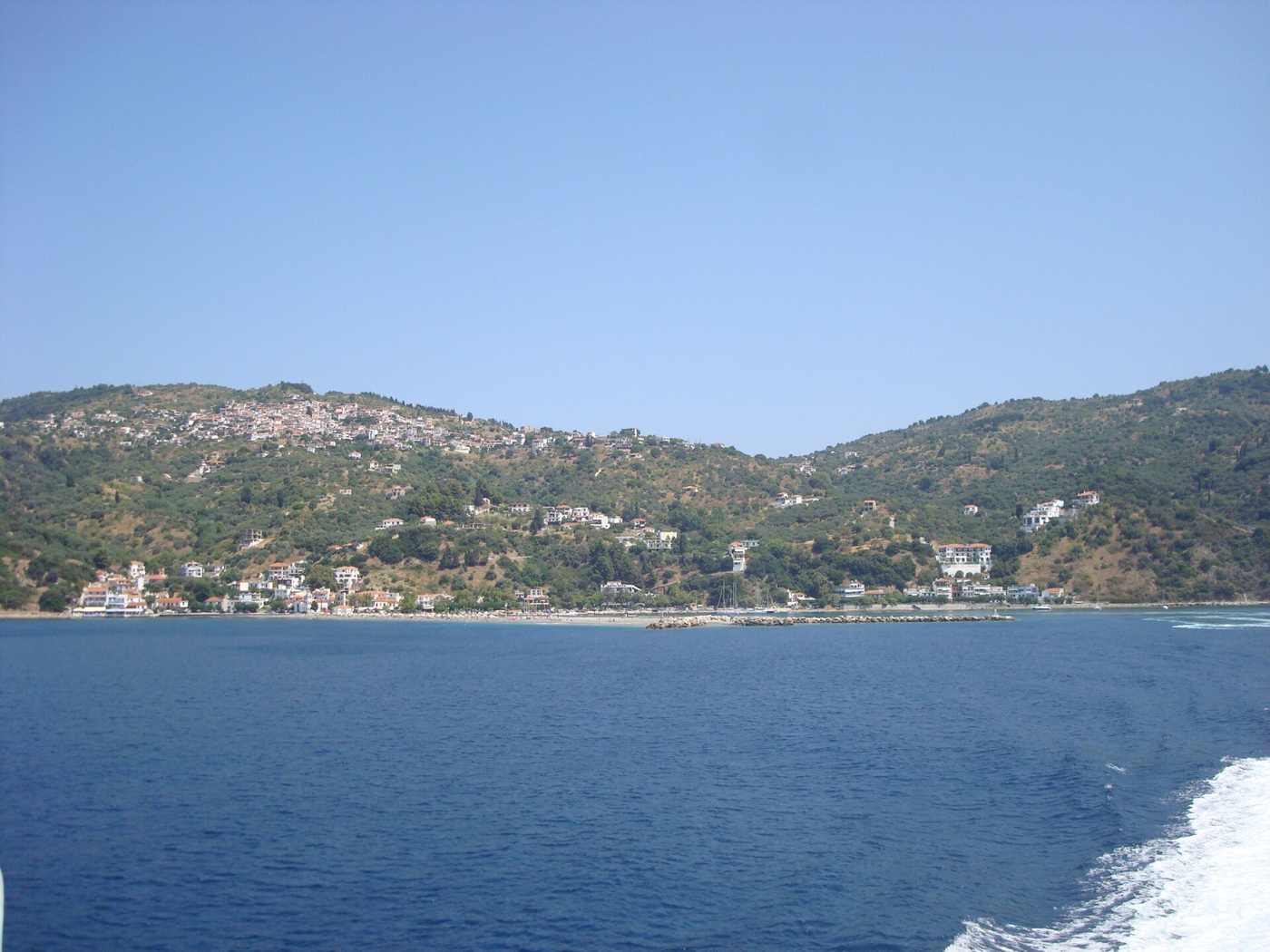
What other wildlife and habitats does the Alonnisos Marine Park protect?
The park shelters dolphins, whales, Eleonora’s falcon, Audouin’s gull and shag colonies, the endemic wild goat of Gioura, and vast Posidonia seagrass meadows. This range of species places it among the richest marine habitats in the Mediterranean.
Dolphins are the wildlife most reliably seen on a marine-park crossing from Skopelos, often riding the bow wave of the excursion boats. Three species frequent the waters: the common bottlenose dolphin, the short-beaked common dolphin, and the striped dolphin of the deeper channels. Pods surface and dive around the boats, and their presence signals the health of the fish stocks the park protects. Rarer visitors include the Risso’s dolphin and, in the open water beyond the islets, the fin whale and sperm whale that pass through the Aegean’s deeper trenches. Sightings of the larger cetaceans are uncommon.
The strait’s depth and the protected fishery make the park one of the better places in the region to watch dolphins from a small boat on a calm summer day.
The cliffs and islets of the park hold seabird colonies of national importance. Eleonora’s falcon, a slender migratory raptor, nests on the sea cliffs of Piperi and Gioura in one of Greece’s larger colonies. Timing its breeding to the autumn passage of small birds. Audouin’s gull, one of the world’s rarer gulls, breeds on the rocky islets, and the European shag dives for fish along the shores. The exposed stacks and caves give these birds the isolation they need away from ground predators and people. Birdwatchers on the excursion boats scan the cliffs of the outer islets, where the restricted access keeps the colonies undisturbed.
The falcon in particular ties the park to a wider network of Aegean island reserves that shelter the species through its breeding season each year.
On land, the park protects the wild goat of Gioura, a distinct breed isolated on that single islet for thousands of years and marked by a dark dorsal stripe. Genetic study links it to the earliest domesticated goats, making it a living record of the region’s prehistory as much as a wildlife curiosity. The goats graze the limestone slopes where no predators reach them, and their number is watched to keep the small population healthy. Gioura’s cave of Cyclops has yielded Neolithic pottery and bones, tying the islet’s natural and human history together. Because landing on Gioura is barred, boats view the goats and the cliffs from the water.
The islet stands as an example of how the park’s strict outer zone guards land and sea species alike within one boundary.
Below the surface, the park’s most extensive habitat is the Posidonia seagrass meadow, a slow-growing sea plant that carpets the shallow seabed around the islets. These meadows shelter fish nurseries, stabilise the sand, and release oxygen into the water, earning the name of the Mediterranean’s lungs. Rocky reefs, sea caves and coralligenous ledges add further habitat, holding grouper, dusky sea bream and octopus that a protected fishery allows to grow large. The clear, nutrient-poor water gives the visibility that makes the park a noted diving area. This seabed richness underpins the whole food chain, from the fish that feed the dolphins and seabirds to the prey of the monk seal.
Guides on the Skopelos boats point out the meadows in the shallows, visible as dark beds through the clear water.
How is the Alonnisos Marine Park zoned, and what rules apply to visitors?
The park splits into Zone A, the strictly protected outer islets, and Zone B, the inner waters around Alonnisos. Piperi forms a no-entry core, fishing and speed face limits, and landing on islets is barred.
The zoning of the marine park follows the sensitivity of its wildlife, tightening from the inhabited inner waters to the closed outer core. Zone B, the inner sector around Alonnisos, carries the villages, farms and most visitor activity under moderate rules that limit certain fishing methods and protect the seabed. Zone A, the larger eastern block, holds the uninhabited islets and the monk seal caves under strict protection, with access controlled and areas closed entirely. Within Zone A, the waters and land around Piperi form an absolute no-entry reserve, open only to licensed researchers.
This graded system lets people live and visit in the calmer inner park while the animals keep an undisturbed sanctuary in the outer islets. It shapes exactly where a boat from Skopelos travels.
Several concrete rules govern any visit to the park. Landing is prohibited on Piperi, Gioura and Psathoura, whose wildlife stays viewed from the water, while Peristera and Kyra Panagia permit controlled stops. Speed limits apply near the islets to cut noise and wake that disturb the seals and seabirds. Anchoring is restricted over the seagrass meadows, which the anchors tear, so boats use fixed moorings or approved spots. Spearfishing is banned throughout the park, and commercial fishing faces gear and area limits that protect the core. Diving is allowed only at designated sites, chiefly the Peristera wreck, under licensed operators.
These measures translate the zoning into day-to-day practice, and the licensed excursion boats from Skopelos and Alonnisos operate inside them by design rather than by choice.
Enforcement rests with the park’s management body and the Greek coastguard, which patrol the waters against illegal fishing, unlicensed diving and unauthorised landing on the closed islets. Wardens monitor the seal caves and the seabird colonies, and researchers track the wildlife under permit. The rules carry legal weight, and breaches draw fines, so the licensed operators follow them closely and brief their passengers before entering the sensitive zones. For an independent visitor sailing a private or chartered boat, knowing the closed areas and the speed and anchoring limits matters, as ignorance is no defence in a protected area of this status.
The park publishes its boundaries and rules through the information centre in Patitiri, and joining a licensed excursion removes the burden of navigating the regulations alone from Skopelos.
The zoning also shapes what a day trip from Skopelos can realistically include. Boats cross into Zone B and the permitted parts of Zone A. Calling at Peristera or Kyra Panagia and cruising past Gioura and Piperi at a distance. They cannot land on the closed core or approach the seal caves. This means a marine-park excursion is a cruise through protected water with swimming stops at open coves, not a landing tour of every islet. Understanding the limits sets the right expectation: the reward is the crossing. The wildlife glimpsed from the deck. The clear coves of the inner islets, rather than a walk on Piperi.
Among the many things to do in Skopelos, the marine-park trip stands apart as the one framed entirely by conservation rules.
How do you visit the Alonnisos Marine Park on a boat trip from Skopelos?
Day excursion boats leave Skopelos Town and Agnontas for the marine park, crossing to Alonnisos and cruising the permitted zones with swimming stops. The full-day trips call at Peristera or Kyra Panagia and pass the outer islets at a distance.
A marine-park day trip from Skopelos begins at the harbour of Skopelos Town or the fishing bay of Agnontas, where licensed excursion boats load in the morning. The crossing to Alonnisos takes under an hour, and the boat then enters the park, cruising the inner zone toward the islets. A typical itinerary calls at Patitiri, the port of Alonnisos, and often the old hilltop Chora, leaving time to walk and eat, before turning to the protected waters. Swimming stops fill clear coves at Peristera or in the bays of Alonnisos. The boat passes Gioura and Piperi at the legal distance for a view of the cliffs and any wildlife.
A guide narrates the conservation story and points out the seagrass meadows and seabird colonies along the route.
Booking a trip is straightforward through the summer season, with operators selling tickets at kiosks along the Skopelos Town waterfront and through hotels. The Skopelos boat tours that serve the marine park range from larger vessels carrying a hundred or more passengers to small boats taking a few dozen into the coves that big craft cannot reach. Larger boats give more shade and stability on the open crossing, while smaller ones reach more secluded stops and get closer, within the rules, to the islets. Trips run days a week in July and August and less often in spring and autumn, weather permitting.
The open strait between the islands can turn choppy in the meltemi wind, so departures depend on the sea, and operators cancel or reroute when the crossing turns rough.
A day on the water calls for a few practical items. A hat, water and reef-safe sun protection suit the long hours on an open deck, and a light layer helps against the wind on the crossing. Swimwear, a towel and water shoes ready a swimmer for the pebble coves and rocky entries at the stops. A camera with a zoom lens improves the odds on a distant seal or a cliff-nesting falcon, and binoculars help scan the islets. Most boats provide shade and sell drinks or a light lunch, though confirming this when booking avoids surprises. Motion-sickness tablets help passengers prone to seasickness on the exposed strait.
Arriving early at the harbour secures a seat in the shade, and following the guide’s briefing on distance and quiet keeps the visit within the park’s rules.
The marine-park excursion combines with the rest of a Skopelos itinerary as its wildlife-and-sea day, set against the beach days and the town and monastery visits. As the boat rounds the north of Skopelos, the clifftop chapel of Agios Ioannis Kastri stands on its rock above the strait, giving the departure a landmark before the open crossing. Independent travellers who prefer to base a day on Alonnisos itself can take the scheduled ferry from Skopelos to Patitiri and join a park boat there. Or hire a local operator on the smaller island. Either way the trip depends on the same protected water and the same rules.
For visitors the marine-park day ranks alongside the beaches and the Mamma Mia sites as a defining part of a stay on Skopelos.
Can you dive the ancient Peristera shipwreck in the Alonnisos Marine Park?
The Peristera shipwreck is a Classical-era cargo ship that sank off Peristera islet with thousands of wine amphorae. It opened as Greece’s first underwater museum, and licensed divers and snorkellers visit the site under guided supervision.
The Peristera shipwreck lies on the seabed off the northwest coast of Peristera islet, inside the marine park a short crossing from Skopelos. The ship, a large merchant vessel of the Classical period. Sank with a cargo of several thousand amphorae that once carried wine. The mound of pottery still covers the sea floor where the timbers rotted away. Discovered by a local fisherman in the mid-20th century and later surveyed by archaeologists. It ranks among the largest ancient wrecks found in the Aegean and reshaped views of the scale of Classical-era trade. The sheer volume of amphorae pointed to a bigger class of cargo ship than scholars had assumed for the period.
The site now forms the centrepiece of Greece’s move to open selected wrecks to divers.
The wreck opened as Greece’s first underwater museum, part of a national programme to make protected ancient sites accessible without lifting them from the sea. Certified scuba divers visit the wreck on guided dives run by licensed operators, descending to the amphora mound with a supervising guide and, in the pilot scheme, an accompanying archaeologist. Non-divers reach the experience too, through a snorkelling route over the shallower edge and an information centre on Alonnisos that shows the wreck by video and virtual tour. The scheme balances access against protection, keeping the site guarded while letting visitors see the cargo in place.
Dives run in the calm months under strict rules, with the number of visitors controlled to protect the fragile pottery. Booking goes through the licensed dive centres based on Alonnisos itself.
Diving the site sits within the wider rules of the marine park, which otherwise limits diving to designated points. The wreck lies at a depth reached by qualified divers, and operators require certification and a briefing before the descent. The amphorae stay exactly as they settled, so touching or removing anything is barred, and guides enforce the no-contact rule closely. Water clarity in the protected sea gives strong visibility over the site. The marine life drawn to the reef of pottery adds fish. Octopus and the occasional grouper to the dive.
For a visitor based on Skopelos, reaching the wreck means crossing to Alonnisos and joining a licensed operator there, as the dive centres and the launch points sit on the neighbouring island rather than on Skopelos itself.
The Peristera wreck adds a cultural layer to a park known first for its wildlife, tying the northern Sporades to the sea routes of the ancient Aegean. The islets that shelter the monk seal today sheltered merchant ships two and a half thousand years ago, and the harbours of Kyra Panagia and Peristera served both. For divers the wreck is a rare chance to swim over an untouched Classical cargo in open water rather than a museum tank. For non-divers the virtual and snorkelling options open the same story. The site strengthens the case for the whole protected area. Showing that its value spans natural and human history alike.
It gives a marine-park trip from Skopelos a second focus beyond the search for seals and dolphins.
When is the best season to visit the Alonnisos Marine Park from Skopelos?
The marine-park boats run from about May to October, with June and September offering the calmest seas and thinnest crowds. July and August bring the fullest schedule but the strongest meltemi wind, which can cancel crossings.
The season for visiting the marine park from Skopelos follows the summer sailing calendar. Running from about May to October when the excursion boats operate and the sea is warm enough to swim. Outside these months the crossings largely stop, the weather turns unsettled, and operators close for winter. Within the season the character of a trip changes month by month, driven mostly by the meltemi. The dry north wind that blows hardest in midsummer and churns the open strait between Skopelos and the islets. Planning a marine-park day around the wind and the crowd levels improves both the comfort of the crossing and the chance of reaching the inner zone.
The guide to the best time to visit Skopelos sets out the wider seasonal picture for the island.
June and September stand out for the marine park. The sea is warm, the excursion boats run on a full or near-full schedule. The meltemi blows less fiercely than in the peak weeks, so crossings are calmer and cancellations rarer. Crowds thin compared with the height of summer, which means smaller groups on the boats and quieter swimming stops in the coves of Peristera. The calmer water in these shoulder weeks lets boats reach the inner zone and hold position near the islets more steadily. Improving the odds of watching dolphins or spotting a distant seal.
For a visitor with flexible dates, these two months give the strongest balance of warm sea, running services and manageable conditions on the exposed crossing to the islets.
July and August bring the fullest excursion schedule and the warmest sea, but also the peak of the meltemi and the largest crowds. The wind can rise for days at a stretch. Turning the open strait rough and forcing operators to cancel or reroute trips to sheltered water. A rigid plan risks a lost day. Boats fill quickly in these weeks, and the popular coves see more visitors. Booking a trip early in a stay leaves room to rebook if the wind closes the first attempt. Mornings tend to be calmer than afternoons, as the meltemi often strengthens through the day, so early departures give the best conditions.
The heat on an open deck makes shade, water and sun protection essential across the high-summer crossings to the park.
May and October bookend the season with cooler, greener conditions better suited to the crossing than to long swims. In May the sea is still warming and the islets carry spring growth, while October brings settled spells between the first autumn fronts. Excursion boats run a reduced schedule in these months, so trips depend on demand and weather, and confirming departures ahead matters. Eleonora’s falcon, arriving to breed in late summer, is most active around the cliffs into early autumn, adding a draw for birdwatchers in September and October. The shoulder months trade the guarantee of a daily boat for calmer, quieter conditions when a trip does run.
For travellers whose main goal is the marine park rather than the beaches, the edges of the season reward patience with the calmest water.
How do you visit the Alonnisos Marine Park responsibly from Skopelos?
Responsible visits mean choosing licensed operators, keeping distance from seals and seabirds, staying quiet, and never landing on the closed islets. The rules protect the monk seal, so following the guides’ instructions is the core of a low-impact trip.
Responsible visiting starts with the choice of boat. Licensed operators know the park’s zones, hold the permits to enter them. Brief passengers on the rules before crossing, so booking with them keeps a trip inside the law and away from the sensitive core. The guides set the distances from Piperi and Gioura, cut engines near any seal in the water, and steer clear of the closed reserves. Following their instructions is the single most effective thing a visitor does, as the whole protection scheme rests on people keeping their distance from the breeding caves. A trip that respects the rules still delivers the crossing, the swimming stops and the wildlife glimpsed from the deck.
Without adding to the disturbance the park was built to remove from these waters.
Conduct on the water carries the rest of the responsibility. Keeping noise low near the islets, staying seated when the boat idles by a colony, and never chasing a surfacing seal all reduce the stress on the animals. Reef-safe sun protection keeps chemicals out of the seagrass meadows, and carrying all litter back to port protects a sea where plastic harms seals, dolphins and turtles alike. At the swimming stops, keeping clear of nesting birds on the low rocks and avoiding standing on the seagrass in the shallows guards the habitats underfoot. These small choices, multiplied across the thousands of visitors a season.
Decide whether the park’s wildlife gains or loses from the boat traffic that its own protection makes possible from Skopelos and Alonnisos.
Independent visitors carry an added duty to know the rules the operators otherwise handle. Anyone crossing from Skopelos on a private or chartered boat must learn the closed areas around Piperi. Gioura and Psathoura, respect the speed limits near the islets. Anchor only where the seagrass is not torn. Reaching the park this way usually means first taking the ferry from Skopelos to Patitiri. Then sailing on from Alonnisos. The information centre in the port of Patitiri supplies the current boundaries, the closed zones and the seasonal notices. For most visitors, though, a licensed excursion removes the risk of a breach entirely and leaves the navigation and the regulations to the crew.
Who cross the strait daily and read its wind and swell from long experience.
The park’s recovery shows that responsible visiting works. Decades of protection have held and slowly grown the monk seal population, kept the seabird colonies breeding on the cliffs, and preserved the seagrass meadows that anchor the food chain. Tourism, run within the rules, funds the wardening and the information work and builds the public support that keeps the reserve in place. A visitor from Skopelos who books a licensed boat, keeps their distance and carries their litter home takes part in that success rather than eroding it. The marine park stands as a working example of a protected sea that people still visit.
Treating it on its own terms is what lets the next generation of travellers cross from Skopelos to find the seals, dolphins and islets intact.
Frequently Asked Questions
What is the Alonnisos Marine Park and why was it created?
The National Marine Park of Alonnisos and the Northern Sporades is the largest marine protected area in Europe, covering about 2,260 square kilometres of sea east of Skopelos. Greece established it in the early 1990s as its first marine park, created chiefly to protect the Mediterranean monk seal, one of the rarest marine mammals on Earth. The park takes in the island of Alonnisos and a group of uninhabited islets to its northeast. From Peristera and Kyra Panagia to Gioura, Psathoura and the strictly protected core of Piperi. Beyond the seal, it shelters dolphins, Eleonora’s falcon and other seabirds, the endemic wild goat of Gioura, and extensive Posidonia seagrass meadows that underpin the whole ecosystem.
It also guards ancient shipwrecks, including the Classical-era wreck off Peristera. A management body based in Patitiri on Alonnisos runs the wardening, research and visitor information, and from Skopelos the park lies a short crossing away across the strait.
How do you get to the Alonnisos Marine Park from Skopelos?
Reaching the Alonnisos Marine Park from Skopelos means a short sea crossing rather than a long trip, as Alonnisos lies about 20 to 30 minutes away by fast ferry. The simplest option is a day excursion boat, which leaves the harbours of Skopelos Town and Agnontas through the summer and crosses directly into the park. Cruising the permitted zones with swimming stops and a guide. Operators sell tickets at kiosks along the Skopelos Town waterfront and through hotels. Trips run days a week in July and August. Less often in spring and autumn, weather permitting.
Independent travellers can instead take the scheduled ferry or hydrofoil from Skopelos to Patitiri, the port of Alonnisos, and join a park boat or dive centre there. The open strait can turn rough in the meltemi wind, so departures depend on the sea. Booking early in a stay leaves room to rebook if the wind closes the first attempt at crossing.
Can you actually see monk seals in the Alonnisos Marine Park?
Seeing a Mediterranean monk seal in the marine park is possible but never a certainty, and close sightings are uncommon. The seals shelter in remote sea caves on the outer islets, chiefly around Piperi, where all access is banned to protect their breeding sites. They spend most of their time inside these caves or feeding underwater, surfacing only briefly, so even a full-day excursion often passes without a clear view. Guides watch for a rounded head breaking the surface near the islets or a seal resting on a low rock at dawn. The calmest mornings in June and September give the best odds.
Dolphins, by contrast, are seen far more often, riding the bow waves of the boats across the strait. Even without a seal sighting, the crossing shows the protected habitat that keeps the species alive. The Marine Park information centre in Patitiri explains the animal’s biology and the conservation work behind its slow recovery.
Which islands and islets are inside the Alonnisos Marine Park?
The Alonnisos Marine Park centres on the inhabited island of Alonnisos and a chain of uninhabited islets stretching northeast toward the open Aegean. Peristera, the closest, lies just off Alonnisos and holds the ancient shipwreck now open to divers. Kyra Panagia, farther out, carries two natural harbours and a working monastery tied to Mount Athos. Gioura is known for its endemic wild goats and the cave of Cyclops, with Neolithic remains, and sits within the strictly protected zone. Psathoura, the northernmost, is a low volcanic islet ringed by clear water and topped by the tallest lighthouse in the Aegean, with a submerged ancient settlement offshore.
Piperi forms the untouchable core of the park, its sea caves sheltering the largest concentration of monk seals in the region, and entry is banned outright except for licensed researchers. Landing is prohibited on Piperi, Gioura and Psathoura, while Peristera and Kyra Panagia allow controlled stops on excursions from Skopelos.
What are the rules for visiting the Alonnisos Marine Park?
The marine park is divided into zones, and the rules tighten from the inner waters around Alonnisos to the strictly protected outer islets. Landing is banned on Piperi, Gioura and Psathoura, whose wildlife stays viewed from the water, while Peristera and Kyra Panagia permit controlled stops. The waters and land around Piperi form an absolute no-entry reserve open only to licensed researchers. Speed limits apply near the islets to cut the noise and wake that disturb seals and seabirds, and anchoring is restricted over the seagrass meadows that anchors tear. Spearfishing is banned throughout the park, and commercial fishing faces gear and area limits. Diving is allowed only at designated sites, chiefly the Peristera wreck, under licensed operators.
The park authority and the coastguard enforce the rules, and breaches draw fines. Licensed excursion boats from Skopelos and Alonnisos operate inside these limits by design, and following the guides’ instructions on distance and quiet keeps a visit lawful and low-impact.
How long does a marine park boat trip from Skopelos take?
A marine-park boat trip from Skopelos usually runs as a full-day excursion, leaving the harbour in the morning and returning in the late afternoon, a span of about eight hours. The crossing to Alonnisos takes under an hour each way. The rest of the day fills with a cruise through the permitted zones. Swimming stops in clear coves, and often a call at Patitiri or the old Chora of Alonnisos for a walk and lunch. Boats pass Gioura and Piperi at the legal distance for a view of the cliffs and any wildlife, while landing stays limited to the open islets.
Shorter half-day trips focus on the nearer waters and the coves of Peristera without the full circuit of the outer islets. The exact route depends on the sea, as the meltemi wind can shorten or reroute a trip. A rough strait cancels crossings and a rigid plan risks a lost day.
Can you dive or snorkel the Peristera shipwreck near Skopelos?
Diving and snorkelling the Peristera shipwreck is possible through licensed operators based on Alonnisos, as the site opened as Greece’s first underwater museum. The wreck is a Classical-era merchant ship that sank off Peristera islet with a cargo of several thousand wine amphorae. The mound of pottery still covers the seabed where the timbers rotted away. Certified scuba divers visit on guided dives, descending to the amphorae with a supervising guide, while non-divers reach the site through a snorkelling route over the shallower edge and an information centre that shows the wreck by video and virtual tour. The amphorae stay exactly as they settled, so touching or removing anything is barred, and guides enforce the no-contact rule.
Dives run in the calm months with visitor numbers controlled to protect the fragile cargo. For a visitor based on Skopelos, reaching the wreck means crossing to Alonnisos and joining a dive centre on the neighbouring island.