
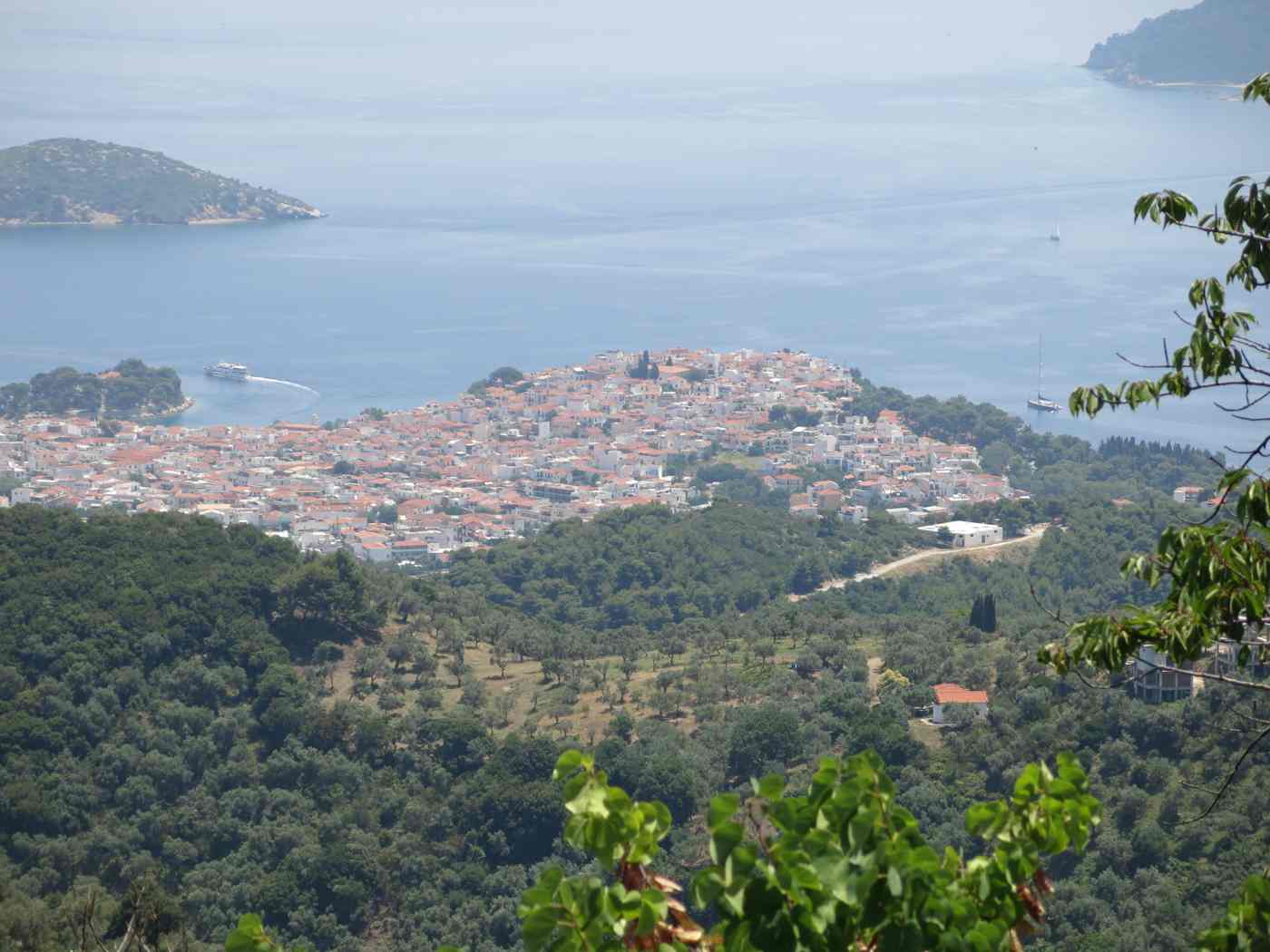
Skiathos boat tours turn a small island of about 48 square kilometres into a full sailing playground. Wooden caiques, speedboats and double-deck excursion boats leave the old port of Skiathos Town every summer morning. Bound for Lalaria beach, three named sea caves, Tsougria islet and the neighbouring islands of Skopelos and Alonnisos. The island’s best-known sight is reachable only by sea, which places the harbour departure boards at the centre of every itinerary. Plan the whole trip with Greece Tours.
This guide covers the round-the-island circuit, the half-day Tsougria swim trips, the full-day Sporades cruises, water taxis to the south-coast beaches and private small-boat hire. Each section states durations in real terms, names the stops, explains how the meltemi wind reshapes schedules and shows which departure suits families, couples and first-time visitors.
Why do boat tours define a holiday on Skiathos?
Boat tours define Skiathos because Lalaria, the island’s signature beach, has no road access and lies below cliffs on the northeast tip. Caiques, speedboats and excursion boats from the old port deliver the coastline the bus never reaches.
The geography of Skiathos explains the boat culture. The island measures about 48 square kilometres. Its single asphalt road runs along the south coast between Skiathos Town and Koukounaries. A stretch of roughly 12 km with bus stops numbered about 1 to 26. The entire north shore, including Lalaria, the Kastro peninsula, the three named sea caves and the twin Aselinos bays, faces the open Aegean without a coastal road. Fishermen converted wooden caiques into passenger boats decades ago, and the old port now works like a second bus network. Morning departures cluster between around 9.30 and 11.00, boats return by late afternoon, and harbourfront kiosks display the day’s routes on chalkboards beside the moorings.
The quay itself functions as the island’s real information office each morning.
A single day afloat covers more of the coastline than a week of driving. The round-the-island circuit passes about 44 km of shore in around four to six hours, touching pebble coves, limestone arches and cliff-backed inlets that no rental car approaches. Tsougria islet sits directly opposite the harbour, about 20 to 30 minutes away, with two sandy swimming coves. Skopelos lies within about one to one and a half hours by excursion boat, and the protected waters around Alonnisos host Mediterranean monk seals inside the national marine park. Each of these targets appears on a scheduled departure board every summer morning.
Travellers assemble a full itinerary from the quayside without booking anything more than a day ahead in most weeks. The harbour boards price and time every option side by side.
Boat trips also anchor the wider list of things to do in Skiathos. Kastro, the medieval clifftop settlement on the northern tip, welcomes far more visitors by sea than by the rough track from the interior. Aircraft spotting at the runway fence, the Evangelistria monastery and the Papadiamantis House museum fill the mornings on land, and the afternoon boat schedule complements them without overlap. Families combine a Tsougria swim with an evening in the old port tavernas. Couples pair the sea-cave circuit with sunset beside the Bourtzi. The harbour boards effectively organise the entire island day, which is why repeat visitors book their boat mornings first and arrange beach time and museum hours around them.
Evening departures stay rare, so the boat day always ends before dinner service begins on the waterfront.
The season shapes everything on the water. Excursion boats run daily from late spring to early autumn, with peak frequency in July and August, then taper to weekend sailings as the water cools. Wooden caiques cruise at around 8 knots, which keeps the round-the-island day unhurried, while rigid inflatables cover the same circuit in about half the time. Skippers monitor the northerly meltemi wind each morning and swap north-coast stops for sheltered southern bays whenever swell builds along the cliffs. Tickets remain simple: kiosks on the old port quay sell each route, hotels along the south coast reserve seats by phone.
Crews confirm the final route at boarding, because conditions on the exposed side of the island change overnight. Shoulder-season visitors check the boards a day ahead, because reduced rotations merge routes.
What does the round-the-island boat trip from Skiathos include?
The round-the-island trip circles about 44 km of coastline in around four to six hours, stopping at Lalaria beach, passing the Kastro peninsula and entering or approaching the Skotini, Galazia and Halkini sea caves.
Most skippers run the circuit clockwise from the old port. Boats round the airport headland first, cross the strait past Tsougria and Tsougriaki islets. Then follow the east coast north toward the limestone country where the caves open at sea level. The order matters: the exposed northeast corner gets its calmest water in the morning. Captains reach Lalaria before midday. Hold the beach stop for about 45 to 90 minutes, then drift west past Kastro for photographs beneath the clifftop chapels. The return leg follows the gentler south coast, passing the Aselinos bays.
Mandraki and the Koukounaries pine fringe before the boats tie up again in mid-afternoon, in time for passengers to reach the bus line for the evening. Anticlockwise departures exist on windier mornings, reversing the same stops.
Kastro anchors the historical half of the route. The fortified settlement crowned this northern crag through the Ottoman centuries. Connected to the island only by a drawbridge. The island’s whole population lived inside the walls for roughly three hundred years. Passengers on the water see the surviving churches, the gate arch and the long stair descending to Kastro beach, where a seasonal canteen serves swimmers below the rock. Deck commentary covers the pirate raids that drove the islanders onto the crag and the later move back down to rebuild the modern town around the harbour.
Larger excursion boats pause offshore for narration, while smaller caiques land passengers on the pebbles for a 30-to-40-minute climb to the ruins about 100 metres above the sea. The beach stop below adds about 30 minutes.
Onboard practicalities stay simple across the fleet. Caiques carry shaded bench seating, a WC and a small bar counter; the double-deck boats add an upper sun deck and a swim ladder at the stern. Skippers announce each stop in English and Greek, and the Lalaria pause doubles as the main swimming window, because the beach has no facilities of its own. A second swim often happens on the south coast, inside a sheltered bay near Tsougria or Arkos islet, where the seabed drops from white sand instead of pebbles. Lunch arrangements vary by route: the full-day circuits either include a simple deck meal or schedule a taverna stop, and the ticket kiosk states which version applies before boarding.
Shade cover extends over roughly half the seating on the traditional hulls.
The circuit suits first-time visitors better than any other single excursion, because it stitches the island’s headline sights into one ticket. Travellers with only one free day see Lalaria, the caves, Kastro and a swimming bay without renting anything or studying bus timetables. Photographers claim the bow benches early for the arch at Tripia Petra. Older passengers favour the slower caiques, which roll less than the fast boats in a light chop. The trade-off is time at each stop: a shared circuit divides about six hours between four or five highlights. Anyone who wants a long. Unhurried Lalaria visit books a dedicated Lalaria shuttle or a private hire instead and treats the circuit as the overview day.
Mixed groups of swimmers and non-swimmers pick it because every stop offers a dry option.
How do boats reach Lalaria beach from Skiathos old port?
Excursion boats and licensed water taxis leave the old port each summer morning and reach Lalaria in about 30 to 45 minutes, running up the east coast; the beach has no road, path or harbour of its own.
Lalaria beach sits under pale limestone cliffs on the island’s northeast tip, and the sea is its only door. Smooth white pebbles cover the shore for about 300 metres. The water over the light stone turns a milky turquoise. The natural arch of Tripia Petra stands at the southern end, framing swimmers who paddle through it. Boats anchor a short distance off the steep-shelving shore and land passengers by bow ladder or tender. The pebbles heat up by midday and press hard underfoot. Crews repeat the same two warnings on every crossing: wear swim shoes. And leave every pebble on the beach, because removal is prohibited and carries a posted fine.
Landings concentrate between late morning and early afternoon, when the light over the arch reaches its brightest angle for photographs.
Two ticket types cover the crossing. The round-the-island circuit includes Lalaria as its centrepiece stop of about 45 to 90 minutes, while dedicated shuttle boats and water taxis run direct, hold the beach for around two to three hours, then return by early afternoon. The direct option leaves the old port slightly later, reaches the pebbles in about half an hour and suits swimmers who want the arch. The caves along the cliff base and a long stretch of unhurried water time. Return boats stage their pickups in sequence. Crews count passengers on and off at every landing, because the beach keeps no lifeguard, no shade structure and no staff between one boat visit and the next.
Tickets for both versions sell from the same quayside kiosks each morning.
The absence of facilities defines the visit. Lalaria has no sunbeds, no taverna, no kiosk, no fresh water and no natural shade at swimming hours, and phone coverage fades under the cliff. Visitors carry everything for the stay: drinking water at a minimum of one litre per person. A hat, high-factor sunscreen and a light cover for the glare that reflects off the white stones. The reward for the logistics is the clearest water on the island, with visibility that reaches about 20 to 30 metres over the pale seabed. Snorkellers follow the cliff line south toward the arch, where the rock walls drop straight into deep blue and shoals of saddled seabream circle the fallen boulders.
Divers rate the arch corridor as the island’s best free snorkel line.
North-facing exposure makes the crossing conditional. The meltemi, the dry northerly wind of high summer, sends swell straight onto the pebbles, and skippers cancel or reroute rather than land through surf. Cancellation decisions come early in the morning, and kiosk staff rebook ticket holders onto the next calm day or onto a south-coast alternative around Tsougria and Arkos. Mid-June and September deliver the longest runs of calm mornings, while late July and August carry the strongest wind interruptions. Travellers with a fixed Lalaria ambition build two spare mornings into the plan. Book the first calm slot the harbour offers. Keep the circuit trip as the fallback, since it approaches the beach whenever landing is workable.
The rerouted south-coast day still includes two swim stops, so a windy ticket keeps its value.

Which sea caves do Skiathos boat tours enter?
Skiathos boat tours visit three named caves on the northeast coast: Skotini, the dark cave entered through a narrow slot; Galazia, the blue cave lit by reflected light; and Halkini, the copper cave named for its mineral-streaked walls.
Skotini, the dark cave, delivers the most theatrical entry of the three. Caiques cut their engines and glide through an opening barely wider than the hull, and the light drops away until the water glows a deep ink blue under the vault. Skippers use a spotlight on the rock formations inside, where the ceiling rises to around 10 metres and pigeons nest in the crevices above the waterline. Small boats reverse out the way they came in, because the chamber leaves no room to turn. Fast RIB tours idle at the mouth instead and send confident swimmers in with masks.
An option that depends entirely on a flat sea, since surge inside the chamber is the firmest limit every crew respects. Engines stay off inside, so the only sounds are water and wingbeats.
Galazia, the blue cave, works on light instead of darkness. Its wider mouth faces the morning sun, and the pale seabed bounces the light upward so the whole chamber glows an electric blue at swimming level. Excursion boats time the pass for late morning, when the angle peaks, and hold position inside for photographs. Swimmers slip off the stern and float over sand that reads as bright as a pool tile, with visibility of about 20 metres on a calm day. The cave sits close along the cliff line from Skotini. A run of two to three minutes by caique. Every cave-route ticket covers both chambers and the pair fills the middle hour of the round-the-island circuit.
Morning circuits from the old port reach it at the right hour almost by design.
Halkini, the copper cave, closes the trio with colour in the rock itself. Oxidised mineral veins streak the walls in rust, ochre and green bands above a shallow shelf where the water turns jade. Boats approach close enough for passengers to read the strata without landing, because the shelf and fallen blocks keep hulls at a respectful distance. The name comes from the metallic sheen the wet rock takes in direct sun, strongest in the early afternoon on the return leg. Guides use the stop to explain the geology of the northeast corner.
Where the pale limestone behind Lalaria’s white pebbles runs in unbroken cliffs west toward the Kastro headland, a line visible in a single sweep from the deck. Painters and photographers rate Halkini the most colourful stop of the three.
Cave access ranks as the most weather-sensitive item on any route card. A half-metre of northerly swell keeps hulls out of Skotini entirely, and crews substitute a longer Lalaria stop or a Kastro landing on marginal days, announcing the change before departure. Calm-morning departures in June and September achieve the highest completion rate for all three chambers. Photography inside rewards preparation: the dark cave needs a raised ISO and steady hands. The blue cave overexposes badly at automatic settings. Phones fare best set to burst mode at the entrances.
Passengers who rank the caves first on their list confirm at the kiosk that the day’s route enters them rather than passing offshore, because both versions sell under near-identical route names. A calm-day ticket bought early in the week settles the question.
Which boat types run tours from the old port of Skiathos?
Three boat classes serve the harbour: traditional wooden caiques cruising at around 8 knots, double-deck excursion boats carrying about 100 to 200 passengers, and fast RIBs or speedboats that halve journey times on every route.
The old port of Skiathos Town concentrates the whole fleet along one stone quay west of the Bourtzi peninsula. Caiques moor stern-to with gangplanks down and route boards propped on the quayside. Ticket kiosks line the pavement behind them. The water taxis hold the eastern end nearest the beach-bus stop. Departures stagger through the morning so the quay never empties: cave circuits first, Lalaria shuttles next, then the Tsougria half-day boats and the big Skopelos cruisers. Evening brings the fleet home in the same order. The walk from the new-port ferry dock takes about five minutes along the waterfront, and the airport sits about 3 km away, so arrival day and boat day combine easily.
Route boards list departure time, stops and return hour in English and Greek on every gangplank.
Wooden caiques carry the island’s fishing heritage into the excursion trade. Hulls of about 12 to 20 metres take roughly 30 to 80 passengers on shaded benches. Roll gently at their 8-knot cruise and land almost anywhere a pebble beach shelves steeply enough for a bow ladder. Their shallow draft suits the cave mouths, and their pace turns the round-the-island day into a slow reading of the coastline rather than a transfer. Skippers, mostly island families who have run the same routes for generations, narrate in Greek and English and adjust stops when a beach looks crowded from the water. The caique’s weak point is speed: distant targets such as Alonnisos stretch beyond its comfortable daily range.
Deck space per passenger runs generous, and the open stern doubles as the swim platform at anchor.
Double-deck excursion boats handle the volume routes. These steel or GRP hulls of about 25 to 35 metres load between around 100 and 200 passengers. Post a fixed itinerary and keep to it. Add the comforts that decide family bookings: a snack bar, twin WCs, an enclosed lower saloon out of the wind and a railed sun deck above. Skopelos and Alonnisos day cruises run almost exclusively on this class, because the open-water legs between the islands demand the stability and the certified capacity. Boarding uses a proper gangway rather than a ladder, which settles the question for pushchairs and passengers with limited mobility. The trade-off is intimacy: the big boats pass the caves but rarely enter them.
Families with buggies board these hulls in under a minute.
Fast RIBs and speedboats sell time. A rigid inflatable covers the old port to Lalaria leg in about 15 to 20 minutes against the caique’s 40. Which converts the same morning into two beaches instead of one. Skippered RIB tours cap groups at about 8 to 12 passengers, tailor the route on the day and reach the outlying islets of Arkos and Tsougriaki that scheduled boats skip. The ride is wetter and firmer over chop, seats are saddle-style or bench, and operators set minimum ages for the exposed bow positions. Pricing per person runs above the shared boats, reflecting the small group size.
The class overlaps with private hire, where the same hulls rent by the half-day or full day. Groups chasing two beaches before lunch book this class first.
What does the Tsougria islet trip from Skiathos offer?
Tsougria, the pine-covered islet directly opposite Skiathos harbour, hosts half-day swim trips: about 20 to 30 minutes each way by shuttle boat to two sandy coves with shallow, sheltered water and a single seasonal beach canteen.
Tsougria closes the view from the whole Skiathos waterfront, a green islet about 2.5 km offshore that shelters the harbour approach. Shuttle boats leave the old port through the morning, cross in about 20 to 30 minutes and land at the main west-facing beach. Where clear shallows run over sand for dozens of metres before the bottom drops. Pines and low scrub cover the interior, a small chapel stands behind the beach, and footpaths connect the landing to a second, quieter cove around the southern point. Boats rotate back to town every hour or two. Visitors choose their own length of stay. From a two-hour swim to a full beach day that ends with the last afternoon return.
The crossing stays calm on north-wind days because Skiathos itself blocks the swell.
Families rate Tsougria as the easiest sea day on the island. The crossing is short enough for toddlers. The main beach faces away from the meltemi and keeps its flat water on days that cancel Lalaria. The gradual sandy entry lets children wade far out under supervision. Sunbeds appear in high season on the main cove, the canteen covers drinks and simple plates. The pine shade line backs the sand for the hours when the sun peaks. Snorkelling around the rocky points turns up wrasse, bream and the occasional octopus over seagrass. Parents pack water shoes for the rock edges and cash for the canteen, and the whole day costs a fraction of an organised cruise.
Shallow water holds bathtub warmth from midsummer onward, weeks ahead of the exposed north-coast bays.
The islet rewards a short walk. The second cove, around ten minutes on foot over the low southern shoulder, stays quiet even in August because the shuttle crowd concentrates at the landing beach. Its mixed sand-and-pebble shore shelves quickly into deeper blue water that suits confident swimmers, and the rocks at either end hold the islet’s best snorkelling. Signage is minimal, so walkers note the path mouth behind the canteen before setting out. The islet has no roads, no permanent residents and no lighting, which is exactly the draw: Tsougria works as the wilderness counterpoint to the organised south-coast beach strip. Sitting about half an hour of water away from the busiest harbour in the Sporades.
Walkers carry water, because the canteen at the landing beach is the islet’s only supply point.
Arkos, the smaller neighbouring islet, pairs with Tsougria on longer routes. RIB tours and private hires anchor in the Arkos channel, where a pale shallow bank glows between the rocks, then continue to Tsougria for the beach hours. Combined tickets sold at the old port bundle both islets with a pass beneath the airport approach, where arriving aircraft descend low over the strait on landing days. Shuttle-only tickets stay the cheapest item on the departure boards and sell right up to casting off. Day planners treat Tsougria as the reliable slot in a wind-disrupted week: on a strong meltemi forecast. Harbour kiosks reroute almost everything south. The islet absorbs the rebooked crowds first each morning.
Return skippers sweep both coves before the final crossing, so late walkers still make the last boat.
How do full-day cruises from Skiathos reach Skopelos and Alonnisos?
Full-day cruises leave the old port in the morning, reach Skopelos in about one to one and a half hours, continue into the marine park waters around Alonnisos, and return to Skiathos by early evening.
The Skopelos cruise is the longest scheduled day on the Skiathos boards. Double-deck boats cast off around mid-morning, cross the open strait east and berth either at Skopelos Town. With its amphitheatre of slate-roofed houses, or at Glossa’s port of Loutraki on the island’s northwest end. Shore time runs about two to three hours, enough for the harbourfront, the lanes climbing toward the castle quarter and a taverna lunch. A run along the Skopelos coast passes Agios Ioannis chapel, the clifftop church that appeared in the Mamma Mia! wedding scenes, and the deck commentary marks the filming points. The return leg recrosses the strait with the afternoon light behind the boat, docking around early evening.
Commentary runs in English and Greek, and the bar deck serves through both crossings.
Alonnisos extends the day into protected water. The National Marine Park of Alonnisos and the Northern Sporades, the first marine park established in Greece. Covers the seas east of Skopelos and shelters the Mediterranean monk seal, one of Europe’s rarest marine mammals. Cruises that include the park slow through the channel islets. Crews point out seabird colonies, the odd loggerhead turtle and dolphin pods that ride the bow wake on calm crossings. Landings focus on Patitiri, the small Alonnisos port, or on a swimming anchorage in a protected bay. Seal sightings stay uncommon and unguaranteed, a point crews state plainly at boarding, and the park’s value reads instead in the clarity and emptiness of the water.
Park rules keep speeds low through the protected channels, which lengthens the leg and calms the ride.
Mamma Mia! tourism keeps these routes full. The production filmed its port and wedding sequences on Skopelos and its town scenes on the Skiathos waterfront. The combined cruise sells as a film-location day and the commentary leans into it. Passengers photograph the 100-plus steps rising to Agios Ioannis chapel from the sea, and the boats hold position offshore long enough for the full cliff profile. Skopelos Town’s harbourfront, backed by the church of Panagitsa of Pyrgos on its rock, fills the remaining frames. Booking pressure peaks in August, when the film-route departures sell out a day or two ahead, while June and September travellers walk up and board the same morning without difficulty.
Fans photograph the chapel from the water on the outbound leg, before the shore crowds build.
Independent travellers weigh the cruise against the scheduled ferry. Regular ferries and hydrofoils connect the new port with Skopelos and Alonnisos, cost less per leg and allow an overnight stay. They deliver transport. Not commentary, and their timetables leave awkward gaps for a single-day return. The cruise packages the crossing, the coastal sightseeing, the swim stop and the guaranteed same-evening return in one ticket. Travellers basing a full week on Skiathos often do both: a cruise first for the overview, then a ferry back to whichever island earned a longer look. Kiosk staff at the old port sell only the excursions; ferry tickets come from the agency offices one street back from the waterfront.
Hydrofoil crossings run faster than the cruise boats but skip every photographic slow-down along the coast.
How do water taxis serve the beaches of Skiathos?
Water taxis shuttle from the old port to the south-coast beaches on fixed summer rotations, serving Kanapitsa, Achladies, Vromolimnos and Koukounaries, and run direct crossings to Tsougria islet throughout the day.
Water taxis extend the bus network onto the water and put the full range of Skiathos beaches within reach of travellers staying in town without a car. Small covered launches leave the old port on a loop through the morning, drop swimmers at jetties or bow-land on the sand, and repeat the rotation into the late afternoon. The ride to Achladies takes about 10 minutes, Kanapitsa about 15 and Koukounaries about 25 to 30, with the sea breeze replacing the coastal road’s summer traffic. Tickets sell on board or at the quay, one way or return. The skippers hold to a posted rotation, so beach days plan as reliably by water as by the numbered bus stops.
The rotation posts its times on the same chalkboards as the excursion fleet.
The water route beats the road on comfort at peak season. The single south-coast road carries every rental car, quad and bus on the island, and the midday run to Koukounaries stretches well past its off-peak time in August. Water taxis skip all of it, load at the quay steps beside the caique moorings and land passengers a towel’s throw from the sand. The launches carry about 20 to 40 passengers under shade canopies, take pushchairs and cool boxes without fuss. The crossing itself works as sightseeing. Tracing the villa-dotted coastline past the Bourtzi and the Kanapitsa headland. The evening return fills fast on the last two rotations, so beachgoers confirm the final departure time at landing.
Skippers thread between moored yachts at walking pace, so the ride suits nervous first-timers too.
Coverage stays a south-coast affair. The taxis work the sheltered shoreline between town and Koukounaries because their light hulls need calm water and easy landings. The exposed north coast. With Lalaria, the Aselinos bays and Kastro beach, belongs to the bigger excursion boats and sits outside every taxi rotation. Banana and Little Banana, the twin coves over the Koukounaries headland, connect on foot from the Koukounaries landing in about 10 to 15 minutes over the ridge path. Megali Ammos and Vassilias sit close enough to town that walkers and the first bus stops cover them without a boat. The taxi network, read together with the bus line, therefore serves the entire organised beach strip twice over.
The split keeps both systems fast: calm-water hops by launch, cliff-coast runs by excursion boat.
Strategic use of the taxis reshapes a carless holiday. Morning boats out and mid-afternoon boats back leave the evening free for the old port tavernas, while a one-way ticket outbound pairs with the bus for the return whenever the last rotation looks full. Beach hoppers ride the loop itself, sampling Vromolimnos before noon and Koukounaries after lunch on a single day. Couples staying at Kanapitsa commute to town by water for dinner and skip the taxi-rank queue entirely. The rotation thins outside high season and stops when the fleet hauls out in autumn, at which point the bus. Running year-round on the same corridor, takes back the whole route until the water taxis relaunch in late spring.
A pocket timetable photographed at the quay answers every return-time question of the week.
How does private boat hire work in Skiathos harbour?
Rental stations around Skiathos harbour hire small motorboats by the day; engines up to 30 horsepower require no licence in Greece, while larger hulls and skippered charters cover the north coast and neighbouring islands.
Licence-free hire opens the coastline to any confident adult. Greek regulations allow motorboats with engines up to 30 horsepower to rent without a skipper’s qualification. Stations at the harbour and on the main south-coast beaches keep fleets of 4-to-6-metre boats for exactly this trade. A briefing covers the fuel system, the anchor, the chart of permitted water and the day’s wind forecast, and takes about 15 to 20 minutes for first-timers. The permitted range typically spans the south coast from town to Koukounaries plus Tsougria and Arkos, with the exposed north coast excluded on all but the calmest forecasts. Renters return by an agreed hour, and fuel used on the day settles at the dock.
Deposits and a passport check complete the paperwork, and stations brief renters beside the boat itself.
A self-drive day builds its own route card. Beach-hopping renters anchor off Vromolimnos for the morning, cross to the Arkos channel for the pale shallows at midday. Then finish with the Tsougria coves before the return leg, a circuit impossible to copy by road. Sandy-bottom anchorages hold well at 3 to 5 metres of depth, and stations mark them on the handover chart. The boat carries a shade bimini, a boarding ladder and a cool box, so the day runs on its own timetable with no rotation to catch. Confidence matters more than paperwork: throttle discipline in the harbour channel.
Respect for the swimmer buoy lines along the organised beaches and an eye on the afternoon wind keep the day simple. Fuel range covers the full permitted zone twice over on a standard tank.
Skippered charters remove the limits. A local skipper takes the licence question, the weather reading and the navigation off the renter, which unlocks the north coast: Lalaria at a private hour. The three caves without a queue at the mouth, Kastro beach with the stairs to the ruins. The Aselinos bays that scheduled boats pass by. Half-day and full-day formats both run, and groups of six to ten split the cost to a level that competes with a family’s worth of cruise tickets. Charters also cross to Skopelos on request, timing the Agios Ioannis chapel stop between the big boats’ waves of visitors. Booking a calm-day slot ahead matters most in August, when the small fleet sells out.
Skippers also read the water for the day’s clearest snorkel stops.
The choice between the three formats follows the group and the target. Shared excursion boats win on cost per person and on commentary. Licence-free hire wins on freedom inside the sheltered zone. The skippered charter is the only format that guarantees the north coast on a private schedule. Families with young children default to the sheltered self-drive triangle around Tsougria. Photographers and swimmers fixated on Lalaria’s arch buy the charter and go at opening light. First-time visitors take the shared circuit before spending on anything private, because one lap of the island teaches the coastline’s layout better than any map. Every later decision, hire, charter or repeat cruise, gets sharper for it.
Each format posts its terms at the quay, so comparing all three takes a ten-minute harbour walk.
How does the meltemi wind affect boat tours on Skiathos?
The meltemi, the dry northerly wind of high summer, cancels or reroutes north-coast stops, so Lalaria and cave landings shift to sheltered south-coast alternatives while Tsougria shuttles and the beach water taxis keep running.
The meltemi blows from the north across the Aegean through July and August, building from mid-morning, peaking in the afternoon and easing after sunset. Skiathos sits at the wind’s western edge. Its gusts arrive lighter than in the Cyclades. Yet the island’s geography splits sharply along the wind line: the north coast takes the swell head-on while the south coast, screened by the island’s own pine ridge, stays workable on all but the roughest days. Skippers read the forecast the evening before and confirm the call at dawn. A morning board change on the old port kiosks tells regular visitors everything: north routes posted means a calm window, south substitutions mean the meltemi owns the day.
Gusts funnel hardest through the strait toward Skopelos in the mid-afternoon hours.
Operators run a practised substitution playbook. On a strong-wind morning the round-the-island circuit becomes a south-and-islets loop through the Tsougria and Arkos channels. Lalaria shuttles rebook to the next calm date. The Skopelos cruisers, big enough to cross regardless, swap the exposed Alonnisos leg for longer Skopelos shore time on the roughest forecasts. Water taxis shorten their rotation to the closest jetties rather than stopping outright. Refund practice stays straightforward across the fleet: a cancelled departure returns the fare or moves it forward. A rerouted one is announced as such before boarding so passengers step off freely. The system runs on the fact that no crew profits from a rough crossing full of unhappy swimmers.
Regulars read a south-substitution morning as a Tsougria day and book accordingly before the queue forms.
Trip planning absorbs the wind with two simple habits. Travellers book the north-coast headliners, Lalaria and the caves, for the first calm morning of the stay instead of saving them for the final day. They hold the sheltered targets. Tsougria, the beach taxis and the town itself, in reserve for the windy slots. Forecast apps show the meltemi days ahead with fair accuracy, and hotel desks along the south coast relay the harbour’s morning decisions by phone. June and September deliver the calmest overall pattern, with long runs of flat mornings, while the last two weeks of July and the first two weeks of August carry the strongest and most frequent blows of the season.
A three-day stay planned this way almost always lands its calm Lalaria morning.
Wind days still produce good sea time. The southern anchorages turn glassy in a northerly, because the island itself flattens the water, and snorkelling off Tsougria or the Kanapitsa headland peaks exactly when the north coast closes. Kite surfers and experienced dinghy sailors head for the gusts on purpose. Safety margins stay conservative across the licensed fleet: Greek port authority rules ground small craft above set wind thresholds. Harbour police enforce the sailing bans at the quay. Which is why a cancelled ticket on Skiathos signals a real sea state rather than excess caution. Passengers who follow the board system swim every day of a windy week, just on the island’s calmer side.
The pattern breaks fast: a hard blow rarely holds beyond two to three days before the flat mornings return.
Frequently Asked Questions
What belongs in a day bag for a Skiathos boat tour?
A Skiathos boat-tour bag starts with water, at least one litre per person, because Lalaria and the cave stops have no kiosks and the deck bars on caiques carry limited stock. Swim shoes rank second: Lalaria’s white pebbles press hard underfoot and heat up by midday, and rocky ladders at the swim stops reward grip. High-factor sunscreen, a hat and sunglasses handle the double glare of open water and pale stone. A light long-sleeve layer covers the breezy return leg. Which feels cooler than the outbound run. A dry bag protects phones during bow-ladder landings, and cash settles small purchases at beach canteens and onboard bars where card terminals lose signal offshore.
Snorkel masks earn their space at the blue cave and the Tsougria points. Motion-sensitive passengers take their usual remedy before boarding, since the northeast corner rolls even on fair days. Towels, a book for the longer deck legs and a fully charged phone for the arch photographs complete the load.
How long does the round-the-island boat trip on Skiathos last?
The full circuit runs about four to six hours dock to dock, depending on hull speed and the number of stops. Wooden caiques at around 8 knots fill the longer end of that range, typically leaving between 9.30 and 10.30 and returning by mid-afternoon. Fast RIBs compress the same lap of about 44 km into roughly three hours, trading deck space for pace. The Lalaria stop absorbs the biggest block, about 45 to 90 minutes on the pebbles. With the three caves adding around 30 to 45 minutes of slow passes and swim calls. A second southern swim stop near Tsougria or Arkos adds another half hour on the fuller itineraries.
Boats that include a Kastro beach landing stretch the day toward seven hours. Passengers connect back to the south-coast bus line comfortably after the standard return. Evening plans in the old port stay safe even on the longest published version of the route.
Do Skiathos boat tours suit young children?
Children handle the standard routes well, with the right boat choice doing most of the work. Double-deck excursion boats and the slower caiques carry shaded seating, WCs and gangway boarding. Which keeps toddlers and pushchairs manageable. The Tsougria shuttle, at about 20 to 30 minutes of flat sheltered crossing, works as the gentlest first sea day. The round-the-island circuit asks more: about four to six hours afloat, a pebble landing at Lalaria that needs swim shoes and carried water. A rolling northeast corner on livelier days. Families with under-fives usually run Tsougria and the water-taxi beaches first and save the full circuit for a calm-forecast morning.
Fast RIB tours set age minimums for the exposed bow seats and suit older children who treat the bumps as the attraction. Crews count passengers at every landing, child-size life jackets come aboard on request, and the swim stops always sit within a watched perimeter off the stern.
Which months give the most reliable boat tours on Skiathos?
June and September deliver the best ratio of calm seas, warm water and running schedules. The full excursion fleet operates from late spring to early autumn. The meltemi wind peaks from mid-July through August and interrupts the north-coast stops. Lalaria and the caves, most often in exactly those weeks. Early June brings water around 22 to 23 degrees, full daily departures and thin queues at the kiosks. September holds the sea near its annual warmest, about 24 to 25 degrees, with softening winds and a fleet still on full rotation until the second half of the month. July and August compensate with the highest frequency of departures and the longest evenings.
Travellers locked to school holidays still cover everything by booking the north-coast routes on the first calm morning of the stay. The season’s opening and closing weeks bookend it with weekend-weighted sailings, cooler water and the emptiest decks, suiting walkers and photographers more than dedicated swimmers.
Where do boat tours depart in Skiathos Town?
Every excursion leaves from the old port, the western arm of the Skiathos Town waterfront on the far side of the Bourtzi peninsula from the ferry dock. Caiques and excursion boats moor stern-to along the stone quay with route boards on the gangplanks. Ticket kiosks line the pavement directly behind the moorings. The water taxis gather at the quay’s eastern end. The walk from the new-port ferry berths takes about five minutes along the harbourfront. The bus terminus and taxi rank sit within the same five-minute radius, so connections work without planning. Morning departures stagger from around 9.30, and boarding closes shortly before the posted time on the chalkboard.
Buyers compare the boards, pay at the kiosk or on the gangplank, and board immediately; reservations matter only in August and for the big Skopelos cruisers. Evening strollers use the same quay to preview the next day’s boards after the fleet returns, which turns route shopping into part of the harbour walk.
Do Skiathos boat trips include swimming stops?
Swimming anchors every route on the departure boards. The round-the-island circuit builds its main swim into the Lalaria stop. About 45 to 90 minutes on the pebbles with the arch a short paddle away. Adds cave swims at Galazia when the sea sits flat. Tsougria shuttles are effectively all swim: the boat lands on sand and leaves the hours to the visitor. Skopelos and Alonnisos cruises schedule a swimming anchorage in a protected bay on the return leg, with stern ladders down and a watched perimeter around the boat. Water taxis deliver swimmers rather than pausing mid-route, so the swim happens at the destination beach.
Crews call each stop’s depth and entry type in advance, pebble landing, ladder drop or sandy wade, which lets weaker swimmers pick their water. Masks and snorkels travel free on every boat, and the clearest conditions of any stop belong to Lalaria, where visibility reaches about 20 to 30 metres over white stone.
Is a shared tour or a private boat better value on Skiathos?
Value splits by group size and target. Solo travellers and couples get the lowest cost per person on shared caiques and excursion boats, which also add commentary and zero responsibility. Groups of six to ten flip the mathematics: a skippered private charter divided that way competes with a stack of individual cruise tickets while buying route control. A private hour at Lalaria and cave entries without queueing at the mouth. Licence-free self-drive hire sits between the two, cheapest for a family that wants its own timetable inside the sheltered southern zone but excluded from the north coast in most conditions. The decisive question is the destination list.
Travellers who want the headline circuit once take the shared boat every time. Travellers chasing empty-beach mornings, photography light or the Aselinos bays that schedules skip pay the private premium and call it the best money of the week. Repeat visitors mix the formats across a single stay and let the wind decide the order.