
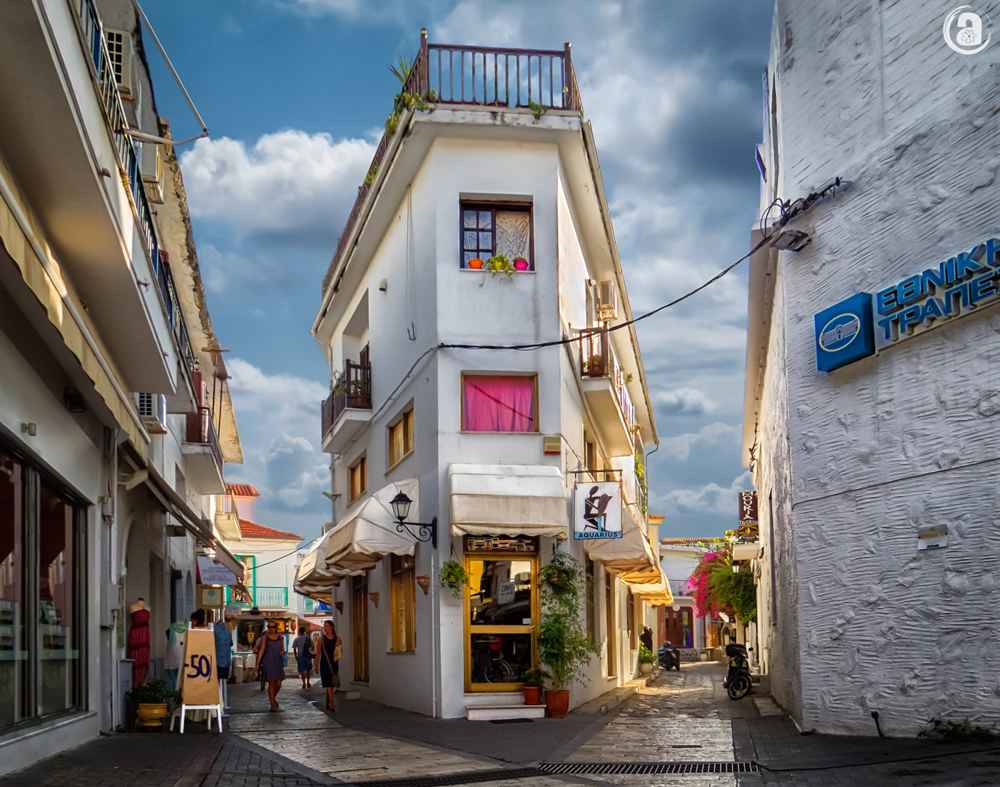
Skiathos Town is the only town on the island and the capital of the westernmost Northern Sporades island. The settlement spreads over two low hills around a southeast-facing harbour, on the site of the ancient city, and was rebuilt after the War of Independence. Around 5,000 residents live here year-round, and the town concentrates the island’s port, bus terminal, shops and nightlife within a walkable grid of whitewashed lanes. Plan the whole trip with Greece Tours.
The Bourtzi peninsula divides the waterfront into the new port, where ferries dock, and the old port, where excursion caiques moor. Papadiamantis Street runs inland from the harbour as the pedestrian spine. This guide covers the layout, the Bourtzi, museums and churches, the shopping street, viewpoints, eating and nightlife. Town beaches, transport connections, the Papadiamantis and Mamma Mia! heritage. A practical one-day plan.
How is Skiathos Town laid out around its harbour?
Skiathos Town covers two low hills on the island’s southeast coast, wrapped around a single harbour that the Bourtzi peninsula splits into a new port for ferries and an old port for excursion boats and fishing caiques.
The town stands on the site of the ancient city and was rebuilt after the War of Independence, when islanders moved back from the fortified Kastro on the northern cliffs. Two hills shape the plan: the eastern hill around the Agios Nikolaos clock tower and the western hill above the old port. Between them, a grid of lanes drops toward the waterfront, where a paved promenade runs the full length of the harbour. The town is the administrative, commercial and social centre of Skiathos, an island of about 48 square kilometres, and around 5,000 of the island’s residents live inside or immediately around it.
Every bus route, ferry departure and boat excursion on the island starts within about 400 metres of the town’s compact harbour front.
The new port occupies the eastern half of the waterfront and handles all ferry traffic. Hydrofoils and conventional ferries from Volos, Agios Konstantinos, Skopelos and Alonnisos tie up along the quay, beside a tree-shaded square where the island buses and taxis wait. The harbour promenade carries a row of cafes facing the moored yachts, and the ring road loops behind the town to keep cars out of the pedestrian core. Alexandros Papadiamantis Airport lies about 2 kilometres northeast of the quay, so arriving aircraft pass low over the water on final approach.
Passengers walk from the ferry ramp to the first hotels and studios in under five minutes, which makes the new port the natural arrival point for the whole island. Kiosks beside the quay sell bus tickets, cold water and island maps.
The old port fills the western corner of the harbour, below the hill of Agios Nikolaos. Wooden caiques, water taxis and excursion boats moor stern-to along the quay, and their ticket desks open each summer morning under canvas awnings. Fishing boats land their catch here at first light, supplying the tavernas that line the quayside behind the mooring bollards. A row of plane trees shades the square of Tris Ierarches church, the parish church that anchors this end of town. The old port keeps the working character that the newer waterfront has lost. Photographers gather here in the evening when the caiques swing on their moorings against the low sun.
Departures for the north-coast beaches and the sea caves leave from this quay, not from the ferry side.
Above both ports, whitewashed lanes climb in steps between two-storey houses with wooden balconies, bougainvillea and pebble courtyards. The rebuilt town follows a compact grid, so navigation stays simple: downhill always leads to the water. Plateia Papadiamanti, the small square near the writer’s house, marks the centre of the grid. Street numbers matter little because locals navigate by churches, of which the town counts more than a dozen inside its core. The full built-up area measures barely 1 kilometre across, and a slow circuit of the lanes, both hills and the complete waterfront takes about 90 minutes on foot.
Cars stay on the ring road, leaving the interior to pedestrians, scooters making deliveries and the cats that occupy every sunny doorstep. The two hill churches serve as fixed landmarks for orientation from any lane.
What is the Bourtzi peninsula in Skiathos Town?
The Bourtzi is a small pine-covered peninsula in the middle of the Skiathos Town waterfront, carrying the remains of a Venetian-era fortress and separating the new ferry port from the old excursion-boat harbour.
The fortress on the Bourtzi dates to the thirteenth century, when the Ghisi brothers, Venetian rulers of the Sporades, fortified the islet to control the harbour. Sections of the defensive wall and the gate survive at the entrance, framed by two stone cannons facing the sea. A causeway now ties the peninsula to the waterfront promenade, so the walk from the ferry quay to the gate takes about three minutes. Stone paths cross the interior under Aleppo pines, passing the former primary school building that crowns the small plateau.
The name Bourtzi comes from the Turkish word for tower and recurs across Greek harbours, from Nafplio to Karystos, always marking a small fortified islet guarding an anchorage against raiders. The walls glow pale gold in the last hour of daylight.
The neoclassical building at the summit worked for decades as the island’s primary school and now hosts exhibitions and cultural events through the summer season. An open-air stage on the seaward tip presents concerts and theatre performances on warm evenings, with the audience facing the dark water and the lights of the harbour. Paths circle the outer edge of the peninsula at sea level, passing swimming rocks where local children dive through the afternoon. A small seasonal cafe operates under the pines, serving coffee and drinks with a clear view over both ports.
Entry to the peninsula stays free and the gates remain open through the day, which makes the Bourtzi the easiest green escape from the crowds of the harbour promenade. Event posters appear on the causeway boards each week in season.
Views from the Bourtzi cover the full sweep of the town: the ferry quay and marina to the east. The caiques of the old port to the west and the twin hills rising behind the waterfront. The tip of the peninsula points at Tsougria islet, about 3 kilometres offshore, and at the sea lane where ferries turn toward Skopelos. Aircraft on final approach to the airport cross this water low enough to read their liveries from the walls. Photographers use the eastern wall in the morning, when the light falls on the harbour front, and the western rocks at dusk, when the old port glows.
The pines keep the paths shaded even in August, when the waterfront promenade stands fully exposed to the sun. The view reaches the Pelion peninsula on clear days.
A visit to the Bourtzi fits any gap in a town day because the full circuit takes about 20 minutes at a slow pace. The paths are stone and packed earth, manageable with a pushchair on the main spine, though the perimeter track narrows over the rocks. Benches under the pines face both harbours, and the peninsula stays cooler than the town streets by a clear margin on hot afternoons. Evening events are posted on boards at the causeway entrance during the festival months. Swimmers use the flat rocks on the southern edge, where ladders drop into water about 3 metres deep.
The Bourtzi closes to visitors only during staged performances, when ticket holders enter through the gate at the causeway. Water shoes help on the rocks because sea urchins settle the crevices.
What fills Papadiamantis Street in Skiathos Town?
Papadiamantis Street is the pedestrian spine of Skiathos Town, running about 350 metres inland from the harbour front and carrying the town’s main shops, bakeries, pharmacies, travel agencies and cafes under balconies and awnings.
The street begins opposite the taxi rank on the harbour and climbs gently inland for about 350 metres to the small triangular junction at Plateia Papadiamanti. Marble paving covers the full length, and traffic stays banned through the day, so the street functions as the island’s main meeting place. The Papadiamantis House museum stands just off the lower half, down a signed lane on the right when walking from the sea. Banks with cash machines, the post office and the town pharmacies cluster along the first 150 metres, which keeps every practical errand within a short walk of the quay.
Overhead, balconies and awnings narrow the sky, and the street holds its shade for most of the morning while the waterfront bakes. Stone benches at the top junction offer the best people-watching seat.
Shops along the street sell gold jewellery, handmade ceramics, olive-wood bowls, leather sandals and linen clothing, with prices displayed in the windows. Bakeries at the upper end sell cheese pies and almond sweets from early morning, and gelato counters open onto the marble paving through the afternoon. Two bookshops stock English-language novels and walking maps of the island’s marked trail network. Souvenir stalls concentrate near the harbour end, while the quieter upper stretch carries goldsmiths and studios where owners work behind the counter. Shopkeepers keep long summer hours, opening about 9 in the morning and trading past midnight in July and August. With a pause in the mid-afternoon heat that empties the marble between about 2 and 6.
Delicatessen shelves add thyme honey, olive oil and mountain tea.
Side lanes multiply the street’s reach across the whole lower town. Narrow alleys on the west side drop toward the old port through arcades of bougainvillea, while stepped lanes on the east climb toward the clock-tower hill. Polytechniou Street, one block east, concentrates the town’s bars and fills after dark with crowds moving between terraces. The square of Tris Ierarches opens near the old-port end, shaded by plane trees and ringed by taverna tables. Lanes here carry painted house numbers on ceramic plaques, and window boxes hold basil and geraniums through the season.
Walkers who leave the main street find the town’s quietest corners within two turns, where laundry lines cross overhead and cats sleep on warm marble steps. Painters set up easels at the arcade corners through the morning hours.
The street runs on a double rhythm across the day. Mornings belong to residents buying bread, arranging boat tickets and drinking coffee standing at counters, and the marble stays cool underfoot until about 11. Evenings bring the volta, the traditional promenade, when families walk the full length at strolling pace, ice cream in hand, and the lit shopfronts frame the crowd. Travel agencies along the lower half sell excursion tickets, hire cars and post ferry departure boards on their doors, updated each morning. Queues form at the cash machines near the harbour junction on changeover days.
Visitors cover the street end to end in eight minutes when empty, but the same walk takes half an hour on an August evening, and that slowness is the point.
Which museums and churches stand in Skiathos Town?
Skiathos Town holds the Papadiamantis House museum, the preserved home of nineteenth-century writer Alexandros Papadiamantis, plus the cathedral of Tris Ierarches by the old port, the clock-tower church of Agios Nikolaos and more than a dozen smaller chapels.
The Papadiamantis House stands in a small courtyard just off the lower half of the main street, a two-storey island house with stone walls and a wooden upper floor. Alexandros Papadiamantis, the writer whose short stories fixed island life in Greek literature, was born in the building and returned to die in the ground-floor room now shown to visitors. The museum preserves his desk, his bed, family icons, manuscripts and photographs across four small rooms. Labels appear in Greek and English, and a visit takes about 20 minutes. The house also shows how island families lived in the nineteenth century, with the kitchen hearth.
The loom and the cistern intact, which gives it value beyond the literary pilgrimage that fills its guest book. A small shop at the entrance sells his story collections.
The cathedral of Tris Ierarches rises beside the plane trees of the old-port square, a stone basilica that serves as the town’s principal church. Inside hangs the icon of Panagia Eikonistria, the island’s patron. Found by a monk in the pine hills inland and carried into town. Islanders process with it through the streets on its winter feast day. Whitewashed steps climb from the square to the church terrace, which overlooks the caiques of the old port. Services fill the building on Sunday mornings, and visitors enter freely outside service hours with shoulders and knees covered.
The dim interior rewards the short climb with a carved wooden iconostasis, silver votive offerings and the smell of beeswax and incense that marks every working Greek church.
Agios Nikolaos church crowns the eastern hill under the town clock, reached by stepped lanes from the harbour in about 10 minutes. The clock tower beside the church rings the hours across both ports and marks the highest point of the town’s silhouette. Smaller chapels punctuate the lanes below: Panagia Limnia near the new port with its walled courtyard. A string of family chapels whose doors open on feast days with bread, music and candles. The feast dates spread across the summer, so a week-long stay often lands on one. Each chapel keeps its own character, from ship models hung by sailors to embroidered icon cloths.
Together they map the maritime faith of a town that lived from the sea. Candles cost a coin dropped in the box by the door.
A heritage circuit links the sights in a walkable loop of about 1.5 kilometres. Start at the Papadiamantis House off the main street, continue to the cathedral square by the old port. Climb the western lanes for the harbour view, then cross the waterfront to the clock-tower hill of Agios Nikolaos. The loop takes about two hours with visits and coffee stops along the way. Morning hours work best because the museum closes in the mid-afternoon and the churches open around services. Modest dress applies inside every church, with covered shoulders and knees, and photography stays banned where icons are displayed.
The route finishes 200 metres from the Bourtzi causeway, which extends the walk for anyone with energy left. Flat shoes matter because the lanes climb on polished stone steps.
Where are the best viewpoints over Skiathos Town?
The clock-tower terrace of Agios Nikolaos gives the widest view over Skiathos Town, covering both ports, the Bourtzi and the ferry lane, with further angles from the Bourtzi walls, the old-port mole and the runway threshold northeast of town.
The terrace beside Agios Nikolaos church, under the town clock, opens the classic panorama: tiled roofs stepping down to the harbour. The Bourtzi splitting the two ports and the ferry lane running out toward the mountains of Evia. The climb from the waterfront takes about 10 minutes up stepped lanes signed from the promenade. Light favours the terrace in late afternoon, when the sun stands behind the viewer and the harbour water turns metallic. The clock strikes the hour loudly at close range, a detail that surprises first visitors. Benches on the terrace edge seat about a dozen people.
The spot fills 30 minutes before sunset in high season, so photographers arrive early to hold the parapet positions that face the Bourtzi. The terrace has no gate and no entry fee.
The Bourtzi delivers the reverse angle: the full town facade seen from the water line, with the two hills rising behind the masts of the marina. The eastern wall frames the ferry quay and the open strait, while the western rocks look straight into the old port. Morning light works here because the sun stands behind the peninsula and models the whitewashed town front. A third angle waits on the old-port mole, where the caiques stack in the foreground and the clock tower closes the frame above the roofs. The 500-metre walk between these three positions produces the complete postcard set of the capital without any climbing.
Which suits visitors with limited mobility and photographers working a single golden hour. Wide lenses capture both ports in a single frame from the causeway.
Aircraft watchers get a viewpoint unique in Greece at the runway threshold, about 2 kilometres northeast of the harbour along the Xanemos road. Arriving aircraft cross the public road at a height of about 15 metres, low enough that departure jet blast pushes standing spectators backward, and warning signs line the fence. The walk from town takes about 25 minutes, or five minutes by scooter, and arrivals cluster through the afternoon during the charter season. The spot doubles as a town viewpoint because the harbour, the Bourtzi and Tsougria islet line up beyond the runway. Xanemos beach, immediately below the threshold, lets spectators swim between arrivals, a combination no other Greek island offers at this scale.
Departures throw engine spray across the fence line, so cameras need cover when jets power up.
Evening panoramas belong to the western hill above the old port, where the lanes end at terraces overlooking the caique quay. The sun drops behind the Pelion peninsula on the mainland, and the old-port lights come on in layers below the churches. Higher still, the road toward the Evangelistria monastery climbs through pines to bends that frame the whole bay, about 3 kilometres from the centre and best reached with wheels. The ring road above the eastern hill gives the counterpart morning view over the new port and the marina. Photographers who want the town with Tsougria behind it shoot from the water on the first excursion boats of the morning, when low light rakes across the strait.
Tripods earn their weight here because the blue hour over the harbour lasts about 25 minutes.
Where do visitors eat and drink in Skiathos Town?
Tavernas concentrate along the old port and the courtyard lanes behind it, cafes and gelato counters line the waterfront promenade and the main street, and Polytechniou Street plus the new-port strip carry the late-night bar scene.
Fish tavernas line the old port under the plane trees, their tables reaching to the mooring bollards, and the catch comes off the caiques at the same quay each morning. Menus run to grilled bream, sardines, octopus dried on lines in the sun and lobster spaghetti, with the day’s fish displayed on ice counters inside. Tables here watch the excursion boats return through the golden hour, which makes the quay the most contested dinner setting in town. Reservations matter in July and August for the front rows facing the water. The square of Tris Ierarches behind the quay holds quieter tables under the trees.
Where the same kitchens serve away from the waterfront foot traffic and the evening crowds thin noticeably. Waiters post the day’s catch on chalkboards by the door.
Courtyard tavernas hide in the lanes between the main street and the old port, serving oven dishes that the waterfront kitchens skip: rooster in wine. Stuffed vegetables, goat with lemon and the local cheese pie of Skiathos, rolled in a spiral and fried in olive oil. Tables occupy stepped alleys under vines, and the walk uphill away from the water reliably lowers the bill. Kitchens open about 6 in the evening and serve past midnight through the season. The town also feeds the late crowd: grills near the bus square hand out gyros and souvlaki wrapped to go until the small hours.
Vegetarians manage well because the oven tradition builds half its dishes from vegetables, pulses, greens and cheese. House wine arrives in copper jugs from barrels in the back room.
Breakfast belongs to the bakeries and the waterfront cafes. Bakeries at the top of the main street open before 7 with cheese pies, spinach pies, bougatsa and almond pastries. The marble counters fill with locals before the shops open. Cafes along the new-port promenade serve freddo espresso. Yoghurt with honey and omelettes facing the moored yachts. Hold their tables through the day as the clientele shifts from coffee to beer. Gelato counters on the main street scoop until midnight. Juice stands at the old port squeeze oranges for the boat crowds each morning.
A picnic assembled from the bakeries, the fruit stalls and the delicatessen counters costs a fraction of a taverna lunch and travels well on the excursion boats. Tables at the promenade rail go first at breakfast.
Night moves in stages that the whole town observes. Aperitifs start on the waterfront cocktail terraces facing the Bourtzi, where tables watch the last ferries dock. Polytechniou Street, one block inland from the main street, packs its bars from about 11, with music spilling between doorways and crowds moving glass in hand. The club strip runs along the new port toward the airport road, and its venues hold dance floors going until dawn in August. The open-air cinema on the ring road screens Mamma Mia! nightly through the summer under jasmine and stars, filling its canvas chairs with first-timers and returnees.
Quieter evenings end on the Bourtzi walls or the old-port mole, where the town lights double in the harbour water. Dress codes stay relaxed everywhere except the club doors in peak weeks.
Which beaches lie within walking distance of Skiathos Town?
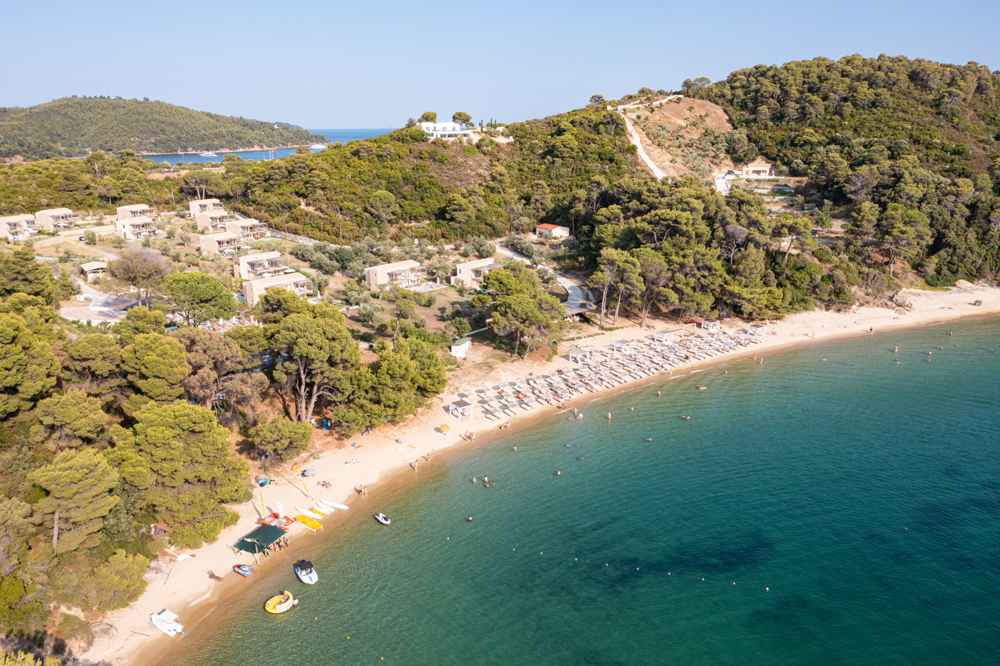
Megali Ammos, a 400-metre sand beach with sunbeds, starts a 10-minute walk southwest of the harbour, with Vassilias and Achladies beyond, while Xanemos beach under the runway lies about 25 minutes northeast on foot.
Megali Ammos translates as big sand and delivers exactly that: a 400-metre strip beginning where the town’s southwest edge meets the coast road. About 10 minutes on foot from the main street. Sunbed concessions and tavernas back most of its length, and the water deepens gradually over sand, which suits children. The beach faces south, so it holds sun from morning until evening and catches the afternoon breeze that cools the whole coast. Hotel guests from the strip above keep it busy through the season, and the first stops of the island bus route line the road behind.
Swimmers here watch aircraft bank over the bay on the airport approach, a backdrop specific to this corner of the island. Sunset lands directly over the bay here in early summer.
Vassilias continues the shoreline about 3 kilometres from the centre, a 15-minute ride on the coastal bus or a 40-minute walk along the road. With pine trees dropping to a mixed sand-and-shingle shore split into coves. Achladies follows at about 4 kilometres, wider and fully organised, with water sports and hotel loungers on the sand. Both carry stops on the single south-coast bus line, numbered from the town terminus, so beach-hopping needs no car. The town end of each beach stays livelier, while the far ends thin out to free sand for towels. Return buses run into the evening through the season, which lets walkers go out on foot along the coast and ride back after a swim.
Pines shade the back of the sand through the afternoon at both beaches.
Xanemos spreads below the runway threshold on the island’s northeast corner, a coarse-sand and pebble beach reached by the airport road in about 25 minutes on foot from the harbour. Aircraft pass directly overhead on arrival, and the beach doubles as the island’s plane-spotting gallery. The north-facing water runs clearer and cooler than the south coast and chops up when the meltemi blows. Closer still, the Bourtzi’s southern rocks give the fastest swim in town, with ladders into deep water three minutes from the ferry quay. The flat rock shelves at Plakes, past the old port on the town’s southwest point. Hold sunbathers through the day and drop into water deep enough for diving from the edge.
Snorkellers work the rock edges at Plakes for octopus and bream.
Water taxis widen the range without wheels. Boats leave the old port through the morning for the south-coast beaches. Taking swimmers as far as Koukounaries at the island’s far end, about 12 kilometres away. Returning through the afternoon. The town beaches trade convenience for space: sand within walking distance fills by noon in August, while a 20-minute bus or boat ride opens progressively emptier shores. Families with small children default to Megali Ammos for the shallow entry and the food behind the sand. Strong swimmers favour the Bourtzi rocks and Plakes for deep clear water without crowds. Every option returns visitors to the harbour in under half an hour, which keeps town-based stays flexible from breakfast to dinner.
Tickets for the water taxis sell on board rather than at desks.
How does Skiathos Town connect the island as its transport hub?
Every transport mode on the island converges on Skiathos Town: ferries and hydrofoils at the new port, excursion boats and water taxis at the old port, the single bus line from the harbour terminus and the airport 2 kilometres northeast.
Ferries and hydrofoils tie up at the new port in the town centre, arriving from Volos and Agios Konstantinos on the mainland in about 1.5 to 2.5 hours by fast boat. With seasonal links from Mantoudi on Evia and from Thessaloniki. Onward connections continue to Skopelos and Alonnisos, which makes the quay the interchange for the whole Sporades chain. Ticket offices face the harbour square and post the day’s departures on boards outside their doors. Full details of routes, boat types and the airport alternative sit in the guide on how to get to Skiathos. Porters and hotel transfers meet the larger arrivals, and the walk from the ramp to the main street takes two minutes.
High-season sailings add extra departures around the weekend changeovers.
The island bus starts from the terminus beside the new port and runs the single south-coast road to Koukounaries, serving stops numbered roughly 1 to 26 along about 12 kilometres. Departures run at high frequency through the summer day, and conductors sell tickets on board. Taxis wait at a marked rank on the harbour square, with boards listing standard destinations. Car, scooter and quad rental offices cluster on the ring road and along the airport road. The compact road network means no drive on the island exceeds about half an hour.
Traffic and parking pressure peak in the town itself, so drivers staying centrally park on the ring road and walk in rather than hunting spaces near the harbour. Fuel stations sit on the ring road and near the airport junction.
Excursion traffic works from the old port. Wooden caiques and modern boats leave each summer morning for the round-the-island route, the sea caves and Lalaria beach, the white-pebble bay on the north coast that no road reaches. Water taxis shuttle to the south-coast beaches, and full-day boats cross to Skopelos and the marine-park waters around Alonnisos. Ticket desks line the quay from early morning, and boards show each boat’s route, departure time and return. North-facing routes cancel when the meltemi builds, with decisions posted at the desks by breakfast. The quay sits 300 metres from the ferry port, so visitors compare every sea option in a five-minute walk along the promenade.
Morning departures fill first because the light on the north coast peaks before noon and the sea stays calmer early.
Alexandros Papadiamantis Airport lies about 2 kilometres northeast of the harbour, close enough that the taxi ride takes five minutes and a loaded walk stays possible in half an hour. Charter and scheduled flights arrive from European cities through the season. Plus domestic flights from Athens year-round. The short runway delivers the low approach over the coastal road that made the airport famous among aviation followers. Buses skip the terminal, so arrivals rely on taxis, transfers or rental pickups arranged ahead. Luggage storage near the harbour bridges awkward gaps between checkout and evening flights. The town’s compactness turns connections that strain larger islands into short errands: ferry-to-flight transfers complete inside 20 minutes door to door.
Check-in queues build early in August, when charter departures stack into the short morning window.
What ties Skiathos Town to Papadiamantis and Mamma Mia!?
Skiathos Town raised Alexandros Papadiamantis, the nineteenth-century writer whose stories fixed the island in Greek literature, and the town’s waterfront later carried port scenes for Mamma Mia!, the film that put the harbour on international screens.
Alexandros Papadiamantis wrote about 180 short stories and the novella The Murderess from material his home town supplied: fishermen, widows, festivals and the pine hills behind the harbour. Born in the town and trained in Athens, he returned to die in the family house that now works as his museum. Greek criticism ranks him at the top of the country’s prose tradition, and his dense mix of demotic and church Greek still anchors school curricula. A bust of the writer watches the harbour from the Bourtzi approach, and his name carries the main street, the airport and the island’s cultural festival.
Readers arrive with his collected stories and walk the settings; English translations sit in both bookshops on the main street. His grave lies in the town cemetery, visited by readers each year.
The literary map extends past the museum and across the town. Alexandros Moraitidis, a second writer of the same generation and a cousin of Papadiamantis, was born here too, and the pair fixed Skiathos in Greek letters twice over. Plateia Papadiamanti holds the writer’s memorial at the centre of the shopping grid. The festival named for him brings readings and music to the Bourtzi’s open-air theatre through the summer. The monastery of Evangelistria, about 4 kilometres north in the pines, appears throughout his stories and pulls literary visitors out of town on a marked road. Local guides link the sites into a half-day walk, and the bookshops stock editions of both writers beside the maps and postcards.
The festival programme posts on boards at the causeway and the square.
Mamma Mia! brought the harbour a second fame. The production filmed its port scenes on the town waterfront, with the old port and its caiques standing in for the fictional island of Kalokairi, while the wedding chapel and the beach scenes went to neighbouring Skopelos. Locals appear among the extras, and the dock sequences fixed the promenade in the film’s opening act. The open-air cinema screens the film nightly through the summer to full benches. Excursion boats sell full-day trips from the old port that pair the town’s filming points with the Skopelos locations. Including the clifftop chapel of Agios Ioannis on the north coast of Skopelos. The soundtrack drifts from waterfront bars every evening in season.
Fans photograph the old-port quay from the exact angles of the film posters.
The double heritage shapes the town’s calendar and its visitor economy. Literary tourism peaks around the writer’s festival, while film tourism spreads across the whole season and fills the Skopelos day boats. Shops sell story collections and soundtrack merchandise within the same 50 metres of the main street. The pairing broadens the town’s pull beyond the beach: rainy-morning options include the museum, the churches and the cinema. Evening options include readings and the outdoor screening under the stars.
The full menu of activities across the island, from the monastery to the boat routes and the trails, sits in the guide to things to do in Skiathos, and the town serves as the base from which every one of them starts. Both audiences meet at the same quay tables by evening.
How does a full day in Skiathos Town come together?
A full day in Skiathos Town runs from bakery breakfast on Papadiamantis Street through the museum, the cathedral square and the Bourtzi, breaks for a swim at Megali Ammos or the rocks, and closes with old-port dinner and the evening.
Morning starts at the bakeries on the upper main street, open before 7, with a spiral cheese pie and coffee standing at the counter. The Papadiamantis House opens mid-morning and takes 20 minutes, followed by the cathedral square and the old-port quay while the caiques load their excursion passengers. The climb to the Agios Nikolaos clock tower fits before the heat builds, about 10 minutes of steps for the full harbour panorama. Shops trade busily until early afternoon, which places the shopping stretch of the main street next on the route. The whole morning circuit covers about 2 kilometres on foot and finishes back at the waterfront in time for the midday water-taxi departures to the beaches.
An early start beats both the heat and the coach groups from the beach hotels.
Midday belongs to the water in every version of the plan. The nearest options run from a swim off the Bourtzi rocks, three minutes from the quay. To the sand of Megali Ammos ten minutes southwest, to a water taxi from the old port down the south coast. Lunch stays light: a bakery picnic in the Bourtzi shade or a taverna table at the beach. The town itself empties between about 2 and 6 as shops shutter against the heat, so the afternoon plan keeps to water, siesta or the cafe awnings. Cool pauses wait inside the museum and the churches, both dim behind thick stone walls.
The lanes refill at 6, when the shutters reopen and the marble comes back to life. Sun hats matter because the promenade offers no shade at noon.
Evening runs on a fixed local order: sunset from the clock-tower terrace or the western lanes. The volta down the main street with ice cream, then dinner at the old port as the excursion boats unload. Tables under the plane trees fill first, so the golden-hour quay seats reward early arrival. Night extends down Polytechniou Street’s bars or out to the open-air cinema for the Mamma Mia! screening under the stars. The waterfront cocktail terraces hold the middle ground, facing the lit Bourtzi across the water. Last gyros wraps come off the grills near the bus square after midnight.
The ten-minute scale of the town means every stage of the night stands within a short walk of every bed. The clock tower rings midnight over the whole sequence.
Town-based stays make this rhythm effortless because rooms, ferries, buses and boats share the same square kilometre. Studios and small hotels fill the lanes and the ring road, with quieter rooms uphill and livelier ones near the waterfront, and the airport sits five minutes away by taxi. Area-by-area comparisons, from the town core to the resort strips at Megali Ammos, Achladies, Troulos and Koukounaries, sit in the guide on where to stay in Skiathos. Light packers manage the whole stay without wheels. One full day covers the town’s core sights at walking pace. Two days add the beaches and a boat trip. The town then works as the launch pad for the rest of the island.
Two hills, two ports and one street hold the entire plan together.
Frequently Asked Questions
Is Skiathos Town walkable without a car?
Skiathos Town works entirely on foot: the built-up area measures about 1 kilometre across. The two ports sit 300 metres apart and every sight, restaurant and hotel inside town stands within a 15-minute walk of the harbour. Cars stay on the ring road that loops behind the hills, leaving the interior lanes to pedestrians. The climbs are the only effort, because both hills rise in steps, and the clock-tower terrace takes about 10 minutes of stairs from the promenade. Wheeled luggage handles the waterfront and the main street easily but struggles in the stepped side lanes. Travellers with rooms uphill pack light or arrange a bag drop with their hosts.
A car earns its cost only for exploring the wider island: the north-coast tracks, the monastery road and the quieter beaches beyond the bus line. Visitors basing in town for the beaches manage with the bus terminus and the water taxis at the old port, both starting beside the harbour.
How far is the airport from Skiathos Town?
Alexandros Papadiamantis Airport lies about 2 kilometres northeast of the harbour, a five-minute taxi ride or a walk of about 25 to 30 minutes along the Xanemos road. No public bus serves the terminal, so arrivals use the taxi rank outside, pre-booked transfers or rental cars collected at the airport offices. The proximity cuts both ways: connections are effortless, and the town’s northeastern edge hears engine noise during the charter season, concentrated in daylight hours. Rooms around the old port and the western hill sit furthest from the flight path. The runway threshold beside the public road doubles as the island’s plane-spotting stage. Where arriving aircraft cross at about 15 metres overhead.
The transfer often starts or ends with a spectacle. Departing visitors reach check-in from any town hotel inside 15 minutes door to door, which permits full final mornings on the beach or in the lanes without airport anxiety. Taxis meet every scheduled arrival, and queues clear within minutes.
Where do the excursion boats leave from in Skiathos Town?
Excursion boats leave from the old port, the western quay below the Agios Nikolaos hill, 300 metres along the promenade from the ferry dock. Departures concentrate between about 9 and 11 in the morning: round-the-island trips to Lalaria and the sea caves. Half-day runs to Tsougria islet, full-day cruises to Skopelos and the Alonnisos marine park. Water taxis shuttling to the south-coast beaches. Ticket desks line the quay under awnings and post each boat’s route, departure and return times on boards the evening before. Buying a day ahead secures space in July and August, though same-morning tickets work outside the peak weeks.
North-facing routes, including every Lalaria trip, cancel when the meltemi wind builds, and the desks announce decisions by breakfast. Returns land between late afternoon and early evening, delivering passengers straight onto the taverna quay in time for dinner under the plane trees. Children travel at reduced fares on most boats, and the larger vessels carry shaded decks, toilets and snack bars for the longer routes.
Can you swim close to Skiathos Town?
Swimming starts three minutes from the ferry quay at the Bourtzi’s southern rocks, where ladders drop into clear water about 3 metres deep. Megali Ammos, the nearest sand, begins a 10-minute walk southwest of the main street: 400 metres of gradual-entry beach with sunbeds, tavernas and bus stops behind the sand. The flat shelves at Plakes, past the old port, serve sunbathers and confident swimmers off deep rock. Xanemos, about 25 minutes northeast under the runway, adds a coarser, cooler north-coast option with aircraft passing overhead. Families default to Megali Ammos for the shallow slope; swimmers wanting depth and clarity pick the rocks instead.
Water taxis from the old port extend the range down the whole south coast within half an hour, as far as Koukounaries. A town base therefore never separates visitors from the sea by more than a short walk, a convenience matched by almost no other Greek island capital. Water clarity peaks in the morning before the boat traffic stirs the bay.
What is Skiathos Town like in the evening?
Evenings run in stages that the whole town follows. The volta fills Papadiamantis Street from about 8, families walking the marble length with ice cream while the shops trade late into the night. Dinner concentrates at the old port under the plane trees and in the courtyard lanes behind it, with the quay tables watching the excursion boats unload in the golden hour. Music starts on Polytechniou Street about 11. A block of bars with terraces that trade until the small hours. The club strip along the new port carries dancing until dawn in August. The open-air cinema screens Mamma Mia! nightly through the summer.
Quieter evenings end on the Bourtzi walls, the clock-tower terrace or the old-port mole, watching the harbour lights double in the water. Every venue stands within a 10-minute walk of every other, so the night needs no transport and no planning beyond a dinner reservation in peak weeks. Families with children fit comfortably into the early stages before the bar crowd takes over.
Is Skiathos Town a good base for visiting Skopelos?
Skiathos Town works as a Skopelos base because boats cross daily through the season. Scheduled ferries and hydrofoils leave the new port for Glossa and Skopelos Town, taking about 20 minutes to one hour depending on the route and the boat. Excursion boats from the old port sell full-day Skopelos trips that bundle the crossing with the Mamma Mia! filming locations. Including the clifftop chapel of Agios Ioannis. Return in time for dinner. Day-trippers cover the highlights comfortably, and the reverse flow runs too, with Skopelos visitors crossing for the airport, the shopping street and the nightlife their quieter island lacks. Independent travellers ride the morning ferry out and the evening ferry back, keeping about six hours ashore.
The pairing lets one accommodation booking cover two islands, and the town’s combined ferry and flight connections make it the practical anchor of any Sporades itinerary built around island hopping. Winter crossings continue on the ferry schedule, though at reduced frequency.
When is the best time to visit Skiathos Town?
Late May, June and September deliver the town at its best balance: open shops and boats, warm sea and walkable afternoon streets without the August crush. July and August bring the full program, every excursion running, nightly cinema, feast days and the volta at maximum density. At the cost of booked-out quay tables and midday heat that empties the lanes between about 2 and 6. April and October offer quiet lanes, working cafes and mild walking weather, though the excursion boats thin out and the north-coast trips depend on calm seas. Winter reduces the town to its resident core, with ferries running. A fraction of restaurants open and the museum on reduced hours.
The reward is the working island life that Papadiamantis wrote about. Beach-first visitors book June or September, nightlife seekers take July and August, and walkers aiming at the trails and the monastery pick the shoulder months on either side. Sea temperature peaks in August and stays swimmable well into October.