
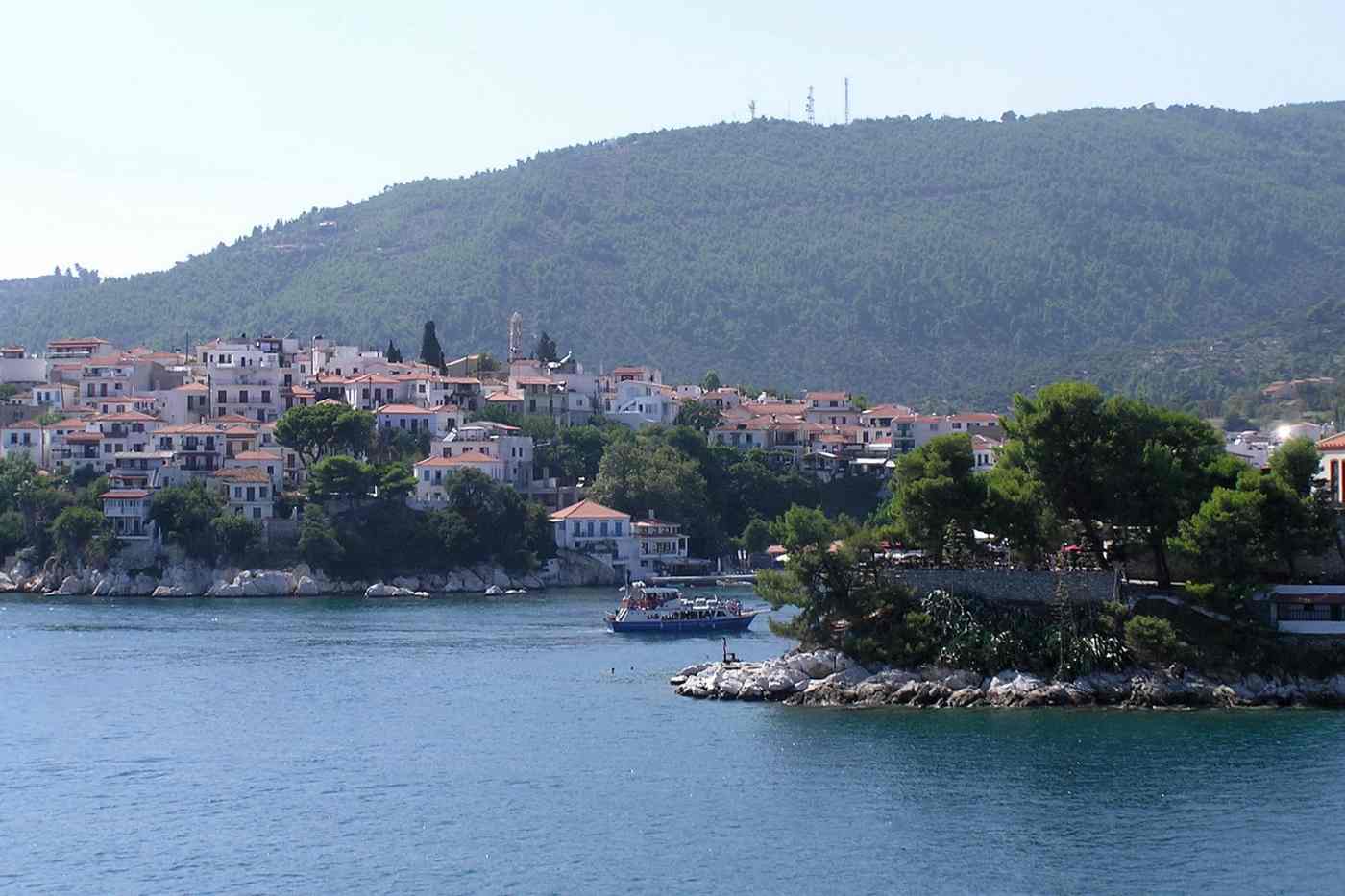
Banana beach, officially named Krassa, stretches along the southwest tip of Skiathos about 12 km from the harbour town, one pine-covered hill beyond the final Koukounaries bus stop. Golden sand, west-facing afternoon light, beach bars and water-sports stations give the bay the youngest energy on the island’s south coast. Plan the whole trip with Greece Tours.
This guide covers the main bay and the naturist cove of Little Banana, the footpath in over the headland, the paid parking. The sunbeds and bars, the water sports, sunset timing. How Krassa measures against neighbouring Koukounaries and Agia Eleni.
Where exactly is Banana beach on Skiathos?
Banana beach, officially named Krassa, occupies a west-facing bay over the headland beyond Koukounaries at the southwest tip of Skiathos, about 12 km from Skiathos Town along the island’s single south-coast road.
Krassa bay, marketed everywhere as Banana beach, sits at the far southwest corner of the island, immediately west of the Koukounaries headland. The south-coast road ends at the Koukounaries roundabout roughly 12 km from the harbour of Skiathos Town, and Banana hides one low, pine-covered hill beyond that terminus. The bay opens toward the west-southwest, facing the sea channel that separates the island from the Pelion peninsula on the mainland. Two rocky arms frame the sand, sheltering the water from the north wind that rakes the opposite shore. Maps label the beach Krassa, road signs above Koukounaries point to Banana. Boat skippers use both names for the same 250-metre strip of pale golden sand between the two headlands.
The island of Skiathos covers about 48 square kilometres, and nearly all of its hotels, buses and rental traffic moves along one 12 km road between the town and Koukounaries. Banana therefore sits at the greatest practical distance from the port while remaining an easy half-day outing. Drivers cover the route in about 25 minutes outside peak hours; the bus needs about 35-40 minutes across its numbered stops. The beach’s position past the road’s end keeps tour coaches and casual harbour strollers away, so Krassa fills with visitors who chose it deliberately. Aircraft descending toward the runway at the island’s eastern tip remain visible far across the water, a reminder of how compact the whole island really is.
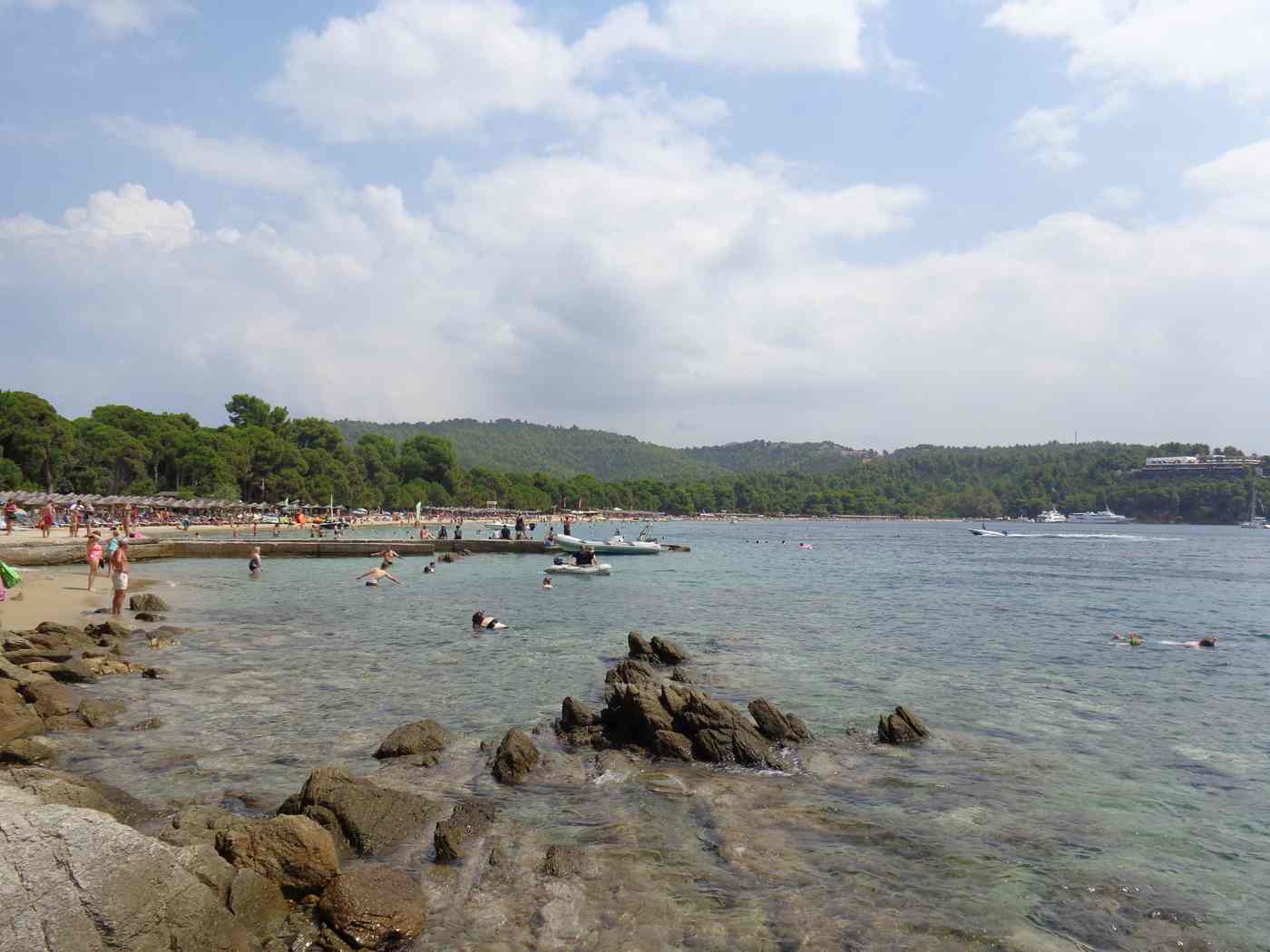
The sand forms a gentle crescent about 250 metres long and 25-30 metres deep, backed by a low slope of stone pines and scrub rather than buildings. The westward orientation is the bay’s defining feature on an island whose main beaches face south: the sun drops toward the water in front of the sunbeds instead of behind them. Direct light stays on the sand about an hour longer than at Koukounaries. Low ridgelines of Evia and the distant mainland shape the horizon. The two enclosing headlands are flat, walkable rock, popular with swimmers who dive from the outer edges. Depth increases quickly beyond the first 10-15 metres, which keeps the swimming zone compact and the water noticeably clear.
Neighbouring coves surround Krassa on three sides. Koukounaries, the island’s most famous beach, lies over the pine saddle to the east, with the Strofilia lagoon and its birdlife directly inland. Agia Eleni occupies the next bay to the north across its own low headland, facing the same westward horizon. Little Banana, also called Spartacus, hides behind the rocks at the southern end of the main strip, reachable in about three minutes on foot. Dirt paths and worn steps connect all of these coves, so a walker moves between four distinct beaches inside half an hour without touching the asphalt road.
The pine cover keeps the paths shaded until early afternoon and the air smells of resin through high summer.
Why is Banana beach on Skiathos also called Krassa?
Krassa is the official Greek name of the bay; the nickname Banana spread from the beach’s curved, yellow strip of sand and from beach-bar marketing that fixed the fruit image on signs, boat boards and maps.
Krassa appears on Greek nautical charts, land registries and municipal documents as the toponym for the bay and the slopes behind it. Islanders used the name long before tourism reached the southwest corner, and older residents of Skiathos Town still give directions with it. The nickname Banana arrived with the first sunbed concessions and stuck because it travels better in every language spoken on the sand. Printed island maps now show both names, usually Krassa first with Banana in brackets, while the hand-painted signs on the Koukounaries footpath read Banana only. Anyone asking a taxi driver for either name reaches the same paid parking area above the southern headland.
The double naming causes no practical confusion for arriving visitors at any point in the season.
The fruit comparison is literal rather than promotional invention. Seen from the footpath as it crests the headland. The strip of sand bends in a shallow arc between two dark rock arms. The dry upper sand turns a saturated yellow by midsummer. The curve, the colour and the narrow, elongated shape together read as a banana lying along the waterline. Photographers use the first bend of the path as the standard viewpoint, about 20 metres above sea level, where the whole crescent fits a single frame with Evia’s ridges behind.
The image appears on postcards and excursion-boat boards across the harbour, which pushed the nickname into every booking conversation and beach comparison on the island decades after locals coined it.
Little Banana carries its own second name, Spartacus, used for the small cove beyond the southern rocks. The name attached itself through the cove’s long-standing naturist crowd and appears on beach guides, forum threads and hand-lettered signs along the connecting path. Regular visitors treat the two names as interchangeable, though staff at the seasonal bar generally say Little Banana to families and day visitors. The cove measures about 60-70 metres of sand and pebble pockets between rock shelves, a quarter of the main beach’s length. Its separate identity matters for navigation: water taxis and private boats anchoring off the coast distinguish the two landings.
Sunbed availability differs sharply between the main strip and the smaller cove on peak days.
Practical naming matters most on the bus and the water. The conductor on the island bus announces Koukounaries as the final stop. Number 26. Banana never gets its own announcement, so first-time visitors count stops rather than listen for the name. Water-taxi boards at the old port of Skiathos Town list Banana with the fruit spelled out in Latin letters, and skippers quote Krassa only when talking to Greek passengers. Map applications pin the main strip under Banana Beach and the cove under Little Banana or Spartacus, all three pins sitting within 400 metres of each other.
Knowing the full set of names saves time when comparing boat routes, reading parking signs or asking directions at the Koukounaries roundabout kiosk area.
What sand and sea conditions does Banana beach offer?
Banana beach combines fine golden sand with a sandy seabed that stays shallow for the first 10-15 metres and then deepens quickly; the west-facing bay keeps the water calm through the meltemi season.
The sand at Krassa is fine-grained and pale gold, soft enough to walk barefoot in the morning and hot enough to demand sandals by midday in July and August. The beach slopes gently from the treeline to the waterline across 25-30 metres. Leaving room for three to four rows of sunbeds plus open sand near the rocks at either end. Entry into the sea is pebble-free along the entire 250-metre strip, a genuine advantage over the mixed entries at north-coast beaches. The dry upper zone drains fast after the brief summer showers, so the surface stays powdery rather than compacted.
Wind-blown sand is minor because the enclosing headlands and the pine slope behind cut most of the airflow at ground level.
Water clarity at Banana ranks among the highest of the organised Skiathos beaches, helped by the sandy bottom and the absence of any stream outflow into the bay. Visibility of 8-10 metres is normal on calm mornings, and the seabed stays visible from the surface across the entire swimming zone. The sea warms steadily from about 22°C in June to about 25-26°C in August and holds that warmth into late September, when air temperatures ease. The bottom stays pure sand for the first 10-15 metres, then drops away at a pronounced angle, so treading-water depth arrives within 20-25 strokes of the shore.
Buoyed lines mark the outer swimming limit in front of the sports stations through the peak weeks.
The rocky arms at both ends of the beach add a second habitat to the sandy bay. Flat shelves of grey limestone step down into 2-4 metres of water, and the boulders below hold seagrass patches, small wrasse, damselfish and sea urchins along the shaded faces. Swimmers crossing from the sand to the rocks pass an abrupt boundary where the bottom changes from bright sand to weed and stone. The most rewarding stretch for anyone carrying a mask. The southern arm doubles as the route to Little Banana and sees constant foot traffic.
The northern arm stays quieter and gives a clean view back down the full curve of the beach toward the bar umbrellas and the pine slope above them.
Swimming conditions follow a reliable daily pattern in high summer. Mornings bring flat, glassy water and the clearest visibility, the window regular visitors use for longer swims between the headlands. A light onshore sea breeze rises after midday, raising a 20-30 cm chop that suits floating rather than lap swimming and fades again toward evening. The quick deepening beyond the shallow shelf demands attention with weak swimmers: a child standing waist-deep reaches overhead depth within a body length or two. Lifeguard coverage is not something to assume anywhere on the island, so families anchor themselves near the shallow central section.
Afternoon sun lands straight onto the water, and the glare off the western horizon makes sunglasses more useful here than on the south-facing beaches.
How do you get to Banana beach from Skiathos Town?
The island bus runs from Skiathos Town to the final Koukounaries stop, number 26, in about 35-40 minutes; a signed footpath then crosses the headland to Banana in another 10-15 minutes of walking.
The bus is the standard route for visitors without wheels. Services leave the terminus beside the new port in Skiathos Town. Follow the single south-coast road through its numbered stops. End at stop 26 by the Koukounaries roundabout after about 35-40 minutes. Frequency rises to a bus roughly every 15-30 minutes through the peak weeks and thins in the shoulder months. Travellers still comparing arrival routes to the island itself find the full picture in the guide on how to get to Skiathos, which covers the airport, the mainland ferry ports and the onward connections.
From stop 26 the beach is a signed walk, so no second vehicle or transfer is needed at the Koukounaries end at any point.
The footpath begins at the western side of the Koukounaries roundabout. Marked by a painted Banana sign. Climbs the pine saddle in a steady 5-8 minute ascent on packed earth and rough stone steps. The crest opens the classic view over the whole crescent, and the descent to the sand takes another 5-7 minutes on a wider, dustier track. Total walking time runs 10-15 minutes at a relaxed pace, and the route carries steady two-way traffic from mid-morning onward in summer. Closed shoes or sturdy sandals handle the loose stones better than flip-flops, and a bottle of water per person makes the return climb in afternoon heat far more comfortable.
Pine shade covers most of the ascent, leaving only the final descent exposed.
Drivers follow the south-coast road to its end and turn onto the short access lane signed for Banana. Which climbs to a paid parking area on the slope above the southern end of the beach. The lot is unshaded gravel and fills by late morning on July and August days, when arriving cars queue for departing ones. From the parking area a broad path with rough steps drops to the sand in about 3-5 minutes. Scooters and quads, the island’s favourite rentals, park along the same area with an easier squeeze. Driving time from Skiathos Town runs about 25 minutes outside peak hours and stretches toward 35-40 minutes behind midday beach traffic.
Early departure beats the queue on both the road and the slope.
Arrival by sea suits anyone based near the old port. Water taxis serve the south-coast beaches from Skiathos Town through the summer, and the Banana landing puts passengers directly onto the sand without the headland walk. Private rental boats anchor off the bay’s centre in settled weather, their passengers swimming the final 30-50 metres or dinghying in. Round-the-island excursion boats pass the bay but focus their swim stops elsewhere, so the water-taxi remains the practical seaborne option. Returning by bus requires the same walk back over the saddle to stop 26. The posted timetable at the stop lists the last departure toward town. The final services of the evening carry the heaviest loads.
Standing room included, through the peak weeks.
What facilities does Banana beach on Skiathos provide?
Beach bars behind the sand rent sunbed-and-umbrella sets along the full 250-metre strip, serve drinks, snacks and cooked plates to the loungers, and keep toilets, showers and changing space open through the season.
Sunbeds cover most of the usable sand from June to September, arranged in three to four rows with straw or canvas umbrellas between them. Front-row pairs at the waterline go first and are usually claimed before noon on peak days. The rows nearer the treeline keep space longer and sit closer to the bar service points. Free sand for towels survives at both rocky ends of the strip and shrinks to narrow margins in August. Staff wave arriving visitors toward open sets rather than enforcing assigned seating, and a set generally holds for the whole day once taken.
Umbrella shade is the only shade on the sand itself, because the pine canopy stops at the slope behind the beds and casts nothing over the beach before late afternoon.
Food and drink run from freddo espresso and pressed juices in the morning through beer, cocktails and iced spirits after midday. Kitchens turn out toasted sandwiches, salads, souvlaki plates, burgers and fruit bowls, delivered to the sunbed on a shout or a flag rather than requiring a walk to the counter. Music plays across the central section of the beach from late morning. Rising in volume as the afternoon builds and giving Banana the most bar-driven soundtrack on the island’s southwest corner. Orders slow visibly at the mid-afternoon peak, when the sand is fullest and the sports stations are busiest. Lunch before or a stocked cool bag spares the wait at the roughest hour.
Prices sit at beach-bar level, above town supermarkets.
Toilets and cold-water showers stand behind the sunbed rows at the bar buildings, open to customers through the operating day, with simple changing cabins alongside. Rinse taps near the paths take the sand off feet before the climb back over the headland. Phone signal covers the whole bay reliably, and the bars keep card terminals alongside cash tills. Storage is informal: valuables stay with towels, so the usual beach discipline applies, with phones and wallets in a zipped bag rather than loose on a lounger.
The nearest pharmacy, supermarket and fuel are back along the south-coast road, a fact worth respecting before the walk in, since the bay itself sells nothing beyond bar stock and the sports stations sell activity, not supplies.
Packing well makes the day smoother. Water for the footpath, a hat for the shade gap between noon and the umbrella hours, and high-factor sunscreen for the reflective western exposure cover the essentials. Sturdy sandals beat flip-flops on the stony saddle, and a mask and snorkel earn their space in the bag at the rocky arms. Families carry their own floats because the stations rent powered activity rather than toys. Cash smooths small purchases even where cards work. Anything forgotten means either paying bar prices or repeating the 10-15 minute walk plus the drive. Regulars arrive supplied from Skiathos Town and treat the bay as self-contained for the full day.
Leaving only the sunset decision, stay or start back, for the late afternoon.
Which water sports run at Banana beach on Skiathos?
Water-sports stations on the sand run towed inflatables, jet skis, waterski and wakeboard sessions, stand-up paddleboards, kayaks and pedalos daily through July and August, with reduced operation in June and September.
Towed rides dominate the mid-day programme. The stations pull banana boats, ringos, sofas and other inflatables behind fast RIBs in loops across the outer bay. With sessions lasting about 10-15 minutes and life vests issued as standard. The banana-boat run doubles as the beach’s namesake photo, a line of riders bouncing across the same curve of water that gave the sand its nickname. Group bookings of four to eight riders get the tow to themselves, while singles and pairs join mixed departures at busy hours. Operators keep the tow corridor outside the buoyed swimming lines. Riders and swimmers stay separated even at the mid-afternoon peak.
And the RIB drivers cut speed hard inside the turn nearest the headlands where snorkellers gather.
Jet skis launch from the southern half of the strip and work a marked corridor out of the bay before opening up in the wider channel. Renters ride solo or two-up after a short briefing, and staff on a chase RIB shadow first-timers for the opening minutes. Sessions run in fixed blocks of about 15-30 minutes, and demand stacks up between early and mid-afternoon, when a queue forms at the counter on the sand. The stations hold riders inside a defined zone visible from the beach, keeping the machines away from the Little Banana cove and the swimmers along the rocks.
Engine noise defines the central hours at Banana; anyone chasing silence walks the saddle to Agia Eleni or waits for the late-afternoon wind-down.
Self-powered rentals suit the calm morning window. Stand-up paddleboards and sit-on-top kayaks go out by the hour. The flat, clear water before midday lets paddlers trace both rocky arms. Cross to the mouth of Little Banana and look straight down at the seagrass and sand boundary below. Pedalos, including versions with slides, circle the inner bay at family pace. The onshore breeze after midday pushes light craft back toward the sand, which conveniently self-limits how far casual paddlers drift. Rental staff match board sizes to riders and hand over dry bags for phones on request.
Paddling at Banana rewards early arrival twice over: glassy water for balance and empty sightlines before the tow boats and jet skis take their corridors for the loud half of the day.
Waterski and wakeboard sessions run off a dedicated boat in the first hours of operation, when the surface is flattest. With instructors coaching beginners from the platform and looping the bay for intermediate riders. Later starts fight the chop, so the serious slots go early and by reservation at the station counter. The whole sports programme scales with the calendar: full service through July and August. A reduced fleet and shorter hours in June and September. Packed-away equipment either side of that window, when Banana reverts to a quiet swimming bay with bar service only. Wind rarely cancels a day here thanks to the western shelter.
A strong southwesterly blow puts the tow rides on pause until the surface settles, usually within the same afternoon.
What is Little Banana beach on Skiathos like?
Little Banana, also called Spartacus, is a 60-70-metre cove of sand and rock shelves behind Banana’s southern headland, long established as the island’s naturist- and LGBT-friendly beach, with one seasonal bar.
The path to Little Banana leaves the southern end of the main strip and crosses the low rock arm in about three minutes. Over worn limestone with a short scramble that stays manageable in sandals. The cove behind is a different scale entirely: 60-70 metres of coarse sand broken by flat rock shelves. Enclosed by higher walls of stone and scrub that block sightlines from the main beach and the parking slope. The water is the same clear, sandy-bottomed blue as the main bay, deepening just as quickly past the shelf. Morning light reaches the sand later here because of the southern wall.
The enclosed shape holds afternoon heat, so the cove runs warmer and stiller than the open strip next door through the peak hours.
Naturism defines the cove’s identity and has for decades. Little Banana operates as clothing-optional by long custom rather than official decree, and on a normal summer day the crowd mixes nude and clothed bathers without friction. The etiquette is settled and self-enforcing: no cameras pointed along the beach, no lingering on the rocks above, swimwear decisions left entirely to each visitor. Newcomers who walk over from the main strip out of curiosity meet a relaxed, unbothered atmosphere rather than a closed club. The seclusion works both ways, keeping the cove invisible from Banana’s sunbeds and giving the main beach’s louder crowd no reason to spill over.
Families generally stay on the main strip, which suits both sides of the headland equally well.
The cove doubles as the island’s recognised LGBT-friendly beach, a reputation reflected in the Spartacus nickname and repeated across guides and forums for years. The crowd skews adult, international and repeat-visit, with regulars who return each season and know the rock shelves by name. The atmosphere stays social but low-key: conversation and swimming rather than music and sports, since no tow boats or jet skis enter the cove and the bar keeps its volume down. Peak occupancy arrives later in the day than on the main strip, and space on the sand stays findable even in August more often than at Banana proper.
Anyone seeking the island’s quietest organised corner within walking distance of a bus stop lands here, whatever brings them over the rocks.
Facilities stay deliberately minimal. One seasonal bar built into the slope serves drinks, coffee and simple food, and rents the cove’s modest stock of sunbeds, fewer than a quarter of the main beach’s count. Toilets exist at the bar; showers and changing cabins do not match the main strip’s setup, so most visitors arrive beach-ready. Shade comes from rented umbrellas and the cliff shadow that creeps across the sand from late afternoon. Swimming off the rock shelves is the cove’s best feature. With 3-4 metres of clear water directly below the flat ledges and the richest snorkelling on this stretch of coast around the boulders at the southern point.
The walk back over the arm returns to full service, music and sports within five minutes.
What atmosphere and crowd define Banana beach in summer?
Banana beach draws the youngest crowd on the southwest coast: bar music, water-sports queues and full sunbed rows shape July and August afternoons, while mornings and shoulder months stay quiet and unhurried.
High summer gives Banana the most energetic daytime scene on this end of the island. The bars push music across the central sand from late morning. The sports stations keep RIBs and jet skis cycling through the afternoon. The sunbed rows fill with a crowd that skews twenties and thirties, heavy on groups and couples. The rhythm resembles a daytime venue more than a quiet cove: rounds of cocktails delivered to loungers, spontaneous games at the water’s edge, a steady soundtrack that peaks mid-afternoon. Nothing here reaches full club intensity. The beach closes down with the light rather than running into the night.
But the contrast with the hushed pine shade of Koukounaries one hill away is sharp and entirely deliberate on the operators’ part.
The day follows a dependable curve. Early arrivals before 10:30 find raked sand, stacked towels, flat water and staff setting up, with the music low and the first paddleboards going out. Occupancy builds through late morning, hits its peak between roughly 14:00 and 18:00. Unwinds fast once the sun drops toward the western horizon and the bus crowd starts the walk back over the saddle. The last hour of direct light belongs to a thinner, calmer crowd nursing final drinks as the glare turns gold. Visitors who dislike the peak simply invert their timing: a morning swim plus early lunch captures the beach’s setting without its volume.
Leaving before the sports corridors and cocktail flags take over the early-afternoon sand.
June and September change the beach’s character more than its services. The bars and stations operate on shorter hours, the sunbed rows thin out, and the crowd shifts toward couples, older travellers and families who avoided the school-holiday peak. Music drops to background level, queues vanish, and front-row sunbeds stay available past midday. The sea holds its warmth deep into September, which regulars treat as the finest month here: 24-25°C water, soft light, and a beach operating at half occupancy with full facilities. Early June runs cooler in the water but greener on the slopes, with the pines fresh and the footpath verges still flowering.
Either shoulder month delivers the same sand and the same sunset with a fraction of the August intensity.
Banana slots naturally into a wider island day rather than demanding a full one. A standard pattern pairs a Koukounaries morning with a Banana afternoon and sunset, all on foot between bus rides. The bay also anchors the beach half of the broader list of things to do in Skiathos, balancing the boat trips, the Kastro ruins and the monastery visits that fill the island’s cultural side. Travellers sequencing their days put the windless mornings here for paddling, the peak afternoons here for the social scene, and the north-coast boat excursions on the calmest forecast days.
The beach rewards both a two-hour visit and a full-day settlement, which explains the constant two-way traffic on the headland path from June through September.
Which season and time of day suit Banana beach best?
June and September deliver the best balance at Banana beach: warm sea, working bars and stations, and open sunbed rows; July and August maximise energy and heat, with the fullest sand and loudest afternoons.
The operating season runs from late spring to mid-autumn, mirroring the island’s charter-flight window. Late spring brings open bars, cool 19-21°C water and near-empty sand, suiting walkers more than swimmers. June warms the sea past 22°C and switches on the full sports programme without peak crowds. July and August deliver 25-26°C water, maximum services and maximum occupancy, with the parking lot and front rows contested by late morning. September keeps the sea at 24-25°C while the crowds fall away week by week, and October closes the bars gradually, returning Krassa to the locals and the pines.
Each phase has a distinct case; only the winter months, when the equipment is packed away and the footpath turns muddy, take the beach fully off the table.
The meltemi, the dry north wind of the Aegean high summer, defines which beaches work on which days, and Banana sits firmly on the sheltered side of the ledger. The wind rakes the island’s north coast, cancelling boat trips to Lalaria and churning the exposed bays, while the southwest corner rides in the lee of the island’s forested spine. On strong meltemi days Krassa shows a textured sea surface and flying umbrella corners at worst, and the swimming stays comfortable inside the headlands. The rarer southwesterly blow reverses the picture, pushing waves straight into the bay and pausing the tow rides.
Checking the wind direction, not just the strength, tells a visitor whether Banana or the north coast owns that particular day.
Time of day changes the beach as much as the calendar. Mornings offer flat water, empty corridors, the clearest snorkelling along the rocky arms, and shade on the footpath climb, the best conditions for swimmers, paddlers and families. The middle hours bring full sun on the sand, peak music, peak sports traffic and the day’s highest temperatures, the window the social crowd travels for. The final two hours of light belong to the bay’s western exposure: direct sun stays on the sunbeds while south-facing beaches slip into shadow. The sea turns metallic gold. The temperature eases into the most comfortable stretch of the day.
A visitor with one afternoon on the island gets more from a 16:00 arrival here than from any midday slot elsewhere.
Sunset is Banana’s structural advantage over nearly every organised beach on the island. The sun drops toward the ridgelines of Evia and the open channel. In clear view of the sand. The bars run a quieter golden-hour service as the sports stations pack up around them. Photographers line the southern rocks, where the curve of the beach, the umbrella rows and the western sky stack into one frame. The show ends with enough twilight to climb the saddle path comfortably, and the walk down to the Koukounaries roundabout catches the afterglow over Strofilia lagoon.
Drivers linger longest, freed from the bus schedule; everyone else times the final departure against the posted evening services from stop 26 and joins the well-trodden procession over the hill.
How does Banana beach compare with Koukounaries and Agia Eleni?
Banana trades the pine-backed scale of Koukounaries for a livelier, more compact bay with later sun; Agia Eleni, one cove north, offers the same westward view with a calmer, family-leaning crowd.
The comparison with Koukounaries beach starts with scale: about 1,200 metres of sand against Banana’s 250, a full protected pine forest and the Strofilia lagoon against a scrub slope, and direct bus access at stop 26 against a 10-15 minute walk over the headland. Koukounaries faces south with broad, gradual shallows that suit small children; Banana faces west with a fast drop-off and a bar-driven soundtrack. Families, first-time visitors and anyone wanting the island’s signature landscape default to Koukounaries. The walk over the saddle functions as a filter: the crowd that makes the climb is younger. Arrives later. Stays for the sunset that Koukounaries, angled away from the western horizon, never quite delivers from its sunbeds.
Agia Eleni occupies the next bay north of Krassa, reached by its own road spur and a separate path across the northern headland. The two beaches share the westward orientation, the Evia horizon and the late light, but the resemblance stops at the atmosphere. Agia Eleni runs quieter: a single organised section with sunbeds and a taverna-style operation. No jet-ski corridor. A crowd of couples and families who picked it precisely to avoid the Banana volume. The sand is slightly coarser and the bay more open, taking a touch more breeze on windy afternoons. Sunset watchers split between the two on equal terms.
A visitor choosing between them decides on sound: cocktails and RIB engines at Banana, cutlery and low conversation at Agia Eleni.
The matching works cleanly by traveller type. Groups in their twenties, sports renters and anyone treating the beach day as a social event get the fullest version of that day at Banana. Parents with young children do better on the shallow, lifeguard-adjacent scale of Koukounaries, saving Banana for a morning visit before the volume rises. Couples chasing quiet light choose Agia Eleni, and naturists have Little Banana over the southern rocks, the only cove of the four with that identity. Budget also plays: free towel space survives longest at the ends of Koukounaries and at Agia Eleni’s margins, while Banana’s compact strip pushes most visitors onto rented sunbeds by mid-morning in August.
Every one of these choices is reversible on foot within the same afternoon.
The four beaches together form a compact walking circuit unmatched elsewhere on the island. The path network over the two headlands links Banana, Little Banana, Agia Eleni and Koukounaries with 10-20 minute segments, letting one bus ticket to stop 26 cover a full day of contrasts: a Koukounaries morning in the pine shade. An Agia Eleni lunch, a Banana afternoon with a paddleboard. A sunset from the southern rocks before the twilight walk back to the roundabout. Signposting is basic but the worn tracks are unmistakable in daylight. This clustering, four distinct characters inside one square kilometre of coastline.
Is the strongest argument for basing a beach-first stay at the island’s southwest end rather than commuting from town every day of the visit.
Frequently Asked Questions
Is Banana beach on Skiathos good for families with children?
Banana beach works for families in the morning and early afternoon, with clear limits later in the day. The sand is soft and pebble-free, the first 10-15 metres of water stay shallow over a clean sandy bottom. Sunbeds. Toilets and food sit within a short walk of any towel spot on the 250-metre strip. The main cautions are physical: the seabed drops off quickly beyond the shallow shelf. Weak swimmers need watching past waist depth. And the access involves either a 10-15 minute headland walk from the Koukounaries bus stop or a 3-5 minute descent from the paid parking, both awkward with buggies.
From mid-afternoon in July and August the music rises and the jet-ski traffic peaks, which pushes most families back over the hill. Parents wanting a full easy day with small children default to Koukounaries, with its longer shallows and direct bus access, and visit Banana as a morning excursion instead.
Is Little Banana on Skiathos a nudist beach?
Little Banana, also called Spartacus, operates as a clothing-optional beach by long-standing custom and is the island’s established naturist and LGBT-friendly cove. Nudity is normal and unremarkable there, though not compulsory: the summer crowd mixes nude and clothed bathers without any friction, and the choice stays entirely personal. The cove sits behind the rock arm at the southern end of the main Banana strip. About three minutes on foot over worn limestone. Its high enclosing walls block all sightlines from the main beach and the parking slope, which is exactly why the tradition settled here.
Etiquette is simple and self-enforcing: no photography along the beach, no staring from the rocks above, and the same sunbed-and-bar manners as anywhere else. One seasonal bar serves drinks and simple food and rents a modest stock of sunbeds. The main Banana strip next door is a conventional swimwear beach, so each side of the headland keeps its own character.
Can you walk from Koukounaries to Banana beach?
A signed footpath links the Koukounaries roundabout, beside the final bus stop number 26, with Banana beach in 10-15 minutes of walking. The route climbs the pine saddle on packed earth and rough stone steps for about 5-8 minutes. Crests at the viewpoint that frames the whole curved bay, then descends a wider, dustier track to the sand in another 5-7 minutes. The gradient stays moderate and fit children manage it easily, though buggies struggle on the steps and loose stones. Sturdy sandals or closed shoes beat flip-flops, and carrying water matters on the return climb in afternoon heat, when the final descent stretch sits in full sun. Pine shade covers most of the ascent until early afternoon.
The path carries constant two-way traffic through the summer. Route-finding is effortless in daylight. The twilight walk back after sunset remains comfortable if started before the light fully fails. And the roundabout kiosk area marks the finish.
Does Banana beach have parking?
A paid parking area sits on the slope directly above the southern end of Banana beach. Reached by a short signed lane off the end of the south-coast road at Koukounaries. The lot is unshaded gravel, holds a limited number of cars, and fills by late morning on July and August days, when arriving drivers queue for departing spaces. From the parking area a broad path with rough steps drops to the sand in about 3-5 minutes. A far shorter approach than the 10-15 minute footpath from the bus roundabout. Scooters and quads squeeze in more easily than cars and remain the low-stress option in peak season.
Drivers beating the crowd aim to arrive before mid-morning or after the mid-afternoon turnover, when the first sunset-watchers replace the day crowd. The alternative is parking around the Koukounaries roundabout area and walking the headland path, which regular visitors treat as the standard fallback once the Banana lot shows a queue.
Is snorkelling worthwhile at Banana beach?
Snorkelling at Banana concentrates along the two rocky arms that frame the sandy bay, and both reward a mask on any calm morning. Flat limestone shelves step down into 2-4 metres of clear water. The boulders below hold seagrass patches, wrasse, damselfish. Blennies and sea urchins along the shaded faces, with visibility of 8-10 metres normal before the midday breeze textures the surface. The central sandy zone itself shows little beyond bright bottom and the buoy lines, so the interest sits entirely at the edges. The southern arm continues around into Little Banana, whose rock shelves and southern point deliver the richest marine life on this stretch of coast.
In 3-4 metres of water directly off the flat ledges. Mornings double the experience: flat surface, best light angles and no tow-boat traffic in the outer bay. Basic rules apply everywhere here: watch for urchins when climbing out, and stay inside the swim lines once the sports stations open their corridors.
Does the meltemi wind affect Banana beach?
The meltemi, the dry northerly wind of the Aegean high summer, leaves Banana largely alone because the beach faces west-southwest in the lee of the island’s forested spine. On strong meltemi days the north coast churns and the Lalaria boat trips cancel, while Krassa shows nothing worse than a textured sea surface. Flapping umbrella corners and slightly cooler air. Swimming inside the two headlands stays comfortable. The sports stations usually keep operating. This shelter is the main reason the southwest corner concentrates the island’s organised beaches. The exception is the rarer southwesterly blow, which pushes waves straight into the bay’s open mouth.
Raises real surf on the sand and pauses the tow rides and jet skis until the surface settles, typically within the same day. The practical habit is checking wind direction rather than just strength each morning: north means Banana runs normally. Southwest means the south-facing beaches such as Koukounaries take over as the calm option.
Where do you watch the sunset at Banana beach?
Banana faces the sunset directly, which almost no other organised beach on the island does. The whole strip works as a viewing platform once the sun drops toward the ridgelines of Evia across the channel. The prime positions are the flat rocks of the southern arm, where the curve of the beach, the umbrella rows and the western sky line up in a single frame. The front-row sunbeds. Which keep direct light about an hour longer than the south-facing beaches over the hill. The bars run a quieter golden-hour service as the sports stations pack up, and the crowd thins to a calm final shift nursing drinks through the colour change.
Timing the exit is the only planning required: the twilight after the drop leaves enough light to climb the headland path comfortably. Bus users check the posted evening departures from stop 26 at the Koukounaries roundabout before settling in for the last hour.