
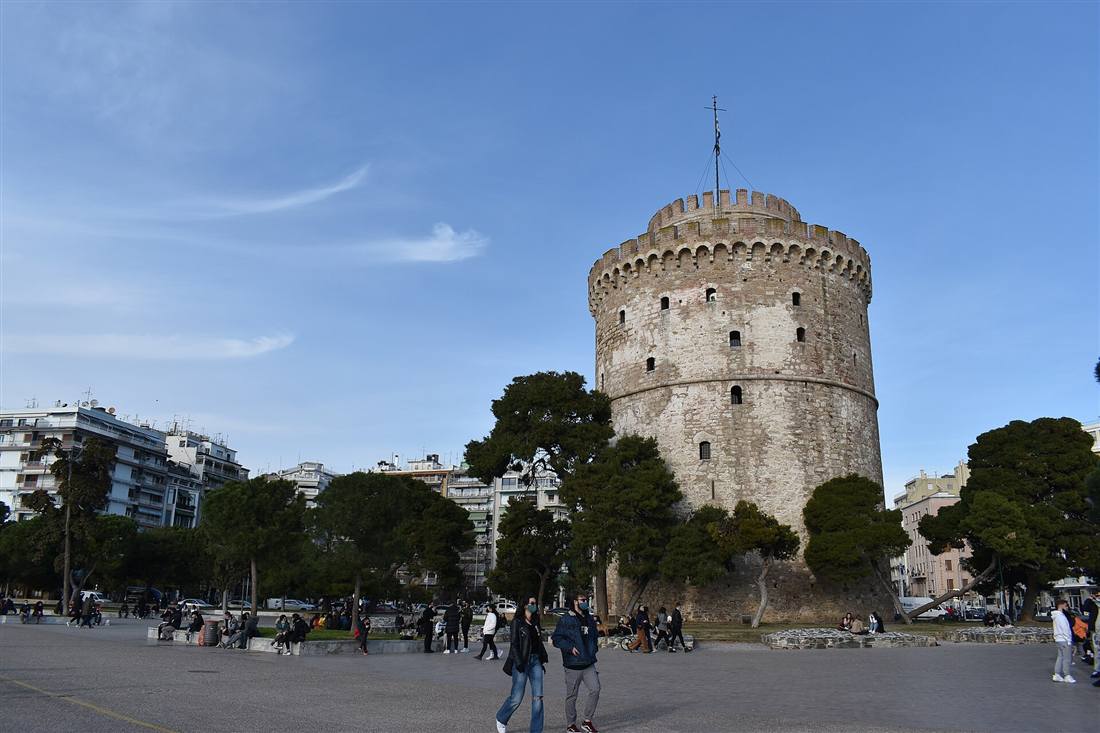
Macedonia tours cover the largest region of Greece: Thessaloniki with its Byzantine churches and its markets, the royal tombs of Vergina, the pebble mosaics of Pella where Alexander was born, the sanctuary at Dion under Mount Olympus, the three legs of Halkidiki with the Athos cruise, Kavala and Roman Philippi in the east, and the lakes of Kastoria and the Prespes in the west. Plan the rest of the trip with Greece Tours.
This page covers the Macedonia tours you can book from Thessaloniki, what each part of the region holds, the sites, museums and monasteries, the beaches and the mountains, the food and the wine, the history from Philip II to 1912, and how the roads, the seasons and the ski centres shape the route.
What do Macedonia tours cover?
Macedonia tours cover Thessaloniki and its Byzantine churches, the royal tombs of Vergina, the mosaics of Pella, the sanctuary at Dion under Mount Olympus, the three legs of Halkidiki, Mount Athos from the sea, Kavala and Philippi, and the lakes of Kastoria and Prespes.
Greek Macedonia is the largest region of the country, running from the Pindus and the Albanian border to the Nestos and from Olympus to the Bulgarian mountains. It is divided into three administrative regions, Western, Central and Eastern Macedonia and Thrace, and holds Thessaloniki, the second city of Greece with about a million people in its urban area. Macedonia tours cross it from Kastoria to the Nestos.
It is also where Greek history turns north. Philip II built the kingdom from Aigai and Pella, Alexander carried it to India, Rome laid the Via Egnatia across it, Byzantium made Thessaloniki its second city, and Paul preached at Philippi and Thessalonica. Four of its sites are on the UNESCO World Heritage list.
Which formats do Macedonia tours take?
- City tours of Thessaloniki, on foot, by e-bike or on the hop-on hop-off bus.
- Day trips from Thessaloniki to Vergina, Pella, Dion, Meteora, Edessa and the Prespes.
- Halkidiki days to the Kassandra and Sithonia beaches and the Blue Lagoon at Ammouliani.
- Mount Athos cruises along the monastery coast from Ouranoupoli or Ormos Panagias.
- Mountain trips: the two-day climb of Olympus from Litochoro and the ski centres inland.
- Kavala and Philippi tours in the east, with the old town, the aqueduct and the Roman city.
Our pages on Thessaloniki, Halkidiki tours and Mount Olympus tours cover parts of the region in detail, and Greece Tours sets out the rest of the country.
Which regional units make up Greek Macedonia?
Greek Macedonia holds thirteen regional units across three administrative regions: Thessaloniki, Chalkidiki, Imathia, Pella, Pieria, Kilkis and Serres in the centre, Kozani, Kastoria, Florina and Grevena in the west, and Kavala and Drama in the east.
The centre is the busiest. Thessaloniki sits at the head of the Thermaic Gulf with Halkidiki’s three peninsulas south-east of it, the Pieria coast and Olympus to the south, and the plains of Imathia and Pella to the west where the Macedonian kings had their capitals. Macedonia tours base themselves there.
The west is mountain country: Kastoria on its lake, the Prespes on the Albanian and North Macedonian border, Florina and Nymfaio in the beech forest, Grevena under the Pindus, and Kozani in the middle with the country’s lignite basin. The east runs from the Strymon to the Nestos, with Kavala on the sea and Drama and Serres inland.
- Thessaloniki – the city, its Byzantine walls and churches, and the gulf.
- Chalkidiki – Kassandra, Sithonia and the monastic peninsula of Athos.
- Imathia and Pella – Vergina, Veria, Pella, Edessa and the Naoussa vineyards.
- Pieria – Mount Olympus, Dion and the coast at Platamonas and Paralia.
- Kastoria, Florina and the Prespes – the lakes, the Byzantine churches and the bears.
- Kavala, Drama and Serres – Philippi, the old town of Kavala, Lake Kerkini and the Nestos.
Distances are longer here than in the south: Thessaloniki to Kastoria runs 220 km, to Kavala 160 km and to Vergina 75 km. Macedonia tours work from Thessaloniki for the centre and change base for the west or the east.
Which Macedonia tours leave Thessaloniki?
Macedonia tours from Thessaloniki run the city walking and e-bike tours, the hop-on hop-off bus, day trips to Vergina, Pella and Dion, the Halkidiki beach days, the Athos cruise, Meteora in a long day, and the Edessa, Naoussa and Prespes routes.
The city is the base for the whole northern half of the country. “Thessaloniki: Hop-On Hop-Off Sightseeing Bus Tour” and “Thessaloniki E-Bike Tour” cover the centre and the waterfront; food tours work the Modiano and Kapani markets; and the Ano Poli walk takes the walls and the Byzantine churches. Macedonia tours start from its waterfront.
Day trips fan out from there. Vergina and Veria lie 75 km west, Pella 40 km, Dion 85 km south under Olympus, and Meteora about 230 km south-west. “From Thessaloniki: Halkidiki Kassandra Beaches Private Tour” runs to the first leg of the peninsula, and the Athos cruises leave from Ouranoupoli, two hours away.
- Vergina – the royal tombs, 75 km west, half a day with Veria.
- Pella – the mosaics and the museum, 40 km west, two hours on site.
- Dion – the Macedonian sanctuary under Olympus, 85 km south.
- Halkidiki – Kassandra and Sithonia beaches, 70 to 120 km south-east.
- Mount Athos cruise – from Ouranoupoli, with the monasteries seen from the water.
- Edessa and Naoussa – the waterfalls and the Xinomavro vineyards, 90 km west.
Our pages on the Vergina day trip, the Pella day trip and the Mount Athos cruise cover the commonest days out.
What do Macedonia tours see in Thessaloniki?
Macedonia tours in Thessaloniki see the White Tower on the waterfront, the Rotunda and the Arch of Galerius, the Roman forum, the Byzantine churches on the UNESCO list, the Ano Poli quarter inside the walls and the Archaeological and Byzantine museums.
The city was founded in 315 BC by Cassander and named for his wife, Alexander’s half-sister. It became the capital of Roman Macedonia, the second city of Byzantium after Constantinople, a major Ottoman town and, after 1912, the northern capital of Greece. The great fire of 1917 cleared its centre, and the plan that replaced it gave the city Aristotelous Square and its axis to the sea. Macedonia tours walk that sequence in one morning.
The modern city runs on trade and students. Its port is the second of Greece and the outlet for the Balkans, the Aristotle University is the largest in the country with about 70,000 students, and the waterfront promenade runs 5 km from the White Tower to the concert hall. The metro opened in 2024 and crosses the centre under the Roman and Byzantine layers that delayed it for twenty years.
Fifteen Palaeochristian and Byzantine monuments were inscribed by UNESCO in 1988. Agios Dimitrios, the basilica of the city’s patron, holds mosaics of the 7th century and the crypt where he was killed. The Rotunda, built about 306 as a mausoleum or temple, became a church and then a mosque and keeps its dome mosaics. Osios David, Agia Sofia, Panagia Chalkeon and Agios Nikolaos Orfanos carry the rest. Macedonia tours take three or four of them on foot.
- White Tower – the 15th-century tower on the waterfront, with the city museum inside.
- Rotunda and Arch of Galerius – the Roman imperial complex of about 300 AD.
- Agios Dimitrios – the basilica and crypt of the city’s patron saint.
- Ano Poli – the upper town inside the walls, with Ottoman houses and the Trigoniou tower.
- Archaeological Museum – the gold of Macedonia, with the Derveni krater.
- Museum of Byzantine Culture – the mosaics, icons and frescoes of the Byzantine city.
The Derveni krater, a bronze wine vessel of the 4th century BC worked in high relief, is the single object to see in the archaeological museum. Our page on things to do in Thessaloniki covers the city day by day.
What do Macedonia tours see at Vergina?
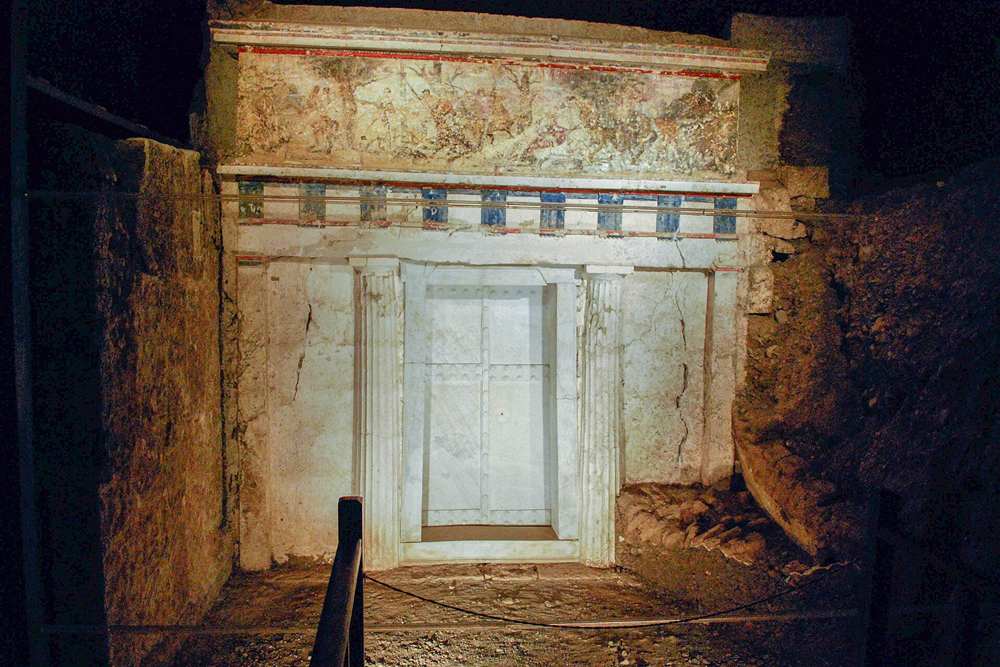
Macedonia tours at Vergina see the royal tombs of Aigai under their earth mound, among them the unlooted tomb identified as that of Philip II, with its gold larnax, its painted facade and its grave goods shown in the museum built inside the tumulus. UNESCO inscribed the site in 1996.
Aigai was the first capital of the Macedonian kingdom and the burial place of its kings. Manolis Andronikos excavated the Great Tumulus in 1977 and found two undisturbed tombs behind their marble doors: the larger with a gold larnax holding cremated bones and a gold wreath, a painted hunt frieze across the facade, weapons, armour and silver vessels. Macedonia tours give the tombs a morning.
The museum is the tumulus itself. Visitors walk into the mound in low light, see the tomb facades in position and the finds in cases around them: the larnax with the sixteen-ray star, the gold wreath of oak leaves, the iron and gold cuirass, the ivory portrait heads and the silver drinking set. Macedonia tours book the entry in advance in summer.
Above the site the palace of Aigai, the largest building of classical Greece at about 12,500 square metres, reopened in 2024 after sixteen years of restoration, with its mosaic floors and its colonnaded court. The theatre beside it is where Philip II was assassinated in 336 BC, at his daughter’s wedding, and where Alexander was proclaimed king.
Vergina lies 75 km west of Thessaloniki and 12 km from Veria. Macedonia tours give the museum ninety minutes and add the palace and Veria in the same day. Our page on the Vergina day trip covers the visit.
What do Macedonia tours see at Pella and Dion?
Macedonia tours at Pella see the pebble mosaics of the 4th century BC, among them the lion hunt and Dionysos on a panther, in the city where Alexander was born, and at Dion the sanctuary of Zeus under Mount Olympus with its baths, theatres and villa mosaics.
Pella replaced Aigai as the Macedonian capital about 400 BC and grew into the largest city in Greece of its time, laid out on a grid with a palace on the hill and a harbour on a lagoon that has since silted up. Philip II ruled from it and Alexander was born there in 356 BC. Macedonia tours reach it 40 km west of Thessaloniki.
Its mosaics are made of natural river pebbles set in lead strips, not cut tesserae, and they are the finest of their kind: the stag hunt signed by Gnosis, the lion hunt of two young men, the abduction of Helen, Dionysos riding a panther. Some stay in the houses under shelters and the rest are in the museum beside the site, which opened in 2009. Macedonia tours see them in the houses and in the museum.
Dion lies 85 km south, at the foot of Olympus on the Pieria plain, where the Macedonian kings held their festival to Zeus before campaigns. Alexander sacrificed here before crossing into Asia. The site keeps the sanctuaries of Demeter, Isis and Zeus Hypsistos in wet ground with water running through them, two theatres, Roman baths and the villa of Dionysos with its mosaic.
- Pella mosaics – pebble floors of the late 4th century BC, in situ and in the museum.
- Pella museum – the finds of the capital, from the palace and the agora.
- Dion sanctuary – the temples of Zeus, Demeter and Isis in the springs under Olympus.
- Dion theatres – the Hellenistic and Roman theatres, used again in summer.
- Villa of Dionysos – the Roman house with its mosaic of the god in a chariot.
- Dion museum – the statues, the water organ and the finds of the sanctuary.
Our pages on the Pella day trip and the Dion archaeological park cover both sites.
What do Macedonia tours do on Mount Olympus?
Macedonia tours on Olympus climb from Litochoro to the refuges at 2,100 m and the summit of Mytikas at 2,917 m, the highest point in Greece, walk the Enipeas gorge to the monastery of Agios Dionysios, and visit the sanctuary of Dion on the plain below.
Olympus is a block of limestone rising straight out of the coastal plain, so the climb is long: from Prionia at 1,100 m the path reaches the Spilios Agapitos refuge in three hours and Mytikas in another three, with a scramble on the final ridge. Most walkers take two days and sleep at a refuge, which is the format of the guided trips from Litochoro. Macedonia tours allow two days for the summit.
The mountain has 52 peaks. Mytikas at 2,917 m is the highest, with Skolio at 2,911 m, Stefani, the Throne of Zeus, at 2,909 m, and the Plateau of the Muses between them. The gods lived on the summit in myth, the Macedonians held their festival to Zeus at Dion below it, and the whole massif became the first Greek national park in 1938. Macedonia tours climb with a guide above the refuges.
Lower routes work without a summit. The Enipeas gorge runs from Litochoro to Prionia in four hours, past pools, bridges and the old monastery of Agios Dionysios, rebuilt after the Germans blew it up in 1943. The Orlias gorge on the north side carries waterfalls, and the coast at Plaka and Gritsa lies twenty minutes from the trailhead.
Macedonia tours book the summit trip with a guide because of the scramble and the weather. Our page on Mount Olympus tours covers the routes and the refuges.
What do Macedonia tours see in Halkidiki?
Macedonia tours in Halkidiki see the beaches of Kassandra and Sithonia, the Blue Lagoon at Ammouliani, the cave of Petralona, ancient Stagira where Aristotle was born, Ouranoupoli at the gate of Athos and the Toroneos and Singitikos gulfs between the legs.
Halkidiki hangs from the mainland in three peninsulas. Kassandra, the western leg, is the developed one, with resorts, beach bars and the sand at Kallithea, Sani and Possidi. Sithonia, in the middle, is greener and rockier, with pine to the water at Vourvourou, Kalogria and Kavourotypes. Athos, the eastern leg, is the monastic republic, closed to casual visitors. Macedonia tours take one leg at a time.
The cruises work the water between them. “Chalkidiki Blue Lagoon Ammouliani Island Cruise with Lunch” and the Blue Lagoon day boats run from Ormos Panagias and Ouranoupoli to the sandbars off Ammouliani, where the water turns pale over white sand, and continue along the Athos coast. Macedonia tours book them from Ormos Panagias or Ouranoupoli.
- Kassandra – Kallithea, Sani, Possidi and Afytos, with the longest sand beaches.
- Sithonia – Vourvourou, Kalogria, Kavourotypes and the Karydi beach pines.
- Ammouliani and the Blue Lagoon – the island and sandbars off the third leg.
- Petralona cave – stalactites and the hominin skull found in 1960.
- Ancient Stagira – the birthplace of Aristotle on a headland above the sea.
- Ouranoupoli – the Byzantine tower and the port for the Athos boats.
Our page on Halkidiki tours covers the three legs, and Kassandra covers the first of them.
What do Macedonia tours see of Mount Athos?
Macedonia tours see Mount Athos from the sea. Cruises from Ouranoupoli and Ormos Panagias sail 500 m off the monastery coast, passing Simonopetra, Dionysiou, Agiou Pavlou and Grigoriou under the 2,033 m peak. Only men with a permit may land.
The monastic republic covers the eastern leg of Halkidiki, 335 square kilometres, and is self-governing under Greek sovereignty and the spiritual authority of the Patriarch of Constantinople. Twenty monasteries hold it, with sketes and cells between them, and about 2,000 monks live there. The avaton, the rule that bars women, has stood since the 11th century. Macedonia tours see it from the water.
From the water the monasteries read as fortresses: Simonopetra on its 300 m rock, Dionysiou on a cliff above the sea, Agiou Pavlou under the mountain, Docheiariou and Xenophontos on the western shore. The boats keep the legal distance and use loudspeakers or a guide to name them.
Male pilgrims with a diamonitirion, the permit issued in Thessaloniki or Ouranoupoli, cross by ferry to Daphni and travel on by road or boat. The permit takes time to arrange, allows a set number of nights, and is separate from the cruise.
Macedonia tours therefore sell Athos in two forms: the half-day cruise for everybody, and the pilgrimage for men who plan it in advance. Our page on the Mount Athos cruise covers the boats.
What do Macedonia tours see at Kavala and Philippi?
Macedonia tours at Kavala see the Panagia old town under its Byzantine castle, the Kamares aqueduct of the 16th century, the Imaret and the tobacco warehouses, and 15 km inland the Roman city of Philippi, on the UNESCO list since 2016.
Kavala climbs an amphitheatre of hills above a working harbour. The Panagia quarter keeps its Ottoman houses and the Imaret, a huge charitable complex built by Mehmet Ali, who was born in the town in 1769 and became the ruler of Egypt; his house and equestrian statue stand at the top of the quarter. The Kamares aqueduct strides across the neck of the peninsula on two tiers of arches. Macedonia tours walk the quarter in an hour.
The east ends at the Nestos. The river comes out of the Rhodope in a gorge that carries a walking path and a rafting stretch, spreads into a delta of reeds and lagoons on the coast, and marks the boundary with Thrace. Keramoti, on the delta, runs the 25-minute ferry to Thasos, which puts the island within an hour of Philippi.
Philippi was founded by Philip II in 356 BC on a site the Thasians had held for its gold. The Roman colony that followed sat on the Via Egnatia, and the battle of 42 BC, in which Antony and Octavian beat Brutus and Cassius, was fought on the plain beside it. Paul preached here in about 49 AD and baptised Lydia in the river, the first recorded Christian congregation in Europe. Macedonia tours take the site and Kavala in one day.
- Philippi theatre – built by Philip II and enlarged by Rome, still used in summer.
- Basilicas A and B – the great early Christian churches on the forum.
- The forum and the Via Egnatia – the Roman road crossing the site.
- Baptistery of Lydia – the modern church and the river site outside the walls.
- Kavala old town – the castle, the Imaret and the Mehmet Ali house.
- Tobacco Museum – the trade that built the modern city.
Our pages on things to do in Kavala and the Philippi day trip cover the eastern end of the region.
What do Macedonia tours see in the west, at Kastoria and the Prespes?
Macedonia tours in the west see Kastoria on its lake with 70 Byzantine churches and its fur trade, the two Prespa lakes on the triple border with their island church and pelicans, Nymfaio in the beech forest with its bear sanctuary, and Florina on the Sakoulevas river.
Kastoria stands on a peninsula in Lake Orestiada at 630 m, ringed by water on three sides. Its mansions, the archontika, were built by fur merchants in the 17th and 18th centuries with painted rooms and overhanging upper floors, and the trade in fur scraps still runs the town’s economy. Its churches, small, brick-patterned and frescoed, run from the 10th century onwards; the Panagia Koumbelidiki with its tall drum is the emblem. Macedonia tours reach it in two and a half hours from Thessaloniki.
The Prespes lie 60 km north-west on the border with Albania and North Macedonia. Great Prespa is shared by three countries, Little Prespa is mostly Greek, and the wetland between them holds the largest breeding colony of Dalmatian pelicans in the world. The island church of Agios Achilleios stands in the shallow water, reached by a floating bridge. Macedonia tours run the lakes as a long day.
- Kastoria – the lake, the Byzantine churches, the fur mansions and the Dragon’s Cave.
- Prespa lakes – pelicans, the island basilica of Agios Achilleios and the border villages.
- Nymfaio – the stone village at 1,350 m with the Arcturos bear and wolf sanctuary.
- Florina – the river houses, the peppers and the road to the Pisoderi ski centre.
- Kaimaktsalan – the ski centre at 2,480 m on the Voras range.
- Grevena and the Pindus – mushrooms, stone bridges and the Valia Calda park.
The west is the coldest part of Greece, with snow from December to March and temperatures that drop below minus ten. Our pages on Kastoria tours and the Prespes day trip cover the lakes.
What do Macedonia tours see at Edessa, Naoussa and Veria?
Macedonia tours at Edessa see the waterfalls that drop 70 m through the town, at Naoussa the Xinomavro vineyards and the park of Agios Nikolaos, and at Veria the Jewish quarter of Barbouta, the Byzantine churches and the Bema of Saint Paul.
Edessa is the city of waters. The Voda river splits into channels through the old town and falls off the edge of the plateau in a series of falls, the largest of them 70 m, with a path behind the curtain and a cave at the bottom. The Varosi quarter above keeps the Ottoman-era houses, and the ancient city of Edessa lies on the plain below. Macedonia tours stop at the falls for an hour.
Naoussa, 20 km south, is the wine town. Xinomavro grows on the slopes of Vermio at 150 to 400 m and makes the tannic red that carries the Naoussa appellation, aged in oak for years; a dozen estates take visitors. The town’s park at Agios Nikolaos runs along the river under plane trees, and its carnival, the Boules, is among the oldest in Greece. Macedonia tours book the cellars in advance.
Veria, 20 km further, holds the Bema of Saint Paul, the marble platform where he preached in 50 AD, the Barbouta quarter of the Jewish community beside the river, more than fifty Byzantine churches, and the old market street. Vergina lies 12 km beyond it.
Our pages on the Edessa waterfalls, the Naoussa wine day and the Veria day trip cover the three towns.
Which beaches do Macedonia tours reach?
Macedonia tours reach the Kassandra beaches at Kallithea, Sani and Possidi, the Sithonia coves at Kalogria, Kavourotypes and Karydi, the sandbars off Ammouliani, the Pieria coast at Plaka and Platamonas, and the Kavala shore at Ammolofoi and Batis.
Halkidiki carries the swimming. Kassandra has the long sand and the beach bars, Sithonia the clear coves between pine and rock, and the gulfs between the legs stay calm in the meltemi. The peninsula holds more Blue Flag beaches than any other part of the mainland. Macedonia tours split the week between coast and sites.
- Kassandra – Kallithea, Sani, Possidi, Chaniotis and Pefkochori.
- Sithonia – Kalogria, Kavourotypes, Karydi, Lagomandra and Armenistis.
- Ammouliani – Alykes and the Blue Lagoon sandbars off the third leg.
- Pieria – Plaka, Gritsa and Platamonas under Olympus.
- Kavala – Ammolofoi, Batis and the Nestos delta beaches to the east.
- Thessaloniki – Epanomi and Nea Michaniona, the city’s nearest sand.
The season runs from June to September, with the water warmest in August and the crowds heaviest in the first fortnight of that month. Macedonia tours use Halkidiki as the beach half of a trip whose other half is archaeological.
Which outdoor tours run in Macedonia?
Outdoor Macedonia tours climb Mount Olympus from Litochoro, ski at Kaimaktsalan, Seli, Pisoderi and Vasilitsa, raft the Aoos and the Nestos, watch pelicans on the Prespes and bears at Nymfaio, and walk the Nestos gorge and the Valia Calda.
The region carries the highest mountains and the coldest winters in Greece, so the outdoor season runs the other way from the islands. Kaimaktsalan reaches 2,480 m and is the highest ski centre in the country; Seli above Naoussa is the oldest, opened in 1934; Pisoderi and Vasilitsa serve the far west. Macedonia tours run outdoors through the winter.
- Olympus – the two-day climb to Mytikas at 2,917 m from Litochoro.
- Skiing – Kaimaktsalan, Seli, Pisoderi, Vasilitsa and Elatochori.
- Nestos gorge – the old rail path and the rafting stretch above Paranesti.
- Prespes – pelican and cormorant colonies, walked and paddled in spring.
- Nymfaio – the Arcturos sanctuary for brown bears and wolves.
- Lake Kerkini – the wetland below the Belles mountains, with buffalo and 300 bird species.
Brown bears, wolves and wild boar live in the Pindus and Voras ranges, and the northern border is the main corridor for large mammals in the country. Macedonia tours with a naturalist take the Prespes and Kerkini in the same week.
What do Macedonia tours eat and drink?
Macedonia tours eat bougatsa and koulouri in Thessaloniki, gyros and soutzoukakia from the refugee kitchens of 1922, Halkidiki green olives, Florina red peppers and mushrooms from Grevena, and drink Xinomavro from Naoussa and Amyndeon with tsipouro from the villages.
Thessaloniki is the food city of Greece. Its cooking came in two waves: the Ottoman city’s own kitchen and the refugees of 1922 from Asia Minor and Pontus, who brought soutzoukakia, spiced sausages, peinirli and the sweets. Bougatsa, semolina cream in filo dusted with sugar, is the city breakfast, and the Modiano and Kapani markets are the working middle of it. Macedonia tours eat their way through the markets.
- Bougatsa – cream, cheese or mince in filo, eaten hot in the morning.
- Soutzoukakia – cumin meatballs in tomato, from the Smyrna kitchen.
- Halkidiki olives – the large green olive with its own protected designation.
- Florina peppers – the long red peppers roasted and preserved in oil.
- Xinomavro – the red of Naoussa, Amyndeon and Goumenissa, aged in oak.
- Tsipouro and ouzo – distilled across the region and drunk with meze.
Naoussa, Amyndeon, Goumenissa and Epanomi are the wine districts; the first three grow Xinomavro and the Vergina plain grows table grapes and peaches. Our page on the Thessaloniki food tour covers the markets and the bougatsa shops.
What history do Macedonia tours tell?
Macedonia tours tell of Philip II at Aigai and Pella, Alexander’s departure for Asia from Dion, the Roman Via Egnatia, Byzantine Thessaloniki, the Ottoman centuries, the liberation of 1912, the Jewish community destroyed in 1943 and the refugees of 1922.
The kingdom rose under Philip II, who took the throne in 359 BC, reorganised the army and brought the Greek cities under his control at Chaeronea in 338 BC. He was killed in the theatre at Aigai in 336 BC; his son Alexander sacrificed at Dion and crossed into Asia in 334 BC, and by his death in 323 BC the Macedonian kingdom reached the Indus. Macedonia tours follow that line from Aigai to Pella.
Rome ended it at Pydna in 168 BC and laid the Via Egnatia from Dyrrachium to Byzantium across the region, through Thessaloniki and Philippi. Paul followed that road in the 40s and 50s AD. Thessaloniki became the second city of Byzantium, was sacked by Saracens in 904 and by Normans in 1185, and fell to the Ottomans in 1430. Macedonia tours cross the Via Egnatia at Philippi.
Under the Ottomans the city took in Sephardic Jews expelled from Spain in 1492, and by the 19th century they were the largest community in it. Greece took Thessaloniki on 26 October 1912. The fire of 1917 destroyed the centre, the exchange of populations in 1922 brought 100,000 refugees, and in 1943 the Germans deported about 46,000 Jews, of whom few returned. Macedonia tours read that history in the Jewish Museum.
Macedonia tours read that sequence in a single street: a Roman arch, a Byzantine church, an Ottoman bath, a 1920s refugee quarter and the Jewish museum. Our page on the history of Thessaloniki covers the city’s part of it.
How do visitors reach Macedonia, and when do the tours run?
Visitors reach Macedonia through Thessaloniki airport, 15 km from the city, by train from Athens in about four hours, and by road on the E75 and the Egnatia Odos. The tours run through the year, with the coast in summer, the sites in spring and autumn and the ski centres in winter.
Thessaloniki is the hub. Its airport takes flights from across Europe, the Egnatia Odos motorway runs east to Kavala and west to Ioannina, and the E75 runs south to Athens in about five hours by road or four by train. Kavala has its own airport at Chrysoupoli, which also serves Thasos. Macedonia tours start and end there.
- Athens to Thessaloniki – about four hours by train, five by road, an hour by air.
- Thessaloniki to Vergina – 75 km west, about an hour.
- Thessaloniki to Halkidiki – 70 to 120 km, one to two hours.
- Thessaloniki to Kavala – 160 km east on the Egnatia, about two hours.
- Thessaloniki to Kastoria – 220 km west, about two and a half hours.
- Thessaloniki to Meteora – about two and a half hours south-west.
Spring and autumn suit the sites and the mountains, summer the Halkidiki coast, and winter the ski centres and the city. Macedonia tours base themselves in Thessaloniki for the centre and east, and change to Kastoria or Florina for the west. Two nights in the city, two in Halkidiki and two in the west covers the region in a week.
Which villages and mountain towns do Macedonia tours reach?
Macedonia tours reach Nymfaio in the beech forest at 1,350 m, Arnaia in the Halkidiki hills, Afytos above the Kassandra coast, Old Panteleimonas under Olympus, Palaios Agios Athanasios below Kaimaktsalan and Vlasti on the Kozani plateau.
The stone villages sit above the plains, and most were rebuilt after the wars or restored as heritage settlements. Nymfaio, founded by Vlach shepherds and rich on goldsmithing in the 19th century, keeps cobbled lanes, a mansion school and the Arcturos sanctuary for brown bears and wolves on its edge. Macedonia tours reach them on the mountain roads.
Old Panteleimonas hangs on a spur under the Platamonas castle with a plane-tree square and a view down the Pieria coast; it was abandoned in the 1960s and repopulated by the families who restored it. Palaios Agios Athanasios, on the road to the Kaimaktsalan ski centre, does the same job in winter, with stone guesthouses and tavernas at 1,200 m.
- Nymfaio – beech forest at 1,350 m, goldsmiths’ mansions and the bear sanctuary.
- Arnaia – the Halkidiki hill town of wooden balconies and weaving.
- Afytos – stone houses above the Kassandra beaches, with the Toroneos gulf below.
- Old Panteleimonas – the restored village under the castle of Platamonas.
- Palaios Agios Athanasios – the winter village under Kaimaktsalan, above Edessa.
- Vlasti and Siatista – the Kozani plateau towns of fur merchants and stone mansions.
The villages work in the opposite season to the coast, filling from December to March and emptying in August. Macedonia tours use them as bases for the ski centres and the mountain roads, and each keeps its own tavernas open through the winter.
Which museums do Macedonia tours visit?
Macedonia tours visit the Archaeological Museum of Thessaloniki with the Derveni krater, the Museum of Byzantine Culture, the tumulus museum at Vergina, the Pella and Dion museums, the Jewish Museum of Thessaloniki and the tobacco and archaeological museums of Kavala.
The Thessaloniki Archaeological Museum holds the gold of the Macedonian kingdom: wreaths of oak and myrtle leaves, grave goods from Sindos and Derveni, and the bronze krater of the 4th century BC worked with Dionysos and Ariadne in relief, found in a tomb at Derveni with cremated bones inside it. Macedonia tours give it ninety minutes.
The Museum of Byzantine Culture beside it covers the centuries the city’s churches belong to, with mosaics lifted from ruined buildings, icons, textiles and the tomb paintings of the early Christian cemeteries. It won the Council of Europe museum prize in 2005.
- Archaeological Museum of Thessaloniki – the Derveni krater, the gold wreaths and the Sindos finds.
- Museum of Byzantine Culture – mosaics, icons and frescoes from the city’s churches.
- Vergina tumulus museum – the royal tombs in position with the larnax and the armour.
- Pella museum – the mosaics and the finds of the Macedonian capital.
- Dion museum – the statues and the water organ of the sanctuary.
- Jewish Museum of Thessaloniki – the Sephardic city and its destruction in 1943.
Kavala adds the archaeological museum on the waterfront and the Tobacco Museum in a former warehouse. Macedonia tours pair each museum with the site it belongs to, since Vergina, Pella and Dion keep their finds beside their ruins.
Which castles and towers do Macedonia tours visit?
Macedonia tours visit the Byzantine walls and the Heptapyrgion of Thessaloniki, the castle of Platamonas above the Olympus coast, the Ouranoupoli tower at the gate of Athos, the Kavala citadel over the old town and the castle of Servia in the Aliakmon valley.
Thessaloniki keeps the longest circuit. Its walls run from the sea up to the Heptapyrgion, the seven-towered fort at the top of Ano Poli that served as a prison into the 1980s, with the Trigoniou tower on the eastern side giving the standard view over the roofs to the gulf. Macedonia tours end the Ano Poli walk there.
Platamonas stands on a hill above the motorway where the coast narrows under Olympus, a Crusader castle of the 13th century on a Byzantine site, with a keep 16 m high and a summer concert season. Ouranoupoli’s tower, built in the 14th century as a dependency of the Athonite monastery of Vatopedi, marks the border of the monastic republic.
- Thessaloniki walls and Heptapyrgion – the Byzantine circuit above Ano Poli.
- Platamonas – the Crusader castle on the Pieria coast under Olympus.
- Ouranoupoli tower – the Athonite tower at the entrance to the third leg.
- Kavala citadel – the fortress over the Panagia quarter, with the harbour below.
- Servia and Rentina – the Byzantine forts guarding the Aliakmon and Strymon passes.
- Petra and Kastoria walls – the mountain and lake defences of the west.
The castles mark the roads rather than the towns: the Via Egnatia, the Olympus coast and the Strymon crossing. Macedonia tours take Platamonas on the way south and the Heptapyrgion at the end of the Ano Poli walk.
Which festivals do Macedonia tours meet?
Macedonia tours meet the Thessaloniki International Film Festival in November, the Dimitria in October, the Ragoutsaria of Kastoria in the first week of January, the Boules carnival of Naoussa before Lent and the Anastenaria fire-walking in the Serres villages in May.
Thessaloniki runs the country’s main cultural calendar outside Athens. The film festival, founded in 1960, fills the port warehouses for ten days each November; the Dimitria, named for the city’s patron saint, run through October with concerts and theatre; and the summer festival uses the Roman forum and the Heptapyrgion. Macedonia tours in those weeks book early.
The village festivals are older. The Ragoutsaria of Kastoria, from 6 to 8 January, brings masked bands through the streets with brass and drums, a midwinter rite that predates the Christian calendar. Naoussa’s Boules, in the weeks before Lent, sends masked dancers in wax faces and white kilts through the town in pairs.
- Thessaloniki Film Festival – November, in the port warehouses.
- Dimitria – October, concerts and theatre across the city.
- Ragoutsaria, Kastoria – 6 to 8 January, masked bands and brass.
- Boules, Naoussa – the pre-Lenten carnival with wax masks.
- Anastenaria – 21 May, fire-walking in Agia Eleni and the Serres villages.
- Feast of Agios Dimitrios – 26 October, the city’s patron and the date of its liberation in 1912.
The Anastenaria, in which participants dance on embers holding icons of Saints Constantine and Helen, came with refugees from eastern Thrace in 1922 and is kept in four villages. Macedonia tours in those weeks book the rooms early, because the towns fill.
Frequently Asked Questions
What is Greek Macedonia?
The largest region of Greece, running from the Pindus to the Nestos and from Olympus to the northern border. It is divided into thirteen regional units across three administrative regions, with Thessaloniki as its capital.
How long do Macedonia tours take?
A day for Thessaloniki, a day for Vergina and Veria, a day for Halkidiki or the Athos cruise, and a week for the region with two nights in the city, two in Halkidiki and two in the west.
What is at Vergina?
The royal tombs of Aigai under their earth mound, among them the unlooted tomb identified as that of Philip II, with a gold larnax, a painted hunt frieze and armour. UNESCO inscribed the site in 1996.
Where was Alexander the Great born?
At Pella in 356 BC, the Macedonian capital 40 km west of Thessaloniki. The site keeps the pebble mosaics of the late 4th century BC and a museum that opened in 2009.
Can women visit Mount Athos?
No. The avaton has barred women from the monastic peninsula since the 11th century. Cruises from Ouranoupoli and Ormos Panagias sail 500 m off the coast and carry everybody.
How do men visit Mount Athos?
With a diamonitirion, the permit issued in Thessaloniki or Ouranoupoli for a set number of nights, then the ferry from Ouranoupoli to Daphni. It is arranged in advance and is separate from the cruise.
How high is Mount Olympus?
2,917 m at Mytikas, the highest point in Greece. The climb from Prionia takes two days with a night at a refuge, and the massif became the first Greek national park in 1938.
Which are the three legs of Halkidiki?
Kassandra in the west, with the resorts and the long sand; Sithonia in the middle, greener and rockier; and Athos in the east, the monastic republic closed to casual visitors.
What is Philippi?
A city founded by Philip II in 356 BC and rebuilt as a Roman colony on the Via Egnatia, where Paul preached in about 49 AD. It has been on the UNESCO list since 2016.
Which food is Thessaloniki known for?
Bougatsa, semolina cream in filo eaten hot in the morning, soutzoukakia and the other dishes brought by the refugees of 1922, koulouri bread rings and the meze of the Modiano and Kapani markets.
Which wine comes from Macedonia?
Xinomavro, the tannic red of Naoussa, Amyndeon and Goumenissa, aged in oak for years, with tsipouro distilled in the mountain villages beside it.
Can you ski in Macedonia?
Yes. Kaimaktsalan at 2,480 m is the highest ski centre in Greece, Seli above Naoussa the oldest, opened in 1934, and Pisoderi, Vasilitsa and Elatochori serve the west and the Pieria mountains.
Where are the pelicans in Greece?
On the Prespa lakes on the triple border with Albania and North Macedonia, which hold the largest breeding colony of Dalmatian pelicans in the world, and on Lake Kerkini north-east of Thessaloniki.
When is the best time for Macedonia tours?
April to June and September to October for the sites and the mountains, July and August for the Halkidiki coast, and December to March for the ski centres and the city.