
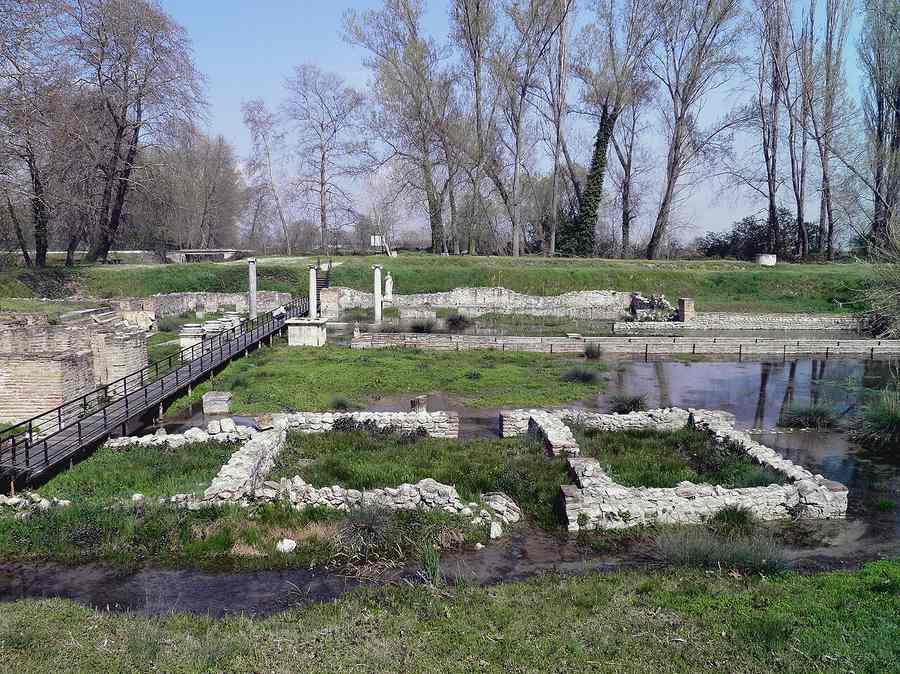
Dion was the sacred city of the ancient Macedonians, the place where their kings worshipped Olympian Zeus at the foot of his mountain. It lies roughly eighty-five kilometres southwest of Thessaloniki, a walled town of temples, theatres, and paved streets set among the springs below Mount Olympus. Here the Macedonian rulers sacrificed before war, and Alexander the Great held games before he marched into Asia. A day among its sanctuaries and its museum reads the religion of a kingdom that changed the ancient world. Reach the sacred plain of the Macedonians with My Greece Tours.
The visit falls into two halves, the open archaeological park with its ruins in the ground and the museum that guards the statues and finds lifted from it. The sections below cover what the park is, why Dion was sacred, the sanctuaries of Zeus and Isis, the Roman city with its theatres and mosaics, the museum and its water-organ, and how to reach the site and pair it with Olympus and the coast. The route from the city runs south along the coast, one of the reward-rich guided Thessaloniki tours that open the wider region.
What is the archaeological park of Dion?
Dion is a walled ancient city at the northern foot of Mount Olympus, set among wetland springs roughly eighty-five kilometres southwest of Thessaloniki, spread across a park of about one hundred and fifty hectares.
The site sits five kilometres from the coast and fifteen kilometres from Katerini, on the low ground where springs rise from the base of Olympus. Water shaped the city and still runs through it, so reeds, poplars, and pools line the excavated streets. The park divides into the walled city and the belt of sanctuaries outside the walls to the south. A traveller walks a grid of paved lanes, past house plots, workshops, and public halls, with the peaks of Olympus filling the western sky. The scale rewards a half-day on foot rather than a quick loop.
The city took its name from Zeus, whom the Greeks called Dios in the possessive, and it grew as the sacred meeting place of the Macedonian kingdom. Kings enlarged its temples, walls, and public buildings from the Archaic age through the Hellenistic and Roman centuries. Excavation has traced a fortified circuit, a colonnaded main street, drainage channels, and blocks of houses and shops. The ruins stand low, rarely above waist or shoulder height, yet the plan reads with unusual clarity because the marsh buried and preserved it.
The archaeological park and the separate museum form two halves of one visit. The open site holds the walls, the streets, the theatres, the baths, and the sanctuaries in their original ground. The museum, half a kilometre west in the modern village, guards the statues, inscriptions, and finds lifted from that ground for safekeeping. Reading them together turns a field of foundations into a living city. This standalone guide pairs with the wider round of day trips from Thessaloniki that reach the sites of Macedonia.
Why was Dion sacred to the ancient Macedonians?
Dion was the chief sanctuary of the Macedonian kingdom, dedicated to Olympian Zeus at the foot of his mountain. Macedonian kings sacrificed here before campaigns, and Alexander the Great held games at Dion before marching into Asia.
Mount Olympus rose above Dion as the home of the gods in Greek belief, which made the plain at its foot the natural seat of their worship. The Macedonians honoured Zeus as the head of that divine household and built his cult around the springs of Dion. The kingdom treated the site as its religious capital, distinct from the royal seats at Aigai and Pella. Panhellenic rites, sacrifices, and athletic and dramatic contests drew people from across Macedonia to the sanctuary each year.
The written record ties the greatest Macedonian rulers to Dion by name. Archelaos, an early king, founded a nine-day festival of games in honour of Zeus and the Muses, with contests in sport and drama. Philip the Second celebrated his victories at the sanctuary. Alexander the Great gathered his army at Dion and offered sacrifice before he crossed into Asia, then vowed monuments here after his first battles. Those acts fixed Dion as the stage where the kingdom asked its gods for success in war.
Alexander commissioned the sculptor Lysippos to cast a bronze group of the companions who fell at the river Granikos, and set the statues at Dion as a war memorial. The Romans later carried that group to Italy as plunder. Worship at the site outlived the kingdom, for the Romans founded a colony at Dion and kept its sanctuaries alive for centuries. The link between the Macedonian throne and this sacred plain places Dion beside the royal tombs at Vergina on any serious tour of the kingdom’s heartland.
What are the sanctuaries of Zeus and Isis at Dion?
Dion holds a belt of sanctuaries south of the walls, among them the great altar and temple of Olympian Zeus, the shrine of Zeus Hypsistos, and the well-preserved sanctuary of Isis built over an older temple of Artemis.
The sanctuary of Olympian Zeus formed the heart of the sacred zone, centred on a large open-air altar where the kingdom made its offerings. Marble statues of the god and of eagles, his sacred bird, once stood in the precinct, and excavators have recovered pieces of them. A second sanctuary honoured Zeus Hypsistos, Zeus the Highest, with a marble eagle and a seated cult statue found on the spot. Together the two precincts anchored the worship of the god who gave the city its name.
The sanctuary of the Egyptian goddess Isis is the best preserved of the group and the most striking to walk. It rose in the Hellenistic and Roman periods over an earlier shrine of Artemis Eileithyia, the goddess of childbirth, so two faiths share one sacred ground. Water fills its precinct to this day, and copies of the cult statues stand in the flooded court where the originals were found. The temple steps, the altars, and the small shrines around the main building survive close to their full plan.
A sanctuary of Demeter, among the oldest at Dion, lies nearby and counts as one of the earliest known cult places in Macedonia. Shrines to Asclepius, the healing god, and to Aphrodite completed the sacred belt. The clustering of temples on the wet ground below Olympus shows how the Macedonians read the landscape as holy. Standing water, springs, and the mountain behind them gave the sanctuaries their setting and their meaning, and the marsh that flooded them in the end also saved their stones.
What can you see in the Roman and Hellenistic city of Dion?
The walled city preserves a Hellenistic theatre and a Roman theatre, the large public baths, a paved Roman road with its drains, the market square, and the villa of Dionysus with its mosaic floors.
The paved Roman road runs straight through the city from the south gate, its stone slabs rutted by cart wheels and flanked by covered drains that still carry the spring water. Colonnades, shopfronts, and public buildings lined this main street. Off it lie the market square, a set of large public baths with their heating channels and statues of the healing gods, and blocks of houses fitted with their own drainage. The grid gives a clear picture of daily life in a Roman provincial town at the foot of Olympus.
Two theatres survive at Dion. The Hellenistic theatre, cut into an earth bank in the Macedonian age, staged the dramatic contests of the festival of Zeus and the Muses. Its curved bank of seating and the pit for the stage machinery can still be traced. The Roman theatre nearby, built later of brick and stone, served the colony under the empire. The pairing lets a visitor read the shift from the Greek to the Roman stage on one site, a rare survival in the north of Greece.
The villa of Dionysus is the finest house uncovered at Dion, a large Roman residence named for the mosaic that paved its banquet hall. That floor shows the god Dionysus riding a chariot drawn by sea creatures, worked in coloured stone. The mosaic now shelters under cover on the site, with the museum holding related finds. The house, its dining room, and its courtyards show the wealth of the Roman colony. The city walls, broad and raised of stone, enclose all of this and mark the circuit the Macedonians first laid out.
What is in the Archaeological Museum of Dion?
The Archaeological Museum of Dion, half a kilometre west in the modern village, holds the finds from the site: statues of the gods, portrait heads, grave stelai, inscriptions, and the hydraulis, the ancient water-organ recovered at Dion.
The museum was built in the late twentieth century to house the growing harvest of finds from the excavation. Its ground floor gathers the sculpture: cult statues of Zeus, Asclepius, and other gods from the sanctuaries, portrait heads of the Roman age, and the copies whose originals still lie in the flooded shrine of Isis. Reliefs, altars, and dedicatory offerings fill out the display. Reading the statues here after walking their empty precincts on the site joins the two halves of the visit into one story.
The prize of the collection is the hydraulis, the water-organ found in the ruins of a building at Dion. This instrument used water pressure to push air through its pipes, and it counts among the earliest keyboard instruments known. Its bronze and pipe remains, reconstructed for display, make Dion a landmark in the history of music. The find draws scholars and musicians to the museum alongside the students of the Macedonian past.
Upstairs and through the galleries, the museum sets out the daily life of the city and its dead. Grave stelai carved with the names and portraits of citizens, funerary altars, coins, pottery, glass, and everyday tools trace the people who lived at Dion across the Greek and Roman centuries. Inscriptions record the laws, the gods, and the festivals of the sanctuary in their own words. The finds here complement the wider holdings of the Archaeological Museum of Thessaloniki, which anchors the Macedonian collections in the city.
How do you get to Dion from Thessaloniki?
Dion lies roughly eighty-five kilometres southwest of Thessaloniki, about an hour and three-quarters by car down the national road. Trains and buses run to Katerini and Litochoro, from where a short local hop or taxi reaches the site.
Driving is the simplest way to reach Dion and the only way to move freely once there. The route follows the main national road south from Thessaloniki along the coast, past Katerini, then turns inland a couple of kilometres to the village and the park. The drive runs about an hour and three-quarters in normal traffic. A rental car makes the day flexible, since it lets a traveller add Litochoro, the Olympus trailheads, or the Pieria beaches to the same loop. Ample free parking waits at the entrance to the archaeological site.
Public transport reaches the region but stops short of the gate. Trains on the main line down the coast call at Katerini and at Litochoro, and intercity buses serve the same towns from Thessaloniki. From Katerini or Litochoro a local bus or a taxi covers the last stretch to Dion, a matter of a couple of kilometres. Travellers without a car should check the current schedules and plan the final connection in advance, since services to the village itself run less often than those to the towns.
A guided day trip removes the logistics and adds the context that loose stones and empty precincts keep quiet. A driver-guide collects travellers in Thessaloniki, handles the drive and the timing, and often pairs Dion with the gorge and viewpoints of Olympus in one full day. Whichever way a traveller arrives, an early start rewards the visit, because the site offers little shade and the summer sun on the open plain grows fierce by midday. The best time to visit Thessaloniki and its region falls in spring and autumn for this reason.
How does Dion pair with Mount Olympus, Litochoro and the Pieria beaches?
Dion sits at the foot of Mount Olympus, ten kilometres from Litochoro and a short drive from the Pieria beaches. Travellers pair the ruins with the Olympus gorge, the town, and the coast in one full day.
Dion and Mount Olympus belong to a single trip, since the sanctuary honours the god whose mountain rises behind it. Litochoro, the gateway town to the peaks, lies about ten kilometres from the site and holds the trailheads for the Enipeas gorge and its monastery. A morning among the ruins and a walk into the lower gorge fill a day well. The mountain itself, the highest in Greece, needs far more time to climb, and the dedicated route up the peaks belongs to the standalone Mount Olympus guide rather than to this page.
The beaches of Pieria stretch along the coast east of Dion, from the sands of Paralia and Olympiaki Akti to the quieter shores near Litochoro. A visit to the ruins pairs cleanly with an afternoon swim, since the sea lies barely five kilometres from the springs of the sacred city. Families in particular find the mix of a short, level ruin walk and a beach afternoon an easy day. The wider round of the region’s Thessaloniki beaches and coastal escapes runs south along this same shore.
A well-built day from Thessaloniki can hold Dion, the Olympus gorge, and a Pieria beach without strain. The order that works best opens at the archaeological park in the cool of the morning, breaks for lunch in Litochoro, and turns to the gorge or the coast in the afternoon. Slotting the sacred city into a broader Thessaloniki itinerary lets a traveller weigh it against the royal Macedonian sites inland and the monasteries to the south. Dion rewards the detour as the one place where the kingdom met its gods.
Frequently Asked Questions
Where is Dion located?
Dion lies at the northern foot of Mount Olympus in the region of Pieria, about eighty-five kilometres southwest of Thessaloniki and five kilometres from the coast. The archaeological park sits beside the modern village of the same name, roughly fifteen kilometres from Katerini. Its position on the springs below the mountain gave the sacred city its setting and shaped the marsh that later buried and preserved its ruins.
How long do you need at Dion?
Plan for at least half a day at Dion to take in both halves of the visit. The archaeological park needs about two hours on foot to cover the sanctuaries, the theatres, the baths, and the villa of Dionysus. The museum in the village asks for another hour to read the statues, the grave stelai, and the water-organ. Travellers who pair Dion with Litochoro or a Pieria beach should set aside a full day from Thessaloniki.
What is the difference between Dion and Mount Olympus?
Dion is the ancient sanctuary city on the plain at the foot of the mountain, while Mount Olympus is the peak itself, the highest in Greece and the mythical home of the gods. The two belong together, since the Macedonians worshipped the Olympian gods at Dion below their mountain. Walking the ruins covers the religion and the history; climbing the peaks is a separate undertaking described on the dedicated Olympus guide.
Can you visit Dion without a car?
Yes, though it takes planning. Trains and intercity buses from Thessaloniki reach Katerini and Litochoro, the two towns nearest the site. From either town a local bus or a taxi covers the final stretch to the archaeological park. Services to the village run less often than those to the towns, so travellers without a car should confirm the current schedules and the last connection before setting out, or join a guided day trip instead.
What is the water-organ of Dion?
The hydraulis of Dion is an ancient water-organ recovered from the ruins of the city and displayed in the Archaeological Museum of Dion. The instrument used water pressure to drive air through a set of pipes, sounded from a keyboard, which makes it one of the earliest keyboard instruments known. Its bronze and pipe remains, reconstructed for the museum, rank the find among the most important in the history of music.
Is Dion worth visiting from Thessaloniki?
Dion rewards the trip for anyone drawn to the Macedonian past, ancient religion, or the setting below Olympus. It is the one place where the kings of Macedonia met their gods, and its sanctuaries, theatres, mosaics, and museum give substance to that story. The site pairs cleanly with Litochoro, the Olympus gorge, and the Pieria beaches, which makes a full and varied day out of a single drive south from the city.