
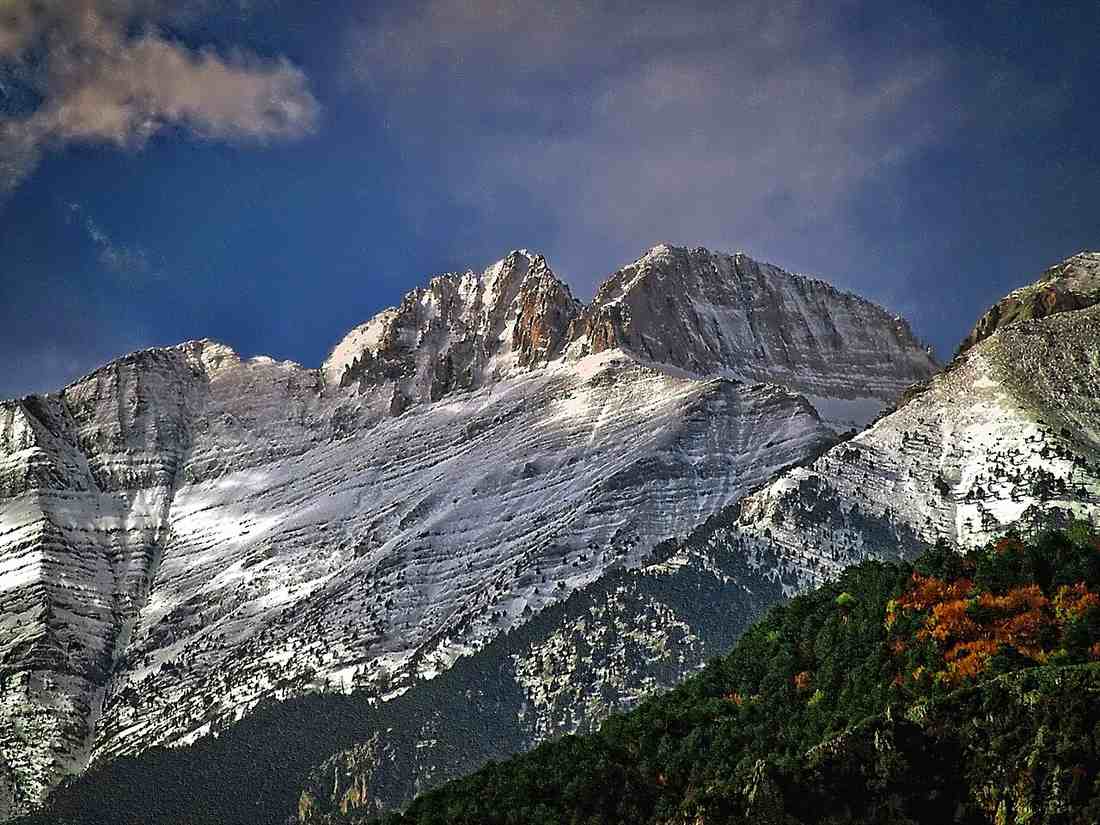
Mount Olympus rises to 2,918 metres on the border of Macedonia and Thessaly, the highest mountain in Greece and the mythical seat of the ancient gods. The peak stands roughly ninety kilometres south of Thessaloniki, close enough for a full-day visit and far enough to fill the day. A day trip pairs the base village of Litochoro and the Enipeas gorge with the archaeological park of Dion at the mountain’s foot. The summit itself demands a scramble and an overnight, yet the lower trails, the gorge, and the ruins reward a single day. Plan the drive, the walk, and the ancient city in one outing with My Greece Tours.
The mountain works best as a loop from the city rather than a race for the top. Its base village, its gorge, and its sanctuary of Zeus each hold a distinct draw for a day-visitor. The sections below cover how to reach the mountain, what to see in Litochoro and the Enipeas gorge, whether the summit is realistic in a day, the ruins of Dion, a workable timetable, and the seasons. The lower half turns to a realistic itinerary and to safety, and the whole outing joins the roster of guided Thessaloniki tours that leave the city each morning.
What is a Mount Olympus day trip from Thessaloniki?
A Mount Olympus day trip from Thessaloniki is a full-day outing to the highest mountain in Greece. It combines the base village of Litochoro, the Enipeas gorge, and the ancient sanctuary of Dion at the mountain’s foot.
The outing centres on the eastern face of Mount Olympus, the side that drops toward the Thermaic Gulf and the town of Litochoro. Litochoro sits at about three hundred metres of altitude, a stone village of red roofs and narrow lanes at the very foot of the range. From its square the peaks rise in a single sweep of grey rock and forest. A day-visitor uses the village as the gateway, then climbs by road or trail toward the gorge and the high trailhead at Prionia.
The mountain is visible from the city itself on a clear morning. From the Thessaloniki waterfront promenade the snow-capped ridge shows across the gulf to the south-west, a pale wall above the sea. That view sets the scale of the trip before it starts. The drive down the coast road or the motorway brings the wall closer until the forested lower slopes fill the windscreen above Litochoro.
A single day covers three distinct experiences rather than one summit push. The gorge walk, the mountain village, and the ruins of Dion each stand on their own, and together they read as a portrait of the massif. The trip ranks among the leading day trips from Thessaloniki, set beside the monasteries of Meteora and the beaches of Halkidiki. It suits travellers who want a mountain and a myth without the commitment of a two-day climb, and it slots into a longer list of things to do in Thessaloniki.
How do you get from Thessaloniki to Mount Olympus?
Litochoro lies roughly ninety kilometres south of Thessaloniki, about an hour by car on the A1 motorway. Trains and intercity buses also serve the area, while organised coach tours run from the city and handle the driving.
A car gives the most freedom for the day. The A1 motorway runs south from Thessaloniki along the coast, and the exit for Litochoro reaches the village in about an hour of driving. From Litochoro a narrow mountain road climbs eighteen kilometres to Prionia, the highest point a vehicle can reach on the eastern side. That road is paved but tight and winding, so the final stretch takes longer than the distance suggests. Road signs along the A1 mark the exit for Litochoro and Dion, and the toll road keeps a steady pace south past Katerini. Parking sits at Prionia beside the trailhead and the taverna.
Public transport reaches the foot of the mountain without a car. Litochoro has a station on the main Athens–Thessaloniki railway, though it sits below the village near the coast, so a short taxi or bus links it to the square. Intercity buses also run to Litochoro through the hub at Katerini. From the village, transport up to Prionia is limited, which makes the gorge trail the natural way onward for those without a car.
An organised tour removes the logistics of the drive and the timing. A coach leaves Thessaloniki in the morning, stops at Dion and Litochoro, and folds in a walk in the lower gorge before the return. The format mirrors the popular run to the Meteora monasteries and the coastal Halkidiki day trip, each a long day out of the city with a guide. A guided outing suits a first visit, since the driver knows the mountain road and the guide reads the ruins and the myth.
What can you see in Litochoro and the Enipeas gorge?
Litochoro is the base village of Mount Olympus, a stone town of lanes and squares at three hundred metres. The Enipeas gorge climbs from its edge to Prionia, past pools, small waterfalls, and the monastery of Agios Dionysios.
Litochoro rewards a walk before the mountain begins. Its central square opens to a view straight up into the gorge, framed by the grey peaks above. The lanes hold tavernas, bakeries, and shops that outfit hikers for the trails. An early-summer mountain-running race climbs from the square to the high peaks and back, a fixture that fills the village each year. The village keeps a maritime thread as well, since generations of its men sailed as sea captains, and a small museum records that seafaring past below a mountain of gods.
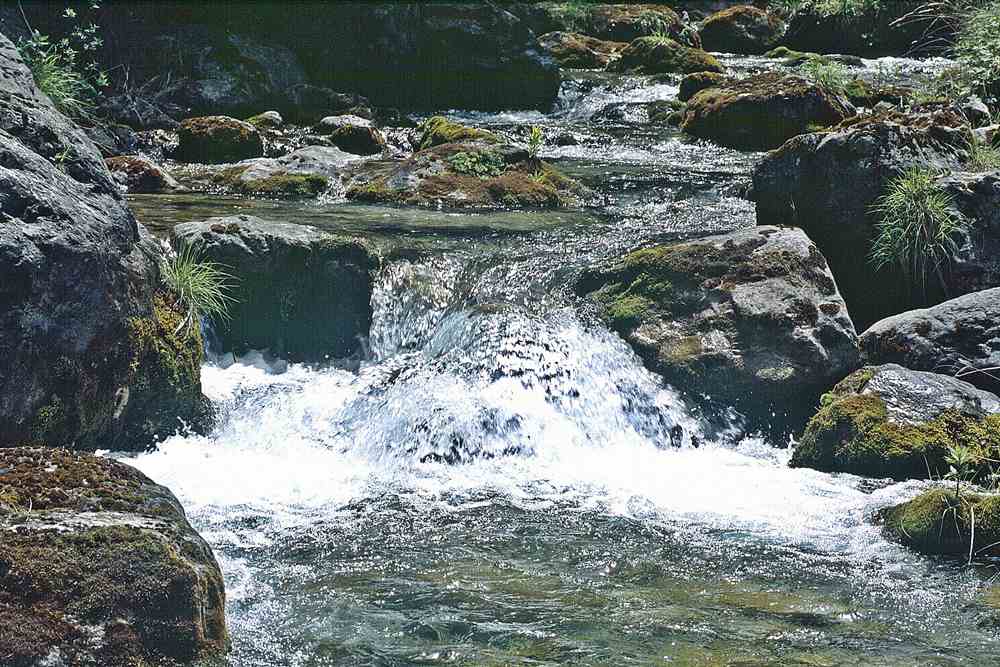
The Enipeas gorge is the classic lower walk of Mount Olympus. The E4 European path leaves Litochoro and follows the river upstream through twelve kilometres of forest, rock, and water to Prionia. The route climbs about seven hundred metres and takes roughly five to six hours one way, so day-visitors usually walk only the lower section and turn back. Wooden bridges cross the stream, and clear pools gather below small waterfalls where walkers pause in the shade. The path is waymarked as part of the long E4 route, and signposts at the trailhead give the walking times to the monastery and to Prionia.
The monastery of Agios Dionysios stands part way up the gorge, founded in the sixteenth century by the hermit whose name it carries. War damage left it partly ruined, and a rebuilt monastery now serves the monks higher up, yet the old walls in the gorge still draw walkers to their spring and chapel. Above the monastery the trail reaches Prionia, at about eleven hundred metres, where a taverna and a car park mark the end of the road and the start of the summit path.
Can you reach the summit of Mount Olympus on a day trip?
No. Reaching Mytikas, the 2,918-metre summit, is a scramble that needs a full day of climbing and, for most, an overnight at a mountain refuge. A day trip from Thessaloniki reaches the gorge and Prionia, not the top.
Mount Olympus carries three main summits above 2,900 metres along a rock crown. Mytikas, at 2,918 metres, is the highest point in Greece, flanked by Skolio at 2,911 metres and the sheer tower of Stefani nearby. Stefani, the jagged east peak, carries the old name the Throne of Zeus for its shape against the sky. The standard route climbs from Prionia through pine forest to the Spilios Agapitos refuge at about 2,100 metres, a walk of two to three hours. From the refuge the path continues to Skala and then across exposed rock to Mytikas.
The final stretch to Mytikas is a Class 3 scramble, not a walk. The route crosses the Kakoskala ledges and climbs the Louki gully on hands and feet, with long drops on either side and loose stone underfoot. Weather turns fast at that height, and cloud, wind, and lightning are real hazards through the afternoon. Reaching the top and returning safely takes climbers two days from Litochoro, with a night at the refuge, which places the summit well beyond a day trip from the city.
A day-visitor still gets a taste of the high mountain without the summit. The walk from Prionia up toward the refuge climbs through old-growth forest to the treeline, where the view opens over the gorge and the gulf. Turning back at the refuge or the first clearing keeps the outing within a single day. Sturdy boots, water, and a warm layer matter even on the lower trail, since the weather on Mount Olympus shifts with height and hour.
What is the archaeological park of Dion?
Dion is an ancient Macedonian city at the north-eastern foot of Mount Olympus, the sacred place where kings honoured Zeus. Its archaeological park holds temples, a theatre, baths, and mosaics, with a separate museum in the modern village nearby.
Dion took its name from Dias, the Greek form of Zeus, and served as the holy city of the Macedonian kingdom. Its kings gathered here to sacrifice to the gods before their campaigns, and Alexander the Great held games at Dion before he marched east. The sanctuary sat where the streams off Olympus reach the plain, a well-watered site sacred to Zeus and the Muses. The city grew through the Hellenistic and Roman ages into a walled town with temples, theatres, and public baths.
The archaeological park spreads across low, green ground crossed by streams and paths. Visitors walk past the sanctuary of Isis, where columns stand again in shallow water, the theatres, the baths, and the mosaic floors of Roman villas. The site museum in the modern village of Dion holds the finds, among them statues, coins, and a water organ, the hydraulis, recovered from the ruins. The excavated ground covers a fenced field beside the village, laid out with gravel paths and boardwalks over the wet meadow. Allow an hour or more for the park and the museum together.
Dion pairs naturally with the wider story of ancient Macedonia. The kingdom’s royal capital lay inland at Aigai, where the tombs of its rulers survive, and a visit to Dion sits well alongside the royal tombs at Vergina on a mountain-and-Macedon theme. On a day trip, the ruins bookend the mountain, since the site lies a short drive from Litochoro on the road back toward the motorway.
What does a realistic Mount Olympus day look like?
A realistic day leaves Thessaloniki in the morning, reaches Dion or Litochoro within about an hour, and splits the day between the ruins, the gorge, and the village. The coach or car returns to the city by evening.
The day opens with the drive south from the city. An early start clears Thessaloniki before the traffic and reaches the foot of Olympus within about an hour. A first stop at the archaeological park of Dion uses the cool of the morning for the open ruins. The site’s paths and streams suit a slow walk before the heat builds on the plain.
Midday turns to the mountain proper. The road climbs from Litochoro to Prionia, and a walk in the lower Enipeas gorge fills an hour or two among the pools and the forest. Lunch fits well in Litochoro, where tavernas on the square face the peaks, a natural pause that a well-planned Thessaloniki itinerary builds around. The village square marks the switch from the ancient city below to the mountain above.
The afternoon holds the walk, the village, and the drive back. Those with more time push higher up the Prionia trail toward the treeline before turning back for the coach. Travellers who want to climb toward the summit split the trip across two days and book a bed in Litochoro or at the refuge, which turns the where to stay in Thessaloniki question toward the mountain instead. A day-visitor, though, returns to the city by evening, the mountain and the myth seen in a single outing.
When is the best time to visit Mount Olympus, and is it safe?
Late spring to early autumn is the best time to visit Mount Olympus, when the trails are clear of snow and the gorge runs green. The high peaks hold snow into June, and winter brings ice and closed refuges.
The mountain keeps a full alpine calendar despite the Greek sun. Snow lingers on the summits into June, and the high traverse to Mytikas stays a serious proposition until then. Summer brings warm, dry days on the lower trails and cool nights at the refuge, the peak window for both the gorge and the summit. The refuge on the main route to Mytikas takes bookings for beds and meals through the summer season. Autumn thins the crowds and colours the forest before the first snows close the high routes again.
Timing on the mountain runs opposite to the city in one respect. The lower gorge and Dion stay open through the year, so a mild winter day still suits the ruins and a short walk, a point worth weighing against the best time to visit Thessaloniki for the wider trip. For the trails above Prionia, summer and early autumn give the safe window. The refuges on the mountain open across the warm months and close for winter.
Safety on Mount Olympus rests on respect for the height and the weather. The gorge and the lower forest walks carry little risk in good conditions with proper footwear. The ground above the refuge is another matter, where exposed rock, sudden cloud, and afternoon storms demand experience and an early turnaround. A day-visitor stays well within the safe ground by keeping to Litochoro, the gorge, and Dion, and by leaving the scramble to a planned two-day climb.
Who first climbed Mount Olympus?
Christos Kakkalos, a hunter and mountain guide from Litochoro, led the Swiss photographer Frédéric Boissonnas and the writer Daniel Baud-Bovy to the first recorded ascent of Mytikas on 2 August 1913. Guides on a Mount Olympus day trip still tell his story.
Kakkalos grew up on the mountain in a family of woodcutters. As a boy he hunted Balkan chamois up to the summit area.
He led later ascents for decades. A refuge on the Plateau of the Muses carries his name.
Pilgrims reached the summits long before 1913. Pottery, coins and the ashes of sacrifices have been found on the high peaks.
Which refuges and chapels stand on the Plateau of the Muses?
The Christos Kakkalos refuge stands at about 2,650 metres on the Plateau of the Muses. The chapel of Profitis Ilias, at 2,803 metres, is the highest chapel in Greece, about 1 kilometre from the refuge and beyond the reach of a Mount Olympus day trip.
Tradition credits Saint Dionysios of Olympus with building the chapel. A small altar inside is framed by icons.
The Kakkalos refuge opens through the summer and early autumn. It has 18 beds, a kitchen and tank water, and places are booked in advance.
The Stavros refuge stands at 930 metres in the forest, 9.5 kilometres up the asphalt road from Litochoro. It works all year as a restaurant. Our Mount Olympus hike page covers the trails between the refuges.
What nature does a Mount Olympus day trip pass through?
Mount Olympus became the first national park of Greece in 1938. A Mount Olympus day trip enters a UNESCO Biosphere Reserve that holds about 1,700 plant species, close to a quarter of the Greek flora.
Twenty-three of those plants grow nowhere else. Evergreen maquis covers the lowest slopes, between 300 and 500 metres. Forests of black pine, fir and beech rise above it.
Bosnian pine climbs to about 2,750 metres, one of the highest tree lines in Europe. Alpine meadows fill the ground above the trees.
Thirty-two mammal species live on the mountain, among them Balkan chamois, roe deer, wild boar and wildcat. The 108 recorded bird species include the golden eagle.
What rules apply on a Mount Olympus day trip inside the national park?
Visitors to Mount Olympus National Park enter only by the existing roads and walk only on marked paths between sunrise and sunset. Hunting, plant collecting and the removal of soil are banned, and cars park only in the marked car parks.
The core zone covers about 4,000 hectares on the eastern side. All forms of exploitation are banned inside it.
Children under 14 enter with an adult escort. Visitors leave nests, eggs and chicks untouched and do not disturb wildlife.
Visitors do not damage rock formations. Animals that come with visitors are not allowed to roam free.
Which myths do guides tell on a Mount Olympus day trip?
Greek myth placed the twelve Olympian gods on the summit of Mount Olympus, in palaces built by Hephaestus and hidden by cloud. Zeus ruled from his throne there after he defeated his father Cronus and the Titans.
Zeus then shared the world with his brothers. Zeus took the sky, Poseidon the sea and Hades the underworld.
The gods feasted on nectar and ambrosia, and the Muses sang for them. Homer first named Olympus as the home of the Olympian gods. The Macedonians honoured Zeus and the Muses at Dion, covered on our Dion archaeological park page.
Leivithra and Pimpleia, on the northern foothills, are tied to Orpheus, son of the Muse Calliope. Our Pieria Riviera day trip page covers the coast below the mountain.
What role did Mount Olympus play in Greek history?
In antiquity the Olympus massif marked the border between Macedon and Thessaly. Under Ottoman rule its forests sheltered the klephts and armatoloi, the armed Greek bands of the mountains, and Olympus became one of their strongest bases.
Nikotsaras and Giorgakis Olympios fought among the bands of Olympus. Giorgakis Olympios came from the village of Livadi on the mountain.
The whole Pieria side of Olympus is a protected archaeological and historical site. Our Macedonia tours page covers the wider region.
Frequently Asked Questions
How far is Mount Olympus from Thessaloniki?
Litochoro, the base village of Mount Olympus, lies roughly ninety kilometres south of Thessaloniki. The drive on the A1 motorway takes about an hour in normal traffic. From Litochoro a narrow mountain road climbs a further eighteen kilometres to the Prionia trailhead, a slow half-hour on tight bends. Trains and intercity buses also reach the area, though a car or an organised coach makes the mountain road and the timing simpler for a day trip.
Can you climb Mount Olympus in one day from Thessaloniki?
No day trip from Thessaloniki reaches the summit. Mytikas, at 2,918 metres, is a Class 3 scramble that most climbers tackle over two days with a night at a mountain refuge. A day from the city covers the base village of Litochoro, the lower Enipeas gorge, and the ruins of Dion. Walkers who want the high trails plan a separate two-day trip and sleep at Litochoro or the Spilios Agapitos refuge.
What is there to see at the foot of Mount Olympus?
The foot of Mount Olympus holds the archaeological park of Dion, the sacred city where Macedonian kings honoured Zeus. Its ruins include temples, theatres, Roman baths, and mosaic floors, with a museum in the modern village. Nearby Litochoro offers a stone village of lanes and squares, and the Enipeas gorge climbs from its edge past pools, waterfalls, and the old monastery of Agios Dionysios toward Prionia.
Do you need a guide for a Mount Olympus day trip?
A guide is not required for Litochoro, Dion, and the lower gorge, all of which a visitor can reach independently by car or public transport. An organised coach tour removes the driving and reads the myth and the ruins, which suits a first visit. For the summit routes above Prionia, experience or a mountain guide matters, since the upper mountain is a technical climb rather than a walk.
What should you bring for the Enipeas gorge walk?
The Enipeas gorge calls for sturdy walking boots, water, and a warm layer, since the weather on Mount Olympus changes with height and hour. Sun protection helps on the open stretches, and a light rain layer covers the afternoon showers of summer. Day-visitors usually walk the lower gorge and turn back rather than push the full twelve kilometres to Prionia, which takes five to six hours one way.
Is Dion worth visiting on the way to Mount Olympus?
Dion rewards an hour or more on a Mount Olympus day trip. The archaeological park spreads across watered ground below the peaks, where columns of the sanctuary of Isis stand again and Roman mosaics survive in place. Alexander the Great held games at Dion before marching east, which ties the site to the wider story of ancient Macedonia. The museum nearby holds the statues, coins, and everyday finds of the city.