
Thessaloniki beaches are not found on the city waterfront. The promenade that runs along the Thermaic Gulf is a place to walk, cycle, and watch the sunset. The sea in front of the city holds no organised swimming beach, and it carries the pollution of a working port and a ring of river mouths. The swimmable coast begins to the south, past the airport. From there it stretches down through the suburban towns of the gulf to the three peninsulas of Halkidiki. Work out where to drive, how far each beach lies, and when the water warms enough for a swim with My Greece Tours.
The right beach depends on how much time and transport you have. A half-day suits the closest towns of the Thermaic Gulf. A full day opens the celebrated coves of Halkidiki. The sections below cover why the city waterfront stays out of the water, where the first real beaches start, the Agia Triada and Epanomi stretch, the Kallikratia run toward Halkidiki, the three legs of the peninsula, and how to plan the day around the sea temperature. Each ties back to the guided Thessaloniki tours.
Can you swim at the Thessaloniki city waterfront?
No. The Thermaic Gulf along the city promenade carries urban, port, and river pollution, and it holds no organised swimming beach. The swimmable coast starts to the south, past the airport.
The inner Thermaic Gulf ranks as poor in ecological quality. The cause is wastewater, ship traffic, and agricultural and industrial run-off that gathers in the enclosed head of the bay. Studies of the water also record microplastic particles across its surface. The waterfront in front of the city works as a promenade rather than a beach, and the locals treat it that way. Reserve the Thessaloniki waterfront promenade for a walk or a bike ride at dusk. It is one of the finest sea-facing walks in Greece, yet it is not a place to bathe.
The shape of the gulf explains the problem. The Thermaic Gulf is a shallow, enclosed bay at the mouths of four rivers. The Axios, the Aliakmonas, the Gallikos, and the Loudias all drain the plain of Macedonia into its head. They carry silt and nutrients that settle in the still water. Add the discharge of a city of a million people and its port, and the load concentrates worst at the northern tip where Thessaloniki sits. The water grows clearer the further you travel from the port and the river deltas.
The pull of the open sea therefore runs south and east. The first proper beaches sit in the suburban towns along the eastern shore of the gulf, beyond the airport at Thermi. There the current freshens and the sand takes over from the harbour front. A short drive is the price of a clean swim. Every option in this guide lies down that coast road rather than in the city itself, so plan to leave the centre before you reach for a towel.
The point matters for a first visit. Guides to the city rightly send you to the seafront for the sunset and the long promenade walk. That waterfront is a highlight in its own right, and the redesigned front ranks among the best urban seaside walks in the country. Treat it as a walk and a view, not a beach. The moment you want to get in the water, the plan shifts to a drive south, and the rest of this guide maps that drive town by town.
Where does the swimmable coast begin south of the city?
The swimmable coast begins at Peraia and Nea Krini, the suburban waterfront towns about nineteen kilometres south-east of the centre. They are the closest organised beaches, roughly a thirty-minute drive from the city.
Peraia is the first beach town most people from the city reach. It is a developed seafront lined with cafés, tavernas, and beach bars behind a strip of golden sand. The town sits about nineteen kilometres, or twelve miles, from the centre. It lies only around ten miles from the airport, which makes it a quick escape for an afternoon rather than a full expedition. The water here runs calm and shallow. The sunbeds and umbrellas of the organised sections give an easy base for a swim.
Nea Krini lies right beside Peraia along the same suburban strip. The two blur into one long waterfront of sand and seafront bars. The shallow, gentle water down this stretch suits younger swimmers, which is why the towns fill with day-trippers on a warm weekend. A family that wants sand underfoot and a café within reach can plan a relaxed outing here. This is the kind of easy coast that pairs with a day of Thessaloniki with kids, close enough to head home for a nap.
Getting to Peraia is straightforward. Regional buses run down the coast road from the city. The drive by car takes around half an hour outside the rush, with parking along the seafront. A rented car opens the whole southern coast beyond the bus network. Travellers who want to roam past the first towns often pick up Thessaloniki car rental for the day. Peraia and Nea Krini fit a half-day, which leaves the morning or the evening free for the city.
These first towns set the pattern for the whole coast. The beaches are organised, the sand is soft, and the water shelves gently. What they lack is the wildness of the peninsulas further south. For a swim close to the hotel, though, they are hard to beat. Many locals treat Peraia as their default summer beach precisely because the round trip fits inside a working afternoon.
What beaches line the Agia Triada and Nea Michaniona stretch?
Agia Triada, Neoi Epivates, Nea Michaniona, and Epanomi form the next stretch of coast, roughly twenty to twenty-five kilometres south. All are sandy and organised, about thirty to forty minutes from the city by car.
Agia Triada sits about twenty kilometres south-east of the city. It is a long organised beach of golden sand backed by cafés, bars, and hotels. The drive runs to around thirty minutes, which keeps it within easy reach. The short hop from the city means it fills up on summer weekends. Neoi Epivates lies just before it. That beach is a sandy front that stretches for more than a mile and carries the same relaxed, family-friendly character along its length.
Nea Michaniona marks the far end of this stretch. It is a working fishing town south of Agia Triada, with a harbour of small boats and tavernas that serve the day’s catch. The beaches here trade a little of the polish of Peraia for the feel of a real coastal town. The fish lunches draw people down from the city on their own account. This part of the coast rewards a longer, slower visit than the closest suburban beaches to the north.
Epanomi is the pick of the group, and the reason the run is worth a full day. It lies roughly twenty-five kilometres south-west of the city, about forty minutes by car. The beach spreads powder-soft golden sand along exceptionally clear water. A natural sandbar pushes out into the sea and gives the shore an almost tropical line. On a clear day the cone of Mount Olympus rises across the gulf to the west. The view alone marks Epanomi out from the towns nearer the city.
Epanomi also splits into two moods. The organised beach carries sunbeds, umbrellas, and beach bars for an easy day. Beyond it, the coast keeps wilder, quieter stretches for those who walk a little further from the car park. A visitor can pick the serviced sand or the empty dune, sometimes on the same afternoon. That range is why the beach tops many local lists for a full day out of the city.
How far is the Kallikratia to Nea Moudania run toward Halkidiki?
Nea Kallikratia lies about forty minutes south, and the coast road runs on through Nea Iraklia to Nea Moudania at sixty-four kilometres. Nea Moudania is the gateway where the three legs of Halkidiki begin.
Nea Kallikratia is a resort town about forty minutes south of the city. A long organised beach of sand fronts it, and it draws both Thessaloniki weekenders and summer residents. It marks the point where the Thermaic Gulf coast gives way to the approaches of Halkidiki. The water off its shore already runs clearer than the beaches nearer the port. The town has grown into a full seaside base with bars and tavernas along the front, suited to a full day rather than a quick dip.
Nea Iraklia continues the line about thirty-five kilometres south of the city. It offers another golden-sand beach in the string of resort towns down this coast. The road then reaches Nea Moudania at sixty-four kilometres. Nea Moudania is a port town that acts as the hinge of the region. This is the practical gateway to the peninsulas. It is a natural place to pause for supplies before the beaches of Halkidiki proper open up ahead.
The fork that defines the region comes at about sixty kilometres from the city. There the road splits. It turns right for Sithonia, or it runs straight on for Kassandra. Those are the two peninsulas that carry the swimming beaches of Halkidiki. Everything past this point counts as a full-day outing, and a car turns the whole run into an easy drive. The same coast anchors a Halkidiki day trip from the city.
The southern run is not the only direction to the sea. A second coast heads east from the city toward the border with Thrace. Asprovalta is the main draw that way, a sandy resort beach about an hour east of Thessaloniki, with showers and other facilities along its front. It offers an alternative to the Halkidiki traffic on a busy weekend. The trade-off is a longer, less scenic drive than the run down to the peninsulas, so most beachgoers still point the car south. The choice comes down to which road looks quieter on the day you set out.
What are the three legs of Halkidiki for beaches?
Halkidiki reaches three peninsulas into the Aegean, Kassandra, Sithonia, and Athos. Kassandra sits closest and busiest, Sithonia holds the celebrated coves, and Athos is the closed monastic peninsula.
Kassandra, the closest leg
Kassandra is the westernmost and nearest of the three prongs. You reach it by continuing straight where the road forks at sixty kilometres. It carries the most developed resorts of Halkidiki and the greatest run of organised beaches. Among them is Sani, a white-sand resort coast about an hour south of the city. Numerous Kassandra beaches hold Blue Flag status for their water and their facilities. That makes the peninsula the reliable choice for a family day of sunbeds, beach bars, and shallow swimming, close enough for a return by nightfall.
Sithonia and its coves
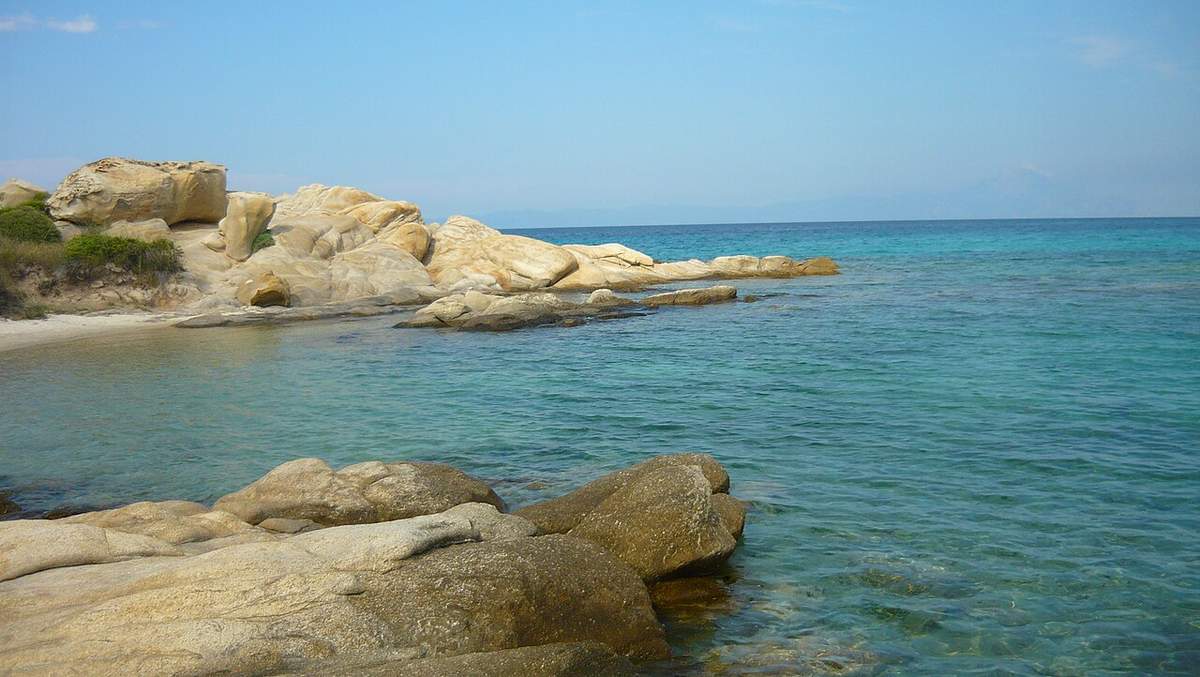
Sithonia is the middle leg. It is the wilder and greener of the two swimming peninsulas. Its coast is a run of pine-backed coves over pale sand and clear turquoise water. The drive to Neos Marmaras, its main resort, takes around an hour. The southern village of Sykia lies about a hundred and sixty kilometres from the city, out at the far tip. The celebrated coves of Sithonia reward the extra distance. Small bays open one after another along its two coasts, each ringed by pine and pale rock. The water reads as clear as glass over the sand. The peninsula rewards an early start, a full day, or a night’s stay to reach the quieter southern bays.
Athos, the monastic leg
Athos is the eastern leg, and the one you cannot swim on. The peninsula forms the autonomous monastic community of Mount Athos. It stays closed to casual visitors, its shore reserved for the monasteries and barred to general tourism. Travellers see its coast from the water instead. A boat cruise skirts the cliffs and the monasteries below the holy mountain. That trip is the classic Mount Athos cruise from Thessaloniki, which trades a beach day for a rare view of the peninsula.
How do you plan a Thessaloniki beach day, and when does the sea warm up?
Choose a Thermaic Gulf town for a half-day and Halkidiki for a full day. The sea warms above twenty degrees Celsius from June through October, and peaks at twenty-seven degrees in August.
The sea temperature sets the season. The water off the coast climbs to nineteen degrees Celsius in May. It reaches twenty-three in June, twenty-six in July, and a peak of twenty-seven in August. It then eases to twenty-five in September and twenty-two in October. The comfortable swimming window runs from June through October. The warmest, calmest water falls across July, August, and September. Match the beach to the month with a look at the best time to visit Thessaloniki.
Transport decides the range. The closest beaches at Peraia, Nea Krini, and Agia Triada sit on the regional bus routes down the coast. A swim there needs no car at all. The Kallikratia run and the peninsulas of Halkidiki stretch well past the easy bus network. They open up properly only with a car. A vehicle turns the whole southern coast into a string of options within a single drive. A rented car is the difference between the nearest town and the coves of Sithonia. It also frees you to leave when the light softens rather than when the last bus runs.
Time decides the target. A half-day matches the suburban beaches of the Thermaic Gulf. There the organised bars and shallow water sit within a thirty-minute drive. A full day earns the clearer coves and Blue Flag sand of Kassandra and Sithonia. The organised beaches trade wildness for sunbeds and cafés. The far coves trade facilities for space and clear water. The coast rounds out a wider run of Thessaloniki day trips and the broader list of things to do in Thessaloniki.
One last call shapes the plan. Decide whether the beach is a day out or a base. For a single swim, drive down, use the organised front, and return to the city by evening. For a run of beach days, a night on the peninsula saves the daily drive and reaches the quiet bays at dawn. Weigh up where to stay in Thessaloniki against a room in Kassandra or Sithonia before you fix the trip.
Frequently Asked Questions
Can you swim in the sea at Thessaloniki city centre?
No. The Thermaic Gulf along the city promenade carries urban, port, and river pollution and holds no organised swimming beach. The waterfront serves as a place to walk and cycle rather than swim. The clean, swimmable coast starts to the south of the city, past the airport, in the suburban beach towns of the gulf and on toward Halkidiki. Plan on a short drive for any real swim.
Which is the closest beach to Thessaloniki?
Peraia is the closest organised beach. It is a suburban waterfront town about nineteen kilometres, or twelve miles, south-east of the centre, and only around ten miles from the airport. The drive takes roughly half an hour. The golden sand, shallow water, and seafront bars make it an easy half-day escape. You can reach it by regional bus or by car.
How far is Epanomi beach from Thessaloniki?
Epanomi lies about twenty-five kilometres south-west of the city, roughly forty minutes by car. It is widely rated the most scenic beach of the region. It offers powder-soft golden sand, exceptionally clear water, a natural sandbar reaching into the sea, and a view across the gulf to Mount Olympus. The clear water and wilder edges make it worth a full day rather than a quick dip.
Can you reach the beaches near Thessaloniki by bus?
Yes, for the closest ones. The suburban beaches at Peraia, Nea Krini, and Agia Triada sit on the regional bus routes that run down the coast from the city, so no car is needed for a half-day swim. The Kallikratia run and the peninsulas of Halkidiki lie past the easy bus network. They open up properly only with a rented car.
When is the sea warm enough to swim near Thessaloniki?
The comfortable swimming season runs from June through October. The water climbs above twenty degrees Celsius in June and stays there into October. It peaks near twenty-seven degrees in August. The warmest and calmest sea falls across July, August, and September. May offers a cooler swim at around nineteen degrees for those who do not mind the chill.
Which Halkidiki peninsula has the best beaches near Thessaloniki?
Kassandra and Sithonia hold the swimming beaches. Kassandra is closest and busiest, with developed resorts and Blue Flag sand, ideal for a family day. Sithonia keeps the celebrated pine-backed coves and clearer water further out. Athos, the third leg, is the monastic peninsula and is closed to casual visitors, so its coast is seen only from a boat cruise.
Do you need a car to reach the beaches near Thessaloniki?
Not for the closest towns, but a car helps for the rest. Peraia, Nea Krini, and Agia Triada sit on the regional bus routes, so a half-day swim there needs no vehicle. The Halkidiki peninsulas and the Kallikratia run lie beyond the easy bus network, and a rented car reaches them in a single drive. A car also lets you skip between coves and choose an organised beach or a wild one on the day.
Are the beaches near Thessaloniki sandy or pebbly?
Most are sandy. The Thermaic Gulf towns of Peraia, Agia Triada, Neoi Epivates, and Epanomi all front onto soft golden sand, as do the Kallikratia resorts and Sani on Kassandra. The coves of Sithonia mix pale sand with the occasional pebble edge, backed by pine. A traveller who wants sand underfoot has the easier choice, since the whole coast south of the city runs to sand rather than shingle.