
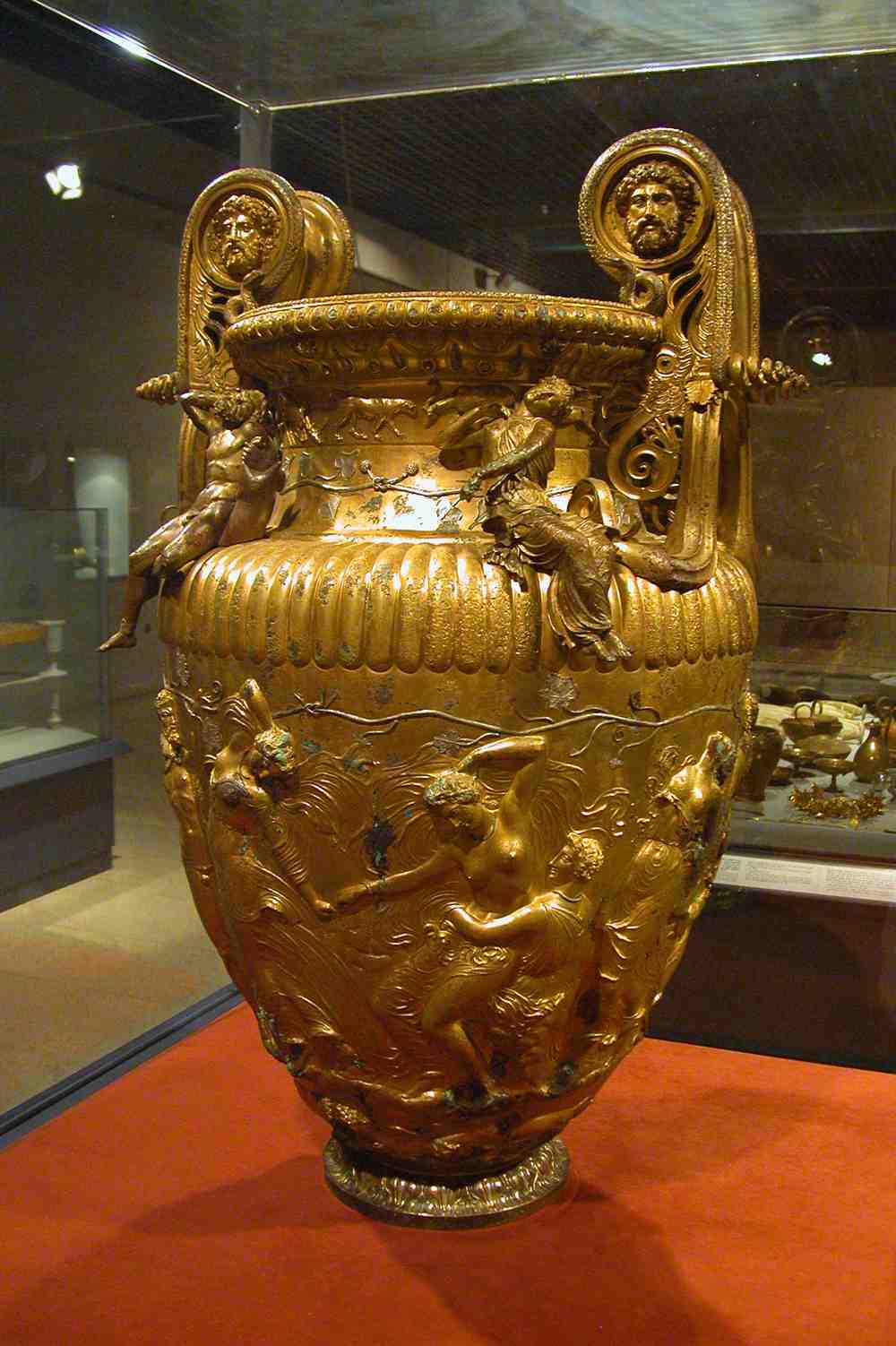
The Archaeological Museum of Thessaloniki keeps the finds of Macedonia under one roof, from prehistory through the Hellenistic kingdom to the Roman city. The bronze Derveni Krater crowns the galleries, and the charred Derveni Papyrus reads as the oldest known manuscript in Europe. Gold wreaths, grave goods, sculpture, and mosaics fill the rooms around them, each drawn from the cemeteries and settlements of the wider region. The building stands on the exhibition grounds near the White Tower, a short walk along the waterfront from the centre. Plan the visit, book the guided walks, and read the treasures of ancient Macedonia with My Greece Tours.
The museum rewards a slow circuit rather than a dash past the star objects. Its strength lies in the way the galleries tie the metalwork, the jewellery, and the sculpture back to the tombs and the towns that produced them. The sections below cover what the museum is, the Derveni Krater and the Derveni Papyrus, the Macedonian gold and grave finds, the Roman and prehistoric collections, how to visit and how long to allow, and how to fold it into a day among the Thessaloniki tours that thread the waterfront and the centre.
What is the Archaeological Museum of Thessaloniki?
The Archaeological Museum of Thessaloniki is the chief museum of ancient Macedonia. It gathers finds from the prehistoric settlements of the region, the Macedonian kingdom, and the Roman city into galleries near the White Tower.
The museum occupies a low modernist building on the exhibition grounds at the eastern edge of the centre. The architect Patroklos Karantinos designed the original block in the clean lines of mid-twentieth-century Greek modernism, and a later wing extended the galleries to hold the growing store of finds. The result reads as a calm, single-level museum rather than a grand palace, which keeps the focus on the objects and their setting.
The collection spans the whole arc of ancient Macedonia. Prehistoric material from the settlements around the Thermaic Gulf opens the story, the tombs of the Macedonian nobility carry it through the age of the kingdom, and the sculpture and mosaics of the Roman city close it. The galleries move the visitor from clay and stone tools to worked gold and cast bronze without a break in the thread.
The museum sits within a compact museum quarter on the waterfront side of the city. The Museum of Byzantine Culture stands next door, the White Tower marks the shore a short walk to the west, and the seafront promenade runs past the door. That grouping puts the archaeological museum at the head of most lists of things to do in Thessaloniki for travellers drawn to the ancient world.
The building works as the regional keeper of Macedonia’s past rather than a single-theme gallery. Finds from the cemeteries of Sindos, Derveni, Lete, and their neighbours converge here, so the museum reads the countryside around the city alongside the port itself. A guide can trace that regional web through the rooms and link each treasure to the ground that gave it up.
What makes the Derveni Krater the museum’s masterpiece?
The Derveni Krater is a large bronze volute krater of the fourth century BC, the finest survival of its kind. Its high-tin alloy gives a golden sheen without gold, and its relief and cast figures form the museum’s single greatest object.
The krater is a monumental mixing bowl, the vessel that ancient banqueters used to blend wine with water before ladling it to the guests. This one weighs about forty kilograms and stands as tall as a child, cast from a bronze whose high tin content lends the metal a warm, golden glow. The workmanship marks it as the outstanding piece of large-scale Hellenistic metalwork to reach the present day.
The decoration reads as a hymn to Dionysos, the god of wine and of the crossing between life and death. The sacred marriage of Dionysos and Ariadne fills the main face in low relief, ringed by a frieze of dancing maenads and satyrs caught mid-step. Fully three-dimensional bronze figures perch on the shoulder of the vessel, slumped and heavy-limbed, the very picture of banqueters worn down by the revel.
The krater came out of a tomb at Derveni, on the road north of the city, where it had served as the urn for a cremated Thessalian nobleman. An inscription names the owner, Astiouneios son of Anaxagoras from Larissa, which ties the treasure to a real person of the Macedonian world. The tomb group around it points to a burial of high rank at the edge of the kingdom’s heartland.
The vessel now holds its own gallery, lit to catch the golden tone of the metal and the depth of the relief. Large metal vessels rarely survive from the ancient world, since bronze was melted and reused across the centuries, which makes this one a genuine rarity. The krater ranks beside the Vix Krater of the Archaic age as one of the two supreme bronze vessels of ancient Greece.
Why is the Derveni Papyrus so important?
The Derveni Papyrus is a charred philosophical scroll from the same cemetery as the krater. It survives as the oldest known manuscript in Europe, and it carries a UNESCO Memory of the World listing for its rank among written treasures.
The scroll came from a funeral pyre at Derveni, where the fire that burned the body also carbonised the papyrus and, by chance, preserved it. Damp and time destroy papyrus across the northern Mediterranean, so the charring that turned this roll to brittle carbon is the reason it reached the present at all. The find ranks as the oldest surviving book of the European tradition.
The text itself is a commentary on an older religious poem tied to the Orphic tradition, read through the lens of early Greek natural philosophy. The anonymous author treats the myth as an allegory of the physical world, weaving together gods, cosmology, and the workings of nature. That blend of religion and reasoned argument gives the scroll a rare window onto the thought of the age before the great philosophers of Athens.
The physical survival makes the papyrus a landmark of conservation and of literature alike. Specialists pieced the blackened fragments back into readable columns through patient work over decades, recovering a running text from what looked at first like burnt debris. The reconstructed columns now let scholars read a voice that would otherwise have vanished with the pyre.
The UNESCO Memory of the World register recognises the scroll among the documentary treasures of humankind, a mark of its standing beyond the borders of Greece. The museum presents the papyrus with care for its fragile state, pairing the charred original with aids that open the text to the visitor. The scroll and the krater together turn the Derveni cemetery into the beating heart of the collection.
What Macedonian gold and grave finds does the museum hold?
The central galleries show the gold of Macedon, the wreaths, jewellery, and grave goods drawn from the high-status cemeteries of the region. Sindos, Agia Paraskevi, Derveni, Lete, and their neighbours supplied the burial treasures on display.
The gold of Macedon gallery gathers the finest metalwork from the tombs of the regional nobility. Delicate gold wreaths shaped as oak and myrtle leaves, worked earrings, necklaces, and pins fill the cases, alongside the vessels and arms that accompanied the dead. The craft in the jewellery reveals a society that commanded goldsmiths of the first rank well before the age of Alexander.
The cemetery of Sindos, west of the city, yielded a striking set of graves rich in gold and bronze. Its burials held masks, model furniture in thin gold sheet, and weapons that mark the standing of the dead within their community. The Sindos finds carry the collection back to the Archaic and early Classical centuries, before the Macedonian kingdom rose to its height.
The grave goods read as a portrait of belief and of wealth alike. The wreaths crowned the dead for the passage beyond, the vessels held offerings, and the arms travelled with warriors into the tomb. Each object was chosen to serve the dead person in the next world, so the cases together sketch the funeral customs of ancient Macedonia in fine detail.
The gold ties the museum to the wider story of the Macedonian court and its reach. The same craft tradition that produced these wreaths adorned the royal tombs at Vergina to the west, and the museum’s holdings set the scene for that greater necropolis. A visit here reads well before or after a trip to the royal burials, and it slots neatly into a broader Thessaloniki itinerary built around the ancient north.
What do the Roman and prehistoric collections show?
The Roman galleries hold sculpture, portraits, and mosaics from the imperial city, while the prehistoric rooms display the tools and pottery of the settlements around the gulf. Together they frame the ages before and after the Macedonian kingdom.
The Roman section presents the face of Thessaloniki as a great city of the empire. Marble portraits, statues of gods and citizens, and coloured floor mosaics lifted from the villas of the town line the galleries. The finds record a port that thrived on the Via Egnatia, the imperial road that linked the Adriatic to the East, and that raised monuments the equal of the Rotunda that still stands in the centre.
The sculpture ranges from public statuary to the carved sarcophagi and grave markers of the townspeople. Portrait heads catch the changing fashions of the imperial centuries, and the mosaics preserve the scenes that once decorated the dining rooms of the well-to-do. The pieces read the daily life and the civic pride of the Roman city in stone and coloured glass.
The prehistoric galleries reach back to the first farmers of the region. Material from the Neolithic through the Bronze Age settlements around the Thermaic Gulf fills the cases with pottery, stone and bone tools, figurines, and the debris of early village life. The displays reconstruct how the mounds and lakeside villages of the plain grew across thousands of years before the city itself existed.
A dedicated gallery turns to Thessaloniki as a subject in its own right, tracing the ancient town from its founding through its Roman peak. The room sets the finds in the frame of the city’s streets and monuments, a thread the traveller can follow out onto the Roman core of the modern centre. It reads well beside a walk past the Rotunda and the ancient forum a short way inland.
How do you visit the Archaeological Museum of Thessaloniki?
The museum stands on the exhibition grounds near the White Tower, an easy walk east from Aristotelous Square along the seafront. A steady visit runs about ninety minutes to two hours across the galleries.
The route from the centre hugs the water. A stroll east from Aristotelous Square along the promenade reaches the White Tower in a quarter of an hour, and the museum sits a short block inland from there beside the exhibition grounds. City buses along the coastal avenue drop close to the door for travellers based farther out or arriving from the train station.
The galleries suit a visit of about ninety minutes for a first pass, and closer to two hours for a slow reading of the star objects. The Derveni Krater and the Derveni Papyrus reward extra time, and the gold of Macedon gallery holds attention with its fine metalwork. The single-level plan keeps the visit compact, with no long climbs between the rooms.
The exhibits carry labels in Greek and English, and the layout follows a clear thread from prehistory through the Roman city. A guided visit adds the context that the labels keep brief, linking each treasure to its tomb and its place in the story of Macedonia. A guide can also weave the museum into a wider walk of the ancient and Byzantine core.
The setting adds ease to the visit. The seafront promenade, the White Tower, and the park behind ring the museum with places to pause before or after the galleries. That waterfront cluster makes the museum a natural anchor for a morning or an afternoon, with a coffee on the shore to round off the ancient world.
How does the museum pair with the neighbouring museum and the waterfront?
The Archaeological Museum pairs naturally with the Museum of Byzantine Culture next door and with the White Tower on the shore. The three sit within a short walk, and the seafront promenade links them into one waterfront circuit.
The Museum of Byzantine Culture stands directly beside the archaeological museum, and the two read as a matched pair. One tells the ancient story of Macedonia, the other picks up the thread through the Byzantine and early Christian city, so a combined visit carries the traveller from the Derveni Krater to the mosaics and icons of the medieval port without leaving the block.
The waterfront ties the museums to the emblem of the city. A short walk west along the promenade reaches the White Tower, whose own museum reads the whole span of Thessaloniki from its founding to the present. The three together frame the ancient, the Byzantine, and the civic story of the city within a short stretch of shoreline.
The circuit extends inland toward the Roman and Byzantine monuments of the centre. The Rotunda, the ancient forum, and the churches of the upper town lie a short way uphill, and the walls crown the heights of Ano Poli above. The museum grounds the whole route by handing the visitor the finds that the standing monuments have lost.
The pairing shapes the rhythm of a day on foot. A morning across the two museums, a walk west to the tower, and an afternoon among the churches inland fill a full day of the ancient and medieval city. The seafront promenade carries the traveller between the stops in the open air, which keeps the museum-heavy schedule from turning into a grind.
Frequently Asked Questions
Where is the Archaeological Museum of Thessaloniki?
The museum stands on the exhibition grounds at the eastern edge of the centre, a short block inland from the White Tower. The seafront promenade runs past the door, an easy walk east from Aristotelous Square along the shore, and the Museum of Byzantine Culture sits directly next door.
What is the most famous object in the museum?
The Derveni Krater is the museum’s celebrated masterpiece, a large bronze volute krater of the fourth century BC with a golden sheen and rich relief. The charred Derveni Papyrus, the oldest known manuscript in Europe, ranks alongside it as the other great treasure of the collection.
What is the Derveni Papyrus?
The Derveni Papyrus is a charred philosophical scroll recovered from a funeral pyre at Derveni, north of the city. The fire that burned the body carbonised and preserved it, and it survives as the oldest known manuscript in Europe, carrying a place on the UNESCO Memory of the World register.
How long does a visit to the museum take?
A first pass through the galleries runs about ninety minutes, and a slower reading of the Derveni Krater, the papyrus, and the gold of Macedon stretches the visit toward two hours. The single-level plan keeps the route compact, with the exhibition grounds and the waterfront close at hand.
Can you combine it with the Museum of Byzantine Culture?
Yes. The Museum of Byzantine Culture stands directly next door, and the two make a natural pair. One covers ancient Macedonia through the Roman city, the other carries the story into the Byzantine and early Christian age, so a combined visit reads the whole sweep of Thessaloniki within one block.
Is the Archaeological Museum of Thessaloniki worth visiting?
The museum holds the finest surviving bronze vessel of Hellenistic Greece and the oldest book of the European tradition, along with the gold of the Macedonian tombs. That concentration of first-rank treasures, a short walk from the waterfront and the White Tower, makes it a leading stop in the city for anyone drawn to the ancient world.