
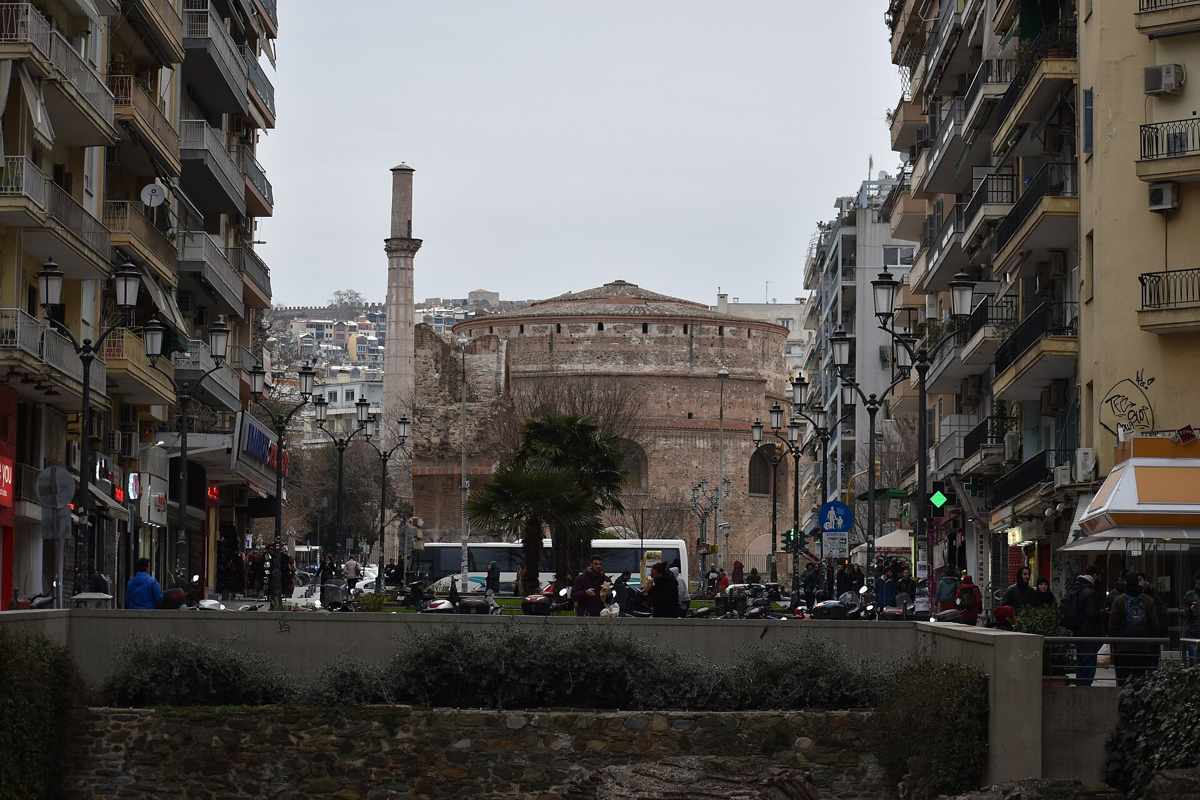
The Rotunda is the oldest monument still standing in Thessaloniki, a colossal circular brick building raised in the early fourth century on the axis of the imperial palace of Galerius. Its dome spans a drum of brick so thick that it has held for more than a millennium and a half. The building has served as a Roman hall, a Christian church, and an Ottoman mosque in turn, and each faith left its mark on the stone and the mosaics inside. Walk the drum, read the gold vaults of the dome, and place the monument in the fabric of the city with My Greece Tours.
The monument rewards a slow circuit under the dome rather than a glance through the door. Its brick walls carry the debate over its first purpose, the finest early Christian mosaics in the country, and the only minaret left in the city. The sections below cover what the Rotunda is, how it passed from Roman to Christian to Ottoman hands, and what survives of its mosaics and its architecture. The later parts turn to the minaret, its UNESCO status, and how to fold the building into a walk of the centre on the guided Thessaloniki tours.
What is the Rotunda of Thessaloniki?
The Rotunda is a circular brick building in central Thessaloniki, raised in the early fourth century beside the palace of the emperor Galerius. It has served in turn as a Roman hall, a Christian church, and an Ottoman mosque.
The building takes the form of a rotunda, a single round chamber roofed by a dome, which gives the monument its name. Its brick walls rise more than six metres thick and carry a dome that clears the drum at a height of close to thirty metres. Eight recesses cut into the wall open the interior and lighten the mass of the masonry. The scale places it among the grandest round buildings to survive from the Roman age.
The Rotunda stands at the top of a short pedestrian street that climbs north from the main avenue of the centre. The Arch of Galerius rises at the foot of that street, and the two monuments share a single axis that once ran through the palace quarter of the emperor. That alignment marks the Rotunda as one piece of a grand imperial complex rather than a building on its own.
The monument now works as a museum and a protected ancient site rather than an active place of worship. Its interior stays open to visitors who come for the mosaics and the architecture, and the space also holds concerts and exhibitions through the year. The Orthodox Church holds the right to services on set dates, so the building keeps a living thread to its centuries as a church.
The Rotunda ranks among the essential stops for a first visit to the city, set within a short walk of the seafront and the Roman forum. It heads most guides to things to do in Thessaloniki for the reach of its history and the survival of its mosaics. A traveller can pair it with the arch below in a single stop and read the imperial quarter in one walk.
What is the history of the Rotunda?
The Rotunda was built in the early fourth century under the emperor Galerius, either as a mausoleum or a temple. It became a Christian church in the late antique period and an Ottoman mosque in the fifteenth century.
Galerius ruled as one of the four emperors of the tetrarchy and made Thessaloniki his eastern capital. He raised the Rotunda as part of a palace complex that spread across the southern quarter of the city, linked to the arch and the palace by a colonnaded route. Scholars still debate whether the emperor meant the round hall for his own tomb or for the worship of the Roman gods. He was buried elsewhere, and the building never held his body.
The building passed to Christian use in the late antique centuries, when it was consecrated as a church dedicated to Saint George. Builders added an apse to the east wall for the altar, cut new entrances, and sheathed the dome and the vaults in the gold mosaics that survive. That conversion tied the Rotunda to the wider Christian rebuilding of the city that reshaped the pagan monuments of the palace, among them the Arch of Galerius that guarded the route below.
Ottoman forces took Thessaloniki in the fifteenth century, and the church became the mosque of Sinan Pasha in the years that followed. The conquerors whitewashed over the Christian mosaics that ringed the lower walls, raised a minaret at the north-west corner, and set a fountain in the yard. The dome mosaics survived under the plaster, which preserved them through the centuries of the mosque.
The building returned to Christian hands when the city passed to Greece in the early twentieth century, and it served again as a church for a spell. An earthquake in the later twentieth century cracked the fabric and closed the monument for a long restoration. The Rotunda reopened as a monument and a museum, its layers of Roman, Christian, and Ottoman use held together under one dome.
What can you see in the Rotunda’s mosaics and architecture?
The Rotunda holds early Christian mosaics of gold glass in its dome and vaults, ranked among the finest in the world. The architecture centres on a vast brick drum roofed by a shallow dome pierced with windows.
The dome mosaics fall into concentric bands set against a ground of gold glass. The lowest and best preserved band shows saints standing in prayer before elaborate architectural backdrops of columns, canopies, and jewelled façades. Their robes, their gestures, and the buildings behind them carry a depth and a polish that rank the work with the mosaics of Ravenna. The upper bands, once crowded with figures and a central image of Christ, survive in fragments after the losses of the centuries.
The vaults of the recesses hold a second layer of mosaic, closer to the eye than the dome. Birds, fruit, vines, and vessels spread across these panels in patterns that read as the fruits of paradise. Their lower height lets a visitor study the tesserae at close range, where the tilt of each gold cube catches the light. The craft of the cutting and the setting shows plainly at that distance.
The structure rests on a ring wall of brick more than six metres thick, which carries the weight of the dome without external buttressing. Eight barrel-vaulted recesses open into that wall and turn the solid mass into a ring of chambers around the central floor. Windows set in the base of the dome and the drum wash the interior with a soft, even light. The engineering places the Rotunda among the boldest domed spaces of the Roman world, a forerunner of the great domes that followed.
The monument sits within the walkable core that holds the other landmarks of the centre. A short walk links the Rotunda to the Roman forum, the churches, and the seafront, where the White Tower anchors the promenade. The cluster of Roman and Byzantine sites in the heart of the city lets a visitor read the mosaics of the dome and the fabric of the drum inside one compact circuit.
Why does the Rotunda’s minaret still stand?
The Rotunda keeps the only minaret still standing in Thessaloniki, raised at its north-west corner during the Ottoman centuries. The tower survived the removal of the city’s other minarets and now stands protected as part of the monument.
The minaret rises as a slender stone tower against the bulk of the brick drum, its balcony ringing the shaft near the top. Ottoman builders added it when the church became a mosque, so the muezzin could call the faithful over the roofs of the quarter. Its pale stone and tapered form mark the Islamic chapter of the building against the Roman and Christian fabric below.
The tower stands alone in the city because the other minarets came down after Thessaloniki passed to Greece. The new administration cleared the Ottoman religious skyline from most of the churches that had served as mosques, yet the minaret of the Rotunda was spared. Its survival preserves a rare full record of the building’s layered use, Roman to Christian to Ottoman, in a single view.
The minaret reads as a monument in its own right rather than a working tower, closed to the climb and held under protection. Its presence turns the Rotunda into a lesson in the shared heritage of the city, where a Roman hall wears a Christian dome and an Ottoman spire at once. Photographers frame the brick drum and the stone shaft together for that reason, a pairing found nowhere else in Greece.
The minaret joins the wider record of Ottoman building that still marks the streets around the monument, from the bathhouses to the covered markets. That record runs strongest in the old upper town, where the lanes of Ano Poli kept their Ottoman houses and their fountains through the fire that razed the lower city. The Rotunda’s spire anchors that thread of the city’s past at the edge of the Roman quarter.
Why is the Rotunda a UNESCO World Heritage Site?
The Rotunda is inscribed on the UNESCO World Heritage List as one of the Palaeochristian and Byzantine Monuments of Thessaloniki. The listing recognises its early Christian mosaics and its role in the development of church architecture.
UNESCO added a group of the city’s early Christian and Byzantine churches to the World Heritage List for their art and their architecture. The Rotunda stands among that group as the earliest and the grandest, its dome mosaics cited as a landmark of late antique art. The listing marks the monuments as a record of the Christian building that spread from the eastern empire across the wider world.
The value cited for the Rotunda rests on the quality of its mosaics and the boldness of its dome. Its gold-ground panels rank among the oldest monumental Christian mosaics to survive, a bridge between the art of Rome and the mature style of Byzantium. The domed hall itself fed the line of church design that led toward the great domes of Constantinople.
The protection that comes with the listing shapes the care of the building and the pace of its restoration. Conservators work to hold the mosaics against damp and time, and the monument opens under rules that guard the fragile surfaces of the dome. The status also lifts the Rotunda onto the map of world heritage travel, which draws visitors who follow the mosaics of the late antique world.
How do you visit the Rotunda?
The Rotunda stands in the centre of Thessaloniki, a short walk uphill from the Arch of Galerius and the main avenue. A visit to the interior takes about thirty to forty-five minutes, the mosaics and the dome included.
The monument sits at the head of a paved pedestrian street that runs north from Egnatia, the main avenue of the centre. The Arch of Galerius stands at the foot of that street, so a walk up from the arch reaches the Rotunda in a couple of minutes along the old imperial axis. The seafront and the White Tower lie a short stroll to the south, which lets a traveller string the sites into one waterfront-to-hill line.
The interior opens to visitors through the week, with a reduced schedule on set days, so a quick check of the current hours rewards the plan. The floor stays clear and level once inside, and the mosaics of the dome read best with the aid of a small pair of field glasses for the high bands. A guide draws out the layers of the building and the meaning of the figures that the bare walls keep quiet.
The Rotunda folds cleanly into a day on foot through the Roman and Byzantine core. A route that opens at the arch, climbs to the Rotunda, and turns toward the forum and the churches builds the imperial city in the right order, the shape a compact Thessaloniki itinerary tends to follow. The monument suits either the morning, before the light hardens on the dome, or the late afternoon, when the gold of the mosaics warms.
The stop pairs well with a coffee on the pedestrian street below the drum, where cafés spread their tables under the arch. The compact scale of the interior keeps the visit short enough to leave room for the forum, the churches, and the seafront in the same day. A guided walk ties the Rotunda to the arch and the palace remains, so the imperial quarter of Galerius reads as one complex rather than three separate stops.
How does the Rotunda fit into the story of Roman Thessaloniki?
The Rotunda formed the northern anchor of the palace complex that the emperor Galerius built across the south of Thessaloniki. The arch, the palace, the hippodrome, and the round hall stood linked along one grand processional axis.
Galerius chose Thessaloniki as the seat of his rule in the eastern half of the divided empire. His architects laid out a district of imperial buildings on the low ground between the main road and the sea, a stage for the ceremony of a Roman court. The Rotunda rose at the head of that district, tied by a covered avenue to the arch that spanned the road and the palace that spread below.
The arch carried carved panels that told of the emperor’s victories over the Persians in the east. A processional way ran from the arch to the Rotunda at one end and toward the palace and the hippodrome at the other. The round hall closed the northern reach of that axis, a fixed point of the ceremonial map of the imperial city. The plan followed the model of the tetrarchic capitals that the four rulers built across the empire.
The purpose the emperor set for the Rotunda stays open to debate among the people who study the site. A mausoleum for his own burial fits the round plan and the scale of a tomb built for a ruler. A temple to the gods, or a throne hall for the imperial cult, fits the position at the head of the palace axis just as well. He died and was laid to rest far to the north, so the building took on its later lives without ever holding its founder.
The imperial district faded with the western empire, yet its bones still shape the streets of the modern centre. The line of the ancient axis survives in the pedestrian street that climbs from the arch to the Rotunda. Excavated remains of the palace and the octagonal throne room lie open a short walk to the south. The visitor who reads the arch, the palace floor, and the round hall in one circuit recovers the plan of the Roman capital that Galerius set on the gulf.
Frequently Asked Questions
Where is the Rotunda located?
The Rotunda stands in the centre of Thessaloniki, at the top of a short pedestrian street that climbs north from Egnatia avenue. The Arch of Galerius rises at the foot of that street on the same ancient axis, and the seafront lies a short walk to the south.
How old is the Rotunda of Thessaloniki?
The Rotunda was built in the early fourth century under the emperor Galerius, which makes it the oldest monument still standing in the city. It has served as a Roman hall, a Christian church dedicated to Saint George, and an Ottoman mosque across its long life.
Can you go inside the Rotunda?
Yes. The interior opens to visitors as a monument and museum, with the dome mosaics and the vault panels the chief draw. The Orthodox Church also holds services on set dates, and the space hosts concerts and exhibitions through the year, so the schedule shifts around those events.
What are the Rotunda’s mosaics?
The Rotunda keeps early Christian mosaics of gold glass in its dome and its recess vaults. The dome band shows saints at prayer before rich architectural backdrops, and the vaults carry birds, fruit, and vines that stand for paradise. The work ranks among the finest early Christian mosaics to survive.
Why is the Rotunda a UNESCO site?
The Rotunda is inscribed as one of the Palaeochristian and Byzantine Monuments of Thessaloniki on the World Heritage List. UNESCO cites its early Christian mosaics and its bold domed architecture, which link the art of Rome to the mature style of Byzantium and fed the church design that followed.
How does the Rotunda link with the Arch of Galerius?
The Rotunda and the Arch of Galerius share a single ancient axis that once ran through the palace complex of the emperor. A walk up the pedestrian street from the arch reaches the Rotunda in a couple of minutes, so the two monuments read best as one stop within the imperial quarter of the Roman city.