
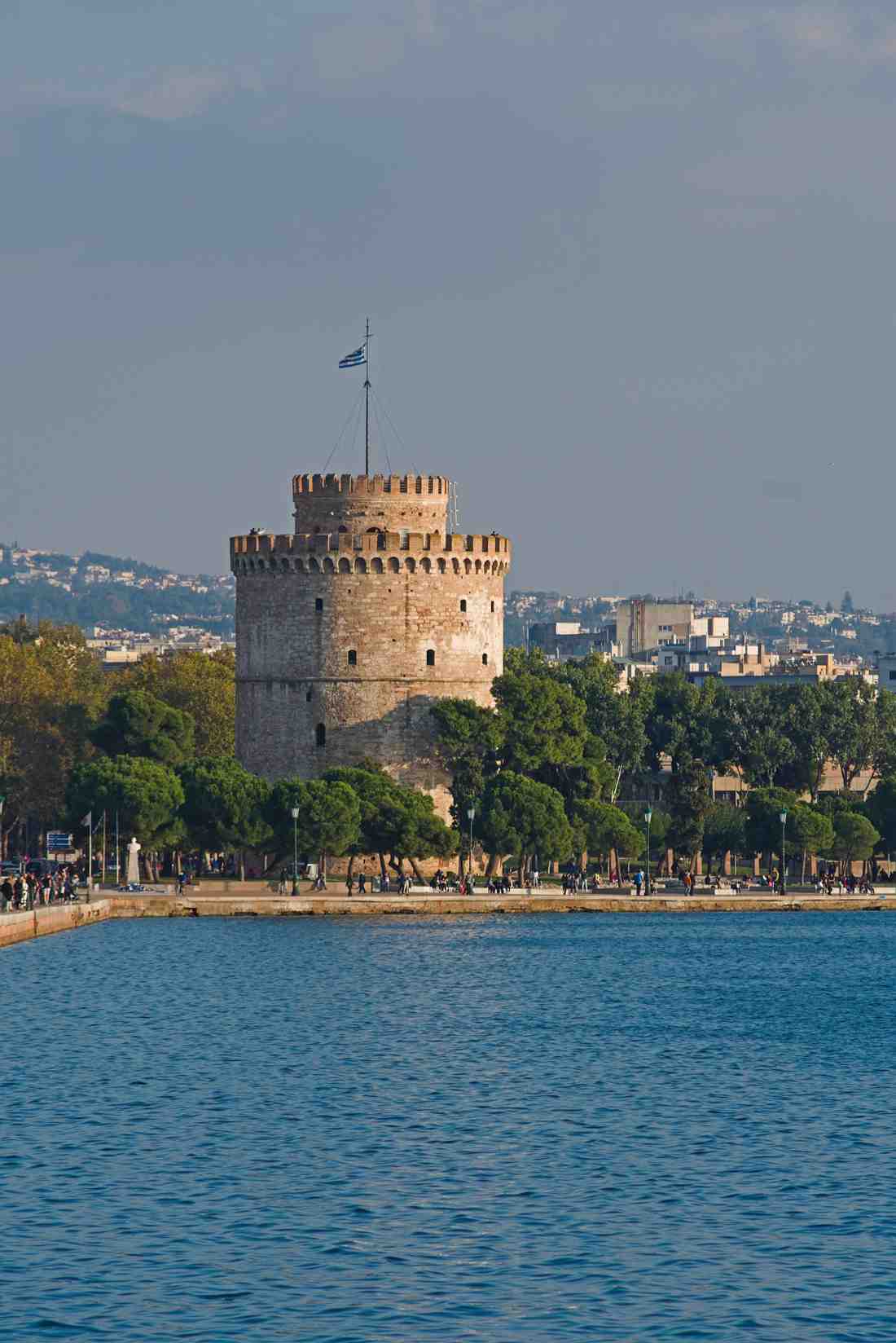
The White Tower is the emblem of Thessaloniki, a stone cylinder on the waterfront at the eastern end of the seafront promenade. The statue of Alexander the Great and the park stand close behind it. The tower once anchored the sea walls that ringed the port, and it now stands alone where the ramparts came down. Inside, a spiral ramp climbs past floors of a museum that reads the city across its Roman, Byzantine, Ottoman, Jewish, and modern layers. The roof crowns the climb with a wide view over the Thermaic Gulf. Plan the visit, book the guided walks, and read the port capital of Macedonia with My Greece Tours.
The monument rewards a slow look rather than a quick photo from the promenade. Its walls carry a garrison and a prison history, a grim nickname that predates the whitewash, and a museum that turns the climb into a timeline of the city. The sections below cover what the tower is, how it was built and renamed, and the story behind its darker name. The later parts turn to the museum floors, the rooftop panorama, how to reach it on foot, and how long a visit takes, with the guided options among the Thessaloniki tours that pair the landmark with the wider centre.
What is the White Tower of Thessaloniki?
The White Tower is a stone tower on the Thessaloniki waterfront, the city’s chief landmark. It once anchored the sea walls, later served as a garrison and prison, and now holds a museum of the city’s history.
The tower is a cylindrical stone keep about thirty-four metres tall, ringed by a lower outer wall and crowned by a turret that carried lookouts above the sea. It marks the point where the eastern land walls met the coastal fortifications, so it worked as both a bastion and a hinge in the defensive line. The round plan gave gunners a clear arc across the water and along the shore, which is why the design outlived the flatter curtain walls beside it.
The monument sits at the eastern end of the Nea Paralia, the seafront promenade that runs south from the old harbour. The statue of Alexander the Great rears on its plinth a short walk along the water, and the park and the concert hall spread behind. The tower reads as the anchor of the whole waterfront rather than a single stop. Its pale drum against the blue of the gulf is the image printed on the postcards and the fridge magnets of the city.
The tower earns its emblem status through survival as well as size. The sea walls that once flanked it were pulled down to open the shore, and the tower alone was kept as a marker of the vanished ring. That isolation, out on the edge of the water with open sky around it, is what makes the drum so recognisable. It lends the tower the role of a civic symbol on the crest of the city and its football clubs.
The landmark also works as a compass for a first visit. The grid of the rebuilt centre runs inland from the shore, and the tower fixes the southern corner of the walkable core. A traveller learning the streets can use it to orient the museums, the squares, and the markets. It heads most lists of things to do in Thessaloniki for that reason as well as for its own walls.
What is the history of the White Tower?
The present tower dates from the fifteenth century, raised under Ottoman rule on the footing of an earlier Byzantine fortification. It reinforced the sea walls, and Greek administration later remodelled and whitewashed it in the early twentieth century.
An earlier tower stood on the same corner of the coastal defences under Byzantine rule, guarding the junction of the land and sea walls. Ottoman forces took the city in the fifteenth century and rebuilt the seaward fortifications, and the stone drum that stands today rose from that programme. Master builders from the sultan’s works are credited with the round keep, which matched the artillery age better than the older square towers along the shore.
The tower served the garrison for centuries as a strongpoint and a store. Its walls and outer ring held guns and men who watched the approaches from the gulf. The structure formed one link in a wall that enclosed the whole city from the upper town down to the sea. The Byzantine acropolis and the Heptapyrgion fortress crowned the heights of Ano Poli, and the line ran down from there to meet the water at the tower.
Greek forces entered Thessaloniki in the early twentieth century as the city passed from Ottoman to Greek hands. The new administration cleared the tower’s grim associations along with its old coat, remodelled the interior, and whitewashed the exterior, which fixed the name it carries today. The sea walls beside it came down in the same era to open the shore for the modern promenade, leaving the tower standing alone.
The building has since changed use more than once, from military store to exhibition hall to the dedicated museum it holds now. Each phase left its mark on the interior, and the current layout threads the story of those changes into the displays. The tower stands protected as a monument of the city, listed among the historic fabric that the Byzantine and Ottoman walls of Thessaloniki still preserve.
Why was the White Tower given a darker name?
The tower served as a prison and a place of execution under Ottoman rule, which earned it the name Tower of Blood, or Red Tower. The whitewash of the early twentieth century replaced that name with the White Tower.
The keep held prisoners for long stretches of its garrison life, and mass executions took place within its walls and on its terrace. The bloodiest chapter fell on the janissaries, the sultan’s own infantry corps, put to death here during the purge that broke the order across the empire. The scale of the killings attached a reputation to the tower that ran well beyond the city.
Locals came to call it the Tower of Blood, and the Ottoman name Kanli Kule carried the same sense of the red stain of its cells. The name marked the building as a place to avoid rather than a landmark to admire, and it clung to the drum through the last decades of Ottoman rule. The grim title fixed the tower in the memory of the city as firmly as the stone did.
The change of name followed the change of hands. Greek administration whitewashed the exterior after the city passed to Greece, and the fresh white coat gave the tower the name it holds today. A popular account credits a prisoner who painted the walls in return for his freedom, a story that survives as folklore even where the record is thinner than the telling.
The whitewash has long since worn from the bare stone, yet the name endured. The tower reads as pale grey rather than gleaming white in most light, but the label from that single act of cleaning stuck fast to the monument. The shift from Tower of Blood to White Tower captures the wider turn of the city from an Ottoman garrison town to the Greek port it became.
What can you see inside the White Tower museum?
Inside, a spiral ramp and stair climb through six floors that hold a museum of Thessaloniki. The displays trace the city from its ancient founding through its Roman, Byzantine, Ottoman, Jewish, and modern chapters, floor by floor to the roof.
The route begins on the ground floor with the founding of the city in the late fourth century BC, told through projections and short films that set the scene for the climb. A spiral ramp winds up the inner wall of the drum, opening onto small round chambers that each carry a theme, so the ascent doubles as a walk forward through the centuries of the city’s life.
The lower floors turn to the fabric of the city and its monuments, the Roman forum, the churches, the walls, and the streets that still shape the centre. Higher chambers move to the people who filled those streets across the eras, their trades, their faiths, and the daily rhythm of the port. Greeks, Ottomans, and a large Jewish community lived side by side here for centuries before the losses of the modern age.
The upper rooms cover the economy, the arts, and the food that gave the city its character, from the market trades to the music and the flavours that still define the table. Sound, image, and object combine on each level rather than the glass cases of an older display style. That approach keeps the climb light and holds the thread of the story from one floor to the next.
The interior itself forms part of the exhibit. The thickness of the walls, the gun embrasures, and the worn stone of the ramp speak to the tower’s military past even as the screens tell the city’s history, so the fortress and the museum read as one. The spiral design rewards a steady pace, and the chambers are compact enough that the climb never feels like a long haul.
What is the view like from the top of the White Tower?
The roof terrace crowns the climb with a wide view over the Thermaic Gulf and the city grid. The waterfront and promenade run below, and Mount Olympus rises across the water to the south on a clear day.
The terrace sits above the turret at the head of the ramp, open to the sky and ringed by the parapet. The Thermaic Gulf fills the view to the south and west, a broad sweep of water that carries the ferries and the fishing boats of the port. The seafront promenade traces the shore below in a long curve, dotted with joggers and cyclists reading small against the water.
Inland the grid of the rebuilt centre spreads up the slope toward the upper town, its blocks and squares laid out in the plan that followed the great fire of the early twentieth century. The dome of the Rotunda and the towers of the Byzantine churches break the roofline, and the Byzantine walls trace the crest of the hill above, so the view doubles as a map of the layers below.
The long line of Mount Olympus closes the horizon across the gulf to the south, its ridge often capped with snow into the spring. The mythical seat of the gods reads clearest in the sharp light of morning or the hour before sunset, and the sea glows gold as the sun drops behind the mountain. The clarity of that view shifts with the season, which ties into the best time to visit for the widest horizon.
The rooftop repays a slow circuit rather than a single glance. Each side of the parapet frames a different piece of the city, the port and the cranes to the west, the promenade and the concert hall to the south, and the churches and walls to the north. The height is modest by the measure of a tower block, yet the open setting on the edge of the water gives the panorama a reach that taller viewpoints inland cannot match.
How do you visit the White Tower on foot?
The tower stands on the waterfront at the eastern end of the promenade, an easy walk from Aristotelous Square through the centre. The seafront path leads straight to it, and buses along the shore drop close to the base.
Aristotelous Square opens onto the water in the heart of the centre, and a stroll east along the seafront reaches the tower in about fifteen minutes. The route hugs the shore past cafés and the old harbour, flat and clear the whole way, so the walk works as an introduction to the waterfront rather than a chore to reach the door. The tower stays in view for most of the approach, which makes it hard to miss.
The city buses that run along the coastal avenue stop close to the tower for travellers based farther out or arriving from the train station. The waterfront itself is pedestrian for long stretches, and the park behind the tower gives shade and benches for a pause before or after the climb. A base near the centre keeps the landmark within walking range, which shapes the choice of where to stay in Thessaloniki for a first visit.
The interior climb runs up a historic spiral ramp and stair with no lift, so the museum floors and the roof suit travellers steady on stairs. The ground floor and the setting on the promenade stay open to everyone, and the park, the statue of Alexander, and the seafront views cost nothing and need no ticket. A guide can fold the tower into a wider walk of the Roman and Byzantine core for the full context.
The monument works well as either the start or the close of a day on foot. Reaching it early opens the roof before the light hardens, while an evening arrival catches the sunset over the gulf and the promenade at its liveliest. The surrounding cafés and the park make it a natural place to rest between longer stretches of sightseeing across the centre.
How long does a White Tower visit take?
A museum visit runs about an hour to ninety minutes, the climb, the six floors, and the roof included. Added to the promenade, the statue, and the park, the tower fills a relaxed half of a day in the centre.
The climb and the displays take most travellers roughly an hour at a steady pace, with the roof terrace worth the extra time on a clear day. The compact chambers keep the museum from turning into a marathon, and the multilingual audio material lets a visitor linger on the floors that hold the deepest interest and move quickly through the rest. A slower, thorough read of every screen stretches the visit toward ninety minutes.
The setting adds time beyond the tower itself. The promenade east and west of the base, the statue of Alexander, and the park behind combine into an easy waterfront loop that rounds the visit to a comfortable half of a day. Pairing the tower with a coffee on the seafront or an ice cream from the kiosks turns the stop into a natural break between the museums and the markets inland.
The landmark slots cleanly into a longer plan of the city. A first day on the seafront and the Roman core can open at the tower before turning inland to the Rotunda and the squares, which is how a compact Thessaloniki itinerary tends to weave it in. The tower repays a visit in most weather, though the widest rooftop views reward a check of the best time to visit Thessaloniki for the clearest air over the gulf.
The tower also suits a return at a different hour. A morning climb for the museum and a separate evening walk to the base for the sunset split the landmark across a stay, and each visit reads the monument in a different light. A guided walk adds the layers of history that the stone alone keeps quiet, and it links the tower to the walls, the churches, and the forum that share its story.
Frequently Asked Questions
Where is the White Tower located?
The White Tower stands on the Thessaloniki waterfront at the eastern end of the seafront promenade, beside the statue of Alexander the Great and the park behind it. It marks the point where the old sea walls once met the eastern land walls, an easy walk east from Aristotelous Square along the shore.
Why is it called the White Tower?
The name comes from the whitewash applied to the exterior in the early twentieth century, after Thessaloniki passed from Ottoman to Greek control. The fresh white coat replaced the tower’s earlier reputation as a prison and a place of execution, which had earned it the grim name Tower of Blood, or Red Tower, in the Ottoman era.
Can you go inside the White Tower?
Yes. The interior holds a museum of Thessaloniki spread across the floors of the tower, reached by a historic spiral ramp and stair. The displays trace the city from its ancient founding through its Roman, Byzantine, Ottoman, Jewish, and modern chapters, and the climb ends on a roof terrace with a wide view over the gulf.
How old is the White Tower of Thessaloniki?
The present tower dates from the fifteenth century, raised under Ottoman rule on the footing of an earlier Byzantine fortification that guarded the same corner of the sea walls. Greek administration remodelled and whitewashed it in the early twentieth century, which gave the monument the form and the name it carries today.
Is the view from the top worth the climb?
The roof terrace gives a wide panorama over the Thermaic Gulf, the seafront promenade, and the grid of the city climbing toward the upper town. Mount Olympus rises across the water to the south on a clear day, and the sea glows gold at sunset, so the rooftop rewards the climb up the spiral ramp for travellers steady on stairs.
How does the White Tower fit into a day in Thessaloniki?
The tower pairs naturally with the seafront promenade, the statue of Alexander, and the Roman core inland, filling a relaxed half of a day. A first day in the centre often opens or closes at the tower, with the museum climb taking about an hour and the surrounding waterfront adding an easy loop on foot.