
Ano Poli, the Upper Town, crowns the hill above the modern centre of Thessaloniki, a quarter of narrow lanes, timber-framed houses, and Byzantine churches ringed by the old city walls. The great fire of the early twentieth century cleared the lower town, yet the flames stopped below this ridge, so the district kept its Ottoman-era streetscape intact. Cobbled alleys climb past small squares, shaded cafes, and the towers of the fortifications to a wide view over the Thermaic Gulf. This guide maps what the quarter holds, its history, its monuments, and the walk that ties them together, planned with My Greece Tours.
The sections below cover what Ano Poli is, why it outlasted the fire, the walls and the Heptapyrgion fortress, the Trigonion Tower, the churches and monasteries, the panorama over the gulf, and the practical routes up and down the hill. Each answer opens with the essential detail first, then adds the history and the context behind it. Guided walks and private itineraries booked through Thessaloniki tours turn the plan below into a fixed schedule, so a half-day climb or a slower afternoon in the upper town runs without guesswork.
What is Ano Poli, the Upper Town of Thessaloniki?
Ano Poli is the old upper quarter of Thessaloniki, climbing the hill above the modern centre to the Byzantine walls. Its Ottoman-era houses and cobbled lanes form the city’s oldest surviving streetscape.
Ano Poli sits north of the city centre, wrapped around the acropolis hill at the top of Thessaloniki. The name translates as Upper Town, and the quarter rises through a grid of stepped alleys that grow steeper toward the ramparts. Wooden houses lean over the lanes on carved brackets, vines cover the courtyards, and shaded platanos squares break the climb. The district reads as a village stitched into a working city, and it holds the texture the lower centre lost to fire and rebuilding.
The quarter carries layers of rule in its stones. Byzantine emperors raised the walls that still crown the hill, and the fifteenth-century Ottoman conquest turned the upper slopes into a Muslim residential district of officials and soldiers. Fountains, a hammam, and timber konak houses survive from that period, mixed with the Greek homes that filled the lanes later. A walk here crosses the medieval and Ottoman city within a short climb.
Ano Poli ranks among the essential stops on any list of things to do in Thessaloniki, and it pairs the monuments of the lower city with a quieter, older mood. The climb rewards travellers who want the view, the churches, and the cafe terraces over the roofline. A loose wander suits the quarter better than a fixed checklist, since the pleasure lies in the lanes themselves.
Why did Ano Poli survive the great fire of Thessaloniki?
Ano Poli survived because its hillside position lay above the fire line. The great blaze of the early twentieth century swept the crowded lower town for three days, yet the flames never climbed the ridge to the upper quarter.
The fire broke out in a kitchen in the packed lower centre and spread through timber houses toward the waterfront. Three days of flames cleared the historic core, from the port up to the edge of the upper town, and left tens of thousands of residents homeless. The disaster erased churches, markets, and the old Jewish quarter at the heart of the port.
Ano Poli stood clear of the destruction. The steep ground, the gardens, and the open squares between the houses slowed any spread, and the ridge marked the upper limit the fire reached. The quarter kept its Ottoman-era layout while the architect Ernest Hébrard redrew the burnt centre below into a modern grid of broad avenues.
The contrast defines the district today. Down the hill the visitor walks arcaded boulevards from the twentieth-century plan, then climbs into lanes that keep the medieval and Ottoman street pattern. That survival makes Ano Poli the one part of central Thessaloniki where the pre-fire city stands, and it explains why the quarter draws travellers hunting the old town.
What are the Byzantine walls and the Heptapyrgion fortress?
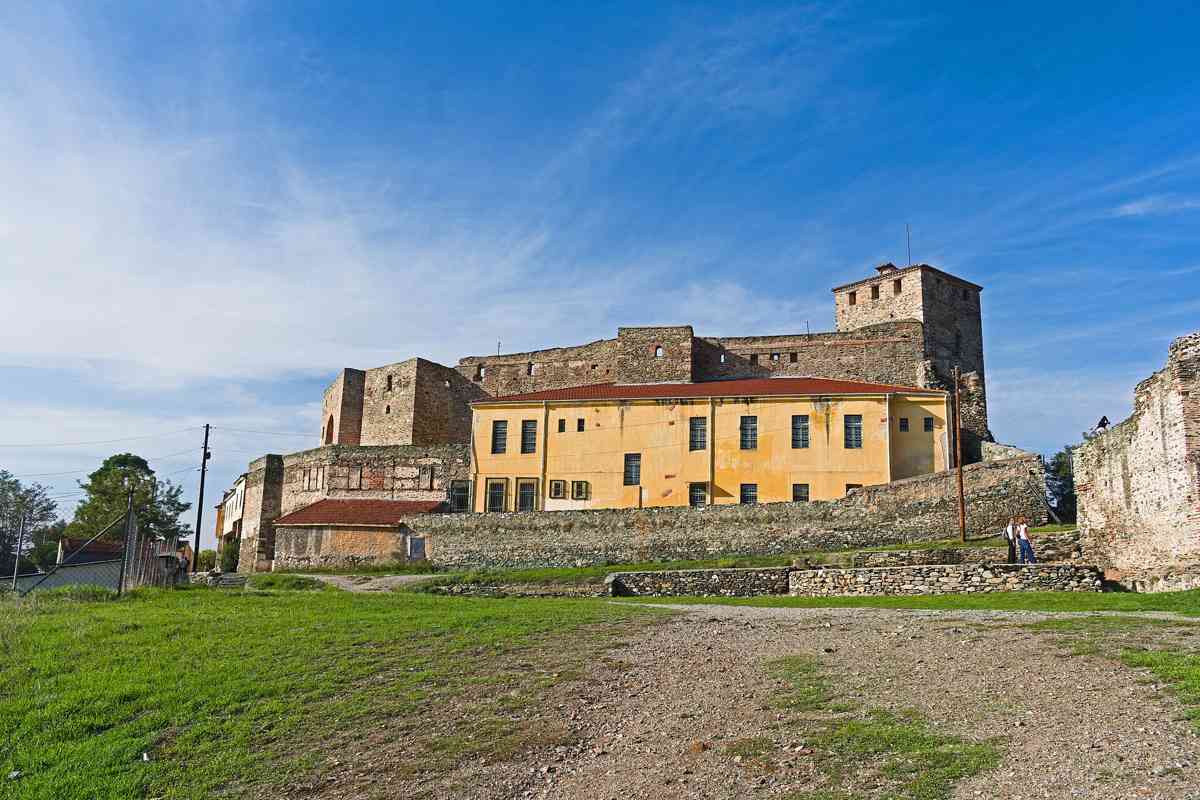
The Byzantine walls ring the top of Ano Poli, and the Heptapyrgion fortress crowns their highest corner. The citadel, also called Yedi Kule, guarded the acropolis and served for a long period as a prison.
The city walls date from the Byzantine centuries, built on earlier Roman lines to defend the port and the acropolis above it. The ramparts run unbroken across the top of the upper town, cut by gates that once controlled the road inland. Towers punctuate the circuit, and a footpath traces the outside of the wall with the city dropping away below.
The Heptapyrgion holds the northern corner where the acropolis meets the main enceinte. Its name means Fortress of Seven Towers, and its oldest sections rise from the Byzantine period, reinforced by later Ottoman builders into the strongpoint of the upper town. An Ottoman inscription over the main gate records one such rebuild in carved marble.
The fortress served as a jail well into the twentieth century, and the cell blocks and yards still stand inside the walls. Restoration opened the site to visitors, who cross the courtyards and climb sections of the rampart. Panels along the route trace the layers from Byzantine garrison to Ottoman citadel to prison.
What does the Trigonion Tower offer?
The Trigonion Tower marks the northeast angle of the Byzantine walls, above the old cemetery gardens. Its rounded artillery bastion gives one of the widest outlooks in Thessaloniki, across the whole city to the Thermaic Gulf.
The tower rose in the late Byzantine to early Ottoman period as a gun platform to guard the vulnerable corner of the fortifications. Its thick round form suited cannon, and the design replaced an older square tower on the same spot. The name comes from the triangular junction of the walls it defends.
The Trigonion answers its more famous counterpart on the shore, the White Tower, at the opposite end of the old fortified line. From this height the walls run down toward the sea, and the tower gives the classic upper-town panorama that appears on postcards of the city. Benches and a small square outside the gate make it a natural pause on the climb.
The spot draws walkers at the golden hour before sunset. The light catches the roofs of Ano Poli, the masts in the marina, and the ridge of Mount Olympus across the water on a clear evening. The open terrace works as the finish of an upper-town walk, with a cafe or two nearby for a drink over the view.
Which churches and monasteries stand in Ano Poli?
Ano Poli holds Byzantine churches on the UNESCO list, led by the Vlatadon Monastery, the Church of Osios David, and Agios Nikolaos Orfanos. Each preserves mosaics or frescoes under low domes on the hillside.
The Vlatadon Monastery keeps a working religious community on a terrace above the walls, founded in the fourteenth century. Its garden holds peacocks and a wide view over the city, and tradition links the site to the apostle Paul’s preaching in Thessaloniki. The monastery guards manuscripts and an institute for Byzantine studies alongside its chapel.
Osios David, higher in the lanes, hides one image worth the climb. A mosaic of Christ in glory from the early Christian centuries survives in the apse, saved behind a later wall of plaster and rediscovered intact. Agios Nikolaos Orfanos, set in a rambling garden nearby, keeps a fresco cycle from the Palaiologan revival under its timber roof.
The churches thread naturally into a walk through the quarter. Small, low, and built in warm stone and brick, they sit among the houses rather than apart from them. A loop links Osios David, Agios Nikolaos Orfanos, and the Vlatadon terrace with the walls, and the doors reward a quiet look at the medieval city’s faith.
What views does the Upper Town give?
The Upper Town gives the widest panorama in Thessaloniki, from the Byzantine walls and the Trigonion Tower. The view runs across the whole city to the Thermaic Gulf, with Mount Olympus on the horizon on a clear day.
Height is the reward for the climb. From the ramparts the roofs of Ano Poli fall away to the modern grid, the dome of the Rotunda and the White Tower mark the lower city, and the harbour opens onto the bay. The wall walk gives a moving panorama that shifts with each tower.
The gulf frames the scene. The flat water of the Thermaic Gulf stretches south from the port, and the long ridge of Mount Olympus closes the horizon across the bay, snow-capped into late spring. The clearest air of morning and the low light before sunset sharpen the distant peak.
The terraces make the most of it. Cafes and tavernas along the walls set their tables toward the view, and a coffee or a plate of meze pairs the panorama with a rest. The upper-town spots sit apart from the busier Thessaloniki restaurants of the lower centre, trading the crowd for the outlook.
How do you get up to Ano Poli?
Ano Poli sits a steep kilometre above the centre, reached on foot, by local bus, or by taxi. Walking up is a demanding climb of roughly one hundred metres, while walking down is the easier direction.
The walk is the classic approach. Stepped alleys climb from the churches of the lower town through the quarter to the walls, gaining about one hundred metres over cobbles and stairs. The route rewards the effort with lanes and squares along the way, though the gradient and the surface ask for good shoes and a slow pace.
Public buses cover the climb for travellers who want to save their legs. City routes run up toward the upper town and the Heptapyrgion from the centre, and a ticket costs the standard urban fare. A taxi covers the same run quickly and cheaply by western standards, and drivers know the drop-off points by the walls.
The smart plan rides up and walks down. A bus or taxi to the top near the Heptapyrgion or the Trigonion Tower saves the hard ascent, and the descent through the lanes turns into a gentle downhill wander to the centre. That order keeps the views ahead and the effort low on the way back.
How do you walk Ano Poli in an afternoon?
A walk through Ano Poli starts at the Trigonion Tower, follows the walls to the Heptapyrgion, then drops through the lanes past Osios David and the Vlatadon Monastery. The loop runs two to three hours at a gentle pace.
The route begins at the top for the view. From the Trigonion Tower the path traces the outside of the Byzantine walls to the Heptapyrgion, with the city spread below the whole way. The fortress gates and the rampart towers give the high points of the walk, and the ground stays level along the wall line.
The descent threads the monuments. From the citadel the lanes drop past the Vlatadon terrace, the fountains, and the Tsinari corner, an old crossroads with a shaded taverna and cobbled squares. Osios David and Agios Nikolaos Orfanos sit a short detour off the main line, worth the doors for their mosaics and frescoes.
The pace matters more than the plan. A loose wander suits the quarter, since the pleasure lies in the leaning houses, the cats on the steps, and the sudden gaps that frame the gulf. A guided walk adds the history behind the walls and churches, while a self-guided loop rewards a map and a free afternoon.
When is the best time to visit Ano Poli?
The golden hour before sunset is the best time to visit Ano Poli, when low light sharpens the view over the gulf. Late spring and early autumn bring the mildest weather for the steep climb.
The light rules the timing. The hour before sunset floods the walls and the roofs with warm colour, and the sun drops behind Mount Olympus across the water for the quarter’s signature view. Morning gives the clearest air for the distant peak, and the cooler start suits the uphill walk.
The season shapes the effort. May, June, September, and October bring warm, dry days ideal for the climb and the wall walk, before or after the peak heat. High summer turns hot and humid, which pushes the ascent to the early morning or the evening and makes the shaded squares and cafes welcome.
Winter keeps the quarter quiet and atmospheric. Crisp, clear days give long views to a snow-capped Olympus, and the lanes empty of visitors. Rain slicks the cobbles and stairs, so sturdy shoes matter more in the wet months, and a mild afternoon between fronts rewards the walk with sharp air and open horizons.
How does Ano Poli fit into a day or two in Thessaloniki?
Ano Poli fills a half-day at the end of a Thessaloniki visit, climbed after the lower monuments and markets. Two days let the quarter close the second afternoon, timed to the sunset over the gulf.
The upper town slots naturally into the second half of a city break. A first day loops the White Tower, the Roman monuments, and the Byzantine churches of the lower centre, and a second climbs to the walls and the fortress. A planned Thessaloniki itinerary threads the quarter into the wider run of sights across two or three days.
A base below the quarter shortens the climb. Rooms in the central grid near Aristotelous keep the upper town within a short bus ride or a steady walk, while a stay in Ano Poli itself trades the daily ascent for the view and the village calm. A guide to where to stay in Thessaloniki matches each district to the shape of a trip.
The quarter also frames the day trips beyond the city. From the walls the traveller reads the whole region, the gulf, Olympus, and the road inland toward the Macedonian tombs and Meteora. A morning in the upper town pairs with an afternoon on the water or an early start for an excursion, and it gives the clearest fix on the setting of Thessaloniki before the wider trip begins.
Frequently Asked Questions
Is Ano Poli worth visiting in Thessaloniki?
Ano Poli ranks among the essential stops in Thessaloniki. The old upper town survived the great fire of the early twentieth century, so it keeps the Ottoman-era houses, cobbled lanes, and Byzantine churches the lower city lost. The Heptapyrgion fortress, the Trigonion Tower, and the walls give the widest view over the gulf, and the quiet squares and cafes reward a slow afternoon away from the crowds below.
How do you get to Ano Poli from the centre?
Ano Poli sits a steep kilometre above the centre, reached on foot, by local bus, or by taxi. The walk climbs about one hundred metres over cobbles and stairs from the lower churches, a demanding ascent. City buses and cheap taxis cover the same run for travellers who prefer to ride up and walk down through the lanes.
What is there to see in Ano Poli?
Ano Poli holds the Byzantine city walls, the Heptapyrgion fortress, and the Trigonion Tower, along with UNESCO-listed churches. The Vlatadon Monastery, Osios David with its early Christian mosaic, and Agios Nikolaos Orfanos with its frescoes stand among the leaning houses. The panorama over the city and the Thermaic Gulf, with Mount Olympus on the horizon, ranks as the quarter’s headline draw.
Is the walk up to Ano Poli difficult?
The climb to Ano Poli gains about one hundred metres over cobbled alleys and stairs, a demanding walk that asks for good shoes and a steady pace. Walking down is far easier than walking up. A bus or a taxi to the top near the Heptapyrgion saves the hard ascent, leaving a gentle downhill wander back to the centre.
What is the Heptapyrgion in Ano Poli?
The Heptapyrgion, also called Yedi Kule, is the citadel that crowns the Byzantine walls at the top of Ano Poli. Its name means Fortress of Seven Towers, and its oldest sections rise from the Byzantine period, reinforced later by Ottoman builders. The fortress served for a long period as a prison, and restoration now opens its courtyards and ramparts to visitors.
When is the best time to visit Ano Poli for the view?
The hour before sunset is the finest time for the Ano Poli view, when low light warms the walls and the sun drops behind Mount Olympus across the gulf. Morning gives the clearest air for the distant peak. Late spring and early autumn bring the mildest weather for the climb, while high summer pushes the walk to the cooler ends of the day.