
Ottoman Thessaloniki is the layer of the city that grew across nearly five centuries of Ottoman rule, and it survives as a thread of baths, mosques, markets, and fountains woven through the Roman and Byzantine streets. The bathhouse on Egnatia, the covered cloth hall behind the shops, the striped minaret above the poorhouse, and the pink house where the founder of modern Turkey was born all belong to that thread. Follow it on foot and the city reads as a stack of eras rather than a single age. Trace the Ottoman monuments from the seafront to the upper town with My Greece Tours.
The Ottoman city rewards a slow walk that links the survivors rather than a single stop at one landmark. Its buildings sit tucked among the Roman forum, the Byzantine churches, and the modern boulevards, so a good route stitches the centuries together in one line. The sections below cover what Ottoman Thessaloniki is, the Bey Hamam and its baths, the mosques that still stand, the Bezesteni and the markets, the White Tower, and the Atatürk House, before the closing walk ties them into the wider city. The later parts fold the monuments into a day on foot on the guided Thessaloniki tours.
What is Ottoman Thessaloniki?
Ottoman Thessaloniki is the city built during the nearly five centuries of Ottoman rule, from the early fifteenth century to the early twentieth. Its baths, mosques, markets, and fountains survive among the Roman and Byzantine streets of the centre.
Ottoman forces took the city in the early fifteenth century, when the armies of sultan Murad the Second breached the walls and ended the last spell of Byzantine and Venetian control. The conquest opened a long chapter that lasted until the city passed to Greece in the early twentieth century. Across those centuries the rulers turned churches into mosques, raised bathhouses and covered markets, and settled a mixed population of Muslims, Orthodox Christians, and a large Sephardic Jewish community drawn from the western Mediterranean. The result was one of the most varied cities of the empire.
The Ottoman builders worked on top of the Roman and Byzantine city rather than clearing it away. They converted the round hall of Galerius and the great basilicas into mosques, added minarets to the old domes, and threaded their own halls between the ancient monuments. That habit of reuse is why the Rotunda wears an Ottoman spire above its Roman brick, and why the churches of the upper town kept their fabric through the centuries of the mosque. The layers sit in contact rather than in sequence.
A great fire late in the chapter, and the exchange of populations in nineteen twenty-three, thinned the Ottoman city that a visitor sees now. The fire razed much of the lower town, and the exchange moved the Muslim population to Turkey, so many mosques lost their congregations and passed to new uses. What survives is a set of anchor monuments rather than a whole quarter, told in fuller depth in the history of Thessaloniki. Each surviving building carries a slice of the vanished city.
What is the Bey Hamam, the Baths of Paradise?
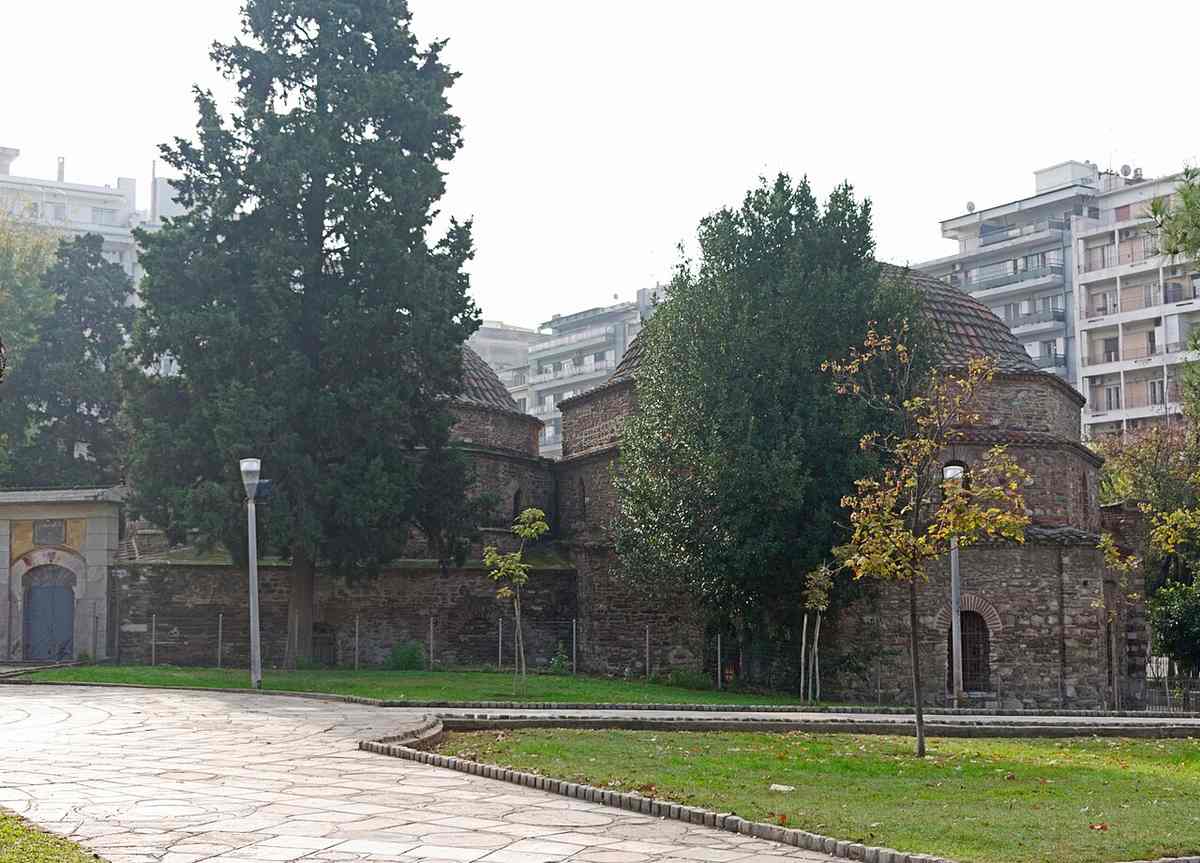
The Bey Hamam is the oldest Ottoman bathhouse in Thessaloniki, raised on Egnatia avenue in the mid fifteenth century by sultan Murad the Second. Residents later knew it as the Baths of Paradise.
The bathhouse stands as a double hamam, with one wing built for men and a separate wing for women, each with its own door onto the street. A bather passed through a sequence of rooms graded by heat, from the cold undressing hall to the tepid middle room and the hot chamber at the core. Marble benches, basins, and low arcades line the halls, and star-shaped openings pierce the domes overhead to drop shafts of daylight onto the steam. The plan follows the classic Ottoman bath, itself an heir to the Roman thermae that once stood in the same city.
The building kept its working life far longer than the empire that raised it. Bathers used the halls under the name of the Baths of Paradise into the late nineteen-sixties, which made the Bey Hamam one of the last of its kind still in service anywhere in the region. The long use spared the structure the neglect that erased many of its peers, so its domes, its marble, and its painted plaster came down to the present in strong condition. Few Ottoman baths carry such an unbroken record of use.
The earthquake of the late nineteen-seventies cracked the fabric and closed the baths, which opened a campaign of careful restoration that returned the halls to public view. The Bey Hamam now works as a monument and a venue for exhibitions and cultural events rather than a working bath. Its position on the main avenue, a step from the Byzantine church of Panagia Chalkeon, places it early on any walk of the Ottoman city. The monument reopened after a further round of conservation that renewed its domes and its marble.
Which Ottoman mosques still stand in Thessaloniki?
Four Ottoman mosques mark the centre: the Hamza Bey Mosque on Egnatia, the Alaca Imaret with its striped minaret, the Yeni Cami built for the Dönme community, and the Rotunda, whose spire is the only minaret left standing.
The mosques of Thessaloniki fall into two groups, the churches turned into mosques after the conquest and the mosques built new by Ottoman patrons. The converted churches lost their minarets after the city passed to Greece, so the Rotunda alone keeps its Islamic tower. The purpose-built mosques kept their form and now serve as monuments, exhibition halls, and museums. Each carries the name of the patron who paid for it, a habit that fixes the building to a governor, a sultan, or a community.
The Hamza Bey Mosque (Alcazar)
The Hamza Bey Mosque rises at a busy crossroads on Egnatia, built in the late fourteen-sixties and counted as the oldest surviving mosque in the city. A daughter of the commander Hamza Bey paid for its construction, and later hands enlarged it around a peristyle courtyard ringed by an arcade. The building spent part of the modern era as a cinema under the name Alcazar, which buried its courtyard behind shops and screens. A long restoration has stripped away the cinema and returned the mosque toward its original plan, arcade and prayer hall together.
The Alaca Imaret
The Alaca Imaret stands in the upper reach of the centre, raised in the fourteen-eighties by Ishak Pasha, a governor of the city under sultan Bayezid the Second. Its name means the coloured or variegated poorhouse, a nod to the banded stone that once patterned the shaft of its minaret. The building served as a mosque and an imaret at once, a charitable kitchen that fed the poor and lodged travellers and students beside the prayer hall. Twin domes cover the central room, and side chambers held the school and the alms kitchen that gave the foundation its charitable arm.
The Yeni Cami and the Rotunda minaret
The Yeni Cami, the new mosque, went up late in the Ottoman chapter for the Dönme, a community descended from followers of Sabbatai Zevi who had converted from Judaism to Islam while keeping their own rites. Its architect blended Ottoman, European, and eclectic forms into a striking façade, and the building later held the city’s archaeological collection. The Rotunda’s slim stone minaret, meanwhile, survived the removal of the city’s other Islamic towers and remains the sole example left standing, a pairing of Roman dome and Ottoman spire found nowhere else in the country.
What was the Bezesteni and the Ottoman markets?
The Bezesteni is a covered Ottoman cloth market of the mid fifteenth century, a stone hall of lead-sheathed domes built to trade silk and fine textiles. It still works as a market in the lower town.
The word bezesteni comes through Turkish from a Persian root that names a hall for the trade in cloth, and the type marked the heart of every large Ottoman market town. The Thessaloniki hall dates to the mid fifteenth century, a rectangle roofed by a run of small lead-covered domes and pierced by heavy gates that could be locked at night. Merchants sold silk, brocade, and other costly stuffs inside, so guards watched the doors and the goods rested behind stone walls. The building reads as a strongroom for trade as much as a shop.
The Bezesteni still shelters small traders under its old domes, which keeps the hall in the working life of the city rather than the museum case. Its lanes join the wider bazaar quarter that the Ottomans set out around it, a grid of covered ways and open stalls that fed the port and the caravans. That quarter runs into the later arcades and food halls that grew up beside it, told at greater length in the story of the Bezesteni and Modiano markets. The commercial thread of the city has held to the same ground for centuries.
The markets tie the Ottoman city to its Jewish and Christian traders as much as its Muslim ones. The Sephardic community that arrived after the expulsions from the western Mediterranean built much of the commerce that filled these halls, a story carried in the record of Jewish Thessaloniki. Silk from the Balkans, dye, and worked metal all passed through the covered ways, so the Bezesteni sat at the centre of a trade that reached far beyond the walls. The market was the meeting ground of the mixed city.
Is the White Tower an Ottoman monument?
The White Tower is an Ottoman rebuild of the early modern period, raised on the corner of the sea walls to strengthen the harbour defence. It later served as a garrison and a prison before it became the city museum.
The tower a visitor sees on the seafront is an Ottoman work that replaced an older Byzantine tower on the same corner of the fortifications. Its builders raised a stout cylinder of stone, ringed by a low outer wall, to close the seaward end of the great circuit that climbed to the citadel. The design belongs to the age of gunpowder, when thick round towers replaced the tall thin towers of the medieval wall. The structure anchored the whole southern flank of the defence.
The tower earned a grim name in the Ottoman centuries, when it held prisoners and, by tradition, saw executions that gave it the byname of the Tower of Blood. A coat of whitewash, applied to soften that reputation, left it pale against the sea and fixed the name it carries now. The tower shed its dark past when the city passed to Greece, and it took on its role as a landmark. The account of the White Tower traces its turns from fort to prison to museum.
The tower now holds a museum of the city spread over its circular floors, with a ramp that spirals up to a viewing gallery at the crown. From the top a visitor reads the whole sweep of the waterfront, the domes of the Ottoman city, and the line of the walls climbing the hill behind. The tower marks the natural hinge of a walk, the point where the seafront promenade meets the historic core. It gathers the layers of the city into one view.
Where was Atatürk born in Thessaloniki?
Mustafa Kemal Atatürk, the founder of modern Turkey, was born in the early eighteen-eighties in a pink three-storey house in the upper town of Thessaloniki. The house survives as a museum within the grounds of the Turkish consulate.
The founder of the Turkish republic entered the world in a corner house on a lane that climbs toward the upper town, when the city still lay under Ottoman rule. The building is a typical Ottoman town house of painted wood and stone, three storeys tall, with an enclosed upper balcony that oversails the street. Its pink walls and shuttered windows mark it out from the newer blocks around it. The house preserves the domestic form of the Ottoman city that the fire and the rebuilding erased elsewhere.
The house now works as a museum, laid out with furnishings and belongings that recall the family and the era. It stands within the walled grounds of the Turkish consulate, so a visit passes through a security check before it reaches the rooms. The site draws a steady stream of visitors from Turkey who come to see the birthplace of the leader who reshaped their state. The museum keeps the interior close to the pattern of a well-to-do Ottoman household.
The birthplace roots the modern history of the two countries in a single Ottoman house, a reminder that the city bred figures who shaped the region far beyond its walls. Its position in the sloping lanes below the citadel puts it on the natural path up to the old quarter, where the Ottoman houses cluster thickest. A guided walk sets the house in the wider fabric of the vanished Muslim city. The building bridges the Ottoman past and the national stories that followed.
How do you walk the Ottoman city among the Roman and Byzantine layers?
A walk of Ottoman Thessaloniki runs from the Bey Hamam on Egnatia through the Bezesteni and the mosques to the White Tower, then climbs to the upper town for the fountains, the tekkes, and the Atatürk House.
The best thread starts at the Bey Hamam on the main avenue, where the Ottoman city meets the Byzantine church beside it, and runs east past the Hamza Bey Mosque toward the Rotunda and its lone minaret. From there the line drops through the bazaar quarter and the Bezesteni to the seafront, where the White Tower closes the walls at the water. The route sets Ottoman baths and markets against Roman arches and Byzantine domes at nearly every turn. A steady pace covers the lower thread in a single morning.
The climb to Ano Poli, the Upper Town opens the second half of the walk, where the fire spared the old streets and the Ottoman houses lean over narrow lanes. Stone fountains still mark the corners of the upper town, relics of the water system that served the Ottoman quarters, and a scatter of tekkes, the lodges of the dervish orders, survive among the churches and the walls. The Alaca Imaret sits on the edge of this reach, close to the line of the walls that climb to the citadel.
The reward of the walk is the way the eras sit in contact rather than apart, a lesson best drawn with a guide who reads the layers in order. A route that pairs the Ottoman monuments with the Roman forum and the Byzantine churches recovers the full stack of the city, the shape a Thessaloniki walking tour tends to follow. Pace it across a relaxed day and the baths, the mosques, and the markets fall into place beside the older stones. Fold the thread into a wider Thessaloniki itinerary and the Ottoman city takes its rightful place among things to do in Thessaloniki.
Frequently Asked Questions
What is the oldest Ottoman monument in Thessaloniki?
The Bey Hamam, raised in the mid fifteenth century, ranks as the oldest and finest Ottoman bathhouse in the city and in Greece. The Hamza Bey Mosque, built a couple of decades later, counts as the oldest surviving mosque, while the Rotunda’s minaret is the only Islamic tower left standing above the city.
Can you visit the Bey Hamam baths?
Yes. The Bey Hamam opens as a monument on Egnatia avenue, close to the Byzantine church of Panagia Chalkeon, and it hosts exhibitions and cultural events under its domes. The double bath, its heated rooms, its marble benches, and the star-shaped openings in the domes stay on view, though the halls no longer work as a functioning bathhouse.
Why does the Alaca Imaret have a striped minaret?
The name Alaca Imaret means the coloured poorhouse, a reference to the banded stone that once patterned the shaft of its minaret. Ishak Pasha, a governor of the city, raised it in the fourteen-eighties as a mosque and an imaret, a charitable kitchen that fed the poor and lodged travellers beside the twin-domed prayer hall.
Who was born in the Atatürk House in Thessaloniki?
Mustafa Kemal Atatürk, the founder and first president of modern Turkey, was born in the pink three-storey house in the early eighteen-eighties, when the city lay under Ottoman rule. The house now works as a museum within the grounds of the Turkish consulate, laid out with furnishings that recall the family and the era.
How many Ottoman mosques remain in Thessaloniki?
The clearest survivors are the Hamza Bey Mosque, the Alaca Imaret, and the Yeni Cami, each preserved as a monument or exhibition hall. The Rotunda, a Roman hall turned church and then mosque, keeps the only minaret left standing, while other converted churches lost their towers after the city passed to Greece.
Is the White Tower Ottoman or Byzantine?
The White Tower on the seafront is an Ottoman rebuild of the early modern period, raised on the corner where an older Byzantine tower once stood. It served the Ottoman garrison as a fort and a prison before it took on its role as the emblem and city museum of modern Thessaloniki.