
Jewish Thessaloniki is the memory of a Sephardic metropolis, the city that Jews expelled from Spain rebuilt on the Aegean and that generations of them called the Mother of Israel. For more than four centuries the community shaped the port, the trades, and the streets, spoke Ladino as its daily tongue, and made Thessaloniki one of the great Jewish cities of the world. Fire, dispersal, and the Holocaust cut that world down, yet its synagogues, its museum, its markets, and its memorials still mark the modern city. Trace the Sephardic story from the harbour to the university and read it into the fabric of the streets with My Greece Tours.
The Jewish past is not a single monument but a layer that runs under the whole centre, from the covered markets to the seafront squares. The sections below cover how the Sephardim reached the city, why it earned the name Mother of Israel, how the great fire and the war reshaped the quarters, and what a traveller can see today. The later parts turn to the Jewish Museum, the surviving synagogues, and the memorials, and to how a guided walk folds them into the wider Thessaloniki tours.
What is Jewish Thessaloniki?
Jewish Thessaloniki is the Sephardic city that grew here after Jews expelled from Spain settled under Ottoman rule. For centuries Jews formed the majority, spoke Ladino, and gave the port the name Mother of Israel.
The Jewish presence in the city reaches back long before the Sephardim. A Greek-speaking community, the Romaniotes, lived here in the Hellenistic age, more than two thousand years ago, and a Jewish congregation is recorded in the city during the early Christian centuries. That older strand set the ground for the far larger community that arrived from the western Mediterranean and reshaped the whole character of the port.
The Sephardic city that followed stood apart from every other in Europe for one plain fact. Jews made up the largest single group in Thessaloniki for much of the Ottoman period, not a minority in a quarter but the dominant community of a major imperial harbour. Their tongue, their trades, and their calendar set the rhythm of the streets, and the name Mother of Israel spread through the Jewish world for the size and the learning of the community.
The Jewish story runs through the whole life of the port, so it belongs beside the Roman, Byzantine, and Ottoman layers that fill the wider the history of Thessaloniki. A traveller who reads the Jewish city reads the reason the harbour grew rich, the markets took their names, and the modern centre carries the memorials it does. That thread ties the sights of the seafront to a past that shaped the whole of Salonica.
How did Sephardic Jews come to Thessaloniki?
Sephardic Jews reached Thessaloniki after the Spanish crown expelled them in fourteen ninety-two under the Alhambra Decree. The Ottoman Empire welcomed the exiles, and thousands settled in the port within a few years of the expulsion.
The expulsion drove the Jews of Spain out to the ports of the Mediterranean, and the Ottoman sultan opened his cities to them. Thessaloniki drew one of the largest waves, with a body of exiles from Spain settling in the harbour shortly after they were driven from the Iberian kingdoms. Jews from Portugal, Italy, and central Europe joined them over the decades, so the community gathered the scattered strands of the western diaspora into one city.
The exiles carried their language with them, and it took root as the everyday speech of the community. Ladino, or Judeo-Spanish, a form of old Castilian written in Hebrew letters, became the street tongue of Jewish Thessaloniki and held that place for centuries. It absorbed Hebrew, Turkish, Greek, and Italian words down the generations, yet its Spanish core kept the memory of the lost homeland alive in daily use.
The sixteenth century brought the community its golden age, when the newcomers built the trades and the learning that made the city famous. Printing presses turned out Hebrew books, rabbinic academies drew students from across the Jewish world, and the wool and textile trades tied the port to markets far beyond the Aegean. The exiles of fourteen ninety-two had, within a single lifetime, turned a provincial harbour into a capital of Sephardic life.
The Ottoman order let the community govern much of its own life. Jewish Thessaloniki ran its own courts, schools, and charities under its rabbis, and it organised itself into congregations named for the home cities of the exiles. That self-rule let the Sephardic tradition of Spain carry on intact in a new land, with its own law, its own presses, and its own tongue. The community grew into a settled world rather than a refuge, rooted in the port for the four centuries that followed the expulsion.
Why was Thessaloniki called the Mother of Israel?
Thessaloniki earned the names Mother of Israel and Jerusalem of the Balkans because Jews formed the majority of its people and led its commerce. The port itself fell quiet on the Jewish Sabbath, a mark of the community’s weight.
The scale of the community set the city apart across the whole of Europe. Jews made up the largest group in the port for long stretches of the Ottoman centuries, a standing that no other European city could match. That majority ran the markets, the workshops, and the harbour, so the Jewish calendar shaped the working week of the entire town rather than one quarter of it.
The harbour carried the clearest sign of that weight. Jewish stevedores and porters worked the quays in such numbers that the port of Salonica fell still on Saturday, when the community kept its Sabbath rest. A trading harbour that closed for the Jewish day of rest, week after week, told every visitor how far the community reached into the ordinary life of the city.
The community lived in quarters that spread across the lower town, near the sea and the covered markets. Its synagogues, named for the home cities of the exiles, from Aragon to Sicily to Provence, stood in the streets between the harbour and the walls. That dense Jewish core sat within a short walk of the seafront that the White Tower still anchors, so the memory of the Sephardic port survives in the ground a modern walk crosses.
How did the great fire reshape the Jewish quarters?
The great fire of nineteen-seventeen swept through the lower town and burned out the heart of the Jewish quarters. It left tens of thousands of Jews homeless, destroyed synagogues and archives, and scattered the community across new districts.
The blaze tore through the crowded streets between the seafront and the upper town in the closing years of the First World War. It razed the historic Jewish quarters that had stood near the harbour for centuries, along with the synagogues, schools, and records held there. The fire fell hardest on the community that had filled the lower town, and it erased at a stroke much of the built memory of Sephardic Salonica.
The rebuilding that followed redrew the map of the city and broke up the old Jewish core. Planners laid out wide new avenues across the burnt ground, and many displaced families moved to fresh districts on the edge of the town rather than back to the quarters they had lost. The dense Jewish heart of the lower town, gathered for four centuries, was dispersed into scattered neighbourhoods.
The fire spared the old upper town, where the lanes of Ano Poli kept their Ottoman houses above the flames, yet the lower districts were remade. New covered markets rose on the rebuilt ground, among them the hall that carried the name of the Jewish Modiano family. The community carried on through the loss, its numbers still large, but the geography of Jewish Thessaloniki never returned to its older shape.
What happened to the Jews of Thessaloniki in the Holocaust?
German forces occupied Thessaloniki in the Second World War and destroyed its Jewish community. Between March and August of nineteen forty-three they deported more than forty-five thousand Jews to Auschwitz-Birkenau, where most were killed on arrival.
The persecution built in stages before the deportations began. In the summer of nineteen forty-two the occupiers forced thousands of Jewish men to gather at Eleftherias Square, the Square of Liberty, where they were held for hours, humiliated, and beaten, then registered for forced labour. That public ordeal on the seafront marked the opening of the campaign against a community of about fifty thousand people.
The deportations followed within months and emptied the city of its Jews. From the spring of nineteen forty-three the Germans packed the community onto trains and sent transport after transport north to Auschwitz-Birkenau. More than forty-five thousand Jews of Thessaloniki were carried away over those months, and most were murdered in the gas chambers on the day they arrived. A community that had stood for centuries was destroyed in a single summer.
The scale of the loss set Thessaloniki apart even among the ruined communities of Europe. Fewer than two thousand of its Jews survived the war, a small remnant of the city once called the Mother of Israel. The synagogues that had numbered in the dozens before the war were almost all gone, and the Ladino streets fell silent. The modern community rebuilt from that remnant keeps the memory and the surviving sites alive.
A minority escaped the deportations by flight or by hiding. Some reached the mountains and joined the resistance, and others found shelter with Christian neighbours or crossed into territory beyond German control. Their number was small against the scale of the loss, yet they carried the community forward. The survivors who came back after the war, together with those who had fled, formed the core of the small community that lives in the city now and tends its remaining sites.
What became of the great Jewish cemetery?
The vast Jewish cemetery, one of the largest in Europe with hundreds of thousands of graves, was destroyed during the occupation. Its headstones were broken up for building material, and the university campus later rose on the site.
The cemetery had spread across a wide field east of the walls for centuries, filling with the graves of the Sephardic community generation after generation. Its scale placed it among the largest Jewish burial grounds anywhere in Europe, a stone record of the community that had lived and died in the port. The ground held the ancestors of a city that measured its Jewish past in centuries.
The destruction came under the pressure of the occupation, when the burial ground was cleared and its stones torn out. Marble from the shattered graves was carted off and reused across the city as building material, in walls, yards, and paving. A necropolis of hundreds of thousands of graves, gathered over four centuries, was broken apart within a short span of the war years.
The Aristotle University of Thessaloniki was later built over the levelled ground, so the main campus now stands where the great cemetery once lay. A memorial on the campus marks the site and names the necropolis that vanished beneath it. Fragments of the old headstones surface still in the fabric of the city, and gathered stones stand in the modern Jewish cemetery as a record of what was lost.
The loss of the cemetery cut a physical link to centuries of the community’s dead. Families could no longer tend the graves of their forebears, and the marble that had marked them was scattered anonymously through the streets. Researchers have traced fragments of the old stones in courtyards, church walls, and paving across the city. Work to gather and record the surviving fragments continues, and the modern Jewish cemetery holds a portion of them as a memorial to the necropolis that was destroyed.
What Jewish heritage sites can you visit today?
A visitor to Jewish Thessaloniki can see the Jewish Museum, the Monastirioton and Yad Lezikaron synagogues, the Holocaust memorial at Eleftherias Square, the university memorial, and the Modiano and Bezesteni market halls named for Jewish families.
The Jewish Museum of Thessaloniki holds the core of the story, set in a former Jewish bank on Agiou Mina Street in the centre. Its rooms trace the life of the Sephardic community from the arrival of the exiles through the golden age, the fire, and the Holocaust, with gravestones from the lost cemetery among the exhibits. The museum sits within the walkable core beside the seafront and Aristotelous Square, so it opens most routes through the Jewish city.
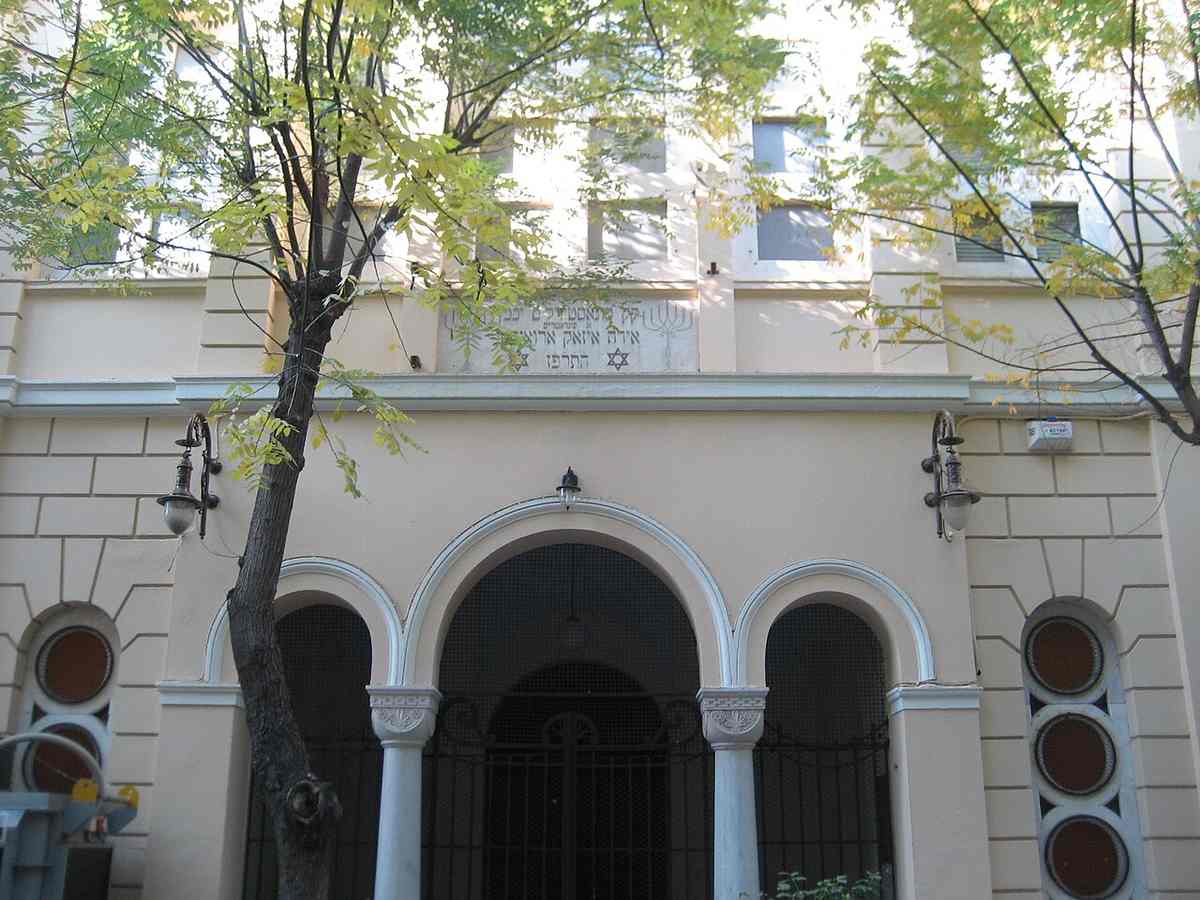
The surviving synagogues carry the living thread of the community. The Monastirioton Synagogue, raised by Jews from Monastir in the nineteen-twenties and used by the Red Cross during the war, is the chief active synagogue of the city. The Yad Lezikaron synagogue, rebuilt from elements of destroyed synagogues, stands as a memorial in stone to the houses of prayer that were lost. The two together frame the arc of ruin and survival.
The markets and mansions carry the Jewish names into daily life. The covered halls of the Modiano market and the Ottoman-era Bezesteni bear the names of the Jewish families who shaped the commerce of the port, and grand houses such as the Casa Bianca and the Allatini villa recall the wealthy Jewish families of the seafront avenue. These sites fold naturally into the wider list of things to do in Thessaloniki.
The memorials hold the weight of the loss for those who come to remember. A Holocaust memorial stands at Eleftherias Square, where the men of the community were gathered in the war, and a second memorial marks the site of the destroyed cemetery on the university campus. A guided Thessaloniki walking tour ties the museum, the synagogues, the markets, and the memorials into one route that reads the Sephardic city in order, the shape a considered Thessaloniki itinerary tends to follow. The Jewish sites also sit close to the Byzantine churches of the centre, so a walk can hold both layers of the city.
Frequently Asked Questions
Why was Thessaloniki called the Mother of Israel?
Thessaloniki was called the Mother of Israel, and the Jerusalem of the Balkans, because Jews formed the majority of its people for much of the Ottoman period. The community led the trade and the learning of the port, and the harbour itself fell still on the Jewish Sabbath, a mark of its weight in the life of the whole city.
When did the Sephardic Jews arrive in Thessaloniki?
Sephardic Jews reached Thessaloniki after the Spanish crown expelled them in fourteen ninety-two under the Alhambra Decree. The Ottoman Empire opened its cities to the exiles, and thousands settled in the port within a few years. Jews from Portugal, Italy, and central Europe joined them, and the community turned the harbour into a capital of Sephardic life.
What language did the Jews of Thessaloniki speak?
The Jews of Thessaloniki spoke Ladino, or Judeo-Spanish, a form of old Castilian written in Hebrew letters that the exiles carried from Spain. It served as the daily street language of the community for centuries and absorbed Hebrew, Turkish, and Greek words, while its Spanish core kept the memory of the lost homeland alive.
What happened to the Jews of Thessaloniki in the Holocaust?
German forces occupied the city and destroyed its Jewish community. Between March and August of nineteen forty-three they deported more than forty-five thousand Jews to Auschwitz-Birkenau, where most were killed on arrival. Fewer than two thousand of the city’s Jews survived the war, a small remnant of a community that had numbered about fifty thousand.
Why is the university built on the Jewish cemetery?
The vast Jewish cemetery east of the walls, one of the largest in Europe, was destroyed during the occupation, and its headstones were broken up for building material. The Aristotle University of Thessaloniki was later raised on the levelled ground. A memorial on the campus marks the site of the necropolis that lay beneath it.
What Jewish sites can you visit in Thessaloniki today?
A visitor can see the Jewish Museum of Thessaloniki, the active Monastirioton Synagogue, the Yad Lezikaron memorial synagogue, and the Holocaust memorial at Eleftherias Square. The Modiano and Bezesteni market halls and the Casa Bianca and Allatini villas carry Jewish family names, and a guided walk links the museum, the synagogues, and the memorials into one route.