
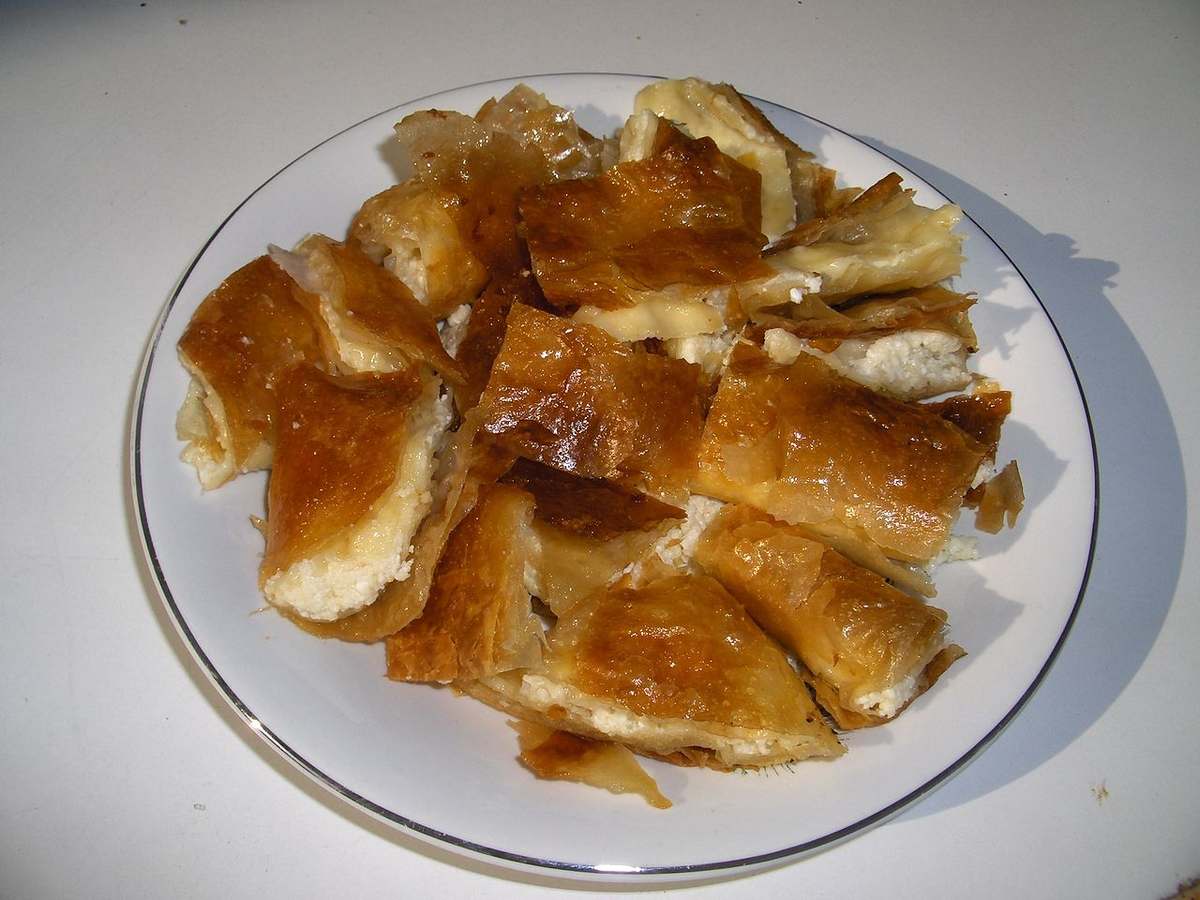
Bougatsa is the signature filo pastry of Thessaloniki, a warm parcel of paper-thin sheets that the city eats for breakfast and after a long night out. The pastry comes sweet, filled with a smooth semolina custard, or savoury, filled with soft cheese, minced meat, or spinach. Its hand-stretched filo and its refugee history from Constantinople and Asia Minor tie the pastry to the identity of the northern capital. Trace the pastry from its Byzantine roots to the counter of a modern bougatsatzidiko with My Greece Tours.
A plate of bougatsa rewards a little knowledge of what sits inside the golden crust and why the city guards the craft. The sections below cover what bougatsa is, the sweet and savoury fillings, the hand-stretched filo, and the Constantinopolitan roots that carried it here. The later parts turn to how it is served, where the tradition lives, and how it differs from the pastries of Serres and Panorama, so the pastry slots into the guided Thessaloniki tours.
What is bougatsa?
Bougatsa is a Greek filo pastry from Thessaloniki, made of hand-stretched sheets wrapped around a filling and baked until crisp. The classic version holds a sweet semolina custard, cut into squares and dusted with sugar and cinnamon.
The word bougatsa reaches back to Byzantine Greek, and the pastry itself descends from the plain filo pies of the Greeks of Cappadocia and Constantinople. A baker layers thin sheets of filo, adds the filling, folds the pastry into a large sheet pie, and bakes it in a hot oven. The result carries a crisp, blistered top and a soft, warm centre. Thessaloniki treats the pastry as a daily food rather than a special-occasion dish.
The Thessaloniki style stands apart for its crisp crust and its restrained sweetness. Bakers here keep the custard light on sugar and let the filo carry the flavour, so the pastry tastes of butter and wheat as much as of cream. The savoury versions lean on cheese, meat, or greens with no sugar at all. A single bougatsa can feed one hungry person or serve as a shared snack for a table of two.
A bougatsa reaches the counter as a broad, flat sheet pie rather than a single small pastry. The baker portions it by weight or by the piece, so a customer names how much to cut rather than picking a fixed item. A standard portion runs to a couple of hand-sized squares, enough for one breakfast. The pastry keeps its heat well, wrapped in paper against the cool of a morning street.
Bougatsa sits near the top of every food-led guide to the city, alongside the covered markets and the seafront cafés. It heads most lists of things to do in Thessaloniki for anyone who travels to eat. A first bite from a paper bag on a morning street corner tells a visitor more about the city than a museum label.
What are the sweet and savoury versions of bougatsa?
Bougatsa comes in one sweet version and three common savoury ones. The sweet holds a semolina custard of milk, butter, sugar, eggs, and fine semolina. The savoury fillings are soft white cheese, seasoned minced meat, or spinach.
The sweet bougatsa, known as bougatsa krema, is the version most travellers picture. Its custard blends milk, butter, sugar, eggs, and fine semolina cooked to a smooth, pourable cream. The semolina gives the filling its silky body and keeps it from running out of the pastry. Bakers spread the warm custard between the filo sheets before the final fold, then finish the baked pastry with icing sugar and ground cinnamon.
The cheese bougatsa carries a soft, slightly sour white cheese in place of the custard, salted and unsweetened. The minced-meat version fills the filo with beef, or a beef-and-pork mix, plus onion and warm spices, closer to a small savoury pie. The spinach version wraps chopped greens and herbs inside the same crisp shell, a cousin of the spanakopita found across Greece. Each savoury type skips the sugar and cinnamon that finish the sweet one.
The choice of cheese shapes the savoury bougatsa most of all. Bakers use a soft, fresh white cheese, mild and lightly sour, sometimes cut with a firmer grating cheese for salt and bite. The cheese melts into the hot filo without turning oily, which keeps the pastry light. A well-made cheese bougatsa balances the salt of the filling against the plain, buttery sheets around it.
The two families suit different moments of the day. Locals reach for the sweet custard pastry at breakfast and the savoury cheese or meat versions for a heavier midday bite. Families split a mix of both, which makes bougatsa an easy choice on a day out with children, and a plan for Thessaloniki with kids often starts at a bougatsa counter. The soft custard and mild cheese suit younger palates that shy from stronger flavours.
How is the paper-thin filo for bougatsa made?
The filo for bougatsa is made from flour, water, and a little fat, then stretched by hand until it turns paper-thin, thinner than two millimetres. A baker swings the dough across a floured table until it is almost see-through.
Filo, whose name means leaf in Greek, ranks among the thinnest doughs in any kitchen. The baker works a simple dough of wheat flour, water, salt, and a touch of oil or butter into a smooth, elastic ball, then rests it so the gluten relaxes. A rested dough stretches without tearing, which lets the baker pull one lump into a sheet wide enough to drape a whole table.
The stretching is the skill that separates a good bougatsa from a poor one. The baker lifts the dough and swings it over the backs of the hands, letting its own weight draw it thinner with each pass. A finished sheet reads as translucent, thin enough to see a hand through, yet strong enough to lift without splitting. Machine-rolled filo exists, yet the bougatsatzidika that stretch by hand keep the older, flakier texture.
The baking sets the character of the finished pastry. A hot oven crisps the buttered top sheets fast while the filling stays soft and warm beneath. Bakers pull the tray before the crust darkens too far, so the leaves turn deep gold rather than brown. The pastry is meant to be eaten within an hour of the oven, since the filo loses its crackle as it cools and sits.
The butter between the layers does more than crisp the crust. It carries flavour, seals the sheets so the filling stays put, and gives the pastry its golden colour in the oven. Bakers brush each layer as they build the pie, which is the reason a good bougatsa tastes of butter before anything else. The best sheets stay separate and flaky rather than merging into a dense pastry.
The quality of the filo decides the crunch of the crust. Layered thin and brushed with butter, the sheets bake into brittle, golden leaves that shatter at the first bite. The flour and butter that feed this craft come from the same northern Greek larder sold in the city’s food halls, and a walk through the Thessaloniki markets shows the raw materials behind the pastry. The hand-stretched sheet is the reason a fresh bougatsa never tastes like a supermarket pie.
How did bougatsa become the signature pastry of Thessaloniki?
Bougatsa reached Thessaloniki with Greek refugees from Constantinople and Asia Minor, who settled in the city after the exchange of populations in nineteen-twenty-three. The first recorded bougatsa shop had opened in the city a generation earlier.
The pastry began as a plain food of the Greeks of Cappadocia and the Byzantine world. Housewives baked filo pies for husbands who worked long days in the fields, since the pastry travelled well and kept without spoiling. The recipe matured in Constantinople while the city still held its Greek population, before it fell in the year fourteen fifty-three. Bougatsa carried that eastern, Constantinopolitan heritage west toward the Greek mainland.
The towns of Serres and Thessaloniki shaped the modern pastry in northern Greece. The first documented licence for a bougatsa shop was granted in Thessaloniki in the closing years of the nineteenth century, which fixes the pastry in the city well before the great migration. Bakers here refined the sweet semolina custard and the crisp, hand-stretched sheet into the version the city sells now.
The pastry also spread south and to the islands over the following decades. Bakers from the north carried the craft to Athens and beyond, and a distinct cheese bougatsa took hold on Crete under the same name. The Thessaloniki sheet, sweet and crisp, stayed the reference point that other cities measured their own against. The city keeps its claim as the home of the pastry through the density of its specialist shops.
The exchange of populations transformed Thessaloniki and its food. Hundreds of thousands of Greek refugees from Asia Minor and the Black Sea coast arrived within a few years, and they brought the ovens, recipes, and skills of the east with them. Their bougatsatzidika spread the pastry through every quarter, and the trade became a fixture of the city’s streets. This chapter belongs to the wider history of Thessaloniki as a city rebuilt by refugees.
How is bougatsa served, and where does the tradition live?
A baker cuts the hot sheet pie with a scraper into small squares, then dusts the sweet version with icing sugar and cinnamon. The savoury kinds go plain. Shops across the centre and Ano Poli serve it warm from the oven.
The serving ritual is quick and unfussy. The baker slides the fresh sheet pie onto the counter, runs a wide scraper across it to cut small squares, and lifts the pieces into a paper wrapper or a box. The sweet version gets a heavy dusting of icing sugar and a shake of ground cinnamon over the top. A savoury bougatsa goes out plain, its cheese, meat, or spinach already seasoned inside.
The wrapper is part of the experience. A sweet bougatsa travels in a folded paper sheet or a light box, dusted so heavily that the sugar clings to the fingers. Locals eat it standing at the counter or walking the pavement, folding the paper back as they go. The pastry is built for the hand and the street, not the plate and the table.
The clock decides which bougatsa a local orders. Workers and students buy the sweet custard pastry early, eaten warm from the paper as they walk to work. The savoury versions carry a heavier lunch through the middle of the day. The same counters draw a late-night crowd, since a hot bougatsa is the classic close to a long night out in the bars of the city.
Ordering runs on a short, spoken exchange rather than a printed menu. A customer names the type, sweet or one of the savoury fillings, and the weight or number of pieces wanted. The baker cuts, dusts, and wraps in a few seconds, and the pastry is paid for by weight at the counter. Most shops sell to take away, though the older bougatsatzidika keep a few tables for a plate and a coffee.
The tradition lives in the bougatsatzidiko, a shop that bakes little else and opens before dawn. These counters cluster in the streets of the historic centre near Aristotelous Square and climb into the old upper town, where the lanes of Ano Poli keep a slower pace. A good shop bakes in small batches through the morning, so each tray reaches the counter hot. The queue at opening time marks the places locals trust.
How does Thessaloniki bougatsa differ from Serres and the trigona of Panorama?
Thessaloniki bougatsa is crisp and lightly sweet, while the Serres style stretches the filo thinner and fluffier. The trigona of Panorama are a separate sweet: syrup-soaked filo cones filled with a rich custard cream, not a sheet pie.
Serres, a town inland from Thessaloniki, claims its own bougatsa lineage. Its bakers pull the filo even thinner and lighter, which yields an airier, more delicate pastry than the sturdy Thessaloniki sheet. The filling and the finish stay close to the city version, sweet custard or cheese, so the difference sits mainly in the texture of the crust. Both towns rank among the heartlands of the northern Greek pastry.
The trigona of Panorama belong to a different family, though visitors often confuse the two. A pastry chef in the hillside suburb of Panorama shaped filo into crisp triangular cones, soaked them in a light sugar syrup, and filled them with a thick vanilla custard cream. The result is a wet, syrupy dessert eaten with a fork, not a dry, hand-held pastry. Sunday trips up to Panorama for a plate of trigona became a Thessaloniki habit through the second half of the twentieth century.
The pastries of the north share one root in the hand-stretched filo of the east. Bougatsa, the trigona, and the sweet and savoury pies of Serres and Veria all trace back to the same Constantinopolitan and Asia Minor kitchens. Veria bakes a creamier, sweeter bougatsa heavy with custard and sugar, a contrast to the crisp Thessaloniki sheet. The map of these pastries reads as a record of where the refugees settled and baked.
Bougatsa anchors any serious eating tour of the city. A morning that opens with a custard bougatsa, moves through the market stalls, and ends over mezes fits neatly into a Thessaloniki food tour, and the pastry gives the day its first taste. Travellers who plan their meals around the city’s Thessaloniki restaurants still start with the street version. A well-built Thessaloniki itinerary leaves room for a bougatsa stop on the first morning.
Frequently Asked Questions
What does bougatsa taste like?
A sweet bougatsa tastes of warm semolina custard against a crisp, buttery filo crust, finished with icing sugar and a hint of cinnamon. The Thessaloniki style keeps the sugar restrained, so the pastry reads as creamy rather than sugary. A savoury bougatsa tastes of salted white cheese, spiced minced meat, or herbed spinach inside the same flaky shell. Both versions arrive hot, and the contrast of crunch and soft filling defines the bite.
Is bougatsa sweet or savoury?
Bougatsa comes both ways. The best-known version is sweet, filled with a semolina custard and dusted with sugar and cinnamon. The savoury versions swap the custard for soft white cheese, seasoned minced meat, or spinach, and skip the sugar. A single bougatsatzidiko usually bakes all of them side by side, so a visitor can order a sweet and a savoury piece together and compare them in one sitting.
When do people in Thessaloniki eat bougatsa?
Bougatsa is a morning food above all, bought hot on the way to work or school and eaten from the paper. The sweet custard version suits breakfast, while the cheese and meat versions carry a heavier midday snack. The pastry also serves as the classic end to a night out, when the late bars empty and the ovens of the all-night shops draw a crowd for a warm, restoring bite.
How is bougatsa different from spanakopita or tiropita?
Bougatsa shares the hand-stretched filo of spanakopita and tiropita, yet the city bakes it as a large sheet pie, cut to order with a scraper, rather than as small folded parcels. Its signature version is the sweet semolina custard, which those savoury pies never carry. The spinach and cheese bougatsa come close to their cousins, though the crisper, thinner Thessaloniki sheet and the counter-cut serving still set the pastry apart.
What are the trigona of Panorama?
The trigona of Panorama are a Thessaloniki dessert of crisp filo shaped into triangular cones, dipped in sugar syrup, and filled with a thick custard cream. They come from the suburb of Panorama on the hills above the city. Unlike bougatsa, they are a wet, syrup-soaked sweet eaten with a fork, and locals long treated a Sunday drive up to Panorama for a plate of them as a weekend treat.
Where can you try bougatsa on a visit?
The surest place is a bougatsatzidiko, a specialist shop that bakes bougatsa through the morning and opens early. These counters gather in the historic centre and climb into Ano Poli, where the ovens run from before dawn. A guided food tour times a stop for the first hot trays of the day. Ordering is simple: point to sweet or cheese, name the number of pieces, and eat it warm on the spot.