
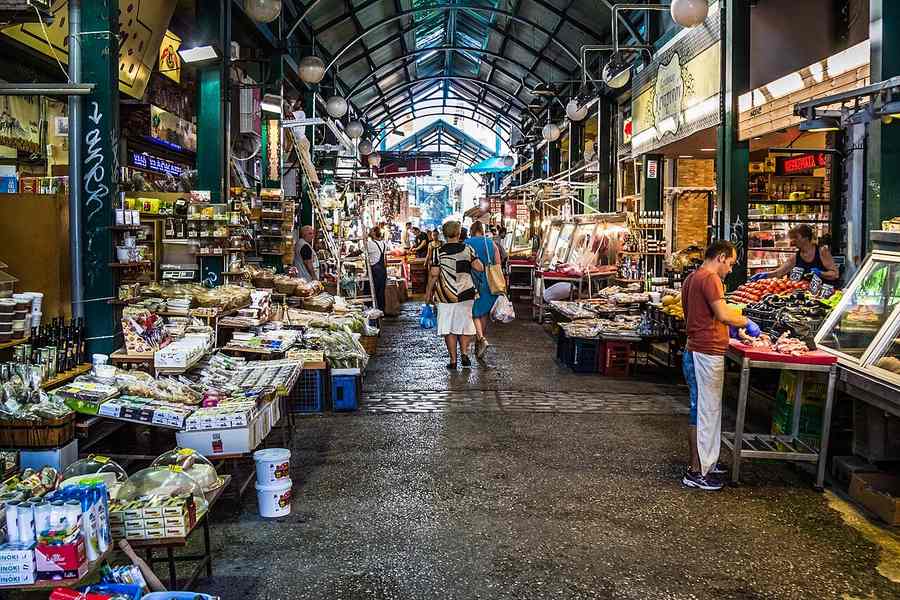
The markets of Thessaloniki fill the streets between Egnatia avenue and the seafront with produce, fish, spice, and cloth. The covered hall of Modiano, the open lanes of Kapani, the Ottoman Bezesteni, and the square of Athonos sit within a few blocks of one another. Each hall carries a layer of the city’s Ottoman and Jewish past into the daily trade of the present. Read the stalls, the domes, and the goods, and place the markets in the wider city with My Greece Tours.
A market walk rewards a slow circuit through the alleys rather than a single stop at one hall. The sections below cover what the markets of Thessaloniki are, how the Modiano hall was built and restored, and what the Kapani, Bezesteni, and Athonos markets sell. The later parts turn to the flea district around Tositsa, the goods on the stalls, and a route that ties the halls to the guided Thessaloniki tours of the centre.
What are the markets of Thessaloniki?
The markets of Thessaloniki are a cluster of food and goods halls in the old commercial core, led by the Modiano covered market, the open Kapani lanes, the Ottoman Bezesteni, and the Athonos square.
The markets sit in a compact grid south of Egnatia, the main avenue that cuts through the centre. Kapani and Modiano share a block, the Bezesteni stands two streets west, and the Athonos square opens a short walk east. A visitor can cross the whole quarter on foot in under fifteen minutes. The density packs the food trade of a city of a million people into a few hundred metres of stalls.
Each hall keeps a distinct trade. Modiano gathers fishmongers, butchers, cheese counters, and tavernas under one roof of glass and iron. Kapani spreads fruit, vegetables, and olives along open lanes. The Bezesteni holds cloth, thread, and jewellery under its six domes, and the Athonos square mixes grocers, herb stalls, and workshops. The split of goods follows lines drawn in the Ottoman centuries, when each trade held its own street.
The markets serve the kitchens of the city as much as the visitor. Cooks buy their fish, greens, and spice here at dawn, and the tavernas of the quarter draw their stock from the stalls a few doors away. That working core sets the markets apart from a tourist arcade and puts them near the top of most guides to things to do in Thessaloniki.
What is the Modiano Market?
Modiano Market is the covered central food hall of Thessaloniki, designed by the architect Eli Modiano and opened in the nineteen-thirties. A long restoration returned it to trade as a hall of stalls, tavernas, and bars.
Eli Modiano trained as an architect in Paris and drew the hall in the manner of the covered markets of that city. The building rose on the site of an old Jewish quarter that the great fire of nineteen-seventeen had cleared, and it opened for trade at the turn of the nineteen-thirties. Its long nave runs under a roof of glass and steel that lights the stalls below. The hall took the name of the Modiano family, a leading Sephardic Jewish house of the city.
The market fell into decline through the late twentieth century as trade drained to the supermarkets of the suburbs. Its roof leaked, its stalls emptied, and the hall closed for a full restoration of the iron frame and the glazing. The work stripped the structure back, repaired the roof, and reset the market as a hall of food counters, tavernas, and bars under the original span. The hall reopened as a dining and market destination at the heart of the centre.
Fishmongers, butchers, and cheese counters line the reopened nave beside tavernas that cook the stalls’ own stock. The mix of raw trade and cooked food makes the hall a fixed stop on a Thessaloniki food tour of the quarter. Diners settle at the counters for grilled fish, small plates, and ouzo through the day and into the night. The hall draws a crowd for its kitchens as much as its stalls, a pull it shares with the wider run of Thessaloniki restaurants nearby.
What is the Kapani open market?
Kapani, also called Vlali, is the oldest open market of Thessaloniki, set in the lanes just south of Egnatia. Its stalls sell fruit, vegetables, fish, meat, cheese, olives, and spice.
The market grew in the Ottoman centuries, and its name comes from the Turkish word for the weigh-house where traders once measured flour and grain. Its lanes wind between low shopfronts hung with awnings, open to the sky rather than roofed like Modiano. Traders call their prices over baskets of produce stacked on the stalls. The market runs from Monday to Saturday through the morning and into the afternoon, busiest soon after the stalls open.
The stalls hold the raw material of the northern Greek kitchen. Crates of oranges, greens, and tomatoes crowd the fruit stands, and barrels of olives and brine line the delicatessen counters. Fishmongers ice their catch from the gulf, and butchers hang cuts behind glass. Sacks of pepper, cinnamon, oregano, and saffron scent the spice stalls that trade beside the cheese counters stacked with feta and graviera.
Kapani links straight into the Modiano hall a block away, so a single loop crosses both markets. The open lanes carry the older, plainer trade, and the covered hall gathers the tavernas and the sit-down food. A short walk south from the stalls reaches Aristotelous Square, the grand civic space that opens onto the seafront. The two markets and the square form the spine of the commercial centre.
What is the Bezesteni covered market?
The Bezesteni is a stone Ottoman covered market built in the mid-fifteenth century under Sultan Mehmed the Second. Its six lead-roofed domes shelter shops that sell cloth, thread, and jewellery.
The name comes through Turkish from a Persian word for a cloth market, and the building held the textile trade from its start. Ottoman builders raised it as a secure hall where merchants stored valuables, checked the quality of goods, and set the rate of the coin. Its walls carry an entrance on each of the four sides, and the interior splits into six rooms under seven double arches that rest on two central piers. Six lead-covered domes cap the roof.
The Bezesteni is one of three Ottoman covered markets that survive within the borders of modern Greece, beside the halls of Larissa and Serres. It stands on Venizelou street near the Hamza Bey mosque, at the heart of the old trading grid. The stone shell has held for more than five centuries while the streets around it burned and rebuilt. Its survival marks it as one of the oldest working buildings in the commercial centre.
Trade under the domes still runs to cloth and small goods. Shops sell fabric by the metre, buttons, ribbons, zips, and thread, beside counters of gold and silver jewellery. The narrow aisles keep the scale of an Ottoman bedesten, where each stall opens onto the covered walk. A buyer after a length of cloth or a repair to a chain finds the trade here that the hall has carried since the fifteenth century.
What is the Athonos square market?
The Athonos market fills a square and a knot of alleys east of the Bezesteni. Its stalls and workshops sell herbs, pickles, dried fruit, salt fish, and antiques, ringed by tavernas and mezze houses.
Athonos Square opens as a small plaza wrapped by a maze of narrow lanes packed with shops. Grocers stack legumes, pickles, and stuffed vine leaves beside counters of salt fish, bread, and phyllo pastry. Herb and spice stalls trade next to sellers of nuts, dried fruit, and flowers. The tight weave of trades gives the square the feel of an old bazaar rather than a single market hall.
The square doubles as a workshop quarter, where craftsmen mend chairs, cane seats, and repair tools in ground-floor ateliers. Antique dealers spread furniture and bric-a-brac along the edges of the lanes. The blend of food, craft, and second-hand goods draws a steady trade of locals through the day. The square keeps the working character that the tourist strips near the seafront have lost.
Tavernas and ouzo houses ring the square and spill their tables into the lanes at midday and after dark. Cooks plate small dishes of the market’s own produce, from grilled octopus to stuffed peppers. The square shifts from a food market by day to a dining and drinking quarter by night, a rhythm tied to the wider Thessaloniki nightlife of the centre.
What can you buy in the Thessaloniki markets?
The Thessaloniki markets sell the food and goods of northern Greece: fish and seafood from the gulf, olives, cheese, and spice at Kapani, cloth and jewellery in the Bezesteni, and antiques in the Bit Bazaar.
The food stalls carry the raw stock of the regional kitchen. Fishmongers ice sardines, anchovies, red mullet, and squid pulled from the Thermaic Gulf. Cheese counters stack feta, graviera, kasseri, and the soft batzos of Macedonia. Barrels of green and black olives sit beside jars of oil, honey, and pickled greens, and the spice stalls weigh out pepper, cinnamon, oregano, and dried herbs by the scoop.
The dry-goods trade runs beside the fresh stalls. Sellers scoop nuts, dried figs, raisins, and pulses from open sacks, and bakers stack bread, koulouri rings, and phyllo pastry. Sweet counters hold halva, loukoumi, and trays of syrup cakes. The stalls also carry the regional exports of northern Greece, from the saffron of Kozani to the red peppers of Florina and the tsipouro of the hills.
The markets sell more than food. The Bezesteni trades cloth by the metre, thread, buttons, and gold and silver jewellery under its domes. The Athonos lanes hold herb sellers, florists, and craft workshops, and the Bit Bazaar spreads antique furniture, brass, and curios along Tositsa street. A buyer can leave the quarter with a wheel of cheese, a length of cloth, or an old brass lamp.
The stalls trade in cash, and prices on the food stands stay close to fixed rather than open to a haggle. The antique dealers of the Bit Bazaar leave room to bargain over a piece. Vendors pack produce in paper and thin bags, so a folding basket earns its place on a long circuit. The stallholders point out the pick of the catch or the ripe fruit to a buyer who asks.
Where is Thessaloniki’s flea market district?
Thessaloniki’s flea market runs through the Bit Bazaar, a hidden square of antique galleries near the Roman forum. The trade centres on Tositsa street, where dealers sell furniture, brassware, and bric-a-brac.
The Bit Bazaar sits between Filippou and Olympou streets, a short walk uphill from the Roman Forum at the edge of the old town. Refugees from Asia Minor settled the quarter in the late nineteen-twenties, and the ground floors of their houses filled with second-hand shops. Seven galleries of antique dealers ring a quiet inner square that the traffic passes by. The market grew from the refugee trade into a fixed antique district of the centre.
Tositsa street forms the spine of the flea trade, lined with the antique houses that give the district its name. Dealers sell brass beds, chandeliers, typewriters, vases, and old musical instruments hauled from the refugee homes of the quarter. Buyers hunt the stalls for furniture, jewellery, and curios of a vanished age. The stock turns over as estates clear, so the goods on the tables shift week to week.
The district turns from an antique market by day to a run of bars and tavernas by night. Its square fills after dark with a young crowd drawn to the cheap tables under the galleries. The flea quarter sits on the climb toward the old upper town, so a walk can carry on from the stalls into the lanes of Ano Poli above.
How do you walk the markets and read their Ottoman and Jewish past?
A market walk runs from Modiano and Kapani through the Bezesteni to Athonos and the Bit Bazaar, a loop of under two kilometres. The halls carry the trade of the city’s Ottoman and Jewish centuries.
A walk of the markets opens best at Modiano and the Kapani lanes, where the food trade runs strongest in the morning. The route then crosses to the Bezesteni for cloth and gold, turns east to the Athonos square for herbs and mezze, and climbs to the Bit Bazaar for antiques. The loop covers under two kilometres and fits inside a half day on foot. It slots into a wider Thessaloniki itinerary alongside the seafront and the monuments.
The Ottoman centuries shaped the plan of the market quarter that survives. Kapani grew as an open bazaar under Ottoman rule, and the Bezesteni still stands as the stone cloth-hall that Sultan Mehmed raised in the fifteenth century. The grid of trade streets, each once given to a single craft, follows the map of the Ottoman city. The market walk reads that history in the halls and the lanes.
The Jewish history of the city runs through the markets as well. Thessaloniki held one of the largest Sephardic Jewish communities in Europe for four centuries, and its merchants ran the trade of the port. The Modiano hall carries the name of one of those families, built on ground the fire of nineteen-seventeen had cleared. The market quarter keeps that thread of the city’s past in the stones and the names.
The markets open through the week, with the food stalls busiest from the early morning to the early afternoon. The lanes stay level and close together, so a walk crosses the whole quarter without a climb until the turn toward the upper town. A guide draws out the layers of trade and faith that the bare stalls keep quiet, and can tie the walk to the church of Agios Dimitrios a short way north. The compact scale leaves room for the markets, a meal, and a monument in one day.
Frequently Asked Questions
Where is the Modiano Market?
Modiano Market stands in the centre of Thessaloniki, in the block between Vasileos Irakliou street and Egnatia avenue, with entrances on Ermou and Vasileos Irakliou. It sits a block from the open Kapani lanes and a short walk north of Aristotelous Square, at the heart of the old commercial quarter south of the main avenue.
What is the Kapani market?
Kapani, also called Vlali, is the oldest open-air market of Thessaloniki, set in a knot of lanes just south of Egnatia. It grew under Ottoman rule, and its name recalls the weigh-house for flour and grain. Its stalls sell fruit, vegetables, fish, meat, cheese, olives, and spice from Monday to Saturday through the day.
What can you buy in the Bezesteni?
The Bezesteni trades in cloth and small goods, as it has since the fifteenth century. Its shops sell fabric by the metre, buttons, ribbons, zips, and thread, beside counters of gold and silver jewellery. The stone hall keeps the scale of an Ottoman covered market, with narrow aisles under six lead-roofed domes.
Is the Bit Bazaar worth visiting?
The Bit Bazaar rewards a visit for its antiques and its quiet, hidden square near the Roman Forum. Seven galleries of dealers sell brass beds, chandeliers, typewriters, vases, and old furniture drawn from the refugee homes of the quarter. The district turns to bars and tavernas after dark, so it works for a drink as well as a browse.
What are the opening hours of Thessaloniki’s markets?
The food markets of Kapani, Modiano, and Athonos trade from the early morning to the late afternoon, Monday to Saturday, with the stalls at their busiest soon after they open. The Bezesteni and the Bit Bazaar keep shop hours through the day. A check of the current times rewards the plan, since schedules shift on set days.
How do the markets connect to Thessaloniki’s history?
The markets hold the trade of the city’s Ottoman and Jewish centuries in one quarter. The Bezesteni and Kapani date from Ottoman rule, the Modiano hall carries the name of a Sephardic Jewish family, and the Bit Bazaar grew from the Asia Minor refugees of the nineteen-twenties. A market walk reads that layered past in the halls, the domes, and the goods.