
A Thessaloniki walking tour threads the compact centre of the city on foot, linking the seafront, the Roman monuments, the Byzantine churches, the markets, and the old upper town in one continuous line. The route runs mostly on the flat or downhill, and the core sights sit within a stretch of roughly two kilometres from the waterfront to the walls. A traveller can walk it alone with a map or follow a guide who reads the layers of Roman, Byzantine, and Ottoman stone in the order the city grew. Plan the stops, the timing, and the climb into the citadel with My Greece Tours.
The walk rewards a fixed order rather than a wander, so the history reads from the sea up to the walls in a clear sequence. The sections below cover what a Thessaloniki walking tour is, the stop-by-stop route from the White Tower to the Trigonion tower, how long the walk takes, what a guide adds, the food-tour and free-tour variants, and when to set out. The later parts turn to the climb into the upper town and the choice between a half-day loop and a full day on the guided Thessaloniki tours.
What is a Thessaloniki walking tour?
A Thessaloniki walking tour is a route on foot through the city centre that links the White Tower, the waterfront, Aristotelous Square, the Roman forum, the Rotunda, the church of Agios Dimitrios, the markets, and the old upper town in one line.
The historic core of Thessaloniki fits within a triangle of low ground and hillside that a walker crosses in an afternoon. The main monuments stand close together, most within a five- to ten-minute walk of the next, so the city suits a tour on foot better than one by car or bus. The route stays on paved streets and a broad seaside promenade for its lower half, then climbs into the lanes of the upper town for the finish. A first visit reads the city best as a single walk rather than a set of separate stops.
The tour takes two forms that share the same monuments. A self-guided walk lets a traveller set the pace, read the sites from a map or an audio app, and pause for coffee or a market stall at will. A guided walk hands the sequence and the history to a local guide, who ties the Roman arch, the Byzantine church, and the Ottoman bathhouse into one story. Both cover the same spine of sights from the sea to the walls.
The self-guided form has grown easier with the audio-guide apps that map the route and narrate each stop in turn. A traveller downloads the trail, follows the pin from the White Tower to the walls, and hears the history at each marker without a printed map. The app version fixes the order and the timing that trip up a first-time walker, and it runs on a small one-off fee rather than a per-hour rate. That option sits between the free wander and the private guide, and it suits a traveller who wants structure without a fixed departure.
The walk carries a traveller through every era of the city in turn, from the Roman capital of Galerius to the Byzantine churches and the Ottoman markets. The lower leg follows the Thessaloniki waterfront promenade along the gulf, where the sea opens on one side and the city rises on the other. The upper leg trades the open front for shaded lanes and the long line of the medieval walls above the roofs.
The grid of the modern centre sits on the plan of the ancient city, so the walk follows streets that Roman surveyors first laid out. The main avenue, Egnatia, traces the line of the Roman road that once linked the Adriatic to Constantinople, and the arch of Galerius still spans its course. The cross streets run down to the sea and up to the walls in the same pattern the ancient engineers set. A walker who reads that grid moves through the ancient plan without leaving the modern pavements, which keeps the route simple to follow on foot.
What route does a self-guided Thessaloniki walking tour follow?
A self-guided Thessaloniki walking tour starts at the White Tower, follows the seafront to Aristotelous Square, climbs to the Roman forum, the Rotunda, and the Arch of Galerius, passes Agios Dimitrios and the markets, then rises into Ano Poli.
The order below runs from the sea up to the citadel, which climbs gently for most of its length and gathers the eras of the city in sequence. A walker can reverse the line and start high in the upper town for a route that falls toward the water instead. The stops sit close enough that the whole spine covers roughly five to six kilometres end to end, before any detours into the side lanes.
The route breaks into six clear stages, each anchored on a landmark that marks the shift from one quarter to the next. The seafront leg runs level from the White Tower to the square, the civic leg turns inland through the markets and the forum, and the Roman leg climbs to the arch and the round hall. The Byzantine leg crosses to the great basilica and the churches, and the final leg rises to the walls. A walker who holds that order reads the city forward in time, from the Roman street plan to the Ottoman lanes at the top, without a single backtrack along the way.
The White Tower and the waterfront
The walk opens at the White Tower of Thessaloniki, the round Ottoman fort that stands as the emblem of the city on the eastern end of the seafront. The tower holds a museum of the city’s history across its floors and a viewpoint over the gulf from the roof. From its base the broad promenade runs west toward the port, a level paved front about one and a half kilometres long. A walker follows it past the sculpture gardens and the umbrella installation for roughly fifteen minutes to reach the heart of the centre.
Aristotelous Square and the markets
The promenade meets the foot of Aristotelous Square, the grand civic space that opens on the sea and frames a view back to the upper town. The square forms the hinge of the walk, its arcaded buildings and cafés set on the main axis that runs inland from the water. A short block north lead into the covered lanes of the Thessaloniki markets, where the Kapani and Modiano halls trade fish, olives, cheese, and spices. The market stalls make the natural mid-walk pause for a bite and a coffee.
The Roman Forum
A few minutes uphill from the square the ground opens onto the Roman Forum of Thessaloniki, the ancient civic centre set two levels below the modern street. The site holds the excavated agora, a restored odeon, and the underground cryptoporticus that once carried the market storerooms. A walker reads the plan of the Roman town from the terrace above the dig, then drops to the paved floor of the forum. The stop marks the point where the walk leaves the modern centre and enters the ancient city.
The Rotunda and the Arch of Galerius
The route climbs a short pedestrian street to the Rotunda of Thessaloniki, the vast round brick hall raised under the emperor Galerius and later dressed as a church with gold mosaics. At the foot of the same street stands the Arch of Galerius, the carved triumphal gate that spanned the old imperial road. The two monuments share one ancient axis and read as a single stop, a couple of minutes apart. A walker takes in the arch, then the round hall, in the sequence of the Roman palace quarter.
Agios Dimitrios and Ladadika
From the Rotunda the walk turns west toward the church of Agios Dimitrios, the great five-aisled basilica raised over the crypt of the city’s patron saint. Its mosaics and its relics draw the deepest Byzantine thread of the route, and the crypt below preserves the site of the martyrdom. A walker who wants more of that thread can string the nearby Byzantine churches of Thessaloniki into the leg. A drop back toward the port reaches Ladadika, the old warehouse district of low painted houses now full of tavernas.
Ano Poli, the walls, and the Trigonion tower
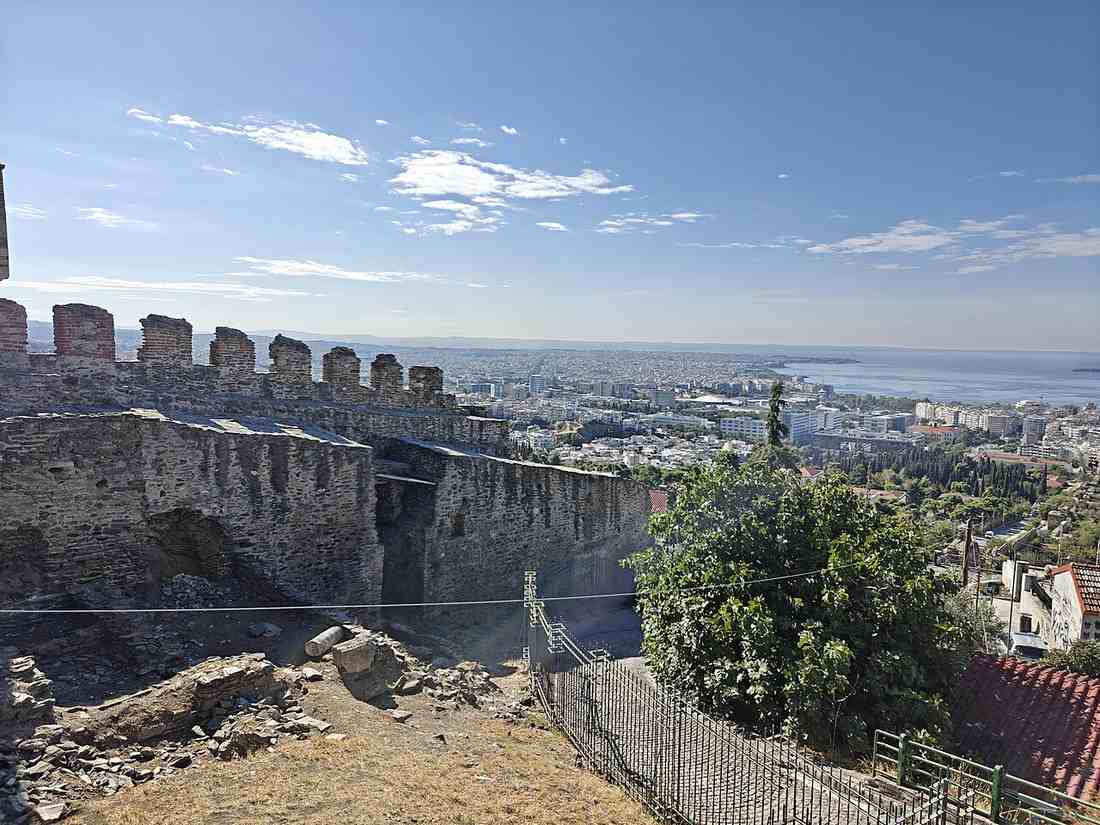
The final leg leaves the flat and climbs into Ano Poli, the upper town of Thessaloniki, the old quarter that escaped the great fire and kept its Ottoman houses and cobbled lanes. The climb gains roughly seventy to ninety metres over about a kilometre, so it takes twenty to thirty minutes at a steady pace. At the top the medieval walls run along the ridge to the Trigonion tower, the round bastion that gives the widest view over the roofs, the gulf, and Mount Olympus beyond. The tower marks the end of the spine and the highest point of the walk.
How long is the Thessaloniki walking tour and how much time do you need?
The full Thessaloniki walking tour covers five to six kilometres from the White Tower to the Trigonion tower. A half-day loop takes three hours, while a full day with interiors and the upper town runs six to seven hours.
The distance stays modest, yet the number of stops sets the pace rather than the length of the path. A walker who reads the outside of each monument and skips the interiors can cover the spine in about three hours, coffee and market break included. That half-day version suits a traveller on a tight schedule or a stopover, and it still touches every era from the Roman forum to the walls. The route stays walkable for anyone comfortable on their feet, bar the climb to the upper town.
A full day adds the interiors, the museums, and the time to linger that the half-day loop trims. The White Tower museum, the forum dig, the Rotunda mosaics, and the crypt of Agios Dimitrios each ask for twenty to forty minutes inside. With those stops and a sit-down lunch, the walk fills six to seven hours from the seafront to the Trigonion tower. That pace matches the way a compact Thessaloniki itinerary tends to spread the sights across a single unhurried day.
The route splits cleanly into a lower half and an upper half for a walker who wants to break it over two mornings. The lower leg from the White Tower to the Rotunda stays flat and covers the Roman and civic core. The upper leg from Agios Dimitrios to the walls carries the Byzantine churches and the climb into Ano Poli. Two half-days let a traveller pair each leg with a long lunch or a museum without the pressure of a single push.
The pace of the group also sets the clock as firmly as the distance on the ground. A solo walker moves fast and pauses at will, so the half-day loop can drop under three hours. A family with young children or a traveller who studies each site slows the tour and stretches it past the estimate. The market break, the coffee stops, and the photo pauses add up across a full day, so a plan that allows a spare hour beats one timed to the minute. A walker who books an interior with a set entry slot works the rest of the route around that fixed point.
What does a guided Thessaloniki walking tour add?
A guided Thessaloniki walking tour adds a local expert who sets the route order, reads the Roman, Byzantine, and Ottoman layers of each monument, and skips the map work. A guide ties the separate stops into one continuous story of the city.
The chief gain of a guide lies in the reading of the stones rather than the navigation. The forum, the Rotunda, and the crypt of Agios Dimitrios keep their meaning quiet to a walker who lacks the background, and a guide draws out the figures, the dates, and the shifts of faith that shaped them. The single axis that links the arch, the round hall, and the palace becomes clear only when someone traces it aloud on the ground.
A guide also solves the order and the timing that a self-guided walker has to plan alone. The route runs in the sequence the city grew, so the history reads forward from the Roman capital to the Ottoman markets without a backtrack. A small group keeps the pace brisk enough to reach the walls before the light turns, yet loose enough to pause for questions. The guide handles the flow of the walk, which frees the traveller to look up rather than down at a phone.
The guided walk suits a first visit, a short stay, or a traveller who wants the depth behind the facades. The local knowledge extends past the monuments to the markets, the food, and the corners that a map leaves out. A guide points the way to the stall for bougatsa or the taverna in Ladadika, and folds those stops into the line of the walk. The result reads the city as a whole rather than a checklist of sites.
The size of the group shapes the guided walk as much as the route it covers. A private tour bends the pace and the stops to the traveller, drops or adds a site, and lingers where the interest runs deepest. A small-group tour trades that freedom for a lower price and a set line, yet keeps the reach of a live guide. A large free tour packs more walkers behind one voice, which suits a budget traveller who wants the outline rather than a tailored plan. A traveller who weighs those trade-offs picks the format that fits the day.
What food-tour and free-tour variants can you choose?
A Thessaloniki walking tour comes in a food-tour variant through the markets and mezze houses, and a free walking tour of the monuments on a tip basis. Both hold to the classic spine but lean toward food or history.
The food variant turns the walk toward the flavours of the city rather than its stones. A Thessaloniki food tour weaves through the Kapani and Modiano markets, stops at a bougatsa bakery, a mezze house, and an ouzo bar, and reads the city’s Balkan and Anatolian roots through its plates. The route still passes the arch, the square, and the churches, yet the stops fall at the tables rather than the terraces. The pace runs slower and the walk shorter, built around three or four tastings.
The free walking tour offers the history-led version on a pay-what-you-wish basis. A local guide leads a group through the White Tower, Aristotelous Square, the Roman forum, the Rotunda, and the churches on a fixed daily departure, and the walker tips at the end by their own measure. The route holds to the classic spine and lasts two to three hours. The format suits a traveller who wants the guided reading without a set fee, though the group runs larger than a private walk.
A traveller can also blend the two into a full day that opens with the monuments and closes with the food. The history-led loop fills the morning from the sea to the walls, and a market-and-mezze crawl fills the afternoon and evening. That pairing reads both halves of the city, the ancient stone and the living table, without a doubled path. The markets and Ladadika sit at the join of the two, which makes the switch from sights to food a natural one.
The food variant leans on the mixed roots that shaped the kitchen of the city over its long history. The stalls trade the sesame bread rings sold on every corner, the layered bougatsa pastry filled with custard or cheese, and the sweet and savoury pies of the Anatolian settlers who arrived a century ago. A tasting walk works through the smoked and cured fish of the market, the local olives and cheese, and a glass of tsipouro to close. The plates read the meeting of Greek, Balkan, and Anatolian cooks that gives Thessaloniki its stand as the food capital of the country.
When should you walk the route and what should you wear on the cobbles?
Walk the Thessaloniki route in the early morning or late afternoon to dodge the midday heat, and wear flat, gripped shoes for the marble streets and cobbled lanes. Spring and autumn give the best weather for the full loop.
The time of day shapes the walk as much as the season on the exposed seafront. An early start catches the promenade cool and the monuments quiet before the coach groups arrive. A late-afternoon start trades the heat for the soft light that warms the White Tower and the walls near sunset, then rolls into dinner in Ladadika. The midday hours in high summer bake the open front and the treeless forum, so a long lunch or a museum fills that stretch well.
The surfaces underfoot decide the choice of shoe more than the distance. The centre runs on polished marble pavements that turn slick in the rain, and the lanes of Ano Poli climb on rough cobbles and worn steps. Flat shoes with a firm grip carry a walker over both without a slip or a sore heel. A pair of trainers or walking sandals beats a smooth-soled sandal on the marble and the stone.
The season sets the comfort of the longer route and the climb to the walls. Spring and autumn hold mild days and cool evenings that suit the full six kilometres and the ascent into the upper town. Summer stays hot and bright, which rewards an early or late walk and plenty of water. Winter turns cooler and wetter, yet the compact core and the covered markets keep the walk fair even under grey skies. A light layer and a small water bottle cover the swings of the day.
The calendar of the city adds its own reason to time the walk with care. A cultural festival, a public holiday, or a match day fills the seafront and the square with crowds that slow the pace and book out the tables. A quiet weekday morning gives the monuments at their calmest, the light soft on the marble and the promenade nearly empty. A traveller who checks the museum schedule before the walk avoids the closed door of a rest day at the White Tower or the forum. That small step keeps the route flowing from stop to stop without a wasted climb.
How do you reach the start and end of the walk?
The Thessaloniki walk starts at the White Tower on the eastern seafront and ends at the Trigonion tower on the walls above Ano Poli. A city bus or a downhill stroll returns a walker to the waterfront.
The White Tower sits at the eastern end of the promenade, within a ten-minute walk of Aristotelous Square and a short hop from the main hotel district. A bus along the seafront or a taxi drops a walker at its base for the start. A traveller staying near the port or the square reaches the tower on foot along the water in a quarter of an hour. The tower makes an easy landmark to gather a group before the walk sets off.
The finish at the Trigonion tower stands high on the walls at the top of Ano Poli, above the tangle of the old lanes. A city bus runs from the upper town back down to the centre for a walker who prefers not to retrace the climb. A downhill stroll through the cobbled streets returns to the Rotunda and the seafront in twenty to thirty minutes. The descent passes cafés with a view that reward a last pause before the walk ends.
The whole route sits within the walkable core, so a traveller rarely needs public transport between the stops. The buses and taxis matter chiefly for the reach to the start and the return from the top. A walker who breaks the route over two mornings can pick up each leg from the nearest square or church without a long transfer. The compact plan keeps the focus on the walk rather than the logistics around it.
The seafront start also links the walk to the wider transport of the city for a traveller arriving from farther out. The promenade runs east past the concert hall toward the newer districts, and buses along the front connect the White Tower to the railway station and the exhibition grounds. A walker staying near the port can join the route at Aristotelous Square instead of the tower and lose little of the line. The choice of entry point bends the walk to the bed for the night rather than a fixed start, which suits a traveller on a stopover or a cruise call.
Frequently Asked Questions
How long does a Thessaloniki walking tour take?
A half-day loop of the main sights takes about three hours, with the monuments read from the outside and a short market break. A full day that adds the interiors, the museums, and the climb into the upper town runs six to seven hours. The spine covers roughly five to six kilometres from the White Tower to the walls.
Is Thessaloniki a walkable city?
Yes. The historic centre is compact, and the main monuments sit within a five- to ten-minute walk of the next along flat streets and a broad seafront promenade. Only the climb into Ano Poli, the upper town, gains real height, at roughly seventy to ninety metres over about a kilometre. A walker comfortable on their feet covers the whole route with ease.
Where should a self-guided walk start?
The White Tower on the eastern seafront makes the clearest starting point, an easy landmark with a museum and a rooftop view. From there the route runs west along the promenade to Aristotelous Square, then climbs inland through the Roman and Byzantine core to the walls. A walker can reverse the line and start high in Ano Poli for a route that falls toward the water.
What are the main stops on the route?
The classic spine links the White Tower, the waterfront promenade, Aristotelous Square, the Roman forum, the Rotunda, the Arch of Galerius, the church of Agios Dimitrios, the markets, Ladadika, and the climb into Ano Poli to the walls and the Trigonion tower. The order runs from the sea up to the citadel, gathering each era of the city in turn.
Should you take a guided or a self-guided walk?
A self-guided walk suits a traveller who wants to set the pace and read the sites from a map or an audio app. A guided walk adds a local expert who reads the Roman, Byzantine, and Ottoman layers and ties the stops into one story. A first visit or a short stay gains the most from a guide, while a repeat visitor may prefer the freedom of walking it alone.
What should you wear for the walk?
Flat shoes with a firm grip carry a walker over the polished marble pavements of the centre and the rough cobbles of the upper town. A pair of trainers or walking sandals beats a smooth-soled sandal, which slips on the marble in the rain. A light layer and a small water bottle cover the swings of the day, and a sun hat helps on the exposed seafront in summer.