
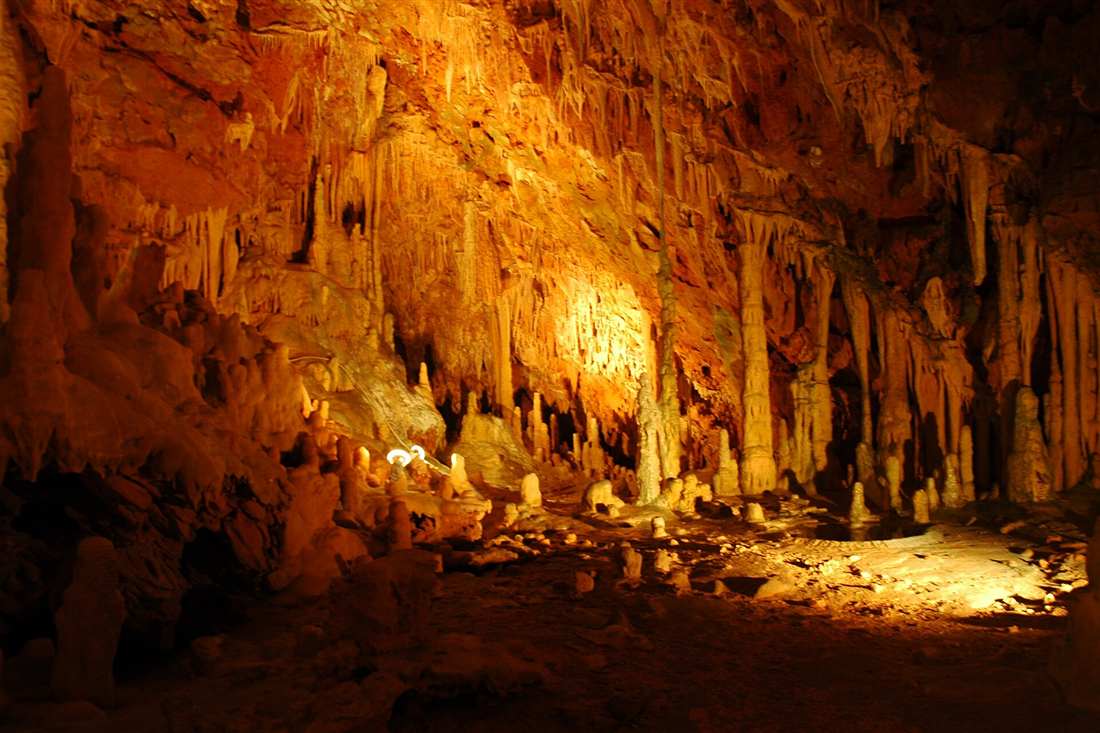
The Diros caves in Mani are the flooded Vlychada galleries at Pyrgos Dirou on the west coast of the peninsula, 12 km south of Areopoli, where a boatman poles visitors 1,200 metres through water halls hung with stalactites before a short walk out. Plan the rest of the trip with Greece Tours.
This page covers the visit: what the punt tour involves, what the cave holds, the tickets and the hours, how to reach Pyrgos Dirou, the guided tours that include it, the Alepotrypa cave next door, what else a Mani day takes in, the season, and who the cave suits.
What are the Diros caves Mani visitors enter, and where do they sit in Laconia?
The Diros caves sit at Pyrgos Dirou on the west coast of the Mani peninsula in Laconia, 12 km south of Areopoli. Vlychada, the flooded show cave, opens 1,200 metres of water gallery to visitors out of 15 km mapped underground.
The entrance stands at sea level inside a small rocky cove, reached by a ramp and a short concrete walkway from the ticket building above. Freshwater from the Taygetos limestone drains through the system and meets seawater at the mouth, which explains the name Vlychada, meaning brackish. Speleologists have surveyed 15 km of passages since systematic exploration began in the 1950s. The Diros caves Mani ticket desk states this at the gate. Visitors to the Diros caves Mani meet it in the first ten minutes.
Three caves form the Pyrgos Dirou group: Vlychada, Alepotrypa and Katafygi. Only Vlychada carries a public boat route. Katafygi stays closed to visitors. Alepotrypa, the dry neolithic cave, sits roughly 100 metres along the same shoreline. Together they occupy a strip of coast between Pyrgos Dirou village, 2 km inland, and the open water of the Messenian Gulf. The Diros caves Mani season turns on this.
Geologically the galleries formed in Cretaceous limestone, hollowed while sea level stood lower during the last glaciation, then drowned as the water rose. The chambers now carry 1.2 to 1.6 metres of water over a rock floor, with a roof height that swings from 12 metres in the large halls to under one metre at the tightest passes. The Diros caves Mani timetable is built on it.
Administration falls to the Ephorate of Palaeoanthropology and Speleology, which runs the ticket desk, the punts and the boatmen. The site works as a single controlled route: entry by boat, exit on foot. Every group covers the same 1,200 metres of the diros caves Mani circuit, and no free wandering of the passages is permitted at any hour. Every Diros caves Mani boat works to that rule.
What happens on the boat tour inside the cave?
A flat-bottomed punt carries 12 to 14 passengers through the water galleries for 25 to 30 minutes. A boatman poles from the stern along a fixed route, ducking under low roof sections, then everyone disembarks and walks the final 300 metres to daylight.
Boarding happens at a small wooden jetty just inside the mouth. Life jackets go on before departure. Passengers sit on bench seats facing forward, knees together, hands inside the hull. The boatman uses a single pole against the rock walls and floor rather than oars, because the passages narrow to two metres across in places and the water runs only waist deep. Every Diros caves Mani boat works to that rule. The Diros caves Mani route is set by it.
The route threads named chambers and passes beneath formations hanging within 40 centimetres of the water surface. At those points the boatman calls out and everyone bends forward. Nobody stands at any stage of the punt ride. The boat travels at walking pace, stopping four or five times so the group looks up at the larger halls. Visitors to the Diros caves Mani meet it in the first ten minutes.
Commentary comes in Greek and English, short and factual, naming chambers such as the Pantheon and the Three Wise Men. Boatmen work fixed shifts and each handles the same circuit dozens of times daily in August. Groups leave the jetty in sequence, so two or three punts share the gallery without meeting head on. That detail shapes a Diros caves Mani visit from the first metre.
Disembarkation happens at a landing stage deep in the system. From there a lit concrete path with handrails runs 300 metres past dry formations to the exit portal above the cove. That final walk takes six to eight minutes at an even pace and completes the standard visit, bringing total underground time to roughly 35 minutes. A Diros caves Mani visit is planned around it.
What do you actually see inside the diros caves Mani galleries?
Dense stalactites, stalagmites, columns and thin drapery curtains fill the roof and walls in cream, ochre, orange and deep red. Water at 12 to 14 degrees stays clear enough to show submerged formations, and fixed lighting doubles every shape as a reflection.
Colour comes from iron and manganese oxides carried in the seeping water. Pure calcite reads white or translucent cream; iron staining shifts sections toward orange and rust red. Curtain formations hang in sheets a few centimetres thick, and lamps behind them show the internal banding. Column growth rates in this limestone run near one centimetre per century. A Diros caves Mani visit is planned around it. A Diros caves Mani boatman handles it from the stern.
The water surface acts as a mirror across most of the route. With the punt stationary and the pole lifted, the reflection reads almost unbroken, and the roof appears to continue downward. Visibility through the water reaches four to six metres in the deeper pools, exposing drowned stalagmites that formed when the chambers stood dry. The Diros caves Mani route is set by it.
Air temperature holds between 16 and 19 degrees year round, with humidity near saturation. In July, when the outside air at Pyrgos Dirou hits 34 degrees, the contrast at the jetty is immediate. Lighting uses low-heat fixtures placed behind rock ribs to limit algae growth on the calcite, so the illumination stays indirect through the diros caves Mani route. It decides when to take the Diros caves Mani boat.
Chamber scale varies sharply. The Great Cathedral rises to a roof around 12 metres above the punt, while linking passages force everyone flat against the benches. Named features along the circuit include the Pink Chamber, the Palm Forest and the Dragon, each labelled by early explorers who mapped the system by lamplight from wooden boats. This is what the Diros caves Mani punt delivers on the water.
How much does a ticket cost and what are the opening hours?
Adult entry runs 15 to 20 euros, with a reduced rate near half that for students, children and EU seniors. Summer hours are 08:30 to 17:30, winter hours 08:30 to 15:00, and the last punt leaves 30 minutes before closing.
The ticket desk sits in the building above the cove, beside the car park. Payment covers the boat ride, the walking section and the boatman. Children under five travel free but still occupy a seat. Tickets are sold on the day only, in person, and no online reservation system exists for individual walk-up visitors at Pyrgos Dirou. This is what the Diros caves Mani punt delivers on the water. Operators confirm it when a Diros caves Mani tour is booked.
Numbered tickets set the boarding order. In July and August the wait between purchase and boarding stretches to 60 or 90 minutes, with the peak between 11:00 and 14:00 when coach groups from Kalamata and cruise transfers from Gythio converge. Arriving at 08:30 or after 15:30 cuts that wait to under 20 minutes. A Diros caves Mani boatman handles it from the stern.
Summer scheduling, roughly June through September, uses the 17:30 close. From November to March the site shuts at 15:00 and runs fewer punts. Anyone driving from Sparta in the afternoon during winter risks reaching the desk after the final boat has already loaded, since the cut-off is enforced strictly. The Diros caves Mani ticket price reflects it.
A shaded waiting area with benches, a kiosk and toilets stands beside the desk. The walk down from the car park to the jetty takes four minutes on a stepped ramp. Combined tickets covering the Neolithic Museum at Pyrgos Dirou are sold separately, and that entry costs a further 4 to 6 euros. The Diros caves Mani galleries are lit for it.
How do you get to Pyrgos Dirou from Kalamata, Areopoli or Gythio?
Driving takes 90 minutes from Kalamata over the Taygetos road, 15 minutes from Areopoli on the coastal route, 40 minutes from Gythio across the peninsula, and 90 minutes from Sparta. Free parking sits directly above the cave entrance.
From Kalamata the road runs south through Kardamyli and Stoupa, 78 km of coastal corniche with tight bends above the Messenian Gulf. Average speed holds near 55 km/h. From Areopoli the run measures 12 km on the EO39, flat and straight past Pyrgos Dirou village, then a signposted right turn descending 2 km to the shore. The Diros caves Mani galleries are lit for it. The Diros caves Mani ticket desk states this at the gate.
Gythio connects by way of Areopoli, 40 km in total, crossing the neck of the peninsula through Karvelas. Sparta adds the Taygetos pass or the Gythio coastal loop, both around 105 km. Athens sits 300 km away, a four-hour drive by the Corinth and Tripoli motorway, which makes a same-day return from the capital impractical. Operators confirm it when a Diros caves Mani tour is booked.
Public buses serve Areopoli from Kalamata and Sparta, but no scheduled service reaches the cave mouth itself. A taxi from Areopoli covers the last 12 km for 20 to 25 euros each way. Most independent visitors rent a car in Kalamata or Gythio, since the diros caves Mani coast rewards a flexible schedule. The Diros caves Mani queue lengthens on that count in August.
Guided day trips remove the driving entirely. Operators running Kalamata tours collect passengers from hotels along the Navarinou seafront between 08:00 and 08:45, then head south in minibuses of eight to sixteen seats. Pickup from Stoupa and Kardamyli cuts 40 minutes off the transfer for anyone staying in outer Mani. A Diros caves Mani tour starts with this settled.
Which guided tours include the diros caves Mani circuit?
Five-hour Peloponnese Mani trips, full-day Oitylo, Diros and Limeni itineraries, hidden Mani culture and nature routes, Kalamata shore excursions and two-day Mani peninsula tours all include Vlychada. Group sizes run from four to sixteen, with hotel pickup across Messinia and Laconia.
The five-hour format departs Areopoli or Limeni at 09:00, allocates 90 minutes at the cave including queue time, then returns through Oitylo bay. The full-day version adds Gerolimenas and Vathia, running 08:00 to 18:00. Both include entry tickets in the quoted price, which sits between 90 and 140 euros per person for small groups. A Diros caves Mani tour starts with this settled. Every Diros caves Mani boat works to that rule.
Culture and nature itineraries pair Vlychada with the Neolithic Museum, the tower village of Vathia and a stop at a working olive press. Autumn departures between October and December frequently attach a Kalamata olive oil tasting to the return leg, using groves around Messini where Koroneiki fruit is harvested from mid-November. The Diros caves Mani ticket desk states this at the gate.
Shore excursions from Kalamata port operate on cruise-ship timetables, allowing seven to nine hours ashore. Those runs prioritise the cave, Areopoli and Limeni, skipping Cape Tenaro because the final 11 km of road is slow. Drivers hold the group to a 15:30 departure from Areopoli to guarantee the return to the quay. The Diros caves Mani season turns on this.
Two-day itineraries overnight in Areopoli or Limeni, visiting the diros caves Mani galleries on the first afternoon when coach traffic has thinned. Day two covers Cape Tenaro, Porto Kagio and Kotronas. Private vehicles carry two to six passengers; scheduled minibuses carry up to sixteen and cost 55 to 85 euros per seat. The Diros caves Mani timetable is built on it.
What is the Alepotrypa cave next door and is it worth entering?
Alepotrypa is a dry neolithic cave 100 metres along the shore from Vlychada, used as a settlement and burial ground from 6000 to 3200 BC. It carries separate entry, takes 30 to 45 minutes, and its finds sit in the Pyrgos Dirou museum.
Excavation began in 1970 under Giorgos Papathanassopoulos after the entrance collapsed and sealed the interior in antiquity. Archaeologists recorded more than 160 burials, storage pits, hearths, pottery, obsidian blades from Melos, silver and copper objects. The chamber floor preserved organic material because the roof fall protected it from later reuse and from weathering. The Diros caves Mani timetable is built on it. A Diros caves Mani visit is planned around it.
Interior dimensions reach 300 metres in length with a large hall the excavators named the Ossuary. Unlike Vlychada, the route is entirely on foot over dry ground with fitted walkways. Roof height allows standing throughout. Lighting is functional rather than decorative, since interpretation focuses on the archaeology instead of the calcite formations. Every Diros caves Mani boat works to that rule.
The Neolithic Museum of Diros stands beside the cave complex, holding painted pottery, human remains, stone tools and the reconstruction of a burial group. Entry runs 4 to 6 euros and the display occupies two rooms. Twenty-five minutes covers it at reading pace, and captions appear in Greek and English. Visitors to the Diros caves Mani meet it in the first ten minutes.
Access to Alepotrypa itself follows a schedule tied to guided slots and conservation work, so opening is confirmed at the Vlychada ticket desk on arrival. Visitors combining both caves with the museum allocate three hours at Pyrgos Dirou. That pairing turns the diros caves Mani stop from a boat ride into a half-day of prehistory. That detail shapes a Diros caves Mani visit from the first metre.
What else does a Mani day around the caves take in?
Limeni sits 14 minutes north with stone tower houses at the waterline, Areopoli 15 minutes east, Oitylo bay 20 minutes north, Gerolimenas 35 minutes south, and Cape Tenaro lighthouse 55 minutes south at the mainland’s southern tip.
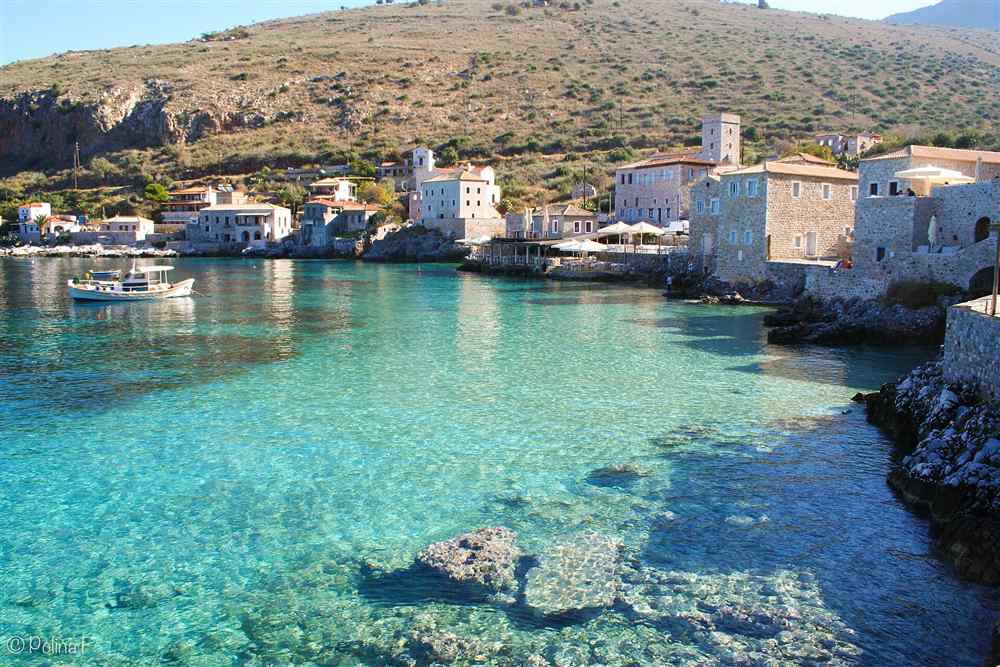
Limeni holds the Mavromichalis tower, restored into a hotel, and a row of stone buildings dropping straight into turquoise water 4 metres deep. Two tavernas serve grilled fish on platforms above the sea. Swimming happens off concrete ledges rather than sand. Parking fills by 13:00 in August, and the village measures 300 metres end to end. That detail shapes a Diros caves Mani visit from the first metre. This is what the Diros caves Mani punt delivers on the water.
Areopoli, capital of inner Mani, centres on Plateia 17 Martiou and the church of Taxiarches with its zodiac reliefs. Its flagstone lanes hold bakeries, the war museum and stone houses built for defence. From there the road south runs 24 km to Gerolimenas, a fishing harbour of twelve buildings under a cliff. A Diros caves Mani visit is planned around it.
Cape Tenaro closes the peninsula. A 2 km footpath crosses a Roman mosaic and the remains of the temple of Poseidon, identified in myth as the gate of Hades, ending at the lighthouse built in 1882. Walking out and back takes 70 minutes. The final road section from Porto Kagio is narrow and unsurfaced in stretches. The Diros caves Mani route is set by it.
Water-based days work from the same coast. A Kalamata yacht charter reaches Limeni and Oitylo bay in three to four hours under motor, anchoring off the cliffs where the caves drain. That approach shows the diros caves Mani shoreline from the sea, with the cove mouth visible as a dark notch in white limestone. It decides when to take the Diros caves Mani boat.
When is the best time of year to visit?
May, June, September and October deliver short queues, mild driving conditions and full boat operation. August brings waits of 60 to 90 minutes between 11:00 and 14:00. Heavy winter rain raises the internal water level and closes the route without notice.
Spring visits pair the cave with wildflowers across the Taygetos foothills and sea temperatures near 19 degrees at Limeni. Shoulder-season arrival at 09:00 puts a party on a punt within 15 minutes. By late June the coach schedules tighten, and from 20 July to 25 August the site handles its annual peak load. It decides when to take the Diros caves Mani boat.
Autumn holds warm sea through October, with air temperatures at Areopoli near 24 degrees and thin traffic on the EO39. November through February brings the closure risk: sustained rainfall over the Taygetos catchment lifts the gallery water by 30 to 50 centimetres, reducing headroom under the low roof sections until the punts cannot pass safely. This is what the Diros caves Mani punt delivers on the water.
Cave conditions themselves stay constant. The interior holds 16 to 19 degrees in January and in August alike, and the water sits at 12 to 14 degrees through every month. Seasonal choice therefore governs the queue, the road and the surrounding villages rather than the underground experience. A Diros caves Mani boatman handles it from the stern.
Time of day matters as much as month. The first hour after 08:30 and the last 90 minutes before closing carry the lightest load. Cruise-ship days at Kalamata port push extra minibuses toward the diros caves Mani entrance around midday, and the port schedule is published in advance for anyone planning around it. The Diros caves Mani ticket price reflects it.
Who does the cave suit, and what are the access limits?
The route suits visitors over four years old who sit still for 30 minutes in a punt. Standing is impossible under the low roof, claustrophobia is a genuine barrier, wheelchair access stops at the entrance area, and a warm layer is needed inside.
Children aged four to eight handle the ride well when seated between adults, and boatmen position families mid-boat. Infants in arms are discouraged because the sudden ducking movements under low formations demand both hands free. No pushchairs go on board; they stay at the ticket building, since the exit path returns above the cove rather than to the jetty. The Diros caves Mani ticket price reflects it.
Headroom drops below one metre at four points on the circuit. Everyone bends forward on command. Passengers over 1.9 metres tall find the seated posture cramped across the full 25 to 30 minutes. Anyone uncomfortable in enclosed, dimly lit spaces with no mid-route exit reconsiders before boarding, because the punt cannot turn around inside the narrow galleries. The Diros caves Mani galleries are lit for it.
Mobility limits are firm. The jetty is reached by a stepped ramp, boarding involves a 40-centimetre step down into a rocking hull, and the 300-metre exit walk climbs gently on wet concrete. Wheelchair users reach the ticket area, the terrace and the museum, but not the boat. Operators confirm it when a Diros caves Mani tour is booked.
Clothing matters. At 16 to 19 degrees with saturated air, a fleece or light jacket keeps a family comfortable through the diros caves Mani circuit even when the outside reading is 34 degrees. Swimwear and beach sandals leave visitors cold within ten minutes of leaving the jetty. The Diros caves Mani queue lengthens on that count in August.
What do you bring, and how far ahead do you book?
Bring a fleece for the 16 to 19 degree interior, flat closed shoes for the wet exit path, and a small bag only. Walk-up tickets are bought at the desk on the day; guided day tours are reserved two to five days ahead.
Footwear governs comfort on the 300-metre walking section, where condensation keeps the concrete damp and the handrail cold. Trainers or walking sandals with grip work; smooth-soled shoes slide. Large rucksacks and hard cases stay in the car, because bench space in the punt is measured to the centimetre and loose luggage blocks the ducking movement. The Diros caves Mani queue lengthens on that count in August.
Photography is permitted without flash across the boat route, since repeated flash damages the lighting balance and disturbs the boatman’s night vision. Sensor performance matters more than lens length: the chambers run dark and the punt never stops fully still. Video from a phone held low above the gunwale records the reflections reliably. A Diros caves Mani tour starts with this settled.
Independent visitors need nothing beyond arrival time. The desk opens at 08:30 and sells tickets continuously until the final punt. Cash and cards are accepted. Groups above fifteen contact the Ephorate in advance so boarding slots are allocated together instead of split across an hour of departures. The Diros caves Mani ticket desk states this at the gate.
Organised trips fill faster. Small-group minibuses covering the diros caves Mani route from Kalamata, Stoupa and Areopoli sell out two to five days ahead from June to September, and private vehicles for four to six passengers close a week out in August. Confirmation includes pickup point, departure time and whether the 15 to 20 euro entry is prepaid. The Diros caves Mani season turns on this.
Frequently Asked Questions
How much does the Diros caves boat tour cost?
Fifteen to twenty euros for an adult ticket with a reduced rate for children and students. The punt runs 25 to 30 minutes through the water galleries, followed by a 300-metre walk out to the exit.
Where are the Diros caves in Mani?
At Pyrgos Dirou on the west coast of the Mani peninsula, 12 km south of Areopoli, 40 minutes from Gythio and about 90 minutes by road from Kalamata or Sparta.
What are the opening hours of the Diros caves?
From 08:30 to 17:30 in summer and 08:30 to 15:00 in winter, with the last boat leaving before closing. Queues run longest between 11:00 and 15:00 in July and August.