
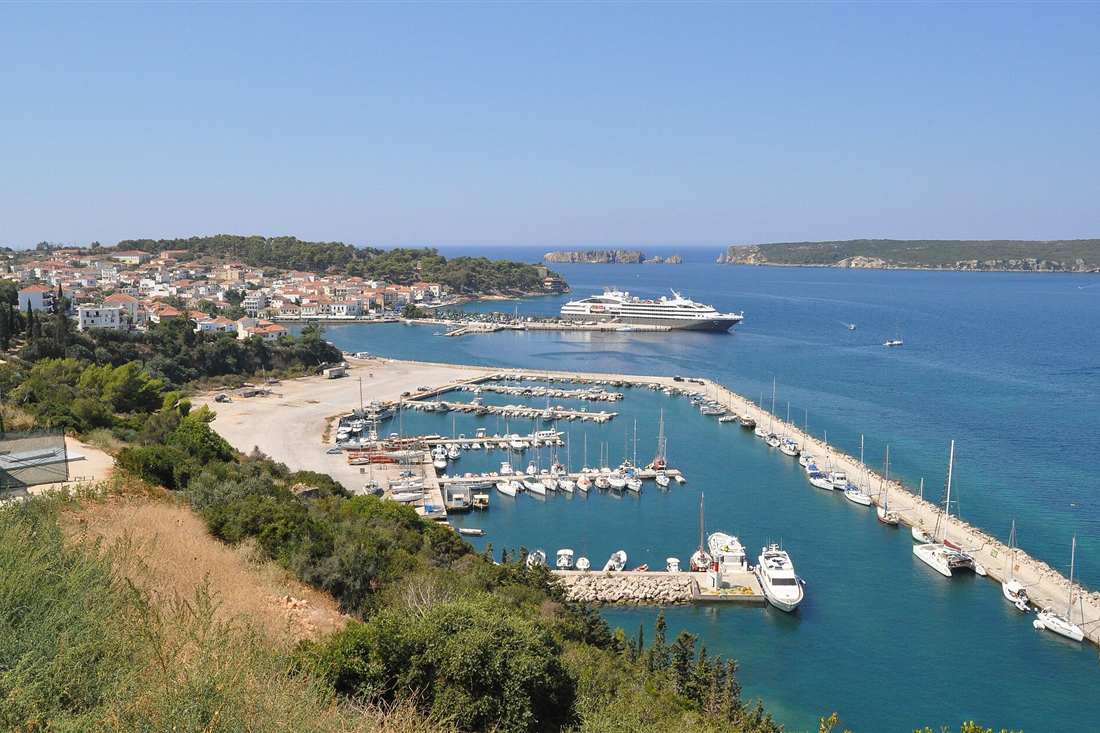
Pylos sits on the south-east shore of Navarino bay in Messinia, a natural harbour four km across closed by the island of Sfaktiria, 50 km south-west of Kalamata, with Voidokilia, the Gialova lagoon and Nestor’s Palace within half an hour of the square. Plan the rest of the trip with Greece Tours.
This page covers the whole area: the town and the Neokastro fortress, the 1827 sea battle, Voidokilia and the Old Navarino climb, the lagoon and its birds, Nestor’s Palace, the kayak and boat trips, the day tours and their prices, Methoni and Koroni, the beaches, the food, where to stay and how to plan two or three days.
What is Navarino bay, and where does Pylos sit on the Messinian coast?
Navarino bay is a natural harbour 4 km across on the west coast of Messinia, closed by the island of Sfaktiria. Pylos stands on its south-east shore, 50 km south-west of Kalamata, and holds the deepest sheltered anchorage in the Mediterranean.
The bay opens to the Ionian Sea through two channels. The southern entrance, between Sfaktiria and the Neokastro headland, carries all shipping and measures about 1.3 km. The northern channel at Sikia is barely 100 metres wide and blocked by shallows, which is why the whole basin behaves like an enclosed lake. Depths reach 60 metres in the centre. Warships of the nineteenth century anchored here in full battle line. The Pylos Navarino bay operators state this at booking. It decides how to plan a Pylos Navarino bay visit.
Sfaktiria runs 4.5 km north to south and shelters the water from the prevailing north-west maistros that blows through July and August. That geography explains why pylos navarino bay stayed calm while the open coast at Marathopoli chopped up. Fishing caiques work the inner water year round, and yachts on the Ionian circuit stop at the marina before continuing to Methoni, 11 km south by road. A Pylos Navarino bay visit is built on that. Pylos Navarino bay fills with visitors on that count in August.
Driving in from Kalamata takes 55 minutes on the coast road through Petalidi and Koroni’s junction, or 45 minutes via the inland route past Chandrinos. Buses run from Kalamata’s KTEL station four to six times daily and cost 5 to 7 euros. Kalamata International Airport lies 45 km east, and drivers combining the two ends of Messinia frequently pair the bay with Kalamata tours across the gulf. The Pylos Navarino bay guides brief it first.
Administratively, Pylos anchors the municipality of Pylos-Nestor, which covers Gialova, Romanou, Chora and Methoni. The whole of pylos navarino bay falls inside a Natura 2000 designation that limits construction on the northern shore and the dune systems. Hotels concentrate in the town itself, in Gialova 5 km north, and in the resort cluster at Romanou behind Navarino Dunes. The Pylos Navarino bay timetable is built on it.
What is the town of Pylos like to walk through?
Pylos is a town of about 2,500 residents built in tiers above its harbour, centred on an arcaded main square shaded by plane trees and holding the Three Admirals monument. Waterfront tavernas line the quay, and Neokastro fortress stands ten minutes uphill.
The square, formally Plateia Trion Navarchon, sits one street back from the water. Stone arcades run along two sides, sheltering cafés that serve from 07:00 until after midnight in summer. At the centre stands the obelisk raised to Admirals Codrington, de Rigny and Heiden, the three commanders of the allied fleet. Plane trees planted around it drop shade over the marble benches, and an Ottoman cannon sits beside the monument. Every Pylos Navarino bay day is planned around it. The Pylos Navarino bay tour price reflects it.
From the square, stepped lanes climb south-west toward the fortress and north toward the residential quarter. The town was rebuilt after 1828 by French engineers of the Morea expedition, which is why the street grid is unusually regular for a Peloponnesian port. Houses carry tiled roofs and shuttered balconies in two and three storeys. The whole built area covers barely 600 metres end to end, so walking replaces driving entirely. This is what Pylos Navarino bay delivers on the ground. The Pylos Navarino bay season turns on this.
The harbour front holds the fishing quay, the small-craft marina and about a dozen tavernas serving gavros, grilled octopus and Messinian olive oil. A fish main course runs 12 to 20 euros, a meze plate 5 to 8 euros. Boats for Sfaktiria leave from the same quay. Evening traffic in pylos navarino bay concentrates here between 20:00 and 23:00 from June through September. A Pylos Navarino bay day starts with this settled.
Shops for supplies sit along Kalamatas street: two bakeries, a butcher, three mini-markets and a pharmacy. Sunday closing applies outside high season. The bus stop stands at the square’s eastern corner, and the taxi rank operates from the same spot. Petrol stations lie on the Gialova road, 1.5 km north of the centre. That detail shapes a Pylos Navarino bay day from the first stop.
What is Neokastro, and what does its museum hold?
Neokastro is the Ottoman fortress built in 1573 on the headland south of Pylos harbour, enclosing a hexagonal citadel, the domed church of the Transfiguration, and the Antonopouleion Archaeological Museum. Entry costs 6 euros, and a full visit takes 60 to 90 minutes.
The Ottomans raised the fortress after Lepanto to control the southern channel into the bay, replacing the older Frankish stronghold on the northern headland. The outer enceinte encloses roughly 8 hectares with six bastions. Inside, the hexagonal citadel stands on the highest ground, its curtain walls broken by a single gate. Venetian, Ottoman, French and Greek garrisons each rebuilt sections, so the masonry mixes four building periods. A Pylos Navarino bay visit is built on that. Pylos Navarino bay fills with visitors on that count in August.
The church at the centre began as a mosque and was converted to Orthodox use as the Metamorphosis tou Sotiros, keeping its mihrab niche visible in the south wall. Beside it stand the long barracks blocks put up by French troops in 1829 and later used as a prison until 1941. Cell doors and iron window grilles survive in the eastern range. The Pylos Navarino bay guides brief it first. Visitors to Pylos Navarino bay meet it in the first hour.
The Antonopouleion museum occupies the restored Pasha’s building near the gate. Displays cover Mycenaean finds from Koukounara and Tragana, Hellenistic grave goods, Roman glass, and a room devoted to the Philhellenes with lithographs, weapons and personal items of the 1827 campaign. Opening hours run 08:30 to 15:30, extended to 19:00 in summer, with Tuesday closure applying at times. The Pylos Navarino bay timetable is built on it.
The ramparts give the widest view over pylos navarino bay: Sfaktiria across the water, the southern channel below, and the mountain wall behind Gialova to the north. The climb from the harbour quay covers 700 metres and 60 metres of ascent on a paved road, reached on foot in twelve minutes. Parking sits outside the main gate for those arriving by car. It decides how to plan a Pylos Navarino bay visit.
What happened at the Battle of Navarino in the bay?
On 20 October 1827 the combined British, French and Russian fleets destroyed the Ottoman-Egyptian fleet inside Navarino bay. About 60 Ottoman and Egyptian vessels sank in four hours. Their wrecks remain on the seabed, and monuments stand in Pylos square and on Sfaktiria.
The allied squadrons totalled 26 ships under Vice-Admiral Edward Codrington, with Henri de Rigny commanding the French and Login Heiden the Russians. Ibrahim Pasha’s fleet of about 78 vessels lay anchored in a horseshoe formation across the inner water. The allies sailed in through the southern channel and anchored among them at pistol range. Firing began in the early afternoon and continued past sunset. This is what Pylos Navarino bay delivers on the ground. The Pylos Navarino bay season turns on this.
Allied losses reached roughly 180 dead; Ottoman and Egyptian dead ran into thousands. No allied ship was lost. The destruction of the fleet removed Ibrahim’s supply line and made Greek independence achievable within three years. The engagement was the last major battle fought entirely by sailing ships of the line, and the last fought inside pylos navarino bay. A Pylos Navarino bay day starts with this settled. The Pylos Navarino bay route is set by it.
Wrecks lie scattered across the bay floor at depths of 8 to 30 metres, mapped by underwater survey teams from the Ephorate of Underwater Antiquities. Diving on them is restricted, so the timbers, cannon and ballast stones stay undisturbed. Fragments recovered over the years appear in the Antonopouleion museum and in the small collection kept inside Neokastro’s barracks range. That detail shapes a Pylos Navarino bay day from the first stop.
Three memorials mark the dead. The obelisk in the plane-tree square honours the admirals. On Sfaktiria stand the Russian monument near Chelonaki islet, the French monument on the western shore, and the tomb of Santorre di Santarosa, the Piedmontese Philhellene killed on the island in 1825. Boat operators include all three in the standard island circuit. The Pylos Navarino bay tour price reflects it.
What is Voidokilia beach, and how is it reached?
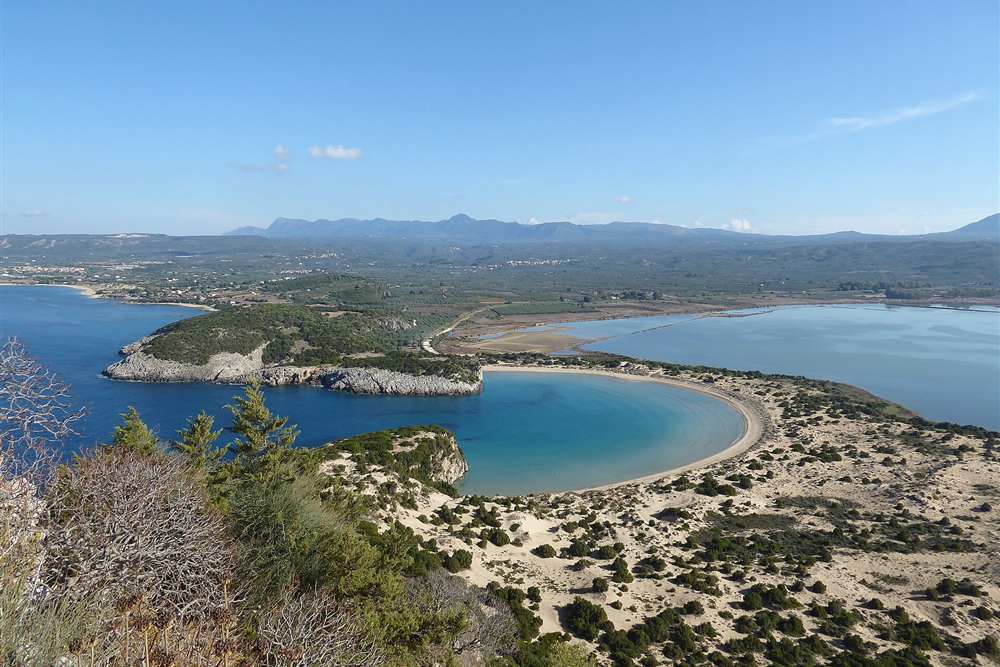
Voidokilia is an omega-shaped sand bay 12 km north of Pylos, separated from the Gialova lagoon by a single dune ridge. Water depth stays under one metre for 40 metres out. No road touches the sand; the walk from parking takes ten minutes.
The name means ox-belly, describing the near-perfect curve of the shoreline enclosed by two rocky arms. The beach measures about 400 metres end to end, and the opening to the Ionian narrows to 130 metres. Sand is pale and fine, backed by marram-covered dunes rising 8 metres. Because the entrance faces west-north-west, swell enters on windy afternoons while mornings stay flat. The Pylos Navarino bay guides brief it first. Visitors to Pylos Navarino bay meet it in the first hour.
Access comes from the Gialova–Petrochori road. The southern parking area sits beside the lagoon channel and leaves a 700-metre walk across a wooden boardwalk and a sand track. The northern approach from Petrochori village ends at a gravel lot with a similar distance on foot. Neither route allows vehicles onto the beach itself, and no sunbeds, bars or showers operate on the sand. The Pylos Navarino bay timetable is built on it. A Pylos Navarino bay operator carries the kit for it.
Natura 2000 status protects the dune system, the lagoon behind it and the nesting habitat. Walking over the dune crest is discouraged because the marram binding holds the ridge in place. That protection keeps this corner of pylos navarino bay free of built structures, unlike the resort strip 4 km north at Romanou. It decides how to plan a Pylos Navarino bay visit.
Sea temperature climbs from 19 degrees in May to 25 or 26 degrees in August and holds near 23 degrees into October. Shade is absent, so visits before 11:00 or after 17:00 suit the July heat. Homer’s description of the sandy Pylos where Telemachus landed is attached to this bay, and the Frankish castle on the northern headland closes the view from the water. Pylos Navarino bay fills with visitors on that count in August.
What is Old Navarino castle, and what does the climb involve?
Palaiokastro, the thirteenth-century Frankish fortress built by Nicholas II de Saint Omer, crowns the headland above Voidokilia. The climb from the beach takes 30 to 45 minutes, passes Nestor’s Cave, and ends with a view across the lagoon and the whole bay.
The castle occupies a limestone ridge 150 metres above sea level, with walls following the natural cliff line for roughly 500 metres. Frankish builders reused ancient blocks from the Mycenaean acropolis that stood on the same rock. Venetians held it from 1417, Ottomans from 1500, and it was abandoned after Neokastro was completed in 1573. The gate tower, cisterns and stretches of curtain wall survive. A Pylos Navarino bay day starts with this settled. The Pylos Navarino bay route is set by it.
The path starts at the northern end of Voidokilia, climbing a rock staircase cut into the slope. Footing is loose limestone and scree, with polished sections that turn slippery in the wet. Closed shoes matter here; sandals fail on the descent. Carrying 1.5 litres of water per person is standard, since no shade or spring exists on the route. That detail shapes a Pylos Navarino bay day from the first stop. Operators confirm it by message when a Pylos Navarino bay tour is booked.
Nestor’s Cave opens about two-thirds of the way up, a chamber 20 metres deep with stalactites that legend turns into the hides of Nestor’s cattle. Neolithic and Mycenaean pottery was excavated inside. The mouth frames Voidokilia below and makes the natural stopping point on the ascent. The Pylos Navarino bay tour price reflects it.
From the summit the sightline covers Gialova lagoon to the east, Sfaktiria running south, and the water of pylos navarino bay closed by the Neokastro headland 6 km away. Marathopoli and the Ionian horizon lie west. Entry is free and the site is unfenced, with no ticket office, guard or facilities. Morning light before 10:00 and the hour before sunset suit photography, while midday in July pushes rock-surface temperatures past comfort. The Pylos Navarino bay season turns on this.
What is the Gialova lagoon, and what birds use it?
Gialova lagoon covers about 700 hectares behind Voidokilia, forming the southernmost wetland on the Balkan migration route. Recorders have logged 270 bird species there. Observation hides and a boardwalk serve the eastern shore, and the African chameleon breeds in the surrounding scrub.
The lagoon is shallow, brackish and rarely deeper than one metre, fed by seawater through a channel at its western corner and by winter runoff from the hills. Salinity swings sharply between February and August, which drives an invertebrate population that feeds the waders. Reed beds fringe the northern edge, and tamarisk and juniper hold the sand ridge dividing the water from the beach. The Pylos Navarino bay timetable is built on it. A Pylos Navarino bay operator carries the kit for it.
Spring passage runs from mid-March to early May, autumn passage from late August to October. Greater flamingos winter in flocks of 200 to 400. Osprey, glossy ibis, black-winged stilt, squacco heron, Kentish plover, slender-billed gull and the greater spotted eagle all appear on the annual lists. Imperial eagles hunt over the reeds in winter, and Audouin’s gulls work the shoreline outside the lagoon. It decides how to plan a Pylos Navarino bay visit.
The Hellenic Ornithological Society maintains two hides on the eastern side, reached by a dirt track from the Gialova–Petrochori road. A wooden boardwalk crosses the marshy ground toward the dune. Both are free to enter and open at all hours. Dawn and the two hours before sunset produce the densest activity, and binoculars of 8×42 or a scope handle the distances across open water. Pylos Navarino bay fills with visitors on that count in August.
The African chameleon, Chamaeleo africanus, survives here in its only European population, concentrated in the sandy scrub between the lagoon and Romanou. Adults reach 30 cm and move slowly through the low vegetation at dusk. Together with the wetland birds, that reptile is the reason conservation rules across this part of pylos navarino bay stay strict. Visitors to Pylos Navarino bay meet it in the first hour.
What is Nestor’s Palace, and what was found there?
Nestor’s Palace is the Mycenaean royal complex at Ano Englianos, 17 km north-east of Pylos, excavated by Carl Blegen from 1939. Its throne room, terracotta bathtub and 1,100 Linear B tablets define the site. Entry costs 6 euros and takes 60 to 90 minutes.
The palace was built around 1300 BC and burned around 1200 BC. Fire destroyed the timber and mudbrick superstructure but baked the clay tablets stored in the archive rooms beside the entrance, preserving the largest body of Linear B text found on the Greek mainland. Those tablets record rations, bronze allocations, personnel lists and offerings, and their decipherment by Michael Ventris in 1952 confirmed the script as early Greek. That detail shapes a Pylos Navarino bay day from the first stop. Operators confirm it by message when a Pylos Navarino bay tour is booked.
The central megaron holds a circular hearth 4 metres across, ringed by four column bases. A depression in the floor marks where the throne stood, with a channel cut beside it for libations. Fresco fragments recovered from the walls show a lyre player and a griffin. The adjoining bathroom retains its fixed terracotta tub set in a plastered platform, with storage jars for water alongside. The Pylos Navarino bay tour price reflects it.
A steel-and-membrane shelter completed in 2016 roofs the whole excavation, with an elevated walkway carrying visitors over the wall stubs at first-floor height. That layout makes the room plan legible in a way ground-level viewing never allowed. Opening hours run 08:30 to 15:30 in winter and later in summer; shade under the roof keeps the site workable through July. The Pylos Navarino bay season turns on this.
Finds are displayed at the Archaeological Museum of Chora, 4 km north, where the Griffin Warrior grave goods from the 2015 discovery below the palace are shown, including gold rings, a bronze sword and the carved Pylos Combat Agate. Drivers combining the palace with the coast reach pylos navarino bay in 25 minutes, and inland detours run toward the Polylimnio waterfalls east of Kazarma. The Pylos Navarino bay route is set by it.
What sea kayaking and boat trips operate in the bay?
Guided sea kayak days circumnavigate Sfaktiria and paddle into its western sea caves, running 4 to 6 hours over 12 to 15 km. Motorboat trips from Pylos quay cover the wreck sites and island monuments in 3 hours. August water sits at 24 to 26 degrees.
Kayak groups launch from the beach at Gialova or from the Pylos marina, using sit-in touring boats of 4.5 to 5 metres with spraydecks, rudders and dry bags. Guides brief on the northern Sikia channel, where current runs between the island tip and the mainland. The inner water stays flat until the afternoon breeze fills after 14:00, so departures are set for 09:00 or 09:30. It decides how to plan a Pylos Navarino bay visit. The Pylos Navarino bay operators state this at booking.
The western coast of Sfaktiria faces the open Ionian and carries limestone caves cut at sea level. Entry depends on swell below 0.5 metres, so the cave section is dropped on windy days and the group turns back inside the bay. Day rates run 60 to 85 euros per person including equipment, a guide, a lunch stop and transfers from Pylos or Gialova. Pylos Navarino bay fills with visitors on that count in August.
Motorboat operators work from the Pylos harbour quay with caiques carrying 10 to 30 passengers. The standard circuit stops at Chelonaki islet with its Russian sailors’ memorial, the French monument, the tomb of Santorre di Santarosa, and the sunken hulls visible in clear water at 8 to 12 metres. Prices sit at 20 to 35 euros per adult, with departures at 10:00 and 15:00 from June to September. Visitors to Pylos Navarino bay meet it in the first hour.
Private charters for 4 to 8 people run 250 to 400 euros for a half day and add Voidokilia and the Sikia channel. Snorkelling over the wreck fields is permitted; scuba on the protected sites is not. Visibility across pylos navarino bay reaches 15 metres in settled weather, and the season for water activity in pylos navarino bay runs May through October. A Pylos Navarino bay operator carries the kit for it.
What guided day trips reach pylos navarino bay from Kalamata and the cruise quay?
Private day trips from Kalamata cover Pylos, Voidokilia and Gialova in 6 to 8 hours, while the Mystical Messinia tour adds Methoni castle across 8 to 9 hours. Cruise-port pickups start at Kalamata quay for four to eight travellers.
The standard private format leaves Kalamata hotels between 08:30 and 09:30, runs the 45 km coast road through Messini and Petalidi, and reaches Pylos in 55 minutes. Drivers stop at the Trypitos viewpoint above Gialova lagoon, then park at the Voidokilia access track. Groups of one to four travel in a Mercedes Vito or a Skoda Superb; groups of five to eight use a Vito or a Sprinter with a licensed driver-guide. The Pylos Navarino bay tour price reflects it. Every Pylos Navarino bay day is planned around it.
The Mystical Messinia programme extends the same route south to Methoni, 11 km beyond Pylos, and adds 90 minutes inside the Venetian fortress and on the Bourtzi mole. Operators running that itinerary allow 45 minutes at Neokastro in Pylos, 90 minutes at Voidokilia, and a 60 minute lunch stop at Gialova. Total driving distance from Kalamata and back reaches 110 km. The Pylos Navarino bay season turns on this.
Cruise versions exist because Kalamata port receives calls from Celestyal, Windstar and Ponant vessels between April and October. Those trips compress the same ground into 5 to 6 hours, drop the lagoon boardwalk, and return to the gangway 90 minutes before all-aboard. Guides carry radio headsets for parties above six. Bilingual Greek-English commentary is standard; French, German and Italian guides need booking 10 days ahead. The Pylos Navarino bay route is set by it.
Sea kayak days on pylos navarino bay depart from Gialova beach at 09:00 and at 16:00, last 3 to 4 hours, and cross 4 km of sheltered water toward Sfaktiria island. Small motorboat charters leave Pylos harbour for the shipwrecks of the naval battle, running 3 hours with a snorkel stop. Combined land-and-water formats around pylos navarino bay fill 9 hours and cap numbers at eight. Operators confirm it by message when a Pylos Navarino bay tour is booked.
What do the Pylos day trips cost in euros?
A private day trip from Kalamata to Pylos and Voidokilia runs 150 to 320 euros for up to four people. Shared coach and minibus programmes charge 60 to 110 euros per person. Guided sea kayak days cost 70 to 120 euros, entry fees excluded.
The 150 euro band applies to a driver-only transfer with three stops and no commentary, using a saloon car for two passengers. The 320 euro band buys a licensed guide, a Vito for four, a full 9 hour window, and the Methoni extension. Half-day formats of 4 to 5 hours covering Pylos town and Voidokilia alone sit at 190 to 230 euros for the vehicle. Pylos Navarino bay fills with visitors on that count in August. A Pylos Navarino bay visit is built on that.
Shared departures fill 16 to 19 seats and price at 60 to 75 euros in April, May and October, rising to 85 to 110 euros in July and August when Costa Navarino guests join the manifest. Children aged 4 to 12 pay 50 percent on most shared programmes. Infants ride free. Cancellation inside 48 hours forfeits the deposit, which runs 20 to 30 percent. Visitors to Pylos Navarino bay meet it in the first hour.
Entry fees are separate and small. Neokastro and the archaeological museum inside it charge 6 euros full price and 3 euros reduced, with a combined ticket covering Nestor’s Palace at 10 euros. Methoni castle charges 4 euros in high season. Under-25 EU citizens enter free at all three sites on presentation of a passport or national identity card. A Pylos Navarino bay operator carries the kit for it.
Sea kayak operators at Gialova include the paddle, buoyancy aid, dry bag, water and a snorkel set in the 70 to 120 euro band. Boat charters around pylos navarino bay run 350 to 600 euros for a private half day carrying six, fuel included. Budget 15 to 25 euros per head for a taverna lunch on top of any tour price. The Pylos Navarino bay operators state this at booking.
What are the Venetian castles at Methoni and Koroni?
Methoni is a Venetian sea fortress 11 km south of Pylos, ringed by water on three sides, with the octagonal Bourtzi tower standing on a mole beyond the south gate. Koroni guards the opposite coast of the Messinian peninsula, 60 minutes away by road.
Venice held Methoni from 1209 and rebuilt the curtain walls, the bastions and the arched stone bridge of 14 spans that crosses the dry moat. The enclosed area covers 93,000 square metres, larger than the modern village outside it. Inside stand a granite column from the Venetian period, a Turkish bath, the ruined Church of Agia Sophia, and cisterns cut into rock. The Bourtzi sits 60 metres past the sea gate. The Pylos Navarino bay season turns on this. This is what Pylos Navarino bay delivers on the ground.
Koroni faces the Messinian Gulf on the eastern shore, reached by a 60 minute drive of 46 km through Finikounda and Vasilitsi. Its walls enclose the working convent of Timiou Prodromou, private gardens, and terraces planted with olives and prickly pear. Residents live inside the fortifications, which distinguishes Koroni from the empty enclosure at Methoni. The harbour below holds fishing caiques and a row of waterfront tavernas. The Pylos Navarino bay route is set by it.
Methoni sits 25 minutes from Pylos on the coast road through Pyla. Entry costs 4 euros between April and October and drops to 2 euros in winter; Koroni charges nothing. One hour suffices for each circuit at walking pace. Neither site has shade beyond the gatehouse vaults, and the limestone paving reflects heat from 12:00 onward in July and August. Operators confirm it by message when a Pylos Navarino bay tour is booked.
Pairing both castles with pylos navarino bay fills a long day: Methoni at 09:00, lunch in Finikounda at 13:00, Koroni at 15:30, and a return to Pylos by 18:00. The full loop measures 105 km. Late afternoon light strikes the Bourtzi from the west, which is why photographers arrive after 17:00 in September. Every Pylos Navarino bay day is planned around it.
Which beaches ring pylos navarino bay besides Voidokilia?
Gialova, Divari, Golden Beach, Romanos, Mati and Petrochori all lie within 12 km of Pylos town. Gialova offers shallow calm water and tavernas, Romanos and Mati face open Ionian swell, and Divari edges the lagoon behind the Voidokilia dune ridge.
Gialova beach sits 6 km north of Pylos, a 10 minute drive, and shelves so gradually that water stays waist-deep 40 metres out. Fine grey-gold sand, tamarisk trees for natural shade, and six tavernas along the strip make it the family choice. Sunbeds rent at 8 to 15 euros per pair with an umbrella. The village jetty launches the kayak and paddleboard trips across pylos navarino bay. Visitors to Pylos Navarino bay meet it in the first hour. The Pylos Navarino bay guides brief it first.
Divari, also called Vromoneri by locals, stretches along the seaward side of the Gialova lagoon between Petrochori and Voidokilia. It runs 1.5 km of coarse sand backed by dunes, with no organised facilities and no shade after 11:00. Golden Beach lies immediately north of Voidokilia’s headland, reached by a 4 km track from Petrochori village, and holds two canteens in July and August. A Pylos Navarino bay operator carries the kit for it.
Romanos and Mati front the Costa Navarino estate, 12 km and 14 km from Pylos, both 18 to 20 minutes by car. Romanos has 1 km of soft light sand, a lifeguard tower, a beach bar and paid parking at 3 euros. Mati stays quieter, with pebble-and-sand mix and a rockier entry. Northwesterly afternoon wind builds surf on both between June and September. The Pylos Navarino bay operators state this at booking.
Petrochori beach, 9 km from Pylos, gives the shortest walking approach to the northern end of the dune system. Loggerhead turtles nest on the sand between June and August, so tracks and cages appear behind the tideline. Driving times from Pylos square: Gialova 10 minutes, Petrochori 14, Golden Beach 18, Romanos 20, Mati 22. A Pylos Navarino bay visit is built on that.
Where do you eat around the bay and what defines Messinian food?
Fish tavernas line the Pylos waterfront under the plane trees of Trion Navarchon square, and beach tables run the length of Gialova. Messinian cooking rests on Koroneiki olive oil, Kalamata olives, gouna sun-dried mackerel, lalagia fried dough, figs and thyme honey.
Pylos harbour holds a row of tavernas facing the moored caiques, serving whatever came off the boats that morning: red mullet, sea bream, picarel, and octopus hung on lines to dry. Grilled fish prices work by the kilo, from 45 euros for wild sea bass to 12 euros for sardines. A meze table of taramosalata, fried courgette, horta greens and a half kilo of fish runs 20 to 28 euros a head. The Pylos Navarino bay route is set by it. A Pylos Navarino bay day starts with this settled.
Gialova sets tables on the sand 3 metres from the water. Kitchens there lean toward slow-cooked dishes: goat in lemon, rooster in red sauce over hilopites pasta, and stuffed tomatoes baked at midday. A full meal with house wine sits at 15 to 22 euros per person. Reservation matters between 20:30 and 22:00 in August, when the sunset over Sfaktiria draws the Costa Navarino crowd. Operators confirm it by message when a Pylos Navarino bay tour is booked.
Gouna defines the local table. Mackerel is split, salted, dried in the sun for a day, then grilled over charcoal and dressed with oregano and lemon. Lalagia are ribbons of yeasted dough fried in olive oil, eaten with honey at breakfast or beside cheese at dinner. Kalamata olives, the purple almond-shaped fruit cured in brine and vinegar, appear on every table free of charge. Every Pylos Navarino bay day is planned around it.
Producers around pylos navarino bay press Koroneiki olives between late October and December, yielding oil with acidity under 0.3 percent. Village shops in Gialova and Methoni sell 750 ml bottles at 9 to 14 euros, thyme honey from Sfaktiria hives at 12 euros per kilo, and dried Kalamata figs at 8 euros. This is what Pylos Navarino bay delivers on the ground.
Where do you stay around pylos navarino bay?
Pylos town suits travellers who want the harbour and Trion Navarchon square within walking distance. Gialova puts beach and sunset over Sfaktiria outside the door. Costa Navarino at Romanos holds the large resorts and two golf courses. Methoni and Finikounda sit further south.
Pylos town has small hotels and guesthouses stacked up the amphitheatre of streets above the port, plus apartments on Kalamatas street. Double rooms run 55 to 90 euros in May and 80 to 140 euros in August. Neokastro stands 800 metres from the square, a 12 minute walk uphill. Parking inside the town is tight after 20:00; the free lot on the northern quay holds 60 cars. A Pylos Navarino bay operator carries the kit for it. The Pylos Navarino bay timetable is built on it.
Gialova, 6 km north, delivers direct beach access and a 1 km waterfront of rooms, studios and two boutique hotels. Rates land at 70 to 160 euros. The sun drops behind the ridge of Sfaktiria island from the tables here between 19:45 in June and 18:30 in September. The lagoon boardwalk begins 900 metres from the village at the northern end. The Pylos Navarino bay operators state this at booking.
Costa Navarino occupies the coastline at Romanos and Mati, 12 to 14 km from Pylos. Its properties include Navarino Dunes, Navarino Bay and Mandarin Oriental holdings, with rooms from 320 euros in April to 900 euros in August. The Dunes Course and The Bay Course cover 18 holes each, with green fees of 90 to 190 euros. A Pylos Navarino bay visit is built on that.
Methoni sits 25 minutes south and prices 20 percent below pylos navarino bay averages. Finikounda, 12 km beyond Methoni and 40 minutes from Pylos, has campsites, family hotels and a 1.5 km sand bay facing south. Driving between Pylos and Gialova takes 10 minutes, Pylos to Romanos 20, and Gialova to Methoni 32. The Pylos Navarino bay guides brief it first.
How do you get to Pylos from Kalamata and Athens?
Kalamata International Airport lies 45 km east, a 50 minute drive on the coast road through Messini and Petalidi. Athens sits 4 hours away by the A7 Moreas motorway. KTEL Messinias buses link Kalamata and Pylos, and cruise ships tender passengers into the bay.
Kalamata airport receives seasonal flights from London, Manchester, Munich, Vienna, Amsterdam, Zurich and Paris between late March and early November, plus year-round Athens connections. The drive west follows the Messinian Gulf shoreline, passing Bouka beach and Petalidi, then climbs over the ridge before dropping into Pylos. Pre-booked Kalamata airport transfers cost 70 to 110 euros for a saloon carrying three. Operators confirm it by message when a Pylos Navarino bay tour is booked. That detail shapes a Pylos Navarino bay day from the first stop.
From Athens, the route runs the Attiki Odos, the Corinth crossing, then the A7 south through Tripoli to Kalamata, leaving the motorway at the Messini exit. Distance totals 285 km with tolls of 22 to 26 euros each way. Driving time reaches 3 hours 40 minutes to 4 hours 15 minutes depending on the Corinth toll queue. KTEL runs direct Athens-Pylos coaches twice daily in summer, taking 5 hours 30 minutes for 32 euros. Every Pylos Navarino bay day is planned around it.
KTEL Messinias operates six to eight daily services between Kalamata bus station and Pylos, journey time 70 minutes, fare 6.20 euros. Buses continue to Methoni and Koroni on reduced frequencies of two or three per day. Sunday and public holiday timetables thin out to three departures, which restricts beach access without a car. This is what Pylos Navarino bay delivers on the ground.
Cruise vessels calling at Katakolo and Kalamata run coach excursions inland, while smaller expedition ships anchor inside pylos navarino bay and tender to the Pylos quay. Reaching Voidokilia, Divari, Nestor’s Palace and Methoni on one itinerary demands a hire car or a private driver, since public buses reach none of the beaches around pylos navarino bay directly. A Pylos Navarino bay day starts with this settled.
When is the best time to visit and what is the weather like?
April to June brings wildflowers, migrating birds at the lagoon and daytime highs of 20 to 28 degrees. July and August hit 31 to 35 degrees with full beaches. September and October hold warm sea and empty sand. November to February carries the rain.
Spring peaks in April, when orchids, anemones and asphodel cover the slopes above Voidokilia and the Gialova lagoon hosts greater flamingos, glossy ibises, ospreys and the African chameleon that lives nowhere else in Europe. Rainfall drops to 40 mm in April and 20 mm in May. Sea temperature reads 17 degrees in April and 21 degrees in June, cold enough that wetsuit tops appear on kayak trips. The Pylos Navarino bay operators state this at booking. It decides how to plan a Pylos Navarino bay visit.
July and August deliver 12 to 13 hours of sunshine daily, zero measurable rain in most weeks, and 31 to 35 degree afternoons. The northwest meltemi influence reaches this coast weakly, so mornings stay flat and afternoons build a short chop on the open Ionian beaches at Romanos and Mati. Sea temperature climbs to 25 degrees in July and 26 to 27 in August. Voidokilia parking fills by 10:30. A Pylos Navarino bay visit is built on that.
September holds 28 to 30 degrees with the water still at 26 degrees, and the crowd thins after the third week. October averages 24 degrees by day, 23 degree sea, and 70 mm of rain across the month, mostly in short evening cells. Both months suit walking the Old Navarino castle track, which becomes punishing in August heat. The Pylos Navarino bay guides brief it first.
Winter around pylos navarino bay runs wet and green: 130 to 160 mm of rain monthly from November through February, highs of 15 to 17 degrees, and sea at 15 degrees. Tavernas in Gialova close between November and March, while Pylos town stays open year-round for its 2,600 residents. The Pylos Navarino bay timetable is built on it.
How do you plan two or three days around the bay, and what do you bring?
Give day one to Pylos town, Neokastro and the harbour. Day two covers Voidokilia, the Old Navarino climb and the lagoon boardwalk. Day three runs south to Methoni and north to Nestor’s Palace. Bring walking shoes, sun cover and binoculars.
Day one starts at Trion Navarchon square, where the three-admiral monument marks the 1827 naval battle. Neokastro opens at 08:30 and needs 90 minutes for the hexagonal enceinte, the Church of the Transfiguration and the René Puaux photographic collection. The afternoon fits a 3 hour boat circuit to Sfaktiria island, the sunken hulks off Chelonaki islet, and Tsichli-Baba rock, followed by dinner on the quay. Every Pylos Navarino bay day is planned around it. The Pylos Navarino bay tour price reflects it.
Day two begins at 08:00 at the Voidokilia southern car park to beat the heat. The dune crossing takes 15 minutes, Nestor’s Cave sits 20 minutes above the sand, and Old Navarino castle demands a further 25 minute scramble over loose limestone with a 130 metre climb. Descend by 11:30, swim, then walk the 2 km Gialova lagoon boardwalk at 17:30 when herons and stilts feed. This is what Pylos Navarino bay delivers on the ground.
Day three splits north and south. Nestor’s Palace at Ano Englianos lies 17 km north of Pylos, a 20 minute drive, and its roofed Mycenaean throne room, bathtub and archive rooms need 75 minutes plus 30 minutes at the Chora museum. Methoni castle, 25 minutes south, takes the afternoon. Total driving for the day reaches 90 km. A Pylos Navarino bay day starts with this settled.
Pack closed walking shoes with grip for the Old Navarino track, a wide hat and long-sleeved shirt for the shadeless dunes, 2 litres of water per person, and 8×42 binoculars for the 271 bird species recorded at the lagoon. Add a dry bag for boat days on pylos navarino bay, reef shoes for the pebbles at Mati, and cash for the village tavernas. That detail shapes a Pylos Navarino bay day from the first stop.
Frequently Asked Questions
Where is Navarino bay?
In Messinia in the south-west Peloponnese, a natural harbour four km across closed by the island of Sfaktiria, with the town of Pylos on its south-east shore, 50 km from Kalamata.
What does a Pylos day trip cost?
From 150 to 320 euros for a private day trip for up to four from Kalamata, 60 to 110 euros per person on the shared programmes, and 70 to 120 euros for the guided sea-kayak day around Sfaktiria.
How do you reach Voidokilia beach?
Twelve km north of Pylos by road to the parking behind the dune, then a ten-minute walk to the sand. No road reaches the beach itself, and the Natura protection keeps it free of buildings.