
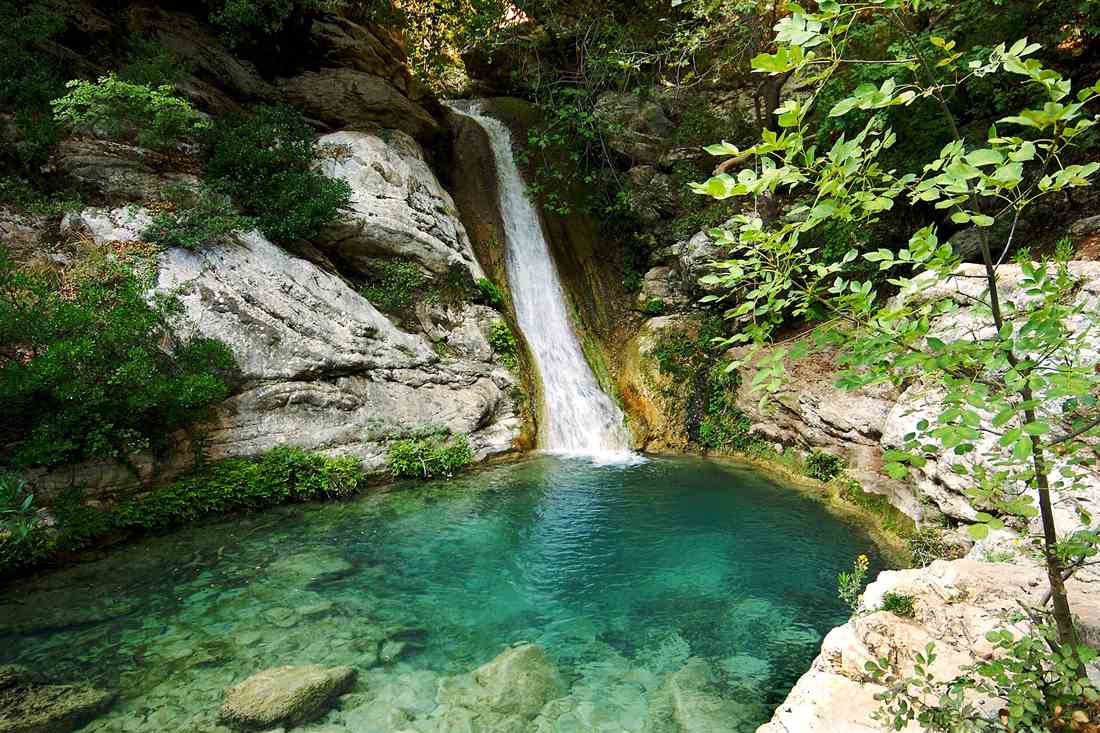
The Polylimnio waterfalls are a chain of pools and falls in a wooded gorge above the village of Charavgi in Messinia, forty minutes inland from Kalamata, walked on a marked path with wooden ladders and rope handrails between the levels. Plan the rest of the trip with Greece Tours.
This guide covers the whole gorge: the named pools in the order the trail meets them, the main fall and its drop, the length of the walk and the time it takes, the swimming and the cold, the guided hike, the canyoning route with its abseils and jumps, the season and the flow, what to wear, and the price ranges.
What is Polylimnio and what forms its chain of pools?
Polylimnio is a chain of emerald pools and waterfalls inside a wooded gorge in western Messinia, in the southern Peloponnese. Spring water drops through limestone terraces into linked basins, and a marked footpath climbs the whole sequence to the tallest fall.
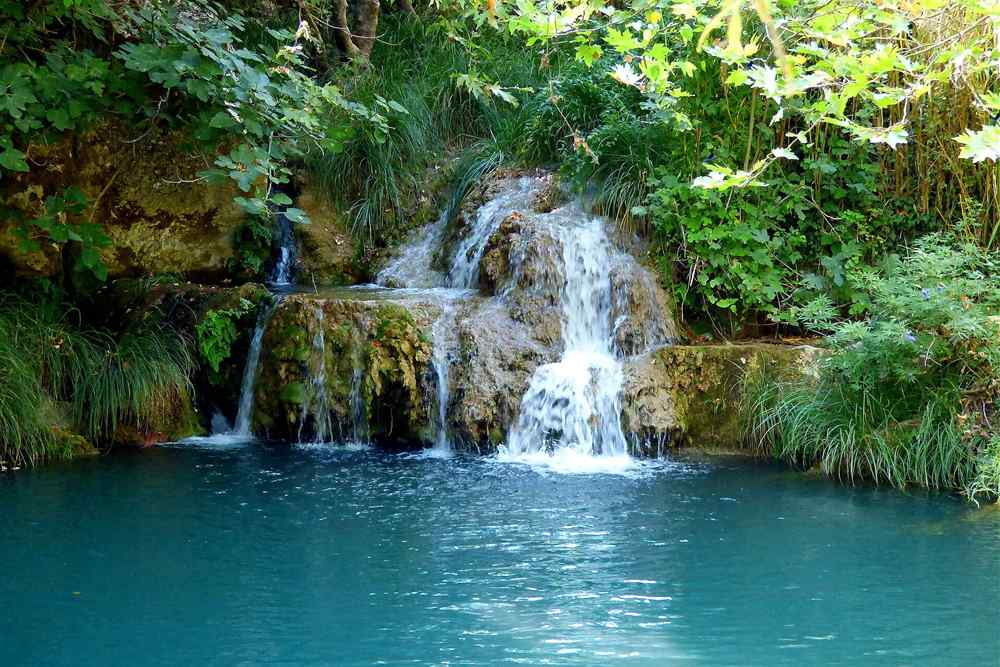
The car park at Charavgi is where every visit to the Polylimnio waterfalls starts. The name pairs the Greek word poly, meaning plenty, with limni, meaning lake. That is a literal description rather than a poetic one. The stream that feeds the gorge rises from karst springs on the slopes of Mount Kalathio, and where the limestone bed steps down, the water carves a bowl. Each bowl fills, overflows, and pours into the next one below it, so the gorge reads as a staircase of water rather than a single cascade.
Late summer drops the level at the Polylimnio waterfalls to a trickle in places. The rock does the shaping. Limestone dissolves under moving water and rebuilds itself as travertine at the lip of each drop, which is why the rims of the pools look moulded rather than broken. The same mineral load gives the water its colour: a saturated green in the deep basins, turning to clear turquoise where the bed shallows over pale gravel.
Ancient Messene pairs with the Polylimnio waterfalls in a single day out. Above the water the gorge is thickly wooded. Oriental plane trees arch across the stream and close the canopy, holding the air five to eight degrees cooler than the open fields outside. Ferns, moss and wild fig grow straight out of the wet walls, and the shade stays constant through the hottest hours of a Messinian afternoon.
A village lunch at Pidima closes the guided day at the Polylimnio waterfalls. Fifteen distinct pools have been counted along the watercourse, though only the lower and middle sections carry a maintained path. The rest sit behind steep rock and are reached solely by rope, which is the domain of the canyoning teams rather than walkers.
Where does Polylimnio sit, and what is the drive from Kalamata?
Polylimnio lies close to the village of Charavgi in western Messinia, roughly thirty kilometres from Kalamata. The drive takes forty to fifty minutes on asphalt, with the final two kilometres on a signposted lane that ends at the gorge car park.
Kalamata sits forty minutes by road from the Polylimnio waterfalls. The route leaves Kalamata westward, skirts the Messinian plain and its olive groves, and climbs gently inland through Aris and the turn for Vlasi. Charavgi is the last settlement before the descent to the trailhead, and brown archaeological-style signs marked Polylimnio stand at each junction from the main road onward. The lane narrows to a single carriageway with passing places for the last stretch, so oncoming vehicles need a slow approach.
Heavy rain closes the upper sections of the Polylimnio waterfalls. Drivers arriving from Athens reach the gorge on the A7 Moreas motorway to Kalamata, then follow the same westward road, a total of three hours from the capital. Travellers landing at Kalamata International Airport sit twenty minutes east of the city, and a pre-booked car or a private Kalamata airport transfer removes the rental-desk queue for anyone with a morning hike booked the same day.
The light in the gorge shapes the photography at the Polylimnio waterfalls. Public buses do not serve the gorge. The KTEL network reaches Messini and Petalidi, both of which leave a long uphill walk with no footway, so a car, a taxi or a booked tour is the practical answer. Taxi fares from Kalamata to the trailhead and back with a waiting period sit well above the per-person cost of a guided departure for two people.
Families manage the lower pools of the Polylimnio waterfalls without trouble. The gorge sits close enough to Pylos, Methoni and Ancient Messene for a paired itinerary, which is covered further down this guide.
Which pools does the trail meet, and in what order?
The footpath meets the pools from the bottom upward: Kadoula first, then Stathoula, Panagos, Italou and Mavrolimna, finishing at Kadi beneath the main waterfall. Each basin carries its own name, its own depth and its own character within the same gorge.
A village lunch at Pidima closes the guided day at the Polylimnio waterfalls. Kadoula sits nearest the car park and takes the first arrivals. It is the shallowest of the named basins, ringed by flat rock that families use as a landing point, and it works as the turning place for walkers who want water without the climb.
The car park at Charavgi is where every visit to the Polylimnio waterfalls starts. Stathoula and Panagos come next as the path tightens between the walls. Panagos holds a deeper centre and a rock shelf on its far side, and the stream between the two runs over a smooth slab that stays slick throughout the year. Italou follows, set under an overhang that keeps direct sun off the surface for most of the day and holds the water noticeably colder than the pools below it.
Wetsuits and helmets come with the canyoning trips at the Polylimnio waterfalls. Mavrolimna, the black lake, earns its name from depth rather than dirt. The bed drops away sharply from the edge and the green of the shallows turns to near-black at the centre, which is the point where walkers who swim tend to stop and float.
Ancient Messene pairs with the Polylimnio waterfalls in a single day out. Kadi crowns the sequence. It is the wide plunge pool at the foot of the main fall, enclosed by a curved wall of rock that throws sound back across the water, and it marks the end of the maintained trail. Beyond Kadi the gorge continues upstream through pools that carry no path at all.
What is the main waterfall at Polylimnio and what is its drop?
The main fall pours into Kadi pool from a height close to twenty-five metres, landing at the head of the gorge in a rock amphitheatre. It is the tallest drop on the watercourse and the finish line for everyone walking the maintained trail.
Families manage the lower pools of the Polylimnio waterfalls without trouble. The water arrives over a lip of travertine and breaks into a broad white column before it hits. In full spring flow the column widens to three or four metres across and the spray reaches the whole basin, coating the surrounding rock and the visitors on it. In late summer the same fall narrows to a ribbon that threads down the wall and leaves the flanking rock dry and warm.
Kalamata sits forty minutes by road from the Polylimnio waterfalls. Kadi pool beneath it is deep and cold, fed directly by the plunge rather than by a slow overflow. The current at the centre keeps the surface moving, and the temperature there runs lower than any other basin in the gorge because the water arrives straight from the fall with no time in the sun.
Booking ahead secures the guided slot at the Polylimnio waterfalls in high season. The rock wall behind the fall curves inward, so sound reflects and the noise of the water fills the space long before the fall itself comes into view. Walkers hear it from the Mavrolimna section, which is one of the reasons the last ten minutes of the climb feel shorter than they are.
The light in the gorge shapes the photography at the Polylimnio waterfalls. Standing directly under the column is discouraged by the guides who work here. Loose stone travels with the water in high flow, and the safe viewing and swimming ground is the near side of the pool, where the bed shelves gradually and the spray still reaches.
How far does the trail run and what time does the full walk take?
The maintained trail runs close to one and a half kilometres from the car park to Kadi pool, with around one hundred and fifty metres of ascent. Walking it without stops takes forty minutes each way; with swims and photographs the visit fills two to three hours.
Ancient Messene pairs with the Polylimnio waterfalls in a single day out. The path starts wide and level on the old streambed, then narrows and steepens after the first two pools. Ascent is spread across short flights of stone and timber rather than one sustained climb, so the effort arrives in bursts. The middle third crosses the stream four times on stepping stones and low timber bridges, and in high water those crossings soak boots to the ankle.
A village lunch at Pidima closes the guided day at the Polylimnio waterfalls. The upper third is the demanding part. The path leaves the water, cuts across a bank of loose earth held by roots, and climbs a series of wooden ladders bolted into the rock to regain the level of the top basin. Walkers carrying small children on their shoulders find this stretch impractical, and the descent afterwards is slower than the climb.
The Polylimnio waterfalls sit in a wooded gorge above Charavgi in Messinia. Guided departures from Kalamata build the timing around three hours on the ground, which covers the walk in both directions, a swimming stop of half an hour and a briefing at the trailhead. That schedule leaves the gorge before the mid-afternoon crowd arrives in high season.
Wetsuits and helmets come with the canyoning trips at the Polylimnio waterfalls. Independent walkers who reach the car park at opening time complete the return trip and are back at their vehicle before the first coach party starts up the path, which changes the experience of the narrow upper section entirely.
What do the wooden ladders and rope sections demand of a walker?
The ladders are timber flights bolted to the rock with a handrail on one side, and the rope sections are fixed lines strung along exposed traverses. Both demand two free hands, dry grip on the rail and a steady single-file pace.
The light in the gorge shapes the photography at the Polylimnio waterfalls. The ladders sit at three points on the upper trail, the longest of them a flight of about twelve steps climbing a wet slab beside the stream. Timber that stays in permanent shade grows a film of algae, so the tread is slick even in dry weather and the rail carries most of the security. A walking pole is a hindrance here, not a help; it belongs strapped to a pack while hands are on the wood.
Families manage the lower pools of the Polylimnio waterfalls without trouble. The fixed ropes cover two traverses where the path crosses steep ground above a drop of three to four metres. The rope is a handline rather than a climbing anchor. Walkers hold it, keep their weight on their feet, and cross one at a time so that the line is never loaded by two people at once.
A walk to the Polylimnio waterfalls climbs past pool after pool on a marked path. Anything carried loose in a hand is a liability on these sections. Phones, cameras and water bottles go inside the pack for the duration, and a small daypack with both straps fastened keeps the load stable on the ladders.
Booking ahead secures the guided slot at the Polylimnio waterfalls in high season. Descending is where injuries happen. The same steps that felt secure on the way up are faced outward on the way down, and the guides slow the group deliberately here, turning walkers to face the ladder and descend it in the manner of a household loft flight, hands on the rail and eyes on the tread.
Is swimming permitted in the pools, and how cold is the water?
Swimming is permitted in the pools, and thousands of visitors swim here through the warm months. The water is spring-fed and stays between fourteen and eighteen degrees Celsius even in August, cold enough to take the breath on entry.
Wetsuits and helmets come with the canyoning trips at the Polylimnio waterfalls. Entry temperature is the shock, not the swim itself. The body adjusts within a minute or two, and the contrast against a Messinian afternoon of thirty-five degrees is exactly what draws people up the gorge. Mavrolimna and Kadi hold the coldest water because depth and shade keep the sun off; the shallower lower basins warm a degree or two by late afternoon.
Ancient Messene pairs with the Polylimnio waterfalls in a single day out. Diving and jumping from the rocks is the one thing to refuse. Depths change with the season, submerged blocks shift after winter floods, and the clear water flattens perspective so a basin reads deeper than it is. Every entry is a controlled one from the edge, feet first, in water already checked.
Wooden ladders and rope handrails link the levels of the Polylimnio waterfalls. A pool with a visible inflow current at its head is best entered from the side. The plunge under the main fall pushes swimmers downward and outward, and the calmer near side of Kadi gives the same view with none of the force.
The Polylimnio waterfalls sit in a wooded gorge above Charavgi in Messinia. Water shoes change the experience for anyone planning to swim more than once. The pool floors are rounded limestone with a fine algal coat, and bare feet slide on the exit slabs, which is where most of the slips in the gorge happen. A quick-dry towel and a dry top for the walk back down matter as well, because the shaded descent chills a wet body fast.
What does the guided hiking tour from Kalamata cover, and what does the guide add?
The From Kalamata: Polylimnio Waterfalls Guided Hiking Tour covers hotel pickup, the road transfer to Charavgi, a led walk through the full pool sequence to the main fall, a swimming stop and the return, running around five hours door to door.
Booking ahead secures the guided slot at the Polylimnio waterfalls in high season. The departure runs in a small group with a licensed local guide, and the vehicle collects from central Kalamata accommodation and the marina area. Drinking water is provided, the pace is set to the slowest walker, and the guide carries a first-aid kit for the trail. Swimwear, a towel and closed shoes with grip are the guest’s responsibility.
The light in the gorge shapes the photography at the Polylimnio waterfalls. What the guide adds is route judgement. The person leading has walked the gorge after rain and in drought, knows which crossing is passable at the current flow, which ladder is greasy, and which basin holds swimmable depth in late summer when three of the others have thinned. That knowledge converts a scramble into a walk.
Kadi is the pool most walkers photograph at the Polylimnio waterfalls. The commentary carries the second half of the value. The guide names the pools, explains the travertine rims, points out the plane trees that hold the canopy, and puts the gorge into the wider Messinian landscape of olive terraces, Frankish towers and the Byzantine sites inland. Independent visitors walk past all of it.
A walk to the Polylimnio waterfalls climbs past pool after pool on a marked path. The hike sells out first in high season because group sizes stay small deliberately. Anyone building a full week around the region can pair it with the wider programme of Kalamata tours and keep every transfer in the same set of hands, which removes the daily rental-car decision entirely.
What does the canyoning descent through the gorge involve?
The canyoning descent enters the gorge above the walking trail and works downstream through the watercourse itself, using abseils on rope, controlled jumps into deep pools, natural rock slides and swims. It runs three to four hours in the canyon.
The Polylimnio waterfalls sit in a wooded gorge above Charavgi in Messinia. Teams start with a briefing and a kit fitting at the meeting point, walk in above the top pools, and rope up at the first drop. From there the only way forward is down the stream. The route strings together a sequence of vertical steps, each one taken by abseil, jump or slide depending on the depth of the landing pool and the flow on the day.
Wetsuits and helmets come with the canyoning trips at the Polylimnio waterfalls. The abseils range from short four-metre steps to a signature descent of around twenty-five metres alongside falling water. Guides rig the anchors, hold the safety line from below, and lower nervous participants under full control rather than leaving them to manage the rope alone. No previous rope experience is asked for.
Mavrolimna lies deeper in the gorge than the lower Polylimnio waterfalls. The jumps are optional at every point. Landings are checked by the guide first, and a walk-around or an abseil replaces any leap a participant refuses. Jump heights run from one metre up to six or seven at the biggest platform, and nobody is pushed past the height they name at the start.
Wooden ladders and rope handrails link the levels of the Polylimnio waterfalls. The natural slides are the section people talk about afterwards. Water has polished the limestone chutes to a smooth channel, and a wetsuit turns them into a toboggan run that ends in a deep basin. The descent finishes at the lower pools where the walking trail begins.
Which two operators run the Polylimnio canyoning, and how do the departures differ?
Two canyoning departures serve the gorge: Peloponnese: Polylimnio Waterfalls Canyoning Adventure and Kalamata: Polylimnio Waterfalls Canyoning Adventure. Both descend the same watercourse with certified guides and full technical kit; they differ in meeting arrangements, group size and total duration.
A walk to the Polylimnio waterfalls climbs past pool after pool on a marked path. The Peloponnese-branded descent is built for travellers arriving under their own steam from across the region, with a meeting point at or near the gorge and a schedule weighted toward time in the canyon. It suits guests staying in Pylos, Messini, Petalidi or the western coastal villages, who reach Charavgi faster than they reach Kalamata.
Booking ahead secures the guided slot at the Polylimnio waterfalls in high season. The Kalamata-branded descent is organised around the city, with the meeting arrangements and timing built for guests based in Kalamata itself or on the seafront hotel strip. Total elapsed time runs longer because the road transfer sits inside the booking, and the in-canyon portion matches the other departure closely.
The main drop at the Polylimnio waterfalls falls into a green plunge pool. Both operators run internationally certified canyoning guides, supply the full technical set, and cap numbers so the ratio of guides to participants stays workable on the rope. Both require swimming ability and set a minimum age. Neither runs when the flow in the gorge exceeds the safe threshold, and both cancel and refund rather than descend a canyon in spate.
Kadi is the pool most walkers photograph at the Polylimnio waterfalls. Choosing between them is a question of geography and timing rather than quality. Guests without a car and a Kalamata base take the Kalamata departure; guests with a vehicle and a western Messinia base take the Peloponnese one and gain an earlier start in the canyon.
Where does the zipline sit on the canyoning route?
The zipline is rigged across the gorge on the canyoning route, below one of the mid-section drops. Participants clip into the harness they already wear, step off the rock platform and glide over a pool to the far bank, guided the whole way.
Wooden ladders and rope handrails link the levels of the Polylimnio waterfalls. It sits inside the descent as one of the linking elements rather than as a separate attraction. Where the watercourse widens and a direct abseil is awkward, the line carries the group across the open air above the water, which shortens the sequence and gives the one aerial view of the gorge that nobody gets from the footpath.
The Polylimnio waterfalls sit in a wooded gorge above Charavgi in Messinia. The setup uses the same harness and helmet issued at the start, with a pulley and a safety lanyard added by the guide at the platform. Nothing extra is carried, nothing is fitted on the spot beyond the clip-in, and the guide checks every attachment before the participant leaves the rock.
Swimming is the reason walkers carry a towel to the Polylimnio waterfalls. The crossing lasts a few seconds. The line is short by commercial zipline standards, and the interest is the setting rather than the speed: plane canopy overhead, green water below, gorge walls close on both sides. Braking is handled at the receiving end by a second guide.
Mavrolimna lies deeper in the gorge than the lower Polylimnio waterfalls. Participants who decline the zipline are routed around it on rope, the same as with the jumps. The element is part of the standard descent for both operators, and it stands out in reviews as the moment people remember from a route otherwise defined by water and rock.
What age, fitness and swimming standard does the canyoning demand?
Canyoning at Polylimnio asks for a minimum age set between ten and fourteen depending on the operator, confident swimming in cold open water, and moderate general fitness. Prior rope experience is not required, and every technical move is taught on the day.
Kadi is the pool most walkers photograph at the Polylimnio waterfalls. Swimming is the non-negotiable requirement. The route crosses pools deep enough that feet find no bottom, and a wetsuit adds buoyancy without replacing the ability to move through water calmly. A participant who panics in deep water places the whole team on the wrong footing halfway down a canyon with no exit path.
A walk to the Polylimnio waterfalls climbs past pool after pool on a marked path. Fitness is measured in stamina rather than strength. Three to four hours of walking on uneven rock, short scrambles, repeated cold-water immersion and the concentration that rope work demands add up. Anyone who walks a hilly five kilometres without difficulty meets the standard comfortably.
The water at the Polylimnio waterfalls stays cold through the whole summer. Height matters for the abseils, in the head rather than the legs. Participants who freeze at an exposed edge slow the descent and lose the enjoyment, though guides talk first-timers over the lip on the majority of trips and the twenty-five-metre drop is the one people fear beforehand and rate highest afterwards.
The main drop at the Polylimnio waterfalls falls into a green plunge pool. Medical exclusions are standard across both operators: heart conditions, epilepsy, recent surgery, shoulder or knee instability, and pregnancy. Weight limits apply because the harness and the rope system carry a rated ceiling. Declaring a condition at booking is what keeps a guide able to plan, and it is never a reason to be turned away without discussion.
What equipment is supplied, and what do walkers wear and carry?
Canyoning operators supply the full technical set: wetsuit, helmet, harness, descender, ropes and a buoyancy top. Participants bring swimwear, a towel and footwear that grips. Hikers on the marked trail bring their own kit entirely, and footwear is the decision that matters.
Mavrolimna lies deeper in the gorge than the lower Polylimnio waterfalls. The wetsuit is the core piece. A five-millimetre suit holds a warmed layer of water against the skin, which turns fourteen-degree pools from an endurance test into a pleasure and buys the hours the descent needs. It also armours knees, elbows and hips against the polished rock of the slides.
Wooden ladders and rope handrails link the levels of the Polylimnio waterfalls. The helmet takes the knocks that rope work and jumping create, and the harness carries the descender and the safety lanyard. Guides fit each item personally and re-check every buckle at the top of the first drop. Dry bags for phones and car keys are provided by both operators, though a personal waterproof case is the sensible backup.
Canyoning turns the Polylimnio waterfalls into a route of abseils and jumps. Trainers fail on the walking trail for a straightforward reason: their soles are built for dry, flat, hard surfaces, and the gorge offers wet, sloped, algae-coated limestone. The tread pattern packs with grit, the flat sole gives no edge on a sloping slab, and the mesh upper turns the shoe into a sponge at the first crossing.
Swimming is the reason walkers carry a towel to the Polylimnio waterfalls. Hiking shoes with a deep lug pattern, closed sport sandals with a rubber outsole, or dedicated water shoes all hold. Add one and a half litres of water per person, a quick-dry towel, a dry shirt, sun protection for the open car park, and a compact pack that leaves both hands free.
What does the Pidima village lunch put on a Messinian table?
The From Kalamata: Polilimnio Waterfalls and Pidima Village lunch pairs the gorge walk with a seated meal in a village taverna beneath the Pidima rock. The table carries Messinian staples: olives, oil, cured pork, hand-cut pasta, village cheese and honey.
The main drop at the Polylimnio waterfalls falls into a green plunge pool. Pidima sits north-east of Kalamata under a dramatic limestone outcrop, a farming village of stone houses, a Byzantine church and a working square. The tour reaches it after the walk, which is deliberate sequencing: the meal lands on genuine hunger, and the village keeps its rhythm rather than performing for a coach.
Kadi is the pool most walkers photograph at the Polylimnio waterfalls. A Messinian table starts with Kalamata olives and the local oil, poured rather than measured, alongside lalagia, the thin fried dough strips that belong to this corner of the Peloponnese. Sfela, the sharp barrel-aged sheep cheese protected by its Messinian origin, arrives with tomato, cucumber and capers.
A guide reads the wet rock that catches walkers at the Polylimnio waterfalls. Main dishes run to hilopites, the square egg pasta cut by hand and served with rooster or with slow-cooked goat, and to gournopoula, spit-roasted pork with crisp skin. Syglino, pork cured in salt, smoked over aromatic wood and preserved in its own fat, appears in the mezze spread and in the omelettes.
The water at the Polylimnio waterfalls stays cold through the whole summer. The finish is figs, thyme honey from the surrounding hillsides, and a walnut or spoon sweet with strong coffee. House wine comes from the region’s own vineyards. The tour includes the transfers, the guided walk in the gorge and the meal in one price, which removes the hunt for a taverna at the end of a wet, hungry afternoon.
Which season carries the strongest flow, and which months close the gorge?
Flow peaks from late winter through early summer, when snowmelt and rain feed the springs and the main fall runs at full width. Late summer thins it to a ribbon. Heavy rain and winter storms close the trail outright for safety.
Swimming is the reason walkers carry a towel to the Polylimnio waterfalls. March through June is the strongest window for the waterfall itself. The gorge runs loud, every basin is full, the crossings are ankle-deep, and the surrounding woodland is at its greenest. Water temperature in that window sits at the bottom of its range, so swimming is brief and bracing rather than leisurely.
Mavrolimna lies deeper in the gorge than the lower Polylimnio waterfalls. July and August bring the crowds and the warmest air. Flow drops, the main fall narrows, and the lower basins hold less depth, but the pools stay swimmable and the shaded canopy makes the gorge the coolest ground in Messinia. Early morning is the answer to the queue at the ladders.
Trainers slip on the limestone around the Polylimnio waterfalls. September and October give the balance: warm water, thin crowds, stable weather and a flow that still fills the deep basins. Canyoning operators run through this period and close as the autumn rains arrive.
Canyoning turns the Polylimnio waterfalls into a route of abseils and jumps. Winter is the closed season in practice. The path floods, the timber ladders ice in cold snaps, and the authorities restrict access after heavy rainfall because the stream rises fast in a narrow channel. When flow is low in the driest weeks and the gorge is at its quietest, a day on the Messinian Gulf aboard a Kalamata yacht charter covers the swimming that the pools no longer do.
Where do cars park, and what facilities stand at the trailhead?
A gravel car park sits at the end of the access lane, a short walk from the first pool. Entry to the gorge is free of charge. A seasonal canteen operates at the trailhead in the warm months, and facilities beyond that are minimal.
The water at the Polylimnio waterfalls stays cold through the whole summer. Capacity at the car park is limited and it fills by late morning through July and August, at which point drivers leave vehicles along the verge of the narrow lane and add a walk to the start. Arriving before ten in the morning secures a place and the quieter trail at the same time.
The main drop at the Polylimnio waterfalls falls into a green plunge pool. No ticket booth or admission fee exists at Polylimnio. The gorge is open ground managed by the local municipality, with a wooden information board at the entrance carrying a route sketch and the safety notices. Signage on the path itself is sparse, which is one more argument for a guided walk on a first visit.
Spring flow makes the Polylimnio waterfalls loudest and fullest. The canteen at the trailhead sells cold drinks, coffee and light snacks during the season and closes out of it. Toilet provision is basic and tied to the canteen’s opening hours. There is no equipment hire, no changing hut and no lifeguard anywhere in the gorge.
A guide reads the wet rock that catches walkers at the Polylimnio waterfalls. Mobile coverage is patchy inside the canyon walls and fails entirely at the upper pools. Anyone walking independently tells another person the plan and the expected return, carries water for the full trip, and does not count on a phone signal to summon help from the top of the trail.
Which safety rules govern the gorge, and which parts suit families with children?
The governing rules are simple: no jumping from unchecked rock, no entry during or after heavy rain, single file on ladders and fixed ropes, and no rubbish left behind. Families with young children manage the lower pools comfortably and stop before the ladders.
Canyoning turns the Polylimnio waterfalls into a route of abseils and jumps. Rain is the dominant risk. A narrow limestone gorge concentrates runoff, so a storm on the hills above raises the stream inside an hour even when the sky at the car park stays clear. The trail closes after heavy rainfall, and the crossings turn from stepping stones into fast water long before the level looks dangerous.
Swimming is the reason walkers carry a towel to the Polylimnio waterfalls. The upper third is the technical part and the section that closes first. Wet timber, greasy slabs and the exposed rope traverses all become unreliable once water is running across the path, and the sensible response to a doubtful surface is to turn around at the pool below it.
Late summer drops the level at the Polylimnio waterfalls to a trickle in places. Children handle the lower gorge well. The walk from the car park to Kadoula and Stathoula is short, shaded, close to flat, and ends at a shallow basin with rock to sit on. That stretch works for ages four upward with a hand held at the stream crossings, and it delivers the swim without the climb.
Trainers slip on the limestone around the Polylimnio waterfalls. Pushchairs are impossible anywhere on the path. Children from around eight who walk confidently manage the full route to the main fall with an adult on the ladders, and guided family departures set the pace and the turning point accordingly. Every child in the water wears footwear with grip.
What pairs with Polylimnio in one day from Kalamata?
Polylimnio occupies a morning, which leaves the afternoon for Ancient Messene, for Pylos and Voidokilia beach, or for the Venetian castles at Methoni and Koroni. Each pairing sits within an hour’s drive of the gorge on good road.
A guide reads the wet rock that catches walkers at the Polylimnio waterfalls. Ancient Messene at Mavromati is the strongest cultural pairing. The city’s stadium, theatre, Asklepieion and nine kilometres of fourth-century walls make it the most complete classical site in the Peloponnese, and the hillside village above it serves lunch with a view across the whole excavation. The drive from Charavgi runs forty-five minutes.
The water at the Polylimnio waterfalls stays cold through the whole summer. The western coast is the alternative. Pylos wraps its square around plane trees and looks across Navarino Bay to the Niokastro fortress, and Voidokilia beach curves into a near-perfect semicircle of sand under Nestor’s Cave. Gorge in the morning and Voidokilia in the afternoon is the standard full-day loop out of Kalamata.
Heavy rain closes the upper sections of the Polylimnio waterfalls. Methoni and Koroni carry the Venetian sea castles, with Methoni’s causeway tower standing in the water and Koroni’s walls wrapped around a working town. The pair adds an hour of driving over the Pylos option and rewards it with the quieter coast.
Spring flow makes the Polylimnio waterfalls loudest and fullest. Eastward, over the Taygetos range, the Byzantine city climbing the hill below Mystras castle is a full half-day in its own right. Visitors treating Kalamata as a base for the wider region combine the gorge with a separate day of Mystras tours rather than compressing two major sites into one afternoon.
What does the light in the gorge do for photography?
The gorge holds deep shade under a closed plane canopy, and the light arrives as narrow shafts through gaps in the leaves. That contrast between shadowed rock and lit water is what defines every strong photograph taken at Polylimnio.
Trainers slip on the limestone around the Polylimnio waterfalls. Mid-morning through early afternoon is the productive window, when the sun clears the gorge walls and reaches the water surface. Before and after that, the whole canyon sits in flat shade with no separation between rock, moss and pool. In high summer the useful window at the top pools narrows to two hours.
Canyoning turns the Polylimnio waterfalls into a route of abseils and jumps. Moving water rewards a slow shutter. A quarter of a second smooths the main fall into a white veil while the surrounding rock stays sharp, and a neutral-density filter makes that exposure possible in daylight. A compact tripod with legs that stand in water earns its weight, and a beanbag on a rock does the same job for anyone travelling light.
The car park at Charavgi is where every visit to the Polylimnio waterfalls starts. Spray is the enemy of the lens at Kadi. A microfibre cloth in a sealed bag, a lens hood and a habit of shooting between gusts are what keep the frames clean. Everything else lives in a dry bag for the ladder sections.
Late summer drops the level at the Polylimnio waterfalls to a trickle in places. The pools photograph best from a low angle close to the surface, where the green depth and the travertine rims both read. A polarising filter cuts the sheen on the water and pulls the colour of the basin out of the reflection, which is the single change that lifts a phone shot into a printable frame.
What do the four Polylimnio tours cost in euros?
Listed prices run in bands: the guided hike sits in the fifty to ninety euro range per person, the village lunch tour in the eighty to one hundred and thirty euro range, and both canyoning descents in the ninety to one hundred and fifty euro range.
Spring flow makes the Polylimnio waterfalls loudest and fullest. The guided hike from Kalamata is the lightest booking. Its price band covers the round-trip transfer, the licensed guide, drinking water and the group cap, and the figure moves with group size and with the season. Private departures for a family or a pair of couples run above the shared rate.
A guide reads the wet rock that catches walkers at the Polylimnio waterfalls. The lunch tour carries a higher band because the meal is inside it. A full Messinian table with wine at a village taverna carries a real cost, and the tour price folds it in alongside the transfer and the guided walk, which is close to what the same day costs assembled piece by piece with a rental car.
Kalamata sits forty minutes by road from the Polylimnio waterfalls. Canyoning sits at the top of the range, and the equipment explains it. Wetsuits, helmets, harnesses, descenders and ropes are inspected, replaced on a schedule and carried to the canyon, and the guide ratio is far tighter than on a walking tour. Both operators price within a narrow band of each other.
Heavy rain closes the upper sections of the Polylimnio waterfalls. Bands shift with season, group size and the exchange of the day, so the live figure on the booking page is the one that counts. Cancellation terms across all four products follow the standard twenty-four-hour free-cancellation model, and high-season dates for the small-group departures close out well in advance.
Frequently Asked Questions
How long is the walk to the Polylimnio waterfalls?
About two kilometres from the car park at Charavgi to the main fall, with wooden ladders and rope sections between the pools. Walkers reach the top pool and return in two to three hours.
Can you swim in the pools at Polylimnio?
Yes. The pools hold water all year and the deepest take a swimmer. The temperature stays between twelve and eighteen degrees even in August, because the gorge sits in shade for most of the day.
What does a guided trip to the Polylimnio waterfalls cost?
The guided hike from Kalamata runs from about 50 to 90 euros per person. The canyoning route with abseils runs from about 90 to 150 euros, and the version with a village lunch from about 80 to 130 euros.