
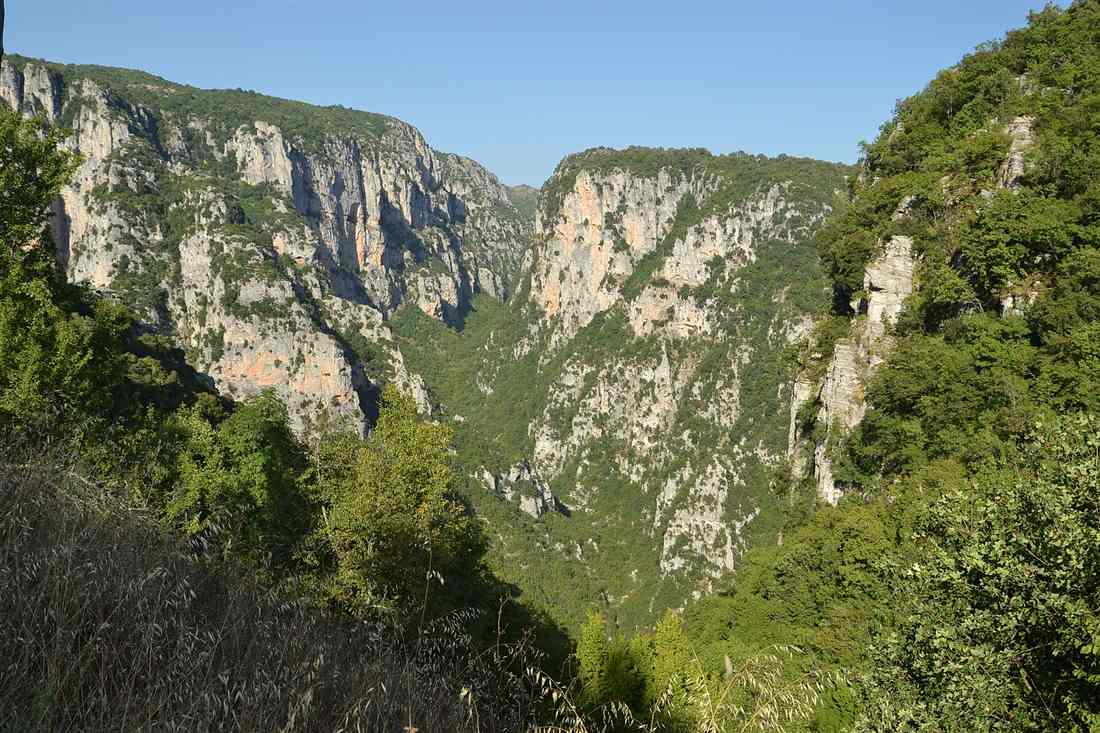
The 3-day Epirus tour from Ioannina covers the stone villages of Zagori, the Vikos Gorge and the Tzoumerka mountains of northwest Greece. Tours across the rest of the country are listed on Greece Tours.
The sections below cover what each 3-day Epirus tour listing names, how three days divide, the Katsanochoria villages, the Molossians and King Pyrrhus, the Despotate of Epirus, the music of the villages, season and booking, with links into the Ioannina tours pages. The tours shown are checked on GetYourGuide and Viator.
What is the 3-day Epirus tour?
The 3-day Epirus tour is a multi-day trip from Ioannina, the capital of Epirus in northwest Greece. The region runs from the Ionian Sea to the Pindus range and the Albanian border. Each version names an area of this region in its title.
Epirus is one of the 13 administrative regions of Greece and sits in the northwest of the mainland. Albania lies along its northern border. Western Macedonia and Thessaly sit to the east, and the region of Western Greece lies to the south. The Ionian Sea forms the western edge. The name comes from the Greek word ipeiros, meaning mainland.
The region splits into four regional units: Ioannina, Arta, Preveza and Thesprotia. Their seats are the towns of Ioannina, Arta, Preveza and Igoumenitsa. The Ioannina unit is the largest, at 4,990 square kilometres, more than half the region. It holds the Zagori and Vikos areas named in two 3-day Epirus tour titles.
The Pindus range runs down the eastern side of Epirus. It separates the region from Macedonia and Thessaly. The highest point in Epirus is Mount Smolikas, at 2,637 metres. Two national parks, Vikos–Aoös and Pindus, lie fully or partly in the Ioannina unit. Three of the four 3-day Epirus tour titles point to areas inside this mountain belt.
Epirus covers 9,203 square kilometres of land. The latest census counted 319,991 residents, about 35 people per square kilometre. The population fell by 5.1 per cent between the last two censuses. Since a reform in the 21st century, the four units hold 18 municipalities between them. Epirus shares one decentralised administration with the region of Western Macedonia.
Ioannina is the regional capital and the largest municipality, with 113,094 residents. Arta follows with 41,633, then Preveza with 30,893 and Igoumenitsa with 25,709. Close to a third of the region’s population lives in the municipality of Ioannina. A 3-day Epirus tour from Ioannina starts in the only municipality in Epirus above 100,000 residents.
What do the 3-day Epirus tours include?
An Ioannina-based local operator lists four versions of the 3-day Epirus tour. The titles name Zagori villages, Tzoumerka villages, the Vikos Gorge and the whole Epirus region. Shorter 2-day versions and single day tours sit alongside them.
The Epirus region title names the whole region rather than one area of it. The Zagori Villages tour names a mountain area of about 1,000 square kilometres north of Ioannina. Mount Mitsikeli, at 1,810 metres, forms the south-western side of Zagori. The city of Ioannina sits at the southern point of the area’s rough triangle.
Tzoumerka is the southern option among the 3-day Epirus tour titles. The name covers the Athamanika mountains, the southern part of the Pindus range. Their highest peak, Kakarditsa, reaches 2,429 metres. The villages spread across the municipalities of North Tzoumerka in Ioannina and Central Tzoumerka in Arta. A national park named Tzoumerka, Peristeri and Arachthos Gorge protects the range.
Trekking in Vikos Gorge is the only 3-day Epirus tour title that names trekking. The Voidomatis river carved the gorge inside Vikos–Aoös National Park. The park covers about 126 square kilometres of protected land. The wider Vikos–Aoös area holds UNESCO Global Geopark status. The 2-day Vikos – Aoos Geopark listing takes its name from it.
Each 2-day title matches the area of a 3-day Epirus tour title, except the Ionio coastline. That coast title points to the Ionian shore of Thesprotia and Preveza. The same operator also runs single day tours, such as Katsanochoria Villages and Discover Epirus Region.
- Epirus region (3 days): the whole region of four regional units
- Zagori Villages tour (3 days): the Zagori area north of Ioannina
- Tzoumerka villages tour (3 days): the villages of the Athamanika range
- Trekking in Vikos Gorge (3 days): trekking in the Vikos Gorge
- Vikos – Aoos Geopark (2 days): the UNESCO geopark area around the gorge
- Tzoumerka villages tour (2 days): a shorter Tzoumerka village format
- Trekking in Tzoumerka villages (2 days): trekking in the Tzoumerka villages
- Ionio coastline (2 days): the Ionian coast of Epirus
Read the itinerary on each 3-day Epirus tour listing before choosing a title. Each page sets out the hotel, meal and transport terms for that format. Check the daily route, the walking load on trekking titles and the group size. The cancellation terms sit on the same page.


How does a 3-day Epirus tour compare with day trips from Ioannina?
A day trip from Ioannina reaches one area and returns to the city the same evening. A 3-day Epirus tour spreads one title over three days. Its listing page sets the daily route and the overnight stops.
Day trips from Ioannina cover one area per day and end with the drive back to the city. The Zagori day trip from Ioannina follows this pattern, with a same-day return. Vikos–Aoös National Park lies about 30 kilometres north of the city, so the return leg stays short.
The Meteora day trip from Ioannina leaves Epirus altogether. Meteora sits in the Trikala unit of Thessaly, on the far side of the Pindus range. The A2 Egnatia Odos motorway carries traffic east from Ioannina across the mountains. None of the 3-day Epirus tour titles names Meteora or any other place in Thessaly.
Three day trips from Ioannina mean three separate return drives to the city. A 3-day Epirus tour runs the same three days under one title and one itinerary. The listing page shows where each night falls. Tzoumerka lies south-east of Ioannina, on the opposite side of the city from Zagori.
- Day trip from Ioannina: one area, no nights away, a return drive to the city each evening
- 2-day listing: one titled area, one night, route set on the listing page
- 3-day listing: one titled area or the whole region, overnight stops set on the listing page
The choice between a day trip and a 3-day Epirus tour turns on the number of areas. One area, such as Zagori, fits a single day out from the city. A trekking plan in the Vikos Gorge over consecutive days points to the 3-day trekking title. The 2-day listings suit a single area with one night away.
How do three days divide between Zagori, Vikos and Tzoumerka?
Three days divide into one area per day: the Zagori villages, the Vikos Gorge and the Tzoumerka mountains. Each block of a 3-day Epirus tour points in one direction from Ioannina. Zagori and Vikos rise to the north, and Tzoumerka rises to the southeast.
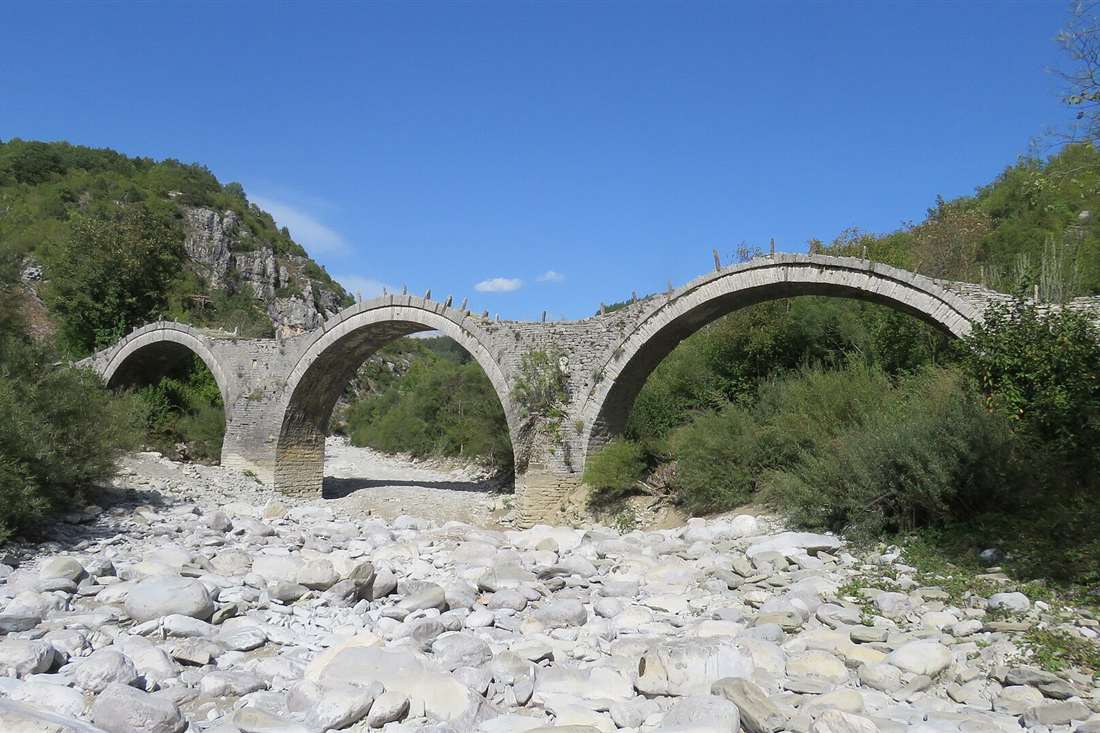
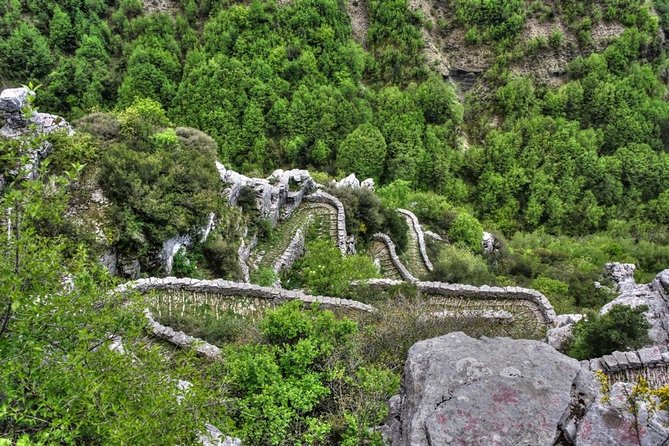
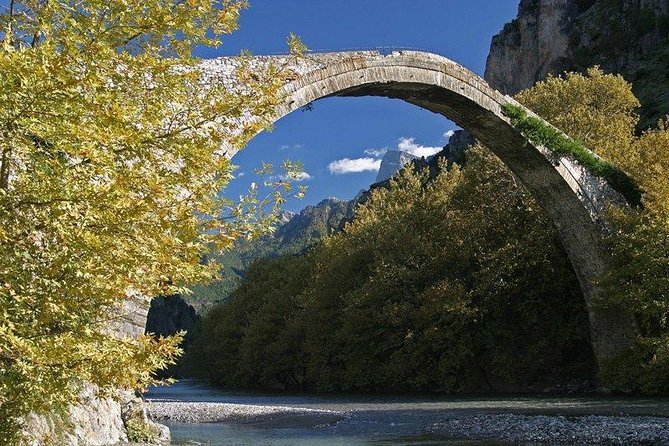
Zagori is a region and municipality in the Pindus mountains north of Ioannina. The Aoos river marks its northern edge. Day one of a sample 3-day Epirus tour belongs here. The Zagori tours page lists the village routes.
Mount Tymfi rises inside Zagori. The Vikos Gorge cuts its southern slopes. Its main part runs about 12 km between Monodendri and the village of Vikos. Guinness lists it as the deepest gorge relative to its width. A 3-day Epirus tour gives the gorge its own day.
The gorge lies in the Vikos–Aoös National Park, created in the 20th century. Monodendri sits on the gorge rim at about 1,060 m, about 40 km from the city. The trail into the gorge starts here. Guests on a 3-day Epirus tour find the route on the Vikos Gorge hike page.
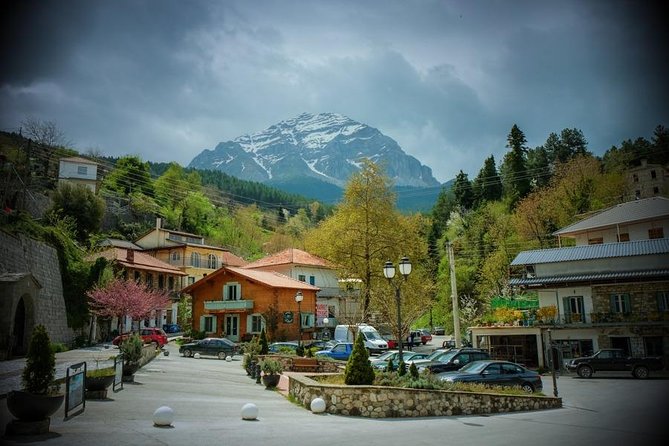
Papigo lies near the northern end of the gorge, about 60 km from Ioannina. Its two villages, Megalo and Mikro Papigo, sit at 960 to 1,000 m on Tymfi’s western slopes. The rock towers of Astraka, at 2,436 m, rise above them. The Voidomatis river forms where the main gorge ends, close to the village of Vikos.
The Tzoumerka, also called the Athamanika mountains, form the southern Pindus between the Arachthos and Achelous rivers. Pramanta, the seat of North Tzoumerka, sits at about 840 m, 65 km southeast of Ioannina. A 3-day Epirus tour reaches these villages on the third day of the sample split below.
- Day one, Zagori: central Zagori villages, ending at the 15th-century Agia Paraskevi monastery in Monodendri.
- Day two, Vikos Gorge: the main section from Monodendri to Vikos village, with Papigo to the north.
- Day three, Tzoumerka: Pramanta and the Anemotrypa cave, inside the Tzoumerka national park.
The Zagori, Vikos and Tzoumerka titles of the local operator each match one area of the split above. The fourth title, Epirus region, names a 3-day Epirus tour of the whole region. Its listing page sets the order of the areas.
What are the Katsanochoria villages?
The Katsanochoria are a group of mountain villages in the southern Ioannina regional unit. They spread between Ioannina and the Arachthos river, on the road toward Arta. The local operator behind each 3-day Epirus tour title also lists a day tour named “Katsanochoria Villages”.
Katsanochoria is also a municipal unit of the North Tzoumerka municipality, covering 103.4 km². Its seat is Kalentzi, and the last census counted 1,592 residents. The ending -choria is the Greek word for villages. Under the Kallikratis reform, the former Katsanochoria municipality became this unit. Guests on a 3-day Epirus tour find it between Ioannina and Pramanta.
The Arachthos river forms the eastern border inside a gorge. Mount Xirovouni at 1,614 m closes the south, and the Aetorrachi ridge closes the west. Mount Tsouka closes the north. The Gkoura peak near Monolithi, at 1,350 m, looks across to the Tzoumerka range. A 3-day Epirus tour bound for the Tzoumerka crosses this river line.
- Aetorrachi, at 848 m, once called Kotortsi, with a listed stone school of the late 19th century
- Elliniko, at about 740 m, with sculptor Theodoros Papagiannis’s museum of contemporary art in its old stone school
- Fortosi, a community that takes in Kostitsi, Nistora and Pateros
- Kalentzi, at 620 m, with the ruins of a Hellenistic castle, the kastri, just outside the village
- Koritiani, a local community of the unit
- Monolithi, on the slopes of Xirovouni west of the Arachthos, once called Vordo
- Pigadia, a local community of the unit
- Plaisia, listed in full as Plaisia Malakasiou
- Platanoussa, at about 450 m, named after the wild plane trees of the area and once called Rapsista
The Ioannina–Arta provincial road runs through the group. Elliniko lies about 20 km southeast of Ioannina, and Aetorrachi lies 22.5 km out. Kalentzi follows at 31 km, Monolithi at 43 km and Platanoussa at 45 km. Monolithi lies 21 km southwest of Pramanta. A 3-day Epirus tour on this road meets Platanoussa 40 km north of Arta.
The Monastery of Panagia Tsouka stands 1.5 km northeast of Elliniko, at 760 m above the Arachthos gorge. Tradition ties its founding to the Byzantine emperor Isaac II Angelos in the 12th century. Its domed church keeps wall paintings from the 17th century. The Prophet Elias monastery stands above Kostitsi, near where the Kalarrytikos river joins the Arachthos.
Agios Nikolaos in Kalentzi and the stone Dormition church in Plaisia date from the early 17th century. Saint Vlasios in Aetorrachi and the Dormition church in Elliniko date from its middle decades. Guests on a 3-day Epirus tour find 18th-century wall paintings in the Agia Paraskevi chapel of Platanoussa. The Plaisia church carries ivy on its bell tower.
Two stone single-arch bridges stand near Elliniko. The Amperia bridge, at 599 m, dates from the 19th century. The Megalo Lagkadi bridge dates from the 20th century. The Tzoumerka tours page covers the villages a 3-day Epirus tour reaches across the Arachthos.

Who were the Molossians and King Pyrrhus of Epirus?
The Molossians were the Greek tribe that ruled inland Epirus through the Aeacid royal house. Their king Pyrrhus fought Rome in southern Italy in the 3rd century BC. A 3-day Epirus tour from Ioannina crosses the land he ruled.
Ancient Epirus held three main Greek tribes. The Chaonians lived in the northwest, along the coast facing Corfu. The Thesprotians held the southwest, and the Molossians held the inland valleys. Ground covered on a 3-day Epirus tour lay inside this tribal map, which later united under Molossian kings.
The Aeacid kings traced their line to Molossus, a grandson of Achilles through his son Neoptolemus. Olympias, daughter of the Molossian king Neoptolemus I, married Philip II of Macedon. Their son was Alexander the Great. Visitors on a 3-day Epirus tour move through the home region of Alexander’s mother.
Pyrrhus was born in the late 4th century BC as a second cousin of Alexander. Early in the 3rd century BC he moved his capital to Ambracia, the city now called Arta. He founded Berenicia near modern Preveza and named it after his mother-in-law, Berenice I of Egypt. Both towns lie south of the mountain villages on a 3-day Epirus tour.
Tarentum, a Greek city in southern Italy, called Pyrrhus in against Rome. He crossed with 20 war elephants. He beat the Romans at Heraclea and then at Asculum, at heavy cost. After Asculum he said that one more such victory meant ruin. English still calls a win that costs too much a “Pyrrhic victory”.
- Early Molossian capital: Passaron, before the move to Ambracia
- Battle of Beneventum, 3rd century BC: Rome defeated Pyrrhus, and he lost half his elephants
- Death at Argos, 3rd century BC: a roof tile thrown by a woman knocked him down
- Epirote League: a federal state formed after Deidamia II, the last Aeacid ruler, died
- Royal name: Pyrrhus named his daughter Olympias, later Olympias II of Epirus
- Roman conquest, 2nd century BC: Rome sacked Molossian towns after the Third Macedonian War
What was the Despotate of Epirus?
Michael I Komnenos Doukas founded the Despotate of Epirus as a Byzantine Greek state after the Fourth Crusade. Its capital was Arta, on the Arachthos River in the south of Epirus. A 3-day Epirus tour crosses land this state held for over two centuries.
The Fourth Crusade seized Constantinople in the early 13th century and broke up the Byzantine Empire. Michael I, a cousin of emperors Isaac II and Alexios III Angelos, took over Epirus. His state joined Nicaea and Trebizond as one of three Greek successor states. Ioannina, where a 3-day Epirus tour begins, grew into one of its chief towns.
Michael’s half-brother Theodore Komnenos Doukas pushed the state east. In the early 13th century he took Thessalonica from the Latin crusaders. He then had himself crowned emperor in the city. Bulgarian tsar Ivan Asen II defeated and captured him at Klokotnitsa. That loss pulled the state back to the Epirote heartland that a 3-day Epirus tour visits.
Arta held the despots’ court through the 13th century. The Panagia Parigoritissa, the Virgin of Consolation, rose there in that century. Its square, three-storey body carries a central dome and smaller corner domes. Part of the old monastery now holds the Archaeological Collection of Arta. Arta tours add these churches before or after a 3-day Epirus tour.
Carlo I Tocco, Count of Cephalonia and Zakynthos, reunited the Despotate’s core in the early 15th century. Ottoman troops took Ioannina first and Arta later in that same century. Vonitsa, the last stronghold, fell in the late 15th century. Zagori and Tzoumerka, the village areas of a 3-day Epirus tour, came under Ottoman rule in that century.
- Kato Panagia: a monastery in Arta founded by Despot Michael II
- Agia Theodora: the Arta church with the tomb of Saint Theodora, wife of Michael II
- Parigoritissa: built by Despot Nikephoros I and his wife Anna Kantakouzene in the late 13th century
- Pantokrator: the mosaic of Christ inside the main dome of the Parigoritissa
What music belongs to the villages of Epirus?
Greek polyphonic song survives in Epirus, sung by groups over a steady drone called the isokratima. Clarinet bands, the moirologi lament and summer village festivals carry the rest of the tradition. A 3-day Epirus tour visits Zagori and Tzoumerka villages inside this music region.
Epirote polyphony is a vocal art for groups of at least four singers. Its tunes rest on a five-note pentatonic scale. The tradition lives in Pogoni villages such as Ktismata and Parakalamos, northwest of Ioannina. The Polyphonic Caravan, which promotes this song, joined a UNESCO safeguarding register in the 21st century.
The clarinet, called klarino, leads the Epirote village band, or kompania. A violin and a laouto lute play beside it. Slow dances follow the clarinet at festivals in the Zagori and Tzoumerka villages of a 3-day Epirus tour. East of Ioannina, the Vlach town of Metsovo on the Pindus road keeps its own dances and costumes.
The moirologi is the lament that village women sing over the dead. In Epirus the clarinet also plays it as a slow, wordless solo. Songs of exile, called xenitia, carry the same grief for men who left to work abroad. Both forms belong to the mountain villages that a 3-day Epirus tour visits.
Each village holds a panigyri, a festival on the feast day of its church. The largest fall around 15 August, the feast of the Dormition of the Virgin Mary. Dancers form slow circles that turn counter-clockwise around the square. Festivals in the villages on a 3-day Epirus tour follow this pattern of church service, music and dance.
- Partis: the taker, who opens the song with the main melody
- Gyristis: the turner, who replies to the taker
- Klostis: the spinner, who moves the line between the main note and the note below it
- Isokrates: the drone singers, who hold the isokratima on one steady note
- Voices: songs run in two, three, four or five parts
- Skaros: a shepherd tune of the Epirote mountains
- Tis tavlas: table songs sung while villagers eat and drink
Which season suits a 3-day Epirus tour?
Late spring and autumn suit a 3-day Epirus tour, with mild days for walking. Summer brings heat and dry streams, and winter brings snow to Tymfi and the Tzoumerka peaks. Ioannina receives about 1,089 mm of rain a year.
Ioannina sits at about 480 m and is wetter and colder than the Ionian coast. The Pindus range catches moist air from the Ionian Sea, which feeds that rainfall. The city has recorded lows of −13 °C and highs of 42.4 °C. In the Vikos–Aoos National Park, yearly temperature swings exceed 40 °C.
Gamila, the 2,497 m summit of Tymfi, holds snow from autumn until late spring. Kakarditsa, the 2,429 m top of the Tzoumerka, turns white in the same months. In December and January, a 3-day Epirus tour gets under ten hours of daylight. In June, the sun sets after 20:30 over the Pindus.
The hiking months run from April to June and from September to October. Walkers on a 3-day Epirus tour find cooler air then than in midsummer. Spring snowmelt fills the Voidomatis and the Arachthos, which drains the western Tzoumerka. The Voidomatis is a seasonal river, with year-round flow only in its lower course.
October rain refills the streams under the Zagori stone bridges after the dry summer. From December, snow and ice slow traffic on mountain roads above 1,000 m. Check the Pindus forecast the day before a winter 3-day Epirus tour starts. Pack warm layers for frost at village height.
- Spring, March to June: wildflowers on the meadows and long, mild days for walks.
- Summer, July and August: highs near 31 °C in Ioannina and the driest weeks of the year.
- Autumn, September to November: beech and oak forests turn gold and copper.
- Winter, December to February: about 170 mm of December rain and January lows near 0 °C.
How do you book and cancel a 3-day Epirus tour?
Book a 3-day Epirus tour on Viator by choosing a listing, a date and the group size. Listings with the free cancellation label allow cancellation up to 24 hours before the start. A voucher arrives by email after payment.
An Ioannina-based local operator lists four versions of the 3-day Epirus tour on Viator. Each version has its own page, date calendar and booking button. Choose the page that matches the area or the walking level wanted, then follow these steps.
- Open the chosen listing and read the overview and the itinerary.
- Pick a start date and the number of travellers, then press “Check Availability”.
- Select the option shown, enter traveller names and contact details, and pay by card.
- Save the confirmation email and the voucher on a phone.
The 24 hours count back from the start time listed for day one. Cancel through the link in the confirmation email or under “Bookings” in the Viator account. Confirm that the free cancellation label appears on the chosen 3-day Epirus tour before payment. The listing also states when confirmation arrives.
Viator sends the voucher by email and to its mobile app. The “Meeting and pickup” section of the listing names the meeting point in Ioannina and the start time. Show the voucher on a phone or on paper there on day one of the 3-day Epirus tour.
Three lines on the listing need a careful read: hotel, meals and fitness level. Hotel and meal details sit under “What’s included”. The fitness level sits under “Additional info” and matters for the trekking version. Travellers with one free day can compare Papigo tours under Mount Tymfi instead.
The booking reference on the voucher speeds up any change or support request. Keep that reference ready until the last evening in Epirus. Mobile signal drops in parts of the Pindus, so save the voucher as a screenshot.
Frequently Asked Questions
How long does the tour last?
It lasts three days, and each of the four Viator titles ends in “(3 days)”. The listing gives the start time of the 3-day Epirus tour on day one. The “What to expect” section lists the stops for each day.
Where does it start?
It starts in Ioannina, the capital of the Epirus region, on the western shore of Lake Pamvotis. The operator behind all four 3-day Epirus tour listings is based in the city. The voucher repeats the meeting point given on the listing.
Which areas do the 3-day listings name?
The titles name the Epirus region, the Zagori villages, the Tzoumerka villages and the Vikos Gorge. Zagori and the Vikos Gorge lie north of Ioannina, and Tzoumerka lies to the southeast. Each 3-day Epirus tour takes its name from one of these areas.
Does the trekking version need hiking fitness?
Yes. “Trekking in Vikos Gorge (3 days)” centres on walking over rocky gorge paths. Read its fitness level before booking this 3-day Epirus tour. Pack hiking boots with ankle support for the stony ground. A refillable water bottle and a sun hat help in summer.
Is a hotel included?
The “What’s included” section of each listing states whether hotel nights form part of the booking. Each 3-day Epirus tour has its own listing page and inclusions list. Read that list before payment, and save the confirmation email with the voucher.
Which airport serves Ioannina?
Ioannina National Airport “King Pyrrhus” serves the city from about 4 km outside the centre. Its IATA code is IOA, and its ICAO code is LGIO. Domestic flights link it with Athens. The airport sits at 475 m above sea level.
How far is Ioannina from Thessaloniki and Athens?
Ioannina lies about 260 km from Thessaloniki on the Egnatia Odos (A2). From Athens, the road route covers about 410 km via the A8 and the Rio–Antirrio bridge. It then follows the Ionia Odos (A5) north to Ioannina. That motorway cut the Antirrio–Ioannina drive to 1 hour 40 minutes.
Which language does the guide speak?
Each listing names the language of its guide in the overview. Check that line before booking a 3-day Epirus tour, along with the group size. Questions about language or private options go to the operator through the Viator messages.
Where do travellers stay before day one?
A night in central Ioannina before day one keeps the start simple. The old town sits inside the castle walls on Lake Pamvotis, close to the city’s hotels. A 3-day Epirus tour from Ioannina then begins at the meeting point on the voucher.
What does the Ionio coastline listing cover?
It is a 2-day title from the same Ioannina operator. Its name points to the Ionian coast of Epirus, around Parga and Syvota. The operator also lists day tours to Parga town and to Syvota on the same coast.
Can children join a 3-day Epirus tour?
Children join the village and region titles on the same booking as adults. The trekking title suits older children with hiking experience, since gorge paths are long and rocky. Check the minimum age on the listing before booking a 3-day Epirus tour.