
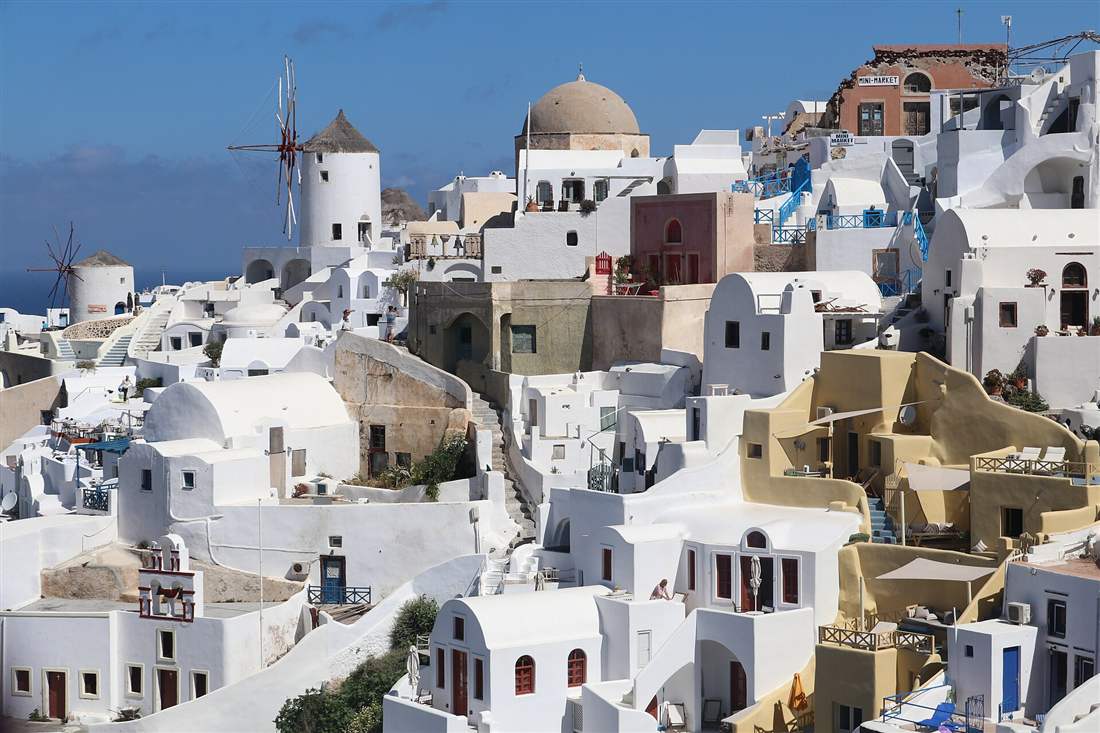
The 7-day Santorini and Mykonos island hopping tour is a private week from Athens that links the two best-known islands of the Cyclades. Tours across the rest of the country are listed on Greece Tours.
The sections below cover what the 7-day Santorini and Mykonos island hopping tour includes, how the week splits, the Cyclades and their white houses, Manto Mavrogenous, pirates, Pyrgos and Emporio, the volcanic arc, festivals, season and booking, with links into the Greek island hopping pages. The tours shown are checked on GetYourGuide and Viator.
What is the 7-day Santorini and Mykonos island hopping tour?
From Athens, the 7-day Santorini and Mykonos island hopping tour runs as a private GetYourGuide tour. It links the Greek capital with Mykonos and Santorini, two islands of the Cyclades, across seven days. Both islands lie in the southern Aegean Sea, east of Attica.
A traveller on the 7-day Santorini and Mykonos island hopping tour begins in Athens, on the Attica peninsula. Ferries for both islands leave from Piraeus, and Rafina adds sailings to Mykonos. Piraeus lies 12 km southwest of central Athens, while Rafina lies 25 km east of the city centre. Athens International Airport also has direct flights to both islands.
The Cyclades group holds about 220 islands in the South Aegean region of Greece. The name means “circular islands”, after the ring they form around Delos. Ermoupoli on Syros is the capital of the South Aegean region. Mykonos and Thira, the official name of Santorini, are two of the nine regional units in the Cyclades.
Mykonos lies 150 km east of Athens, between Tinos, Syros, Paros and Naxos. Chora, the main town of Mykonos island, lies on the west coast. The old port is in Chora, and the new port lies at Tourlos to the north. Mykonos is the larger island on the 7-day Santorini and Mykonos island hopping tour by land area.
Santorini lies about 200 km southeast of the Greek mainland. Fira, on the west coast, is the main town of Santorini island and the seat of its municipality. Island ferries dock at Athinios, the main port, about 8 km by road from Fira. Santorini is the more populated island on the 7-day Santorini and Mykonos island hopping tour.
Each island on the 7-day Santorini and Mykonos island hopping tour has its own airport. Mykonos Airport lies about 4 km southeast of Chora and has a 1,903-metre asphalt runway. Santorini International Airport lies north of Kamari village on the east coast. It sits about 6 km southeast of Fira, and its 2,197-metre runway handles military and civil flights.
Each island also heads a wider municipality. The Mykonos municipality spans about 105 square kilometres and takes in the islands of Delos and Rineia. The Santorini municipality spans about 91 square kilometres and includes the inhabited island of Therasia. The population figures below count the two municipalities of the 7-day Santorini and Mykonos island hopping tour.
- Mykonos island area: 85.5 square kilometres
- Mykonos highest point: 341 metres above sea level
- Mykonos municipality population: 10,704 residents at the latest census
- Mykonos Airport codes: JMK (IATA) and LGMK (ICAO)
- Delos distance from Mykonos: 2 km across the sea
- Santorini island area: about 76 square kilometres
- Santorini municipality population: 15,480 residents at the latest census
- Santorini International Airport codes: JTR (IATA) and LGSR (ICAO)
- Cyclades land area: 2,572 square kilometres
What does the 7-day Santorini and Mykonos island hopping tour include?
The GetYourGuide listing names the 7-day Santorini and Mykonos island hopping tour as a private tour from Athens. Hotel, ferry, meal and guide details sit on that listing page in full. Site tickets and island fees count as separate costs unless the listing names them.
On GetYourGuide, a private tour means only the booked group takes part, with no other travellers added. That private label covers the 7-day Santorini and Mykonos island hopping tour from start to finish. Before choosing a travel date, read the group size, the meeting point in Athens and the tour language.
Six listing lines set the daily shape of a 7-day Santorini and Mykonos island hopping trip. Read each line in full and note any item marked as not included. Each item marked as not included becomes an extra cost on Mykonos or Santorini. The checklist below covers hotels, ferry legs, transfers, guided parts, flights and meals.
- Hotels: the hotel name, star rating, room type and nights on each island.
- Ferry legs: the Athens port, the Mykonos to Santorini crossing and the seat class.
- Transfers: pickups between each port or airport and the hotel, on both islands and in Athens.
- Guided parts: the visits led by a licensed guide and the hours left free.
- Flights: any leg flown instead of sailed, with the airport named for each island.
- Meals: each breakfast, lunch and dinner the listing names, and the island where each one falls.
Greek law reserves guiding inside archaeological sites and museums for licensed tourist guides. Any guided site visit on a 7-day Santorini and Mykonos island hopping trip follows that rule. These guides complete state training at schools run by the Greek Ministry of Tourism. Free hours on the islands carry no guide unless the listing names one.
The Akrotiri site on Santorini preserves a Bronze Age town with multi-storey houses and wall paintings. Excavations there began in the 20th century under the archaeologist Spyridon Marinatos. The site sells its own entry ticket at the gate. On a 7-day Santorini and Mykonos island hopping tour, that ticket is extra unless listed.
Delos, a UNESCO World Heritage Site, lies off the west coast of Mykonos. Greek myth names the island as the birthplace of Apollo and Artemis. A Delos visit needs two tickets: the boat crossing from Mykonos and the site entry. Both tickets stay outside a 7-day Santorini and Mykonos island hopping trip unless the listing names them.
Greece charges a climate crisis resilience fee on each hotel room per night. The rate rises with the hotel’s star rating and climbs from April to October. Cruise passengers pay a separate port fee, highest at Santorini and Mykonos from June to September. Meals missing from the listing, plus taxis and buses beyond listed transfers, are paid on the spot.


How does it compare with the 8-day Greece tour and a self-planned week?
Three formats cover the same two islands. The 8-day Greece tour adds mainland sites, and a self-planned week books each ferry, hotel and transfer separately. The 7-day Santorini and Mykonos island hopping tour packs both islands into one private week from Athens.
A packaged private week fixes the stops before departure day. Guests on the 7-day Santorini and Mykonos island hopping tour travel as a single private party. No other travellers join the group. Couples, families and groups of friends keep the week to themselves. Planning shrinks to one reservation and one start date.
The 8-day Greece tour with Santorini and Mykonos keeps both islands and adds mainland sites to the route. It runs one day longer and reaches places the island route skips. Guests who want only Athens and the two islands choose the 7-day Santorini and Mykonos island hopping tour. The shorter week leaves one more day of annual leave free.
A self-planned week hands every booking to the traveller. Blue Star Ferries runs conventional ships on Cyclades routes out of Piraeus, and SeaJets runs high-speed boats. The 7-day itinerary for Athens, Santorini and Mykonos maps that route day by day. It mirrors the 7-day Santorini and Mykonos island hopping tour without the single booking.
- Planning load: one booking per packaged tour. A self-planned week needs one booking per ferry, hotel and transfer.
- Nights: one fewer on the 7-day tour than on the 8-day tour. A self-planned week sets any count.
- Ferry legs: the island route needs three crossings, from Athens to Mykonos, Mykonos to Santorini and Santorini back.
- Flexibility: a self-planned week can reverse the island order or add a night. Both packaged tours follow a set route.
Wind adds a planning risk on the island legs. The meltemi, a strong dry north wind of the Aegean, can keep high-speed boats in port. On a self-planned week, a cancelled sailing means rebooking hotels and onward tickets alone. Guests comparing a self-planned week with the 7-day Santorini and Mykonos island hopping tour weigh that rebooking load.
A self-planned week can also add a third island. Paros, Naxos and Ios sit on ferry lines between Mykonos and Santorini, so a stopover costs no detour. On the 7-day Santorini and Mykonos island hopping tour, the island stops are Mykonos and Santorini alone. Each extra island adds one more ferry ticket and one more hotel to book.
The island route uses three bases: Athens, Mykonos and Santorini. Bags move on each transfer day. On a self-planned week, each move pairs a ferry time with a hotel check-out. Both island ports sit outside the main towns, so every crossing adds a road leg at each end. The Athinios road on Santorini climbs the cliff in hairpin bends.
How do seven days split between Athens, Mykonos and Santorini?
Seven days split into Athens, Mykonos and Santorini blocks. Two days in Athens, two on Mykonos and three on Santorini add up to seven. A 7-day Santorini and Mykonos island hopping week places Athens at the start or the end.
Starting in Athens leaves a buffer day after a long-haul flight into the capital. Ending there puts the final night on the mainland, near the international departure. Either order keeps the islands back to back on a 7-day Santorini and Mykonos island hopping week. A single ferry leg links them. The sample below starts in Athens.
- Days 1 and 2: Athens, with the Acropolis, the Acropolis Museum and the Plaka district below the hill.
- Day 3: a morning ferry from Piraeus or Rafina to Mykonos.
- Days 3 and 4: Mykonos Town and a boat trip to Delos, the ancient sanctuary of Apollo.
- Day 5: a high-speed ferry from Mykonos to Santorini.
- Days 5 to 7: Santorini, with Fira, Oia and the Bronze Age site of Akrotiri.
- Day 7: a flight or ferry from Santorini back to Athens.
Two Attica ports start the sea leg of a 7-day Santorini and Mykonos island hopping week. Piraeus port sits beside Piraeus metro station on Line 1. From there, high-speed boats reach Mykonos in about 2.5 hours. Conventional ferries take about 5 hours on the same run. Rafina is the shorter crossing from the Attica coast.
Mykonos ferries dock at the New Port in Tourlos. The onward leg of a 7-day Santorini and Mykonos island hopping week runs south from that quay. High-speed boats cover Mykonos to Santorini in about 2.5 hours. The Mykonos to Santorini ferry crossing ends at Athinios port, south of Fira. Cruise ships use the old port at Skala, below Fira.
Direct ferries link Santorini and Piraeus every day of the year. High-speed boats make that crossing in about 5 hours. Conventional ferries take about 8 hours. On a 7-day Santorini and Mykonos island hopping week, that slow crossing uses up the final day. Travellers with an evening flight from Athens leave Santorini by high-speed boat before noon.
Flights replace the sea legs at either end of the week. Athens to Mykonos takes about 45 minutes by air, and Athens to Santorini about 50 minutes. The Santorini flight saves over 7 hours against the conventional ferry. A mixed 7-day Santorini and Mykonos island hopping week flies one end and sails the rest. Both routes use Athens International Airport.
The split also runs in reverse: Athens, then Santorini, then Mykonos. Santorini then takes days 3 to 5, and Mykonos takes days 6 and 7. That order ends with the Mykonos to Rafina run, about 2 hours by high-speed boat. Conventional ferries on the same run take about 4.5 hours. Conventional boats on that line call at Andros and Tinos.


Where do Mykonos and Santorini sit in the Cyclades?
Mykonos sits in the central Cyclades, beside Delos, while Santorini closes the group at its southern edge. About 115 km of open sea lie between the two islands. A 7-day Santorini and Mykonos island hopping tour crosses that stretch by ferry.
The Cyclades rise from a shallow sea floor between mainland Greece and the Dodecanese. Geologists read them as the tops of a sunken mountain range. That range once linked Attica with Asia Minor. Its rocks are marble, schist and granite, with volcanic islands along the southern rim.
Mykonos stands on granite, a hard rock that weathers into rounded boulders. Thin soil, low hills and dry stone walls shape its landscape. The granite shows along the coast roads seen on a 7-day Santorini and Mykonos island hopping tour. Fresh water is scarce, so the island relies on desalination plants.
Santorini is a ring of islands around a flooded caldera. Thira forms the main crescent, Therasia the western arc and Aspronisi a small islet between them. Its rocks are lava, ash and pumice laid down by eruptions. Crete lies about 110 km to the south. Guests on a 7-day Santorini and Mykonos island hopping tour reach the southern end of the Cyclades here.
Naxos lies between the two islands and is the largest of the Cyclades. Its peak, Mount Zas, reaches 1,004 m, the highest point in the group. Paros sits west of Naxos and gave its name to Parian marble. Ancient sculptors carved temples and statues from that white stone.
Ferries on a 7-day Santorini and Mykonos island hopping tour pass these islands on the way south. Ios lies on the same line, north of Santorini. The Small Cyclades, a cluster of low islets, lie southeast of Naxos. Iraklia, Schoinoussa, Koufonisia and Donousa form that cluster.
The Early Cycladic culture flourished on these islands in the 3rd millennium BC. Its artists carved flat marble figurines with folded arms. The Museum of Cycladic Art in Athens holds a large collection of them. A visit there fits the Athens days of a 7-day Santorini and Mykonos island hopping tour.
The two islands differ in rock, size and rhythm. Mykonos has sandy bays and a busy harbour town. Santorini has cliff-top villages above a sea-filled crater. The contrast is set out in Santorini vs Mykonos. That page compares the two stops of a 7-day Santorini and Mykonos island hopping tour side by side.
- Mykonos: central Cyclades, granite bedrock, beside Delos
- Santorini: southern edge, lava and pumice around a caldera
- Naxos: the largest island of the group, with Mount Zas at 1,004 m
- Paros: west of Naxos, the source of Parian marble
- Ios: on the ferry line just north of Santorini
- Small Cyclades: Iraklia, Schoinoussa, Koufonisia and Donousa
- Crete: about 110 km south of Santorini
Why are Cycladic houses white with blue details?
Cycladic houses are white because builders coat them in lime wash, which reflects heat and seals the walls. Blue doors and shutters add colour against the white. On a 7-day Santorini and Mykonos island hopping tour, both islands show this building style.
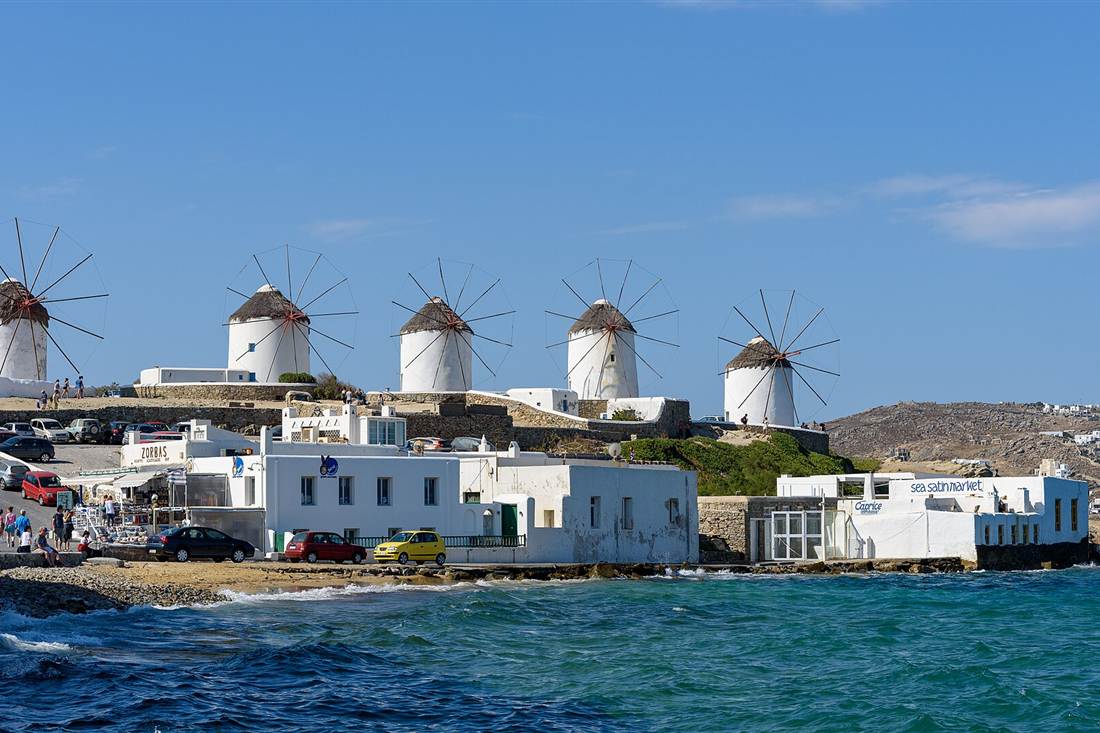
The typical Cycladic house is a cube of stone with thick walls and small windows. Thick walls keep rooms cool in summer and warm in winter. Small windows cut the glare and the force of the wind. Houses on a 7-day Santorini and Mykonos island hopping tour stack up the hillsides in the same pattern.
Lime wash, called asvesti in Greek, is a mix of slaked lime and water. It reflects sunlight, so walls absorb less heat. Lime also works as a mild disinfectant. Owners refresh the coat before Easter and before summer, so towns look newly painted in the warm months.
Flat roofs once collected rainwater for underground cisterns. Owners kept the roofs whitewashed and clean for that reason. Rain is scarce in the Cyclades, so every drop counted. Cisterns still sit under older houses seen on a 7-day Santorini and Mykonos island hopping tour.
Blue paint covers doors, shutters, railings and the domes of churches. White and blue match the colours of the Greek flag. On Mykonos, doors and balconies also appear in red and green. Domed chapels dot both islands, and their blue domes face the sea on Santorini’s caldera rim.
Santorini adds a building type of its own, the yposkafa, or cave house. Builders dug these rooms into the soft volcanic ash of the cliffs. The ground keeps them cool in summer and mild in winter. Oia and Fira hold rows of them. Travellers on a 7-day Santorini and Mykonos island hopping tour sleep in converted ones.
The streets of Mykonos Chora twist in narrow stone lanes outlined in white. The turns break the force of the wind between the houses. Across the sea, Oia on Santorini climbs the caldera edge in terraces of cave houses and captains’ mansions.
Greek law protects the old centres of both islands as traditional settlements. New buildings follow rules on height, shape and colour. Those rules keep the white cubes in place for each 7-day Santorini and Mykonos island hopping tour.
- Shape: stone cubes with flat roofs and thick walls
- Coating: lime wash, renewed before Easter and summer
- Roofs: once used to catch rainwater for cisterns
- Colour: blue doors, shutters and church domes
- Cave houses: rooms dug into volcanic ash on Santorini
- Streets: narrow, winding lanes against the wind
- Rules: protected traditional settlements on both islands
Who was Manto Mavrogenous of Mykonos?
Manto Mavrogenous was a heroine of the Greek War of Independence from a wealthy Mykonos family. She spent her fortune on ships and fighters for the Greek cause. Her square in Mykonos town greets guests on a 7-day Santorini and Mykonos island hopping tour.
Manto was born in Trieste in the late 18th century, to a merchant family from Mykonos. Her father, Nikolaos Mavrogenis, traded across the Mediterranean. The family was related to Nikolaos Mavrogenes, a Prince of Wallachia in the 18th century. Manto studied ancient Greek philosophy and history in Trieste.
The family returned to the Cyclades after her father’s death. Manto joined the Filiki Eteria, the secret society that prepared the revolt against Ottoman rule. When the war broke out in the early 19th century, she urged the island’s leaders to join it. Guests on a 7-day Santorini and Mykonos island hopping tour walk the harbour she knew.
Manto paid for ships from her own fortune and armed their crews. Her vessels joined the Greek fleet in the Aegean. She also funded fighters on land in the Peloponnese and on Euboea. The Greek leader Demetrios Ypsilantis gave her the honorary rank of lieutenant general.
In the autumn of the war’s second year, an Ottoman force landed on Mykonos. Manto rallied the islanders and led them in driving the landing party back to its ships. The defence of the island made her name across Greece. Her letters to the women of Europe raised support for the Greek cause. Her island is one of two stops on a 7-day Santorini and Mykonos island hopping tour.
Her engagement to Ypsilantis ended, and her fortune was gone by the end of the war. She lived in Nafplio, the first capital of the new state, in the years after the war. She later moved to Paros and died there in poverty in the mid-19th century.
Manto Mavrogenous Square lies by the harbour in Mykonos town. A bust of the heroine stands at its centre. Guests on a 7-day Santorini and Mykonos island hopping tour pass it near the old port.
- Birthplace: Trieste, in the late 18th century
- Family: merchants from Mykonos
- Society: the Filiki Eteria, which prepared the War of Independence
- Rank: honorary lieutenant general
- Battle: the defence of Mykonos against an Ottoman landing
- Death: on Paros, in the mid-19th century
- Memorial: Manto Mavrogenous Square and its bust in Mykonos town
How did pirates shape the Cycladic towns?
Pirate raids from the Middle Ages to the 18th century pushed islanders into walled hilltop villages. Streets twisted into mazes. Venetian lords built castles called kastra and kastelia. A 7-day Santorini and Mykonos island hopping tour walks through both kinds of town.
After the Fourth Crusade in the early 13th century, Venetian nobles took the Cyclades. Marco Sanudo founded the Duchy of the Archipelago, with its seat on Naxos. Both stops of a 7-day Santorini and Mykonos island hopping tour sat under the duchy. Ottoman rule followed in the 16th century, after the raids of the admiral Barbarossa.
Pirates and corsairs raided the islands for slaves, food and ships. Settlements moved inland or onto steep heights, out of sight from the sea. Houses joined wall to wall to form an outer ring with one gate. Towns seen on a 7-day Santorini and Mykonos island hopping tour keep that defensive plan.
Santorini held five fortified settlements, the kastelia. Skaros, on a rock near Imerovigli, served as the island’s capital until the 18th century. Oia, Pyrgos, Emporio and Akrotiri held the other four. Only ruins remain on Skaros today. A footpath from Imerovigli reaches them on a 7-day Santorini and Mykonos island hopping tour.
Lookout towers, called goulades, watched the sea from each kasteli. The Oia castle of Agios Nikolaos stood at the village tip, now the sunset viewpoint. Akrotiri’s castle, La Ponta, still keeps a Venetian tower at the southwest end of the island.
On Mykonos, the medieval Kastro quarter crowns the rocky point above the old harbour. The Venetian castle there has vanished, but its name survives. Panagia Paraportiani, a whitewashed cluster of five chapels, stands at the old castle gate. Guests on a 7-day Santorini and Mykonos island hopping tour find it beside Little Venice.
Venetian rule also left Catholic churches on both islands. Fira holds the Catholic cathedral of St John the Baptist, seat of the Latin bishop of Santorini. Its bell tower rises above the cliff-top town, close to the caldera edge.
The maze of Chora’s lanes also slowed raiders who broke into the town. Dead ends and sharp turns hid escape routes known only to residents. The Mykonos windmills stand on the ridge just south of Kastro. A 7-day Santorini and Mykonos island hopping tour reaches them on foot from the harbour.
Piracy also emptied Delos after its ancient prime. Raiders sacked the island in the 1st century BC, and its people never returned in numbers. Boats from Mykonos reach the ruins, as set out on the Delos island page. The crossing fits a free day on a 7-day Santorini and Mykonos island hopping tour.
- Duchy of the Archipelago: Venetian rule from the early 13th century, seat on Naxos
- Barbarossa: the Ottoman admiral who took the islands in the 16th century
- Kastro: a walled village with houses forming the outer wall
- Kasteli: the Santorini name for each of its five fortified villages
- Goulas: a lookout and refuge tower inside a fortified village
- Paraportiani: the Mykonos church at the side gate of the old castle

What are Pyrgos and Emporio, the inland villages of Santorini?
Pyrgos and Emporio are two fortified inland villages in southern Santorini, built as medieval kastelia. Travellers on a 7-day Santorini and Mykonos island hopping tour find Pyrgos about 7 km south-east of Fira. Emporio, the largest village, lies about 12 km from Fira.
Pyrgos Kallistis is the highest village on Santorini, built on a hill below Mount Profitis Ilias. Its name joins the Greek word for tower with Kalliste, an ancient name for the island. On a 7-day Santorini and Mykonos island hopping tour, its maze of lanes leads to an island-wide view.
The Venetian-era kasteli ruins crown the hill, one of five fortified settlements on Santorini. It once served as the island’s administrative centre. Its only entrance was the Kasteloporta, and underground passages gave shelter and escape routes. Visitors on the 7-day Santorini and Mykonos island hopping route can trace its walls. A strong 20th-century earthquake left them heavily damaged.
A survey recorded 49 churches and chapels across Pyrgos and Mount Profitis Ilias. The 17th-century Church of the Presentation of the Theotokos stands at the castle’s highest point. Agios Nikolaos in the main square dates from the same century. The squares and lanes appear street by street in Pyrgos village on Santorini.
Mount Profitis Ilias, above Pyrgos, rises to 567 m, the highest point of Santorini. Two monk brothers, Gavriil and Ioakeim Belonias, began its monastery in the 18th century. In late Ottoman times, it ranked as a leading monastic centre of the Cyclades. A road climbs the peak, a short ride on a 7-day Santorini and Mykonos island hopping stay.
Emporio, also called Nimborios, sits 79 m above sea level at the foot of Mount Profitis Ilias. Its medieval kasteli forms a ring of joined houses that face inward for defence. It has one entrance, which locals still call the Gate. Travellers on a 7-day Santorini and Mykonos island hopping tour can walk through that Gate today.
The square Goulas tower, in the north of the village, dates from around the 15th century. A tunnel linked it to the kasteli. It later served the Monastery of St John on Patmos. On nearby Gavrilos hill stand eight protected 19th-century windmills. Byzantine ruins share the hilltop, within reach on a 7-day Santorini and Mykonos island hopping stay.
- Pyrgos population: 1,078 residents at the last census
- Kseporto: the local name for the newer part of Pyrgos outside the walls
- Theotokaki church in the Pyrgos kasteli: believed to date from the 10th century
- Agios Georgios Katafyo: an 18th-century church on a steep slope opposite Pyrgos
- Agios Nikolaos Marmaritis: a 3rd-century BC building turned into a church, outside Emporio
- Panagia Mesani in Emporio: a 16th-century church with a 19th-century carved wooden screen
- Gavrilos hilltop: the chapel of Prophet Elias stands beside the windmills
What links Santorini to the South Aegean Volcanic Arc?
Santorini is the chief volcanic centre of the South Aegean Volcanic Arc, about 450 km long. The arc formed as the African plate slid beneath the Aegean. Santorini is the one stop of a 7-day Santorini and Mykonos island hopping tour on the arc.
The chain runs from the Isthmus of Corinth to the Bodrum peninsula in Turkey. It spans 20 to 40 km in width. Behind it, the Aegean crust is stretching and thinning, which pushed the arc south. The southern Aegean ranks among the fastest-deforming parts of the Himalayan-Alpine mountain belt.
Ten active volcanic centres line the arc between Greece and Turkey. Only Santorini, Kolumbo and Nisyros have erupted or shown strong unrest in the past 100 years. A 7-day Santorini and Mykonos island hopping tour from Athens starts near the arc’s western end.
- Sousaki: on the Greek mainland near the Isthmus of Corinth
- Aegina: an island in the Saronic Gulf, south-west of Athens
- Methana: a peninsula with over 30 eruption centres, last active in the 3rd century BC
- Milos: a volcanic island in the western Cyclades
- Santorini: nine recorded eruptions above the sea since the 2nd century BC
- Kolumbo: an undersea volcano off the north-east coast of Santorini, which erupted in the 17th century
- Nisyros: a caldera 3 to 4 km wide, with steam blasts in the 19th century
- Kos, Yali and Akyarlar: the eastern end, toward the Bodrum peninsula
Santorini sits close to the middle of the arc. Its Bronze Age eruption buried the town seen on a Santorini Akrotiri tour under ash. Around Pyrgos, older non-volcanic basement rock breaks the surface. Visitors on a 7-day Santorini and Mykonos island hopping tour stand there on rock older than the volcano.
The Kameni islands grew in the caldera centre after that blast. Palea Kameni formed in eruptions around the start of the 1st century AD. An undersea eruption struck it again in the 8th century AD. It holds a hot spring. The Kameni islets are the newest land in view on the 7-day Santorini and Mykonos island hopping route.
Nea Kameni is nearly round and about 2 km across, covering 3.4 square km. Its current centre of activity broke the sea surface in the 18th century. Further eruptions followed in the 19th and 20th centuries. The last, a small lava dome, ended in the mid-20th century. The island is a protected scientific site with an active sulphur vent.
ISMOSAV, the Institute for the Study and Monitoring of the Santorini Volcano, watches Nea Kameni. In the 21st century, satellite radar showed Santorini’s magma chamber swelling by 10 to 20 million cubic metres. Parts of the island rose 8 to 14 cm in 15 months. A 7-day Santorini and Mykonos island hopping tour reaches a volcano under constant watch.

Which feasts and festivals fall on Mykonos and Santorini?
The Dormition of the Virgin on 15 August is a national holiday and a feast on both islands. A 7-day Santorini and Mykonos island hopping tour in August meets panigyria at Panagia Episkopi and Tourliani. Easter, Ifestia fireworks and September concerts complete the year.
- First Sunday of Lent: the Tourliani image of the Virgin travels in procession from Ano Mera to Chora.
- Good Friday and Holy Saturday: Epitaphios processions and midnight Resurrection services on both islands.
- July: Santorini Jazz Festival at Cine Kamari, the open-air cinema in Kamari on the east coast.
- 15 August: Dormition feasts at Panagia Episkopi in Mesa Gonia and at Tourliani in Ano Mera.
- 23 August: main feast of the Tourliani monastery, the Afterfeast of the Dormition.
- First three weeks of September: Santorini International Music Festival in Fira.
- A Saturday night in September: Ifestia fireworks over the Santorini caldera.
Panagia Episkopi stands at Mesa Gonia, at the foot of Profitis Ilias on Santorini. Tradition credits Emperor Alexios I Komnenos with founding it at the end of the 11th century. Its 12th-century holy image, the Panagia Glykofilousa, shows Mary embracing the infant Jesus. Crowds of locals and visitors fill the church on its feast day, 15 August.
On Mykonos, the Panagia Tourliani monastery sits in Ano Mera, 7 kilometres from Chora. Tradition names monks from Paros as its founders in the 16th century. A large festival takes place there on 15 August. The main feast falls on 23 August, when the Dormition feast closes. Its church museum keeps the monastery’s first bells and gold-embroidered epitaphs.
Lent brings a Mykonos custom tied to Tourliani. On the first Sunday of Lent, the monastery’s image of the Virgin leaves Ano Mera in procession. It stays in one of three Chora churches until the Saturday of Lazarus, eight days before Easter. A 7-day Santorini and Mykonos island hopping week in mid-Lent finds the holy image in Chora.
Orthodox Easter moves each year. On Good Friday evening, parishes on both islands carry the Epitaphios, the flower-covered bier of Christ. At midnight on Holy Saturday, worshippers pass candle flames from hand to hand. Families crack red-dyed eggs and roast lamb on Easter Sunday. A 7-day Santorini and Mykonos island hopping tour over Easter week meets these rites.
Ifestia lights up Santorini once a year. Fireworks above the caldera re-enact a volcanic eruption, and live concerts share the same evening. Entry is free, and every caldera viewpoint faces the show. Timing a 7-day Santorini and Mykonos island hopping week around that September Saturday adds the fireworks.
The Santorini International Music Festival runs through the first three weeks of September. Concerts take place at the Petros M. Nomikos Conference Centre in Fira. Pianist Athena Capodistria founded it in the late 20th century. Solo recitals, orchestras, piano duets and opera fill the programme. A 7-day Santorini and Mykonos island hopping week in early September meets this concert series.
Which season suits the 7-day Santorini and Mykonos island hopping tour?
Late spring, June and September suit a 7-day Santorini and Mykonos island hopping tour. Those months bring warm sea water, long hours of sunshine and little rain. July and August add the strong meltemi wind and the busiest ferry routes of the year.
Mykonos receives about 312 millimetres of rain a year, and Santorini about 270 millimetres. The rainy season runs from October to March, and December and January are wet on both islands. July on Mykonos records only 0.1 millimetres. A 7-day Santorini and Mykonos island hopping week in July meets near-rainless days. September brings 10.4 millimetres on Mykonos.
Sunshine peaks at 12 hours a day in July on both islands. June brings 11 hours and August 11.5 hours. Late spring gives 9.5 hours a day, the same as September. A 7-day Santorini and Mykonos island hopping tour in October still gets 7.5 hours of sun a day. Cloudy days are rare in July and August.
Sea water is coldest in February and March, at about 15.5°C on both islands. Late spring water sits at 18.5°C. The sea reaches 21.5°C to 22°C in June and peaks at 24°C to 24.5°C in August. During a 7-day Santorini and Mykonos island hopping week in September, the sea holds 23.5°C to 24°C. October water stays at 21.5°C.
- Spring (March to late spring): highs of 15°C to 23°C and 4 to 5 rain days in April.
- Summer (June to August): highs of 24°C to 29.6°C and nights between 20.8°C and 23.7°C.
- Autumn (September to November): highs from about 26°C to 18°C, with 3 rain days in September.
- Winter (December to February): highs of 12.6°C to 15.6°C and 3.5 to 5 hours of sun a day.
The meltemi is a dry north wind that blows from late spring to mid-September. On Mykonos, average wind speeds reach 28 km/h in July and 29 km/h in August. Its strongest spells reach force 7 to 8 on the Beaufort scale. A 7-day Santorini and Mykonos island hopping week in August meets the wind at full strength.
On the windiest days, inter-island ferries cannot sail and stay in port. In peak summer, high-speed boats link Mykonos and Santorini at least three times a day. The crossing takes about 2 to 2.5 hours. From November to March, direct sailings drop to one or two a week. A whole winter week can pass with no direct boat.
Hotels and tavernas on both islands open in April and close in late October. July and August are the busiest months on both islands. A 7-day Santorini and Mykonos island hopping week in June or September avoids that peak of crowds. Each island’s month-by-month weather is covered under when to visit Santorini and when to visit Mykonos.
How do you book and cancel the 7-day Santorini and Mykonos island hopping tour?
The 7-day Santorini and Mykonos island hopping tour books online through its GetYourGuide listing. The form runs through the date, travellers, the private option, details and payment. Free cancellation applies up to 24 hours before the start where the listing shows that label.
The GetYourGuide page titled “From Athens: Santorini & Mykonos 7-Day Island-Hopping Tour” holds the full booking form. The six steps below follow that form from top to bottom.
- Pick a start date in the calendar on the listing.
- Set the number of travellers in the group.
- Press “Check availability” to load the open options for that date.
- Choose the private option for the group.
- Enter the lead traveller’s name, email address and phone number.
- Pay on the secure checkout page to confirm the booking.
Free cancellation on the 7-day Santorini and Mykonos island hopping tour depends on its listing label. Under that label, a cancellation made 24 hours or more before the start earns a full refund. Cancellations go through the booking page in the GetYourGuide app or account.
After payment, GetYourGuide sends a confirmation email and adds a voucher to the app. Each 7-day Santorini and Mykonos island hopping voucher lists the booking reference and the start date. The listing states whether a mobile voucher works at the start in Athens.
The listing’s “Meeting point” section places the start of the 7-day Santorini and Mykonos island hopping tour. That section gives either a fixed address in Athens or a pickup rule. The same details print on the voucher after booking.
Two parts of the 7-day Santorini and Mykonos island hopping listing settle the logistics: “Includes” and “Not included”. Hotels, ferry legs and island transfers count only when “Includes” names them. Anything left off “Includes” stays a separate booking for the traveller.
On Mykonos, ferries from Athens dock at the new port at Tourlos, north of Mykonos Town. Buses to Tourlos leave from a depot at the old port in town. Rides from the ferry to hotels are covered under Mykonos port transfers. Mykonos Airport (JMK) handles flights to the island.
On Santorini, ferries dock at Athinios, the island’s ferry port south of Fira. Skala, the old port below Fira, serves cruise ships that anchor offshore. Road options from Athinios appear under Santorini port transfers. Flights land at Santorini International Airport (JTR) instead.
Frequently Asked Questions
How long does the tour last?
The tour runs for 7 days, counted from the start date picked at booking. Day one begins in Athens. The listing title, “From Athens: Santorini & Mykonos 7-Day Island-Hopping Tour”, fixes that length. The itinerary block shows how the 7-day Santorini and Mykonos island hopping schedule splits its days.
Where does the tour start?
Athens is the start city of the 7-day Santorini and Mykonos island hopping tour. Piraeus is the chief passenger port of Greece and the main ferry gate to the Cyclades. Rafina, a second ferry port, sits on the eastern coast of Attica. Athens International Airport (ATH) handles flights from abroad.
Is the tour private?
Yes. GetYourGuide lists the 7-day Santorini and Mykonos island hopping tour as a private tour. Only the travellers named in one booking take part, with no other guests added. The group size equals the traveller count set on the booking form. The private option appears once the date and group size are chosen.
Which islands does the tour visit?
The tour visits two Cyclades islands: Mykonos in the centre and Santorini in the south. Mykonos is known for its windmills and the Delos crossing. Santorini is known for its caldera and cliff-top villages. Athens adds the Greek capital to the start or end of the week.
How do the islands connect by sea?
Ferries to Mykonos leave from both Piraeus and Rafina on the Attica coast. High-speed vessels link Mykonos with the surrounding islands and with Athens every day. Santorini connects with Piraeus by ferry every day, all year round. Direct sailings also run between Mykonos and Santorini, with no change of ship.
How long does the ferry from Mykonos to Santorini take?
High-speed ferries cross from Mykonos to Santorini in about 2 to 3 hours. Conventional ferries call at other Cyclades ports on the way and take longer. Departures leave the new port at Tourlos, and arrivals dock at Athinios on Santorini. Each ferry operator sets its own timetable for the route.
Are hotels included in the tour?
The hotel answer sits on the GetYourGuide listing, not in the tour title. Nights on Mykonos and Santorini count as included only when the “Includes” list names them. The “Not included” list of the 7-day Santorini and Mykonos island hopping tour flags every extra. Both lists also cover ferry tickets and port transfers.
Which airports serve the islands?
Each island has its own airport: Mykonos Airport (JMK) and Santorini International Airport (JTR). Flights from Athens to either island take under an hour. Both airports take jets the size of the Boeing 737 and the Airbus A320. A short drive links each airport with the main town.
Which travel documents do EU and non-EU visitors carry?
EU citizens carry a passport or national ID card on the 7-day Santorini and Mykonos island hopping tour. Greece belongs to the Schengen Area. Non-EU visitors carry a passport valid for 3 months past the planned exit from Schengen. Nationals of visa-required countries also carry a Schengen visa. Visa-free stays last up to 90 days in any 180-day period.
Can children join the tour?
The traveller counter on the booking form shows the age groups the listing accepts. Age limits for the 7-day Santorini and Mykonos island hopping tour, if any, sit under “Important information”. Each child carries a personal passport or ID card. Greek ferry tickets and domestic flights name every passenger, infants included.