
Lefkada tours cover the Ionian island joined to the mainland by a bridge: the beaches of Porto Katsiki, Egremni and Kathisma below white cliffs, the lighthouse of Cape Lefkatas, Lefkada town and the fortress of Agia Mavra, the boats from Nydri to Skorpios and Meganisi, the Dimosari waterfalls, the windsurfing bay of Vasiliki and the villages of Karya and Englouvi. Plan the rest of the trip with Greece Tours.
This page covers the Lefkada tours you can book from the town, Nydri and Vasiliki, what each place holds, the beaches, boats, sports and food of the island, and how to plan four to six days.
Because Lefkada is reached by road, visitors drive onto the island with their own car, and every beach, harbour and village on this page lies within an hour of the swing bridge at its entrance.
What do Lefkada tours cover?
Lefkada tours cover the beaches of the west coast, Porto Katsiki, Egremni and Kathisma, below white cliffs over turquoise water, the lighthouse and legend of Cape Lefkatas, the town of Lefkada and the castle of Agia Mavra, the harbour of Nydri with its boats to Skorpios and Meganisi, the waterfalls of Dimosari, the windsurfing bay of Vasiliki, and the mountain villages of Karya and Englouvi.
Lefkada is an Ionian island joined to the mainland of Greece by a causeway and a swing bridge, so visitors drive straight onto it. Its west coast is a wall of limestone cliffs above some of the most photographed beaches in Greece, its east coast faces a calm inland sea of small islands, and its mountainous interior holds stone villages and upland plateaus.
Lefkada tours split into beach and coast drives on the west, boat cruises from Nydri and Vasiliki on the east and south, and village and nature tours inland. The island is compact enough to reach every area from one base within an hour.
- West coast beaches – Porto Katsiki, Egremni and Kathisma.
- Cape Lefkatas – the lighthouse and the leap of Sappho.
- Lefkada town – the colourful houses and the lagoon.
- Nydri – the harbour for Skorpios and Meganisi.
- Vasiliki – the windsurfing bay of the south.
- Karya and Englouvi – the mountain villages.
Our Lefkada page covers where to stay and the Ionian islands tours page the wider island group. Lefkada tours work as four to six days based on the island.
What do Lefkada tours see at Porto Katsiki and Egremni?
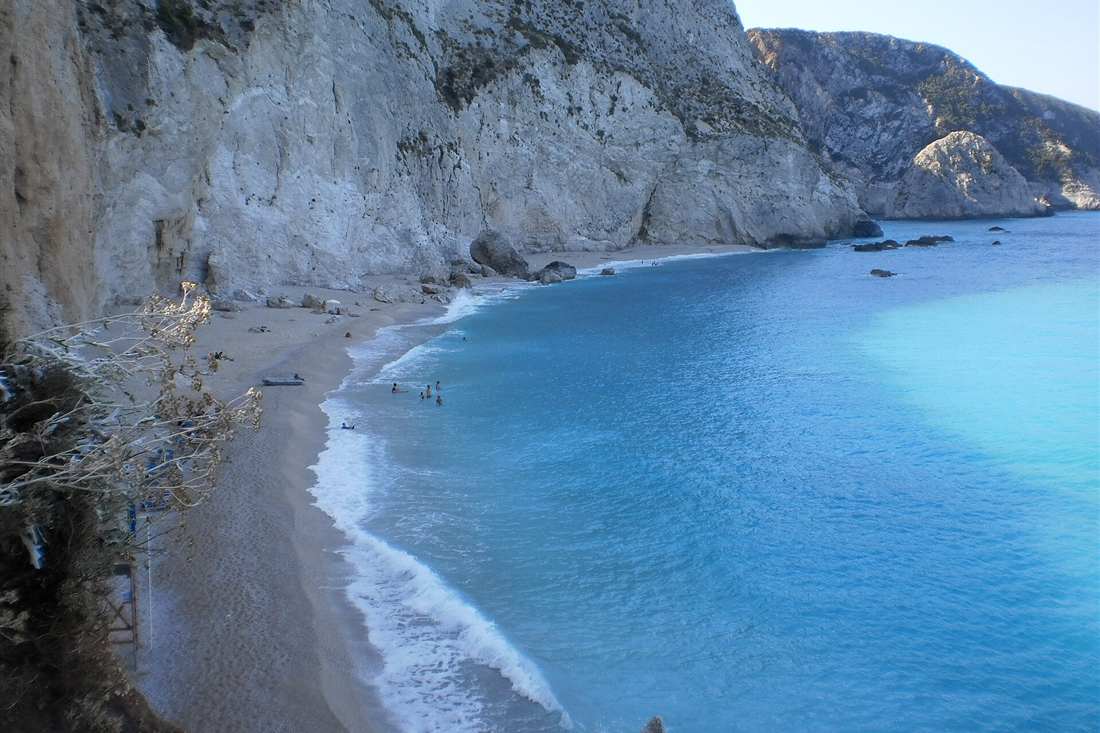
Lefkada tours at Porto Katsiki see a cove of white pebbles under sheer white cliffs at the southern end of the west coast, reached by a stairway from the car park or by boat from Nydri and Vasiliki, and at Egremni a long beach below the cliffs, with water that shades from turquoise to deep blue.
The west coast beaches of Lefkada owe their colour to the white limestone of the cliffs: the fine white pebbles and sand reflect the light through the clear water and turn it a brilliant turquoise. Porto Katsiki, the goat’s port, is the best known, a small bay closed by cliffs on three sides.
Egremni stretches for more than a kilometre below the cliffs north of Porto Katsiki. Its access stairs have been damaged by earthquakes in the past, so boats from the east coast harbours are a reliable way to reach it. Both beaches face west and are best on calm days, since the open sea brings waves when the wind blows.
Parking at Porto Katsiki fills by mid-morning in August, so Lefkada tours by boat or an early start by car give the calmest visit, with the cliffs in full sun before the crowds arrive.
- Porto Katsiki – the cove under the white cliffs.
- Stairway access – the steps from the cliff-top car park.
- Egremni – the long beach north of Porto Katsiki.
- White pebbles – the source of the turquoise colour.
- Boat access – the cruises from Nydri and Vasiliki.
- Calm days – the best conditions for the west coast.
Our Porto Katsiki and Egremni pages cover both beaches. Lefkada tours reach Porto Katsiki in about an hour from the town.
What do Lefkada tours see at Kathisma and Agios Nikitas?
Lefkada tours at Kathisma see a wide beach of white sand below the western hills, with beach bars, clear water and paragliders landing on the sand after flights from the slopes above, and at Agios Nikitas a fishing village of narrow lanes and tavernas at the northern end of the west coast, with the cove of Mylos beyond it.
Kathisma is the most organised beach of the west coast, with sunbeds, cafés and water sports, and it keeps its turquoise water and white sand despite the crowds. Tandem paragliding flights take off from the hills above and glide over the coast before landing on the beach.
Agios Nikitas is a small village built around one lane that runs down to the sea, with guesthouses and restaurants on both sides. From its beach, small boats and a coastal path lead to Mylos, a quiet cove of white sand without a road.
The cliffs behind Kathisma are also the take-off point for sunset flights, and the road above the beach has viewpoints over the whole west coast down toward Cape Lefkatas.
- Kathisma – the wide organised beach of the west.
- Paragliding – the tandem flights over the coast.
- Agios Nikitas – the fishing village of the north-west.
- Mylos – the cove reached by boat or path.
- Kalamitsi – the beach below the village of the same name.
- Pefkoulia – the long beach north of Agios Nikitas.
Our Kathisma and Agios Nikitas pages cover the north-west. Lefkada tours watch the sunset from the Kathisma hills.
What do Lefkada tours see at Cape Lefkatas?
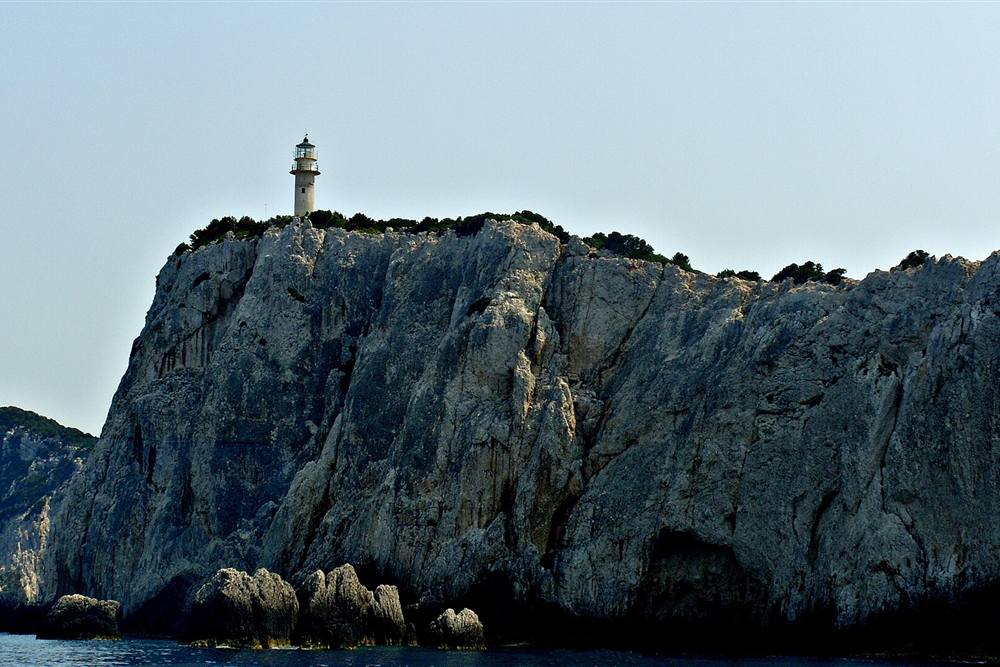
Lefkada tours at Cape Lefkatas see the white cliffs at the southern tip of the island, rising about 60 m above the sea, with the lighthouse on the edge, the site of the ancient temple of Apollo Lefkatas, and the place where legend says the poet Sappho leapt into the sea for love.
The cape gave the island its name: Lefkada comes from the Greek for white, after these cliffs. In antiquity a temple of Apollo stood here, and in a ritual described by ancient writers, a person was thrown from the cliff each year to carry away the misfortunes of the community, then fished out of the sea below.
The legend of Sappho, the poet of Lesbos, tells that she jumped from the cape after an unhappy love, and the rock became known as the Lovers’ Leap. Today the lighthouse stands alone at the end of a long road across the bare hills, and the sunset over the open Ionian Sea is one of the great views of the island.
- White cliffs – the rock that gave Lefkada its name.
- Lighthouse – the tower on the edge of the cape.
- Temple of Apollo – the ancient sanctuary on the headland.
- Sappho’s leap – the legend of the poet.
- Lovers’ Leap – the name of the rock.
- Sunset – the view over the open Ionian Sea.
Our Cape Lefkatas page covers the cape. Lefkada tours drive to the lighthouse for the sunset after a beach day at Porto Katsiki.
What do Lefkada tours see in Lefkada town and at Agia Mavra?
Lefkada tours in the town see the colourful houses with upper floors of wood and metal built to withstand earthquakes, the pedestrian market street, the churches with Ionian bell towers, the lagoon and its birds, and at the entrance to the island the Venetian and Ottoman fortress of Agia Mavra beside the swing bridge.
Lefkada town was rebuilt after a series of earthquakes with a style of its own: stone ground floors and lighter upper floors of timber, later clad in painted metal sheets, in shades of blue, pink, yellow and green. The main street runs from the harbour to the central square, lined with shops and cafés.
The town sits beside a shallow lagoon where flamingos and herons feed in winter and spring. At the northern entrance, the fortress of Agia Mavra, founded in the 14th century and rebuilt by the Venetians and the Ottomans, guards the channel beside the floating swing bridge that opens every hour for passing boats.
The archaeological museum of the town shows the finds from the Nydri plain excavated by Dörpfeld, and the small phonograph museum keeps old gramophones, records and household objects of the island.
- Colourful houses – the earthquake-resistant upper floors.
- Market street – the pedestrian heart of the town.
- Ionian bell towers – the churches of the town.
- Lagoon – the flamingos and herons of the shallows.
- Agia Mavra fortress – the castle at the island’s entrance.
- Swing bridge – the floating bridge that opens for boats.
Our Agia Mavra castle and Lefkada town pages cover the north. Lefkada tours walk the town in the evening.
What do Lefkada tours see in Nydri and at the Dimosari waterfalls?
Lefkada tours in Nydri see the busiest harbour of the east coast, facing the green islets of the inland sea, with boats leaving for Skorpios, Meganisi and the west coast beaches, and a short walk inland the Dimosari waterfalls, a gorge of plane trees with a pool below the falls.
Nydri sits on a sheltered bay opposite the small islands of Madouri, Sparti and Skorpios, and its waterfront is lined with tavernas and the booths of the boat companies. The German archaeologist Wilhelm Dörpfeld excavated near here, convinced that Lefkada was the Ithaca of Homer, and his statue stands on the quay.
The Dimosari falls lie a few kilometres inland from the village, reached by a road and a shaded path along the stream. The water falls into a cool pool where visitors swim in summer, and in spring the stream runs strongest after the winter rains.
Madouri, the green islet in front of the harbour, is private and belongs to the family of the poet Valaoritis, whose mansion stands among the trees and can be seen from the boats leaving Nydri.
- Nydri harbour – the boats of the east coast.
- Inland islets – Madouri, Sparti and Skorpios.
- Wilhelm Dörpfeld – the archaeologist who sought Homer’s Ithaca here.
- Dimosari waterfalls – the falls in the plane gorge.
- Swimming pool – the cool pool below the falls.
- Waterfront tavernas – the evening meals by the bay.
Our Nydri and Dimosari waterfalls pages cover the east. Lefkada tours by boat leave Nydri every morning in summer.
What do Lefkada tours see on the boat cruise to Skorpios and Meganisi?
Lefkada tours by boat from Nydri sail past Skorpios, the private island once owned by Aristotle Onassis, stop at the sea caves and villages of Meganisi, including the Papanikolis cave where a Greek submarine hid in the Second World War, and swim in the turquoise bays of the inland sea.
Skorpios is a green island of pine and cypress where Onassis married Jacqueline Kennedy in 1968, and it remains private, so the boats pass along its shore and stop for swimming off its beaches. Meganisi, the largest of the small islands, has three villages, Vathi, Katomeri and Spartochori, and a coast of caves and coves.
The Papanikolis cave, on the western shore of Meganisi, is a sea cave large enough for a submarine, named after the Greek submarine that used it as a hiding place. The day cruises combine these stops with lunch in a Meganisi harbour, and some continue to Kalamos and Kastos further south.
Meganisi keeps a slow island life, with small harbours of fishing boats, tavernas on the quay and paths across the island between Vathi and Spartochori for visitors who stay the night.
- Skorpios – the private island of Onassis.
- Meganisi – the island of three villages.
- Papanikolis cave – the sea cave of the submarine.
- Spartochori and Vathi – the harbours for lunch.
- Swimming stops – the turquoise bays of the inland sea.
- Kalamos and Kastos – the islands further south.
Our Skorpios and Meganisi pages cover the islands. Lefkada tours take the full-day cruise in calm weather.
What do Lefkada tours see in Vasiliki?
Lefkada tours in Vasiliki see the village and bay on the south coast, one of the best-known windsurfing spots in Europe thanks to the thermal wind that rises every summer afternoon, the boats to Porto Katsiki, Egremni and the Blue Cave, and the ferries to Kefalonia and Ithaca.
The bay of Vasiliki is calm in the morning, when beginners learn on flat water, and the wind builds after midday, bringing out the experienced windsurfers. Schools and rental centres line the beach, and the village harbour has tavernas and cafés facing the boats.
Boat trips from Vasiliki run along the south-west coast to the beaches below the cliffs and to sea caves, with snorkelling stops in clear water. In summer, ferries cross from Vasiliki to Fiskardo on Kefalonia and to Ithaca, which makes the village a gateway to the neighbouring islands.
The village also has a small pebble beach, bakeries and a waterfront of cafés where the windsurfers gather in the evening to watch the sunset over the bay after the wind drops.
- Vasiliki bay – the windsurfing centre of the south.
- Thermal wind – the afternoon breeze of summer.
- Windsurf schools – the lessons on flat morning water.
- Beach boats – the trips to Porto Katsiki and Egremni.
- Blue Cave – the snorkelling stop of the south coast.
- Kefalonia and Ithaca ferries – the summer crossings.
Our Vasiliki page covers the bay. Lefkada tours reach Vasiliki in about 45 minutes from the town.
What do Lefkada tours see in the mountain villages?
Lefkada tours in the mountains see Karya, a village of plane-shaded squares known for its karsaniko embroidery, Englouvi, the highest village of the island, famous for its lentils, the monastery of Faneromeni above the town, and the upland plateaus and olive terraces of the interior.
The interior of Lefkada is a surprise after the beaches: green mountains of oak and olive, stone villages, and small plateaus where farmers grow lentils, vines and fruit. Karya, the largest mountain village, has a square shaded by old plane trees with tavernas, and a small museum of the embroidery its women made for generations.
Englouvi sits at about 700 m, and its small lentils are prized across Greece. The monastery of Faneromeni, on a hill above the town, keeps a church, a small museum and a view over the lagoon and the mainland.
The road from Karya to Englouvi climbs through oak woods and past small chapels, with views over the islands of the east coast, and the villages sell their lentils, honey and embroidery at the roadside.
- Karya – the village of the plane-tree square.
- Karsaniko embroidery – the needlework of the women of Karya.
- Englouvi – the highest village and its lentils.
- Faneromeni monastery – the view over the lagoon.
- Upland plateaus – the lentil and vine fields.
- Olive terraces – the groves of the interior.
Our Karya page covers the village. Lefkada tours of the interior combine the villages with a lunch in Karya.
Which beaches do Lefkada tours visit?
Lefkada tours visit Porto Katsiki, Egremni, Kathisma, Kalamitsi, Gialos and Pefkoulia on the west coast, the town beach of Gyra by the lagoon, the pebble coves of Mikros Gialos and Agiofili on the south coast, and the calm bays of Nikiana, Nydri and Desimi on the east coast.
The two coasts of Lefkada suit different days. The west faces the open Ionian Sea, with dramatic cliffs, white sand and turquoise water, but it catches the waves when the wind blows. The east and south are sheltered, with calm bays, pine trees and fishing villages, ideal for families and for days when the west is rough.
Agiofili, near Vasiliki, is a small cove reached by boat or a short walk, and Mikros Gialos is a pebble bay below the village of Poros with clear water and tavernas. Desimi, south of Nydri, is a sheltered bay of pebbles and olive trees.
- West coast beaches – Porto Katsiki, Egremni and Kathisma.
- Gialos and Kalamitsi – the quieter west coast sands.
- Gyra – the long beach by the lagoon.
- Agiofili – the cove near Vasiliki.
- Mikros Gialos – the pebble bay below Poros.
- Desimi and Nikiana – the calm bays of the east.
Our Lefkada beaches page covers the coast. Lefkada tours choose the east coast on windy days.
What food and wine do Lefkada tours taste?
Lefkada tours taste the island’s salami, cured with pepper and garlic, the lentils of Englouvi, the olive oil of the terraces, local honey, fish and seafood in the harbour tavernas, and the wines of the Vertzami grape, the dark red variety of the island.
The Lefkada kitchen mixes the Ionian and the mainland. The island’s salami is a local speciality made in the villages, and the small lentils of Englouvi go into soups and salads. The harbour tavernas of Nydri, Vasiliki and the town serve fresh fish, octopus and shellfish from the inland sea.
Vertzami, a grape of deep colour and firm tannins, is the pride of the island’s vineyards, and small wineries offer tastings of Vertzami reds and local whites. Olive oil and thyme honey are sold in the mountain villages, and every meal ends with a sweet or a glass of local spirit.
Village tavernas cook the local salami into pies and omelettes, and the bakeries of the town sell the mandolato nougat and sesame pasteli of the Ionian islands to take home.
- Lefkada salami – the cured sausage of the villages.
- Englouvi lentils – the small lentils of the mountain.
- Harbour seafood – fish and octopus of the inland sea.
- Vertzami – the dark red grape of the island.
- Olive oil – the oil of the terraces.
- Thyme honey – the honey of the hills.
Our Lefkada food page covers the tastings. Lefkada tours end the day at a harbour taverna in Nydri or Vasiliki.
Which outdoor activities do Lefkada tours offer?
Lefkada tours offer windsurfing and kitesurfing in Vasiliki, tandem paragliding over Kathisma, sea kayaking to the caves of the south coast, sailing from the marina of the town, snorkelling in the clear bays, hiking on the old paths of the mountains and the gorges, and mountain biking on the forest roads of the interior.
Lefkada is a sailing base of the Ionian, with a large marina in the town and charter fleets that sail the inland sea to Meganisi, Kalamos, Kastos and Ithaca. Day skippers and self-drive boats without a licence give visitors the freedom to find their own coves.
On land, walking routes link the mountain villages and descend through gorges to the coast, and forest roads suit mountain bikes. Sea kayak tours paddle along the south coast to caves near Mikros Gialos and Vasiliki, stopping on beaches that the roads do not reach.
Hikers follow the path from Nydri to the Dimosari falls and on to the villages above, or walk the old paths from Agios Nikitas along the cliffs to the western beaches.
- Windsurfing – the afternoon wind of Vasiliki.
- Paragliding – the tandem flights over Kathisma.
- Sea kayaking – the caves of the south coast.
- Sailing – the charter fleets of the town marina.
- Hiking – the village paths and gorges.
- Mountain biking – the forest roads of the interior.
Our Lefkada kayak tour page covers the paddling. Lefkada tours book the sports a day ahead in July and August.
What history and writers do Lefkada tours discover?
Lefkada tours discover an island ruled by Byzantines, Franks, Ottomans, Venetians, French and British before it joined Greece in 1864, the birthplace of the poet Angelos Sikelianos and the writer Lafcadio Hearn, the home of the poet Aristotelis Valaoritis on the islet of Madouri, and the theory of Wilhelm Dörpfeld that Lefkada was Homer’s Ithaca.
The Ottomans held Lefkada from the late 15th century until the Venetians took it in 1684, and after the fall of Venice the French, the Russians and the British ruled the Ionian Islands in turn. Under British protection the islands kept their own state until they joined Greece in 1864, and the town still shows the mix of Venetian churches and British-era buildings.
Lafcadio Hearn, born on the island in 1850 to a Lefkadian mother and an Irish father, became famous as a writer on Japan. Angelos Sikelianos, the poet who revived the Delphic festivals, was born in the town, and Aristotelis Valaoritis lived and wrote on Madouri, the green islet off Nydri, where his house still stands.
- Ionian history – Ottomans, Venetians, French and British.
- Union with Greece – the Ionian Islands joined in 1864.
- Angelos Sikelianos – the poet born in the town.
- Lafcadio Hearn – the writer born on the island in 1850.
- Aristotelis Valaoritis – the poet of Madouri.
- Dörpfeld’s Ithaca – the theory of Homer’s island.
Lefkada tours of the town pass the houses and statues of the island’s writers on the walk from the harbour.
How do visitors reach Lefkada, and how do Lefkada tours plan the days?
Visitors reach Lefkada by road across the causeway and swing bridge from the mainland, by air to Aktion airport near Preveza, about 20 km away, and by bus from Athens in about five hours. Lefkada tours plan a day for the west coast beaches and Cape Lefkatas, a day for the boat cruise from Nydri, a day for Vasiliki and a day for the town and the villages.
Lefkada town, Nydri and Vasiliki are the main bases, each close to a different part of the island. A car is the key to the west coast and the villages, while the boats from Nydri and Vasiliki cover the islands and the beaches of the cliffs.
June and September give warm seas, calm weather and fewer visitors. July and August bring the busiest weeks and the best wind in Vasiliki, and the International Folklore Festival fills the town in August with dancers and musicians from around the world.
- Aktion airport – about 20 km from Lefkada town.
- Athens by bus – about five hours.
- Day one – Porto Katsiki, Egremni and Cape Lefkatas.
- Day two – the boat cruise to Skorpios and Meganisi.
- Day three – Vasiliki and the south coast.
- Day four – the town, Agia Mavra and the mountain villages.
Our Lefkada boat trips page covers the cruises. Lefkada tours join Kefalonia and Ithaca for a longer Ionian route.
Frequently Asked Questions
What are the best Lefkada tours?
The boat cruise from Nydri to Skorpios and Meganisi, the west coast beach drive to Porto Katsiki and Cape Lefkatas, the Vasiliki boats to the south-west beaches, and a village tour of Karya and Englouvi are the core Lefkada tours.
How do visitors get to Porto Katsiki?
By car to the cliff-top car park and down a stairway, about an hour from Lefkada town, or by boat from Nydri and Vasiliki.
Is Lefkada an island you can drive to?
Yes. A causeway and a floating swing bridge join Lefkada to the mainland, with Aktion airport about 20 km away.
What is Skorpios?
The private island off Nydri once owned by Aristotle Onassis, passed by the day cruises that stop to swim off its shore.
Where is the best windsurfing on Lefkada?
In the bay of Vasiliki on the south coast, where a thermal wind rises every summer afternoon.
When is the best time for Lefkada tours?
June and September for warm seas and fewer visitors, July and August for the wind in Vasiliki and the August folklore festival.