
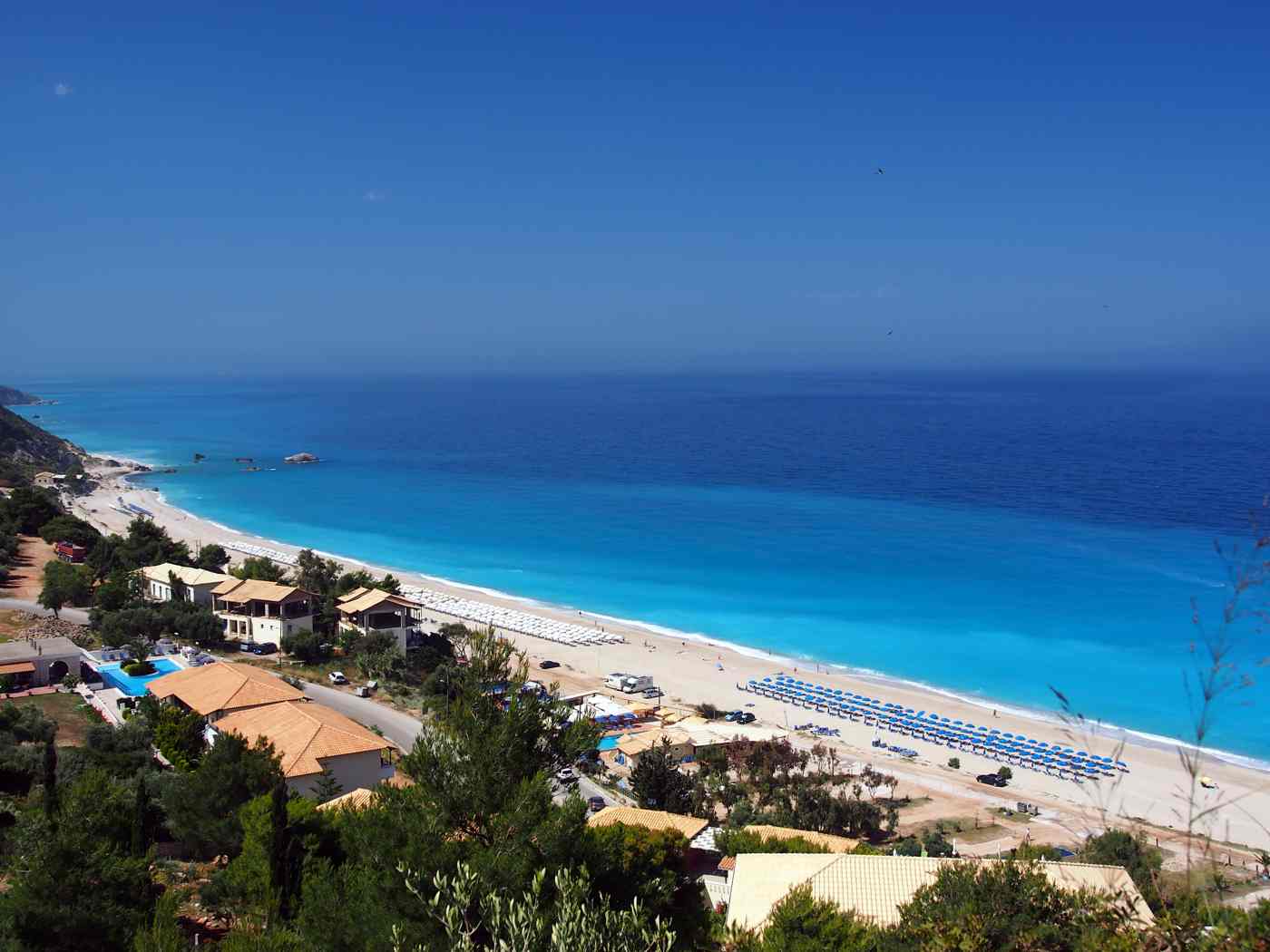
Kathisma Beach ranks among the longest and best known stretches of sand on the west coast of Lefkada, an Ionian island in western Greece. It lies about 15 km southwest of Lefkada Town and roughly 3.5 km south of the village of Agios Nikitas. At the foot of tall green cliffs that drop towards the open sea. The shore itself is a broad band of fine pale sand mixed with small pebbles, wide enough to hold both organised sections and quiet free ends. Its combination of easy road access, full facilities and west-facing sunsets explains why it draws steady crowds through the summer months. Plan the whole trip with Greece Tours.
What separates Kathisma from many of the beaches of Lefkada is how simple it is to reach. A good asphalt road with only bends runs down from the main west-coast route to the shore. The bay is one of the few on the island served by the local bus. No long staircase, no dirt track and no boat transfer stand between the car park and the water. A large free parking area sits along the sand at the end of the road, with private paid parking close by. That accessibility turns Kathisma into a full-day beach rather than a short photo stop.
What and where is Kathisma Beach in Lefkada?
Kathisma is a long sandy beach on the west coast of Lefkada, about 15 km southwest of Lefkada Town. Tall green cliffs rise behind it and the open Ionian stretches out in front.
The beach occupies a wide open bay on the western side of the island, where the mountain spine of Lefkada falls steeply towards the sea. Green slopes covered in low scrub, pine and olive rise directly behind the sand. The contrast between that vegetation and the pale shore is the first thing most arrivals notice. The sand runs for several hundred metres in a gentle curve, broad enough that even a busy August afternoon leaves walking room near the waterline. Small pebbles mix into the sand in places, particularly where winter storms have reworked the shore, but the surface stays comfortable underfoot along most of its length.
Kathisma belongs to the same western coastline that holds Porto Katsiki and the other well known cliff beaches, yet its character differs. Instead of a narrow strip below a vertical wall, it offers a long horizontal shore with room for parking, bars and sports on the sand itself. The cliffs here stand back from the water rather than hanging over it, which keeps the beach in sunlight until late in the day. That geometry also gives the bay an open horizon to the west. With no headland blocking the view towards the sea and the evening sun as it drops behind the waterline.
The water in front of the beach is clear and takes on the deep blue that the west coast is known for. Depth increases moderately as bathers move out, so the shallow zone is short compared with the sheltered beaches on the eastern side of the island. The seabed is mostly sand with scattered pebbles near the shoreline, and there are no rocky reefs across the main swimming area. Because the bay faces the open Ionian, water clarity stays high through the season, refreshed constantly by the swell that rolls in from the west and turns over along the shore.
Development along Kathisma is concentrated at the back of the sand rather than spread across it. A line of beach bars and tavernas occupies the strip between the road and the shore. With sunbed rows in front of them, while the two ends of the beach carry no infrastructure at all. Rooms and small hotels sit on the slope above, though the bay has never been built up in the way that resorts on the east coast have. Green hillside still dominates the view from the water, broken only by the road that descends to the shore. The result is a beach that provides services to a full-day crowd without losing the shape of its natural coastline.
How do visitors reach Kathisma Beach from Lefkada Town and Agios Nikitas?
A good asphalt road connects Kathisma with Lefkada Town, about 15 km to the northeast, and with Agios Nikitas around 3.5 km north. The local bus also serves the beach in summer.
Drivers leave Lefkada Town on the west-coast road that climbs into the hills and continues above Agios Nikitas before descending to the bay. The route is surfaced throughout and carries only bends on the final stretch, which makes it far gentler than the mountain approaches to the southern beaches. The distance covers about 15 km and the drive takes roughly half an hour at a relaxed pace. Signposting is clear at the junction where the road turns towards the shore. The descent ends directly at the parking area beside the sand rather than at a viewpoint high above the water.
From Agios Nikitas the journey is much shorter, around 3.5 km along the same coastal road. Visitors staying in that village often treat Kathisma as their main swimming beach, because the small cove in Agios Nikitas itself is narrow and fills quickly. The road climbs out of the village, runs along the slope with open sea views, then drops to the bay within minutes of driving. Cyclists and scooter riders manage the same distance without difficulty, and the gradient stays moderate throughout. Walking the route is feasible but exposed, with little shade along the roadside during the hottest hours of the day.
Kathisma is one of the few west-coast beaches on the island included in the local bus network. Services run from the terminal in Lefkada Town through the western villages during the summer timetable, which allows visitors without a vehicle to reach the sand directly. The stop lies beside the road at the top of the beach, a short walk from the bars and the sunbed rows. Bus frequency is limited compared with a city network, so travellers plan the return journey before setting out. This link is a genuine advantage over Egremni beach and other southern shores, which have no public transport at all.
The absence of a staircase sets Kathisma apart from most of the celebrated west-coast beaches. Arrivals step from the car park onto the sand at the same level, with no descent of hundreds of steps and no boat transfer from a harbour. That makes the beach practical for families with pushchairs, for older visitors and for anyone carrying cool boxes, umbrellas or beach equipment. Taxis from Lefkada Town and the western villages drop passengers at the same point beside the shore. Boat trips along the coast pass the bay, yet the road remains the standard way in and out for the great majority of visitors.
Where do drivers park at Kathisma Beach in Lefkada?
A large free car park runs along the back of the beach at the end of the access road. Private paid parking operates nearby, and the free spaces fill early in peak season.
The main parking area stretches along the landward edge of the sand, following the line of the beach rather than sitting in one square block. Spaces are unmarked in places and vehicles park in loose rows, which allows a considerable number of cars to fit along the strip. Access is direct from the descending road, so drivers do not negotiate narrow village lanes or awkward reversing points. The surface is compacted earth and gravel rather than asphalt, and dust rises in dry weather. Parking there carries no charge, which is unusual on a beach with this level of organisation behind it.
Peak-season demand outstrips the free capacity from mid-morning onwards. In July and August the closest rows are taken well before eleven o’clock, and later arrivals park progressively further from the central bars. Drivers who reach the bay before ten in the morning find space without difficulty and secure a shaded position under the roadside trees. The same pattern reverses in the late afternoon, when day visitors leave and sunset watchers take their place. Traffic on the single access road slows noticeably during those two changeover periods, so a measure of patience forms part of the routine at both ends of the day.
Private paid parking operates close to the beach as an alternative when the free area is full. These plots sit slightly back from the sand and charge a daily rate, and they normally retain space long after the public rows have filled. Visitors arriving in the middle of the day therefore keep a fallback rather than circling the bay in search of a gap. Motorcycles and scooters slot into spaces along the roadside and rarely face a problem at any hour. Hire cars, which make up much of the summer traffic, take the standard rows and follow the same early-arrival logic as everyone else.
Parking close to one end of the beach shapes the whole day for visitors. Those who stop at the northern side reach the quieter free sand within a short walk, while the central section leads straight into the organised rows and the bars behind them. Shade is scarce in the car park itself, so windscreen covers and a position under vegetation make a real difference by mid-afternoon. Valuables travel onto the sand rather than staying in the vehicle, as at any busy beach. The road ends at the bay, so no through traffic adds to the pressure on the available space.
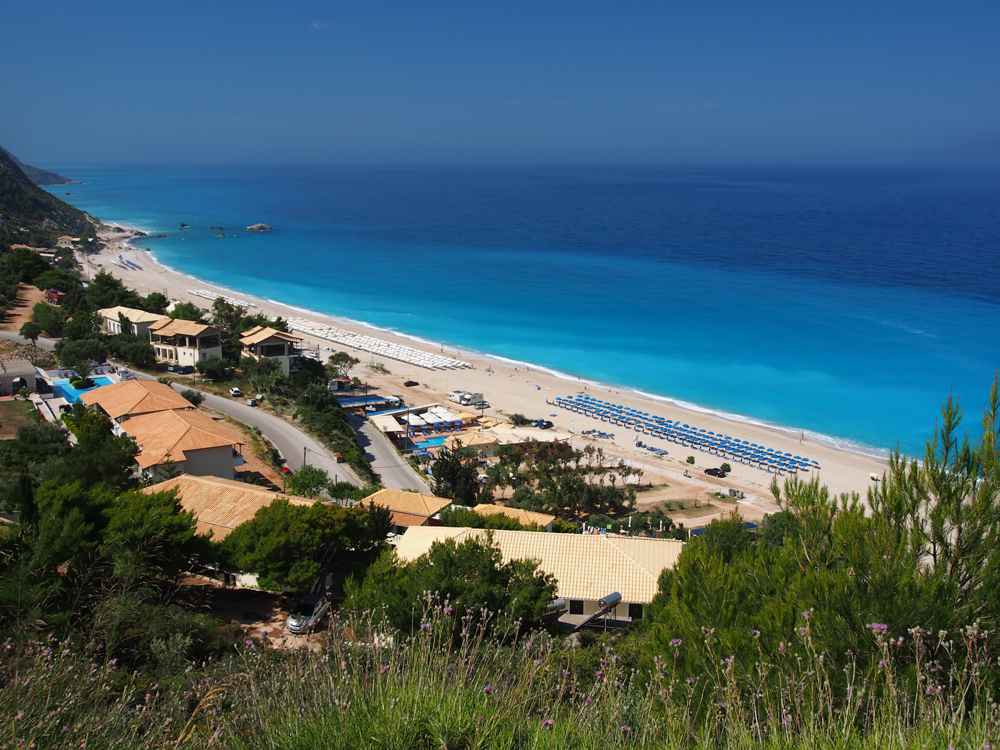
What facilities does Kathisma Beach offer along the sand?
Kathisma offers rented sunbeds and parasols along its organised sections, several beach bars and tavernas, showers, changing cabins and toilets inside the bars. The two ends of the beach stay free of infrastructure.
The organised part of Kathisma covers the central and longest portion of the shore. Rows of sunbeds and parasols run parallel to the water in front of each bar, arranged in blocks that stretch back lines from the sea. Front rows cost more than those further back, a pricing pattern common along the west coast of Lefkada. Some bars set no separate sunbed fee at all and allow visitors to use the loungers in exchange for a drink or a meal, while others charge per set for the day. Arrangements differ between operators, so a short walk along the sand reveals the options.
Beach bars and tavernas line the back of the sand and function as the service core of the bay. They provide food and drinks through the day, from breakfast to evening meals, and their staff manage the sunbed rows in front of them. Showers stand at the edge of the sand for rinsing off salt, and changing cabins allow visitors to switch clothes without walking back to a vehicle. Toilets are located inside the bars themselves rather than in separate public blocks. Music plays at several of the venues during the afternoon, with volume rising towards sunset at the busier ones.
The two ends of the beach carry no sunbeds, no music and no service of any kind. Visitors who bring their own umbrella and mat spread out on open sand there, with far more space between groups than in the central rows. Those sections attract families seeking quiet, readers and anyone who prefers the sound of the surf to a playlist. The walk from the car park adds minutes, and the difference in atmosphere is considerable. Because the beach is long, both patterns coexist without conflict, and visitors choose their level of organisation at the moment they arrive.
Watersports operate from the sand during the summer season, using the open water in front of the bay. Equipment hire and rides are based near the central bars, where the concentration of visitors supports the activity. The exposed western position produces regular afternoon waves, which suits sports and limits others on the windier days. Lifeguard presence varies through the season and is not guaranteed outside the busiest weeks of the year. Bins stand along the organised stretch, and the sand is cleaned regularly by the businesses that work there, which keeps the main section tidy through the high season.
Is swimming at Kathisma Beach suitable for children?
Swimming at Kathisma suits confident swimmers more than small children. The west-facing bay collects afternoon wind and swell, waves are common and the depth increases moderately a short distance from the shore.
The morning usually brings the calmest water of the day at Kathisma. Wind on the west coast tends to build from late morning onwards, so families with young children often arrive early and swim before the sea roughens. By mid-afternoon the surface carries a steady chop and breaking waves reach the shoreline, particularly on days when the prevailing north-westerly blows hard. Those waves rarely grow to a dangerous size in settled summer weather, yet they knock small children off balance near the waterline. Parents therefore read the sea conditions at the moment of arrival rather than relying on a fixed reputation for the bay.
Depth increases moderately rather than abruptly as bathers move away from the sand. Adults find themselves out of their depth within metres of the shoreline on the steeper sections. The gradient varies along the length of the beach according to how winter storms have shaped it. The seabed is soft and free of rocks across the main swimming area, which removes one common hazard. Undertow forms close to the shore when the swell runs strongly, dragging loose sand back with each wave. Swimmers who stay within the sheltered central section meet the mildest version of these conditions.
The eastern beaches of the island present a different picture, with shallow calm water and almost no wave action. Families who want that environment for toddlers use the sheltered coast and treat Kathisma as an afternoon destination for older children and adults. Teenagers and confident swimmers generally enjoy the movement in the water, which supports bodyboarding and other surf-adjacent play. Inflatable toys behave unpredictably once the wind rises, so they stay close to the shore or on the sand rather than drifting seawards. These are the ordinary considerations of any open west-facing coast rather than particular problems at this bay, and regular visitors plan their swimming hours around them.
Water temperature climbs through the season, staying cool in June and reaching its warmest in August and early September. The constant exchange with the open Ionian keeps the sea clear and also keeps it fresher than in enclosed bays. Sun exposure is intense on the open sand, with limited natural shade outside the parasol rows, so hats and cover work harder here than on a shaded beach. Late afternoon brings a softening of the light and often a slight drop in wind. Which swimmers regard as the best hour of the day for a long swim before the evening crowd arrives.
Why is Kathisma known for sunsets and paragliding?
Kathisma faces due west across the open Ionian, so the sun sets straight out to sea with no land in the way. The cliffs above the bay serve as launch points for paragliders.
The orientation of the bay explains the reputation. Nothing stands between the sand and the western horizon, so the sun drops into open water rather than behind a ridge or an offshore island. Colour builds across the whole sky in the final half hour, reflected along the wet sand and the line of the surf. Crowds gather on the beach and at the bars during that period, and the atmosphere shifts from a swimming afternoon to an evening gathering. Many visitors who spent the day elsewhere on the island drive over specifically for the last hour of light and stay for a meal afterwards.
The bars along the back of the sand orient their seating towards the water for exactly this reason. Tables fill in the hour before sunset and the pace of service slows as the crowd settles in. Parking pressure returns at the same time, since sunset visitors arrive as day visitors leave, and the free rows change hands quickly. Those who prefer quiet walk towards the free ends of the beach, where the same view comes without music or company. The road back towards Lefkada Town and Agios Nikitas then carries a steady stream of traffic for roughly an hour afterwards.
The cliffs and hills above Kathisma create the conditions that paragliders look for. Steady onshore wind meeting a high slope produces reliable lift. Pilots launch from the ridge to fly along the coastline before landing on the sand or on open ground nearby. Watching the canopies turn above the bay has become part of the beach experience, particularly in the afternoon once the wind is established. Tandem flights operate through the summer season for visitors without their own equipment, launching from the high ground and landing near the sand. The same wind that supports the flying is what puts waves on the water below, so the two features of the bay share a single cause.
Photographers treat the bay as one of the reference points on the western coast of Lefkada. The combination of green cliffs, pale sand and open sea gives depth to images at both ends of the day. The low sun rakes across the shore in the final minutes. Long exposures of the surf work well because the swell is consistent. Viewpoints on the road above the beach provide a wider frame that takes in the whole curve of the bay. Those pull-ins fill with parked cars in the evening, so drivers slow down on the descent at that hour.
How does Kathisma compare with Porto Katsiki and Egremni beach?
Kathisma trades the vertical cliff drama of Porto Katsiki for length, easy access and full facilities. Egremni beach lies further south and demands a longer drive and a descent, while Kathisma sits at road level.
Porto Katsiki sits well to the south, at the foot of a white cliff reached by a long staircase from a clifftop car park. Its shape is narrow and theatrical, its facilities minimal, and its visiting pattern built around hours rather than a full day. Kathisma reverses each of those terms with a long shore, level access and a full service line at the back of the sand. Visitors who want the postcard cliff make the southern trip once, then return to Kathisma on the days when convenience matters more than the view from the clifftop above.
Egremni beach lies on the same southwestern coast and shares the character of a long sandy strip below high ground. Reaching it involves a considerable drive from the northern part of the island followed by a descent to the shore. Its facilities remain limited compared with the organised rows at Kathisma. Boat trips from the southern ports serve it as an alternative to the land route. For a visitor based in Lefkada Town, in Agios Nikitas or in the northern resorts, the difference in travel time becomes the deciding factor on most days of a holiday.
Among the beaches of Lefkada, Kathisma occupies the middle ground between wild and developed. It carries the open western scenery that the island is known for and the infrastructure that a full beach day requires, without the resort density found along the eastern side. Families, couples and groups of friends all find a workable section along its length, from the sunbed rows in the centre to the empty free ends beyond them. Length is the quality that makes this possible, since one shore absorbs several different crowds at once. That range explains its steady popularity across very different types of visitor and its place near the top of most island beach lists.
Combining the three in one itinerary is straightforward for anyone with a car. A common pattern places the southern beaches in the morning, when their car parks are emptier and the sea is calmer. Kathisma in the late afternoon for the sunset over the open water. The northern position of Kathisma also fits a day that includes Agios Nikitas for lunch or an evening meal, since only about 3.5 km separate the two. Visitors relying on the bus have a simpler choice, since Kathisma is the accessible option and the southern cliff beaches require a hire car. A taxi or an organised boat excursion from the ports.
Frequently Asked Questions
How far is Kathisma Beach from Lefkada Town?
Kathisma lies about 15 km southwest of Lefkada Town, which translates to roughly half an hour of driving on the west-coast road. The route is asphalt throughout and carries only bends on the final descent to the bay. It is far easier than the mountain roads that lead to the southern cliff beaches. Signposting marks the turn towards the shore clearly, and the road ends at the parking area beside the sand rather than at a clifftop viewpoint. The same road passes Agios Nikitas around 3.5 km before the beach, which makes the two easy to combine in one outing.
Travellers without a vehicle reach the bay on the local summer bus from the town terminal, one of the few west-coast beaches with that link.
Is there a bus to Kathisma Beach in Lefkada?
Kathisma is served by the local bus during the summer timetable, which sets it apart from most beaches on the west coast. Services leave from the terminal in Lefkada Town and run through the western villages, stopping beside the road at the top of the beach. From the stop it is a short level walk down to the sand, the bars and the sunbed rows, with no staircase involved. Frequency is limited compared with an urban network, so travellers check the departure times for the return leg before setting out for the day.
The bus makes Kathisma the practical choice for visitors without a hire car, since Porto Katsiki and the southern beaches have no public transport and depend on a car, a taxi or an organised boat excursion from the ports.
Is parking free at Kathisma Beach?
A large free car park runs along the back of the beach at the end of the access road. Following the line of the sand rather than sitting in a single block. The surface is compacted earth and gravel, spaces are largely unmarked, and vehicles fit into loose rows along the strip. In July and August the closest rows are taken well before eleven o’clock in the morning. Arriving early secures both a shaded space and a short walk to the water. Private paid parking operates close by and charges a daily rate, which gives midday arrivals a fallback when the free area is full. Motorcycles and scooters find roadside gaps at almost any hour.
Pressure returns in the late afternoon, when sunset visitors take the places that day visitors are leaving.
Do visitors have to rent sunbeds at Kathisma Beach?
Sunbeds are optional at Kathisma, because the two ends of the beach remain free of any infrastructure. Visitors who bring their own umbrella and mat spread out on open sand there, with more room between groups and no music from the bars. Along the central and longest section, rows of sunbeds and parasols stand in front of each beach bar, and front rows cost more than the lines set further back. Some bars charge no separate fee at all and allow visitors to use the loungers in exchange for a drink or a meal, while others price each set for the day.
Arrangements differ between operators along the shore, so a short walk reveals which section fits a given budget and preferred level of organisation.
Is Kathisma Beach windy and are there waves?
Kathisma faces west across the open Ionian, so it takes the afternoon wind and the swell that comes with it. Mornings are usually the calmest part of the day, with the wind building from late morning and the surface carrying a steady chop by mid-afternoon. Breaking waves along the shoreline are common, particularly when the prevailing north-westerly blows hard, and the depth increases moderately a short distance from the sand. Confident swimmers and teenagers generally enjoy those conditions, while families with toddlers tend to swim early or use the sheltered eastern beaches of the island instead. The same wind supports the paragliders launching from the cliffs above the bay and the watersports operating from the sand.
It forms part of the character of the beach rather than an occasional inconvenience.
What is the best time of day to visit Kathisma Beach?
Early morning and late afternoon suit different priorities at Kathisma. Arriving before ten o’clock secures a free parking space near the centre of the beach and the calmest water of the day. Which matters for families and for anyone swimming with children. The middle of the day brings the fullest sunbed rows, the busiest bars and the strongest sun on open sand with little natural shade. From late afternoon the wind often eases slightly and the light softens, and the bay fills again with visitors who come specifically for the sunset over the open sea.
Many combine the two patterns by spending the morning at the southern beaches such as Porto Katsiki and returning north to Kathisma for the final hours of daylight and a meal afterwards.