
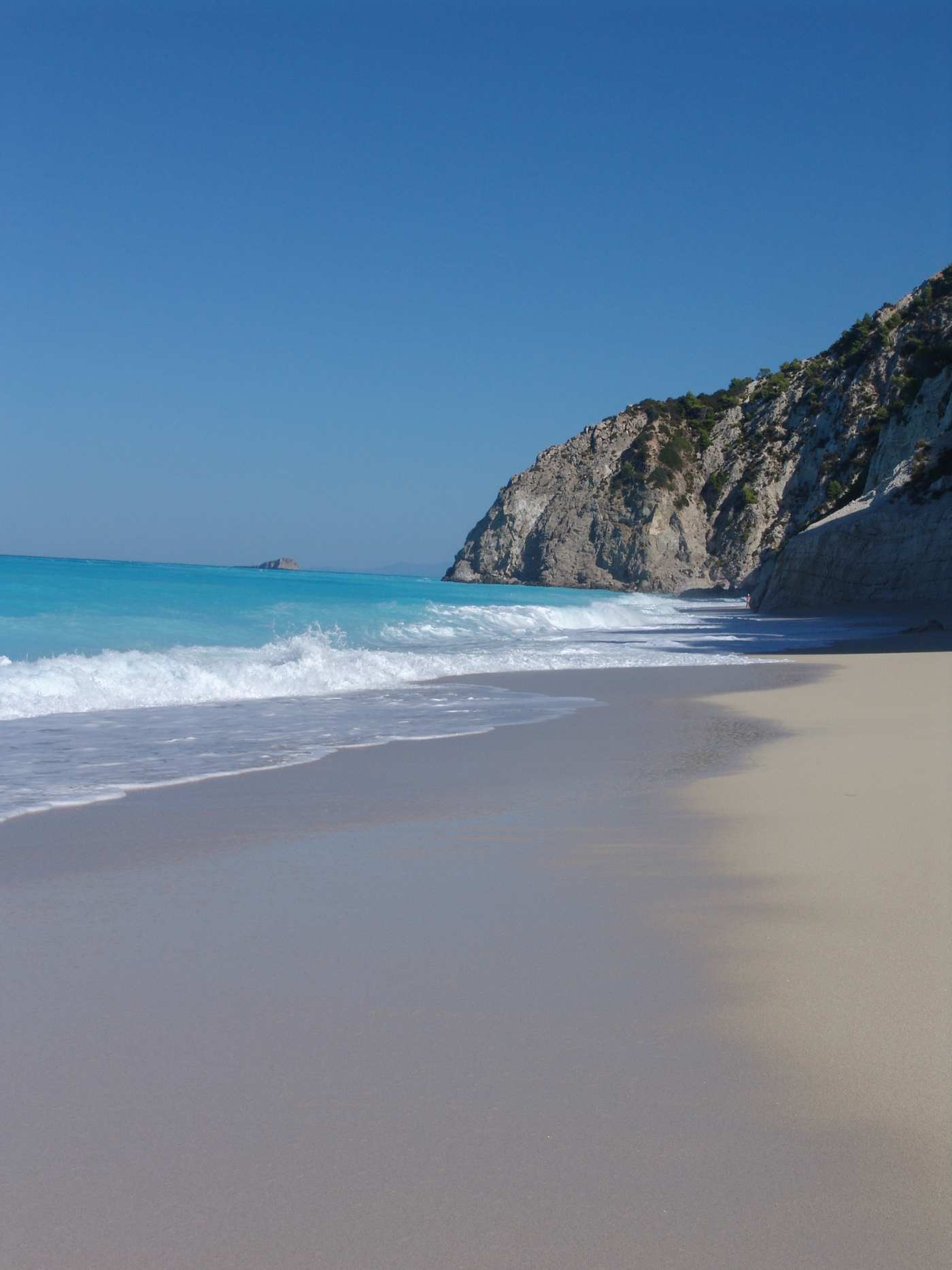
Egremni is the long white-pebble beach on the south-west coast of Lefkada. The second shore south along that coast after Porto Katsiki, lying below the village of Athani and about 40 km from Lefkada Town. It runs for roughly two kilometres at the foot of a high. Near-vertical cliff of pale rock. The water in front of it holds an exceptionally clear Ionian turquoise that deepens within steps of the shoreline. The beach carries no organised infrastructure and no reliable facilities, which keeps it wild and quiet in character compared with the developed resorts on the eastern side of the island. Plan the whole trip with Greece Tours.
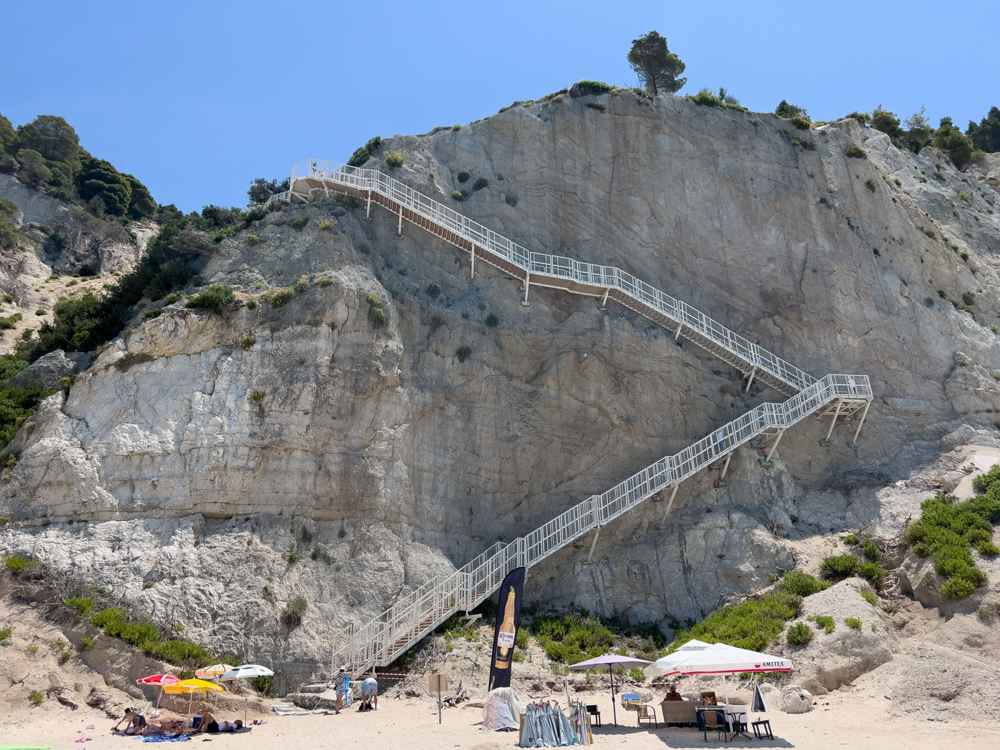
Reaching Egremni takes deliberate effort. A powerful earthquake set off extensive landslides along this stretch of coast. Destroying the access road and the original flight of around three hundred steps. Burying part of the sand, so the shore today is shorter than it once was. A rebuilt metal staircase of about 347 steps now forms the only land route down, steep and often slippery underfoot, with the return climb the hard part in afternoon heat. Many visitors skip the descent altogether and arrive by sea on taxi boats and day cruises from Vasiliki and Nydri, which delivers the head-on view of the cliff wall.
Where is Egremni beach on Lefkada and what makes up its shore?
Egremni lies on the south-west coast of Lefkada, below the village of Athani and about 40 km from Lefkada Town. Its shore runs roughly two kilometres of white pebble beneath a near-vertical pale cliff.
The south-west coast of Lefkada falls away from a high inland ridge in a single line of cliffs, and Egremni occupies one of the longest breaks in that wall. Travelling south along the coast, it is the second beach after Porto Katsiki, close enough that both shores share the same geology and the same pale rock face. The beach is reached from the plateau above rather than from any coastal road, because no road runs along the water at this point. That position explains almost everything about the place, from the effort of the descent to the absence of buildings on the shore itself.
The shore is white pebble rather than sand, with the stone graded from coarse near the waterline to finer material further back. Pebble beaches drain quickly and stay clean, and Egremni holds no seaweed line or river silt to cloud the shallows. The pale stone under the water acts as a reflector. Which is the physical reason the sea reads as an intense turquoise close in and shifts to deep blue where the seabed drops. The bottom shelves fast, so swimmers lose their footing within a short distance of the edge, and the colour change marks that transition clearly from the shore.
Behind the beach the cliff rises almost vertically in layered limestone, pale enough to glare in midday sun and streaked where past rockfalls have peeled away the surface. The wall gives the beach its name and its scale, dwarfing the people on the pebbles when the shore is seen from a boat offshore. Loose material still sits on the upper slopes, and fresh scars remain visible along the length of the face. The cliff throws no useful shade during the hottest part of the day. The strip directly beneath it is the one part of the shore visitors are advised to avoid.
Among the beaches of Lefkada, Egremni belongs to the western group that trades comfort for scale and water quality. There are no sunbeds set out in rows, no taverna at the back of the shore and no reliable source of drinking water at the bottom of the steps. Visitors carry in what they need and carry out what they leave, and the beach recovers its emptiness within an hour of the last boat departing. That combination of length, colour and bare infrastructure is what separates it from the organised sandy shores further north on the same coast.
How did the earthquake and the landslides change Egremni beach?
A powerful earthquake triggered extensive landslides along this coast, destroying the access road and the original flight of around three hundred steps. Falling material buried part of the sand, leaving Egremni shorter than before.
The earthquake struck the western side of Lefkada and shook the cliff line hard enough to bring down large volumes of rock. Whole sections of the slope failed at once, sweeping away the road that once carried cars close to the top of the beach and taking the original staircase with them. That older flight of around three hundred steps had been the standard way down for years. Its loss cut off the shore from land access entirely for a long period. The scale of the collapse was visible from the sea, where fresh pale scars ran from the clifftop to the waterline along much of the coast.
Material from the slides reached the beach itself and buried part of the shore under rock and debris. The result is a shorter beach than the one older photographs show. With the buried section still marked by coarse fallen stone rather than the smooth white pebble that covers the rest. The overall two-kilometre run remains, but the usable width narrowed in places where the toe of a slide came to rest against the water. Visitors who knew Egremni before the collapse notice the difference at once in the shape of the shoreline and the texture underfoot near the northern end.
The landslides also changed how people travel to the beach. Before the collapse, the drive down and the walk to the shore formed a straightforward half-day trip from most parts of the island. Afterwards, boat traffic became the dominant way in, and the taxi-boat and day-cruise routes out of Vasiliki and Nydri absorbed the demand while the land route stayed closed. Even now that walking access has been restored. A large share of the people on the pebbles arrive by sea rather than by staircase. The beach fills and empties on the rhythm of the boat schedules rather than the car park above.
Geological instability on this coast has not ended with the main event. Loose blocks and unconsolidated soil remain on the upper slopes, and material continues to detach after heavy rain, strong wind or further seismic movement. Local authorities have kept the warning in place for that reason, advising visitors to stay clear of the base of the cliffs rather than sheltering against them. The beach itself is open and used through the summer. The safe zone is the strip nearest the water rather than the strip nearest the rock. And that distinction matters more here than on almost any other shore in Lefkada.
How do travellers drive to Egremni beach from Lefkada Town, Athani and Vasiliki?
Drivers follow the west-coast road south from Lefkada Town for about 40 km, passing through Athani and continuing to the parking area above the beach. From Vasiliki the approach climbs north-west to the same village.
The drive from Lefkada Town runs south down the western side of the island on a road that climbs steadily away from the coastal plain and holds high ground for most of its length. The distance is about 40 km, and the driving time is longer than that figure suggests because of the bends and the gradient on the final stretch. The same road serves the northern west-coast beaches first, including Kathisma beach, before it narrows and turns inland towards the high villages. Fuel, groceries and cash are easier to sort out before the last section, since the settlements beyond that point are small and services are limited.
Athani is the reference village for the whole southern end of this coast, and it sits above both Egremni and Porto Katsiki on the high ground. The road past the village continues towards the cliffs, then splits, with one branch running to the Porto Katsiki car park and the other reaching the ground above Egremni. Signposting is present but sparse, and the final approach is a single-track surface with passing places rather than a two-lane road. Coaches do not use it, so the traffic is car, taxi and scooter, with the tightest pressure falling in the middle of the day during the peak weeks.
Visitors staying at Vasiliki on the south coast approach from the opposite direction, climbing north-west out of the bay and joining the same road that serves Athani. The distance is considerably shorter than the run from Lefkada Town, which is one reason the southern resorts treat Egremni as a local beach rather than a full-day excursion. Scooters and quad bikes are common on this route, though the exposed sections carry strong crosswinds in the afternoon and the surface is rough in places. Anyone driving a low hire car takes the last kilometres slowly, because the road edges are unprotected and the drop is immediate.
Parking sits on the plateau at the head of the staircase and is informal rather than laid out, filling from mid-morning onwards in July and August. There is no shade for vehicles, and cars left through the middle of the day become extremely hot, so a sunshade for the windscreen is worth carrying. Nothing is sold at the top with any reliability, which means water and food are bought earlier in the journey. The practical rhythm for drivers is an early arrival, a long swim and a return climb well before the strongest afternoon heat settles on the cliff face.
How steps lead down to Egremni beach and how hard is the climb back?
About 347 steps on a rebuilt metal staircase form the only land route down to Egremni. The descent takes most walkers under fifteen minutes, and the return climb is the demanding part.
The rebuilt staircase replaced the original flight destroyed by the landslides and follows a line pinned to the slope rather than the old route. It is metal rather than cut stone, with about 347 steps arranged in flights that turn back on themselves as they drop towards the pebbles. The structure is steep throughout, and the treads collect fine dust and grit through the season, which makes them slippery underfoot for anyone wearing smooth-soled sandals. Proper trainers or walking sandals with grip are the sensible choice, and carrying a bag on the back leaves both hands free for the rail.
Going down is quick and most people cover the full flight in ten to fifteen minutes without stopping. The gradient works against the knees rather than the lungs, and walkers with joint problems find the descent harder than the numbers imply. There is no shade on the staircase itself at any point in the day, and the metal absorbs heat, so the surface radiates warmth from late morning onwards. The reward arrives at the bottom. Where the steps open directly onto the white pebble and the full two-kilometre sweep of the shore comes into view along the base of the cliff.
The climb back is the part that defines the trip. The same 347 steps taken upward in mid-afternoon, after hours of sun and swimming, demand steady pacing and water in hand. Most walkers take twenty to thirty minutes with pauses, and the heat reflected from the pale rock adds to the effort considerably. Setting off before the hottest part of the day, or waiting until the sun has dropped towards the horizon, cuts the difficulty sharply. Anyone arriving without at least a litre of water per person finds the return far harder than expected, since nothing is sold at the bottom.
The staircase is not suitable for visitors with limited mobility, for small children who tire quickly or for anyone carrying heavy beach equipment. Families with young children generally choose the boat approach instead, and older visitors do the same. Weather closes the practical window further, because the metal becomes genuinely dangerous when wet and strong wind funnels along the face of the cliff. Checking conditions before committing to the drive saves a wasted journey of about 40 km from Lefkada Town. The decision is easier once the alternative sea route from the southern harbours is understood.
How do taxi boats from Vasiliki and Nydri reach Egremni beach?
Taxi boats and organised day cruises run to Egremni from Vasiliki on the south coast and from Nydri on the east coast. The sea route avoids the staircase entirely and delivers a head-on view of the cliff.
Vasiliki provides the shortest sea approach, because the harbour sits around the southern tip of the island from the west-coast cliffs. Small taxi boats leave through the morning and drop passengers directly onto the pebbles, then return at a set hour later in the day. The crossing rounds the headland and opens onto the full length of the cliff wall at once, which is the view no land visitor ever gets. Passengers step ashore in shallow water at the front of the beach, so a dry bag for phones and cameras is worth carrying on any of these transfers.
Nydri, on the sheltered eastern side of Lefkada, is the base for the larger day cruises rather than short taxi transfers. These boats usually build a full-day circuit that takes in stops along the coast and the offshore islets, with Egremni as one call among them. The run is longer and the time ashore shorter than on a direct transfer. Which suits visitors who want the view and a swim rather than a full day on the pebbles. Departures cluster in the morning, and the boats return to the eastern harbours in the late afternoon after crossing back around the southern end of the island.
Arriving by sea changes the character of the visit. There is no climb at either end, no parking to find and no exposure to the mountain road, so the trip becomes accessible to people the staircase excludes. The trade-off is control over timing, since departure hours are fixed and the boat sets the length of the stay. Passengers who want the beach at its emptiest do better with an early taxi boat than with a large cruise, because the cruise vessels arrive together in the middle of the day and concentrate everyone on the same section of shore.
Sea conditions govern the service more than the calendar does. This is an exposed western coast with no natural harbour at the beach, so boats land on an open shore and cannot do so in a heavy swell. Strong afternoon wind cancels sailings and shortens time ashore, and operators make that call on the morning of departure rather than the day before. Visitors staying at Vasiliki or Nydri check with the harbour before planning around a fixed return. They keep a second beach in reserve for the days when the sea runs high along the western cliffs of Lefkada.
What are the swimming conditions and facilities at Egremni beach?
Water at Egremni is exceptionally clear and deepens within steps of the pebbles. The beach is unorganised with no reliable facilities, so visitors bring water, food and their own shade.
The sea shelves steeply from the shoreline, and swimmers reach depth almost immediately rather than wading out across shallows. Visibility is high because the pebble bed produces no suspended sediment, and the bottom stays readable well beyond the point where footing is lost. Water temperature climbs through the summer and stays comfortable into the early autumn, though the depth keeps it fresher than on shallow sandy bays. Entry over rounded pebbles is awkward barefoot, and swim shoes make the first metres considerably easier, particularly where the stones run coarse near the buried northern section of the shore. Snorkellers find clean rock and open sand patches within a short swim of the pebbles.
Egremni faces west and takes the weather straight off the open Ionian, with nothing between the shore and the horizon to break it. Mornings are usually calm and the sea glassy, then the wind builds through the afternoon and pushes a chop onto the beach. That daily pattern favours an early visit for swimming and explains why the boats work the morning hours. The same exposure produces the sunset light that draws people to the western cliffs. Strong onshore wind raises a short. Steep swell that makes both swimming and boat landings uncomfortable by late afternoon.
Facilities are effectively absent. There are no sunbeds or umbrellas for hire that visitors can count on, no toilets, no taverna and no shop at the bottom of the steps. Water, food, sun cream and a portable umbrella belong in the bag before the descent or the boat. A rubbish bag for the return is part of the same list. Phone reception is patchy under the cliff, which is another reason to fix return times with a boat before landing. The absence of infrastructure is exactly what preserves the emptiness that brings people here in the first place.
Safety below the rock face deserves particular attention. The cliffs still shed loose material, and the shaded strip at the base looks inviting in the middle of the day for precisely the wrong reason. Visitors are advised to keep away from the foot of the wall and to set up nearer the water, where nothing overhangs. That advice applies most strongly after rain, wind or any seismic activity, and it applies to the buried section at the northern end where past debris has come to rest. A free-standing umbrella is the practical answer to shade on this beach.
How does Egremni beach compare with Porto Katsiki and Kathisma beach?
Egremni is the longest and least developed of the three, running about two kilometres of white pebble. Porto Katsiki is the compact neighbouring cove to the north, and Kathisma beach is the organised, road-accessible option.
Porto Katsiki sits immediately north of Egremni on the same cliff line and shares the same pale rock and turquoise water, but the two shores differ in scale and shape. Porto Katsiki is a compact cove framed by a headland, and its outline is the image that represents the island in most travel photography. Egremni is the opposite in form: a long, open ribbon of pebble stretching for around two kilometres with no enclosing arms and far more room to spread out. Visitors who want the postcard view choose the cove, while those who want space and quiet walk south along the pebbles at Egremni.
Kathisma beach lies further north on the same western coast and answers a different need altogether. The road runs to the back of the shore, so no staircase and no boat are involved, and the beach carries the sunbeds, tavernas and parking that Egremni lacks entirely. Families with small children, visitors with limited mobility and anyone who wants lunch without carrying it down a staircase choose Kathisma for those reasons. The trade-off is crowd density and development along the back of the shore, which are precisely the things Egremni avoids by being difficult to reach in the first place. The water and the pale stone remain recognisably the same coast.
Access effort separates the three clearly. Kathisma asks for a drive and nothing more. Porto Katsiki asks for a drive and a shorter flight of steps from its car park. Egremni asks for about 347 steps in each direction or a boat from Vasiliki or Nydri. Visitors often pair the western beaches on a single day, taking Porto Katsiki in the morning and Egremni afterwards, or the reverse. The pairing works because both sit above Athani on the same stretch of road, which keeps the driving between them short even though the coastline below is impassable on foot.
Ranking the beaches of Lefkada against each other depends on what the visit is for. Egremni delivers length, emptiness and the most dramatic relationship between shore and cliff, at the cost of shade, comfort and easy access. Porto Katsiki concentrates the same colour and rock into a smaller frame that photographs better and fills faster. Kathisma trades the drama for services and a straightforward arrival. Most visitors spending days on the island end up seeing all three. Egremni is the one that rewards an early start and a properly packed bag more than any of the others.
Frequently Asked Questions
How steps lead down to Egremni beach?
The rebuilt metal staircase at Egremni carries about 347 steps from the parking area on the plateau down to the pebbles. It replaced the original flight of around three hundred steps, which the landslides destroyed along with the access road. The new structure follows a line pinned to the slope and turns back on itself in a series of flights. Most walkers descend in ten to fifteen minutes and take twenty to thirty minutes on the way back, depending on pace and heat. There is no shade at any point on the staircase, and the metal treads collect dust that makes them slippery under smooth soles.
Grippy footwear and a hand free for the rail are worth arranging before starting down.
Is Egremni beach accessible by car?
Cars reach the plateau above Egremni but not the beach itself. The old road that once ran closer to the shore was destroyed by the landslides and has not been rebuilt. The staircase of about 347 steps is the only land route down. Drivers come from Lefkada Town on the west-coast road, a distance of about 40 km. Or from Vasiliki on a shorter climb from the south coast, passing Athani in both cases. The final approach is single-track with passing places and no barrier on the drops, so it suits small cars driven slowly. Parking at the top is informal and unshaded, and it fills from mid-morning onwards through the peak summer weeks.
Arriving early secures a space and keeps the return climb out of the worst heat of the afternoon.
Is Egremni sand or pebble, and how deep is the water?
Egremni is a white-pebble beach rather than a sandy one, with stone graded from coarse near the waterline to finer material further back. The pale bed reflects light through the water, which produces the intense turquoise close to shore and the deep blue further out. The seabed shelves quickly, so swimmers lose their footing within steps of the edge and the water is genuinely deep a short distance out. Clarity is high because pebbles hold no silt and produce no suspended sediment. Entry barefoot over rounded stones is awkward, particularly near the northern section where landslide debris left coarser material, so swim shoes make a noticeable difference to comfort.
The colour change in the water marks the point where the bed drops away, and it is visible from the pebbles.
Can visitors reach Egremni by boat from Vasiliki or Nydri?
Boat access is the easier route to Egremni and the one visitors choose over the staircase. Taxi boats run from Vasiliki on the south coast, which is the closest harbour by sea, and drop passengers straight onto the pebbles before returning at a fixed hour. Larger day cruises leave from Nydri on the east coast and call at Egremni as one stop within a longer coastal circuit. Both approaches give the head-on view of the cliff wall that no land visitor sees. Sailings depend on sea state, because the boats land on an open western shore with no harbour, and strong afternoon wind cancels departures or shortens the time ashore.
Morning crossings are the calmest and put visitors on the pebbles before the day-cruise traffic arrives.
Is Egremni beach safe after the landslides?
The beach is open and used through the summer, but the cliffs above it remain unstable and loose material still falls. Visitors are advised to keep away from the base of the rock face and to settle nearer the water, where nothing overhangs. The shaded strip directly beneath the cliff looks attractive in the middle of the day and is exactly the place to avoid. Risk rises after heavy rain, in strong wind and following any seismic movement, so conditions are worth checking before the trip. The staircase itself is maintained and in regular use, though wet treads make it hazardous after rain.
Bringing a free-standing umbrella removes any reason to shelter against the wall, and settling on the strip nearest the water keeps the whole party clear of the fall line.
What do visitors bring to Egremni beach?
Egremni is unorganised with no reliable facilities, so everything needed comes down the steps or off the boat. Water is the priority, with at least a litre per person for the beach and the return climb, followed by food, sun cream and a portable umbrella for shade. Swim shoes help on the coarse pebbles, and footwear with grip matters on the metal staircase. A dry bag protects phones and cameras during a boat landing in shallow water. Phone reception is patchy under the cliff, so return times with a taxi boat are agreed before landing.
A rubbish bag completes the list, since nothing is collected at the bottom and the shore stays clean only because visitors carry their waste back out.