
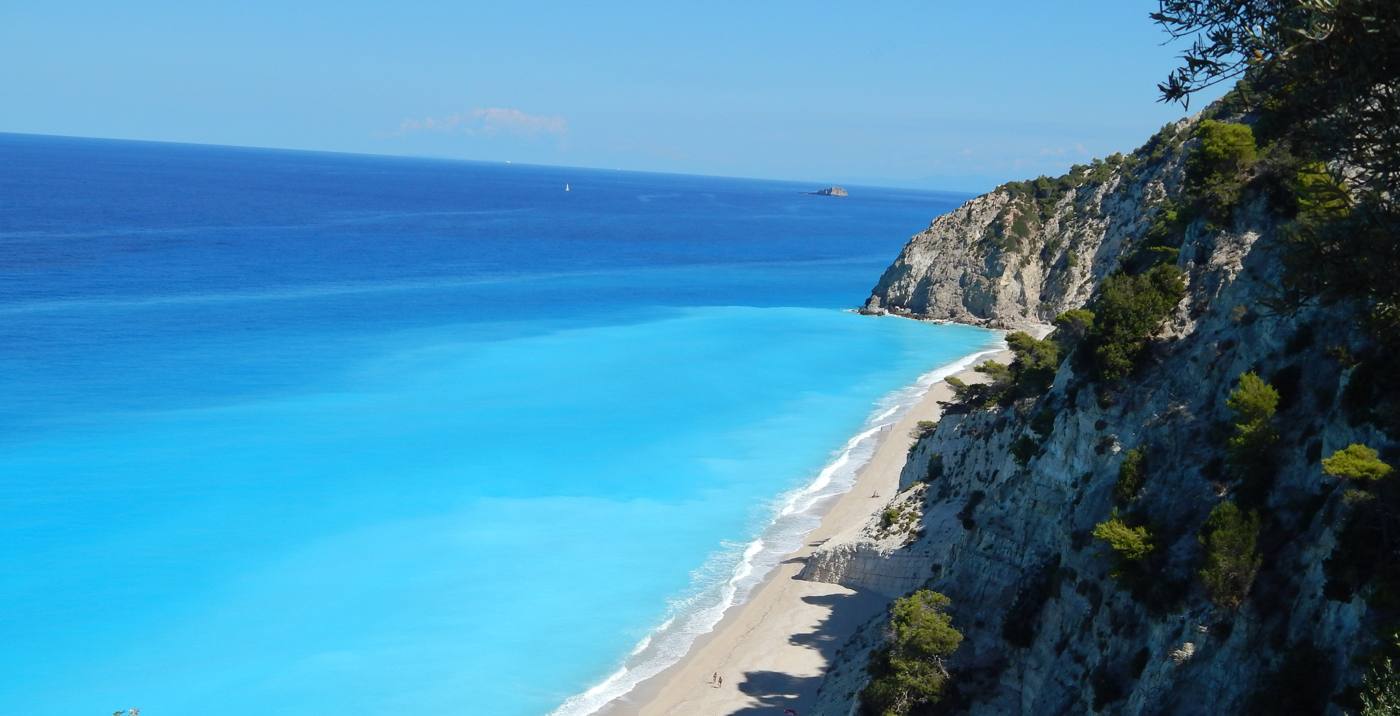
Lefkada sits on the western edge of Greece, joined to the mainland by a causeway and a floating bridge, and its coastline behaves like two separate islands. The western shore runs beneath tall white limestone cliffs that drop into open Ionian water, while the eastern shore curls into green, sheltered inlets that barely register a wave. Choosing a beach here means choosing a coast first and a beach second. The difference shows in the ground underfoot, the depth of the water metres out, and the strength of the afternoon wind. Plan the whole trip with Greece Tours.
West-coast beaches such as Porto Katsiki, Egremni beach and Kathisma beach share pale pebbles. Coarse pale sand and water that turns deep turquoise within a stride or two of the shoreline. The east coast, behind Nydri, Nikiana and Lygia, offers small shingle bays with shallow warm water and almost no swell. In the south, Vasiliki funnels a reliable afternoon thermal wind into its bay and built a windsurfing centre around it. The north-west adds Agios Nikitas, Mylos and long sandy Pefkoulia, and several of the finest coves on the island are reached only from the sea.
How do the west and east coasts of Lefkada differ?
The west coast faces the open Ionian beneath tall limestone cliffs, with deep turquoise water and afternoon swell. The east coast is green and sheltered, with shallow shingle bays and calm water.
The island’s spine of limestone runs north to south and decides everything about its shores. On the west, that rock ends in tall white walls that fall straight towards the open Ionian. Beaches there sit at the foot of cliffs with little flat land behind them. On the east, the same ridge slopes away gently into a channel protected by the mainland, and the coastline breaks into a series of small green inlets. The result is two very different swimming environments within a drive of about half an hour across the island. Visitors who treat Lefkada as one uniform coast are usually surprised by the contrast.
Underfoot the two coasts feel nothing alike. West-coast bays are floored with pale pebbles and coarse pale sand. That bright bed throws light back into the water and gives it the deep turquoise tone seen in most photographs of the island. The same ground shelves quickly, so swimmers reach chest depth within strides and open water not far beyond. East-coast bays are shingle rather than sand, darker and finer in places, and they slope so gradually that children stand comfortably a long way out. Water on the sheltered side warms earlier in the season because so little cold open sea circulates through the inlets.
Wind separates the coasts as sharply as the rock does. Mornings on the west are often glassy, and the sea lies flat against the pebbles until late morning. Through the afternoon a breeze builds off the open Ionian, pushing a short swell onto the shore and lifting fine grit off the beach. Families with small children therefore arrive early and leave by mid-afternoon. The east coast barely notices the same wind, because the ridge and the mainland channel block it, and its bays stay calm from dawn until dusk. Swimmers who dislike waves plan their week around this pattern rather than around individual beaches.
Choosing between them comes down to what the day is for. Strong swimmers, photographers and anyone drawn to cliff scenery head west to Porto Katsiki, Kathisma beach and their neighbours, accepting steps, exposed parking and an afternoon chop as the price. Families with toddlers, older visitors and anyone staying on a yacht work the east side. Where the water is warm, waist-deep and still. Tavernas sit steps from the shingle. A common approach is to split the week between the two coasts, spending calm mornings on the west and windy afternoons in the shelter of Nydri or Sivota.
Which west-coast beaches of Lefkada sit beneath the cliffs?
Porto Katsiki, Egremni beach and Kathisma beach form the core of the west coast, joined by Kalamitsi, Pefkoulia, Avali and Gialos. All lie below white limestone walls on pale pebble and coarse sand.
Porto Katsiki lies near the southern end of the western shore, a narrow strip of pale pebbles under a sheer white cliff that splits the coastline behind it. Access is by road along the ridge to a car park on the clifftop. Then down a long flight of concrete steps to the shore. The return climb is the hardest part of the visit. The water turns deep within metres and holds an intense blue against the pale bed. Boat trips along the west coast also stop offshore, and visitors see the beach first from the sea, where the cliff reads as a single white wall.
Egremni beach sits just north of it and shares the same geology, a long pale pebble shore beneath a very high cliff. Its clifftop access was altered by landslides, and the old staircase no longer serves visitors as it once did. Most people now arrive by sea, on day boats that run along the western shore. Arriving that way changes the character of the visit, since swimmers drop straight into deep turquoise water off the boat rather than walking down to it. The beach itself is long enough to absorb boatloads without feeling crowded, and it carries very facilities compared with the road-served beaches further north.
Kathisma beach lies a short drive south of Agios Nikitas and is the most developed of the western beaches. A road drops to shore level. No staircase stands between the car park and the sand. And the beach carries sunbeds, showers and a line of seasonal businesses along its back edge. The bed is coarse pale sand mixed with fine pebble, and it shelves quickly metres out. Kalamitsi, south of it, is quieter and reached by a road down from the village of the same name. Its shore is pebble with sand patches. The swell arrives there in the afternoon exactly as it does at Kathisma.
Avali and Gialos fill the gap between Kalamitsi and the far south, both reached by narrow roads that wind down from the ridge and end in unsurfaced parking. Neither carries the crowds of the headline beaches, and facilities on both are limited to a small seasonal presence at best. Pefkoulia, at the northern end of the same coast, is the longest sandy stretch on the western shore and the easiest to reach, since the main road runs close to its back edge. All of these beaches share the western pattern: clear deep water, pale ground, and a wind that strengthens as the afternoon goes on.
What are the sheltered east-coast bays of Lefkada like?
East-coast bays are small, shingled and shallow, backed by green hillsides. Nydri, Nikiana, Lygia, Perigiali, Desimi and Mikros Gialos sit beside the resorts, and Sivota holds the yacht inlets.
The eastern shore of Lefkada looks across a narrow channel towards the mainland, and that channel does the work of a breakwater. Hills come down to the water in green folds, and the coast breaks into a run of small bays rather than long open beaches. Most of them are shingle, with a band of coarser stone at the waterline and finer material below the surface. Depth increases slowly, so a swimmer walks a considerable distance before losing the bottom, and the sea holds its warmth well into the evening. Boats moored a short way out are a permanent part of the view here.
Nydri is the busiest settlement on this side and functions as the island’s boat-trip hub, with a waterfront of tavernas and a shingle beach beside it. Perigiali and Nikiana sit immediately to the north, quieter versions of the same arrangement. Each with a narrow shore of small stones and shallow water directly in front of the accommodation. Lygia, closer to Lefkada Town, keeps a working fishing harbour alongside its swimming areas. None of these beaches competes with the west on scenery, but all of them put flat water, shade and a place to eat within paces of the sunbeds.
Desimi occupies a deep horseshoe bay south of Nydri, enclosed by wooded slopes on both sides and almost entirely free of swell. Its ground is fine shingle, the water is clear and shallow for a long way out, and campsites and small tavernas back the shore. Mikros Gialos, near the village of Poros, is a wider bay of pale pebbles with a gentler setting and rather fewer visitors. Both are reached on winding roads down from the main east-coast route, and both suit swimmers who want calm water without the crowds of Nydri. Parking at each is informal and fills early in the peak weeks.
Sivota lies at the southern end of this coast in a long. Narrow inlet that yachts use as a natural harbour. The village sits at the head of it surrounded by hills. Swimming happens from small stretches of shingle at the edges of the inlet and from coves reached by tender or on foot, rather than from a single large beach. The water inside is completely sheltered, deep towards the middle and shallow at the sides. Boat traffic through the entrance is constant in the season, and the tavernas along the quay serve the sailing crowd as much as the beach crowd.
What does the south coast around Vasiliki offer?
Vasiliki anchors the south with a funnel-shaped bay and a long windsurfing shore, with Ponti alongside it. Agiofili, a white-pebble cove around the headland, is reached by taxi boat or a rough track.
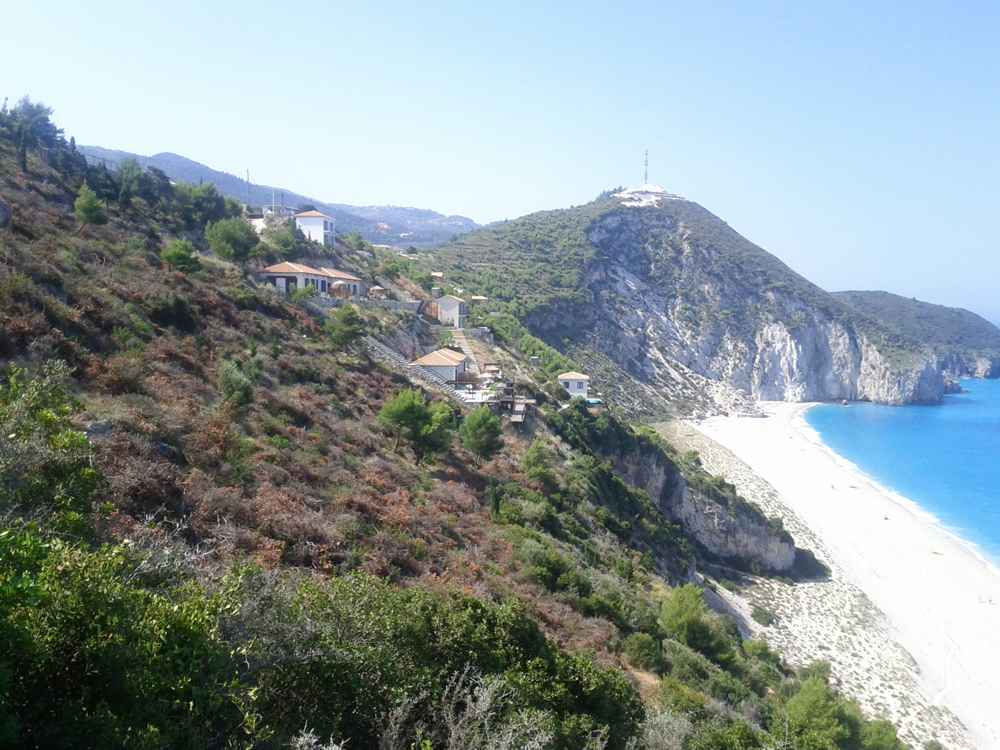
Vasiliki occupies a wide bay at the southern tip of the island, shaped like a funnel that opens to the west. The shore in front of the village is pebble. Backed by a long line of trees and a promenade of tavernas. The water is clear and moderately shallow before it drops away. Ferries to the Ionian neighbours use the small harbour at one end, and the sailing schools occupy the open stretch towards Ponti. The bay carries a different rhythm from the rest of the island, because its afternoons belong to the wind rather than to sunbathing. The village fills with board traffic from midday onwards.
Ponti sits at the western corner of the same bay, where the beach broadens and the thermal wind arrives first and strongest. Its ground is small pebble and coarse sand, and the water stays shallow far enough out for boards to be rigged and launched from a standing depth. Swimmers use the morning, when the surface is still and the bay reads like any other calm shore, and the afternoon belongs to sails. Accommodation and eating places sit directly behind the beach. The road between Ponti and Vasiliki village runs flat along the bay. Which makes the whole stretch easy to walk from end to end.
Agiofili lies just around the headland from Vasiliki, a compact cove of white pebbles with water so clear that the stones on the bottom stay visible at swimming depth. Access is deliberately awkward: a taxi boat runs across from Vasiliki harbour in minutes. Or a rough unsurfaced track drops down from the road above and ends in a short walk. The cove faces east enough to escape the worst of the afternoon wind that fills the bay behind it. Facilities are minimal by the standards of the resort beaches, and most visitors bring water and shade with them for the day.
The south coast as a whole works differently from either of the long coasts. Distances are short, so a single base in Vasiliki puts the windsurfing shore. The pebble beach in front of the village and the boat to Agiofili within minutes of each other. The road in from the north crosses the ridge and descends in tight bends, which makes the drive slower than the map suggests. Swimming conditions divide by hour rather than by beach: flat and warm until early afternoon. Then increasingly choppy as the thermal fills in and holds until the evening drops it away again.
Which beaches lie in the north-west of Lefkada?
Agios Nikitas sits above Mylos beach, reached on foot over the headland or by water taxi. Long sandy Pefkoulia lies next door, below the same cliff line that shapes the whole western shore.
Agios Nikitas is the only village on the western shore built right at the sea. A single narrow street of stone houses running down to a small beach at its foot. Cars stop at the top, so the lower village is walked rather than driven, and the beach in front is short, pebbly and sheltered by headlands on both sides. The setting gives the north-west a different feel from the cliff beaches further south, where nothing stands between the car park and the shore. Rooms, tavernas and small shops line the street, which makes the village a practical base for the whole western coast.
Mylos beach lies immediately around the northern headland from the village and is reached either on foot over the rock or by water taxi from the beach at Agios Nikitas. The footpath climbs from the end of the village, crosses the ridge and drops to the shore in about fifteen minutes, with the last section steep enough to need care. The bay itself is coarse pale sand and pebble, open to the west and therefore exposed to the same afternoon swell as its neighbours. Water taxis shuttle back and forth through the day, and visitors walk one way and ride the other.
Pefkoulia lies on the other side of the village, a long sandy beach that runs north below the cliff road towards the far end of the coast. Its length means the crowd spreads out, with organised sunbeds and a seasonal bar presence at the southern end and long empty stretches beyond. The bottom is sand rather than pebble, which makes entry easier on bare feet, though the shelf still drops away within a short distance. Parking sits along the back edge close to the road, so this is one of the simplest western beaches to reach with a car and small children in tow.
The north-west sits within easy reach of Lefkada Town, which puts these beaches about twenty minutes from the causeway and the island’s main services. Agios Ioannis, on the flat coast just west of the town and marked by its old stone windmills, closes the gap between the town and the cliff coast. Its shore is long, sandy and shallow, and the same westerly wind that troubles swimmers further south makes it the second board sailing centre on the island. Visitors basing themselves in the north often combine a morning at Pefkoulia or Mylos with an afternoon at Agios Ioannis.
Where do windsurfers and kitesurfers go on Lefkada?
Vasiliki and Agios Ioannis carry the island’s board sailing. The bay at Vasiliki funnels a reliable afternoon thermal, while Agios Ioannis near Lefkada Town, marked by old windmills, takes windsurfers and kitesurfers.
Vasiliki became a windsurfing centre because of its shape rather than its beach. The bay narrows inland like a funnel, and as the land heats through the morning the air draws in from the open sea, accelerating as it compresses between the slopes. The result is a thermal wind that arrives at much the same hour each afternoon and blows across flat, shallow water with a long fetch. That combination of reliable timing, warm water and a bay that keeps a board within sight of the shore is what the schools and rental operations built around. It made the village the island’s board sailing address.
Conditions at the Ponti end suit beginners and intermediates in particular. The shallow shelf lets a rider stand while rigging and water-starting. The bay is enclosed, so drift carries a board across the water rather than out to sea, and the wind arrives gradually instead of gusting from nothing. Mornings are quiet enough for lessons on flat water. The strength builds through the middle of the day. The strongest hours come in the late afternoon when more experienced sailors take over. Kit storage, launching areas and instruction all cluster along the same stretch of shore, so the beach works as a base for a full day.
Agios Ioannis, on the coast just outside Lefkada Town, is the island’s other wind beach and the one favoured by kitesurfers. Its long sandy shore faces the open sea across a flat foreshore, with shallow water and space behind the beach to lay out lines and launch a kite safely. The row of old stone windmills at the back of the beach is a reminder that the wind here worked as a resource long before it became a sport. Since the beach sits close to town, riders staying in Lefkada Town reach it in minutes without crossing the island at all.
Swimmers and board riders divide the same beaches by clock. Sand-floored beaches such as Pefkoulia, Agios Ioannis and parts of Kathisma beach are the easiest for barefoot entry and for children. The pebble shores of the west and the shingle of the east are kinder on windy days, because they raise no cloud of sand. Wind also decides comfort more than temperature does: a sheltered east-coast bay stays swimmable all day. A west-coast beach is at its calmest before the breeze fills in. The wind beaches of the south are flattest in the morning hours.
How are Lefkada beaches reached, and what parking and facilities exist?
Roads serve most beaches, staircases and footpaths guard the west, and boats reach Egremni beach, Agiofili and Mylos most easily. Facilities thin out as access gets harder.
Boats reach several of the finest coves more easily than roads do. Egremni beach lost its old clifftop staircase route to landslides. The great majority of visitors now arrive on day boats that work the western shore from Nydri and the southern harbours. Agiofili is reached most simply by taxi boat from Vasiliki, a crossing of minutes, with the alternative being a rough track and a walk. Mylos beach is served by water taxi from Agios Nikitas as well as by its footpath. Day cruises from the eastern resorts take in a run of these beaches within a single trip.
Steps and paths guard the rest of the west coast. Porto Katsiki is entered by a long concrete staircase from the clifftop car park, and the climb back up in the middle of the day is the part visitors underestimate. The footpath to Mylos beach crosses a headland on loose ground and needs proper shoes rather than sandals. Kalamitsi, Avali and Gialos each end with a short walk from wherever the road stops. Carrying a cool box, an umbrella and beach chairs down any of these routes is heavy work, which is one reason the road-served beaches stay busier through the season.
Driving is the practical way to see the coast, since the beaches sit far apart and public transport concentrates on the towns. The west-coast road runs high along the ridge with steep descents to individual beaches, and several of those descents are narrow, unsurfaced and awkward to reverse on. Parking at Kathisma beach and Pefkoulia is close to the sand and largely organised. Parking at Porto Katsiki and the smaller coves is a clifftop or roadside area that fills by late morning in the busiest weeks. Arriving before mid-morning or after the middle of the afternoon avoids the worst of the pressure.
Facilities thin out steadily as the beaches get harder to reach. The developed shores, meaning Kathisma beach, Pefkoulia, the resort bays of the east coast and the Vasiliki front, carry sunbeds, umbrellas, showers, seasonal eating places and toilets within walking distance. Porto Katsiki holds a limited seasonal presence at the top and bottom of its steps. Egremni beach, Agiofili and the smaller western coves offer very little, so water, shade and food travel with the visitor. Shade is the scarce commodity on the west in general, because the cliffs face the wrong way to cast any of it across the shore at midday.
Frequently Asked Questions
Which coast of Lefkada has the best beaches?
Neither coast wins outright, because the two serve different purposes. The west coast holds the beaches that appear in photographs of the island, among them Porto Katsiki, Egremni beach, Kathisma beach, Kalamitsi and Pefkoulia. All of them sit beneath white limestone cliffs on pale pebble and coarse sand, with deep turquoise water that shelves away quickly. That coast is exposed, and an afternoon wind and swell build through the day. The east coast, behind Nydri, Nikiana, Lygia, Perigiali, Desimi and Mikros Gialos, is green and sheltered, with small shingle bays, shallow warm water and almost no swell at any hour. Strong swimmers and photographers favour the west, while families, older visitors and sailors favour the east.
Many people staying a week use both, taking the west in the calm of the morning and the east in the windy part of the afternoon.
Are Lefkada beaches sandy or pebbly?
Both, and the split follows the coast. West-coast beaches are floored with pale pebbles and coarse pale sand, which is what gives the water its deep turquoise colour. Pefkoulia is the longest properly sandy stretch on that side, and Kathisma beach mixes coarse sand with fine pebble. East-coast bays are shingle rather than sand, generally small and gently shelving, which suits paddling and long shallow entries. In the south, Vasiliki and Ponti are pebble and coarse sand, while Agiofili is a cove of white pebbles. Agios Ioannis, west of Lefkada Town, is long and sandy. Bare feet cope more easily with the sandy beaches, and beach shoes make the pebble shores comfortable.
Pebble and shingle beaches hold one advantage on breezy days, since they raise no blowing sand when the afternoon wind arrives.
How is Porto Katsiki reached?
Porto Katsiki is reached by road along the ridge of the southern west coast, ending at a car park on the clifftop. A long flight of concrete steps then drops from there to the shore. The descent is straightforward, and the climb back is the demanding part, best avoided in the hottest hours with heavy bags. The car park fills by late morning in the busiest weeks, so arriving early or after the middle of the afternoon is easier. Boat trips along the west coast also stop offshore, letting passengers swim in without touching the steps at all. A limited seasonal presence sits at the top and bottom of the stairway.
Visitors generally carry their own water and shade, since the cliff casts none over the beach during the middle of the day.
Is Egremni beach still reached from the clifftop road?
Egremni beach is now reached mainly from the sea. Landslides altered the clifftop access that once brought visitors down the long staircase. The great majority of people now arrive on day boats that run along the western shore from Nydri and the southern harbours. The beach itself is unchanged in character, a long strip of pale pebble beneath a very high white cliff. With water that turns deep turquoise within metres of the shoreline. Facilities are minimal, so food, water and shade travel with the visitor. Anyone set on a land approach checks the current situation locally before setting off, because the state of the descent has changed more than once.
For most travellers the boat is both the simpler option and the one that shows the cliff at its full height.
Which Lefkada beaches suit families with young children?
Families with young children are best served by the east coast, where the bays are sheltered. The shingle shelves gently and the water stays shallow and warm a long way out. Nydri, Perigiali, Nikiana and Lygia put flat water. Shade and tavernas within steps of the sunbeds. Desimi and Mikros Gialos near Poros offer the same calm with fewer people around them. On the west coast, Pefkoulia and Kathisma beach are the practical choices, because parking sits close to the shore and no staircase stands between the car and the sand. Both remain exposed to the afternoon swell, so mornings work better there.
Beaches entered by steps, footpaths or boat, among them Porto Katsiki, Mylos beach, Egremni beach and Agiofili, are harder work with small children and a load of beach kit.
When is the wind strongest on Lefkada beaches?
Wind on Lefkada follows a daily pattern rather than a seasonal one. Mornings are usually calm across the whole island, with a flat sea even on the exposed western shore. The breeze builds from late morning, strengthens through the afternoon and holds until early evening, when it drops away again. On the west coast that means a short swell onto beaches such as Kathisma beach and Porto Katsiki, plus blowing grit on the sandier stretches. In the south, the funnel shape of the bay at Vasiliki concentrates the same thermal into a reliable afternoon wind. Which is why the windsurfing schools sit there and at Agios Ioannis.
The east coast is shielded by the island’s ridge and the mainland channel, and its bays stay calm from dawn until dusk.