
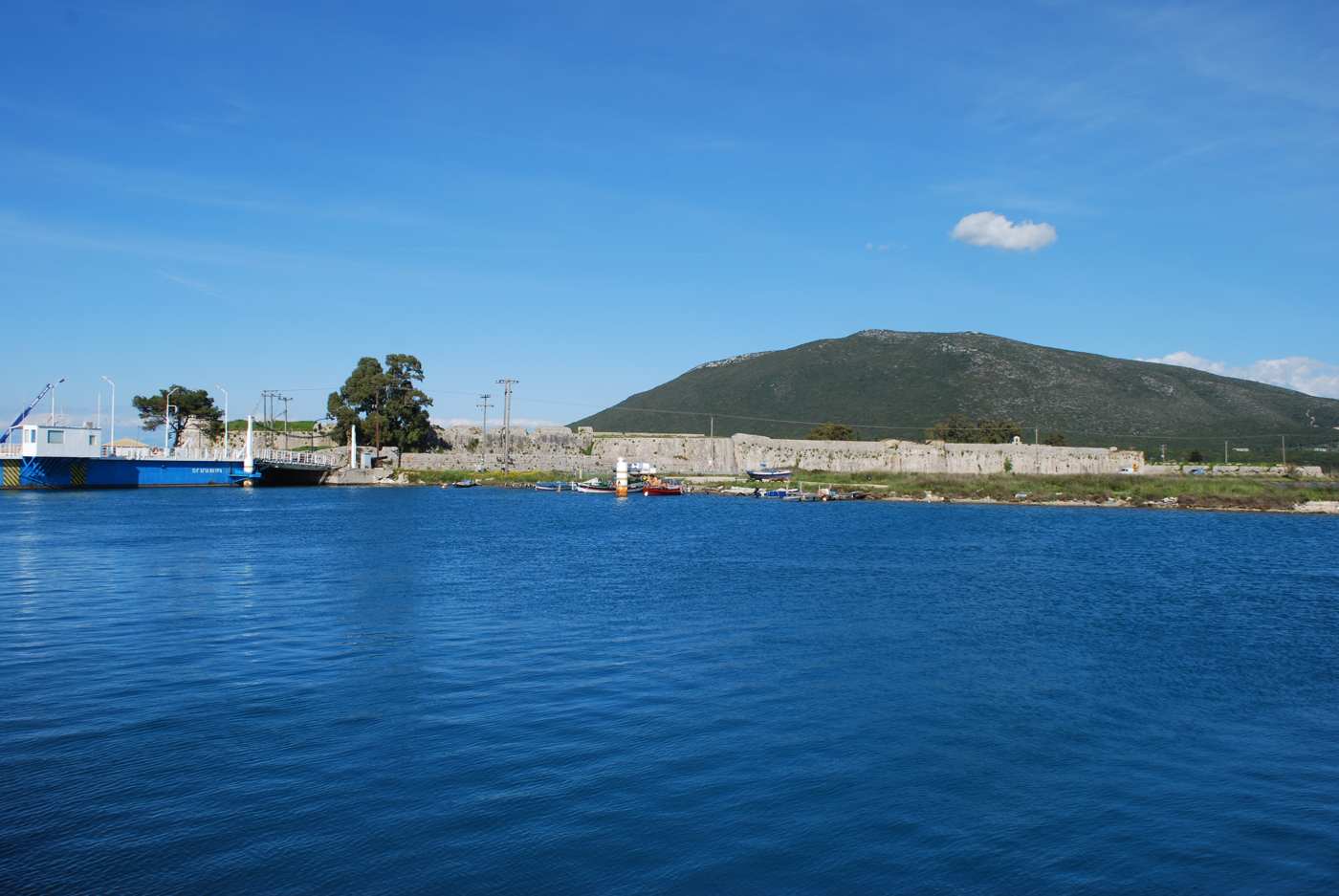
Lefkada Town, also called Chora, is the capital of the Ionian island of Lefkada, set at its northern tip beside a shallow lagoon. The town faces the narrow channel that separates the island from the mainland, crossed by a causeway and a floating bridge. Guarding that channel stands the Venetian castle of Agia Mavra, an irregular heptagon strengthened with bastions and outer ramparts. Behind the seafront a pedestrian main street runs through the old town, lined with shops, cafes, tavernas and Ionian churches. One of the largest marinas in Greece anchors the waterfront and its evening scene. Plan the whole trip with Greece Tours.
The character of Lefkada Town comes from its earthquake-resistant architecture, born of frequent tremors. Heavy stone ground floors carry lightweight upper storeys of timber frame clad in painted sheet metal and wood, so buildings flex rather than collapse. Church bell towers even stand apart from their churches as a further precaution. On the town’s edge the Gyra lagoon holds old windmills, salt pans and birdlife, including flamingos, alongside a long sandy beach used for windsurfing. Small museums, the pine-clad Faneromeni monastery above the rooftops and a summer folklore festival round out a capital that works as a central base rather than a beach resort.
What and where is Lefkada Town, and how do you reach it across the bridge?
Lefkada Town is the island’s capital at its northern tip, beside a shallow lagoon. Travellers reach it across a causeway and a short floating bridge from the mainland.
Lefkada Town sits at the northern point of Lefkada, one of the Ionian islands off western Greece. The town wraps around the edge of a shallow lagoon, with the sea channel to the mainland on one side and wetlands on the other. This position made it both a defensive strongpoint and a natural harbour. Because Lefkada lies so close to the coast, the crossing is unusually short for a Greek island. A causeway carries the road out over the water, ending at a floating bridge that swings open to let boats pass. The result is an island capital that feels tethered to the mainland.
The question of how to get to Lefkada has a simpler answer than for most Greek islands. No long ferry is required to reach the town itself. Drivers follow the coast road, cross the causeway and roll over the floating bridge directly into the capital. The nearest airport, Aktion, lies a short distance north on the mainland, close enough that visitors reach the town within minutes of landing. This ease of access is one reason Lefkada Town works well as a central base for exploring the wider island.
The lagoon defines the town’s setting and its history. Shallow and sheltered, it separates the built-up capital from the open Ionian Sea and shapes the local climate and light. Salt pans and reed beds fringe its edges, and the water draws wading birds throughout the year. The causeway and bridge thread across the narrowest neck of this water, linking the town to the road network. From the waterfront, views reach across the lagoon towards low hills and the distant mainland mountains, giving the capital an open, watery horizon on almost every side.
Lefkada Town gathers services that outlying villages lack. Shops, banks, offices and the main market cluster within a compact grid behind the seafront. The population swells in summer as visitors use the town for supplies, dining and transport connections before heading to the beaches further south. Roads fan out from the capital along both the east and west coasts, so day trips to distant bays and mountain villages start here. This role as a hub, rather than a resort, gives the town a steady, working rhythm.
What is the Agia Mavra castle at the entrance to Lefkada Town?
Agia Mavra is a Venetian castle guarding the channel at the town’s entrance. It follows an irregular heptagon plan reinforced with bastions and outer ramparts.
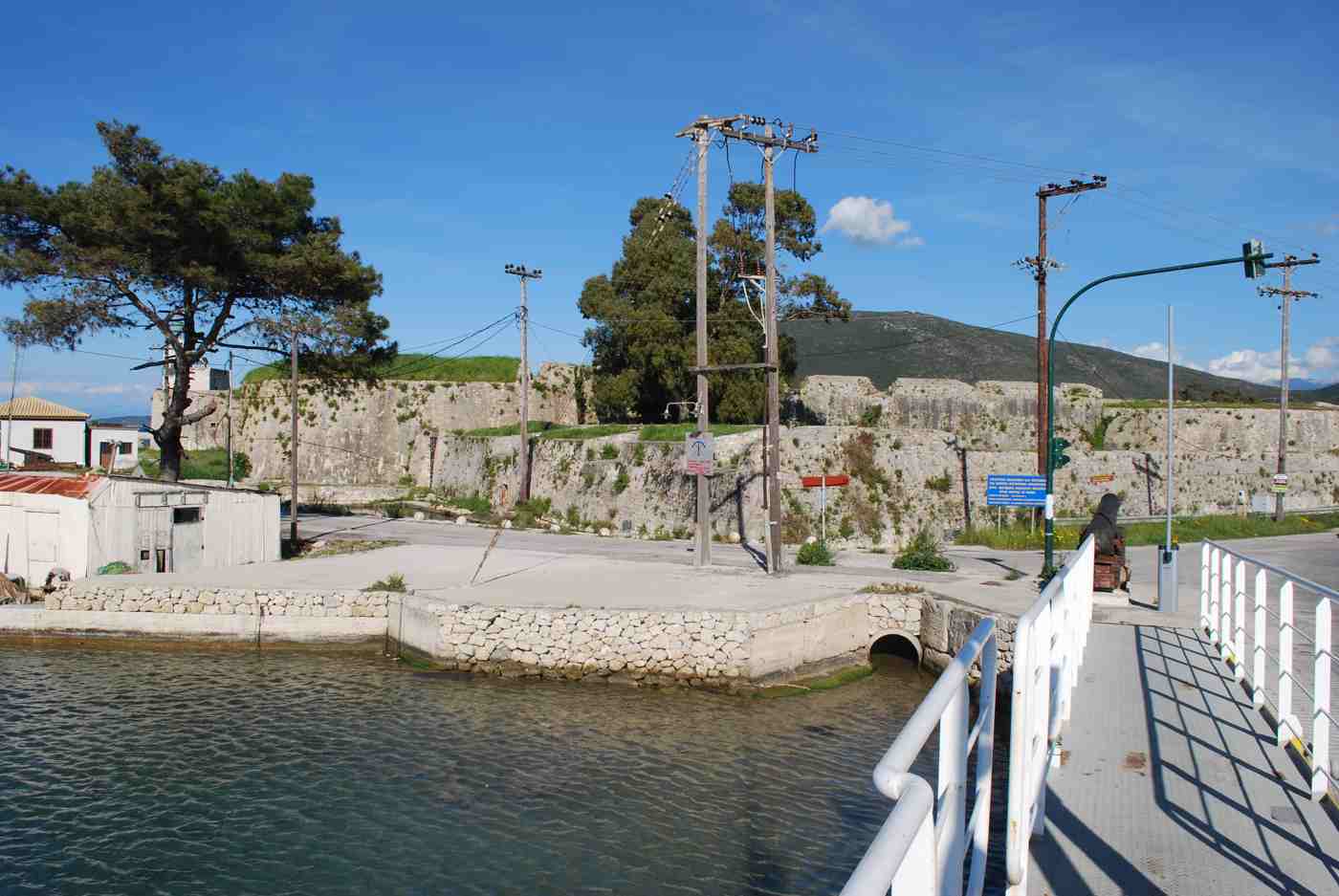
The castle of Agia Mavra stands beside the channel where the causeway meets the island, the first landmark most arrivals see. Built to control the crossing, it commands the narrow water between Lefkada and the mainland. Its plan is an irregular heptagon, a seven-sided outline shaped to the ground and the line of the shore. Angled bastions project from the walls, and outer ramparts add a second line of defence beyond the main enceinte. From a distance the low, broad silhouette reads more as a fortified island than a tall keep, spread flat across its rocky base.
For centuries Agia Mavra served as the island’s main defence against pirates who raided the Ionian coasts. Its guns covered the channel, so no hostile vessel slip through towards the town unopposed. The bastions gave defenders wide fields of fire, while the ramparts and wet ground around the walls slowed any assault. Control of the fortress meant control of the crossing, and with it the safety of the capital and its trade. Successive rulers of the island maintained and adapted the works, adding to the layered character visible in the surviving walls today.
A walk through Agia Mavra now trades military purpose for open views. Paths follow the tops of the ramparts, looking out over the sea, the wetlands and the floating bridge below. Visitors can trace the outline of the bastions and read the logic of the heptagon plan from within. The wide horizons take in the lagoon, the town’s rooftops and the mainland shore across the water. Interpretation of the site links its stones to the long story of sieges and defence that shaped this corner of the Ionian, when the castle stood as the island’s shield.
The castle’s position ties it tightly to the daily life of Lefkada Town. Traffic crossing the bridge passes almost beneath its walls, and the fortress frames the entrance to the harbour approaches. Because it sits on the water rather than on a high peak, it feels close and accessible rather than remote. Its flat expanse of stone contrasts with the flexible timber-and-metal houses of the town beyond, marking the shift from hard defence to a settlement built to bend with the earth. For visitors the walk here is a natural first stop on the island.
Why does Lefkada Town look the way it does — the earthquake-resistant architecture?
Frequent tremors shaped the town’s building style. Heavy stone ground floors carry lightweight upper storeys of timber frame clad in painted sheet metal and wood, so houses flex rather than fall.
Lefkada Town lies in an active seismic zone, and its buildings answer that danger directly. The standard house rests on a solid ground floor of heavy stone, which anchors the structure and resists shaking at its base. Above this sits a lighter upper storey built from a timber frame, clad in thin sheet metal and painted wood. This two-part design lowers the mass carried high on the walls, where a quake does the most damage. The heavy base and light top work together, so the whole building can sway and settle without the catastrophic collapse that solid masonry risks in a tremor.
The logic behind the style is one of flexibility rather than brute strength. A rigid stone tower crack and fall when the ground jolts, but a timber frame can flex and absorb the movement. Sheet-metal cladding keeps the upper walls light and easy to repair after damage. Painted in soft colours, these metal and timber faces give the streets their distinctive look, quite unlike the bare stone of many mainland towns. The result is a townscape born of hard practical need, where the appearance of the houses is a direct record of how they are engineered to survive.
The same caution extends to the churches and their bells. In places a heavy stone bell tower rises straight from the body of the church, but here that be a hazard. A falling tower crush the roof and worshippers below. To avoid this, the bell towers of Lefkada Town often stand as separate structures, set apart from the churches they serve. Should a tremor bring a tower down, the church itself is spared. This separation is one of the clearest signs of how deeply the fear of earthquakes runs through the town’s design.
Together these features make the capital’s architecture a lesson in living with risk. Nothing about the stone bases, the light metal-clad storeys or the detached bell towers is decorative first; each choice earns its place by protecting life and property. Over generations the style has hardened into local tradition, repeated street after street until it defines the character of the old town. Visitors who understand the reasoning see the painted upper floors and the standalone belfries not as quirks but as a coherent, tested response to the ground beneath. The town wears its engineering openly on every façade.
What is the old town and its main street like?
The old town runs behind the seafront along a pedestrian main street of Ioannou Mela and Dorpfeld. Shops, cafes, tavernas and Ionian churches line the route.
The heart of Lefkada Town is its old quarter, set just behind the seafront and its harbour. A single pedestrian spine threads through it, formed by the linked streets of Ioannou Mela and Dorpfeld. Closed to through traffic, this route becomes an open-air corridor of shops, cafes and tavernas. The buildings that line it show the town’s typical construction, with stone bases and painted timber-and-metal upper floors leaning over the pavement. Narrow side lanes branch off into quieter residential blocks, so the main street acts as a busy central artery feeding a web of smaller ways.
Walking the length of Ioannou Mela and Dorpfeld reveals the town’s social life. By day the shops trade in local goods, clothing and food, while cafes fill their terraces along the paving. In the evening the street draws residents and visitors alike for the traditional stroll, with tavernas serving Ionian dishes as the light fades. Because the way is level and car-free, it suits an unhurried pace. The mix of everyday commerce and leisure gives the old town a lived-in feel, distinct from a purely tourist promenade, and keeps activity going from morning until late.
Ionian churches punctuate the old town and mark its religious history. Their architecture reflects the island’s long ties to Venice and the wider Ionian world, seen in the plans and decoration of the buildings. Following the town’s cautious tradition, several stand near their detached bell towers rather than beneath a single integrated one. Inside, icons and carved fittings record generations of local devotion. These churches sit quietly among the shops and houses. A short walk along the main street passes several without any sense of leaving the everyday life of the town behind.
The scale of the old town keeps it easy to explore on foot. Distances between the main street, the seafront and the lagoon edge are short, so visitors can wander without a plan and rarely lose their way. The pedestrian core links naturally to the harbour front and the approaches to the marina, joining the town’s separate elements into one walkable centre. Small squares open out along the route, offering shade and seating. This compact, connected layout is a large part of why Lefkada Town works so well as a base from which to see the rest of the island.
What is the Lefkada Town marina and waterfront?
The marina is one of the largest in Greece, with several hundred berths and a lively evening scene. It anchors the town’s waterfront beside the old town and lagoon.
The modern marina forms the busy edge of the waterfront at Lefkada Town. Ranked among the largest in Greece, it offers several hundred berths for yachts and pleasure craft. Its sheltered position, close to the channel and the floating bridge, makes it a natural stop for sailors cruising the Ionian islands. Pontoons and quays reach out into the protected water, filling through the season with boats of sizes. The scale of the harbour reflects the town’s role as a sailing centre, drawing crews who provision, moor and rest here before continuing along the coast to the southern bays.
In the evening the marina becomes one of the town’s liveliest spots. Crews come ashore, and residents and visitors gather along the quays where cafes and bars line the water. Masts and rigging make a backdrop to the tables, and the reflected lights stretch across the harbour. The scene links directly to the old town behind it, so a stroll can move from the pedestrian main street out to the boats within minutes. This flow between the historic streets and the modern waterfront gives the capital two connected centres of activity, busy well into the night.
The waterfront also frames the town’s relationship with its water on every side. To one side lies the sea channel and the castle of Agia Mavra; to the other spreads the shallow lagoon with its windmills and salt pans. The marina occupies the sheltered middle ground, where the town meets navigable water. Promenades run along the front, giving open views over moored boats towards the bridge and the mainland hills beyond. Because the harbour sits so close to the old quarter, the boundary between the working port and the living town almost disappears along the quay.
For visitors the marina and waterfront serve as both a gateway and a gathering place. Sailors use it as a base to reach the island’s beaches and neighbouring isles by sea, while land-based travellers enjoy the walk and the dining it offers. Its size and services mark Lefkada Town as a hub of Ionian sailing rather than a quiet fishing harbour. Combined with the short crossing to the mainland and the nearby airport, the marina reinforces the capital’s character as a central. Well-connected base, where the life of the town spills straight onto the edge of the sea.
What museums and cultural sights are in Lefkada Town?
Lefkada Town holds small museums covering archaeology, folklore and the phonograph. These collections sit within the compact centre, alongside churches and the busy squares that shape the town’s cultural life.
The archaeological museum gathers finds from across the island, presenting objects that trace Lefkada’s settlement and daily life through successive periods. A folklore museum records the customs, costumes and household tools of the local communities, giving visitors a grounded sense of island tradition. The phonograph museum is the most distinctive of the three, displaying old recording machines, gramophones and vintage discs alongside everyday antiques. Together these small collections sit within easy walking distance of one another, so a visitor covers them in a single unhurried morning. Each occupies a modest building in the centre, keeping the cultural circuit close to the shops and cafes.
Churches form the other strand of the town’s cultural fabric, several rebuilt in the low, timber-framed style that follows the island’s earthquake-resistant tradition. Their interiors hold painted screens and icons that reflect the Ionian religious art of the region. Walking between them, a visitor passes belltowers built separately from the naves, a local response to seismic risk. The compact grid of the centre keeps these sights linked by short lanes rather than long avenues. This concentration makes the cultural core of Lefkada Town simple to explore on foot, with each museum, church and square feeding naturally into the next along the same streets.
Squares punctuate the town and act as the setting for much of its cultural life, from morning markets to evening gatherings. The main pedestrian street links these open spaces, lined with shops that supply the whole island and cafes that stay busy through the day. Cultural events spill into these squares in summer, when performances and stalls occupy the paved ground. The proximity of museums to this everyday activity means culture and daily life share the same streets rather than sitting apart. A visitor exploring the beaches of Lefkada often returns to the town for this mix of small museums, tavernas and the animated central squares.
Cultural sightseeing in the town pairs well with a car-based itinerary, since the centre works as a practical base rather than a beach resort. A morning among the museums leaves the afternoon free for the coast, with Agios Nikitas and other villages a short drive away. The town’s central position on Lefkada shortens the reach to most corners of the island. Visitors deciding where to stay in Lefkada often weigh this cultural core against the quieter coastal settlements. The result is a capital that rewards slow walking, with archaeology, folklore and the phonograph collections anchoring a compact and walkable cultural centre.
What is the Faneromeni monastery above Lefkada Town?
The Faneromeni monastery stands on a pine-covered hill above Lefkada Town. It holds Byzantine icons, a small ecclesiastical museum and a viewpoint that looks over the town and the open Ionian Sea.
The monastery occupies a wooded ridge just west of the town, reached by a short drive or a longer walk up through the pines. Its position gives it the finest viewpoint in the immediate area, with the lagoon, the rooftops and the open Ionian laid out below. The complex centres on a church that has been rebuilt over its long history after fire and earthquake damage. Cypress and pine shade the courtyard, making the terrace a cool place to pause. From here a visitor reads the whole geography of the town, the causeway and the water at a single glance.
Inside, the monastery keeps Byzantine icons and religious objects that record centuries of worship on the island. A small ecclesiastical museum gathers vestments, manuscripts and liturgical items into a compact display beside the church. These holdings make Faneromeni a cultural stop as much as a religious one, extending the museum circuit of Lefkada Town onto the hill. The icons show the devotional art of the Ionian region, painted in the styles that spread through these islands. Visitors treat the collection as a quiet counterpart to the archaeology and folklore museums down in the centre, another layer of the area’s heritage.
The viewpoint is the reason visitors climb to Faneromeni, especially in the softer light of early morning or late afternoon. The terrace overlooks the lagoon, the long sandy spit and the channel that separates the island from the mainland. Beyond the water the hills of the coast rise, and the airport plain spreads to the east. Benches and low walls let visitors sit and take in the panorama without hurry. Photographers favour the spot for its clear sweep over the roofs of the town, and the calm of the pine hill contrasts with the busier streets below by the harbour.
Reaching the monastery takes only minutes by car from the centre, and the road climbs steadily through the trees to the gate. Modest dress is expected, as the site remains an active place of worship. Many visitors fold Faneromeni into a wider tour of Lefkada, pausing here before driving on to Agios Nikitas or the western coast. The combination of Byzantine icons, a small museum and a commanding view makes it one of the town’s essential sights. It rewards even a short visit, offering both a religious focus and the clearest orientation over the capital and its lagoon.
What is the Gyra lagoon, its windmills and its beach?
The Gyra lagoon lies on the edge of Lefkada Town, ringed by a road past old stone windmills and salt pans. Its long sandy spit, Gyra and Ai Giannis beach, is shallow and windy.
The lagoon forms a shallow, sheltered basin between the town and the sea, separated from the open water by a thin arc of sand. A road circles it, passing the stone windmills that once ground grain using the steady coastal wind. Several of these towers still stand along the spit, their round walls a familiar image of the area. Salt pans edge parts of the shore, remnants of the traditional salt harvest that used the shallow, evaporating water. The circuit makes an easy, flat route for walking or cycling, with the lagoon on one side and the sea on the other.
Birdlife fills the wetland through much of the year, and the lagoon is one of the better places near the town to watch it. Flamingos appear in season, wading the shallows in loose pink groups that draw walkers to the water’s edge. Herons, ducks and smaller waders share the same margins, feeding in the brackish shallows and around the salt pans. The quiet road and open sightlines make the birds simple to observe without disturbing them. This mix of wildlife, windmills and salt pans gives the Gyra circuit a character quite different from the streets of Lefkada Town a short distance away.
The sandy spit carries Gyra and Ai Giannis beach, a long shallow strand that faces the open Ionian. Shallow water and a steady wind make it a centre for windsurfing and kitesurfing, with boards skimming the surface on breezy afternoons. The beach shelves gently, so the water stays low for a good distance from the shore. Its exposure to the wind keeps it cooler and livelier than the sheltered town front, which suits the surf schools that operate here. Among the beaches of Lefkada this windswept spit stands out for sport rather than calm swimming, close enough to reach on foot or by a short drive.
The whole circuit sits within reach of the town, so a visitor walks or cycles out to the windmills and back in an easy outing. Cafes and tavernas cluster near the beach end of the spit, serving the surfers and walkers who gather there. The flat road and constant views make it a favourite for sunset, when the light spreads across the lagoon and the mills. Windsurfers value the reliable breeze, while birdwatchers keep to the quieter inner shore by the salt pans. This blend of nature, sport and industrial heritage makes Gyra one of the most rewarding short trips from Lefkada Town.
What is Lefkada Town like in the evening, and what about the folklore festival?
Lefkada Town fills its squares and pedestrian street in the evening, with tavernas and cafes busy late. Each summer the International Folklore Festival brings dance groups from around the world to the streets and squares.
Evenings centre on the main pedestrian street and the squares that open off it, where residents and visitors gather after the heat of the day. Tavernas set tables along the paved lanes, serving island cooking to a steady flow of diners. Cafes and bars keep the squares busy well into the night, their chairs spilling across the stone. The low, timber-framed houses give the streets an intimate scale, and the short distances make the whole centre easy to stroll. This nightly rhythm, unhurried and social, is one of the pleasures of staying in the town rather than at a remote beach.
The International Folklore Festival is the town’s signature summer event, drawing dance groups from countries to perform in the streets and squares. Costumed troupes fill the centre with music and movement over evenings, turning the whole town into an open stage. The festival has a long tradition and forms part of a wider cultural programme that animates the capital through the warm months. Crowds line the squares to watch, and the performances spill into the surrounding lanes. This gathering gives Lefkada Town a cultural profile well beyond its size, tying the local folk heritage recorded in its museum to living performance from around the world.
Dining choice is broad for a town of this size, with tavernas covering island staples, grilled fish and the produce of the surrounding countryside. Cafes serve through the day, and the island’s main shops line the centre, drawing residents from villages across Lefkada to the capital. Evening browsing pairs naturally with a meal, since the shops, tables and squares share the same streets. Sweet shops and bakeries add to the mix, busy in the hours after dark. This concentration of food and retail means a visitor rarely leave the centre, and it keeps the evening comfortably walkable from one square to the next.
The atmosphere stays relaxed rather than raucous, aimed at families and couples strolling between squares as much as at late-night crowds. Music drifts from cafes, and in festival weeks the folk performances lift the whole town’s energy. Warm nights keep people outdoors, and the compact plan means the walk between dinner, a drink and the waterfront takes only minutes. Visitors weighing where to stay in Lefkada often choose the town for exactly this evening life, trading beach frontage for animated streets. The mix of tavernas, cafes, shops and the summer folklore festival gives the capital a distinct evening character its coastal villages lack.



Is Lefkada Town a good base, and how do you get around from it?
Lefkada Town works well as a base, central on the island and about twenty minutes from Aktion airport across the water. A car is the practical way to reach the beaches and villages.
The town’s central position is its main advantage as a base, placing most of the island within a manageable drive. Roads fan out from the capital to the west-coast beaches, the southern resorts and the mountain villages inland. Aktion airport sits about twenty minutes away across the water to the north, reached by the causeway and bridge, which makes arrivals and departures simple. This combination of central location and quick airport access suits visitors who want to explore widely rather than settle at one beach. For a touring holiday, the capital offers a convenient hub from which the rest of Lefkada opens up.
A car is the practical way to get around from the town, since the best beaches lie on the west coast and require a drive over the hills. Roads reach Agios Nikitas and the string of celebrated western strands within a short journey from the centre. Parking concentrates around the marina and the edges of the old town, keeping the pedestrian core free of traffic. Buses connect the capital with the main villages and resorts, though their timetables suit planners rather than the spontaneous. Renting a vehicle in the town gives the freedom to chase the beaches of Lefkada across a single day.
Choosing the town as a base trades beach frontage for convenience, culture and evening life, since the capital is not itself a swimming resort. Visitors who prefer sand at their doorstep look to the coastal villages, while those who value shops, tavernas and a central position favour the town. Its museums, the Gyra lagoon and the Faneromeni viewpoint fill the hours between beach trips. Deciding where to stay in Lefkada comes down to this balance between coastal calm and central practicality. For drivers, the town’s reach across the island frequently tips the choice towards the capital and its walkable, well-served centre.
Getting around beyond the island is straightforward too, with the mainland linked by the bridge and the airport close at hand. Ferries and roads from Lefkada reach the neighbouring Ionian islands and the wider region for day trips and onward travel. Within the town itself, walking covers everything, from the marina to the squares and the lagoon path at Gyra. The short hop to Aktion airport keeps transfer times low at both ends of a holiday. Taken together, the central location, quick airport access and easy driving make Lefkada Town a sound and flexible base for a car-borne exploration of the island.
Frequently Asked Questions
Is Lefkada Town on the beach?
Lefkada Town is not a beach resort itself, sitting instead beside a shallow lagoon at the northern tip of the island. The nearest sand lies out on the Gyra spit, where Ai Giannis beach faces the open Ionian and draws windsurfers rather than swimmers seeking calm water. For sheltered swimming and the famous west-coast strands, visitors drive out from the capital, reaching Agios Nikitas and the celebrated western beaches within a short journey over the hills. The town instead offers shops, tavernas, small museums and an animated evening scene. Many travellers use it as a central base, spending mornings on the coast and returning to the capital for its cultural sights and dining.
Choosing between town and coast usually comes down to whether beach frontage or central convenience matters more on the trip.
What museums can you visit in Lefkada Town?
Lefkada Town holds three small museums that between them cover archaeology, folklore and the phonograph. The archaeological museum displays finds from across the island, tracing settlement and daily life through successive periods. The folklore museum records local costumes, customs and household tools, while the phonograph museum shows old recording machines, gramophones and vintage discs alongside everyday antiques. All three sit within the compact centre, close enough to see in a single unhurried morning. The Faneromeni monastery above the town adds a small ecclesiastical museum with Byzantine icons, extending the cultural circuit onto the pine hill. Together these collections give the capital a cultural weight beyond its size, pairing naturally with the churches and squares of the centre.
Visitors often combine the museums with a meal and some shopping along the main pedestrian street.
How do you get to the Faneromeni monastery?
The Faneromeni monastery sits on a pine-covered hill just west of Lefkada Town, minutes away by car up a road that climbs steadily through the trees. Walkers can also reach it on foot, following the slope up from the centre for a longer but rewarding approach. The monastery offers the finest viewpoint in the area, its terrace overlooking the lagoon, the sandy spit and the open Ionian, with the airport plain spreading to the east. Inside, it keeps Byzantine icons and a small ecclesiastical museum of vestments and manuscripts. As an active place of worship, it expects modest dress from visitors.
Many fold the stop into a wider tour of the island, pausing here before driving on towards Agios Nikitas or the western coast, since it doubles as a cultural and orientation point.
Can you see flamingos at the Gyra lagoon?
Flamingos appear at the Gyra lagoon in season, wading the shallow, brackish water in loose pink groups that draw walkers to the shore. The lagoon, on the edge of Lefkada Town, is one of the better spots near the capital for birdwatching. Its open sightlines and quiet ring road making the birds simple to observe. Herons, ducks and smaller waders share the same margins, feeding around the salt pans and the shallows. A road circles the whole basin, passing old stone windmills and the remnants of the traditional salt harvest, so wildlife, industrial heritage and the sea sit side by side. The flat circuit suits an easy walk or cycle from the town.
Birdwatchers tend to keep to the quieter inner shore, away from the windswept beach end where the surfers gather.
What is the folklore festival in Lefkada Town?
The International Folklore Festival is the town’s signature summer event, bringing dance groups from around the world to perform in its streets and squares. Costumed troupes fill the centre with music and movement over evenings, turning the whole capital into an open-air stage. The festival has a long tradition and anchors a wider cultural programme that animates Lefkada Town through the warm months. Crowds line the squares to watch, and the performances spill into the surrounding lanes and along the main pedestrian street. The gathering ties the local folk heritage, recorded in the town’s folklore museum, to living performance from countries.
For visitors, it turns an ordinary summer evening into a spectacle and gives the capital a cultural profile well beyond its modest size. It remains one of the highlights of the town’s calendar.
Is Lefkada Town a good base for exploring the island?
Lefkada Town makes a strong base for exploring the island, thanks to its central position and quick access to Aktion airport, about twenty minutes away across the water. Roads fan out from the capital to the west-coast beaches, the southern resorts and the inland mountain villages, so most of the island lies within a manageable drive. A car is the practical way to get around, reaching Agios Nikitas and the beaches of Lefkada within a short journey over the hills. The town itself offers shops, tavernas, small museums and lively evenings rather than a beach at the doorstep. Visitors weighing where to stay in Lefkada often choose the capital for this blend of convenience, culture and dining.
For a touring holiday by car, its reach across the island frequently tips the decision towards the town.