
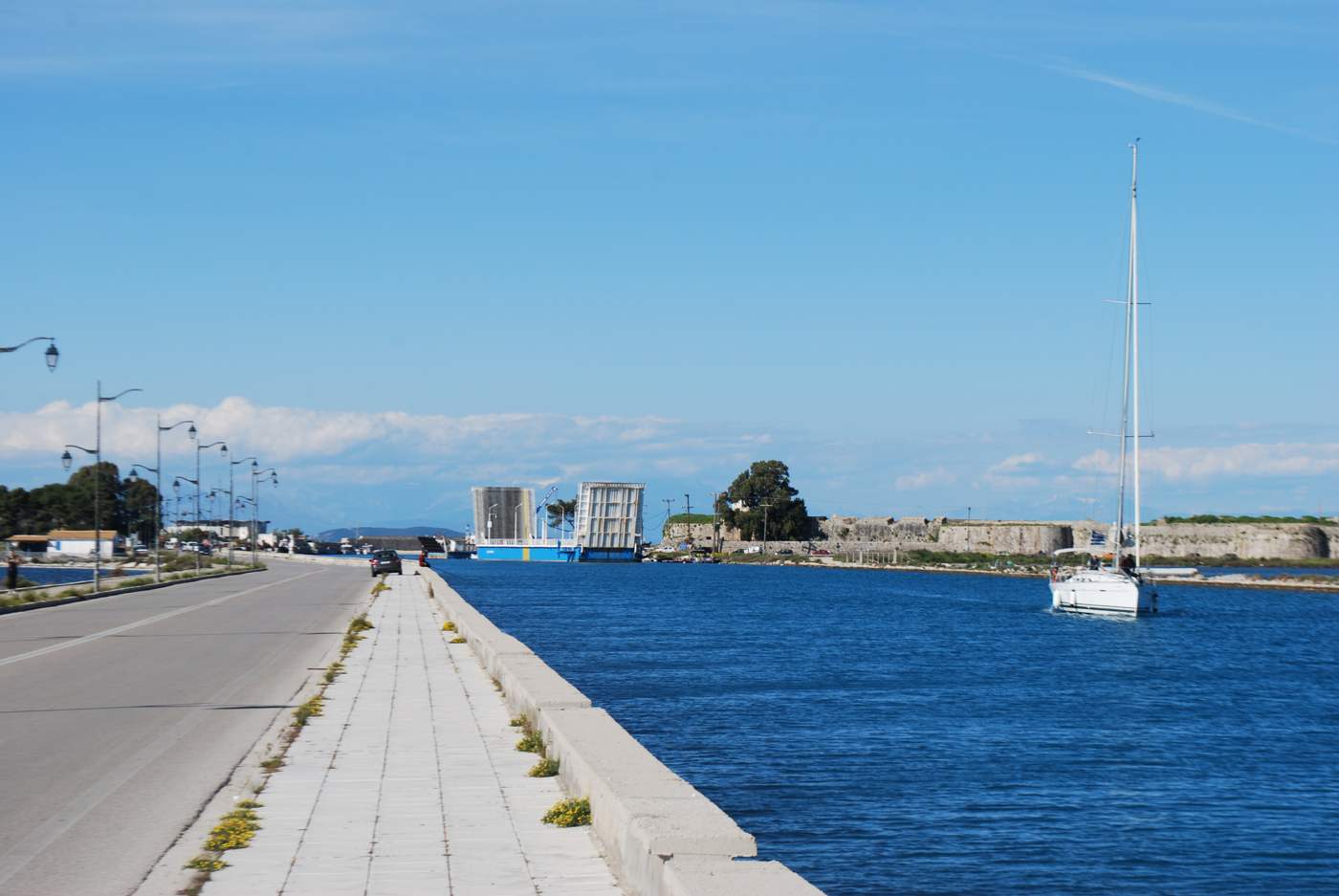
Lefkada stands apart from the other Ionian islands because it connects to the Greek mainland by road rather than by sea. A short causeway and a floating swing bridge cross the narrow channel near Lefkada Town, so no ferry is needed to arrive from Greece. The island has no airport of its own, yet Aktion National Airport at Preveza sits only about 20 to 25 km north. This guide explains every route: the airport and its tunnel drive, the road and bus from Athens, the fly-and-ferry option through neighbouring islands. How to move around once you arrive. Plan the whole trip with Greece Tours.
Choosing how to get to Lefkada depends mainly on where the journey begins. Travellers arriving from abroad usually land at Aktion and drive the short coastal road, while those starting in Athens can drive about 360 km or take a KTEL bus from the Kifissos terminal. Some visitors fly into Kefalonia or Zakynthos and continue by inter-island ferry to Vasiliki or Nydri. Each approach reaches the same destination, though the cost, comfort and flexibility differ. The sections below set out the practical detail of every option, then weigh them so each type of traveller can pick the route that suits the trip.
How do you get to Lefkada without a ferry?
Lefkada connects to the mainland by a road causeway and a floating swing bridge across a narrow channel. No ferry is needed to arrive from Greece, making it the only Ionian island reached entirely by road.
The link between Lefkada and the mainland is unusual among the Ionian islands. A low causeway carries the road across the shallow lagoon that separates the island from the coast of Aitoloakarnania. At the end of this causeway a floating swing bridge spans the narrow shipping channel beside Lefkada Town. The bridge pivots open at set intervals to let boats pass, then closes so cars, buses and motorbikes can continue. Because the crossing is so short and quick, most visitors barely notice they have left the mainland. This road connection is the defining feature of how the island is reached.
The absence of a sea crossing shapes every journey to the island. Travellers do not book a car ferry, match a sailing timetable or queue at a port to arrive from Greece. A vehicle can be driven directly onto the island at any hour, subject only to the brief pauses when the swing bridge opens. This freedom explains why so many people reach Lefkada by car or coach rather than by boat. The mainland motorway network feeds traffic toward the causeway, and the final approach runs along the water beside Lefkada Town before the road crosses onto the island. Travellers who start on Corfu follow the ferry and road plan on our Lefkada from Corfu page.
The floating bridge is a working piece of infrastructure rather than a tourist attraction. It rests on pontoons and swings aside on a fixed schedule during the day, allowing yachts and small craft to move between the lagoon and the open sea. Drivers occasionally wait minutes while it operates, though the delay is minor. The channel it crosses is only a few dozen metres wide, a reminder of how close the island sits to the coast. This narrow gap is the sole barrier between Lefkada and the rest of the country, and a low bridge is enough to close it.
For arriving travellers, the practical message is simple. Anyone driving from Athens, from the airport at Preveza or from northern Greece reaches the island without a ferry ticket. The only sea journeys connected with Lefkada are the inter-island ferries that link its southern ports with neighbouring islands, and these are optional rather than essential. That single fact separates Lefkada from Corfu, Kefalonia and Zakynthos, all of which demand a boat from the mainland. The road causeway keeps the island open and accessible throughout the year, in every season and in most weather conditions.
Which airport serves Lefkada?
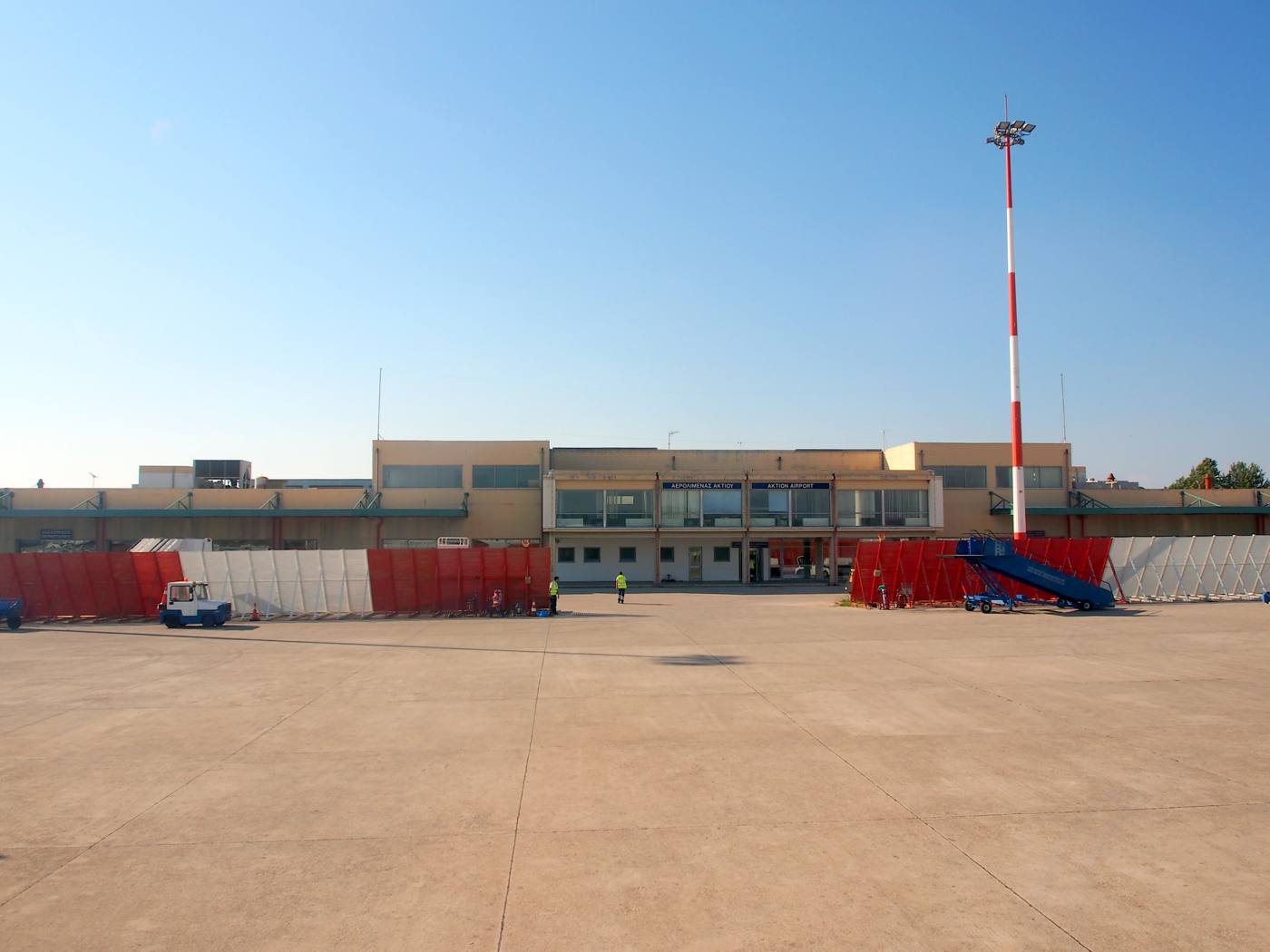
Aktion National Airport at Preveza, coded PVK, is the nearest airport to Lefkada. It lies about 20 to 25 km north of Lefkada Town, roughly a half-hour drive along the coast road and through the Aktio-Preveza undersea tunnel.
Lefkada has no airport of its own, so air travellers use Aktion National Airport near Preveza on the mainland. The airport carries the code PVK and sits on a spit of land across the water from Preveza town. It is the closest air gateway to the island, about 20 to 25 km north of Lefkada Town by road. The drive south takes roughly half an hour, following the coast and passing through the undersea tunnel that links the Aktion peninsula with Preveza. For many foreign visitors this small regional airport is the natural starting point for a holiday on the island.
The flight network at Aktion is strongly seasonal. From spring to autumn the airport receives charter and scheduled services from across Europe, timed to the summer holiday demand for the Ionian coast. These flights bring visitors from Britain, Germany, Italy, Scandinavia and other markets directly to the region. During the colder months the international schedule thins out considerably, and the airport falls quiet. Travellers arriving out of season often find fewer direct options and route instead through Athens. The seasonal pattern is worth keeping in mind when planning the timing of a trip to Lefkada, especially outside the peak weeks.
Alongside its international traffic, Aktion maintains a domestic link to Athens. This connection matters for travellers who arrive in Greece at the main Athens hub and prefer to fly the final leg rather than drive or take a coach. The short domestic hop shortens the overall journey considerably compared with the long road route. It also serves visitors from other Greek islands who reach Athens first and then transfer. The Athens service runs through more of the year than the seasonal charters, giving Lefkada a year-round air connection of sorts by way of the capital and its main airport.
The undersea tunnel between Aktion and Preveza is central to the airport drive. Before it opened, the crossing depended on a small ferry across the harbour mouth, which added time and uncertainty. The tunnel now carries the road beneath the channel, so traffic flows smoothly from the airport toward Preveza and on toward Lefkada. From the terminal the route runs south along the coast, crosses the causeway and reaches Lefkada Town in around half an hour in normal conditions. This quick, reliable link is what makes Aktion such a convenient entry point for the island.
How do you get from Aktion airport to Lefkada?
Aktion airport connects to Lefkada by hire car, pre-booked transfer or taxi. The drive covers about 20 to 25 km south through the undersea tunnel and along the coast to Lefkada Town, taking roughly half an hour.
Car-hire desks operate at Aktion airport, and for arrivals collecting a vehicle at the terminal is the simplest choice. A hire car removes the need for onward booking and gives immediate freedom to reach any part of the island. The drive south to Lefkada Town is short and straightforward, running through the undersea tunnel and along the coast road. Because a car is close to essential once on the island, picking one up at the airport combines the transfer and the island transport in a single step. Booking ahead in the busy summer months is a sensible precaution.
Pre-booked transfers offer an alternative for travellers who prefer not to drive straight after a flight. A driver meets the arriving passengers and takes them directly to their accommodation, whether in Lefkada Town, Nydri or one of the coastal resorts. This service suits families with luggage, groups and anyone reaching the airport late in the day. The fixed arrangement removes any uncertainty about finding transport on arrival. Prices are agreed in advance with the transfer operator rather than metered, which visitors find reassuring after a long journey. It is a comfortable, door-to-door way to complete the final leg of the trip.
Taxis also wait at Aktion, providing an on-demand option without any prior booking. A taxi can carry passengers across the tunnel and over the causeway to Lefkada Town or further south along the island. This choice works well for smaller parties and for those who decide their onward plans only after landing. Availability depends on the timing of flights, so late arrivals in the quieter season find fewer cars waiting. For a single short transfer a taxi is quick and convenient, though for a longer stay the daily cost of separate trips soon exceeds the price of a hire car.
The choice among these options turns on the length and shape of the trip. Visitors staying put in one resort and relying on organised excursions be content with a transfer or occasional taxi. Those intending to explore the west-coast beaches, the mountain villages and the southern ports will benefit far more from their own vehicle. Whichever is chosen, the physical journey from Aktion to Lefkada is the same short run through the tunnel and along the coast. The half-hour transfer is one of the shortest airport-to-island connections anywhere in the Ionian, a clear advantage for Lefkada.
How do you drive to Lefkada from Athens?
Driving from Athens to Lefkada covers about 360 km and takes roughly four to four and a half hours. The route follows the motorway west toward the Rio-Antirrio bridge, then continues north-west to the island causeway.
The road journey from Athens to Lefkada runs about 360 km and takes roughly four to four and a half hours in normal traffic. The route leaves the capital on the motorway heading west across the Peloponnese toward Patras. Near the coast it reaches the Rio-Antirrio bridge, the long span that crosses the Gulf of Corinth to the mainland shore opposite. From there the road turns north-west through western Greece toward the Ambracian region and the coast. The final stretch brings drivers to the causeway beside Lefkada Town, completing the journey onto the island itself.
This drive is popular because it delivers a car directly to an island where a car is close to essential. Rather than hiring on arrival, visitors bring their own vehicle the whole way from Athens. The motorway sections are fast and modern, which keeps the overall time down despite the distance. Rest stops and fuel are readily found along the main route, so the journey can be broken as needed. Arriving under one’s own power also means the island’s beaches and villages are immediately within reach, without any further transport arrangements once Lefkada is reached.
An alternative inland approach runs through the Ambracian region rather than straight along the western coast. Both roads broadly connect Athens with the north-western corner of the country where the island sits. The choice between them depends on starting point within the city and personal preference, though the distance and time are similar. Signposting toward Preveza, Vonitsa and Lefkada guides drivers through the final section. Throughout the drive the road standard is high on the motorway and steady on the connecting roads. The clear, well-used route is one reason self-driving from Athens remains a common way to reach Lefkada.
Timing and season shape the driving experience. In the peak summer weeks traffic toward the Ionian coast increases, particularly at weekends, which can lengthen the journey a little. Outside those periods the roads are quieter and the four-hour estimate holds comfortably. The Rio-Antirrio bridge carries a toll, as do sections of the motorway, and these form the main fixed costs of the drive beyond fuel. For groups and families, sharing one vehicle over the full distance is often the most economical way to reach Lefkada. It removes any dependence on local buses once on the island.
Can you reach Lefkada by KTEL bus?
Lefkada is served by KTEL coaches from the Kifissos terminal in Athens. The journey takes about five and a half hours and ends at the bus station in Lefkada Town, using the same road causeway as cars.
The KTEL intercity coach network provides a direct public-transport link between Athens and Lefkada. Services depart from the Kifissos bus terminal on the western edge of the capital, the main hub for coaches to western and northern Greece. The journey to the island takes about five and a half hours, a little longer than driving because of stops along the way. The coach follows broadly the same road corridor, crossing to the mainland shore and running north-west toward the coast. It ends at the bus station in Lefkada Town, placing arrivals in the heart of the island’s main settlement.
For travellers without a car, the KTEL coach is the most straightforward way to reach Lefkada from Athens. No driving is required, and the fare is a single fixed cost rather than fuel and tolls. The service suits solo travellers, couples and anyone happy to rely on other transport once on the island. Because the coach crosses the causeway like any vehicle, no ferry connection or transfer is involved. Passengers step off in Lefkada Town, close to accommodation, shops and the waterfront. The simplicity of a single through journey from a major city terminal makes the coach an appealing budget option.
The trade-off with the coach is reduced flexibility once the island is reached. Lefkada Town is well placed for exploring on foot and for onward connections, yet the west-coast beaches and mountain villages lie beyond easy reach of the limited local buses. Visitors arriving by KTEL often hire a car or scooter after they arrive, or base themselves where organised excursions call. Planning where to stay in Lefkada around this reality helps, since a central or well-connected base reduces the need for a vehicle. The coach delivers the traveller efficiently, but the island still rewards independent transport.
Coach frequency follows demand and season, with more departures in the busy summer months and fewer in winter. The Kifissos terminal handles routes, so travellers check that they board the correct service for the island. Luggage is carried in the hold, and the long journey is broken by scheduled rest stops. Arriving at the Lefkada Town bus station, passengers find taxis and local connections for the last short leg to their accommodation. As a low-cost, car-free route from the capital, the KTEL coach remains a reliable and well-used way to travel to Lefkada.
How do you reach Lefkada via Kefalonia or Zakynthos?
Some travellers fly to Kefalonia or Zakynthos, then continue to Lefkada by inter-island ferry. These boats link Vasiliki and Nydri on Lefkada with Kefalonia, Ithaca and Meganisi, but do not run from the mainland.
A less obvious route reaches Lefkada by air through a neighbouring island. Kefalonia and Zakynthos both have their own airports with summer flights from across Europe, sometimes on days or from cities that Aktion does not serve. Travellers landing there can continue to Lefkada by sea using the inter-island ferry links. This approach suits visitors combining more than one Ionian island in a single trip, or those who find a more convenient flight into Kefalonia or Zakynthos. It adds a boat leg to the journey, but keeps the whole trip within the island chain rather than routing back through the mainland.
The inter-island ferries connect the southern ports of Lefkada with its neighbours. Vasiliki, at the island’s southern tip, and Nydri, on the sheltered east coast, act as the main departure points. From these harbours boats sail to Kefalonia, to Ithaca and to the small island of Meganisi just offshore. The network stitches the central Ionian together and allows island-hopping without returning to the road. Crucially, these ferries operate between the islands only; none of them runs to or from the Greek mainland. That distinction matters when planning, because the mainland connection to Lefkada is always by road.
Choosing the fly-and-ferry route depends on the shape of the wider holiday. A traveller spending days on Kefalonia before moving to Lefkada gains two islands from one set of flights. Someone flying only to Lefkada, by contrast, reaches it faster and more simply through Aktion, without any boat at all. The ferry option introduces a dependence on sailing timetables and on the summer schedule, since services thin out sharply outside the peak season. For a multi-island itinerary the extra leg is a feature rather than a burden, adding variety to the journey to Lefkada.
Practical planning for this route centres on matching flights, ferries and the season. The inter-island boats concentrate in the summer months, so an autumn or winter arrival narrows the choices considerably. Vasiliki and Nydri each have their own connections, and the right port depends on which neighbour the traveller flies into. Once the ferry docks on Lefkada, the same rule applies as for every other arrival: a hire car greatly eases movement around the island. The fly-and-ferry approach is best viewed as an island-hopping option rather than the quickest single route to Lefkada.
What is the best way to get around Lefkada?
A hire car is the best way to get around Lefkada, as the west-coast beaches and mountain villages lie beyond the limited local buses. Buses connect the main towns but leave much of the island hard to reach independently.
Once on Lefkada, a hire car is close to essential for seeing the island properly. The most celebrated sights, the west-coast beaches with their white cliffs and turquoise water, sit along winding roads that public transport barely touches. Mountain villages inland are similarly hard to reach without a vehicle. A car turns a half-day excursion into a simple drive and opens the whole island to independent exploration. This is why so visitors either bring a car from Athens, collect one at Aktion airport or hire locally soon after arriving. The freedom it provides shapes the entire experience of the island.
The local bus network exists but is limited in both coverage and frequency. Services run mainly between Lefkada Town and the larger coastal settlements such as Nydri and Vasiliki, following the eastern side of the island. Timetables are sparse, especially outside the peak season, and beaches and villages have no service at all. For a traveller on a tight budget and content to stay near the main towns, the buses provide a workable link. For anyone hoping to roam the west coast or the interior, they fall well short of what a car offers over a full stay.
Scooters and small motorbikes are a further option for getting around, popular with younger visitors and couples. They handle the narrow village lanes easily and are cheaper to hire than a car. On the longer runs to the far beaches and over the mountain roads, though, they suit only confident riders. Taxis fill the remaining gaps for occasional trips, particularly in the evenings or for journeys the buses do not cover. None of these substitutes fully replaces a car for a stay of days, which is why the hire car dominates the way visitors move around Lefkada.
Decisions about transport link closely to accommodation. Thinking about where to stay in Lefkada in relation to the roads and beaches helps a visitor judge how much they will rely on a car. A base in or near Lefkada Town, Nydri or Vasiliki gives access to bus links and services, while a remote villa on the west coast makes a vehicle indispensable. For most trips the practical conclusion is consistent: arrange a car for at least part of the stay. With one, every corner of Lefkada, from the northern causeway to the southern ports, becomes easily reachable.
Frequently Asked Questions
Do you need a ferry to get to Lefkada?
No ferry is needed to reach Lefkada from the Greek mainland. The island is joined to the coast by a short road causeway and a floating swing bridge that crosses a narrow shipping channel near Lefkada Town. Cars, coaches and motorbikes drive straight across, pausing only briefly when the bridge opens to let boats pass. This makes Lefkada the only Ionian island reached entirely by road, unlike Corfu, Kefalonia and Zakynthos, which all require a boat from the mainland. The only ferries connected with the island are the inter-island services that link its southern ports, Vasiliki and Nydri, with neighbouring Kefalonia, Ithaca and Meganisi. These sailings are optional and used mainly for island-hopping.
For a straightforward arrival from Athens or the airport at Preveza, no sea crossing is involved at all.
Which airport is closest to Lefkada?
Aktion National Airport near Preveza, with the code PVK, is the closest airport to Lefkada. It lies about 20 to 25 km north of Lefkada Town, a drive of roughly half an hour along the coast road and through the Aktio-Preveza undersea tunnel. The airport receives seasonal charter and scheduled flights from across Europe between spring and autumn, together with a domestic link to Athens that runs through more of the year. Car-hire desks, pre-booked transfers and taxis serve arriving passengers for the short onward journey. Because Lefkada itself has no airport, Aktion is the natural gateway for visitors flying in from abroad.
Some travellers instead fly to Kefalonia or Zakynthos and continue by inter-island ferry, though for a direct arrival Aktion offers by far the shortest transfer to the island.
How long does it take to drive from Athens to Lefkada?
Driving from Athens to Lefkada takes roughly four to four and a half hours and covers about 360 km. The route leaves the capital on the motorway heading west toward Patras, crosses the Gulf of Corinth on the Rio-Antirrio bridge, then runs north-west through western Greece toward the coast. The final stretch reaches the causeway beside Lefkada Town, where the road crosses onto the island. Much of the journey uses fast, modern motorway, which keeps the time down despite the distance. Tolls apply on the bridge and parts of the motorway, forming the main fixed costs beyond fuel.
In the peak summer weeks traffic toward the Ionian coast can lengthen the trip a little, while outside those periods the four-hour estimate holds comfortably. A car also proves invaluable once on the island.
Is there a bus from Athens to Lefkada?
A KTEL intercity coach runs from Athens directly to Lefkada. Services leave from the Kifissos bus terminal on the western side of the capital and take about five and a half hours to reach the island. The coach follows broadly the same road corridor as cars, crossing the causeway and ending at the bus station in Lefkada Town. Because the island connects to the mainland by road, no ferry or transfer is involved in the journey. The coach is the most economical car-free way to travel from the capital, with a single fixed fare and luggage carried in the hold.
Its main drawback is limited flexibility once the island is reached, since local buses do not serve beaches and villages. Many passengers therefore hire a car or scooter soon after arriving in Lefkada Town.
Can you island-hop to Lefkada by ferry?
You can reach Lefkada by ferry from neighbouring Ionian islands, though not from the mainland. Inter-island boats link the southern ports of Vasiliki and Nydri with Kefalonia, Ithaca and the small island of Meganisi. Travellers who fly into Kefalonia or Zakynthos can therefore continue to Lefkada by sea, combining more than one island in a single trip. These ferries operate mainly in the summer months, so the choice narrows sharply outside the peak season. The service connects the islands only, and none of the boats runs to or from the Greek mainland, where the road causeway remains the sole link to Lefkada.
For a multi-island holiday the ferry leg adds variety, but for a direct arrival the airport at Preveza or the road from Athens is quicker and simpler.
Do you need a car on Lefkada?
A car is close to essential for exploring Lefkada, because the island’s finest beaches and mountain villages lie beyond the reach of the limited local buses. The famous west-coast beaches sit along winding roads that public transport barely touches, and the inland villages are similarly hard to reach without a vehicle. Buses run mainly between Lefkada Town and the larger coastal resorts such as Nydri and Vasiliki, with sparse timetables outside the peak season. Visitors can bring a car from Athens, collect one at Aktion airport or hire locally after arriving. Scooters suit shorter trips and confident riders, while taxis cover occasional journeys.
Choosing a base near the main towns reduces reliance on a car. For freedom across the whole island a vehicle is the practical choice.