
A Lefkada kayak tour is a guided sea-kayaking trip along the Ionian coast, running three hours on the half-day programmes and six to eight hours on the full-day ones, with touring kayaks, a guide, safety gear and a snack stop included. Plan the rest of the island with Greece Tours.
This page covers the whole product: where the boats launch, what the Blue Cave paddle and the Meganisi crossing involve, the kayaks and equipment supplied, the price bands, the season and the wind window, the caves reachable only by paddle, the multi-day expeditions, and how a Lefkada kayak tour compares with a day boat.
What is a Lefkada kayak tour and what does the day include?
A lefkada kayak tour is a guided sea paddle of 3 to 8 hours along the Ionian coastline, running from east-coast bays and west-coast beaches, with sit-on-top or sit-inside touring kayaks, buoyancy aids, a qualified guide and a mid-route snack included.
The half-day format covers 3 to 4 hours on the water and 8 to 12 km of coastline, with one long stop for swimming and a second for fruit, pastries and water. The full-day format runs 6 to 8 hours, covers 14 to 20 km, and adds a beach lunch. Groups hold 4 to 12 paddlers behind one lead guide and one sweep guide. The Lefkada kayak tour operators state this at booking.
Operators such as Lefkas Kayaks, Sea Kayak Lefkada and Trekking Hellas run fixed departures at 09:00 and 15:30 from June through September. Booking closes 12 hours before launch because the guide checks the Poseidon System forecast for wave height at Cape Lefkatas and swaps the route between the east and west coasts accordingly. A Lefkada kayak tour is planned around it.
Briefing takes 25 minutes on the sand: paddle grip, forward stroke, sweep turn, wet exit, raft-up recovery and the three whistle signals. Nobody enters the water before the buoyancy aid is fitted and closed. A standard lefkada kayak tour keeps the fleet within 200 m of the shoreline, so the swim distance to land never exceeds a few minutes. A Lefkada kayak tour launches with this settled.
Where do Lefkada kayak tours launch from around the island?
Launches happen at Nydri, Vlycho bay, Desimi and Sivota on the sheltered east coast, at Agios Nikitas, Kathisma and Kalamitsi on the exposed west coast, at Mikros Gialos on the south-east, and at Vasiliki for wind-experienced paddlers.
The east coast carries the bulk of departures because the Meganisi channel breaks the swell. Nydri sits 16 km south of Lefkada town on the coastal road, has parking behind the quay, and puts paddlers into flat water within 60 seconds of leaving the beach. Vlycho bay, 3 km further, is a closed lagoon with a 1.2 km fetch and no boat traffic beyond moored yachts. Every Lefkada kayak tour works to that rule.
Desimi bay and Mikros Gialos serve the southern routes toward Sivota fjord, a 4 km inlet lined with 60 m limestone walls. Sivota itself works as both start and finish for the Rouda bay circuit. Vasiliki, 39 km from Lefkada town, hosts the Eric bay windsurf fleet and delivers 5 to 7 Beaufort by mid-afternoon, which restricts kayaking there to the 07:30 to 11:00 window. Each Lefkada kayak tour is priced against that figure.
On the west coast, Agios Nikitas is the standard beach for the cave route, Kathisma adds 5 km of cliff paddling south, and Kalamitsi opens the stretch toward Gialos. Any west-coast lefkada kayak tour cancels above 1.2 m of Atlantic-driven swell arriving from the north-west. The Lefkada kayak tour timetable is built on it.
What does the Blue Cave lefkada kayak tour on the west coast involve?
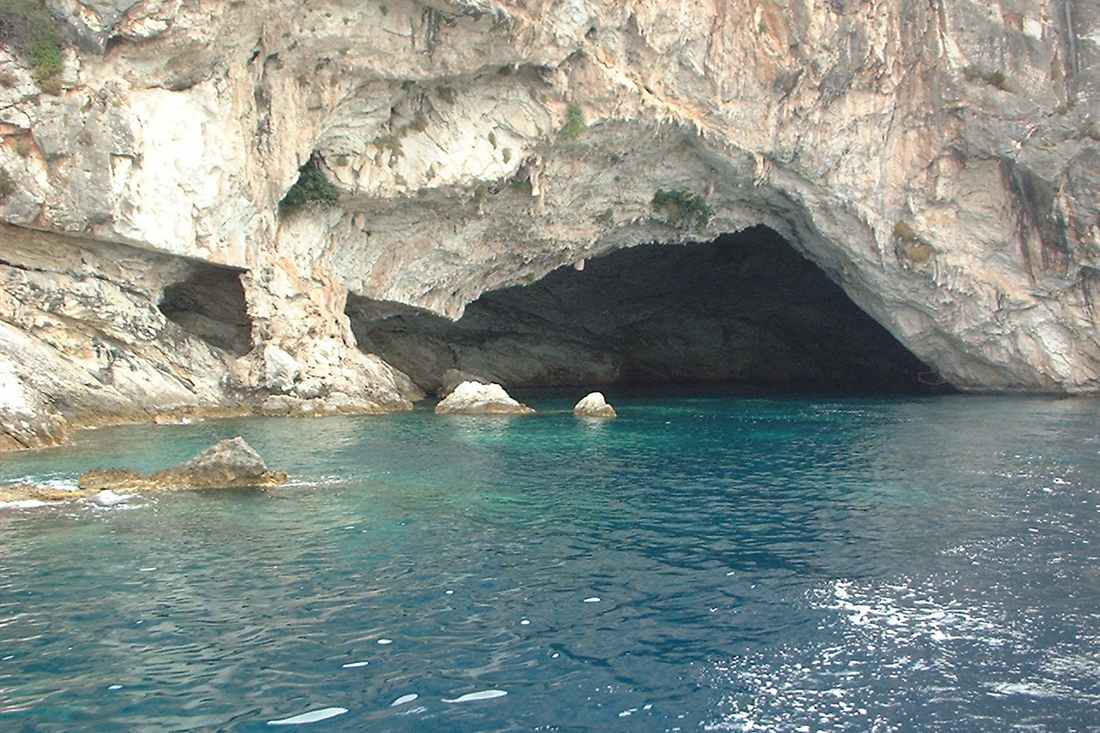
The Blue Cave route launches from Agios Nikitas beach, runs 6 to 9 km round trip past the Kalamitsi cliffs, enters a limestone sea cave and natural arch that only paddle craft fit through, includes snorkelling inside, and finishes with a Greek snack stop.
The cave sits 2.8 km north-west of Agios Nikitas beneath a 90 m cliff face. Its mouth measures under 4 m across at the waterline, which excludes every motor caique and RIB operating out of Nydri. Inside, the floor drops to 11 m and the sunlight refracting through the entrance turns the chamber cobalt between 10:30 and 12:30. This is what a Lefkada kayak tour delivers on the water.
Paddling time is 55 minutes each way at a cruising pace of 4 km/h, plus 40 minutes anchored inside the chamber. Guides raft the kayaks together, hand out masks and snorkels, and hold the fleet on a bow line while paddlers swim the perimeter. Water temperature inside the cave sits 2°C below open sea because sunlight reaches the surface for a short window. The Lefkada kayak tour fleet is equipped for it.
The return leg stops at a pocket beach south of the arch for the taste-of-Greece plate: feta, olives, watermelon, tomatoes, koulouri and cold water. This lefkada kayak tour runs mornings only, since the north-west afternoon breeze raises a 0.8 m chop against the cliffs and reflected waves make the cave mouth unusable after 14:00. Paddlers on a Lefkada kayak tour meet it on the first crossing.
What does the Meganisi and Skorpios paddle cover from Nydri?
The route crosses the Vlycho channel from Nydri, tracks the Skorpios shoreline, passes Madouri and Sparti islets, then follows Meganisi to Spilia and Agios Ioannis beaches. Distance totals 12 to 18 km and the day runs 6 hours door to door.
The first crossing measures 1.9 km of open water between Nydri quay and the north tip of Skorpios. Guides run it as a tight pod with the sweep kayak downwind, because the ferry lane to Meganisi carries the Kefalonia Lines vessel and private charter traffic every 40 minutes in July and August. Landing on Skorpios is prohibited; paddling the 30 m offshore line is permitted. Guides on a Lefkada kayak tour brief the point on the beach.
Madouri, the wooded islet holding the Valaoritis mansion, lies 700 m off Nydri and takes 12 minutes to round. Sparti adds a further 2.4 km of undeveloped shoreline with pebble coves at its southern end, used as the first swim stop at roughly the 90-minute mark. That detail separates one Lefkada kayak tour from the next.
The crossing to Meganisi lands at Spilia, a shingle cove with tavernas at Spartochori 400 m uphill. Agios Ioannis, 3 km south-west, closes the outward leg with sand and 2 m visibility on a calm day. The return to Nydri covers 6 km against the afternoon Maistros, which is why this lefkada kayak tour departs at 08:30 sharp. It shapes where a Lefkada kayak tour goes.
How difficult is a lefkada kayak tour and who is it suitable for?
East-coast routes demand no prior experience and suit paddlers aged 8 upward in a double kayak. West-coast and Meganisi crossings require moderate fitness, a 4 km/h sustained pace, and a minimum age of 12 with an adult in the same boat.
Sea state governs difficulty far more than distance. Between 07:00 and 12:00 the Ionian surface around Vlycho, Desimi and Sivota holds glass-calm conditions with under 0.2 m of ripple. The Maistros, the north-west thermal wind, builds from 13:00 and reaches 4 to 5 Beaufort by 16:00 at Cape Lefkatas, pushing wave height on the west coast to 1 m. A Lefkada kayak tour is planned around it.
A fit adult in a double touring kayak sustains 4.5 km/h. A mixed group of 10 averages 3.5 km/h including two swim stops, so an 18 km day occupies 6 hours. Guides schedule a 10-minute raft-up every 45 minutes for water and sun cream. Nobody paddles more than 90 continuous minutes. A Lefkada kayak tour launches with this settled.
Swimming ability of 50 m in open water is the standard prerequisite. Operators accept participants up to 110 kg per seat and 200 kg per double hull. Pregnancy beyond the second trimester, recent shoulder surgery and untreated epilepsy exclude participation. A lefkada kayak tour on the Vlycho lagoon remains the entry option for families with children under 10. A Lefkada kayak tour books out on that count in August.
What kayaks and equipment do Lefkada operators supply?
Operators supply double and single sit-inside touring kayaks of 4.5 to 5.6 m, sit-on-tops for beginners, spray decks, buoyancy aids, fibreglass or aluminium paddles, 10 and 20 litre dry bags, snorkel masks, waterproof phone cases, VHF radios, first aid kits and a support boat on crossings.
Fleet models include the Prijon Seayak, the Necky Manitou and Rainbow Laser doubles built in Italy for warm-water touring. Sit-inside hulls carry rudders and bulkhead storage for the lunch crates. Sit-on-tops handle beginners and children because re-entry after a capsize takes 20 seconds without any wet-exit drill. Each Lefkada kayak tour is priced against that figure.
Every paddler receives a CE-certified 50 N buoyancy aid sized from XS to XXL and wears it for the whole session. Guides carry a tow line, a paddle float, a bilge pump, a spare split paddle, a 4 litre first aid kit and a handheld VHF tuned to Channel 16 for Lefkada Port Authority. The Lefkada kayak tour timetable is built on it.
Dry bags hold cameras, keys, phones and a towel. Snorkel masks come sanitised between departures and are handed out at the cave or reef stop. On Meganisi crossings, a 5 m RIB shadows the group at 100 m, carrying drinking water, the lunch and space for two paddlers. Wetsuits appear only on a lefkada kayak tour scheduled in May or late October. The Lefkada kayak tour season turns on this.
What does a lefkada kayak tour cost and what is included?
Half-day guided paddles cost 45 to 70 euros per person, full days 70 to 110 euros, multi-day and three-day Ionian expeditions 130 to 190 euros per day, and private guiding 250 to 400 euros for the boat regardless of group size.
The half-day fare covers the kayak, paddle, buoyancy aid, spray deck, dry bag, guide, insurance, snorkel mask and a snack of fruit, pastries and 1.5 litres of water. The full-day price adds a taverna lunch at Spartochori or Sivota, or a packed meal of pita, cheese pies, salad and yoghurt carried in the rear hatch. The Lefkada kayak tour fleet is equipped for it.
Three-day expeditions from Nydri to Meganisi, Kalamos and Kastos include camping permits, tents, sleeping mats, all meals and a 1 kg dry-bag allowance per paddler. Prices sit at 390 to 570 euros for the full itinerary. Single-kayak supplements add 10 to 15 euros per day. Paddlers on a Lefkada kayak tour meet it on the first crossing.
Transport from Lefkada town, Vasiliki or the west-coast beaches is charged at 10 to 20 euros return per person on scheduled minibuses. Photographs shot by the guide on a GoPro are supplied free by WeTransfer within 48 hours. Cash and card both work at the beach base. Deposit for a lefkada kayak tour runs 20 to 30 percent, refundable when the operator cancels for wind. Operators confirm it by message when a Lefkada kayak tour is booked.
When is the best season and time of day to paddle in Lefkada?
The season runs May to October. Morning launches between 08:00 and 12:00 deliver the calmest water, before the Maistros thermal builds after 13:00. Sea temperature climbs from 19°C in May to 26°C in August and holds 24°C through September.
May and June bring air temperatures of 24 to 29°C, empty beaches at Kathisma and Mikros Gialos, and wind under 3 Beaufort on most mornings. July and August push air to 33°C and fill the Nydri channel with charter yachts, which moves guided groups closer inshore and earlier, with 08:00 departures standard. That detail separates one Lefkada kayak tour from the next.
September is the strongest month for the west coast. Sea temperature peaks at its warmest of the year, tourist volume drops after the first week, and swell events remain infrequent until the equinox. October offers 22°C water and 24°C air, though north-westerly fronts arrive every 6 to 9 days and cancel cave routes for 48 hours at a time. It shapes where a Lefkada kayak tour goes.
Afternoon departures at 15:30 work on the east coast only, inside Vlycho bay and Rouda bay, where land shelters the water. Operators shut between mid-November and mid-April: sea temperature drops to 15°C, daylight ends by 17:15, and the Ionian records regular 2 m swell. No commercial lefkada kayak tour runs in that window. The Lefkada kayak tour route is set by it.
Which sea caves, arches and beaches are reachable only by kayak?
Papanikolis cave on Meganisi, the rock arch beside Agiofili, the cliff bases below Egremni and Porto Katsiki, and the unnamed coves south of Kathisma stay closed to motor craft because of shallow entrances, submerged reefs and mooring bans, leaving paddle access as the single route in.
Papanikolis measures 120 m deep and 20 m high on the west coast of Meganisi, and legend ties it to a Greek submarine sheltering there during the Second World War. Excursion boats halt at the mouth. A kayak crosses the shallow sill and reaches the pebble ledge at the rear, 100 m inside the chamber. A Lefkada kayak tour launches with this settled.
Agiofili, 1.5 km south of Vasiliki, holds a limestone arch on its northern flank with 1.5 m of clearance at the waterline. Paddlers thread it in single file. Below Egremni and Porto Katsiki, 150 m cliffs drop straight into 30 m of water, and the rockfall zone at the base carries a permanent anchoring prohibition for vessels over 6 m. A Lefkada kayak tour books out on that count in August.
The coves between Kathisma and Kalamitsi hide behind fringing reefs 40 m offshore, with 60 cm of water over the rock at the gap. Kayaks draw 15 cm. A west-coast lefkada kayak tour lands at three of these beaches, all of them without road access, footpath or beach bar. The Lefkada kayak tour operators state this at booking.
What do you wear and bring on a Lefkada sea kayaking day?
Quick-dry shorts and a long-sleeved rash vest, reef shoes with a closed toe, a hat secured by a cord, polarised sunglasses on a retainer, factory-sealed reef-safe sun cream, 2 litres of water and a 10 litre dry bag cover the full-day requirement.
Cotton retains water and chafes at the shoulders after 90 minutes of paddling, so synthetic or merino fabric performs better. A long sleeve prevents the forearm burn that arrives from reflected glare off the water, which reaches 60 percent of direct exposure. Sun cream of SPF 50 goes on 20 minutes before launch and again at the second raft-up. The Lefkada kayak tour timetable is built on it.
Footwear matters at every landing. Kathisma, Mikros Gialos and Spilia are coarse pebble, and sea urchins colonise the rock ledges at Sivota and Papanikolis. Reef shoes or neoprene booties with a hard sole solve both. Flip-flops float away during a wet exit and stay in the car. The Lefkada kayak tour season turns on this.
The guide carries the first aid kit, VHF, tow line, spare paddle, snack crate and group water reserve. Passports, laptops, jewellery and large sums of cash stay locked in the vehicle at the beach base. A phone travels in the supplied waterproof case clipped to the deck line on any lefkada kayak tour crossing open water. Every Lefkada kayak tour works to that rule.
How does a lefkada kayak tour compare with a boat trip or a self-drive boat?
A kayak covers 12 to 18 km a day at 4 km per hour, enters caves under 2 m of headroom, and carries 6 to 12 paddlers. A day boat covers 40 km, holds 40 passengers, and stops offshore.
The caïque cruises from Nydri to Skorpios, Meganisi and Kefali reach four anchorages between 09:30 and 17:00, costing 25 to 35 euros per adult. Speed is the trade. Those hulls draw a metre and stay 30 m off the rock, so the sea caves at Papanikolis, Agiofili and the Meganisi south shore stay outside the itinerary. A guided paddle enters them at walking pace. Paddlers on a Lefkada kayak tour meet it on the first crossing.
Self-drive rentals from Nydri and Sivota run 30 hp engines, 90 to 160 euros per day plus 30 to 50 euros of fuel, and no licence for the smaller boats. That format buys range and independence, and loses the shoreline detail: the paddler reads the seabed at 2 m depth, hears the swell working the limestone, and lands on pebble strips no tender reaches. Comparisons of the full menu of Lefkada boat trips against paddling come down to whether distance or proximity matters more. Operators confirm it by message when a Lefkada kayak tour is booked.
Price sits close together. A half-day lefkada kayak tour runs 45 to 60 euros with gear, guide and a snack; a full day runs 70 to 95 euros with lunch. The kayak group of 6 to 12 keeps the guide within talking distance of every boat, which no 40-passenger deck manages. Effort is the cost: 3 to 5 hours of paddling, arms and core working throughout. This is what a Lefkada kayak tour delivers on the water.
What multi-day sea kayaking expeditions run from Lefkada?
Three-day and five-day expeditions leave Nydri and Vlycho for Meganisi, Kalamos, Kastos and Ithaca, covering 14 to 22 km daily. Nights split between wild camping on pebble coves and taverna villages, with a support boat carrying baggage, water and spare paddles.
The three-day route crosses the 3 km channel to Meganisi, follows its south coast past Papanikolis cave, and overnights at Spilia or Vathy. Day two runs 18 km east to Kastos, a 5.5 km long island with one harbour village and two tavernas. Day three returns via Kalamos or the Palairos mainland shore. Total distance falls between 45 and 55 km. It shapes where a Lefkada kayak tour goes.
The five-day version pushes south to Ithaca, adding the 12 km open crossing from Kastos toward Kioni. That leg demands force 3 conditions or lower and a departure before 09:00, since the afternoon maistros builds from the northwest after 13:00. Guides carry VHF radio, flares, a tow line and a first-aid kit; the support RIB tracks the group within 500 m. The Lefkada kayak tour route is set by it.
Prices run 380 to 480 euros for three days and 620 to 780 euros for five, covering kayak, dry bags, tent, guide, baggage transfer and most meals. June, July, September and early October hold the settled window. A multi-day expedition suits paddlers who have finished at least one full-day lefkada kayak tour and hold comfort with 4 hours of continuous paddling in a loaded double or single sea kayak. Guides on a Lefkada kayak tour brief the point on the beach.
Can beginners and families join a lefkada kayak tour?
Yes. Operators accept children from age 6 in the front seat of a double kayak with a parent behind. No paddling experience is required. The briefing lasts 20 to 30 minutes and covers stroke, rescue drill and signals. Swimming ability is mandatory.
The family route runs inside the Vlycho lagoon and along the Geni peninsula, a sheltered 6 to 8 km loop where fetch never exceeds 1.5 km and depth stays under 6 m. Wind rarely exceeds force 3 inside the bay before noon. The loop takes 3 hours including a 40-minute swim and snack stop at a pebble beach below Geni chapel. A Lefkada kayak tour books out on that count in August.
Children under 12 never paddle a single kayak on a guided trip. They wear a child-sized buoyancy aid sized to weight bands of 20 to 30 kg and 30 to 50 kg, and the guide positions the family boat mid-group, ahead of the sweep. Parents supply the propulsion; the child contributes what the child contributes, and the guide carries a short tow line for the last kilometre. The Lefkada kayak tour operators state this at booking.
Adults new to the sport start on the same lagoon route or on the Desimi to Sivota stretch. A first lefkada kayak tour builds the forward stroke, edge control and the wet-exit drill in waist-deep water. Rigid plastic sit-on-top doubles serve the family sessions; touring sea kayaks with rudders and bulkheads serve the longer coastal days from Nydri and Vasiliki. A Lefkada kayak tour is planned around it.
What wildlife and seabed do paddlers see from the cockpit?
Posidonia oceanica meadows carpet 3 to 12 m of sand between Nydri and Meganisi, loggerhead turtles surface off Vasiliki and Agiofili, and monk seals use the sea caves of southern Meganisi. Visibility reaches 10 to 15 m in June and September.
The seagrass matters beyond scenery. Posidonia stabilises the seabed, oxygenates the water and shelters juvenile fish, which is why the water between Geni and Desimi stays clear while the sand outside the meadow clouds after a blow. Dark meadow patches read black from the cockpit; the pale sand corridors between them show every ripple at 4 m. The Lefkada kayak tour season turns on this.
In 2 to 6 m of water paddlers pick out damselfish shoals over rock, sea urchins wedged into crevices, octopus dens marked by shell piles, and salema grazing the shallows. Loggerhead turtles, Caretta caretta, feed in the Vasiliki bay shallows and surface to breathe every 5 to 15 minutes. Distance rules apply: no approach inside 10 m, no touching, no feeding. Every Lefkada kayak tour works to that rule.
Monachus monachus, the Mediterranean monk seal, uses caves with submerged entrances along the Meganisi and Atokos coasts. Sightings are rare and guides steer groups clear of pupping caves between September and November. Kingfishers work the Vlycho lagoon margin, shags dry their wings on offshore rocks, and Eleonora’s falcons hunt the cliffs from August. A lefkada kayak tour puts the eye 40 cm above the surface, which is the whole advantage. Each Lefkada kayak tour is priced against that figure.
How do you book a lefkada kayak tour and what is the cancellation policy?
Book 3 to 7 days ahead in July and August, 24 to 48 hours ahead in June and September. Most operators run with a minimum of 4 paddlers, allow free cancellation up to 24 hours before departure, and refund in full for weather cancellations.
Reservations go through operator websites, WhatsApp or the desks in Nydri harbour and Vasiliki. Payment splits between a 20 to 30 percent deposit online and the balance in cash on the beach. Confirmation arrives with the meeting point, the launch time and the kit list: swimwear, quick-dry shirt, reef shoes, hat, 1.5 litres of water and reef-safe sunscreen. Operators confirm it by message when a Lefkada kayak tour is booked.
Pickup covers Nydri, Vlycho, Perigiali and Lefkada Town for east-coast departures, and Vasiliki, Ponti and Agios Petros for the south. Transfer adds 5 to 10 euros per person or comes free above two bookings. Departure sits at 09:00 for morning trips and 16:30 for sunset paddles, which run 2.5 hours and finish before dark in July. This is what a Lefkada kayak tour delivers on the water.
Weather governs everything. If the guide cancels for wind above force 4, the operator refunds the full amount or moves the booking to another date at no charge. A no-show or a cancellation inside 24 hours forfeits the deposit. Groups below the minimum get a rescheduled slot or a refund, notified by 19:00 the previous evening. Travel insurance covering watersports settles the rest. The Lefkada kayak tour fleet is equipped for it.
What safety rules and sea conditions govern the paddle?
Guided trips launch in Beaufort force 1 to 3 and abort above force 4. Buoyancy aids stay on from launch to landing. Guides carry VHF, flares, tow line and first aid, and the Greek coastguard requires registered operators to file group numbers.
The wind pattern is predictable. Mornings on the east coast hold glass to force 2 until 12:00. The northwest maistros fills in from 13:00 and reaches force 4 to 6 across Vasiliki bay by 15:00, which is why the windsurf fleet launches in the afternoon and the kayaks land before it. South coast departures leave at 09:00 for the same reason. The Lefkada kayak tour route is set by it.
Group discipline uses the raft-up: paddlers bring boats parallel, grip each other’s cockpit rims and form a stable platform for a drink, a radio call or a re-entry. It converts a scattered line into one rigid unit in 30 seconds. The guide leads, a sweep paddler closes the rear, and no boat drifts beyond 50 m of the line. Guides on a Lefkada kayak tour brief the point on the beach.
The support RIB, where one runs, holds within a 500 m radius and carries spare paddles, a pump and drinking water. Guides hold sea kayak leader qualifications and a valid first-aid certificate. Cave entry happens only in flat conditions with no swell working the entrance. On any lefkada kayak tour the guide’s decision to turn back is final and applies before the group commits to an exposed headland.
Where do paddlers stop for lunch and swimming?
South-coast trips land at Agiofili’s white pebbles, 1.5 km east of Vasiliki, and at Ammoglossa near the Lefkada channel. East-coast trips take taverna lunches at Spilia and Vathy on Meganisi. Swim breaks run 30 to 45 minutes.
Agiofili sits under a limestone cliff with no road access, reached by 15 minutes of paddling from Ponti beach or a steep 700 m footpath. The pebbles are fist-sized, the water drops to 5 m within 20 m of shore, and clarity holds at 12 m. Boats beach bow-first and paddlers haul them above the wash line before swimming. The Lefkada kayak tour operators state this at booking.
On Meganisi the fleet lands at Spilia, where two tavernas serve grilled fish, Greek salad and a plate of the day for 12 to 18 euros. Vathy, 1.5 km further, holds a working harbour with five tavernas along the quay. Full-day trips build in 60 to 75 minutes ashore, enough for food and a second swim before the return crossing. A Lefkada kayak tour is planned around it.
Guides carry fruit, cereal bars, nuts and 2 litres of spare water per boat in a deck bag, plus a dry bag with towels. Half-day formats skip the taverna and take the snack on a beach: Desimi, Poros Mikros Gialos or the coves under Geni. Every lefkada kayak tour builds at least one swim stop, and the guide anchors the group’s boats together in the shallows during it.
What does the west coast route add over the east coast?
The west coast delivers open Ionian swell, cliffs rising 100 to 150 m below Egremni and Porto Katsiki, and water clarity to 15 m. The wind window closes by 11:30, and trips run less frequently because the coast offers few sheltered landings.
Between Porto Katsiki and Egremni the shoreline is a wall of white marl and limestone with no road, no harbour and no bailout for 6 km. Swell arriving from the northwest refracts around Cape Lefkatas and rebounds off the cliff, creating clapotis that unsettles paddlers used to the flat inner sea. Boat control in that water demands edging and a reliable brace. Every Lefkada kayak tour works to that rule.
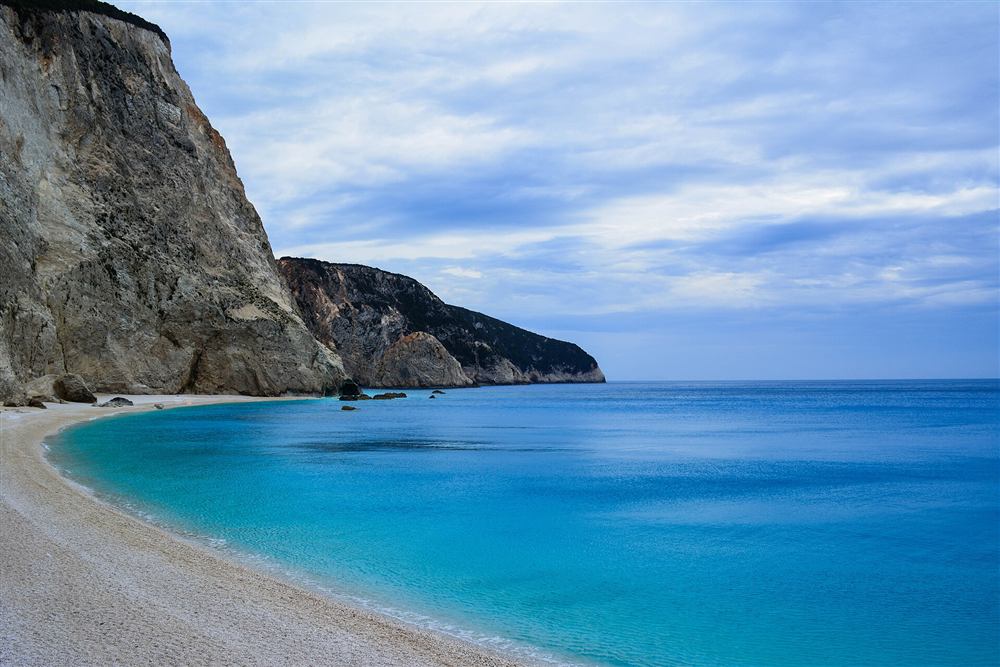
The reward is scale and light. The cliffs drop straight to 20 m of water, the sand at the foot of Egremni shows turquoise from 200 m out, and caves cut into the base of the headland take a kayak 15 m inside. Porto Katsiki’s beach fills with 800 visitors a day in August; from the water the crowd stays a line on the sand. Each Lefkada kayak tour is priced against that figure.
Operators launch from Agios Nikitas, Kathisma or Vasiliki and run the west route only in force 1 to 2 with a swell under 0.5 m, which delivers 3 to 5 usable mornings a fortnight in July. Departure sits at 08:00, landing by 12:00. A west-coast lefkada kayak tour costs 75 to 100 euros and carries a prerequisite of prior sea kayaking experience.
How does kayaking fit into a wider week on Lefkada?
A morning paddle finishes by 13:00, leaving the afternoon for Kathisma beach, the Dimosari gorge walk or windsurfing at Vasiliki. Driving times stay short: Nydri to Kathisma takes 30 minutes, Nydri to Vasiliki 25 minutes, Lefkada Town to Porto Katsiki 50 minutes.
The island measures 35 km north to south and 15 km across, and one road ring connects the coasts. That geometry lets a visitor paddle Meganisi in the morning and swim at Egremni by 16:00. Fuel costs stay under 10 euros a day for that pattern, and parking above Kathisma runs 3 to 5 euros in high season. This is what a Lefkada kayak tour delivers on the water.
Dimosari waterfall, above Nydri, needs 45 minutes of walking from the upper car park through a gorge with three pools and a 12 m fall. Water stays at 14 to 16 degrees through August. The walk pairs cleanly with a dawn paddle since both finish before the heat peaks. Guides in Nydri run both activities from the same office. The Lefkada kayak tour fleet is equipped for it.
Vasiliki bay carries a 15 to 25 knot thermal from 14:00 through July and August, and the windsurf centres at Ponti rent rigs for 40 to 60 euros a day. Kitesurfers work Agios Ioannis on the west side. Planning a full week on Lefkada around one lefkada kayak tour, one gorge walk, two beach days and one Meganisi crossing fills seven days without repetition.
What makes Lefkada better for sea kayaking than the other Ionian islands?
Lefkada connects to the mainland by a floating bridge, removing ferry dependence. Eleven islets sit within 10 km of Nydri, the inner sea between Lefkada and Akarnania stays sheltered in force 5, and the island offers more than twenty launch beaches.
The bridge at the Lefkada channel opens on the hour for yacht traffic and closes within 10 minutes. Drivers from Athens reach Nydri in 4.5 hours and from Preveza airport in 40 minutes. Corfu, Kefalonia and Zakynthos each require a ferry crossing of 1.5 to 3 hours, which rules out day-trip paddling for visitors based on the mainland. Guides on a Lefkada kayak tour brief the point on the beach.
Density of targets settles the rest. Skorpios, Sparti, Madouri, Heloni, Thilia and Meganisi all sit inside a 10 km radius of Nydri harbour, so a half-day paddle reaches real islands rather than a stretch of the same coast. Zakynthos offers one famous cliff coast with a 3 km committing crossing to reach it. Corfu spreads its interest across 120 km of shoreline. That detail separates one Lefkada kayak tour from the next.
The inner sea between Nydri and the Akarnanian mainland works as a natural windbreak: the maistros blows over the top of the 1,158 m Stavrota ridge and the water below Vlycho stays paddleable when Vasiliki records force 6. That reliability is what lets a lefkada kayak tour operate 150 days a year, from late April to mid-October, with a cancellation rate under 10 percent in June and September.
Frequently Asked Questions
What does a Lefkada kayak tour cost?
From 45 to 70 euros for a half-day paddle, 70 to 110 euros for a full day with lunch, 130 to 190 euros per day on the multi-day Ionian expeditions, and 250 to 400 euros for a private guide with a group of four.
Do you need kayaking experience for a Lefkada kayak tour?
No experience is needed on the sheltered east-coast routes from Nydri and Vlycho bay. The guide runs a 20-minute briefing on the beach, and the west-coast Blue Cave paddle asks for a swimmer of average fitness.
Where does the Blue Cave kayak tour launch from?
From the beach at Agios Nikitas on the west coast, with the round trip to the cave and back running 6 to 9 km over three to four hours, including a snorkelling stop inside the limestone chamber.