
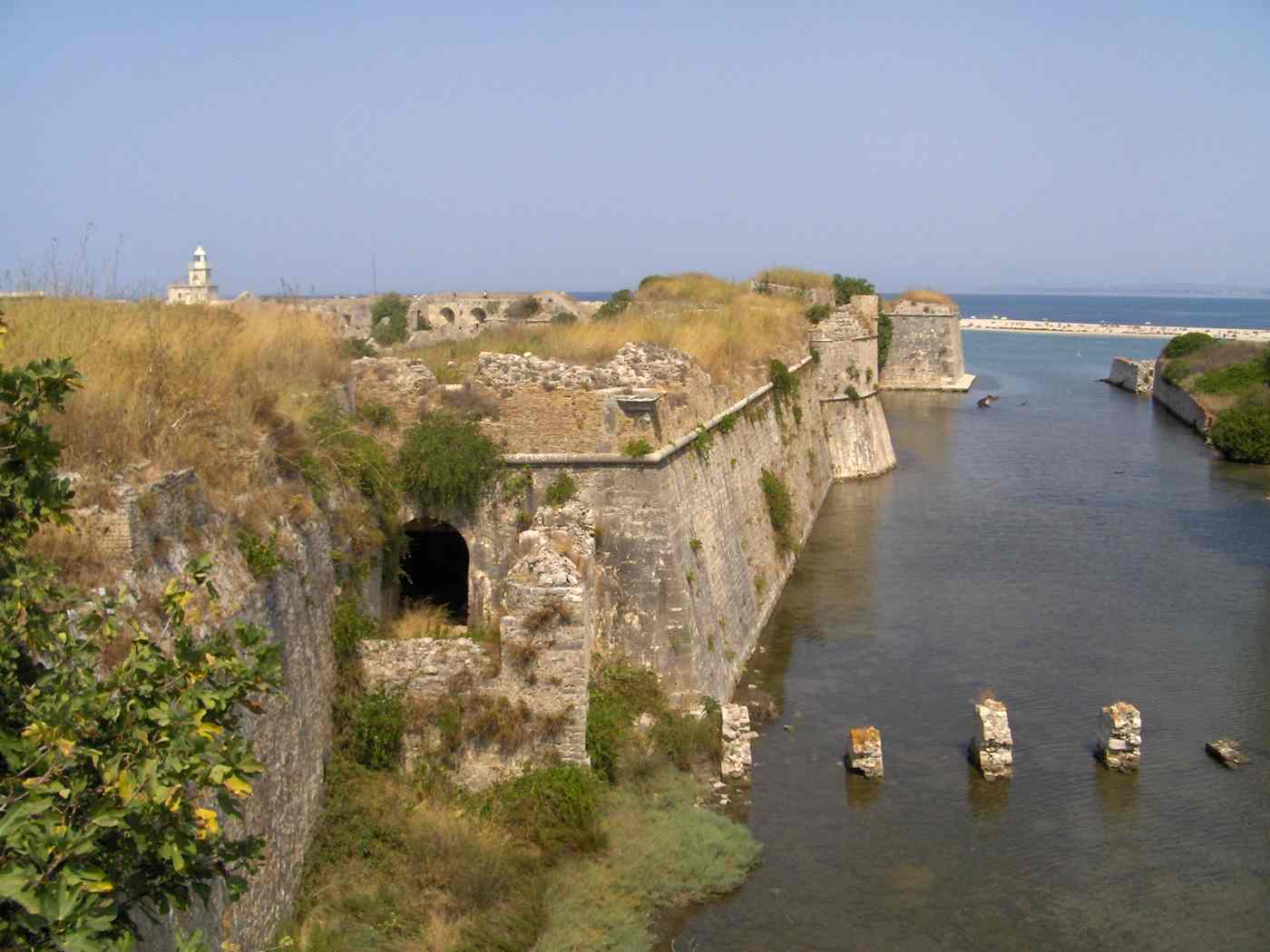
Agia Mavra Castle guards the entrance to Lefkada. A large medieval fortress on a low spit of land beside the causeway and floating bridge that link the island to the Greek mainland. Also known as Santa Maura, the castle sits at the narrow strait between the island and the coast. A position that controlled the sea lanes toward the Ambracian Gulf and the only land crossing. Its wide, low walls, moat and bastions still dominate the approach to the island. For arrivals Agia Mavra Castle is the first monument they see on Lefkada, standing where road, lagoon and open sea meet. Plan the whole trip with Greece Tours.
The fortress was begun around 1300 by the Angevin count Giovanni Orsini and rebuilt by the Venetians, who named the whole island Santa Maura after it. Over the centuries it passed between Ottomans, Venetians, French, Russians and British before the Ionian islands united with Greece in 1864. A fire in 1888 gutted the buildings inside. Today the outer walls survive well while the interior holds ruins. Cisterns and the small church of Agia Mavra that gave the castle and the island their name. This guide sets out who built the castle, its layered history, what visitors see today, and how to reach it from Lefkada Town.
What is Agia Mavra Castle in Lefkada?
Agia Mavra Castle, also called Santa Maura, is a large medieval fortress at the entrance to Lefkada, on a low spit beside the causeway to the mainland.
Agia Mavra Castle stands at the north-eastern tip of Lefkada, on a flat spit of land between the shallow lagoon and the sea channel that separates the island from the mainland. Its plan is low and broad rather than tall, a design suited to cannon warfare, with thick curtain walls, corner bastions and a surrounding moat once filled by the sea. The fortress covered a wide area, large enough to hold a walled town in its prime. From its ramparts the whole strait is visible, which is exactly why it was built here, at the point every ship and every traveller had to pass.
The castle takes its name from Saint Mavra. The small church of Agia Mavra inside the walls carries the dedication that later spread to the entire island as Santa Maura. Today the causeway and floating bridge that carry the road onto Lefkada run right beside the fortress, so drivers pass its walls on the way into the island. This makes Agia Mavra Castle both a historic monument and a landmark of arrival, the structure that frames the first view of Lefkada for anyone crossing from the mainland side.
The castle belongs to a chain of fortifications that guarded the Ionian approaches. Its position gave control of the sea route toward the Ambracian Gulf and of the narrow land communication between the island and the coast. Because it sat on open, low ground rather than a hill, its strength lay in its walls, water defences and firepower rather than height. The result is a sprawling, horizontal fortress, unusual among Greek castles, and one of the most substantial reminders of the island’s long history among the many things to do in Lefkada.
Who built Agia Mavra Castle and why?
The Angevin count Giovanni Orsini began Agia Mavra Castle around 1300 to control the strait, the sea route to the Ambracian Gulf and the land crossing to Lefkada. Later rulers, especially the Venetians, rebuilt and enlarged it.
The origins of Agia Mavra Castle lie around 1300, when the island passed to the Orsini family and the count Giovanni Orsini began work on a large fortress at its entrance. The site was chosen for control rather than comfort, commanding the narrow water between Lefkada and the mainland and the shallow crossing that linked them. From here a garrison watch the sea lanes running toward the Ambracian Gulf and block any hostile approach to the island. The first castle was a compact fortification that grew, over the following centuries, into a walled town and the island’s capital.
Each successive ruler left a mark on the walls. The fortress was designed and redesigned for the weapons of its age, so early medieval towers gave way to the low bastions and thick ramparts that suit artillery. The moat, fed from the sea, added a water barrier on the exposed flat ground where no natural slope offered protection. Cisterns stored fresh water for a garrison that be cut off by a siege, and an aqueduct once brought supply from the mainland. The engineering answered a single problem, how to hold a low, water-girt site against attack from every side.
The strategic logic never changed. Whoever held Agia Mavra Castle held the gateway to Lefkada and a grip on the surrounding waters, so every power that reached this corner of the Ionian wanted it. That importance explains both the scale of the works and the long list of occupiers who rebuilt them. The castle’s purpose was always to command the crossing. Its history is the history of the forces who fought to control that crossing. From the Orsini counts through the Venetians to the powers of the modern age.
What is the history of Agia Mavra Castle?
Agia Mavra Castle changed hands repeatedly: taken by the Ottomans in 1479, by the Venetians in 1502, and contested by French, Russian and British forces before the Ionian islands united with Greece in 1864.
It grew into the walled capital of the island through the fourteenth and fifteenth centuries. In 1479 it fell to the Ottomans, who held this frontier fortress on the edge of Venetian and Ottoman spheres. In 1502 a Venetian and allied force took it, opening a long period in which control swung between the two powers. Each capture brought repairs and new defences, so the surviving walls record layers of Ottoman and Venetian building. The castle’s story through these centuries is one of a contested border post rather than a quiet provincial keep.
The Venetian era gave the castle and the island the name Santa Maura, and Venetian engineers shaped much of what stands today, widening the bastions and strengthening the seaward defences. When Venice fell at the end of the eighteenth century, the Ionian islands entered a turbulent phase. Between roughly 1797 and 1810 French, Russian and British forces in turn occupied or besieged the fortress as the wider wars of the age reached the Ionian. The British held the islands through the following decades as a protectorate, keeping Agia Mavra Castle in military use.
The long saga of foreign rule ended in 1864, when Britain ceded the Ionian islands to Greece and Lefkada was united with the Greek state. The castle remained a base after that, but in 1888 a fire swept through the interior and destroyed most of its buildings. That blaze marks the end of the fortress as a living garrison town and the beginning of its life as a ruin and a monument. The dates that punctuate this history, from 1300 to 1864, trace the passage of the island through the hands of nearly every power that mattered in the Ionian.
Why is the castle also called Santa Maura?
The Venetians named the castle, and then the whole island, Santa Maura after the church of Agia Mavra inside its walls. For centuries Lefkada was known internationally as Santa Maura, a name still tied to the fortress.
The name Santa Maura comes from the small church of Agia Mavra, dedicated to Saint Mavra, that stood within the fortress. During the Venetian period the Italian form of the saint’s name, Santa Maura, attached first to the castle and then to the island as a whole. On old maps and in the records of trade and war. Lefkada appears as Santa Maura. The fortress at its gate carried the name that its little church had given it. This is why the castle answers to two names today, the Greek Agia Mavra and the Venetian Santa Maura.
The double name reflects the double history of the place. Under Greek Orthodox tradition the church and its saint kept the name Agia Mavra, while the Venetian administration and the wider Mediterranean world used Santa Maura for the strategic island they governed. The persistence of the Italian form shows how long and how deeply Venice shaped Lefkada. When the island united with Greece the older Greek name Lefkada returned to official use. Santa Maura survives as the historic name of both the castle and the island, a reminder of the centuries of Venetian rule that the fortress embodies.
The name also travelled far beyond the island. Because Santa Maura commanded a key point on the sea routes of the Ionian, it appears in the logs of merchants, the reports of admirals and the treaties of the great powers, always as a place worth holding. Sailors knew the fortress as the marker of the strait, and its name fixed the island on the mental map of the Mediterranean. To read the old sources is to meet Lefkada under its Venetian title again and again. The castle that carried the name Santa Maura effectively gave the island its identity for the outside world across the whole early-modern age.
What can visitors see at Agia Mavra Castle today?
Visitors to Agia Mavra Castle today walk its well-preserved outer walls and bastions, cross the moat, and see the ruins inside: cisterns, an aqueduct trace, foundations of the old town and the small church of Agia Mavra.
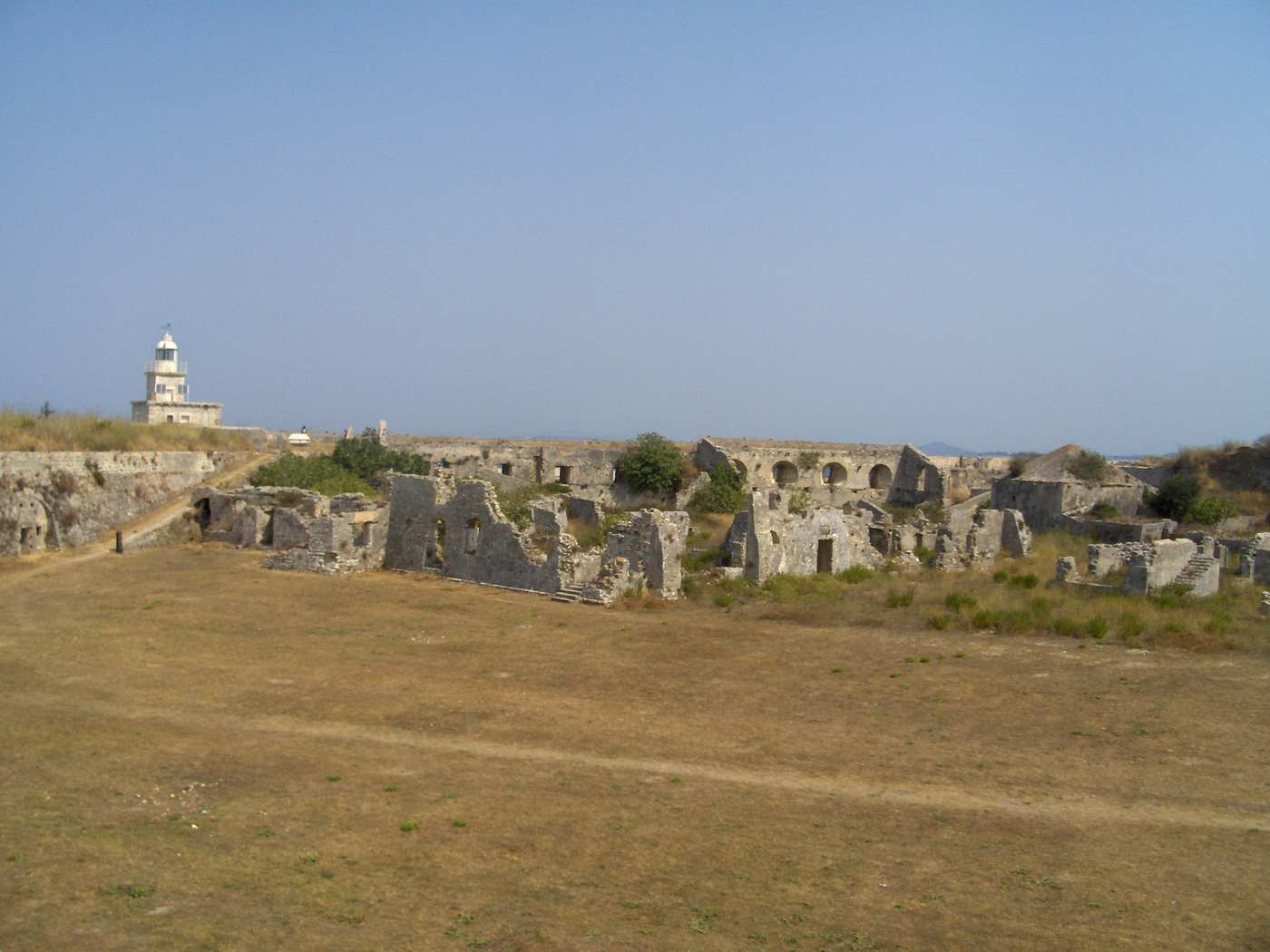
The strongest impression Agia Mavra Castle leaves is its scale and its walls. The outer curtain, bastions and gate survive in good condition, and a walk along or beside them shows how the fortress ringed its low spit of land. The moat that once held sea water still marks the perimeter. Entering through the gate, visitors reach a broad open interior where the buildings of the former garrison town once stood, now reduced to foundations, cisterns and scattered ruins after the fire of 1888. The space reads as the ghost of a walled town rather than a single keep.
Within the walls the small church of Agia Mavra remains the focus, the dedication that named the whole island. Around it lie the remains of cisterns that stored the garrison’s water, traces of the aqueduct that once fed them, and the outlines of barracks, stores and lanes. Information around the site helps visitors read these low remains, though much is left to the imagination. The interior is open and exposed. The visit is as much about the sense of a vanished town as about standing monuments. Walked at an easy pace across the wide enclosure.
The ramparts repay the climb with the view. From the walls of Agia Mavra Castle the eye takes in the causeway, the shallow lagoon with its salt pans and birdlife, the channel to the mainland and the rooftops of Lefkada Town across the water. This is the same panorama that made the site so valuable to its builders, now enjoyed by visitors rather than watched by sentries. Photographers come for the long, low lines of the fortress against the water. The light over the lagoon at either end of the day gives the walls their finest setting.
How do you get to Agia Mavra Castle from Lefkada Town?
Agia Mavra Castle sits right beside the causeway at the entrance to Lefkada, about a kilometre from Lefkada Town.
Reaching Agia Mavra Castle is simple because it stands at the very gateway of the island. From Lefkada Town the castle lies about a kilometre away along the waterfront toward the bridge, an easy walk or cycle beside the lagoon. Drivers arriving from the mainland pass directly by the walls as the road crosses the causeway and floating bridge onto Lefkada, so the fortress is impossible to miss. Parking is available near the entrance, and the flat approach makes the site easy to combine with a stroll along the town’s marina and salt pans.
It fits naturally into the start or end of a trip. Details of the crossing itself appear on the page for getting to Lefkada, which explains the causeway and bridge that run beside the fortress. Many visitors stop at Agia Mavra Castle on the way in, while first impressions are fresh, or on the way out as a last look at the island. From the town it also pairs with a walk out to the lagoon and, for those heading south, a drive on toward Nydri and the east coast.
Once at the site, the visit is straightforward and self-guided. The ground is flat and open, so walking the interior and the accessible stretches of wall takes an hour or so at a relaxed pace. Sturdy shoes help on the rough ground, and there is little shade inside, so a hat and water are worth carrying in summer. Opening arrangements for the enclosed areas vary through the year. It is best to check locally before a visit if entry to the church or a specific part of the walls is the aim. As a landmark and a viewpoint, however, the castle rewards even a short stop.
Is Agia Mavra Castle worth visiting?
Yes, Agia Mavra Castle is worth visiting for its scale, its layered history and its position at the gateway of Lefkada.
For anyone interested in history, Agia Mavra Castle is one of the most significant monuments on Lefkada. Its walls carry the marks of Orsini counts, Ottoman and Venetian engineers and the powers of the modern age. A visit reads the island’s whole past in a single site. The sheer size of the fortress, and the sense of a walled town now reduced to ruins, give it a scale that few other sights on the island match. Standing at the point every conqueror had to take, it explains why Lefkada’s story is so tangled with the forces that fought over the Ionian.
The castle also works simply as an easy, atmospheric outing. It is free to walk around the exterior, close to town, flat and open, and framed by the lagoon, the salt pans and the sea. Birdwatchers enjoy the shallow waters around it, photographers the long low walls against the water, and families the space to wander. Combined with a walk in Lefkada Town or a stop on the way to the beaches, it fills an hour or two without effort. Among the sights of the island, Agia Mavra Castle stands out as both a serious historic monument and a pleasant, accessible place to visit.
A visit rewards a little imagination as well. Standing on the ramparts, it is easy to picture the garrison town that once filled the enclosure. The ships that passed through the strait under the guns. The sieges that changed the island’s rulers. The low walls and the water on every side make the defensive purpose plain. The small church at the centre roots the whole vast work in the saint who gave it a name. Few monuments on Lefkada tell the island’s story so directly, which is why Agia Mavra Castle belongs near the top of any list of places to see.
Frequently Asked Questions
How old is Agia Mavra Castle?
Agia Mavra Castle dates to around 1300, when the Angevin count Giovanni Orsini began building the fortress at the entrance to Lefkada. It grew over the following centuries into a walled town and the island’s capital, and was repeatedly rebuilt by later rulers, especially the Venetians in the sixteenth century. The castle stayed in military use through the Ottoman, Venetian, French, Russian and British periods until the Ionian islands united with Greece in 1864. A fire in 1888 destroyed most of the buildings inside. This makes it a monument with more than seven centuries of continuous history at the gateway of the island.
Why was Lefkada called Santa Maura?
Lefkada was called Santa Maura after the church of Agia Mavra inside its castle, dedicated to Saint Mavra. During the Venetian period the Italian form of the name, Santa Maura, attached first to the fortress at the island’s entrance and then to the whole island. On old maps and in trade and military records Lefkada appears as Santa Maura for centuries. When the island united with Greece in 1864, the ancient Greek name Lefkada returned to official use. Santa Maura survives as the historic name of both the castle and the island, tied above all to the fortress that carried it.
Is there an entrance fee for Agia Mavra Castle?
It is free to walk around the exterior of Agia Mavra Castle and to take in the walls, moat and views from beside the causeway. Access to enclosed parts of the interior, including the church and certain stretches of wall. Depends on opening arrangements that vary through the year. It is best to check locally before a visit if you want to go inside. The site is close to Lefkada Town, flat and open, so even a short stop at the walls is worthwhile. Sturdy shoes, a hat and water help, as the interior is rough underfoot and offers little shade in summer.
What is there to see inside Agia Mavra Castle?
Inside Agia Mavra Castle the outer walls and bastions are the best-preserved feature, ringing a broad open interior where the old garrison town once stood. After the fire of 1888 the interior is mostly ruins: cisterns that stored the garrison’s water, traces of an aqueduct, and the foundations of barracks and lanes. The small church of Agia Mavra, which gave the castle and the island the name Santa Maura, still stands within the walls. From the ramparts there are wide views over the causeway, the lagoon and salt pans, the channel to the mainland and Lefkada Town across the water. The visit is self-guided and takes about an hour.
How far is Agia Mavra Castle from Lefkada Town?
Agia Mavra Castle is about a kilometre from the centre of Lefkada Town, standing at the entrance to the island beside the causeway and floating bridge. Visitors reach it easily on foot or by bike along the waterfront past the lagoon, or by a short drive. Anyone arriving on the island by road passes directly beside the fortress, as the causeway runs alongside its walls. Because it sits at the gateway of Lefkada, the castle fits naturally into the start or end of a visit. Pairs well with a walk through the town, the marina and the salt pans that surround the shallow lagoon.
Who built Agia Mavra Castle?
Agia Mavra Castle was begun around 1300 by the Angevin count Giovanni Orsini, after the island passed to the Orsini family. He raised the first fortress at the entrance to Lefkada to control the strait and the crossing to the mainland. Later rulers enlarged and rebuilt it, above all the Venetians, who in the sixteenth century widened the bastions. Strengthened the seaward defences and named the castle and the island Santa Maura. Ottoman engineers also left their mark during their periods of control. The walls that survive today are therefore the work of powers across the centuries, layered onto the original Orsini plan.
Is Agia Mavra Castle the same as Santa Maura?
Yes, Agia Mavra Castle and Santa Maura are two names for the same fortress at the entrance to Lefkada. Agia Mavra is the Greek name, taken from the church of Saint Mavra inside the walls, while Santa Maura is the Venetian form that spread to the whole island during centuries of Venetian rule. For a long time Lefkada itself was known internationally as Santa Maura, after the castle. Today the island uses its ancient Greek name of Lefkada again. The fortress is still called both Agia Mavra Castle and Santa Maura, and both names appear on maps and in guides.