
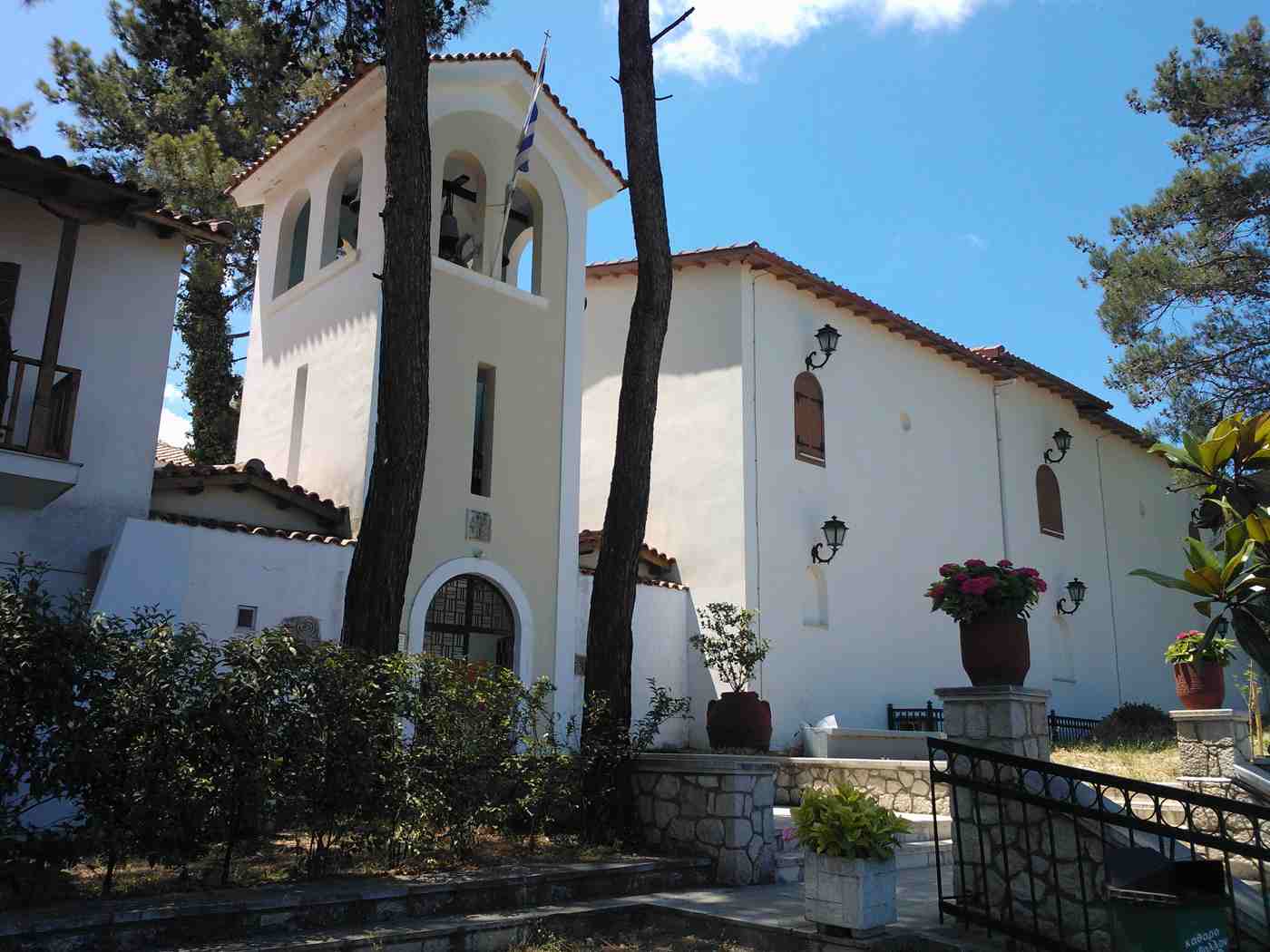
Faneromeni Monastery is the most important religious site on Lefkada, set on a pine-covered hill above the town near the village of Tsoukalades. Dedicated to the Virgin Mary Faneromeni, the patron saint of the island. The monastery draws pilgrims and visitors for its revered icon, its museum of Byzantine treasures and its wide views over the water. From its terrace the whole of Lefkada Town, the shallow lagoon and the mainland coast spread out below. Faneromeni Monastery combines faith, history and landscape in a single, easily reached spot just above the island’s capital. Plan the whole trip with Greece Tours.
Tradition dates the monastery to the seventeenth century and places it on the site of an ancient temple of Artemis. Where disciples of the Apostle Paul are said to have first preached Christianity on the island. The church was built in 1634 and rebuilt in 1734 under Venetian rule, and after a fire in 1886 it was restored to its present form. Behind its walls lie a lush garden courtyard, an ecclesiastical museum of icons and manuscripts, and a terrace with a sweeping panorama. This guide covers the history of Faneromeni Monastery, its icon and patron-saint role, what visitors see, and how to visit respectfully.
What is Faneromeni Monastery in Lefkada?
Faneromeni Monastery is the main religious centre of Lefkada, a working monastery on a hill above Lefkada Town dedicated to the Virgin Mary Faneromeni, the island’s patron saint. It is known for its icon, its museum and its panoramic views.
Faneromeni Monastery stands on a wooded hill above the capital of Lefkada, near the village of Tsoukalades and a short drive up from Lefkada Town. It is dedicated to Panagia Faneromeni, the Virgin Mary in her title as the patron of the island, and it holds that role as the spiritual heart of Lefkada. Set among pines with a walled courtyard and a terrace over the sea, the monastery is both an active religious community and one of the most visited sights on the island. Drawing pilgrims to its feast days and travellers to its icons and views.
The setting explains much of the monastery’s appeal. From its height the view reaches over the rooftops of the town, the causeway and the shallow lagoon, across to the northern coast and the mainland mountains beyond the water. The grounds are quiet and green, a contrast to the beaches and resorts elsewhere on the island, and they offer a cool, shaded stop in summer. For visitors touring the sights of the island, Faneromeni Monastery pairs history and devotion with one of the finest outlooks on Lefkada, all within easy reach of the town.
What is the history of Faneromeni Monastery?
Tradition dates Faneromeni Monastery to the seventeenth century, on the site of an ancient temple of Artemis.
The roots of Faneromeni Monastery reach back, by tradition, to the earliest Christian centuries. The disciples of the Apostle Paul are said to have preached on this hill, and the monastery is held to stand on the site of an ancient temple of Artemis, the huntress goddess, whose worship the new faith replaced. The monastery itself is dated to the seventeenth century, with the church first built in 1634. This long tradition, layering an ancient sanctuary and an early Christian memory beneath the later monastery. Gives the site a depth of history that few other places on the island can claim.
The buildings that stand today are the result of repeated rebuilding. Under Venetian rule the church was reconstructed in 1734, and the monastery grew as the chief religious foundation of Lefkada. A serious fire in 1886 damaged much of the complex, after which it was restored to the form visitors see now. Each phase of building and repair reflects the island’s changing fortunes, from Venetian times through the modern age. The present Faneromeni Monastery, with its restored church and museum, preserves this continuity of worship on a site held sacred across centuries.
Why is the Virgin Mary Faneromeni the patron of Lefkada?
The Virgin Mary Faneromeni is the patron saint of Lefkada, and her revered icon is kept at the monastery. The island turns to Panagia Faneromeni for protection, and her feast is among the most important religious events of the year.
At the heart of Faneromeni Monastery is the icon of the Virgin Mary Faneromeni, honoured as the protector of the whole island. The name Faneromeni, meaning revealed or made manifest. Belongs to a tradition of miraculous icons found or revealed to the faithful. The image draws pilgrims who come to venerate it and seek the Virgin’s protection. As the patron saint of Lefkada, Panagia Faneromeni links the monastery to the identity of the island itself. A visit to the shrine is, for Greeks, a visit to the spiritual centre of their home.
The devotion focused on the monastery peaks on the feast days of the Virgin, when the icon is honoured and the community gathers. These occasions fill the hilltop with worshippers and give the quiet grounds a very different character. Throughout the year, though, a steady flow of pilgrims and visitors comes to light a candle before the icon and to sit in the church. This role as the island’s patron shrine is what raises Faneromeni Monastery above the many smaller churches and chapels of Lefkada into its single most important religious site.
What can visitors see at Faneromeni Monastery?
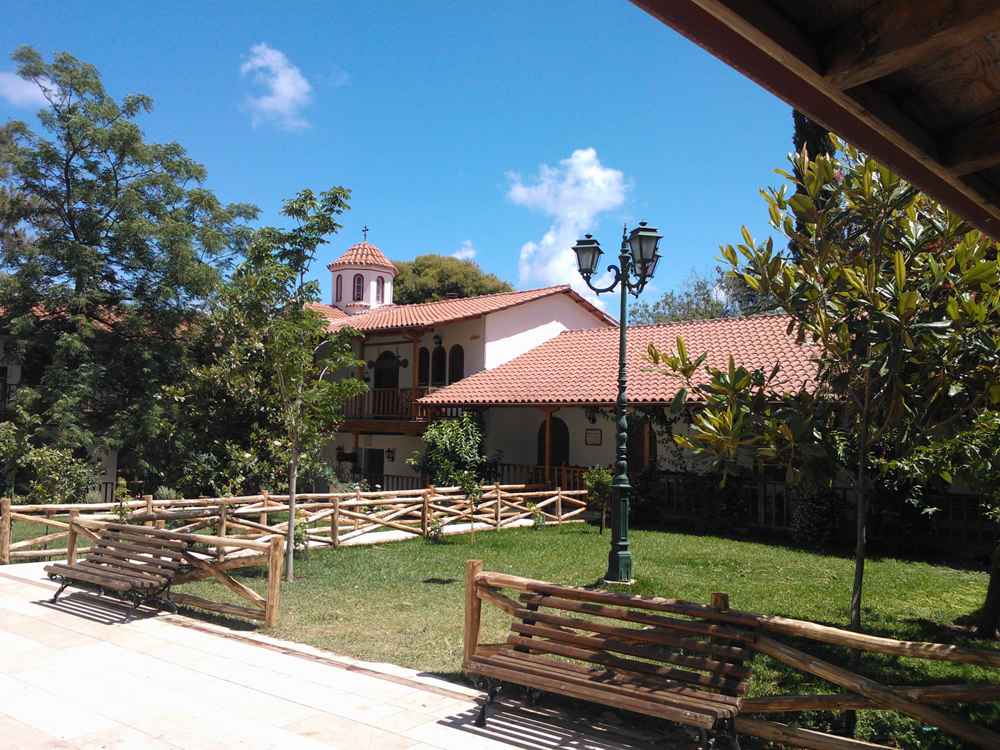
Visitors to Faneromeni Monastery see the restored church with its icons, an ecclesiastical museum of Byzantine icons, manuscripts and gospels, a library, and a green courtyard garden. The terrace gives a wide panorama over the town and the sea.
The church is the centre of any visit to Faneromeni Monastery, its interior holding the venerated icon of the Virgin and other sacred images. Alongside it, an ecclesiastical museum displays Byzantine icons, old manuscripts and gospels. Other treasures gathered over the monastery’s long history, giving a sense of the religious art of the Ionian. A library preserves further records of the island’s faith. Together these collections make the monastery not only a place of worship but a small museum of Lefkada’s Orthodox heritage, well worth the short climb from the town.
Beyond the church and museum, the grounds themselves reward a visit. A walled courtyard encloses a lush, well-tended garden, shaded and quiet, that offers a cool retreat in the heat of summer. Pines surround the complex, and paths lead to the terrace and viewpoints. The atmosphere is peaceful and contemplative, a contrast to the busy beaches of the west coast such as those near Agios Nikitas. Visitors move between the church, the museum and the gardens at an unhurried pace, and the whole site can be seen comfortably in an hour or two.
What are the views like from Faneromeni Monastery?
Faneromeni Monastery sits on a hill above Lefkada Town, so its terrace gives one of the best panoramas on the island: the town, the causeway and lagoon, the northern coast, and the mainland mountains across the water.
The position of Faneromeni Monastery, high on a pine-covered hill above the capital, gives it a commanding outlook. From the terrace the view sweeps over the rooftops of Lefkada Town, the causeway and floating bridge, and the shallow lagoon with its salt pans. Beyond the town the eye follows the north-eastern coast of the island and crosses the channel to the mountains of the mainland. This wide panorama is one of the reasons the monastery is so popular. Rewarding the short drive up with a view that takes in much of the island’s northern end in a single frame.
The light shifts the scene through the day, and visitors time their climb for the softer colours of the late afternoon and the approach to sunset over the sea. The height also brings a cooling breeze that makes the terrace pleasant when the coast is hot. For photographers the monastery offers both its own architecture, framed by pines, and the broad landscape below. Combining faith, history and this outlook, Faneromeni Monastery stands among the finest viewpoints as well as the holiest sites on Lefkada.
How do you get to Faneromeni Monastery?
Faneromeni Monastery is a short drive up from Lefkada Town toward Tsoukalades, only kilometres from the centre.
Faneromeni Monastery lies just kilometres from Lefkada Town, on the hill toward the village of Tsoukalades. The road climbs in curves up from the capital, and the drive takes only a short time by car or taxi. Because it is so close to the town, the monastery is one of the easiest sights to add to a day on the island, whether at the start of a stay or between beach visits. Parking is available near the entrance, and the final approach through the pines gives a first taste of the calm that defines the site.
The visit combines well with other stops near the north of the island. From the monastery it is a short return to Lefkada Town for a walk along the marina, and the road on toward the west coast leads to the beaches near Tsoukalades and Agios Nikitas. Details of reaching the island in the first place appear on the page for getting to Lefkada. As a self-guided visit, the monastery needs no booking, though checking local opening times before setting out is sensible, and modest dress is required to enter the church.
What visitors know before visiting Faneromeni Monastery?
Faneromeni Monastery is an active religious site, so visitors keep modest dress with shoulders and knees covered, stay quiet in the church, and check opening times, which usually break in the early afternoon. Entry is generally free.
Faneromeni Monastery asks visitors to respect its religious character. Modest dress is required to enter the church, with shoulders and knees covered, and wraps are often available at the entrance for those who need them. Inside the church visitors keep quiet, avoid flash photography where it is restricted, and behave as they in any place of worship. These simple courtesies matter especially on feast days, when pilgrims fill the site, but they apply on any ordinary day as well.
Practical planning is easy. The monastery is generally open to visitors in the morning and again in the late afternoon, with a break in the early afternoon, though exact hours vary through the season. It is worth checking locally before setting out. Entry is generally free, in keeping with its role as the island’s patron shrine. Allowing an hour or two lets visitors see the church, the museum and the gardens and enjoy the view without rushing. With a little care over timing and dress, Faneromeni Monastery is one of the most rewarding and accessible sights on Lefkada.
Frequently Asked Questions
Is Faneromeni Monastery worth visiting?
Yes, Faneromeni Monastery is one of the most rewarding sights on Lefkada and its most important religious site. It combines the venerated icon of the Virgin Mary Faneromeni, the island’s patron saint. With an ecclesiastical museum of Byzantine icons and manuscripts, a peaceful garden courtyard and one of the finest panoramas on the island. From its hilltop terrace the view sweeps over Lefkada Town, the lagoon and the mainland across the water. It is only a short drive up from the town, needs no booking. Can be seen in an hour or two. Making it easy to add to any visit to the island.
What is the icon of Faneromeni Monastery?
The icon of Faneromeni Monastery is the image of the Virgin Mary Faneromeni, the patron saint of Lefkada, kept in the monastery church. The name Faneromeni means revealed or made manifest, from the tradition of miraculous icons revealed to the faithful. Pilgrims come to venerate the icon and to seek the protection of the Virgin for the island. The icon is at the heart of the monastery’s role as the spiritual centre of Lefkada. It is honoured especially on the feast days of the Virgin, when the hilltop fills with worshippers from across the island.
How old is Faneromeni Monastery in Lefkada?
By tradition Faneromeni Monastery dates to the seventeenth century, though the site is held to be far older. Standing where an ancient temple of Artemis once stood and where disciples of the Apostle Paul are said to have preached. The church was first built in 1634 and rebuilt in 1734 under Venetian rule. A fire in 1886 damaged the complex, after which it was restored to its present form. This long history, layering an ancient sanctuary, an early Christian memory and centuries of monastic life, makes it the most historic religious site on Lefkada.