
Lefkada hiking ranges from waterfall gorges and mountain ridges to short coastal paths that drop to hidden beaches, all on one road-connected Ionian island in western Greece. A green mountain spine runs down the centre of the island and rises to Mount Stavrota at about 1,180 metres, while a broken west coast falls in cliffs to the sea. Between the peaks and the shore sit stone villages linked by old mule paths, springs, olive terraces and shaded ravines. This mix gives Lefkada hiking a range that suits both a gentle village stroll and a hard climb to open summits. Plan the whole trip with Greece Tours.
The classic outing is the Dimosari waterfall walk in the gorge above Nydri, a moderate loop past pools and cascades. Beyond it, walkers cross the central plateau near the mountain village of Englouvi, follow pine paths from Agios Nikitas down to Milos beach. Trace the springs around Sivros in the south. Reach the exposed clifftop of Cape Lefkatas. Spring and autumn bring wildflowers, mild air and long views across to Ithaca, Kefalonia and Meganisi. This guide sets out the best trails, the seasons and the practical points that make Lefkada hiking rewarding rather than punishing.
Is Lefkada good for hiking?
Lefkada is good for hiking, with a mountainous interior, waterfall gorges, old mule paths between hill villages and short coastal routes to beaches. Trails range from easy village walks to a climb up Mount Stavrota at about 1,180 metres.
Lefkada suits walkers because its landscape changes sharply over short distances. A green mountain spine runs down the middle of the island, rising to Mount Stavrota at around 1,180 metres, so the interior carries real relief rather than gentle hills. Streams cut ravines such as the Dimosari gorge above Nydri, where water runs even in summer and feeds pools and cascades. Old stone paths, built for mules and farmers, still link the hill villages of Karya, Englouvi and Vafkeri across olive terraces and oak woods. This variety means Lefkada hiking can fill a full holiday without repeating the same ground twice.
The island is also compact, and its causeway link to the mainland means no ferry is required to reach the trailheads. The mountainous core measures only about fifteen kilometres across, so a walker based near Nydri or in the west can reach most routes within a short drive. On the same day it is possible to hike a shaded gorge in the morning and a clifftop path above the sea in the afternoon. Views open constantly across the Ionian, reaching the neighbouring islands of Ithaca, Kefalonia and Meganisi from the higher ground. Few Greek islands pack this much walking into so small an area.
Lefkada hiking does carry limits worth knowing before setting out. Much of the terrain is exposed, with little shade once a path leaves the woods, and the rock underfoot is often loose and steep. Summer heat makes the open ridges and cliff paths hard going in the middle of the day. Waymarking is patchy on the higher routes, so a map, a downloaded track or local advice helps on the less-travelled trails. Taken with sensible timing and enough water, none of this spoils the walking, and it keeps the busier gorges and village paths firmly within reach of most visitors, part of the wider range of things to do in Lefkada.
What are the best hiking trails in Lefkada?
The best hikes in Lefkada are the Dimosari waterfall loop near Nydri, the climb to Mount Stavrota from the central plateau, the pine path from Agios Nikitas to Milos beach, and the springs walk around Sivros in the south.
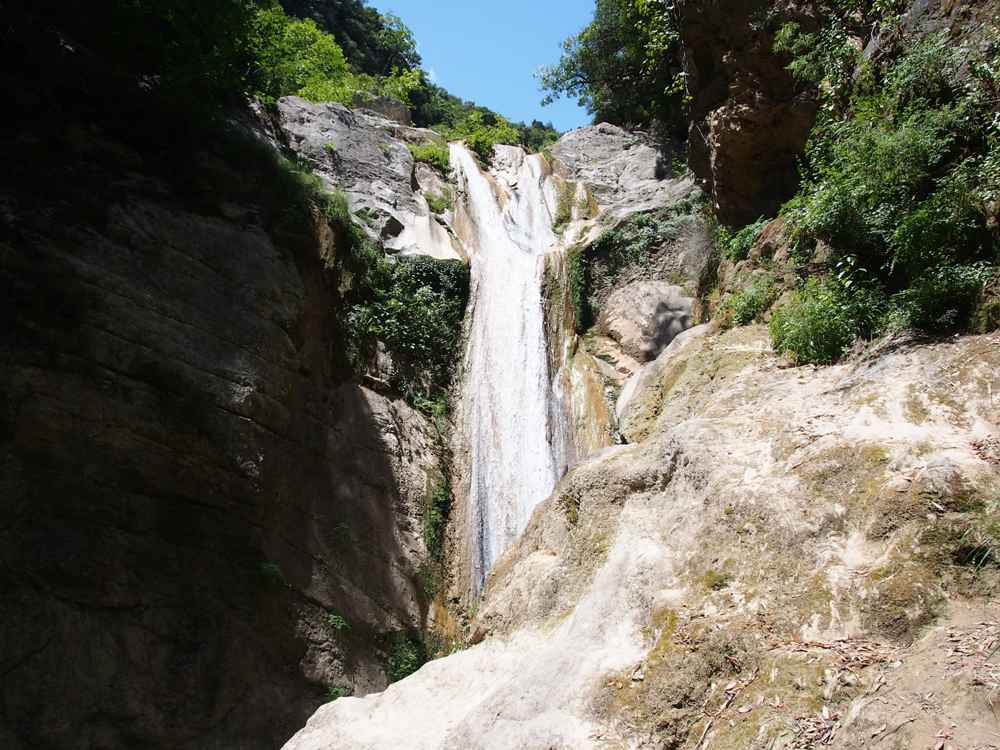
The Dimosari (Nydri) waterfall walk is the signature route and the busiest. A moderate loop of roughly seven kilometres into the gorge behind Nydri, where a stream feeds a chain of pools and falls. For height and long views, the ascent of Mount Stavrota climbs from the central plateau near the mountain village of Englouvi to the highest point on the island. On the west coast, a shaded path drops from Agios Nikitas through pines to the sandy cove of Milos beach, a short walk that ends with a swim. In the south, the springs walk around Sivros follows old water channels and stone paths through a quiet farming valley.
These routes cover the main types of Lefkada hiking, so choosing between them is really a choice of landscape. The gorge walk gives shade, running water and a family-friendly grade. The Stavrota climb gives altitude, open ridges and the widest panorama across the southern Ionian. The Agios Nikitas path trades distance for a scenic descent to the sea, ideal on a hot day. The Sivros springs loop gives a gentle, low-level introduction to the rural interior, away from the coast entirely. Between them they suit different fitness levels and different moods across a week on the island.
Shorter walks fill the gaps between the headline trails. The mule paths that link Karya, Vafkeri and Englouvi make easy village-to-village strolls through olive groves and plane trees. The clifftop approach to Cape Lefkatas, the island’s dramatic southern tip, is a bare, wind-blown walk to the lighthouse and the sheer drop where the ancient temple once stood. Many west-coast beaches, from Egremni to Gialos, are reached only on foot down long stair-paths that count as short hikes in their own right. Together they mean Lefkada hiking rewards even a traveller with only a spare hour or two.
What is the Dimosari waterfall hike near Nydri?
The Dimosari hike is a moderate loop of about seven kilometres into the gorge above Nydri, following a stream past pools and waterfalls.
The Dimosari gorge lies just inland from Nydri on the east coast, and its walk is the introduction most visitors take to Lefkada hiking. From the edge of Nydri a track climbs into the ravine, where a permanent stream has cut a green corridor between rock walls. The path crosses the water on stones and small bridges, passing a series of pools and cascades fed by springs high in the mountains. Because the gorge holds shade and running water, it stays cool even in high summer, which explains its popularity when the open ridges are too hot for comfort.
The route runs about seven kilometres and is rated moderate rather than hard, though the footing is rocky and wet in places. Most walkers allow around two to three hours at an easy pace, with time to stop at the falls. The finest of the cascades drops into a clear pool deep enough for a cold swim, a reward that turns the walk into a half-day outing. Sturdy shoes with grip matter here, since the wet stones and stream crossings are slippery. Families with older children manage the route comfortably in good weather.
The Dimosari walk connects easily to the rest of a Lefkada hiking day because Nydri sits at its foot, with parking, cafes and boat departures on the waterfront. Many visitors combine the morning gorge with an afternoon on the water or a drive up to the hill villages above. The stream that carves the gorge is the same system that gives the area its waterfalls, and a fuller account of the falls themselves appears on the page for the Dimosari waterfalls. For a first walk on the island, the shade, the water and the modest distance make this the safest bet.
Can you climb Mount Stavrota, the highest peak in Lefkada?
You can climb Mount Stavrota, the highest peak in Lefkada at about 1,180 metres, on a demanding walk from the central plateau near Englouvi. The reward is a full panorama across the island and the southern Ionian.
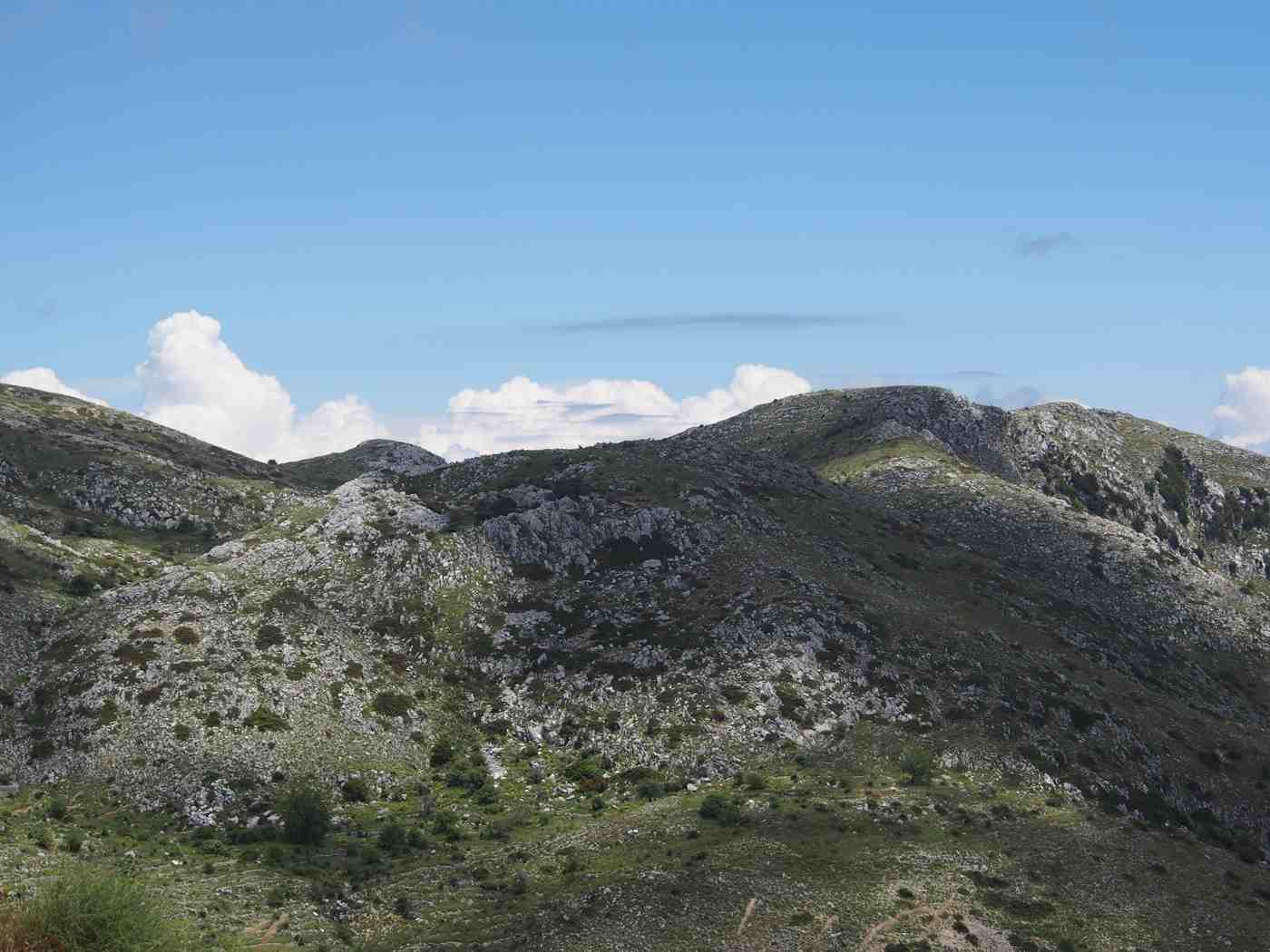
Mount Stavrota crowns the central ridge of Lefkada at around 1,180 metres, the roof of the island. The usual approach starts high already, from the plateau near Englouvi, so the climb gains height on open mountainside rather than from sea level. Tracks and faint paths cross grazing land, thyme scrub and bare rock towards the summit, where the ground falls away on every side. From the top the view runs the length of Lefkada and out over the sea to Ithaca, Kefalonia and Meganisi, with the mainland mountains closing the eastern horizon. This is the most ambitious of the standard Lefkada hiking routes.
The climb suits experienced walkers rather than casual strollers. The terrain is exposed, with almost no shade and little water once the plateau is left behind, and the waymarking thins out on the upper slopes. A map or a downloaded track, an early start and plenty of water are sensible precautions, and the ascent is best avoided in the fierce heat of midsummer afternoons. In return the walker gets solitude, wide skies and the sense of standing above the whole island. Spring, when the high grassland is green and flowering, is the finest season for the summit.
The high country around Stavrota rewards walkers even short of the peak. The plateau near Englouvi, famous for its lentils grown at altitude, is ringed by old threshing circles and windmill stumps that make gentler goals. Paths from here toward Karya and the eastern slopes give shorter, lower walks with much of the same view for a fraction of the effort. For anyone building a week of Lefkada hiking, Stavrota is the summit to aim for on the clearest. Coolest day, with the surrounding plateau as a rewarding fallback when the weather closes in.
Which easier coastal and village walks suit Lefkada hiking?
Easier Lefkada hiking includes the pine path from Agios Nikitas to Milos beach, the mule paths linking Karya, Vafkeri and Englouvi, and the short clifftop walk to Cape Lefkatas. These are low-effort routes with strong rewards.
The gentlest coastal walk on the island drops from Agios Nikitas through pine woods to Milos beach, a sandy cove reached only on foot or by boat. The path is short, shaded for much of the way and ends at the water. It doubles as the approach to one of the prettiest beaches on the west coast. On the way back the climb is modest, and the whole outing fits comfortably into a morning. This kind of route shows how much of Lefkada hiking is really about reaching places that no road serves, rewarded by a quiet swim at the end.
Inland, the old mule paths between the hill villages make relaxed walks with plenty of shade. Trails link Karya, the largest mountain village and a centre for traditional embroidery, with Vafkeri and the plateau of Englouvi, crossing olive groves, plane-shaded springs and stone terraces. These are low-level routes, cool under the trees and easy to follow between settlements where a taverna waits at either end. They give a feel for the working interior of the island, far from the beaches, and suit walkers who prefer villages and farmland to bare ridges.
At the southern tip, the walk out to Cape Lefkatas is short but dramatic, a bare path over windswept scrub to the lighthouse and the sheer white cliffs that give the island its name. There is little shade and often a strong wind. The sense of standing at the edge of Lefkada, where the ancients kept a temple to Apollo, is worth the exposure. Combined with a swim at nearby Porto Katsiki or Egremni, it makes an easy half-day. These short routes prove that rewarding Lefkada hiking does not always demand a hard climb.
When is the best time for hiking in Lefkada?
The best time for Lefkada hiking is spring, from April to June, and autumn, in September and October, when temperatures are mild, wildflowers bloom and the air stays clear. Midsummer is too hot for the exposed routes.
Spring is the finest season for Lefkada hiking. From April to June the mountainsides turn green, wildflowers cover the plateau and the ravines, and daytime temperatures stay mild enough for long climbs. Streams run full, so the Dimosari gorge and other waterfalls are at their best, and the high grassland around Stavrota is soft underfoot. The air is usually clear, opening the long views across to the neighbouring islands. For the summit walks in particular, late spring offers the best combination of comfortable heat and reliable weather on the exposed high ground.
Autumn, through September and October, is the second window and in ways the easiest. The sea is still warm for a swim at the end of a coastal walk. The summer crowds have thinned. The heat has dropped to a level that makes even the open ridges pleasant. The light softens through the season, and the first rains freshen the parched interior without yet turning the paths to mud. This is a good time to combine walking with beach days, since the water holds its summer warmth well into the month.
Midsummer, in July and August, is the season to plan around rather than avoid entirely. The heat on the exposed cliff and ridge paths is severe in the middle of the day, and shade is scarce once a route leaves the woods. Walkers who hike then start at first light, keep to the shaded gorges such as Dimosari, and rest through the hottest hours. Winter brings cooler, wetter weather and even snow on the highest ground, which can close the summit routes, though the lower village paths stay walkable. Matching the route to the season is central to enjoyable Lefkada hiking.
What you bring and know before hiking in Lefkada?
For Lefkada hiking, bring sturdy shoes, plenty of water, sun protection and a map or downloaded track, since paths are exposed, rocky and lightly waymarked. Start early in summer and tell someone your route on the higher trails.
Footwear and water top the list for Lefkada hiking. The paths are often rocky, loose and steep, and the wet stones in the gorges are slippery, so shoes with real grip beat sandals or trainers. Because shade is scarce on the ridges and cliffs and springs are unreliable in summer, carrying enough water is essential, along with a hat, sunglasses and sunscreen for the exposed sections. A light layer helps on the higher ground, where the wind picks up even on warm days. None of this is heavy, but going without it turns an easy walk into a hard one.
Navigation deserves a little thought, since waymarking varies from route to route. The Dimosari gorge and the popular village paths are easy to follow, but the higher trails toward Stavrota and the remoter corners are faint and poorly signed. A paper map, or a track downloaded to a phone before setting out, removes most of the guesswork. Local advice from a village or a walker’s guide fills the rest. Mobile coverage reaches much of the island but not every ravine, so it pays not to rely on a live signal in the deeper gorges.
A habits keep Lefkada hiking safe and low-stress. Start early on hot days to finish the exposed sections before the midday heat, and turn back rather than push on if the weather changes on the high ground. Tell someone your planned route and rough timing before a solo walk on the quieter trails. A car reaches most trailheads, as bus services into the interior are limited, so a hire car makes the walking far easier to organise. With sensible preparation, the island’s range of gorges, ridges, mule paths and coastal descents is open to almost any visitor who wants to explore Lefkada on foot.
Frequently Asked Questions
Is hiking in Lefkada difficult?
Lefkada hiking spans a wide range of difficulty, so there is a route for most abilities. The Dimosari waterfall loop near Nydri and the village mule paths are moderate to easy, shaded and well used, and suit families and casual walkers. At the other end, the climb to Mount Stavrota at about 1,180 metres is demanding, exposed and lightly waymarked, and is best kept for experienced walkers. The main hazards across the island are heat, loose rocky ground and a lack of shade rather than technical climbing. Choosing a route to match your fitness and the season, and carrying enough water, keeps the walking well within reach.
Do you need a guide to hike in Lefkada?
You do not need a guide for the popular Lefkada hiking routes. The Dimosari gorge, the Agios Nikitas path to Milos beach and the mule paths between Karya and Englouvi are straightforward to follow on your own with a basic map or a downloaded track. A guide becomes useful on the higher and remoter trails, such as the ascent of Mount Stavrota, where the waymarking is faint and the terrain exposed. Walkers who want the reassurance of local knowledge, or who prefer not to plan the logistics. Can join an organised walk. Independent hiking is entirely practical on the island’s main routes.
How long is the Dimosari waterfall hike?
The Dimosari waterfall walk above Nydri runs about seven kilometres as a loop and takes most people around two to three hours at an easy pace. With extra time to stop at the falls and swim. It is graded moderate rather than hard, though the path is rocky and the stream crossings are wet and slippery, so shoes with grip are important. The route stays shaded and cool through the gorge, which makes it the most comfortable of the summer walks. Its finest cascade drops into a clear pool deep enough for a cold swim at the turnaround point.
What is the highest mountain in Lefkada?
The highest mountain in Lefkada is Mount Stavrota, which reaches about 1,180 metres along the central ridge of the island. It is usually climbed from the high plateau near the village of Englouvi, one of the highest settlements on Lefkada. The summit is exposed, with almost no shade or water on the upper slopes. The waymarking is sparse, so the walk suits experienced hikers with a map and an early start. From the top the view runs the length of the island and out over the southern Ionian to Ithaca, Kefalonia and Meganisi. Spring, when the high grassland flowers, is the best season for the ascent.
Can you hike to beaches in Lefkada?
Yes, several of the finest beaches on Lefkada are reached on foot, which makes short beach walks a favourite kind of Lefkada hiking. The pine path from Agios Nikitas descends through woods to the sandy cove of Milos beach, which no road serves. On the west coast, long stair-paths drop down the cliffs to Egremni and other hidden bays, counting as short but steep hikes in their own right. These routes reward the effort with quieter sand and clear water than the drive-up beaches. The climb back up is the harder half, so save energy and water for the return leg.
Where do the main Lefkada hiking trails start?
The main Lefkada hiking trails start from a handful of accessible points spread around the island. The Dimosari waterfall walk begins at the edge of Nydri on the east coast, where there is parking and a signed track into the gorge. The Agios Nikitas path to Milos beach leaves from the west-coast village of the same name. The climb toward Mount Stavrota is usually started from the high plateau near Englouvi, and the gentler village walks link Karya, Vafkeri and Englouvi in the interior. A hire car reaches all of these trailheads easily, while bus services into the mountains are limited, so most walkers drive to the start and back.
Is Lefkada hiking suitable for families with children?
Much of Lefkada hiking suits families, provided the route matches the children’s age and stamina. The shaded Dimosari gorge near Nydri is the classic family walk. Cool in summer and ending at a pool where older children can swim, though the wet, rocky footing calls for proper shoes. The short pine path from Agios Nikitas to Milos beach is another easy option that rewards children with sand and clear water at the end. The gentle mule paths between the hill villages give flat, shady strolls with a taverna at either end. The exposed summit climb to Mount Stavrota and the windy Cape Lefkatas walk are better left for older, fitter groups.