
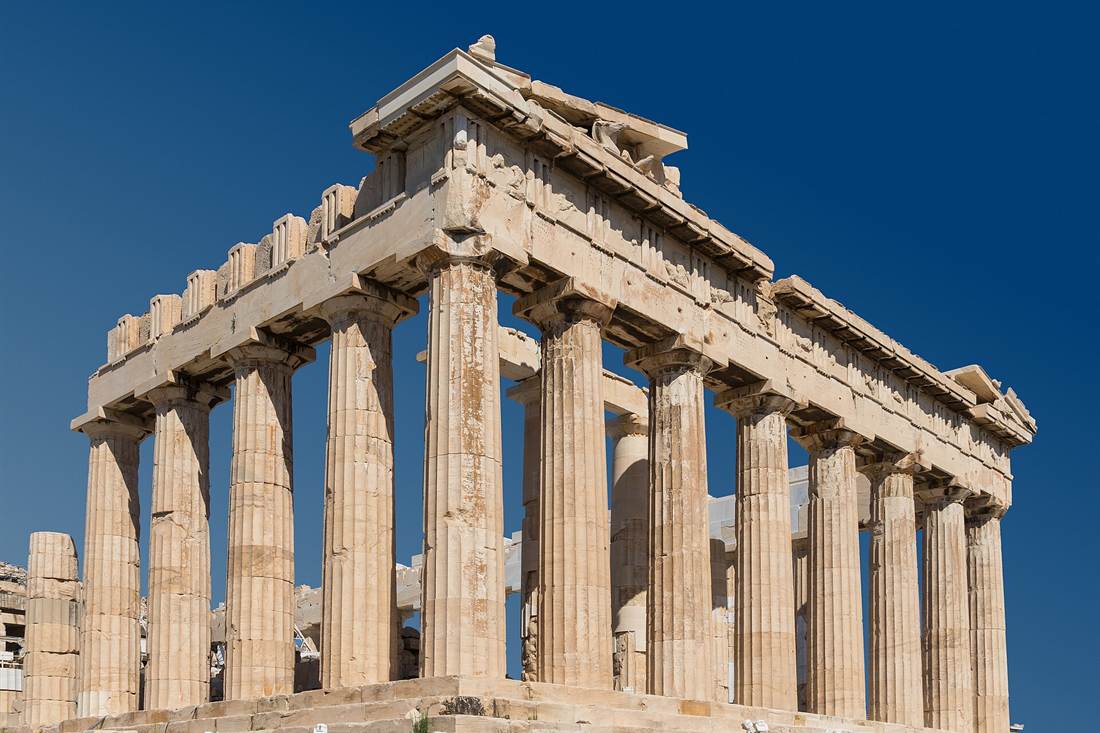
Athens historical sites span 3,400 years of recorded history, from the Mycenaean fortress on the Acropolis to the palace that now houses the Greek Parliament. The classical monuments are the best known, but Roman arches, Byzantine churches and Ottoman mosques stand within a few streets of them.
Only two of these sites, the Acropolis and Daphni Monastery, carry a UNESCO World Heritage listing. If you plan to add an island after Athens, the Greece Tours homepage links the islands and regions we cover. For the landmarks that need no ticket, such as the Parliament, the squares and the old churches, read the plan for Athens free sightseeing.
What are the main Athens historical sites, and which period does each one belong to?
The main Athens historical sites fall into six periods. They begin with a Bronze Age settlement and end with the nineteenth-century capital. The city’s recorded history spans over 3,400 years. Roman, Byzantine and Ottoman monuments still stand beside the classical ones.
The oldest known human presence in Athens is the Cave of Schist. It dates to between the 11th and 7th millennia BC. People have lived in the city without a break for at least 5,000 years. By the fourteenth century BC, Athens was a centre of the Mycenaean civilisation.
UNESCO lists two Athens historical sites as World Heritage Sites: the Acropolis and the medieval Daphni Monastery. The Acropolis was inscribed in nineteen eighty-seven and meets five of the cultural criteria. The listed area covers 3.04 hectares, with a buffer zone of 116.71 hectares around it.
- Bronze Age and the early city. One of the oldest Athens historical sites is the Mycenaean fortress on the Acropolis. Iron Age burials in the Kerameikos show Athens as a leading trade centre from 900 BC onwards.
- The classical city, 508 to 338 BC. Cleisthenes brought in democracy in 508 BC. Philip II and Alexander the Great defeated an alliance led by Athens and Thebes at Chaeronea in 338 BC. Athens historical sites of this period include the Parthenon, the Erechtheion, the Ancient Agora and the Pnyx.
- The Hellenistic and Roman city, 322 BC to AD 395. In the second century AD, the emperor Hadrian ordered new public buildings. Athens historical sites from these centuries include Hadrian’s Library, the Odeon of Herodes Atticus, the Temple of Olympian Zeus and the Tower of the Winds.
- The Byzantine city, AD 395 to the early thirteenth century. Almost all of the important Middle Byzantine churches in and around Athens were built in the eleventh and twelfth centuries. Daphni Monastery and Kapnikarea are two Athens historical sites from those centuries.
- Ottoman rule, until eighteen thirty-three. Sultan Mehmed II captured Athens in the fifteenth century. Ottoman forces withdrew in March, eighteen thirty-three. The Tzistarakis Mosque in Monastiraki Square and the Fethiye Mosque are two Ottoman monuments that remain.
- Modern Greece from the nineteenth century. Athens replaced Nafplio as the capital in eighteen thirty-four. The palace of the Bavarian king, now the Greek Parliament, belongs here. The Zappeion and the First Cemetery of Athens are two more Athens historical sites from this period.
Which Athens historical sites were built in the age of Pericles?
Five Athens historical sites come from the building programme of Pericles. Four stand on the Acropolis. These are the Propylaea, the Parthenon, the Erechtheion and, at the south-west corner, the Temple of Athena Nike. The fifth, the Temple of Hephaestus, sits on Agoraios Kolonos hill at the north-west side of the Ancient Agora.
- Parthenon: 447 to 432 BC. Ictinus and Callicrates were the architects, and Phidias led the sculpture. Pentelic marble.
- Propylaea: begun in 437 BC and almost finished in 432 BC. Mnesicles was the architect. Doric columns of Pentelic marble.
- Erechtheion: 421 to 406 BC. The architect is unknown, and the overseers were Philokles and Archilochos. Pentelic marble with a blue Eleusinian limestone frieze.
- Temple of Athena Nike: finished around 420 BC. Callicrates was the architect. Pentelic marble. It is the smallest temple on the Acropolis, 8 metres long and 5.5 metres wide.
- Temple of Hephaestus: begun in 449 BC. The architect is unknown and goes by the name of the Hephaisteion Master. Marble from Mount Penteli, except the bottom step.
Pericles drew the money for these Athens historical sites from the treasury of the Delian League. In 449 BC he proposed a decree that allowed 9,000 talents for rebuilding Athenian temples. The back room of the Parthenon held the League’s money. The history of the Acropolis tells the story of the rock before and after these buildings.
Quarrymen cut the Pentelic marble blocks to exact measurements, and the architects rejected blocks with faults. Stonemasons travelled to Athens from far and wide to work on the Parthenon. Slaves, foreigners and Athenian citizens did the same jobs for the same pay.
The Erechtheion has two porches, which is unusual for a Greek temple. The second porch rests on six sculpted maidens. You can read more in the guide to the Erechtheion and its Caryatids.
The age of Pericles runs from about 461 to 429 BC. He died of the plague in 429 BC. Three of the five Athens historical sites were finished after he died. Those are the Erechtheion, the Temple of Hephaestus and the Temple of Athena Nike.
A group of scholars believes the Temple of Hephaestus took about three decades. Funds and workers went to the Parthenon first. Its roof was finished in the Peace of Nicias, between 421 and 415 BC.
Which Athens historical sites show how Athenian democracy worked?
Four Athens historical sites show democracy at work. Citizens voted on the Pnyx hill. The Areopagus judged murder cases. Councillors and jurors worked in the Ancient Agora. The rebuilt Stoa of Attalos now holds the finds from the Agora dig.
Begin at the Pnyx, a hill less than 1 km west of the Acropolis. The assembly first met in the Agora. In the early fifth century BC it moved to this hillside. The presiding officer opened each debate by asking who wished to speak.
The Pnyx is one of the Athens historical sites where citizens voted on the city’s laws. One scholarly estimate puts the crowd at about 6,000 citizens. In the third quarter of the fourth century BC the hill was rebuilt and enlarged. Builders cut the speakers’ platform from the bedrock.
Next among the Athens historical sites of democracy is the Areopagus, the Hill of Ares. A council met here, and Solon reorganised it in 594 BC. Ancient authors say that reforms in 462 or 461 BC left it with murder trials only. In The Eumenides, a play by Aeschylus from 458 BC, Orestes stands trial on this hill.
The Ancient Agora lies north-west of the Acropolis, with the Areopagus on its southern edge. Among Athens historical sites, it was the daily workplace of democracy. The Council of 500 ran the daily affairs of the city. Lot chose its members, 50 from each of 10 tribes, and each served for one year.
The council’s executive group dined in the Tholos. This round building was about 60 feet across and went up around 470 BC. Jurors came from a stone machine, the kleroterion. Citizens placed name tokens in its slots. A die released through a tube chose each row of tokens or discarded it. Athens used this machine from 370 BC.
The Agora also hosted ostracism. A citizen scratched a name on a pottery shard, an ostrakon, to send a leader into exile. Plutarch gives the quorum as 6,000 votes. Around 12,000 political ostraka have been dug up in the Agora and the Kerameikos.
King Attalos II of Pergamon ruled from 159 to 138 BC. He built the Stoa of Attalos as a gift to Athens. It measures 115 by 20 metres and has two storeys. The American School of Classical Studies at Athens began systematic digging in the Agora in nineteen thirty-one.
The school dedicated the rebuilt stoa on 3 September nineteen fifty-six. Today it holds the Museum of the Ancient Agora, with the excavated finds and records. Of the four Athens historical sites here, this stoa is the one rebuilt on its original foundations.
Which Athens historical sites hold the city’s graves and memorials?
The Kerameikos holds the graves, gates and city wall of ancient Athens. The First Cemetery of Athens holds the graves of modern Greece, from generals to poets. Together, these two Athens historical sites cover burial in both eras.
The Kerameikos was the potters’ quarter of ancient Athens, and the English word ceramic comes from its name. The cemetery grew beside the Eridanos river. An organised burial ground existed here from about twelve hundred BC. Archaeologists have found cist graves and offerings from that time.
Themistocles built a wall around Athens after the Persian sack of 480 BC. The builders set old grave monuments into it. A short dated list shows how the Kerameikos changed around that wall:
- 478 BC: the Dipylon Gate and the Sacred Gate open in the new wall.
- 471 BC: the wall is complete, 8,500 metres long, with at least 13 gates.
- About 400 BC: the Pompeion, a courtyard of 45 by 17 metres, is built between the two gates.
- 317 BC: a decree bans lavish tombs along the Street of Tombs.
- 86 BC: the siege of Sulla destroys the fourth-century Pompeion.
The Sacred Gate took its name from the Sacred Way to Eleusis. The Eridanos river ran through it in a channel. Among Athens historical sites, it is unusually well preserved. Its remains show building phases from the fifth century BC to the first century AD.
The Dipylon, whose name means Two-Gated, was the main gate of the wall. It served the city until the third century AD. Outside it lay the state cemetery, where Athens buried the citizens it honoured.
State graves beside the gate held warriors and statesmen, among them Pericles and Cleisthenes. In 431 BC Pericles gave his funeral oration in this cemetery.
These Athens historical sites lie under a living city. Builders of the Kerameikos metro station found about 1,000 tombs from the fifth and fourth centuries BC. They also found a pit with the remains of 89 people. Pottery dates the pit to between 430 and 426 BC.
The First Cemetery of Athens is the official cemetery of the city and the first one built. It opened in eighteen thirty-seven. It lies behind two other sites: the Panathenaic Stadium and the Temple of Olympian Zeus. The cemetery sits at the top end of Anapafseos Street, which means Eternal Rest Street.
Pines and cypresses shade the paths. Three churches stand inside: Saint Theodores, Saint Lazarus and the Catholic church of Saint Charles. Protestants and Jews have burial areas too. The Municipality of Athens runs the cemetery, and it is a declared historical monument.
Theodoros Kolokotronis, a leader of the Greek War of Independence, lies here. So does the poet Odysseas Elytis, who won the Nobel Prize in Literature in nineteen seventy-nine. The Kerameikos records the ancient city, and the First Cemetery records the modern capital. Both rank among the Athens historical sites you can read through their graves.
Which Athens historical sites date from Roman rule under Hadrian?
Three Athens historical sites date from Hadrian’s stay in the winter of AD 131 to 132. They are his Library, his Arch and the finished Temple of Olympian Zeus. The Roman Agora, its gate and the Tower of the Winds are older. They come from the first century BC.
- Tower of the Winds, finished by about 50 BC: a roof of 24 stone slabs held by one round keystone.
- Roman Agora, built between 27 BC and 17 BC: an open court about 100 metres east of the old agora.
- Gate of Athena Archegetis, 11 BC: four Doric columns in Pentelic marble.
- Arch of Hadrian, AD 131 or 132: one passage 6.5 metres wide, built with no cement or mortar.
- Hadrian’s Library, AD 132: a Corinthian entrance, a columned courtyard and a long pool.
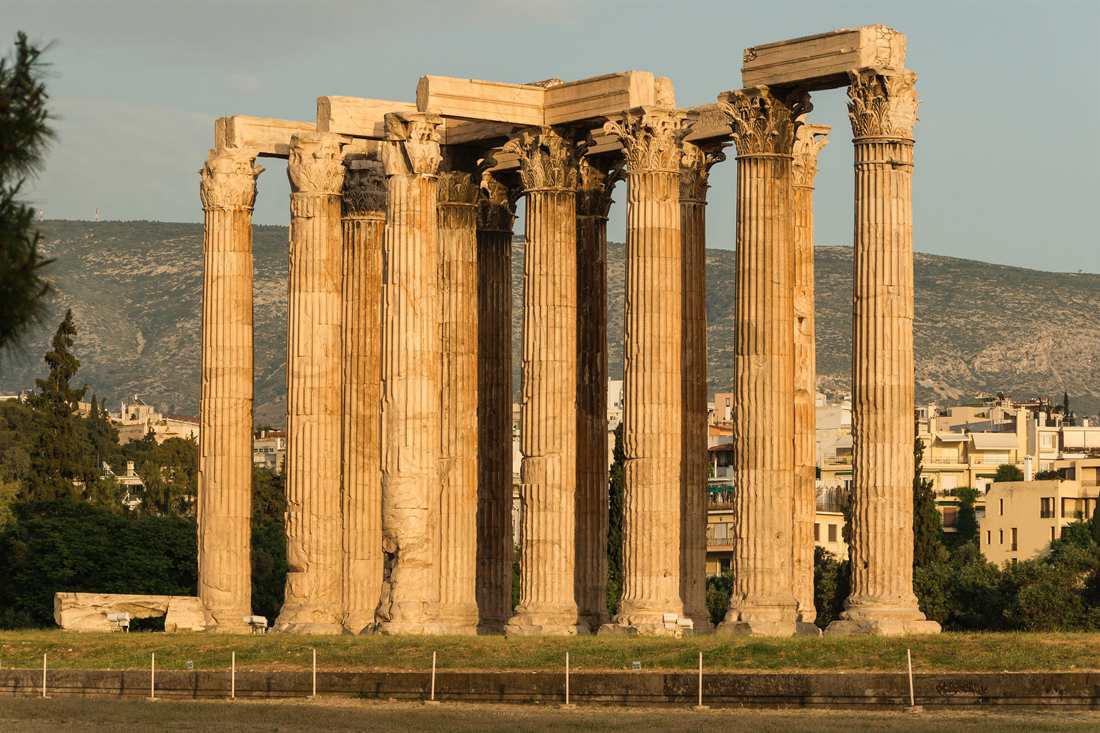
- Temple of Olympian Zeus, dedicated in AD 132: 110.35 metres long and 43.68 metres wide.
Hadrian knew the city before he built there. He held Athenian citizenship and served as archon in AD 112. He arrived in Greece in the autumn of AD 124, and a building programme began on that visit. At the Athenians’ request he revised their constitution and added a new tribe named after himself.
Two of these Athens historical sites carry his name. Hadrian’s Library lay on the north side of the Acropolis and opened onto the Roman agora. Its ceilings were gilded wood, and shelves on the east side held rolls of papyrus. Hadrian’s Arch crossed an old road that led to the Olympian Zeus temple.
The Temple of Olympian Zeus is the Athens historical site that Hadrian finished rather than started. Work began in the sixth century BC and stopped more than once. Hadrian dedicated the temple in AD 132 and took the title Panhellenios. A walled, marble-paved precinct surrounded it.
The Roman Agora is not Hadrian’s work, which matters when you sort Athens historical sites by ruler. Julius Caesar promised the money in 51 BC, and Augustus paid for it. Hadrian appears on the gate, where an inscription records a decree from his reign about taxes on oil merchants.
The Tower of the Winds stands next to the east gate of that agora. A tank in its rear turret fed the water clock inside. The water came from the Clepsydra spring on the Acropolis. The sundials on the east and west faces have four hour lines each. The south face has eight.
Which Athens historical sites were built for plays, music and games?
Three of these Athens historical sites were built for crowds. The Theatre of Dionysus held plays, the Odeon of Herodes Atticus held music, and the Panathenaic Stadium held games. Their stone and marble phases run from the fourth century BC to AD 161.
Among the Athens historical sites on the Acropolis slopes, the Theatre of Dionysus lies on the south side. It stands inside the sanctuary of Dionysus the Liberator. Its stone seating comes from the fourth century BC, when the statesman Lycurgus oversaw the work. The auditorium had 78 rows, split into 13 wedges by 12 stairways.
The two front rows were thrones of Pentelic stone for priests and officials. The central throne belonged to the priest of Dionysus. The Romans refurbished the stage building in the time of Nero. The Athenians also gave Hadrian a statue in the theatre, with an inscription that listed his career.
The Odeon of Herodes Atticus went up in AD 161. The orator Herodes Atticus built it in memory of his Roman wife, Aspasia Annia Regilla. He gave it to the city as a gift. The hall held 5,000 people and was the largest of its time.
It had 33 rows of marble seats and a roof of cedar of Lebanon timber. The Heruli destroyed it in AD 267. Builders restored the stands in Pentelic marble in the nineteen fifties. Today it is one of the Athens historical sites that still holds an audience.
The Panathenaic Stadium is the one built for games among these Athens historical sites. It fills a natural ravine between the hills of Agra and Ardittos. A racecourse for the Panathenaic Games stood there from the sixth century BC. In the fourth century BC Lycurgus built a stadium of poros stone on it.
Herodes Atticus rebuilt the stadium in Pentelic marble by AD 144, with 50,000 seats. Owls, the symbol of Athena, decorated the seats. When Herodes died, his funeral took place in the stadium he had commissioned.
All three of these Athens historical sites fell out of use. For the stadium, Emperor Theodosius I banned the old festivals in the late fourth century AD, and it was abandoned. Ernst Ziller excavated it in eighteen sixty-nine and eighteen seventy. After a rebuild, it hosted the opening and closing ceremonies of the first modern Olympics in eighteen ninety-six.
Which Athens historical sites date from the Byzantine centuries?
Four churches in the centre tell the Byzantine side of the Athens historical sites. They are Kapnikarea, Holy Apostles of Solaki, Agioi Theodoroi and the Little Metropolis. Three date from the tenth and eleventh centuries, and all four follow the cross-in-square plan.
Start with Kapnikarea, the easiest of the Byzantine Athens historical sites to find. It stands in the middle of Ermou Street, at the edge of Plaka. It is one of the oldest churches in Athens still in use. Scholars date the south church to just after the middle of the eleventh century.
It is a domed cross-in-square. It has three parts: the south church, the chapel of Saint Barbara and a porch on the west. When King Otto had Leo von Klenze draw the new city plan, the church was considered for demolition. Ludwig I of Bavaria objected and saved it.
Holy Apostles of Solaki stands inside the Ancient Agora, next to the Stoa of Attalos. It dates from the late tenth century and is built of brick. Besides the Temple of Hephaestus, it is the only monument in the Agora that has stood intact since its foundation. That makes it a rare survivor among the Athens historical sites.
It was the first significant church of the Middle Byzantine period in Athens. It started the Athenian type, which joins the four-pier plan to the cross-in-square. Builders set it partly over a second-century nymphaeum.
Agioi Theodoroi stands in Klafthmonos Square, at the corner of Euripidou and Skouleniou streets. It dates from the middle of the eleventh century. An inscription over the west door names Nikolaos Kalomalos, who renewed the church from its foundations. His title was spatharokandidatos.
Historians read the date on that inscription as either the year ten forty-nine or ten sixty-five. Conservation work in nineteen sixty-seven found graves and part of a Roman mosaic under the church.
The Little Metropolis stands on Mitropoleos Square, beside the Metropolitan Cathedral of Athens. It is a small building, just 7.6 metres by 12.2 metres. Its walls are reused marble blocks, with ninety sculptures set above the windows. Only the dome uses brick.
Its other names are Agios Eleftherios and Panagia Gorgoepikoos. It got the name Little Metropolis because it stood inside the bounds of the residence of the Metropolitan of Athens. From eighteen forty-one to eighteen sixty-three, the building housed the public library of Athens.
The date of the church is still argued. Scholars have proposed dates from the ninth to the thirteenth century. In fourteen thirty-six the antiquarian Cyriacus of Ancona noted one of its reused inscriptions lying in the Ancient Agora. One historian therefore dates the church after that year.
The Byzantine and Christian Museum is the place that holds the finds. Its sculpture collection came from works gathered at monuments around Attica. The museum owns over 25,000 artefacts from the third to the twentieth century AD. It is the indoor stop on a trail of Athens historical sites from this age.
Which Athens historical sites are monasteries beyond the old centre?
Two of the Athens historical sites outside the old centre are Byzantine monasteries. Daphni, in the suburb of Chaidari, holds a UNESCO listing. Kaisariani stands on the northern side of Mount Hymettus, near Athens.
Daphni Monastery is one of the Athens historical sites built over an older sanctuary: the Sanctuary of Apollo. The Goths desecrated that sanctuary in AD 395, and a monastery followed near the end of the sixth century. One of the four Ionic columns still stands in the south wall of the church. Lord Elgin took the other three to London.
The mosaics date from the early Komnenian period, around the turn of the twelfth century. Sixteen prophets ring the base of the dome, below Christ Pantocrator. The glass of the gold tesserae is believed to have been made on site.
Frankish crusaders sacked the monastery in the early thirteenth century. The region then joined the Duchy of Athens under Othon de la Roche. He gave Daphni to the Cistercian Abbey of Bellevaux. The Cistercians added a cloister and twin pointed arches in the Gothic style.
UNESCO listed Daphni in nineteen ninety, together with two monasteries outside Athens. The listed area covers just under one hectare. The name Daphni is modern Greek for laurel grove.
Among the Athens historical sites, Kaisariani Monastery grew in layers. Remains of a large early basilica lie to the west. A smaller church was built over it in the tenth or eleventh century. The church that survives dates from around the turn of the twelfth century.
Two Athens historical sites share one date, fourteen fifty-eight. That year the Cistercians left Daphni, and the Duchy of Athens ended. The Turks occupied Attica, and Sultan Mehmed II went to Kaisariani. According to Jacob Spon, a French doctor, the sultan received the key to the city there.
The buildings left of the east entrance at Kaisariani circle a natural water source. Later the bath house became an olive oil press, and its jars survive. An inscription on the west wall says that Ioannis Ypatos painted the church frescoes in sixteen eighty-two. The wealthy Benizelos family paid for them.
Which of the two is closer to the centre? On distance alone, Kaisariani. The town of Kaisariani lies about 3 km southeast of the city centre, and the monastery belongs to its municipality. Daphni lies 11 km northwest of central Athens.
To choose between the two Athens historical sites, match the art. Daphni has gold mosaics, and Kaisariani has frescoes.
Which Athens historical sites date from Ottoman rule?
Three Ottoman buildings are among the Athens historical sites still standing in the old centre. They are the Fethiye Mosque, the Tzistarakis Mosque and the Bath House of the Winds. None works as a mosque or a bath today.
A crusader duchy came before the Ottomans. The Duchy of Athens was one of the states set up in Greece after the Fourth Crusade.
Three powers held the duchy in turn: the French de la Roche dynasty, the Catalans and the Italian Acciaioli. The Ottoman conquest ended it in the fifteenth century. All three Athens historical sites took their Ottoman form after that conquest.
Start with the Fethiye Mosque. It stands on the north side of the Roman Agora. The site held a Christian basilica from the eighth or ninth century. That church became a mosque in the middle of the fifteenth century. The date matched a visit by Sultan Mehmed the Conqueror in fourteen fifty-eight.
The building you see now went up between sixteen sixty-eight and sixteen seventy. Its porch rests on five arches, each topped with a small dome. The main hall sits under a dome on four pillars. In Ottoman times people called it the Wheatmarket Mosque.
The Venetians besieged the Acropolis from 23 to 29 September of sixteen eighty-seven. A mortar shell hit the Parthenon, where the Ottomans stored gunpowder. The Venetians then held the city from October until the following spring.
In that time one of these Athens historical sites changed faith again. The Venetians made the Fethiye Mosque a Catholic church for Dionysius the Areopagite.
After Greek independence the building served as a barracks, a military prison and a military bakery. In the early twentieth century it stored finds from the Agora and Acropolis excavations. After a long restoration it reopened to the public, and cultural exhibitions are held there.
The next of these Athens historical sites is the Tzistarakis Mosque on Monastiraki Square. The Ottoman governor of Athens, Mustapha Agha Tzistarakis, built it in seventeen fifty-nine. According to tradition, he used a pillar of the Temple of Olympian Zeus to make lime for the building. Wikipedia names a column of the nearby Hadrian’s Library as the other candidate.
The Turks considered that act a sacrilege and feared vengeful spirits loosed upon the city. It cost the governor his post. Athenians who shared the belief took a plague outbreak later that year as proof.
During the Greek War of Independence the building was an assembly hall for the town elders. In March of eighteen thirty-four it hosted a ball in honour of King Otto. Architect Anastasios Orlandos partly rebuilt it in nineteen fifteen. From nineteen eighteen until nineteen seventy-three it housed the Museum of Greek Handwork.
Today the mosque is an annex of the Museum of Greek Folk Art, and a pottery collection remains inside. An earthquake damaged it in nineteen eighty-one. It reopened to the public in nineteen ninety-one.
The Bath House of the Winds is the only Ottoman public hammam that survives in Athens. It stands at Kyrristou 8, near the Tower of the Winds. It dates from the early Ottoman period, between the fifteenth and the seventeenth century.
The bath kept working until nineteen sixty-five. In nineteen ninety-eight it passed to the Museum of Modern Greek Culture, which uses it for exhibitions. Among the Athens historical sites of Ottoman rule, it is the one built for washing, not for prayer.
Which Athens historical sites hide in the old neighbourhoods of Plaka, Monastiraki and Anafiotika?
Three old quarters around the Acropolis count as Athens historical sites in their own right. Plaka lies over the ancient town. Anafiotika grew from the homes of island builders. Monastiraki took its name from a monastery that has vanished.
Start in Anafiotika, on the northeast side of the Acropolis hill. Builders from the island of Anafi came to Athens in the reign of King Otto to refurbish his palace. They put up the first houses here. Carpenters, stone workers and marble workers from other Cycladic islands soon joined them.
The quarter kept changing. Greek refugees from Asia Minor settled here in nineteen twenty-two. Until then the people came only from the Cycladic islands. In nineteen fifty a part of the quarter was destroyed for archaeological research. In nineteen seventy the state began to buy the houses.
The little streets from Stratonos up to the Acropolis rock are still unnamed. The houses go by names like Anafiotika 1 and Anafiotika 2. This corner is young next to the Athens historical sites around it.
From there the lanes lead into Plaka, which wraps the Acropolis on its north and east sides. Plaka is built over the residential areas of the ancient town. People have lived here from the Neolithic age to today. Adrianou and Tripodon streets can be traced back to ancient times.
Wikipedia says Plaka contains monuments from all periods of the city’s history. So the quarter holds Athens historical sites from every era.
Adrianou Street is the largest street in Plaka. It splits the quarter in two. Ano Plaka lies right under the Acropolis. Kato Plaka lies between Syntagma and Monastiraki. The name Plaka is first recorded in the second half of the seventeenth century. Until King Otto’s time it meant only the area around the Choragic Monument of Lysicrates.
A fire in eighteen eighty-four burned a large part of the quarter. It gave archaeologists the chance to dig two Athens historical sites, the Roman Agora and Hadrian’s Library. Plaka held an Albanian community until the late nineteenth century. Today it is the only neighbourhood in Athens with all utilities underground, in custom-made tunnels.
Follow Adrianou Street toward Monastiraki, the third quarter among these Athens historical sites. Adrianou and Pandrossou are its two main streets. The district is named after Monastiraki Square, and the square is named after the Church of the Pantanassa.
This tenth-century church was the main church of a vanished monastery. People first called it the Great Monastery, then monastiraki, meaning little monastery. It stands in the square between Athinas and Mitropoleos streets, facing Monastiraki station.
The station serves Line 1 and Line 3 of the Athens Metro. A short route links these Athens historical sites. Start in Anafiotika, cross Plaka along Adrianou Street and finish at Monastiraki Square. Walkers who want every leg with its length and metro stops can follow the Athens historical walking routes.
Which Athens historical sites mark the birth of modern Greece?
In eighteen thirty-four, the new Greek kingdom made Athens its capital. Five Athens historical sites tell what came next. They are the Old Royal Palace, Syntagma Square, the National Historical Museum, the Zappeion and the Athens Trilogy.
When Otto of Bavaria arrived as king, Athens held only 4,000 to 5,000 people. They lived in scattered houses at the foot of the Acropolis. A modern city plan was laid out, and public buildings went up. All five of these Athens historical sites date from after his arrival.
The Old Royal Palace is the first royal palace of modern Greece. The Bavarian architect Friedrich von Gärtner designed it. King Ludwig I of Bavaria paid for it as a personal loan to his son Otto. Work began in eighteen thirty-six. Islanders from Tinos, Sifnos, Paros and Naxos volunteered to work on it without pay.
On 3 September eighteen forty-three, Dimitrios Kallergis and his soldiers gathered under the king’s windows and demanded a constitution. Otto granted one. The coup was bloodless. The square in front of the palace took the name Syntagma, which means Constitution.
In November nineteen twenty-nine the government decided to move Parliament into the palace. The Senate convened there on 2 August nineteen thirty-four. The move gave new jobs to two Athens historical sites. One is the palace. The other is Parliament’s old home on Stadiou Street, now the National Historical Museum.
Parliament sat in that Old Parliament House from eighteen seventy-five until nineteen thirty-two. The museum was founded in eighteen eighty-two and is the oldest of its kind in Greece. Its collection runs from the fall of Constantinople in fourteen fifty-three to the Second World War. Weapons, paintings, manuscripts and regional costumes fill the rooms.
Among the Athens historical sites tied to the Olympic Games, the Zappeion opened on 20 October eighteen eighty-eight. Theophil Hansen designed it, and it was the first building raised for the revival of the Games. Its benefactor, Evangelos Zappas, did not live to see it built. In nineteen seventy-nine, Greece signed its European Community accession papers in the marble atrium.
The Zappeion sits next to the National Gardens, which surround the palace. The Athens Trilogy groups three neoclassical buildings on Panepistimiou Street. They rise side by side, and two brothers designed them.
- University: Christian Hansen designed it with an H-shaped plan. It was founded in eighteen thirty-seven and moved into the main building in November eighteen forty-one.
- Academy: his brother Theophil Hansen designed it. The foundation stone went down on 2 August eighteen fifty-nine, with money from the magnate Simon Sinas.
- National Library: Theophil Hansen designed this one too. The foundation stone went down on 16 March eighteen eighty-eight, and the three Vallianos brothers from Kefalonia paid for it.
Ernst Ziller supervised two of the three Athens historical sites in the Trilogy, the Academy and the Library. The Academy as an institution is younger than its building. It was founded on 18 March nineteen twenty-six, and the Numismatic Museum used the building before that. The University had 33 professors and 52 students in its first year.
Which Athens historical sites lie outside the city centre?
Four Athens historical sites lie beyond the centre. Cape Sounion sits at the southern tip of Attica. Eleusis lies in the west, Brauron on the east coast and Marathon in the northeast. All four belonged to ancient Attica, the land ruled from Athens.
Cape Sounion is the southernmost of these Athens historical sites. It lies 69.5 kilometres (43.1 miles) southeast of Athens. The Temple of Poseidon there went up between 444 and 440 BC. Builders laid marble from the Agrileza quarries over the limestone base of an older temple. Wilhelm Dorpfeld found that older temple in eighteen eighty-four.
Herodotus records a festival at the cape in the sixth century BC. The leaders of Athens sailed there in a sacred boat, and the festival came round every four years.
Of the Athens historical sites outside the centre, Eleusis lies in the west. It is now the town of Elefsina, on the Thriasian Plain in West Attica. The Sacred Way ran from Athens to it. Eleusis kept the title of polis and the right to coin its own money. No other town in Attica held that right, except Athens.
The Telesterion, the initiation hall of the Mysteries, had a roof that covered 3,000 people. The Mysteries were popular by 600 BC and declined in the fourth century AD.
The Persians destroyed the hall in 480 BC, and the Costoboci tribe destroyed it in 170 AD. Both times it was rebuilt. Alaric the Visigoth’s forces destroyed it in 396 AD, and nobody rebuilt it.
Vravrona is the modern name of Brauron, where the sanctuary of Artemis stands on the east coast of Attica. The tyrant Pisistratus came from Brauron by birth. He is credited with moving the cult to the Acropolis.
Two Athens historical sites shared that cult: the Brauron sanctuary and the Brauroneion on the Acropolis. The Brauroneion was the city’s own sanctuary of Artemis Brauronia. Its procession ran every four years, during the Arkteia festival.
The Brauron sanctuary had a pi-shaped stoa with dining rooms for ritual feasts. It stayed in use until the third century BC. Tension between Athens and the Macedonians then led to its abandonment. John Papadimitriou began the modern excavation in nineteen forty-eight.
Marathon is the northeastern of these Athens historical sites, about 17 miles from Athens. The Athenians beat a Persian force on its plain in 490 BC. The Soros, their burial mound, holds the ashes of 192 men and stands about 40 feet tall.
Dimitrios Philios excavated the Soros first. Valerios Stais dug it again in eighteen ninety and eighteen ninety-one. A second, smaller mound holds the Plataeans who fell beside the Athenians. Herodotus says the Greeks counted 6,400 Persian dead on the field. The name Marathon comes from the Greek word for fennel.
Which tours cover the Athens historical sites in one visit?
Six GetYourGuide listings in Athens link two or more of the Athens historical sites in a single outing. They run from 2 hours on an e-scooter to 6.5 hours on a full-day private tour. Each one names the monuments on its route.
The Acropolis and Ancient Agora walk lasts 4 hours and runs in English. It carries a skip-the-line label. The listing names the Erechtheion, the Parthenon, the Temple of Athena Nike and the Agora. It adds the Temple of Hephaestus, the Stoa of Attalos and the south slopes of the Acropolis.
The Acropolis, Plaka and Ancient Athens four-wheel e-scooter tour takes 2 hours. It runs in English, Spanish, Hebrew, German and French, and its label says small group. The ride reaches Acropolis viewpoints, the Ancient Agora and the Pnyx with less walking. For a short taste of the Athens historical sites, it is the shortest of the six.
The Athens Highlight Tour is a half-day outing of 5 hours in English. Its labels read skip the line, private group, small group and pickup available. The listing names the Acropolis, the Acropolis Museum, the Temple of Zeus and the Panathinaiko Stadium.
A second half-day listing runs 4 to 5 hours in English. It carries the same four labels: skip the line, private group, small group and pickup available. Its title promises the Acropolis, the Parthenon and all major sights.
The half-day city tour with Lycabettus takes 5 hours. It visits the Acropolis and the Plaka district. It also includes the guard change at the Tomb of the Unknown Soldier. Its labels say private group, small group and pickup available.
The full-day city tour is the longest at 6.5 hours, in English and Greek. Its labels say skip the line, private group, small group and pickup available. The listing names five stops: the Acropolis, its museum, the Ancient Agora, the Olympian Zeus temple and the Panathenaic Stadium.
Choose by the stops you want. The 2-hour ride reaches the Pnyx. The half-day tours add the Panathinaiko Stadium or Lycabettus. The 6.5-hour tour names the widest spread of Athens historical sites. All six listings show a free cancellation label.
What do travellers ask about Athens historical sites?
Three metro stations serve these sites, and one pedestrian street links the Acropolis slopes. Travellers also ask about a prince’s tomb, a hill with a view and a pass. The pass adds more sites to the Acropolis ticket.
Which metro stations serve the Athens historical sites?
Acropolis station on Line 2 stands on the east side of the Acropolis Museum. Planners first chose the name Olympieion, after the Temple of Olympian Zeus. Monastiraki station is next to the site of the Ancient Agora. Thiseio station took its name from the Temple of Hephaestus.
Can you walk between the Athens historical sites?
Yes. Dionysiou Areopagitou Street is a pedestrian street along the south slope of the Acropolis. It starts near Hadrian’s Arch and ends near Philopappos Hill. The Theatre of Dionysus has its entrance near Makrygianni Street. The Odeon of Herodes Atticus has its entrance near the far end.
Which of the Athens historical sites is a prince’s tomb?
The Philopappos Monument on Mouseion Hill, southwest of the Acropolis. It honours Gaius Julius Antiochus Epiphanes Philopappos, a prince from the Kingdom of Commagene who died in AD 116. His sister Julia Balbilla and the Athenians built it. It measures 9.80 by 9.30 metres and is built of white Pentelic marble. Only two-thirds of the front wall still stands.
What does a multi-site pass add to the Athens historical sites?
A multi-site pass pairs a timed-entry ticket for the Acropolis with access to up to 5 more archaeological sites. One GetYourGuide listing gives those sites 3 days of validity after the Acropolis visit. It also offers an optional audio guide.
Which hill shows the Athens historical sites from above?
Mount Lycabettus, at 277 metres, is the highest point in Central Athens. A panorama from its slopes shows the Panathenaic Stadium, the Parliament, the Temple of Olympian Zeus and the Acropolis. The Lycabettus Funicular climbs it from Aristippou Street in Kolonaki. A chapel of Saint George from the nineteenth century stands on the hill.
Is there more to Athens than its ruins?
Yes. The Athens guide goes on to museums, places to stay, walkable neighbourhoods and day trips of one day each.