
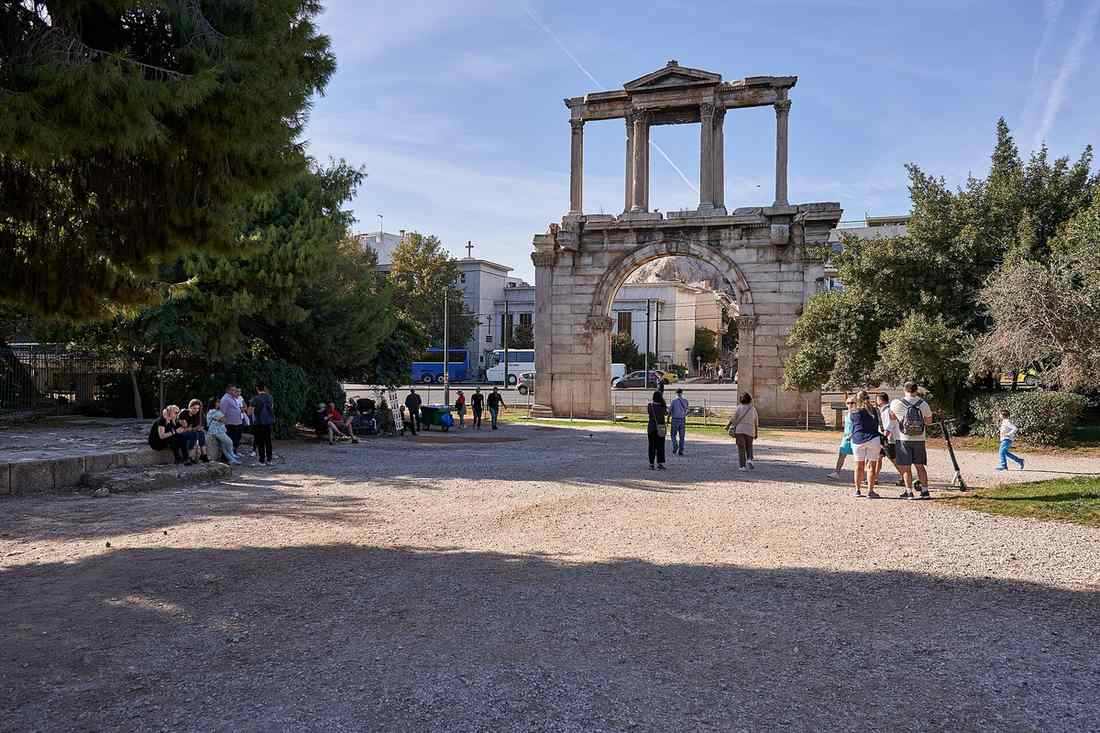
The Arch of Hadrian, or Hadrian’s Gate, in Athens is a graceful marble Roman gateway built around 132 AD beside the Temple of Olympian Zeus, famous for the inscriptions dividing the old city of Theseus from the new city of Hadrian. See it on a combined-ticket walk of the ancient sites with skip-the-line access from My Greece Tours.
This free, central monument is an easy highlight in the Athens travel guide. The sections below cover what it is, its history, the inscriptions, the architecture, what to see nearby, practical details and how to get there.
What is the Arch of Hadrian in Athens?
The Arch of Hadrian, known in Greek as Hadrian’s Gate, is a monumental marble gateway in central Athens, built around 132 AD. Resembling a Roman triumphal arch, it stands 18 metres high on the ancient road between the old city and the Temple of Olympian Zeus. Made of fine Pentelic marble, it is famous for its two contrasting inscriptions.
Standing proudly beside one of the busiest avenues in central Athens, the Arch of Hadrian is one of the city’s most recognisable Roman monuments and a free, open-air landmark that everyone passes between the Acropolis and the great Temple of Olympian Zeus. Commonly called Hadrian’s Gate, it is a grand ceremonial archway that in some respects resembles a Roman triumphal arch, though it served more as a symbolic gateway than a defensive structure. Built around 132 AD entirely from the same fine, white Pentelic marble used for the Parthenon, it rises about 18 metres high and 12.5 metres wide, spanning what was once an ancient road leading from the older heart of Athens to the new district that grew up around the great Temple of Olympian Zeus.
Its design combines a lower arched gateway with an upper tier of slender Corinthian columns, an elegant nod to the classical architecture of Athens itself. Most famously, the arch carries two short inscriptions, one on each face, that playfully divide the city between its legendary founder Theseus and the Roman emperor Hadrian. Easy to admire and free to visit, it is a fitting introduction to Roman Athens. It stands beside the great temple covered in the Temple of Olympian Zeus guide. Its story begins with a philhellene emperor.
What is the history of the Arch of Hadrian?
The arch was built around 131 to 132 AD to honour the Roman emperor Hadrian and celebrate his arrival in Athens, timed to coincide with the dedication of the neighbouring Temple of Olympian Zeus, which he completed. Hadrian, who ruled from 117 to 138 AD, was a passionate admirer of Greek culture and a great benefactor of Athens, visiting the city at least three times.
The story of the arch is bound up with the emperor it honours, Hadrian, one of Athens’s greatest Roman patrons. Ruling the Roman Empire from 117 to 138 AD, Hadrian was famous for his philhellenism, his deep love and admiration for Greek culture, and of all the cities of the Greek world Athens held a special place in his affection; he visited at least three times during his reign and lavished it with new buildings, monuments and institutions. The arch was erected around 131 to 132 AD, most likely by the grateful citizens of Athens, to mark the emperor’s arrival, his adventus, and to thank him for his many gifts to the city.
The timing was closely tied to the completion and dedication of the colossal Temple of Olympian Zeus nearby, a vast project begun centuries earlier that Hadrian finally finished, and the arch marked the entrance to the new quarter of the city he had developed around it. In this way the gateway served both as a tribute to the emperor and as a symbolic threshold into the Athens that Hadrian had renewed and expanded. This imperial connection gives the modest monument real historical weight. The same emperor’s library appears in the Hadrian’s Library guide. The inscriptions tell the rest of the story.
What do the inscriptions on the arch say?
The arch carries two inscriptions, one on each side. The side that faces the Acropolis bears the words, “This is Athens, the age-old city of Theseus”, while the side facing the Temple of Olympian Zeus declares, “This is the city of Hadrian, and no longer of Theseus”. Scholars believe they marked the boundary between the old classical city and the new district built by Hadrian.
The most fascinating feature of the arch, and the reason it captures so many imaginations, is the pair of carved Greek inscriptions running along its frieze, one on each face, that engage in a witty dialogue about the city. On the north-western side, the one looking toward the Acropolis and the old town, the inscription declares: “This is Athens, the age-old city of Theseus”, invoking the legendary hero-king who, according to myth, founded and united Athens. On the south-eastern side, facing the Temple of Olympian Zeus and the newer quarter, the second inscription responds: “This is the city of Hadrian, and no longer of Theseus”. The most widely held interpretation is that the arch stood at the symbolic boundary between the ancient, classical Athens of Theseus and the “new Athens” that the emperor Hadrian had built and embellished around the great temple, so that passing through the gate meant crossing from the old city into the new.
Whether read as a literal boundary marker or as a flattering tribute to Hadrian’s transformation of the city, the inscriptions turn a simple gateway into a thought-provoking statement about old and new Athens. They remain perfectly legible today. The classical city they reference is detailed in the Acropolis history guide. The design itself rewards a closer look.
What is the architecture of the arch like?
The Arch of Hadrian is built entirely of Pentelic marble and stands about 18 metres high, 12.5 metres wide and 2.3 metres deep. It has two levels: a lower section with a single large arched gateway, and an upper tier of thin Corinthian columns and pilasters framing rectangular openings, originally perhaps holding statues. The elegant Corinthian order echoes classical Athenian architecture.
For all its symbolic importance, the arch is also an elegant and carefully composed piece of architecture that rewards a moment’s study. It is constructed entirely from fine Pentelic marble, the prized white stone quarried from nearby Mount Pentelikon and used for the Parthenon and other classical masterpieces, which gives it a luminous, harmonious quality. The monument rises to about 18 metres in height, spanning around 12.5 metres in width with a depth of roughly 2.3 metres, and it is composed of two clearly distinct storeys. The lower level takes the form of a single large rounded archway, the gateway proper, flanked by pilasters, through which the ancient road once passed.
Above it sits a lighter, more decorative upper tier, an arrangement of slender Corinthian columns and pilasters framing a central rectangular opening and side bays, which may originally have held statues, perhaps of Hadrian and Theseus. The graceful Corinthian order and the use of classical marble are deliberate echoes of the architectural legacy of ancient Athens, blending Roman form with Greek refinement. The result is a monument that is both imposing and delicate. Seeing it framed against the Acropolis or the temple columns is memorable. The nearby Roman marketplace appears in the Roman Agora guide. The arch sits among many other sights.
What is near the Arch of Hadrian?
The Arch of Hadrian stands right beside the Temple of Olympian Zeus, with the Acropolis and its museum a short walk away, along with the Panathenaic Stadium, the National Garden, Zappeion and the Plaka old town all within easy reach. Its central position makes it a natural stop on a walking route linking the main ancient sights of Athens.
One of the joys of the Arch of Hadrian is its prime central location, surrounded by major attractions that make it easy to combine into a rewarding walking tour. Immediately behind the arch rise the towering columns of the Temple of Olympian Zeus, the largest temple in ancient Greece, which Hadrian completed and to which the gateway formed the entrance, so the two monuments are always visited together. A short walk to the north-west brings you to the foot of the Acropolis and the modern Acropolis Museum, while the charming old quarter of Plaka, with its lanes and tavernas, lies just beyond. In the other direction, the marble Panathenaic Stadium, home of the first modern Olympics, the green expanse of the National Garden and the elegant Zappeion Hall are all within a few minutes’ stroll.
This concentration of landmarks means the arch is rarely a destination in itself but rather a memorable stop on a route through ancient and central Athens. Standing beneath it, you can take in the temple, glimpse the Acropolis and orient yourself among the city’s great sights. Its setting makes it one of the easiest monuments to see. The green oasis nearby is covered in the National Garden guide. Visiting could hardly be simpler.
How do you visit the Arch of Hadrian?
The Arch of Hadrian is a free, open-air monument you can view at any time, day or night, as it stands beside Vasilissis Amalias Avenue with no enclosure or entry fee. The nearest metro stations are Akropoli and Syntagma on lines 2 and 3. Combine it with a ticket to the adjacent Temple of Olympian Zeus, which is part of the Athens combined ticket.
Visiting the Arch of Hadrian is wonderfully easy, as it is one of the few major ancient monuments in the city that you can admire completely free of charge and at any hour. The arch stands in the open beside the busy Vasilissis Amalias Avenue, at the edge of the archaeological zone, with no fence, gate or ticket required, so you can walk right up to it, photograph it and read its inscriptions whenever you pass, including when it is attractively floodlit at night. The most convenient way to reach it is by metro: Akropoli station on line 2, the red line, is just a couple of minutes’ walk away, and Syntagma station, served by lines 2 and 3 and the airport line, is also close, while buses and the tram stop nearby.
Because the arch is unenclosed, there is nothing to book, but most visitors pair it with the adjacent Temple of Olympian Zeus, which does charge admission and is included in the Athens combined ticket covering the Acropolis and other sites. Allow just a few minutes to see the arch itself, then continue to the temple and beyond. With such easy, free access, it is a must-see on any walk through central Athens. Combined tickets are explained in the getting around Athens guide. The questions below cover the points visitors ask most.
Frequently Asked Questions
What is the Arch of Hadrian famous for?
The Arch of Hadrian is famous as a marble Roman gateway built around 132 AD to honour the emperor Hadrian, and especially for its two inscriptions: one side reads “This is Athens, the age-old city of Theseus”, the other “This is the city of Hadrian, and no longer of Theseus”, marking the boundary between old and new Athens.
Is the Arch of Hadrian free to visit?
Yes, the Arch of Hadrian is a free, open-air monument with no enclosure or entry fee, viewable at any time, day or night. It stands beside Vasilissis Amalias Avenue near the Temple of Olympian Zeus. Most visitors combine it with the temple next door, which charges admission and is on the Athens combined ticket.
How do you get to the Arch of Hadrian?
The Arch of Hadrian is very central, beside Vasilissis Amalias Avenue at the edge of the archaeological zone. The nearest metro stations are Akropoli on line 2, a couple of minutes’ walk away, and Syntagma on lines 2 and 3. It sits right beside the Temple of Olympian Zeus and a short walk from the Acropolis.