
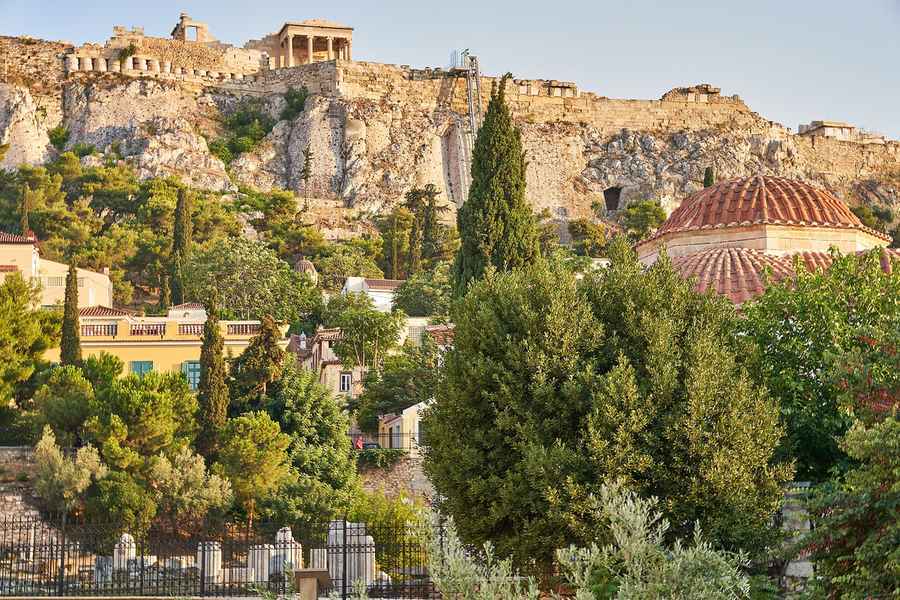
Hadrian’s Library in Athens is the grand Roman complex built by Emperor Hadrian in 132 AD beside Monastiraki, with its famous columned façade, vast courtyard and library halls. See it on a combined-ticket tour of the ancient sites with skip-the-line access from My Greece Tours for the full story.
This central Roman ruin is an easy highlight in the Athens travel guide. The sections below cover what it is, its history, what to see, the layout, practical details, nearby sites and how to get there.
What is Hadrian’s Library in Athens?
A large Roman public building raised by Emperor Hadrian around 132 AD, Hadrian’s Library stands just north of the Roman Agora and beside Monastiraki Square. More than a library, it was a grand cultural centre with a vast colonnaded courtyard, reading rooms, lecture halls, a garden and a pool. Its impressive surviving columns and façade make it a striking central ruin.
Right in the heart of old Athens, a few steps from bustling Monastiraki Square, lie the imposing ruins of Hadrian’s Library, one of the city’s most underrated ancient sites. Built around 132 AD by the philhellene Roman emperor Hadrian, who lavished attention on Athens as the cultural and spiritual centre of his empire, it was the largest and most magnificent building of his ambitious construction programme in the city. Despite its name, it was far more than a place to store books: it functioned as a grand cultural and intellectual complex, sometimes called the “University of Athens”, combining a library with reading rooms, lecture halls, a peaceful inner garden, and a large central courtyard surrounded by a hundred columns.
Modelled on the great imperial forums of Rome, it was a place for study, reading, debate and learning at the heart of the ancient city. Today, the surviving ruins, including a stretch of the splendid columned façade and the remains of the courtyard and halls, give a vivid sense of its former scale and grandeur, all set against the backdrop of the Acropolis. It is an easy and rewarding stop in the centre. It sits beside the district covered in the Monastiraki guide. Its origins lie with a remarkable emperor.
What is the history of Hadrian’s Library?
Hadrian’s Library was established by the Roman emperor Hadrian in the years 132 to 134 AD, as part of his grand programme to renew Athens as the cultural heart of the empire. It served as a centre of learning for centuries, was damaged in the Herulian invasion of 267 AD, later rebuilt, and over time hosted early Christian churches before falling into ruin. Excavations have revealed its full plan.
The story of Hadrian’s Library is bound up with the emperor who created it and the long centuries of change that followed. The emperor Hadrian, who reigned in the early second century AD and was a devoted admirer of Greek culture, chose Athens as a showcase for his vision of the empire, and around 132 to 134 AD he endowed the city with this monumental library and cultural centre as the centrepiece of an urban renewal that also gave Athens its famous arch and the completion of the Temple of Olympian Zeus. For generations the library served as a hub of learning and scholarship. It suffered serious damage during the devastating Herulian invasion of 267 AD, which wrecked much of Roman Athens, and was later repaired in the early fifth century.
In subsequent centuries the site took on new roles, with a succession of early Christian and Byzantine churches built within its courtyard, traces of which still survive among the ruins, before the complex gradually fell into decay. Modern archaeological excavation has uncovered the full plan of the building, allowing visitors to appreciate its original grandeur. This long history layers Roman, Byzantine and later remains on a single site. The same emperor’s work appears in the Temple of Olympian Zeus guide. The standing remains bring it to life.
What can you see at Hadrian’s Library?
At Hadrian’s Library you can see the impressive columned western façade with its tall Corinthian columns and monumental gateway, the outlines of the great courtyard and its central pool, the foundations of the library and lecture halls along the east side, and the remains of early Christian churches built later within the complex. An information area explains the layout.
Although partly ruined, Hadrian’s Library preserves enough to convey its former splendour, and a visit takes you through the grand spaces of a Roman cultural centre. The most striking and photographed feature is the well-preserved western wall and entrance, where a row of tall Corinthian columns of green-veined marble still stands proud against the sky, flanking the monumental gateway that once formed the imposing main entrance, or propylon, to the complex. Passing inside, you can trace the outline of the vast rectangular courtyard, originally surrounded on all sides by a colonnade of around a hundred columns and centred on a long decorative pool, which served as a peaceful space for reading and reflection.
Along the eastern side lie the foundations of the most important rooms: the main library hall itself, where the precious scrolls were kept in niches, flanked by lecture and reading halls. Scattered across the courtyard are the remains of the early Christian churches, including a distinctive quatrefoil structure, built on the site in later centuries, adding another layer of history. Information panels help you picture the original building. Seeing it set against the Acropolis is memorable. The neighbouring Roman site is covered in the Roman Agora guide. Planning a visit is simple.
How do you visit Hadrian’s Library?
Set on Areos Street, just off Monastiraki Square and next to the Tzistarakis Mosque, the site charges admission of around €6, and the site is included in the Athens combined ticket covering several monuments. Allow about 30 minutes to explore. It is open daily, generally from morning to late afternoon, with shorter winter hours, so check current times before visiting.
Visiting Hadrian’s Library is easy and fits effortlessly into a day exploring central Athens. The site entrance is on Areos Street, just a few steps from the lively hub of Monastiraki Square, next to the Ottoman-era Tzistarakis Mosque, placing it right among the old town’s main attractions. Admission costs around €6 for a standalone ticket, but crucially the site is included in the Athens combined ticket, the multi-site pass that also covers the Acropolis, the Ancient Agora, the Roman Agora and other monuments, so it can be visited at no extra cost if you already hold one, with the usual reduced rates and free-entry days. The complex is compact, so around thirty minutes is enough to walk the courtyard, admire the columned façade and study the ruins of the halls and churches at a relaxed pace.
It is open daily, generally from the morning until the late afternoon, with shorter hours in winter and occasional closures, so it is wise to check the current opening times before you go. Because it sits in the heart of Monastiraki, it combines perfectly with the nearby Roman Agora, the Ancient Agora and a wander through the old town. Combined tickets are explained in the getting around Athens guide. It pairs naturally with the sites next door.
What is near Hadrian’s Library?
Hadrian’s Library sits among the central sights: the Roman Agora and Tower of the Winds are right beside it, the Ancient Agora and Temple of Hephaestus a short walk away, Monastiraki Square and its flea market at its doorstep, and Plaka, the Acropolis and the Temple of Olympian Zeus all within easy walking distance, making it ideal to combine with other monuments.
One of the great advantages of Hadrian’s Library is its position at the very heart of ancient and old Athens, surrounded by major attractions that are easy to combine into a single day. Immediately beside it lies the Roman Agora, the marketplace of Roman Athens, crowned by the beautifully preserved octagonal Tower of the Winds, an ancient timepiece and weather station. A short walk away spreads the larger Ancient Agora, the civic heart of classical Athens, with its almost intact Temple of Hephaestus and the reconstructed Stoa of Attalos. Right on the library’s doorstep is bustling Monastiraki Square, famous for its flea market, souvenir shops and rooftop bars with Acropolis views, while the charming old quarter of Plaka, with its narrow lanes and tavernas, unfolds just beyond.
The Acropolis itself rises a short stroll to the south, and the towering Temple of Olympian Zeus and Hadrian’s Arch, another of the emperor’s monuments, lie about twenty minutes’ walk away. This concentration of sights means Hadrian’s Library is best enjoyed as one stop on a rich walking tour of the ancient centre. The civic ruins next door appear in the Ancient Agora guide. The questions below cover the points visitors ask most.
How do you get to Hadrian’s Library?
Extremely central, Hadrian’s Library lies just a few steps from Monastiraki Square. The easiest way is the metro to Monastiraki station, served by lines 1 and 3, just a short walk from the entrance on Areos Street. It is also an easy walk from Plaka, Syntagma and the Acropolis, so most visitors simply stroll there as part of exploring the old town.
Reaching Hadrian’s Library could hardly be easier, thanks to its prime location in the heart of the historic centre. The simplest approach is by metro: Monastiraki station, served by both line 1, the green line, and line 3, the blue line, which also runs directly from the airport, sits just a couple of minutes’ walk from the site, with the entrance on Areos Street a short stroll from the square. Because the library lies at the centre of the old town, however, many visitors never need transport at all and simply walk in as part of a wider tour of the area: Plaka and Syntagma are within easy walking distance, the Acropolis is a short stroll to the south, and the whole archaeological zone is linked by pedestrian-friendly streets.
Once you arrive, the compact site is quickly explored on foot, and it slots naturally between the Roman Agora next door and the bustle of Monastiraki. Comfortable shoes are useful for the uneven ancient paving and the cobbled old-town lanes around it. With such central access, the library is one of the easiest ancient sites to reach in the city. The wider network is explained in the getting around Athens guide. The questions below cover the points visitors ask most.
Frequently Asked Questions
What is Hadrian’s Library famous for?
Hadrian’s Library is famous as the grand Roman cultural complex built by Emperor Hadrian around 132 AD beside Monastiraki, far more than a library, with a vast colonnaded courtyard, reading rooms and lecture halls. Its surviving Corinthian columns and monumental façade make it one of the most impressive central Roman ruins in Athens.
How much does Hadrian’s Library cost?
Admission to Hadrian’s Library is around €6 for a standalone ticket, and it is also included in the Athens combined ticket covering the Acropolis, Ancient Agora, Roman Agora and other monuments. With the usual reductions and free-entry days, it can be visited at no extra cost if you already hold the multi-site pass.
How do you get to Hadrian’s Library in Athens?
The site lies a few steps from Monastiraki Square, with its entrance on Areos Street. The easiest way is the metro to Monastiraki station on lines 1 and 3, a short walk away. It is also an easy stroll from Plaka, Syntagma and the Acropolis as part of exploring the old town.