
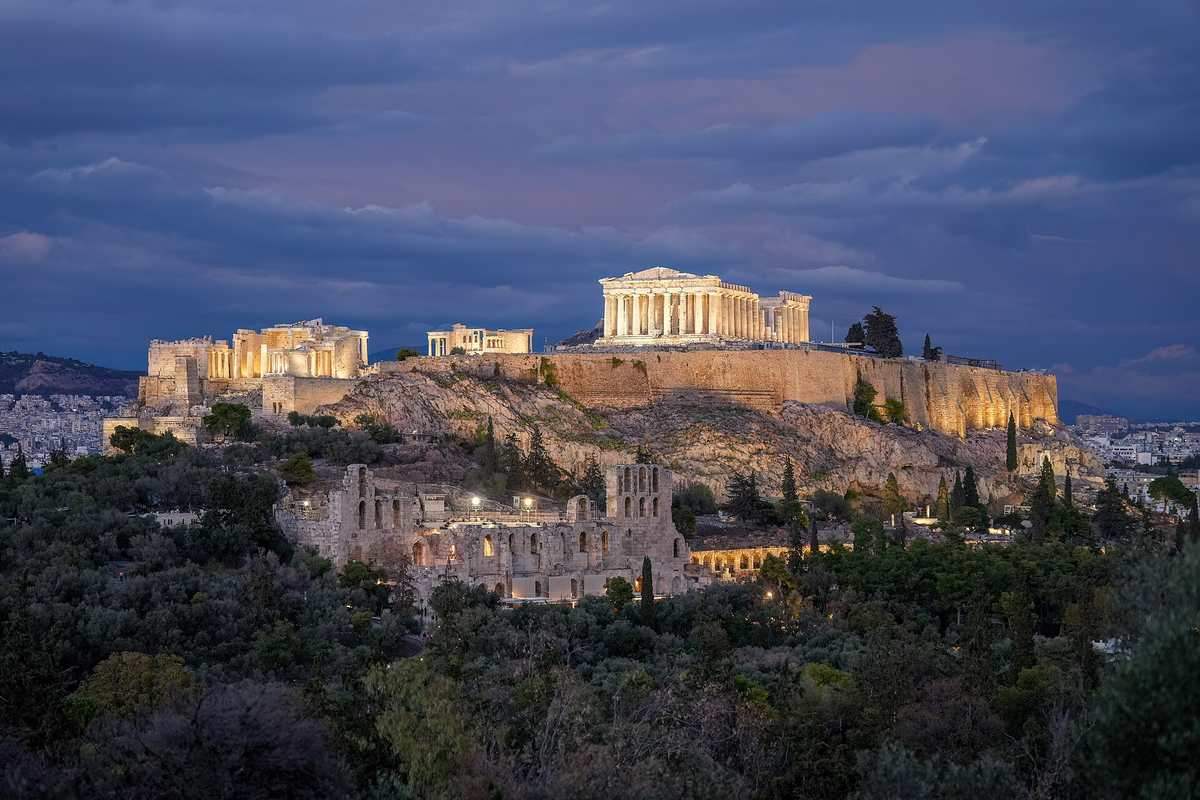
The Acropolis history runs from a Mycenaean fortress and Archaic temples through the Persian destruction of 480 BC to Pericles’ Golden Age masterpieces like the Parthenon, then Roman, Byzantine, Ottoman and modern eras. Explore this sacred rock with expert skip-the-line tickets and guided tours from My Greece Tours to bring its 3,000-year story to life.
Understanding the history deepens any visit in the Acropolis tickets and tours guide. The sections below cover the timeline and significance in full.
What is the history of the Acropolis in brief?
The Acropolis has been used since the Neolithic era, fortified as a Mycenaean citadel, and crowned with Archaic temples that the Persians destroyed in 480 BC. Pericles rebuilt it in the Golden Age (447-432 BC) with the Parthenon and other temples. It later served Roman, Byzantine, Frankish and Ottoman rulers before its modern restoration.
The Acropolis of Athens has a history stretching back thousands of years, layered with the marks of many civilisations. The rocky hill was inhabited as early as the Neolithic period, and by the late Bronze Age, around the 14th century BC, Mycenaean kings had fortified it with massive walls and built a palace on the summit. In the Archaic period, grand temples to the goddess Athena rose on the rock, only to be destroyed when the Persians sacked Athens in 480 BC. The Acropolis’s most glorious chapter came in the mid-5th century BC, when the statesman Pericles led a magnificent rebuilding programme during the Golden Age of Athens, creating the Parthenon, the Erechtheion, the Temple of Athena Nike and the Propylaea gateway that still crown the hill. In later centuries the monuments were adapted by Roman, Byzantine, Frankish and Ottoman rulers, surviving conversion into churches and a mosque and a devastating explosion, before the modern Greek state began the careful restoration that continues today. This long story makes the Acropolis a monument to the whole sweep of Western history, set out alongside the guide to the Parthenon. Its earliest eras set the stage.
What was the Acropolis before the Classical era?
Before the Classical era, the Acropolis was a Neolithic settlement and then a fortified Mycenaean citadel, with massive walls and a royal palace built around the 14th century BC. In the Archaic period it held early temples to Athena, including the Hecatompedon and the Old Temple of Athena, the predecessors of the Parthenon, which the Persians later destroyed.
Long before the famous marble temples, the Acropolis served as both a refuge and a sacred place, and its earliest history shaped what came later. The hill was settled in the Neolithic period, prized for its defensible height and springs. By the Mycenaean age, around the 14th century BC, it had become a powerful citadel: kings fortified the rock with enormous Cyclopean walls, some eight metres tall, and built a royal palace on the summit, traces of which survive. As Athens grew in the Archaic period from the 8th to 6th centuries BC, the Acropolis shifted from fortress to religious sanctuary dedicated to Athena, the city’s patron goddess. Large temples were raised there, including the Hecatompedon, or Hundred-Footer, built around 580 BC on the site later occupied by the Parthenon, and the Old Temple of Athena Polias from the mid-6th century BC. These Archaic temples, decorated with painted sculpture, were the direct ancestors of the Classical monuments. Their fate was sealed by the Persian invasion, which cleared the way for the Golden Age rebuilding, set out alongside the guide to the Acropolis monuments. The Persian destruction was a turning point.
How did the Persians affect the Acropolis?
The Persians sacked Athens and destroyed the Acropolis in 480 BC during the Greco-Persian Wars, burning its Archaic temples to the ground. After the Greek victory, the Athenians at first left the ruins as a memorial, then rebuilt the walls and, decades later under Pericles, raised the magnificent Classical temples seen today.
The Persian destruction of 480 BC was the pivotal event that cleared the way for the Acropolis’s golden age. During the Greco-Persian Wars, the army of the Persian king Xerxes captured and sacked Athens, and on the Acropolis they burned and demolished the Archaic temples, including the unfinished pre-Parthenon and the Old Temple of Athena, leaving the sacred hill a field of ruins. After the Greeks won their decisive victories and drove the Persians out, the Athenians initially chose to leave the blackened ruins untouched as a solemn war memorial, a reminder of what they had suffered and overcome. In the following years the statesmen Themistocles and Cimon rebuilt the Acropolis’s defensive north and south walls, incorporating fragments of the destroyed temples into the masonry, where they can still be seen. It was only later, from 447 BC, that the rebuilding of the temples themselves began under Pericles, transforming the scarred sanctuary into the crowning glory of Classical Athens. The Persian sack thus marks the line between the Archaic and Classical Acropolis, set out alongside the guide to the Temple of Athena Nike. The Golden Age created the monuments we admire.
What did Pericles build on the Acropolis?
In the Golden Age (447-432 BC), Pericles led a great building programme that created the Acropolis’s famous monuments: the Parthenon, temple of Athena and centrepiece; the Propylaea, the monumental gateway; the elegant Temple of Athena Nike; and the Erechtheion with its Caryatids. Architects Iktinos and Kallikrates and the sculptor Phidias led the work.
The Acropolis as we know it is largely the creation of one extraordinary period, the Golden Age of Athens under the leadership of Pericles in the mid-5th century BC. Funded partly by the wealth of the Athenian-led Delian League and inspired by the city’s victory over Persia and its new democracy, Pericles launched an ambitious building programme from around 447 BC to adorn the sacred rock. Its centrepiece was the Parthenon, the great Doric temple of Athena built between 447 and 432 BC by the architects Iktinos and Kallikrates, with sculptural decoration overseen by the master sculptor Phidias, who also made the colossal gold-and-ivory statue of Athena inside. Alongside it rose the Propylaea, the grand monumental gateway designed by Mnesicles; the small, jewel-like Temple of Athena Nike by Kallikrates; and the Erechtheion, the complex Ionic temple famous for its porch of Caryatids, sculpted maidens serving as columns. Together these masterpieces represent the peak of Classical Greek art and architecture. This single, dazzling generation of building defines the Acropolis, set out alongside the guides to the Propylaea and the Erechtheion and Caryatids. The monuments survived many later eras.
What happened to the Acropolis after antiquity?
After antiquity the Acropolis monuments were repeatedly adapted: the Parthenon became a Christian church under the Byzantines, then a mosque under Ottoman rule. In 1687 a Venetian bombardment ignited Ottoman gunpowder stored in the Parthenon, causing a huge explosion. Lord Elgin removed sculptures around 1800, and modern Greece has restored the site since the 19th century.
The Acropolis monuments did not stand still after the Classical age; they were reused and altered by every power that ruled Athens, accumulating a rich, sometimes turbulent later history. Under the Romans the sanctuary continued in use, and in the Byzantine era the Parthenon was turned into a Christian church of the Virgin Mary, while the Erechtheion also became a church. After the Frankish period, the Ottomans captured Athens in the 15th century and turned the Parthenon into a mosque, adding a minaret. The most catastrophic moment came in 1687, during a war between the Venetians and the Ottomans: the Ottomans were storing gunpowder inside the Parthenon when a Venetian cannonball struck it, and the resulting explosion blew out the centre of the temple, reducing much of it to ruins. Around 1800 the British diplomat Lord Elgin removed a large portion of the surviving Parthenon sculptures, now controversially held in the British Museum, along with a Caryatid. Since Greek independence in the 19th century, the Acropolis has undergone careful, ongoing restoration. This layered afterlife is part of its story, set out alongside the guide to the Acropolis Museum highlights. Its importance endures.
Why is the Acropolis historically important?
The Acropolis is historically important as the supreme symbol of Classical Greek civilisation, art and architecture, and as a monument to the birthplace of democracy in 5th-century BC Athens. Its temples, above all the Parthenon, embody the ideals and achievements of the Golden Age. A UNESCO World Heritage Site, it has inspired Western culture for over two millennia.
The Acropolis holds a unique place in world history as the enduring emblem of ancient Greek civilisation at its height. It was the sacred and symbolic heart of Classical Athens, the city that, in the 5th century BC, gave the world democracy, philosophy, drama and a flowering of art and learning, so the monuments crowning the rock stand as a tribute to that golden age and to the democratic ideals born below it. The Parthenon in particular is regarded as the masterpiece of Classical Greek architecture and a monument to democracy and to the Athenian victory over Persia, its perfect proportions and sculptures admired for nearly 2,500 years. The Acropolis and its art have profoundly shaped Western architecture, politics and aesthetics, inspiring everything from Roman and Neoclassical buildings to modern parliaments. Recognised as a UNESCO World Heritage Site, it draws millions of visitors who come to stand amid the origins of Western culture. This towering significance is why the Acropolis is one of the most important monuments on Earth, set out alongside the guide to the best time to visit. The questions below cover the points visitors ask most.
What can you still see of the Acropolis’s history today?
Today you can still see the Golden Age monuments, the Parthenon, Erechtheion, Propylaea and Temple of Athena Nike, along with the ancient circuit walls, fragments of destroyed Archaic temples built into them, and the south-slope theatres. The original sculptures are displayed in the nearby Acropolis Museum, letting you trace the full history on site.
One of the joys of visiting the Acropolis is how much of its long history remains visible on the rock and in the museum below. The crowning monuments of the 5th-century BC Golden Age still stand: the mighty Parthenon, the elegant Erechtheion with its Caryatids, the grand Propylaea gateway and the little Temple of Athena Nike, all in gleaming Pentelic marble, give a vivid sense of Classical Athens at its height. The defensive circuit walls that ring the summit preserve fragments of the earlier Archaic temples destroyed by the Persians in 480 BC, deliberately built into the north wall as a memorial, so the Persian destruction is literally embedded in the rock. On the slopes, the Theatre of Dionysus and the Odeon of Herodes Atticus show the Classical and Roman eras. Traces of the Mycenaean walls and later additions hint at the deeper past, while the marks of the building’s later life as a church, mosque and the scars of the 1687 explosion can still be read. The original sculptures, including the Caryatids and the Parthenon frieze, are displayed in the nearby Acropolis Museum. Together, the rock and the museum let you walk through 3,000 years of history, set out alongside the guide to the Acropolis Museum highlights. The questions below cover the points visitors ask most.
Frequently Asked Questions
How old is the Acropolis of Athens?
The Acropolis has been used since the Neolithic period and was fortified as a Mycenaean citadel around the 14th century BC, so the site is over 3,000 years old. Its famous surviving monuments, such as the Parthenon, date from the Classical Golden Age of the mid-5th century BC, around 2,500 years ago.
Who built the Acropolis?
The Classical monuments of the Acropolis were built under the statesman Pericles during the Golden Age (447-432 BC). The architects Iktinos and Kallikrates designed the Parthenon, Mnesicles the Propylaea, and the master sculptor Phidias oversaw the sculptural decoration. Earlier Mycenaean and Archaic structures preceded them on the same sacred rock.
Why was the Acropolis built?
The Acropolis was first a fortified citadel and then a sacred sanctuary dedicated to Athena, the patron goddess of Athens. Pericles rebuilt its temples in the 5th century BC to honour Athena, celebrate the Athenian victory over Persia and showcase the city’s wealth, power and cultural achievement during its democratic Golden Age.