
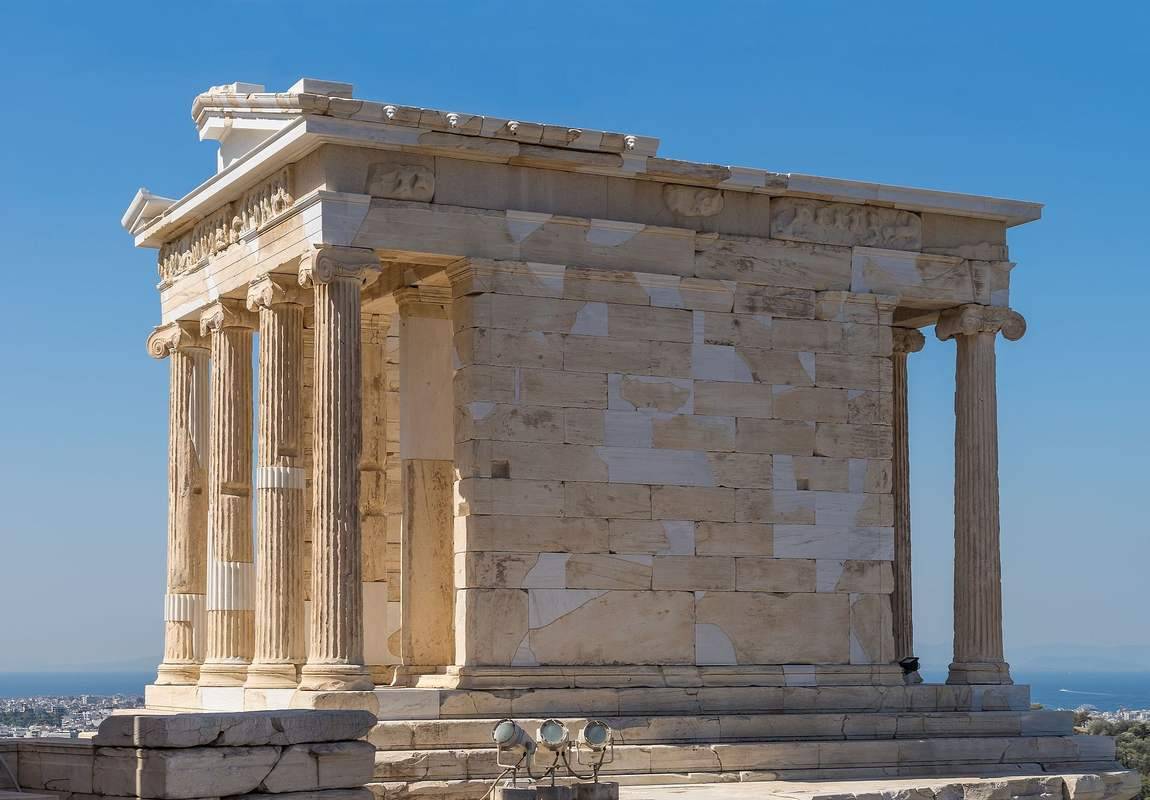
Perched on a bastion beside the Acropolis entrance, the small, elegant Temple of Athena Nike was built around 420 BC by Kallikrates to honour Athena as the bringer of victory. Discover this jewel of the Acropolis with skip-the-line tickets and expert guided tours from My Greece Tours for a richer, queue-free visit. Plan the whole trip with Greece Tours.
The Temple of Athena Nike is the first monument you meet in the Acropolis tickets and tours guide. The sections below cover its history, architecture and how to see it in full.
What is the Temple of Athena Nike?
A small Ionic temple of the Acropolis, the Temple of Athena Nike honours the goddesses Athena and Nike and built around 420 BC. It stands on a bastion at the south-west corner, to the right of the entrance, and is the earliest fully Ionic temple on the rock, celebrating Athenian victory, especially over the Persians.
The temple is one of the smaller but most charming monuments of the Acropolis, the first temple visitors encounter as they approach the entrance. It is a compact, elegant temple of the Ionic order, the more slender and decorative of the Classical Greek architectural styles, and indeed it is regarded as the earliest and purest fully Ionic temple on the Acropolis. The temple was dedicated jointly to the goddess Athena and to Nike, the personification of victory, worshipped together as Athena Nike, Athena as bringer of victory. Perched dramatically on a high bastion at the south-western corner of the rock, to the right of the monumental gateway, it commanded views over the surrounding land and sea and celebrated the military triumphs of Athens, above all the great victory over the Persians. Though small, it is a jewel of Classical architecture, refined in proportion and richly sculpted. The temple greets every visitor at the threshold of the Acropolis, set out alongside the guide to the Acropolis monuments. Its building reflects the city’s fortunes.
When and why was the Temple of Athena Nike built?
The Temple of Athena Nike was built around 449 to 420 BC, designed by the architect Kallikrates as part of Pericles’ Acropolis programme, though delayed by the Peloponnesian War. It honoured Athena Nike, celebrating Athenian victories, especially over the Persians, and replaced earlier shrines on the same bastion that the Persians had destroyed in 480 BC.
The Temple of Athena Nike was part of the great 5th-century BC rebuilding of the Acropolis, and its construction history mirrors the turbulent fortunes of Athens at the time. The bastion on which it stands had long been a sacred spot with earlier shrines to Athena Nike, but these, like the rest of the Archaic Acropolis, were destroyed when the Persians sacked Athens in 480 BC. As part of Pericles’ programme to rebuild the sacred rock in marble, the new temple was planned, with construction recorded as underway around 449 BC and largely completed around 420 BC, the long span reflecting interruptions caused by the costly Peloponnesian War. It was designed by Kallikrates, one of the architects also associated with the Parthenon. The temple’s purpose was both religious and political: to honour Athena Nike and to celebrate and give thanks for Athenian military victory, particularly the triumph over the Persian invaders, projecting the city’s confidence and power. Its prominent position over the entrance made it a fitting emblem of victory. This blend of piety and propaganda shaped the temple, set out alongside the guide to the history. Its architecture is finely balanced.
What is the architecture of the Temple of Athena Nike?
Built of white Pentelic marble, the Temple of Athena Nike is a small Ionic temple in the amphiprostyle tetrastyle form, with a portico of four slender Ionic columns at both the front and rear. It stands on a high bastion at the south-western corner of the Acropolis, by the entrance, its compact, graceful proportions making it a gem of Classical design.
The Temple of Athena Nike is admired for its perfectly balanced, refined architecture on an intimate scale. Built entirely of fine white Pentelic marble, the same prized stone as the Parthenon and Propylaea, it is a temple of the Ionic order, characterised by slender, fluted columns topped with elegant scroll-like volute capitals. Its plan is described as amphiprostyle and tetrastyle, meaning it has a portico of four Ionic columns at both the front (east) and the rear (west) of the small rectangular chamber, but no columns along the sides, giving it a compact, jewel-box form. The temple sits on a tall, high bastion at the south-western corner of the Acropolis, just to the right of the Propylaea gateway, a commanding position that made it visible from afar and gave it views over the approaches to the city. Despite its modest size, its harmonious proportions, graceful columns and rich sculptural decoration make it a masterpiece of the Ionic style and a perfect counterpoint to the grand Doric monuments nearby. Its elegance rewards a close look, set out alongside the guide to the Propylaea. Its sculptures celebrated victory.
What sculptures decorated the Temple of Athena Nike?
The little temple was decorated with a sculpted frieze showing gods gathered around Zeus and scenes of battle, including the Greek victory over the Persians at Marathon. Around its bastion ran the famous Nike Parapet, a balustrade carved with winged Victory figures, including the celebrated relief of Nike adjusting her sandal, now in the Acropolis Museum.
For such a small building, the Temple of Athena Nike carried a wealth of fine sculpture that reinforced its message of victory. A continuous sculpted frieze ran around the top of the temple: on the east side it depicted an assembly of the gods gathered about the enthroned Zeus, while other sides showed scenes of battle, including conflicts between Greeks and Persians and between Greeks, with the celebrated victory of the Athenians over the Persians at the Battle of Marathon in 490 BC among the subjects, directly linking the temple to Athenian military glory. Around the edge of the steep bastion on which the temple stood ran a sculpted marble balustrade known as the Nike Parapet, carved with numerous figures of Nike, winged Victory, in flowing motion, celebrating triumph and making offerings to Athena. The most famous of these reliefs is the exquisite figure of Nike bending to adjust her sandal, a masterpiece of Classical sculpture admired for its graceful, almost transparent drapery, now displayed in the Acropolis Museum. These sculptures made the little temple a showcase of art, set out alongside the guide to the Acropolis Museum highlights. Its later history saw destruction and rebuilding.
What happened to the Temple of Athena Nike and how do you visit it?
The Temple of Athena Nike was demolished by the Ottomans in 1686 to build defences, then reconstructed after Greek independence in 1834 and again restored, most recently. Today you see it on its bastion to the right of the Propylaea as you enter the Acropolis. You can admire it closely from the path but cannot enter it.
The Temple of Athena Nike has had a turbulent later history of destruction and careful restoration, and today it greets every visitor at the entrance to the Acropolis. In 1686, during the Ottoman period and the conflict with the Venetians, the Ottomans demolished the temple and used its stones to build fortifications and a defensive bastion around the entrance to the Acropolis, so for a time the temple vanished entirely. After Greek independence, the temple was rediscovered and reconstructed from its surviving pieces in 1834, an early triumph of archaeological restoration, and it has since been dismantled and rebuilt again for conservation, with a major restoration completed that returned it to its elegant form. Visiting it is easy and is the first thing you do on the Acropolis: as you climb to the entrance, the temple stands prominently on its high bastion to the right of the Propylaea gateway, where you can admire it at close range from the approach path, though, like the other monuments, you cannot enter it. A guide can point out its history and sculptures as you pass. The little temple is a perfect introduction to the site, set out alongside the guides to skipping the lines and the best time to visit. The questions below cover the points visitors ask most.
What is the significance of the Temple of Athena Nike?
The little temple is significant as the earliest fully Ionic temple on the Acropolis, a jewel of Classical architecture, and a powerful symbol of Athenian victory. Dedicated to Athena as bringer of victory, it celebrated the triumph over the Persians and projected the city’s confidence, while its sculptures and graceful form make it a masterpiece in miniature.
Though one of the smallest monuments on the Acropolis, the Temple of Athena Nike carries great significance on several levels. Architecturally, it is important as the earliest and purest fully Ionic temple on the sacred rock, introducing the elegant, slender Ionic style alongside the mightier Doric monuments, and it is admired as a perfectly proportioned jewel of Classical design, a masterpiece in miniature. Religiously and politically, it was dedicated to Athena Nike, Athena in her aspect as the bringer of victory, fusing devotion to the city’s patron goddess with the celebration of military triumph; its construction in the aftermath of the Persian Wars made it a monument to Athenian victory and a confident statement of the city’s power and divine favour. Its sculptures reinforced this message, with the frieze depicting the Greek victory over the Persians at Marathon and the famous Nike Parapet celebrating Victory herself. Perched prominently on its bastion over the entrance, it greeted every visitor and procession with the promise of victory under Athena’s protection. Its survival, destruction and repeated restoration also make it a symbol of the endurance of Greek heritage. This rich significance belies its small size, set out alongside the guide to the history. The questions below cover the points visitors ask most.
Frequently Asked Questions
What is the Temple of Athena Nike?
A small Ionic temple on the Acropolis, the Temple of Athena Nike is dedicated to Athena and Nike and was built around 420 BC by the architect Kallikrates. It stands on a bastion at the south-west corner, to the right of the entrance, and is the earliest fully Ionic temple on the rock, celebrating Athenian victory.
Why was the Temple of Athena Nike built?
The Temple of Athena Nike was built to honour Athena Nike, Athena as the bringer of victory, and to celebrate and give thanks for Athenian military triumphs, especially the victory over the Persians. Part of Pericles’ 5th-century BC programme, it replaced earlier shrines on the same bastion destroyed by the Persians in 480 BC.
Where is the Temple of Athena Nike on the Acropolis?
The Temple of Athena Nike stands on a high bastion at the south-western corner of the Acropolis, just right of the Propylaea gateway as you enter. It is the first monument visitors encounter when approaching the entrance, and can be admired closely from the path, though you cannot enter the temple itself.