
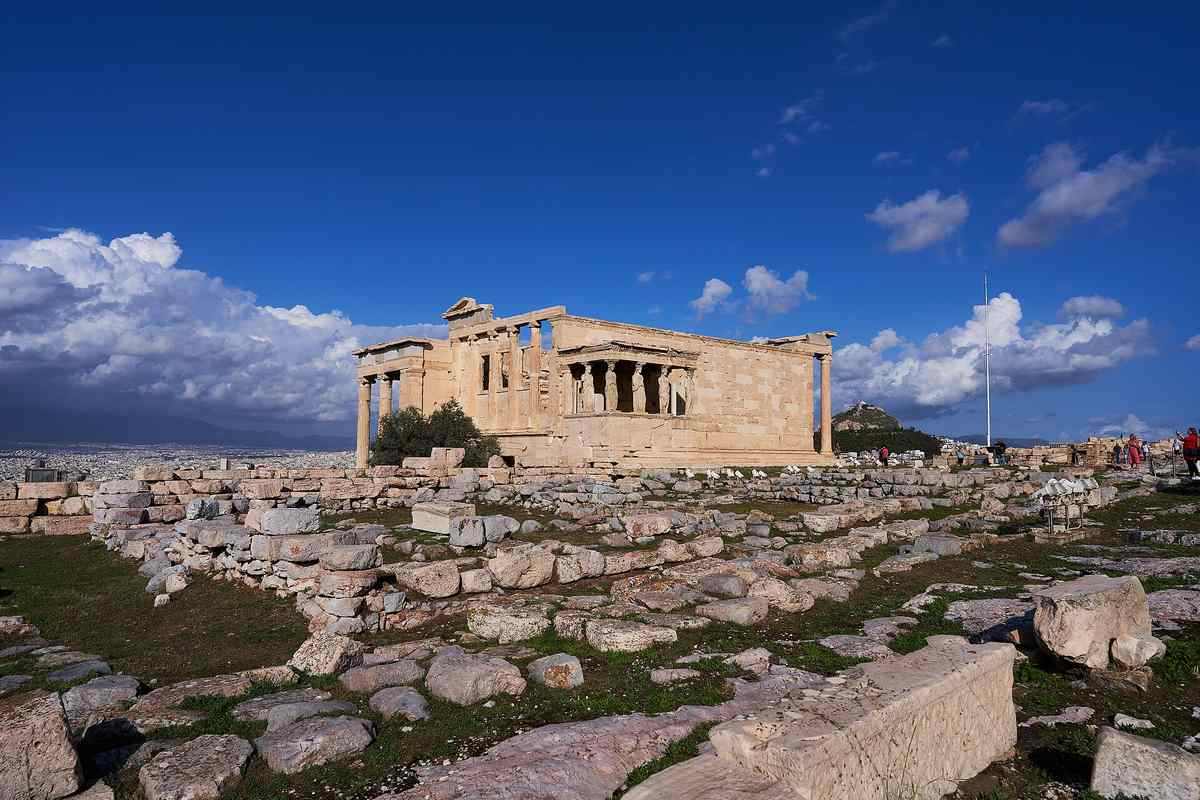
The Erechtheion is the Acropolis’s most sacred temple, built 421-406 BC and famous for its Porch of the Caryatids, six marble maidens that stand in place of columns. Discover this Ionic masterpiece and its statues with skip-the-line tickets and expert guided tours from My Greece Tours for a deeper, queue-free visit. Plan the whole trip with Greece Tours.
The Erechtheion is one of the must-see monuments in the Acropolis tickets and tours guide. The sections below cover the temple, its myths and the Caryatids in full.
What is the Erechtheion?
The Erechtheion is an Ionic temple on the northern side of the Acropolis summit, built between 421 and 406 BC during the Golden Age. It was the holiest building on the rock, dedicated to Athena, Poseidon and the legendary king Erechtheus, and is famous for its elegant Porch of the Caryatids, where six marble maidens serve as columns.
The Erechtheion is among the most beautiful and intriguing monuments on the Acropolis, standing opposite the Parthenon on the north side of the summit. Built between 421 and 406 BC, in the latter part of Pericles’ great building programme and during the Peloponnesian War, it is a refined example of the Ionic order, the more slender and ornate of the Classical Greek styles. Far more than an ordinary temple, the Erechtheion was the holiest building on the whole Acropolis, raised on the spot richest in myth and religious significance, and it housed several of the city’s holiest cults and relics. It was dedicated to multiple deities and heroes, principally Athena, the patron goddess, alongside the sea god Poseidon and the legendary early Athenian king Erechtheus, after whom it is named. Its most celebrated feature is the Porch of the Caryatids, where six sculpted marble maidens stand gracefully in place of plain columns to support the roof. This blend of sanctity, elegance and the famous statues makes the Erechtheion unforgettable, set out alongside the guide to the Acropolis monuments. Its sacred myths explain its importance.
Why is the Erechtheion the most sacred temple?
The Erechtheion was the most sacred temple because it stood on the spot where, in myth, Athena and Poseidon contested for Athens: Poseidon struck the rock to make a salt spring, and Athena planted the first olive tree, winning the city. It also held the tomb of King Erechtheus and the holiest cult statue of Athena.
The Erechtheion’s supreme sanctity comes from the powerful myths and ancient relics associated with its very ground, making it the spiritual heart of the Acropolis. According to legend, this was the exact spot where the gods Athena and Poseidon competed for the right to be patron of the new city. Poseidon struck the rock with his trident and produced a spring of salt water, while Athena planted the first olive tree; the Athenians judged Athena’s gift the more valuable, and she became the city’s protectress, giving Athens its name. The Erechtheion was built to enshrine the sacred tokens of this contest, said to include the marks of Poseidon’s trident and the sacred olive tree growing beside the temple. The building also housed the tomb of the mythical king Erechtheus, from whom it takes its name, and, most importantly, the ancient and holiest wooden cult statue of Athena Polias, the focus of the city’s greatest religious festival, the Panathenaea. With so many sacred associations gathered in one place, the Erechtheion was revered above all other temples, set out alongside the guide to the history. The Caryatids are its glory.
What are the Caryatids?
The Caryatids are six sculpted marble maidens, around 2.3 metres tall, that stand in place of columns to support the roof of the Erechtheion’s southern porch. Carved with flowing robes and elaborate hairstyles, each is subtly different. They are named after the maidens of Karyes and are among the most famous sculptures of ancient Greece.
The Caryatids are the crowning glory of the Erechtheion and one of the most admired creations of Greek sculpture. A caryatid is a sculpted female figure used as an architectural support in place of a column, and the six Caryatids of the Erechtheion are the most famous examples in the world. They stand on the parapet of the temple’s southern porch, gracefully bearing the weight of the roof on their heads. Carved from marble and standing around 2.3 metres tall, the maidens are robed in finely draped garments whose vertical folds echo the fluting of Doric columns, while baskets on their heads, intricate hairstyles and a subtle shift of weight onto one leg give them both structural strength and lifelike elegance. Each of the six is subtly individual in pose and detail, a triumph of combining function and beauty. The figures face outward toward the route of the great Panathenaic procession that passed below the Acropolis. Their poise and artistry have inspired architects for over two millennia. The Caryatids are an unmissable highlight, set out alongside the guide to the Acropolis Museum highlights. Their later history is dramatic.
What happened to the original Caryatids?
The Caryatids on the Erechtheion today are replicas. Five of the six originals were removed for protection and are displayed in the Acropolis Museum. The sixth was taken to Britain by Lord Elgin around 1800 and remains in the British Museum in London. The replicas on the temple let visitors see the porch as it looked.
The Caryatids you see on the Erechtheion today are faithful copies, as the precious originals have been moved to protect them, and their story reflects the wider fate of the Acropolis sculptures. By the 20th century, pollution and weathering in Athens were seriously damaging the original marble figures, so five of the six surviving Caryatids were carefully removed from the temple for conservation, restoration and protection, and they are now displayed indoors in the Acropolis Museum, where visitors can admire them up close, their details still remarkable. The sixth Caryatid had a different fate much earlier: around 1800, the British diplomat Lord Elgin removed it from the Erechtheion, along with many Parthenon sculptures, and took it to Britain, where it remains in the British Museum in London, separated from its five sisters, a source of lasting controversy and Greek calls for its return. To preserve the temple’s appearance, exact replicas now stand in the porch, so visitors still experience the famous composition in situ while the originals are safe. Seeing both the replicas on the rock and the originals in the museum is ideal, set out alongside the guide to the Acropolis Museum tickets. The architecture is uniquely complex.
What is the architecture of the Erechtheion?
The Erechtheion is an asymmetrical, multi-level Ionic temple, unusual in form because it was built to enclose several sacred shrines and to fit the uneven, holy ground. It has porches on different sides and levels, including the famous Porch of the Caryatids on the south and an elegant north porch with ornate Ionic columns, all in fine Pentelic marble.
The Erechtheion is one of the most architecturally unusual and ingenious temples of ancient Greece, its irregular form reflecting the sacred constraints of its site. Unlike the perfectly symmetrical Parthenon, the Erechtheion is asymmetrical and built on several levels, an unconventional design forced by the uneven, sloping rock and by the need to incorporate and protect a number of separate sacred spots, shrines and relics, including the marks of Poseidon’s trident and the tomb of Erechtheus. Built of fine Pentelic marble in the elegant Ionic order, it has porches of different sizes projecting from different sides and at different heights. The most famous is the Porch of the Caryatids on the south side, with its six maidens. On the north side is a large, beautiful porch with tall, slender Ionic columns and an ornately carved doorway, considered a masterpiece of Ionic design. The east front has its own columned portico. This complex, multi-level arrangement, marrying refined craftsmanship with religious function, makes the Erechtheion a fascinating contrast to its mighty neighbour, set out alongside the guide to the Parthenon. Visiting it is part of the Acropolis experience.
How do you visit the Erechtheion?
You visit the Erechtheion by entering the Acropolis with a ticket and walking to it on the summit, opposite the Parthenon. You can admire it and the Caryatid replicas closely from the exterior but cannot enter the temple. To see the five original Caryatids, visit the nearby Acropolis Museum. Go early or late to avoid crowds.
Seeing the Erechtheion is a simple and rewarding part of any Acropolis visit, and it is one of the monuments visitors most enjoy. After entering the archaeological site with your ticket and climbing through the Propylaea to the summit, you will find the Erechtheion on the north side of the rock, directly opposite the Parthenon, so it is impossible to miss. You can walk around the temple and admire it from close range, including a fine view of the famous Porch of the Caryatids with its six replica maidens, but, as with the other monuments, you cannot enter the building itself, which is protected. To complete the experience, visit the nearby Acropolis Museum at the foot of the hill, where the five surviving original Caryatids are beautifully displayed indoors, allowing you to see the genuine sculptures in detail. As with the rest of the site, visiting early at opening or in the late afternoon helps you avoid the crowds and the heat, and a guide adds rich context to the myths and architecture. The Erechtheion is a true highlight, set out alongside the guides to skipping the lines and guided tours. The questions below cover the points visitors ask most.
Why are the Caryatids so famous?
The Caryatids are so famous because they are the finest and most celebrated example of sculpted female figures used as architectural columns, masterfully combining structural function with lifelike grace and beauty. Standing on the Erechtheion, the Acropolis’s most sacred temple, they have inspired architects for over 2,000 years and remain an icon of Classical Greek art.
The Caryatids of the Erechtheion enjoy a unique fame that goes far beyond their original role, and there are several reasons for it. Artistically, they are regarded as the supreme example of the caryatid, a sculpted female figure that replaces a column, and the six maidens are admired for the extraordinary skill with which the sculptors married structural strength with beauty and naturalism: their finely carved, flowing drapery echoes the fluting of columns and visually bears the weight of the roof, while their subtly individual poses, with weight shifted onto one leg, give them a lifelike grace rare in load-bearing figures. Their position on the Erechtheion, the most sacred building on the Acropolis, and facing the route of the great Panathenaic procession, lent them prestige and visibility. Over the centuries the Caryatids have become an enduring icon of Classical Greek art, inspiring imitations on buildings around the world, from ancient Rome to Neoclassical museums, banks and monuments. Their dramatic later story, the five originals now preserved in the Acropolis Museum and the sixth controversially held in the British Museum, has only added to their renown. This blend of beauty, sanctity and fame makes the Caryatids unforgettable, set out alongside the guide to the Acropolis Museum highlights. The questions below cover the points visitors ask most.
Frequently Asked Questions
What is the Erechtheion?
The Erechtheion is an Ionic temple on the northern side of the Acropolis summit, built between 421 and 406 BC. It was the holiest building on the rock, dedicated to Athena, Poseidon and the legendary king Erechtheus, and is famous for its Porch of the Caryatids, where six marble maidens serve as columns.
Are the Caryatids on the Acropolis real?
No, the Caryatids on the Erechtheion today are replicas. Five of the six original maidens were removed for protection and are displayed in the Acropolis Museum, while the sixth was taken to Britain by Lord Elgin around 1800 and remains in the British Museum in London. Replicas stand in the porch.
What is the difference between the Erechtheion and the Parthenon?
The Parthenon is the large Doric temple of Athena and the Acropolis’s centrepiece, famous for its grandeur and symmetry, while the Erechtheion is a smaller, asymmetrical Ionic temple opposite it, regarded as the most sacred building, dedicated to several deities and famous for its Caryatids. Both were built during the 5th-century BC Golden Age.