
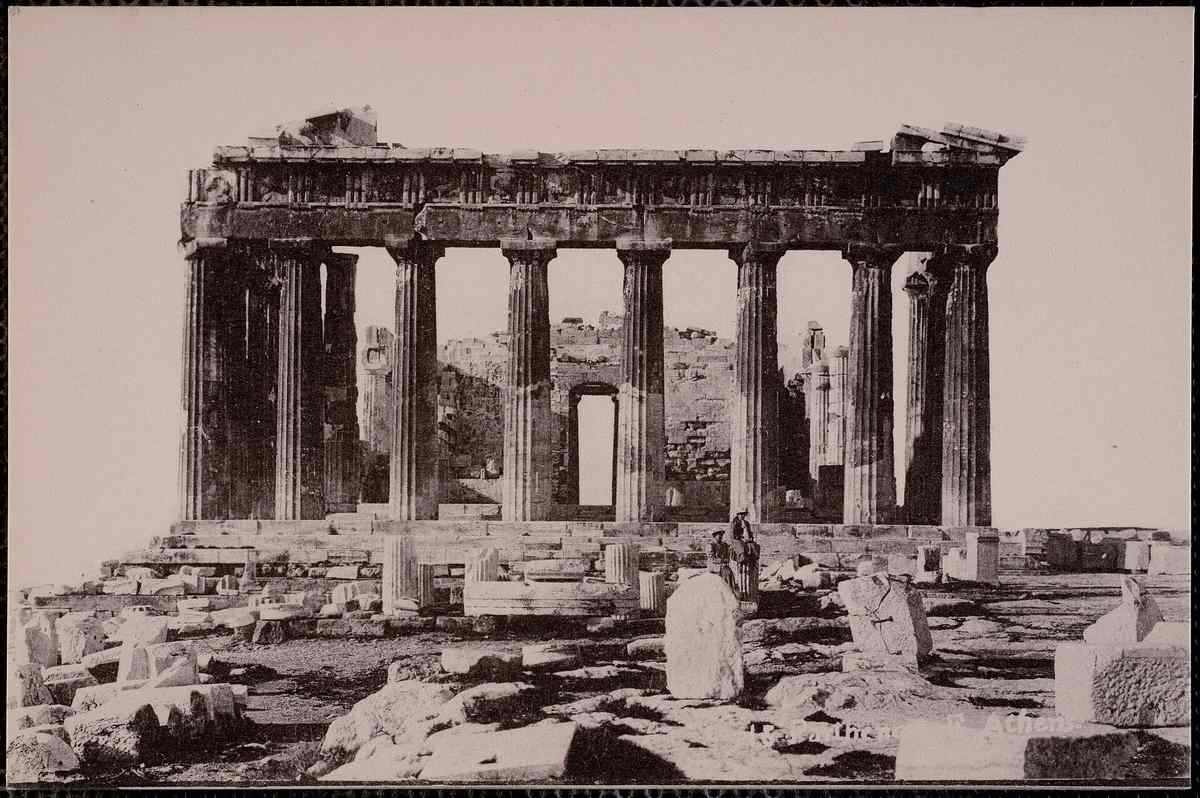
The Parthenon is the great Doric temple of Athena crowning the Acropolis, built between 447 and 432 BC by Iktinos and Kallikrates with sculptures by Phidias, and the supreme masterpiece of Classical Greek architecture. See it up close with skip-the-line tickets and expert guided tours from My Greece Tours for a deeper, queue-free experience. Plan the whole trip with Greece Tours.
The Parthenon is the centrepiece of every visit in the Acropolis tickets and tours guide. The sections below cover its history, architecture and how to see it in full.
What is the Parthenon?
The Parthenon is the largest and most famous temple on the Acropolis of Athens, a Doric temple dedicated to the goddess Athena Parthenos, built in the 5th century BC. The masterpiece of Classical Greek architecture, it once housed a colossal gold-and-ivory statue of Athena and stands as an enduring symbol of ancient Athens and Western civilisation.
The Parthenon is the crowning glory of the Acropolis and one of the most recognisable buildings in the world. It is a temple of the Doric order, the simplest and most monumental of the Classical Greek architectural styles, built entirely of gleaming white Pentelic marble on the highest point of the sacred rock. The temple was dedicated to Athena Parthenos, meaning Athena the Virgin, the patron goddess of Athens, and its main purpose was to shelter a magnificent colossal statue of the goddess, made of gold and ivory by the sculptor Phidias. More than a place of worship, the Parthenon was a treasury and a triumphant statement of Athenian power, wealth and artistic genius at the height of the city’s Golden Age. Admired for nearly 2,500 years for its perfect proportions and refinements, it is regarded as the supreme achievement of Classical architecture and a symbol of democracy, ancient Greece and Western culture itself. It remains the focus of any visit to the Acropolis, set out alongside the guide to the Acropolis history. Its origins lie in the Golden Age.
When and why was the Parthenon built?
The Parthenon was built between 447 and 432 BC during the Golden Age of Athens, under the statesman Pericles, as part of a great programme to rebuild the Acropolis after the Persians destroyed its temples in 480 BC. It honoured Athena, celebrated the Athenian victory over Persia, and showcased the city’s wealth, power and democratic achievement.
The Parthenon was the centrepiece of an ambitious rebuilding of the Acropolis launched by the Athenian statesman Pericles in the mid-5th century BC. The previous temples on the rock had been burned to the ground by the Persians when they sacked Athens in 480 BC, and for some years the Athenians left the ruins as a memorial. With the threat past, Athens at the head of the Delian League had grown rich and confident, and Pericles directed this wealth into a magnificent building programme to glorify the city and its patron goddess. Construction of the Parthenon ran from 447 to 432 BC, with the main structure completed in just nine years, an astonishing pace. The temple served several purposes: to honour Athena, to whom it was dedicated; to celebrate the Athenian triumph over the Persian invaders; to house the city’s treasury; and to proclaim the power, sophistication and democratic ideals of Athens at its zenith. It is often seen as a monument to democracy itself, built by the world’s first democratic city. This golden moment gave rise to the masterpiece, set out alongside the guide to the Acropolis monuments. Its architecture is a marvel of precision.
What are the Parthenon’s architectural features?
The Parthenon is a Doric temple with 46 outer columns and 19 inner columns, built of Pentelic marble. Famously, it contains almost no perfectly straight lines or right angles: subtle curves and tilts, known as optical refinements, correct for distortions in human vision and make it appear flawlessly regular. It also blends Doric form with an Ionic interior frieze.
The Parthenon’s enduring fame rests above all on the extraordinary sophistication of its architecture. It is the supreme example of the Doric order, with a rectangular plan surrounded by a colonnade of 46 outer columns, plus a further 19 inner columns, all of Pentelic marble. Its most remarkable feature is hidden in plain sight: the building contains almost no truly straight lines or right angles. The columns lean slightly inward and bulge subtly in the middle, the base curves gently upward toward the centre, and the corner columns are thicker and more closely spaced. These deliberate, minute deviations, known as optical refinements, were designed to counteract the distortions of human vision, so that the temple appears perfectly straight, balanced and alive rather than rigid. The Parthenon also cleverly combines its monumental Doric exterior with Ionic elements, most notably a continuous sculpted Ionic frieze running around the top of the inner chamber. This blend of mathematical precision, subtle artistry and harmonious proportion is why the Parthenon is considered the pinnacle of Classical architecture, set out alongside the guide to the Propylaea. Its sculptures were equally magnificent.
What sculptures decorated the Parthenon?
The Parthenon was richly decorated with sculpture by Phidias and his workshop: two great pediments showing Athena’s birth and her contest with Poseidon, 92 metopes of mythological battles, and a 160-metre Ionic frieze depicting the Panathenaic procession. Inside stood Phidias’s colossal gold-and-ivory statue of Athena. Many surviving sculptures are now in the Acropolis Museum and British Museum.
The Parthenon was not only an architectural masterpiece but also a showcase of the finest Classical sculpture, overseen by the great master Phidias. Three great sculptural programmes adorned the exterior. The two triangular pediments at each end held large free-standing figures: the east pediment depicted the dramatic birth of Athena, springing fully grown from the head of her father Zeus, while the west pediment showed the contest between Athena and Poseidon for patronage of Attica and the city of Athens. Along the top of the outer colonnade, 92 carved panels called metopes depicted mythological battles, such as Greeks against centaurs and Amazons, symbolising the triumph of civilisation over chaos. Running around the inner chamber was the famous Ionic frieze, around 160 metres long, carved in low relief with the great Panathenaic procession in honour of Athena. Within the temple stood Phidias’s crowning work, the colossal gold-and-ivory statue of Athena Parthenos. Many of these sculptures survive today, divided between the Acropolis Museum in Athens and the British Museum in London. This wealth of sculpture made the Parthenon a treasure of art, set out alongside the guide to the Acropolis Museum highlights. The temple’s later history was dramatic.
What happened to the Parthenon over the centuries?
Over the centuries the Parthenon was turned into a Christian church under the Byzantines and then a mosque under the Ottomans. In 1687 a Venetian bombardment ignited Ottoman gunpowder stored inside, causing a massive explosion that destroyed much of the temple. Around 1800 Lord Elgin removed many sculptures, and Greece has restored the monument since the 19th century.
The Parthenon has endured a turbulent history far beyond its centuries as a temple of Athena. In late antiquity and the Byzantine era it was turned into a Christian church honouring the Virgin Mary, with the interior altered for worship. After Athens fell to the Ottomans in the 15th century, the Parthenon became a mosque, complete with a minaret. Its greatest catastrophe came in 1687, during a war between the Venetians and the Ottomans: the Ottoman defenders were using the temple to store gunpowder when a Venetian cannonball struck it, and the resulting explosion blew apart the centre of the building, toppling columns and walls and reducing the once-intact temple to the ruin we see today. In the early 19th century, the British diplomat Lord Elgin removed a large portion of the surviving sculptures and shipped them to Britain, where the so-called Parthenon Marbles remain in the British Museum, the subject of a long-running dispute over their return. Since Greek independence, painstaking restoration has stabilised and partly reconstructed the monument. This long, dramatic afterlife adds to its mystique, set out alongside the guide to the history. Today you can admire it up close.
How do you visit the Parthenon today?
You visit the Parthenon by entering the Acropolis archaeological site with a ticket, then walking up through the Propylaea to the top, where you can admire and circle the temple, though you cannot go inside it. Buy skip-the-line tickets or a guided tour in advance, and visit early or late to avoid crowds and heat.
The Parthenon is the highlight of a visit to the Acropolis, and seeing it is straightforward with a little planning. You reach it by entering the Acropolis archaeological site with a valid ticket, passing through the security check and climbing the slope and the monumental gateway, the Propylaea, to the flat summit of the rock, where the Parthenon stands. Visitors can walk all the way around the temple and admire it from every angle, but for conservation reasons you cannot enter the interior or touch the marble; the building is roped off, so it is appreciated from the exterior. To make the most of your visit, buy your tickets in advance, ideally skip-the-line tickets or a guided tour, to avoid the long queues at the entrance, especially in peak season. Time your visit for early morning at opening or the late afternoon before closing, to escape the worst crowds and the fierce, shadeless summer heat. A guide brings the temple’s history and sculptures vividly to life. With tickets booked and good timing, you can enjoy the Parthenon at its best, set out alongside the guides to skipping the lines and guided tours. The questions below cover the points visitors ask most.
Why is the Parthenon so important and famous?
The Parthenon is so important and famous because it is the supreme masterpiece of Classical Greek architecture, the symbol of ancient Athens, its democracy and its Golden Age, and an icon of Western civilisation. Its perfect proportions, optical refinements and superb sculptures have been admired for nearly 2,500 years, inspiring countless buildings worldwide.
The Parthenon’s enduring fame rests on a rare combination of artistic perfection, historical significance and symbolic power. Artistically, it is regarded as the pinnacle of Classical Greek architecture, the most refined expression of the Doric order, famous for its harmonious proportions and the subtle optical refinements, the curves and tilts, that make it appear flawlessly regular and alive; together with its magnificent sculptures by Phidias, it set a standard of beauty admired for nearly 2,500 years. Historically, it was the centrepiece of the Golden Age of Athens under Pericles, built by the world’s first democracy at the height of its power and confidence after the victory over Persia, so it stands as a monument to democracy, to Athenian achievement and to the flowering of Classical civilisation. Symbolically, the Parthenon has become an icon of ancient Greece and of Western culture itself, its image instantly recognisable around the world and its form echoed in parliaments, museums and monuments from Europe to America. As the focus of a UNESCO World Heritage Site, it draws millions of visitors who come to stand before the very emblem of the classical ideal. This blend of beauty, meaning and influence is why the Parthenon matters so much, set out alongside the guide to the Acropolis history. The questions below cover the points visitors ask most.
Frequently Asked Questions
What was the Parthenon used for?
The Parthenon was a temple dedicated to the goddess Athena Parthenos, the patron of Athens, and its main purpose was to house her colossal gold-and-ivory statue by Phidias. It also served as the city’s treasury. Over later centuries it was used as a Christian church and then an Ottoman mosque.
Can you go inside the Parthenon?
No, you cannot go inside the Parthenon. For conservation and safety reasons the temple is roped off, so visitors admire and walk around it from the outside on the Acropolis summit. You can, however, see its original sculptures and frieze up close in the nearby Acropolis Museum at the foot of the hill.
Who built the Parthenon and when?
The Parthenon was built between 447 and 432 BC during the Golden Age of Athens, under the statesman Pericles. It was designed by the architects Iktinos and Kallikrates, with the sculptural decoration and the great statue of Athena created by the master sculptor Phidias and his workshop.