
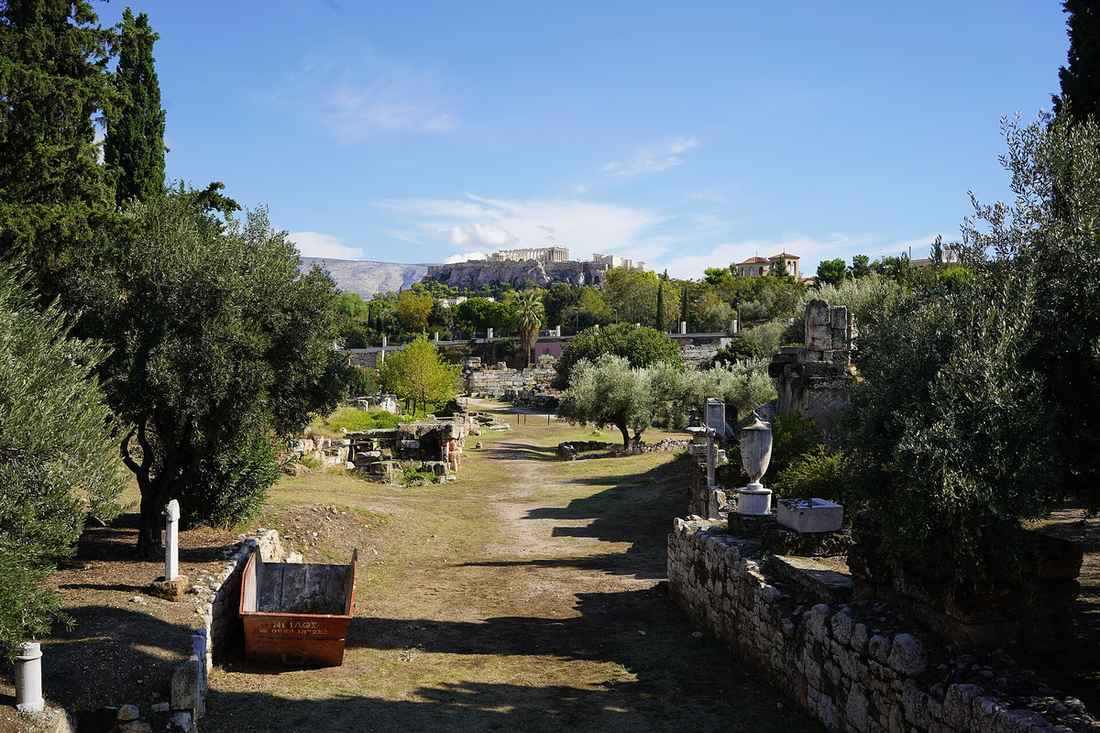
Kerameikos is the ancient cemetery and potters’ quarter of Athens, a peaceful and underrated archaeological site with the great Dipylon Gate, sculpted grave monuments and the Oberlander Museum. Add it to a skip-the-line combined-ticket tour of the ancient sites from My Greece Tours for richer context.
This quiet, atmospheric site is a rewarding stop in the Athens travel guide. The sections below cover what it is, its history, what to see, the museum, practical visiting details and how to get there.
What is Kerameikos in Athens?
Kerameikos ranks among the loveliest and least-visited archaeological sites in central Athens, the ancient cemetery and potters’ quarter of the city, lying on the north-west fringe of the old town. It preserves the Dipylon and Sacred Gates, stretches of the city wall, the Street of Tombs with its grave monuments, and the small Oberlander Museum.
Tucked away on the edge of the lively Gazi district, this tranquil green archaeological park offers a quite different experience from the crowded Acropolis. Kerameikos takes its name from the potters, the keramikoi, who once worked the clay banks of the Eridanos river here, and it served the dual role of a busy potters’ quarter and the principal cemetery of ancient Athens. The site sits on the north-west fringe of the ancient city, just where two of its most important gates once pierced the great defensive wall. Today it is one of the quietest and most atmospheric corners of central Athens, a sunken expanse of ruins, wildflowers and tortoises threaded by the trickling Eridanos stream, with the Acropolis visible in the distance.
Despite its central location, it remains pleasantly uncrowded, making it a restful escape from the city’s busier monuments. Within its bounds you can trace the line of the ancient walls and gates, walk the road of the dead lined with funerary sculpture, and visit a fine little museum of grave goods and stelae. For history lovers it is a quietly moving place. It pairs well with the civic ruins in the Ancient Agora of Athens guide. Its long story explains what survives.
What is the history of Kerameikos?
Kerameikos was used as a cemetery from the Early Bronze Age, around 2700 BC, and continued in use for some three thousand years until the 6th century AD. It was also the potters’ quarter, giving us the word “ceramic”. The area gained its great gates and walls when Themistocles fortified Athens in 478 BC after the Persian Wars.
The story of Kerameikos stretches across virtually the whole of ancient Greek civilisation. The earliest tombs on the site date back to the Early Bronze Age, around 2700 to BC, and the cemetery then functioned almost without interruption right through to the 6th century AD, an extraordinary span of roughly three thousand years of continuous burial. Alongside the graves, generations of potters built their workshops here beside the Eridanos river, exploiting its clay, and it is from this keramos, or potters’ clay, that the modern word “ceramic” ultimately derives. The defining moment in the site’s monumental history came in 478 BC, when, in the urgent aftermath of the Persian Wars, the Athenian statesman Themistocles had a massive defensive wall thrown up around the city; this wall cut through the district and opened here at two great gateways, the Dipylon and the Sacred Gate.
Burials clustered along the roads leading out through these gates, and over the centuries the elaborate tombs of prominent Athenians lined the routes. Even after antiquity, potters continued to work amid the ruins. This deep continuity gives the site its rare richness. The same era is explored in the guide to Acropolis history. The standing remains bring that past to life.
What can you see at Kerameikos?
At Kerameikos you can see the monumental Dipylon and Sacred Gates, long stretches of the Themistoclean city wall, and the Street of Tombs lined with replicas of sculpted grave monuments, including bulls, sirens and horsemen. The Eridanos stream still runs through the green site, where tortoises roam among the ruins below the modern city.
The archaeological park rewards a slow, attentive wander among its scattered monuments. The most important structures are the two great gateways in the city wall: the Dipylon, a huge double gate that was the largest in the ancient Greek world and the place where the grand Panathenaic procession to the Acropolis formally began, and the nearby Sacred Gate, through which the Sacred Way to Eleusis began. Between and beyond them you can follow long, well-preserved stretches of the Themistoclean wall that once defended Athens. The site’s most evocative feature is the Street of Tombs, an avenue of the dead lined with the funerary monuments of wealthy Athenian families, where you will see sculpted reliefs of a charging bull, mournful sirens, a horseman and tender family farewell scenes; the originals are protected in the museum while faithful copies stand in place.
All this lies in a sunken green hollow where the little Eridanos stream still flows through reeds, tortoises wander among the stones, and the Acropolis rises on the skyline. Allow time simply to absorb the peaceful, melancholy beauty of the place. The procession that began here is described in the guide to the Panathenaic Stadium. The on-site museum deepens the visit.
What is in the Kerameikos Museum?
The on-site Oberlander Museum houses an outstanding collection of finds from the cemetery excavations, including the original sculpted grave stelae and statues, such as the famous bull from the tomb of Dionysios of Kollytos, alongside pottery, funerary offerings, jugs, perfume bottles and urns recovered from the tombs. It gives the open-air ruins their full meaning.
No visit is complete without stepping into the small but excellent museum within the archaeological grounds. Known as the Oberlander Museum after the benefactor who funded it, this compact building gathers the finest objects unearthed during more than a century of excavation at the site, and it transforms a walk among the ruins into a vivid encounter with ancient death and remembrance. Its galleries display the original grave sculptures whose copies stand outside on the Street of Tombs, including the powerful marble bull that once crowned the tomb of Dionysios of Kollytos, along with statues of sirens, a horseman and various human figures carved with striking emotion.
Around them are arranged the everyday and ceremonial goods recovered from the graves: black-figure and red-figure pottery, slender perfume bottles, oil jugs, plates and burial urns that reveal Athenian beliefs about the afterlife and the changing styles of Greek ceramics over many centuries. Together the objects tell the human story behind the monuments, from grand aristocratic memorials to the simple offerings left for ordinary citizens. It is a quietly rewarding collection that few crowds ever reach. Larger collections await at the National Archaeological Museum. Planning a visit takes only a moment.
How do you visit Kerameikos?
Kerameikos is open daily, generally from 8am to around 5pm, with the museum opening later, at 10am, on Tuesdays. Admission is around €10 and is included in the Athens combined ticket covering several sites. Allow about two hours, visit early to avoid groups and heat, and reach it on foot from Thissio or Kerameikos metro stations.
A visit to Kerameikos is easy to plan and slots neatly into a day among the ancient sites. The site and its museum open daily, typically from 8am until about 5pm, though hours are extended in summer and shortened in winter, and on Tuesdays the museum opens later in the morning, at around 10am, while the grounds open earlier. Admission costs in the region of €10, and crucially the site is included in the Athens combined ticket, the multi-site pass that also covers the Acropolis, Ancient Agora and other monuments, so it can be visited at no extra cost if you already hold one. To enjoy both the open-air ruins and the Oberlander Museum at a relaxed pace, set aside about two hours.
Because shade is limited within the sunken site, it is best to come earlier in the morning or in the late afternoon, especially in summer, both to avoid the heat and to have the peaceful grounds largely to yourself. The site rarely sees the crowds of the bigger monuments, so you can wander the Street of Tombs in near solitude. Sturdy shoes help on the uneven ground. Combined tickets and routes are explained in the guide to getting around Athens. The questions below cover the points visitors ask most.
Why is Kerameikos worth visiting?
Kerameikos is worth visiting for its rare peace, its layered history and its low crowds. Few sites let you walk an ancient cemetery, trace the city walls and gates, and study original grave sculpture in such a green, tranquil setting in the centre of Athens. Included in the combined ticket, it offers a moving, uncrowded contrast to the busy Acropolis.
Several qualities make this quiet site a rewarding addition to any Athens itinerary, especially for those seeking something beyond the obvious monuments. The first is its remarkable tranquillity: while crowds throng the Acropolis a short distance away, here you can often wander almost alone among the tombs, reeds and wildflowers, accompanied only by birdsong and the resident tortoises. The second is the depth of history on show, spanning some three thousand years from Bronze Age graves to the great Themistoclean gates, all readable in a single compact site that vividly illustrates how the ancient city lived, died and defended itself. The third is the quality of what survives, from the monumental Dipylon Gate, where the Panathenaic procession once set out, to the poignant family grave reliefs whose originals fill the excellent Oberlander Museum.
Practically, the site is included in the Athens combined ticket, so it costs nothing extra for many visitors, and it sits beside the lively bars of Gazi and Kerameikos for an easy evening afterwards. For history enthusiasts and anyone craving a calm green refuge in the city, it richly repays the short visit. It pairs well with the nearby nightlife described in the Psiri guide. The questions below cover the points visitors ask most.
Frequently Asked Questions
What is Kerameikos famous for?
Kerameikos is famous as the principal ancient cemetery and potters’ quarter of Athens, giving us the word “ceramic”. It preserves the monumental Dipylon and Sacred Gates, the Themistoclean city wall and the Street of Tombs with its sculpted grave monuments, all in a peaceful, green and rarely crowded archaeological site.
How much does it cost to visit Kerameikos?
Admission to Kerameikos is around €10 and includes the on-site Oberlander Museum. The site is also covered by the Athens combined ticket, which bundles the Acropolis, Ancient Agora and other monuments, so you can visit Kerameikos at no extra charge if you already hold that multi-site pass.
How do you get to Kerameikos in Athens?
Kerameikos is a short walk from two metro stations: Kerameikos on the blue line, less than ten minutes away, and Thissio on line 1, about five minutes away. It lies on the edge of the Gazi district, close to the Ancient Agora and the start of the Acropolis promenade.