
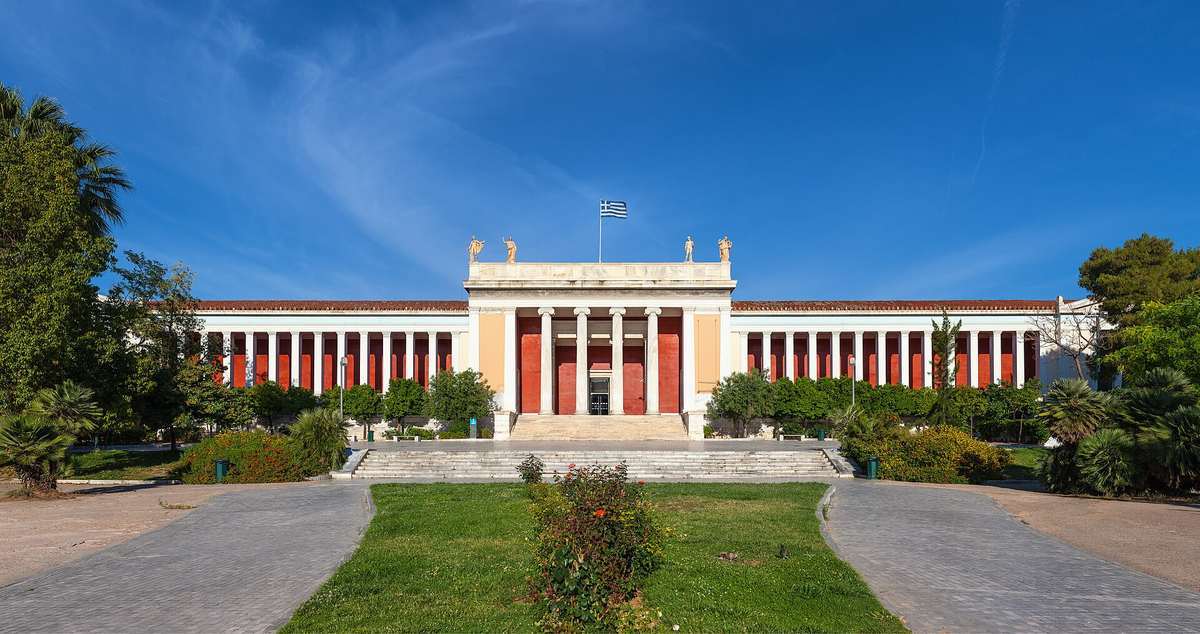
Athens’s National Archaeological Museum is the largest in Greece and one of the world’s finest, home to the gold Mask of Agamemnon, the astonishing Antikythera Mechanism, the Artemision Bronze and the Akrotiri frescoes. Explore its treasures with skip-the-line tickets and guided tours from My Greece Tours for a richer, queue-free visit.
The National Archaeological Museum is a must-see in the Athens travel guide. The sections below cover its highlights, collections and visiting tips in full.
What is the National Archaeological Museum?
Athens’s National Archaeological Museum is the biggest archaeological museum in Greece, displaying treasures of Greek antiquity from prehistory to late antiquity. Its highlights include the gold Mask of Agamemnon, the Antikythera Mechanism, the Artemision Bronze and the Akrotiri frescoes.
The National Archaeological Museum of Athens is one of the world’s most important museums and an essential visit for anyone interested in ancient Greece. Housed in a grand neoclassical building a little north of the city centre, it is the largest archaeological museum in Greece and holds one of the finest and most comprehensive collections of Greek antiquities anywhere, spanning thousands of years from the Neolithic and Bronze Age through the Mycenaean, Archaic, Classical, Hellenistic and Roman periods. Its galleries are filled with masterpieces of sculpture, pottery, jewellery, metalwork and frescoes, gathered from sites across Greece, telling the whole story of ancient Greek civilisation under one roof.
Among its world-famous treasures are the gold funerary Mask of Agamemnon from Mycenae, the extraordinary Antikythera Mechanism, the magnificent Artemision Bronze statue and the vivid prehistoric frescoes from Akrotiri on Santorini. While the Acropolis Museum focuses on the Acropolis itself, the National Archaeological Museum offers the grand, panoramic view of Greek antiquity. It is a treasure house not to be missed, set out alongside the guide to the must-see museums. Its most iconic piece is the Mask of Agamemnon.
What is the Mask of Agamemnon?
The Mask of Agamemnon is a golden funerary mask from a Mycenaean royal grave, dating to around 1550 BC. Heinrich Schliemann, who found it at Mycenae, believed it was the legendary king Agamemnon, though it predates the Trojan War era by centuries.
The Mask of Agamemnon is the single most famous object in the National Archaeological Museum and one of the most celebrated artefacts of ancient Greece. It is a funerary mask hammered from a thin sheet of gold, made to cover the face of a deceased nobleman, and it dates to around 1550 BC, deep in the Mycenaean Bronze Age. The mask was discovered in 1876 by the pioneering German archaeologist Heinrich Schliemann, who excavated the royal shaft graves at Mycenae, the great citadel of the Mycenaean civilisation. Schliemann, captivated by Homer’s epics, believed he had uncovered the body and face of Agamemnon himself, the legendary king who led the Greeks against Troy in the Iliad, and famously declared he had gazed upon the face of Agamemnon.
Modern archaeology, however, has shown that the mask is several centuries older than the supposed era of the Trojan War, so it cannot be Agamemnon, but the romantic name has stuck. Regardless of whose face it depicts, the mask is a masterpiece of Mycenaean goldwork and a haunting, beautiful symbol of that lost civilisation. It is the museum’s must-see highlight, set out alongside the guide to Greek mythology sites. The Antikythera Mechanism is equally astonishing.
What is the Antikythera Mechanism?
The Antikythera Mechanism is an ancient Greek analogue computer, built around 100 BC. Recovered from a Roman-era shipwreck near Antikythera, its bronze gears predicted eclipses, tracked astronomical cycles and modelled the movements of the sun, moon and planets.
The Antikythera Mechanism is one of the most extraordinary and mysterious objects in the entire museum, often described as the world’s first analogue computer. It was discovered in the early twentieth century by sponge divers who came upon a Roman-era shipwreck off the small island of Antikythera, between Crete and the Peloponnese; among the cargo they recovered a corroded, unremarkable-looking lump of bronze, which sat in a museum storeroom for years before researchers realised its astonishing nature. The mechanism, built around 100 BC, is an intricate device of interlocking bronze gears, originally housed in a wooden case, that functioned as a sophisticated astronomical calculator.
By turning a handle, its complex gearing could predict solar and lunar eclipses, track the irregular cycles of the moon, model the movements of the sun, moon and likely the planets, and even track the four-yearly cycle of the ancient Olympic Games. Its technological sophistication was so advanced that nothing comparable is known again for over a thousand years, making it a genuine wonder of the ancient world. Seeing this remarkable device, with its fragments and reconstructions on display, is unforgettable, set out alongside the guide to ancient Greek history. The museum holds many more treasures.
What other highlights can you see in the museum?
Other highlights include the Artemision Bronze of Zeus or Poseidon hurling a weapon, the Jockey of Artemision, the Akrotiri frescoes from Santorini, the gold treasures of Mycenae, Cycladic figurines and a vast collection of Classical and Hellenistic sculpture.
Beyond its two most famous pieces, the National Archaeological Museum overflows with masterpieces that reward a thorough visit. A standout is the Artemision Bronze, a magnificent, larger-than-life bronze statue from around 460 BC depicting a powerful god, either Zeus or Poseidon, poised in the act of hurling a thunderbolt or trident, a supreme example of early Classical sculpture recovered from the sea. Nearby is the dynamic Jockey of Artemision, a spirited bronze of a young boy riding a galloping horse. The museum’s Mycenaean galleries hold a dazzling array of Bronze Age gold, including the shaft-grave treasures of Mycenae alongside the famous mask, while the prehistoric collection features the beautifully preserved, colourful frescoes from Akrotiri on Santorini, buried by a volcanic eruption around 1600 BC.
There are also elegant Cycladic marble figurines, a vast sweep of Classical and Hellenistic marble sculpture, including gods, athletes and grave reliefs, exquisite painted pottery charting the development of Greek art, jewellery, bronzes and Egyptian antiquities. The breadth and quality are staggering, making the museum a complete journey through ancient Greek art. These treasures fill many galleries, set out alongside the guide to things to do in Athens. Visiting is easy with planning.
How do you visit the National Archaeological Museum?
The museum is on Patission Street, north of the centre, reachable by metro to Victoria or Omonia, by bus or a 20-minute walk. Allow two to three hours, buy tickets in advance to skip queues, and visit in the morning.
A little planning helps you enjoy the vast National Archaeological Museum. It is located on Patission (28is Oktovriou) Street, a short distance north of the very centre, slightly away from the main cluster of ancient sites; you can reach it by metro to Victoria station on Line 1 or Omonia, by bus or trolleybus, or on foot in around 20 minutes from the centre. Given the size and richness of the collection, allow around two to three hours to take in the highlights, or longer if you want to explore in depth, and consider focusing on the key galleries, the Mycenaean gold, the Antikythera Mechanism, the great bronzes and the Classical sculpture, if time is limited.
Buy your ticket in advance to skip the queue, and visit in the morning or on a quieter day to avoid crowds. The museum is air-conditioned, a welcome refuge from the summer heat, and has a pleasant courtyard cafe. Note that it is a separate museum from the Acropolis Museum, with its own ticket, and it deserves a dedicated visit rather than being squeezed in. With these tips, it is a deeply rewarding experience, set out alongside the guides to getting around Athens and the best time to visit. The questions below cover the points visitors ask most.
How does the National Archaeological Museum compare to the Acropolis Museum?
The Acropolis Museum focuses on the sculptures and finds from the Acropolis itself, while the National Archaeological Museum covers all of ancient Greece, with treasures from sites across the country. Both are world-class, and ideally you visit both.
Visitors often wonder how the National Archaeological Museum and the Acropolis Museum compare, and whether to see one or both. The answer is that they are different and complementary, so ideally you visit both. The Acropolis Museum, at the foot of the sacred rock, is focused and site-specific: it displays the original sculptures and artefacts from the Acropolis monuments, above all the Parthenon frieze and the Caryatids, in a modern building designed in dialogue with the temple above. It is best visited straight after the Acropolis itself to connect the sculptures to the buildings.
The National Archaeological Museum, by contrast, is encyclopaedic. It tells the whole story of Greek civilisation across thousands of years, gathering masterpieces from sites all over Greece, from Mycenaean gold and Cycladic figurines to Classical bronzes and the Antikythera Mechanism. It gives the grand, panoramic view of antiquity that the Acropolis Museum does not attempt.
In short, the Acropolis Museum deepens your understanding of the Acropolis, while the National Museum broadens it to all of ancient Greece. Both are among the finest museums in the world and reward a dedicated visit, so culture lovers should make time for each rather than choosing between them. Together they are unbeatable, set out alongside the guide to the Acropolis Museum highlights. The questions below cover the points visitors ask most.
What are the main collections in the museum?
The museum is organised into major collections: the Prehistoric collection with Mycenaean and Cycladic art, the vast Sculpture collection, the Bronze collection, the Vase and Minor Arts collection, the Egyptian collection and the Thera frescoes from Akrotiri, each filling its own galleries.
The scale of the National Archaeological Museum comes from the way its holdings are grouped into distinct, world-class collections, each a museum in its own right. The Prehistoric collection is among the most celebrated, gathering the Bronze Age gold of Mycenae, the marble figurines of the Cycladic islands and the wall paintings of Akrotiri, and it charts the earliest chapters of Aegean civilisation. The Sculpture collection is the largest, tracing Greek marble and stone work from the rigid Archaic kouroi through the balanced Classical masterpieces to the dramatic, emotional figures of the Hellenistic age.
The Bronze collection holds the museum’s great cast-metal statues, including the Artemision Bronze and the Jockey of Artemision, recovered from ancient shipwrecks and rare survivals of an art form usually melted down. The Vase and Minor Arts collection follows the development of Greek pottery and painting across the centuries, alongside jewellery, glass and small objects of daily life. The Egyptian and Near Eastern collection, unusual for a Greek museum, adds antiquities from the wider ancient Mediterranean world. Together these collections let a visitor walk through the entire sweep of ancient art under one roof.
What is the history of the museum building?
The National Archaeological Museum occupies a grand neoclassical building north of the centre, purpose-built in the late nineteenth century to gather Greece’s scattered antiquities. Later expansions and renovations enlarged the galleries, and the building itself is a landmark of Athenian neoclassical architecture.
The museum was created to bring together the antiquities of the newly independent Greek state, which until then had been dispersed across temporary collections and storerooms. Its imposing neoclassical home, set back from Patission Street behind a formal garden, was built in the later nineteenth century specifically to house and display these national treasures, and its symmetrical facade, columns and long galleries reflect the era’s admiration for the classical past it was built to protect.
Over the decades the building was extended and modernised to keep pace with the growing collection and rising visitor numbers. Successive expansions added exhibition wings, while later renovations reorganised the galleries, improved lighting and conservation, and restored the building after wartime disruption, when the collection was famously buried and hidden for safekeeping. Today the museum combines its historic neoclassical grandeur with modern display, and the building itself, alongside its contents, stands as a monument to how Greece has preserved and presented its heritage.
What practical tips help your visit?
Buy tickets online, arrive early, and start with the Mycenaean gold, the Antikythera Mechanism and the great bronzes before the galleries fill. Wear comfortable shoes, and allow extra time, as the collection is far larger than it first appears.
A little strategy makes the visit more rewarding, given the museum’s size. Arriving soon after opening lets you reach the most famous rooms, the Mycenaean shaft-grave gold and the Antikythera Mechanism, before the tour groups gather, and a timed online ticket removes the wait at the entrance. Picking two or three collections to focus on, rather than trying to see everything, prevents the museum fatigue that its sheer scale can cause.
Comfortable shoes matter, as the galleries stretch across two floors and a full visit involves a good deal of walking on hard floors. The building is air-conditioned, which makes it a welcome refuge on the hottest summer afternoons, and the courtyard café offers a quiet break to rest between collections. Guided tours and audio guides help bring the highlights to life, adding the stories behind the objects that a label cannot convey. With a plan and a relaxed pace, the museum becomes one of the most rewarding half-days in Athens rather than an overwhelming marathon.
Frequently Asked Questions
What is the National Archaeological Museum in Athens?
The National Archaeological Museum is the largest archaeological museum in Greece, in central Athens, and among the world’s finest, displaying treasures of Greek antiquity from prehistory to late antiquity. Its highlights include the gold Mask of Agamemnon, the Antikythera Mechanism, the Artemision Bronze and the Akrotiri frescoes.
What are the highlights of the National Archaeological Museum?
The highlights of the National Archaeological Museum are the gold Mask of Agamemnon from Mycenae, the Antikythera Mechanism (an ancient analogue computer), the Artemision Bronze of Zeus or Poseidon, the Jockey of Artemision, the Mycenaean gold treasures, the Akrotiri frescoes from Santorini and the Cycladic figurines.
How much time should you spend at the National Archaeological Museum?
You need around 2 to 3 hours to see the highlights of the National Archaeological Museum, or longer to explore its vast collection in depth. If time is short, focus on the Mycenaean gold, the Antikythera Mechanism, the great bronzes and the Classical sculpture. Buy tickets ahead and visit in the morning to avoid crowds.
Where is the National Archaeological Museum in Athens?
The National Archaeological Museum is on Patission Street, also called 28is Oktovriou, a short distance north of the historic centre and slightly away from the main cluster of ancient sites. You can reach it by metro to Victoria station on Line 1 or to Omonia, by bus or trolleybus, or on foot in around twenty minutes from Syntagma. Because it sits apart from the Acropolis area, it is best treated as a dedicated visit rather than squeezed between other sights.
Is the National Archaeological Museum worth visiting?
Yes, the National Archaeological Museum is one of the most rewarding visits in Athens and among the finest archaeological museums in the world. It holds treasures found nowhere else, from the gold Mask of Agamemnon and the Antikythera Mechanism to the great bronzes and the Akrotiri frescoes, giving a panoramic view of Greek civilisation that complements the Acropolis and its own museum. For anyone interested in ancient Greece, it is an essential and deeply memorable stop.
Is the National Archaeological Museum the same as the Acropolis Museum?
No, they are two separate museums with different focuses and their own tickets. The Acropolis Museum, beside the sacred rock, displays the sculptures and finds from the Acropolis itself, such as the Parthenon frieze and the Caryatids. The National Archaeological Museum, north of the centre, covers all of ancient Greece with treasures from sites across the country. Both are world-class, and culture lovers should ideally visit each rather than choosing between them.