
Daphni Monastery near Athens is a UNESCO World Heritage Byzantine monastery famous for its dazzling 11th-century golden mosaics, crowned by the awe-inspiring Christ Pantocrator gazing down from the dome. See it alongside the city’s headline sights with skip-the-line tickets and tours from My Greece Tours for a glimpse of Byzantine glory.
This masterpiece of Byzantine art is a rewarding stop in the Athens travel guide. The sections below cover what it is, its history, the mosaics, the Christ Pantocrator, the architecture, practical details and how to get there.
What is Daphni Monastery?
Daphni Monastery is a UNESCO World Heritage Byzantine monastery about 11 kilometres west of central Athens, in the Haidari suburb. Built in its current form in the 11th century on the ancient Sacred Way to Eleusis, it is celebrated as one of the finest surviving examples of Middle Byzantine art, above all for its superb golden mosaics, and forms a UNESCO trio with Hosios Loukas and Nea Moni.
One of the great treasures of Byzantine Greece sits surprisingly close to the modern capital, at Daphni Monastery, a masterpiece of medieval art only about eleven kilometres west of central Athens in the suburb of Haidari. The monastery stands beside the route of the ancient Sacred Way, the road along which pilgrims once processed from Athens to the Sanctuary of Eleusis, lending the site deep historical resonance. Though a religious community existed here from earlier centuries, the buildings that survive today date mainly from the eleventh century, the second golden age of Byzantine art, when the monastery was rebuilt and adorned with the extraordinary decoration for which it is famous.
Daphni is celebrated above all for its breathtaking gold-ground mosaics, considered among the finest surviving anywhere in the Byzantine world, and for its elegant church architecture. In recognition of its outstanding artistic importance, it was inscribed as a UNESCO World Heritage Site, alongside two sister foundations: Hosios Loukas, which lies close to Delphi, and Nea Moni, set on Chios island, a trio jointly celebrated as Middle Byzantine masterpieces. For lovers of art and history, it is an unmissable and easily reached destination. It complements the Byzantine treasure in the Hosios Loukas day trip guide. Its long history reaches back to antiquity.
What is the history of Daphni Monastery?
Daphni Monastery was founded on the site of an ancient sanctuary of Apollo beside the Sacred Way to Eleusis, with an early monastery built around the 6th century. The surviving church and decoration date from the 11th century, the height of Byzantine art. Later held by Cistercian monks under Frankish rule, then Orthodox again, it suffered earthquake damage but has been carefully restored.
The history of Daphni is long and layered, reflecting the changing fortunes of the land between Athens and Eleusis. The monastery occupies the site of an ancient pagan sanctuary dedicated to Apollo, known as Apollo Daphnaios, from which it takes its name, Daphni meaning “laurel”, the plant sacred to the god. The first Christian monastery was established here around the sixth century AD, but the buildings that survive and make the site famous belong to the eleventh century, when, during the second golden age of Byzantine art and architecture, the monastery was magnificently rebuilt and decorated with its celebrated mosaics. Its later history was eventful: after the Frankish conquest of Athens following the Fourth Crusade, the monastery passed in the thirteenth century to Cistercian monks, who added Gothic elements, before returning to Greek Orthodox hands under Ottoman rule.
Over the centuries the buildings suffered damage from earthquakes and neglect, and the monastery has been the subject of careful conservation and restoration in modern times to preserve its precious mosaics. This rich past, spanning pagan, Orthodox and Western Christian phases, adds depth to a visit. The ancient road it stands on is part of the Eleusinian story, told in the Eleusis day trip guide. Its glory lies in its mosaics.
What are the mosaics of Daphni?
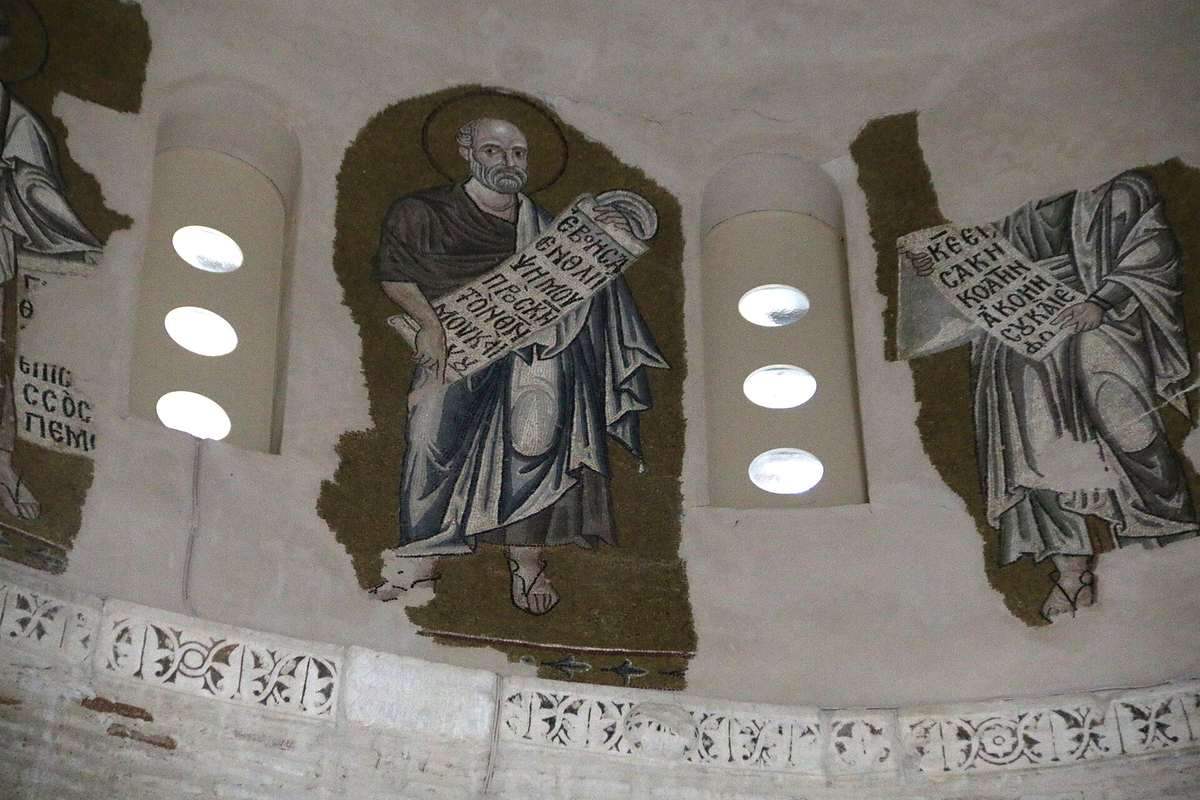
The mosaics of Daphni, created in the 11th and 12th centuries on shimmering gold backgrounds, are among the finest of the second golden age of Byzantine art. They cover the church interior with scenes from the life of Christ and the Virgin, alongside individual figures of archangels, prophets, saints, martyrs and bishops, rendered with grace, dignity and a classical elegance unusual for the period.
The supreme glory of Daphni, and the reason it ranks among the most important monuments in Greece, is its extraordinary cycle of mosaics, executed in the eleventh and twelfth centuries during the second golden age of Byzantine art. Set against luminous backgrounds of gold tesserae that glow and shimmer in the changing light, the mosaics cover the upper walls, vaults and dome of the church with a carefully planned programme of religious imagery. Across the surfaces unfold the great scenes from the life of Christ and the Virgin Mary, including the Annunciation, the Nativity, the Baptism, the Transfiguration, the Crucifixion and the Resurrection, rendered with remarkable skill and emotional depth.
Between these narrative scenes stand stately individual figures, ranks of archangels, Old Testament prophets, apostles, saints, martyrs and bishops, gazing out with solemn presence. What distinguishes the Daphni mosaics is their refined, almost classical elegance and humanity, with graceful proportions and gentle expressions that set them apart from the more rigid style of much Byzantine art and reflect a sophisticated artistic moment. Standing within the church surrounded by these glowing golden images is a profoundly moving experience. They are masterpieces of world art. One figure above all dominates the church.
What is the Christ Pantocrator at Daphni?
The Christ Pantocrator at Daphni is the most famous mosaic in the monastery, a colossal half-length image of Christ as ruler of all set in the centre of the main dome. Gazing down with a stern, powerful and intensely human expression, it is regarded as one of the greatest creations of Byzantine art and the most awe-inspiring of all Pantocrator images, dominating the whole church.
If the mosaics of Daphni are its glory, the single most celebrated and overwhelming of them all is the great Christ Pantocrator that fills the centre of the main dome, an image of such power that it has become one of the most famous works of Byzantine art in the world. The Pantocrator, meaning “ruler of all” or “almighty”, is the traditional Byzantine depiction of Christ as the supreme judge and ruler of the universe, placed in the dome so as to gaze down upon the worshippers below from the symbolic heavens. At Daphni this colossal half-length figure of Christ, set against a gold ground and ringed by an inscription, is rendered with extraordinary intensity: his face is stern, commanding and deeply serious, his eyes piercing, conveying a sense of awesome divine authority and judgement that is at once magnificent and unsettling.
Art historians have described it as one of the greatest creations in all of art and the most awe-inspiring and convincing of all the many Byzantine Pantocrators. To stand beneath the dome and look up into that powerful gaze is the unforgettable climax of any visit to Daphni. It is the heart of the monument. The architecture that frames it is equally fine.
What is the architecture of Daphni like?
The church of Daphni is an elegant 11th-century example of the cross-in-square plan with a large central dome supported on squinches defining an octagonal space, a hallmark of Middle Byzantine architecture. Its exterior shows the refined cloisonné masonry of the period, with stone blocks framed by bricks. The walled complex also includes monastic remains, a courtyard and later Gothic additions.
Beyond its mosaics, Daphni is an architectural masterpiece in its own right, embodying the elegant style of Middle Byzantine church building. The main church, or Katholikon, is built on the sophisticated octagonal variant of the cross-in-square plan, in which a large central dome rests upon an octagonal arrangement of arches and squinches, the curved structural elements that carry the round dome over the square space below, creating a soaring, harmonious and light-filled interior perfectly suited to displaying the mosaics. The exterior is finished in the refined cloisonné masonry characteristic of the period, where neatly dressed stone blocks are framed and separated by bricks laid in decorative patterns, giving the walls an understated, geometric elegance.
The walled monastic complex around the church preserves the remains of the cells, courtyards and defensive walls, along with traces of the later Gothic additions made by the Cistercian monks during the Frankish period, a reminder of the site’s layered history. Set among trees on the edge of the city, the ensemble has a quiet, dignified beauty. The combination of this exquisite architecture and the glowing mosaics makes Daphni a complete Byzantine masterpiece. It rewards an unhurried visit. Planning a trip is simple.
How do you visit Daphni Monastery?
Daphni Monastery is about 11 kilometres west of central Athens in Haidari, reached by bus or a short taxi or drive, with the nearest metro being some distance away. It is generally open on limited days with modest or free admission, but hours vary, so check before visiting. As a restored monument, dress modestly and respectfully, allow around an hour, and confirm it is open.
Visiting Daphni Monastery is straightforward, though it lies outside the historic centre and its opening times require checking in advance. The monastery is located about eleven kilometres west of central Athens, in the suburb of Haidari beside the old road toward Eleusis and the Peloponnese. It can be reached by city bus from central Athens, by a short taxi or ride-hailing trip, or by car with parking nearby, while the metro does not stop immediately at the site, so some onward connection is usually needed. An important practical point is that, as a precious and restored monument managed by the archaeological service, Daphni is generally open only on certain days of the week and for limited hours, which have varied over the years, and admission is modest or sometimes free; it is therefore essential to check the current opening days and times before making the trip, to avoid disappointment.
Because it remains a sacred site, visitors should dress modestly, covering shoulders and knees, and behave quietly and respectfully within the church. Allow around an hour to admire the mosaics and the architecture at a contemplative pace. For lovers of Byzantine art, the short journey is richly rewarded. The wider routes appear in the getting around Athens guide. The questions below cover the points visitors ask most.
Frequently Asked Questions
What is Daphni Monastery famous for?
Daphni Monastery is famous as a UNESCO World Heritage Byzantine monastery near Athens, renowned for its dazzling 11th-century golden mosaics, above all the awe-inspiring Christ Pantocrator in the dome, considered one of the greatest works of Byzantine art. It forms a UNESCO trio with Hosios Loukas and Nea Moni of Chios.
How far is Daphni Monastery from Athens?
Daphni Monastery is about 11 kilometres west of central Athens, in the suburb of Haidari beside the ancient Sacred Way to Eleusis. It is reached by city bus, a short taxi or ride-hailing trip, or by car. Opening days and hours are limited, so it is essential to check before visiting.
Can you visit Daphni Monastery?
Yes, you can visit Daphni Monastery, but it is generally open only on certain days of the week and for limited hours, which vary, with modest or free admission. Always check the current opening times before going. Dress modestly as it is a sacred restored monument, and allow about an hour for the mosaics and architecture.