
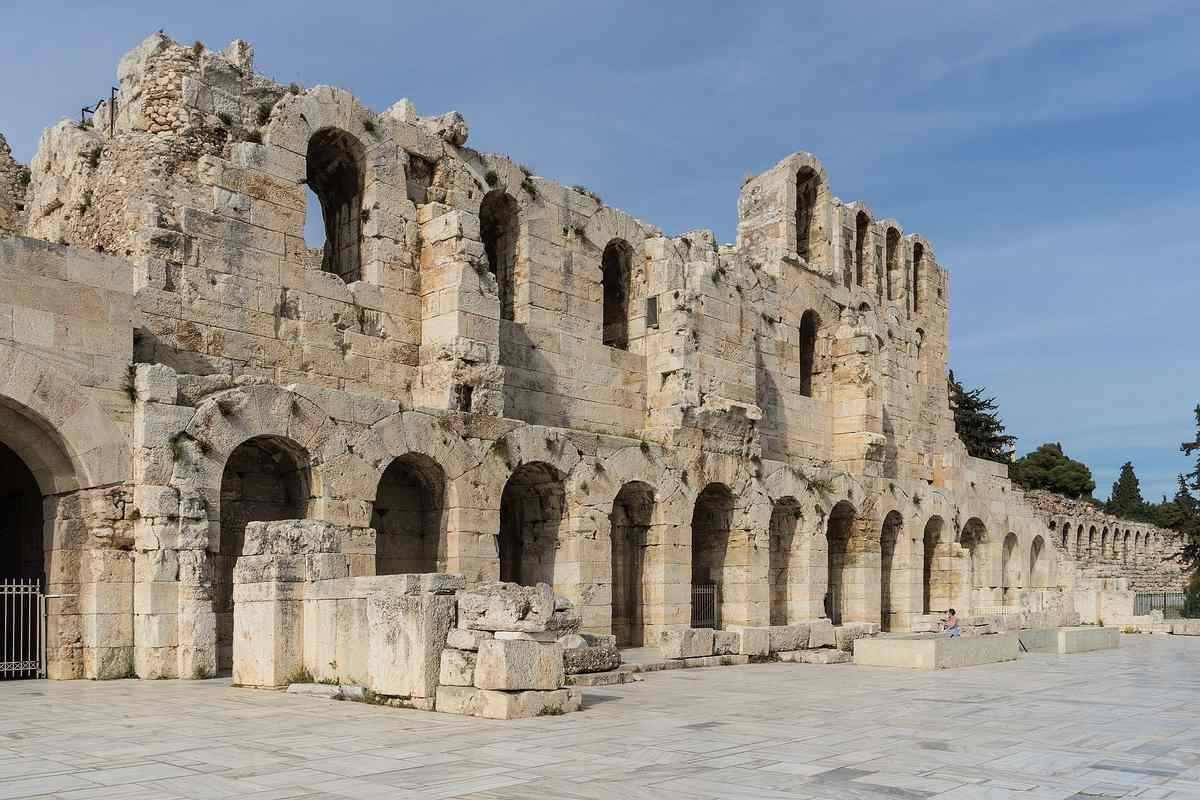
The Odeon of Herodes Atticus is a magnificent Roman theatre on the south-west slope of the Acropolis, raised in 161 AD for around 5,000 spectators and still staging world-class concerts during the Athens Epidaurus Festival. Discover this living ancient venue with skip-the-line tickets and guided tours from My Greece Tours for a richer, queue-free visit. Plan the whole trip with Greece Tours.
The Odeon of Herodes Atticus is one of the great sights of the south slope in the Acropolis tickets and tours guide. The sections below cover its history, concerts and how to see it in full.
What is the Odeon of Herodes Atticus?
The Odeon of Herodes Atticus is a Roman-era stone theatre on the Acropolis’s south-west slope, constructed in 161 AD by the wealthy Athenian Herodes Atticus in memory of his wife. With seating for around 5,000 and superb acoustics, it was restored in the 1950s and still hosts concerts and performances during the Athens Epidaurus Festival each summer.
The Odeon of Herodes Atticus is one of the most striking and best-preserved monuments on the slopes of the Acropolis, and uniquely among the ancient theatres it remains a living, working venue today. Built into the south-west slope of the sacred rock, it is a grand Roman-era theatre, or odeon, a covered theatre designed especially for musical performances. With its steeply tiered stone auditorium, imposing multi-storey stone stage building and capacity for around 5,000 spectators, it was one of the premier performance venues of the ancient world and is famed for its excellent acoustics. After lying ruined for centuries, it was carefully restored in the mid-20th century, and remarkably it has returned to its original purpose: each summer it hosts prestigious concerts, opera, ballet and theatre as the centrepiece venue of the renowned Athens Epidaurus Festival. To attend a performance beneath the floodlit Acropolis is an unforgettable experience. The Odeon is a magnificent sight by day and a magical setting by night, set out alongside the guide to the Acropolis monuments. Its origins lie in a Roman love story.
When and why was the Odeon of Herodes Atticus built?
The Odeon of Herodes Atticus was built in 161 AD, during the Roman period, by the immensely wealthy Athenian magnate and benefactor Herodes Atticus in memory of his late wife, Aspasia Annia Regilla. It was a grand gift to the city, providing a roofed theatre for musical performances, with a three-storey stone facade and a cedar-wood roof.
The Odeon of Herodes Atticus has a touching origin story rooted in the Roman era of Athens. It was built in 161 AD, several centuries after the Classical Golden Age, when Athens was part of the Roman Empire but still revered as a great cultural centre. The theatre was the gift of Herodes Atticus, an extraordinarily wealthy Athenian aristocrat, statesman and benefactor who was famous for funding magnificent public buildings across the Greek world. He constructed the Odeon as a memorial to his beloved wife, Aspasia Annia Regilla, who had recently died, dedicating the splendid building to her memory. As an odeon, it was designed specifically for musical and dramatic performances and, unlike the open-air Theatre of Dionysus nearby, it was originally roofed, with a remarkable cedar-wood roof spanning the auditorium, a steeply tiered seating area and an impressive three-storey stone stage facade. This combination of a personal tribute and civic generosity gave Athens one of its finest theatres. The building reflects both Roman engineering and the enduring cultural prestige of Athens, set out alongside the guide to the history. Its later history saw ruin and revival.
What happened to the Odeon and how was it restored?
The Odeon was partly destroyed in 267 AD by the invading Heruli, less than a century after it was built, and lay in ruins for centuries. In the 1950s the Greek government funded a major restoration, repairing and replacing the stone seating, restoring the stage and improving the acoustics, bringing the ancient theatre back into use as a performance venue.
The Odeon of Herodes Atticus enjoyed only a short life in its original form before disaster struck, but it was destined for a remarkable revival. Little more than a century after it was built, the theatre was damaged and partly destroyed in 267 AD during the invasion of Athens by the Heruli, a Germanic people who sacked the city, and its splendid cedar roof and much of its structure were lost. For many centuries thereafter the Odeon stood as a ruin on the slope of the Acropolis. Its rebirth came in the mid-20th century, when the Greek government funded an extensive and careful restoration: the project repaired and replaced the original marble and stone seating of the auditorium, restored the stage area and the towering stage facade, and improved the acoustics, returning the theatre to a usable, magnificent condition while preserving its ancient character. Thanks to this restoration, the Odeon was brought back to life and could once again host performances, an exceptional case of an ancient monument resuming its original function. This revival is what makes the Odeon so special today, set out alongside the guide to the best time to visit. It now hosts world-famous performances.
What performances are held at the Odeon of Herodes Atticus?
The Odeon of Herodes Atticus hosts concerts, opera, ballet and theatre each summer as the main venue of the Athens Epidaurus Festival. Legendary artists such as Maria Callas, Margot Fonteyn, Luciano Pavarotti and Yanni have performed here, and the famous Yanni Live at the Acropolis concert was filmed at the Odeon. Tickets are sold separately for these events.
One of the most extraordinary things about the Odeon of Herodes Atticus is that it remains a premier cultural venue almost 1,900 years after it was built, hosting world-class performances every summer. The theatre is the flagship venue of the Athens Epidaurus Festival, Greece’s most important annual cultural festival, which from late spring through summer presents a rich programme of classical music concerts, opera, ballet, contemporary dance and ancient and modern theatre beneath the floodlit Acropolis. Over the decades, many of the greatest artists in the world have graced its ancient stage, including the opera diva Maria Callas, the ballet legend Margot Fonteyn, the tenor Luciano Pavarotti and the entertainer Liza Minnelli, while the celebrated Yanni Live at the Acropolis concert, watched by millions on television, was filmed at the Odeon. Attending an evening performance here, with the marble glowing and the Parthenon lit above, is a magical, bucket-list experience. Tickets for festival events are sold separately from the Acropolis entrance ticket and should be booked in advance, as performances sell out. Checking the festival programme can crown a trip to Athens, set out alongside the guide to guided tours. Visiting by day is simple too.
How do you visit the Odeon of Herodes Atticus?
By day, you can view the Odeon of Herodes Atticus from within the Acropolis archaeological site, included in your standard ticket, as you walk the south-west slope, though you cannot usually enter the auditorium itself except during performances. To go inside, attend an Athens Epidaurus Festival event in summer, for which tickets are sold separately.
There are two ways to experience the Odeon of Herodes Atticus, by day as a monument and by night as a venue, and it is worth knowing the difference. By day, the Odeon is part of the Acropolis archaeological site and included in your standard Acropolis ticket: as you explore the south-west slope on your way to or from the summit, you can admire the magnificent theatre, its towering stone stage facade and its sweeping auditorium, from the viewpoints and paths around it. However, on ordinary days you generally cannot walk down into the seating or onto the stage, as the interior is reserved and protected; it is appreciated from above and around rather than entered. The only way to go inside and sit in the ancient auditorium is to attend a performance during the Athens Epidaurus Festival in the summer months, for which you buy a separate event ticket in advance; this is the truly special way to experience it. Either way, the Odeon is a highlight, best seen early or late to avoid the crowds and heat, with a guide adding rich context. The Odeon rewards every visitor to the Acropolis, set out alongside the guides to skipping the lines and a one-day itinerary. The questions below cover the points visitors ask most.
How do you attend a performance at the Odeon of Herodes Atticus?
To attend a performance at the Odeon of Herodes Atticus, book tickets for an Athens Epidaurus Festival event, held there from late spring through summer. Tickets are sold separately from the Acropolis ticket, through the festival’s official channels, and sell out fast for popular shows. Arrive early, bring a cushion for the stone seats, and dress for a cool evening.
Attending an evening performance at the Odeon of Herodes Atticus, beneath the floodlit Acropolis, is one of the most magical experiences Athens offers, and it is well worth planning for. Performances take place during the Athens Epidaurus Festival, Greece’s premier cultural festival, which runs from around late May or June through the summer and stages concerts, opera, ballet, dance and theatre at the Odeon. To attend, you need to buy a ticket for a specific event, which is entirely separate from the Acropolis archaeological-site ticket; tickets are sold through the festival’s official box office and website and through authorised sellers, and the most popular concerts sell out quickly, so book well in advance once the programme is announced. On the night, arrive early to find your seat and soak up the atmosphere, and bring a cushion or hire one, as the ancient stone and marble seating is hard, and a light layer, since evenings can turn cool in the open-air theatre. Photography rules vary by event, so check. Sitting in the 1,900-year-old auditorium as world-class artists perform, with the Parthenon glowing above, is unforgettable. Checking the festival programme when planning your trip can crown your visit to Athens, set out alongside the guide to the best time to visit. The questions below cover the points visitors ask most.
Who was Herodes Atticus, the builder of the Odeon?
Herodes Atticus was a Greek orator and teacher from Marathon, born around 101 AD. He served as a Roman consul in 143 AD and tutored the future emperors Marcus Aurelius and Lucius Verus. He spent his fortune on public buildings across Greece.
Herodes was a leading figure of the Second Sophistic, a movement of Greek public speakers under Roman rule. His family held large estates in Attica.
In Athens he rebuilt the Panathenaic Stadium in white Pentelic marble. At Olympia he funded a monumental fountain, the Nymphaeum, dedicated in the name of his wife Regilla. It stands among the monuments of Olympia.
Herodes died around 177 AD. Athenians still call his theatre the Herodeion.
What does the Odeon of Herodes Atticus look like?
The Odeon of Herodes Atticus has a steep semicircle of marble seats, the cavea, facing a flat orchestra. Behind the stage rises a stone wall pierced by rows of arched openings, about 28 metres high.
Romans called this stage wall the scaenae frons. Its arches and niches were once richly decorated. Today its weathered stone contrasts with the pale marble of the restored seats.
The best daytime view is from the path on the south slope of the Acropolis. It passes right above the theatre and looks straight down into the seats. The same path leads east to the Theatre of Dionysus.
At street level, the pedestrian Dionysiou Areopagitou street runs beside the arched facade.
How do you get to the Odeon of Herodes Atticus?
The Odeon of Herodes Atticus stands on Dionysiou Areopagitou street, at the south-west foot of the Acropolis. Acropoli station on metro Line 2, the red line, lies a short walk east along the car-free street.
The street runs through the Makrygianni district, past the Acropolis Museum. It is closed to traffic, and there is no parking beside the theatre. The Athens metro is the easiest way to arrive.
On performance nights, the entrance gate opens on Dionysiou Areopagitou street. Evening shows start after dark, at around 9 pm. The theatre bans stiletto heels to protect the ancient stone.
Frequently Asked Questions
What is the Odeon of Herodes Atticus?
The Odeon of Herodes Atticus is a Roman-era stone theatre on the Acropolis’s south-west slope, constructed in 161 AD by the wealthy Athenian Herodes Atticus in memory of his wife. With seating for around 5,000 and superb acoustics, it was restored in the 1950s and still hosts concerts during the Athens Epidaurus Festival.
Can you go inside the Odeon of Herodes Atticus?
By day you can view the Odeon from within the Acropolis site, included in your ticket, but you generally cannot enter the auditorium itself, which is reserved and protected. To go inside and sit in the ancient theatre, attend an Athens Epidaurus Festival performance in summer, for which tickets are sold separately.
Does the Odeon of Herodes Atticus still host concerts?
Yes, the Odeon of Herodes Atticus still hosts concerts, opera, ballet and theatre every summer as the main venue of the Athens Epidaurus Festival, almost 1,900 years after it was built. Legendary artists like Maria Callas and Luciano Pavarotti have performed here. Tickets for these events are sold separately and book up fast.