
The 4-day Peloponnese, Delphi and Meteora tour from Athens links the Corinth Canal, Mycenae, Epidaurus, Olympia, Delphi and two Meteora monasteries with history-loving guides. Tours across the rest of the country are listed on Greece Tours.
The sections below cover what the Peloponnese, Delphi and Meteora tour includes, the route, five World Heritage Sites, ticket rules, Mycenae, Epidaurus, Olympia, Delphi, Meteora, season and booking, with links into the Peloponnese tours pages. The tours shown are checked on GetYourGuide and Viator.
What is the 4-day Peloponnese, Delphi and Meteora tour?
The 4-day Peloponnese, Delphi and Meteora tour is a guided trip that starts in Athens. History-loving guides lead it across three regions: the Peloponnese, Central Greece and Thessaly. Its six stops mix ancient sites, a canal and monasteries.
The six stops of the 4-day Peloponnese, Delphi and Meteora tour span more than three millennia of building. Mycenae’s Lion Gate dates from the 13th century BC. Epidaurus gained its stone theatre in the 4th century BC. The Great Meteoron monastery dates from the 14th century AD. The Corinth Canal opened at the end of the 19th century.
Olympia gave its name to the Olympic Games, first held there in the 8th century BC. Winners took home a wreath cut from a wild olive tree. Delphi was home to the oracle of Apollo, spoken through a priestess called the Pythia. Ancient Greeks marked Delphi as the navel of the world with a carved stone, the omphalos.
One family of gods links three of the ancient stops. Zeus was the chief god of the sanctuary at Olympia. His son Apollo took Delphi by killing the serpent Python, in Greek myth. Apollo’s son Asclepius, god of medicine, was worshipped at Epidaurus. His staff with one coiled snake is still a symbol of medicine.
The northern end of the 4-day Peloponnese, Delphi and Meteora tour sits at Meteora, by the Pindus range. The name Meteora means suspended in the air in Greek. Pillars of sandstone and conglomerate rise there above the plain of the Pineios River. Monks built 24 monasteries on the rocks, and six still hold working communities.
The word Peloponnese means the island of Pelops, a mythical king honoured with a shrine at Olympia. The peninsula covers about 21,550 square kilometres. Four stops on the Peloponnese, Delphi and Meteora tour lie on that peninsula or at its edge.
What does the Peloponnese, Delphi and Meteora tour include?
The 4-day Peloponnese, Delphi and Meteora tour includes three hotel nights, each with breakfast and dinner. Entry tickets, lunches and drinks are not named in the listing. Those three items need a separate budget for the whole trip.
- Included: three hotel nights along the route.
- Included: breakfast at the hotel after each of the three nights.
- Included: dinner at the hotel on each of the three evenings.
- Included: history-loving guides who lead the tour.
- Shown on the listing: the cancellation terms.
- Not named in the listing: entry tickets to the archaeological sites and monasteries.
- Not named in the listing: lunches on the four days.
- Not named in the listing: drinks, at meals or between stops.
Breakfast and dinner at the hotels give the 4-day Peloponnese, Delphi and Meteora tour a half-board meal plan. Half board is the hotel trade term for a room with those two meals. Full board adds lunch, and all-inclusive adds drinks as well.
Three of the ancient sites have villages with tavernas close to their gates. The modern village of Ancient Olympia lines the road beside the sanctuary. Modern Delphi lies just west of the Sanctuary of Apollo, on the road toward Itea. Mykines sits on the approach road below the citadel of Mycenae.
Five of the six stops on the 4-day Peloponnese, Delphi and Meteora tour charge for entry. Mycenae, Epidaurus, Olympia and Delphi are fenced archaeological sites, each with its own museum. Each Meteora monastery charges its own fee at the door. The Corinth Canal is an open viewpoint from the road bridges.
Two regional drinks come from areas on the Peloponnese, Delphi and Meteora tour. The Nemea zone, just north of Mycenae, makes red wine from the Agiorgitiko grape. Thessaly, the region of Meteora, makes tsipouro, a clear spirit from grape pomace, around Tyrnavos. Greek tavernas pour house wine in metal jugs measured by the kilo.
Which route does the tour follow over four days?
The 4-day Peloponnese, Delphi and Meteora tour leaves Athens for the Corinth Canal, Mycenae and Epidaurus. It continues to Olympia, Delphi and the Meteora monasteries. Hotel nights fall in Olympia, Delphi and Kalambaka, and day four ends in Athens.
- Day 1: start in Athens, then the Corinth Canal, Mycenae and Epidaurus before the first night in Olympia.
- Day 2: Olympia, the next stop in the site order, then the second hotel night in Delphi.
- Day 3: Delphi, the next stop in the site order, then the third hotel night in Kalambaka.
- Day 4: visits to two Meteora monasteries, then the return to Athens.
The first stop of the 4-day Peloponnese, Delphi and Meteora tour is the Corinth Canal. The cut runs 6.4 kilometres through the Isthmus of Corinth. Its rock walls rise up to 90 metres above the water. The channel below is 8 metres deep. The canal links the Gulf of Corinth with the Saronic Gulf.
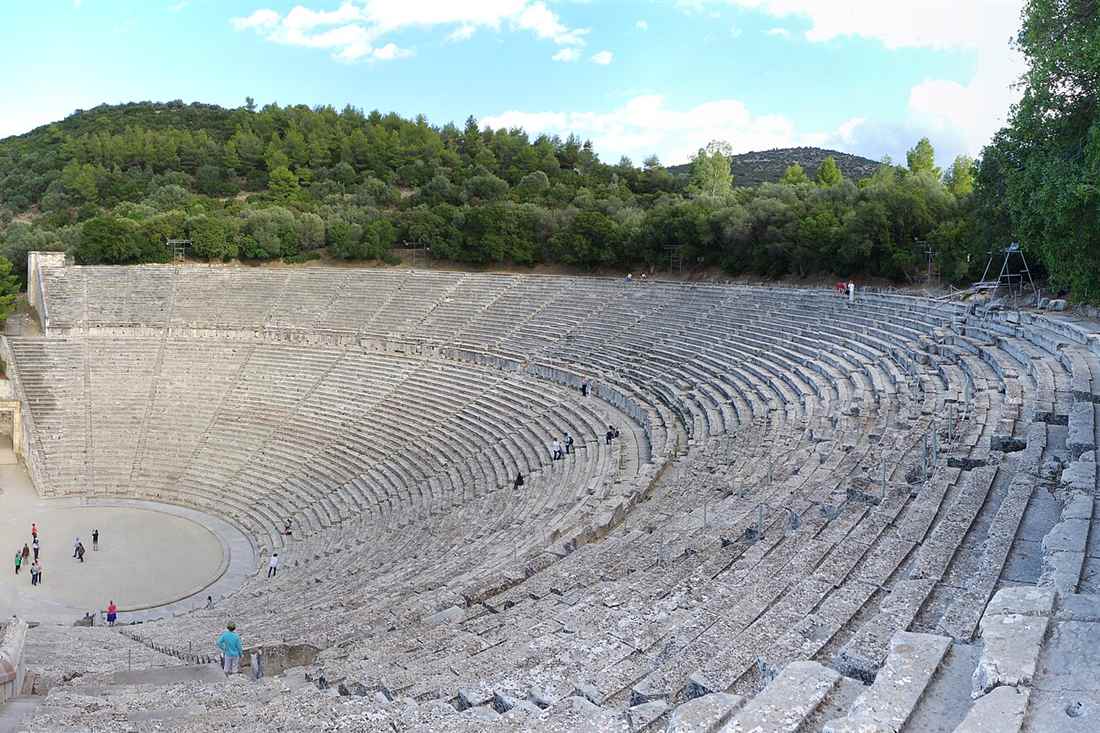
Stops two and three on the Peloponnese, Delphi and Meteora tour, Mycenae and Epidaurus, lie in the Argolis. Homer named Mycenae as the seat of King Agamemnon. Its largest beehive tomb, the Treasury of Atreus, rises 13.5 metres inside. The Epidaurus theatre seats about 14,000 people in 55 rows of limestone.
Olympia comes fourth in the order of the 4-day Peloponnese, Delphi and Meteora tour. The Temple of Zeus there held a gold-and-ivory statue by Phidias. Phidias made the seated figure, about 12 metres tall, in the 5th century BC. The stadium track runs about 192 metres, the length of one ancient stade.
Delphi holds the Temple of Apollo, a theatre and a stadium on terraces of Mount Parnassus. The terraces look down on the Pleistos valley and its olive groves. The Athenian Treasury stands beside the Sacred Way, rebuilt from its original marble blocks. The sanctuary on its own is also the subject of a Delphi day trip from Athens.
Kalambaka, the last hotel base on the 4-day Peloponnese, Delphi and Meteora tour, sits below the rocks. Kastraki, a village at the foot of the pillars, lies just northwest of the town. The Great Meteoron is the largest monastery on the rocks, and Varlaam ranks second in size. Meteora on its own is the focus of a Meteora private tour.
How does it compare with the 6-day private Peloponnese tour and Meteora sunset?
The 4-day Peloponnese, Delphi and Meteora tour runs two days shorter than the private 6-day Peloponnese option. Four days suit a tight schedule. Six days suit travellers who want a private group and an evening at Meteora.
Six named sites fill the Peloponnese, Delphi and Meteora tour, an average of 1.5 per day. They stretch from the Corinth Canal on the isthmus to the Meteora rocks in Thessaly. Meteora lies farthest north of the six stops. The private 6-day option adds 48 hours to that calendar.
A private tour takes one booking party and no other travellers. That format defines the 6-day private Peloponnese tour and Meteora sunset. Its title names the Peloponnese and Meteora but leaves out Delphi. The 4-day Peloponnese, Delphi and Meteora tour lists history-loving guides and carries no private label.
Both tours save Meteora, with its monasteries on rock pillars above Kalambaka, for the final stretch. The 6-day option closes with sunset light on those pillars. Day four of the 4-day Peloponnese, Delphi and Meteora tour brings visits to two Meteora monasteries.
Three of the six named sites lie inside the Peloponnese: Mycenae, Epidaurus and Olympia. Olympia sits in the Alpheios valley of Elis, in the western Peloponnese. The Corinth Canal cuts the isthmus at its northeast edge. Delphi lies in Central Greece and Meteora in Thessaly, both north of the Gulf of Corinth.

Which World Heritage Sites does the four-day route pass?
The 4-day Peloponnese, Delphi and Meteora tour passes five UNESCO World Heritage properties. They are Mycenae, Epidaurus, Olympia, Delphi and Meteora. Four are listed as cultural sites, and Meteora is listed for both culture and nature.
Meteora alone on the 4-day Peloponnese, Delphi and Meteora tour is listed for culture and nature. It qualifies under four cultural criteria and one natural criterion. Mount Athos is the other Greek property listed for both. It joined the list in the same year as Meteora.
- Archaeological Sites of Mycenae and Tiryns: the 13th-century BC Lion Gate opens through the Cyclopean walls of Mycenae.
- Sanctuary of Asklepios at Epidaurus: its late 4th-century BC theatre held 13,000 to 14,000 spectators.
- Archaeological Site of Olympia: the ancient Olympic Games ran here every four years from the 8th century BC.
- Archaeological Site of Delphi: the oracle of Apollo spoke from this sanctuary at the foot of Mount Parnassus.
- Meteora: 24 Orthodox monasteries rose on its sandstone peaks, mainly in the 14th century.
The Mycenae and Tiryns listing joins two Bronze Age citadels of the Argolid. Only Mycenae appears among the named stops of the 4-day Peloponnese, Delphi and Meteora tour. Homer praised Tiryns for its walls, yet the citadel stays off the stop list. Those walls reach 17 metres thick where tunnels pass through them.
Of the six sites on the Peloponnese, Delphi and Meteora tour, the Corinth Canal alone lacks a listing. A first attempt began under Nero in the 1st century AD. The 6.4-kilometre cut through the isthmus opened in the 19th century. Rock walls rise 90 metres above the water between the Gulf of Corinth and the Saronic Gulf.
Delphi was the first of the five to join the World Heritage List. Epidaurus and Meteora followed one year later, and Olympia a year after them. Mycenae and Tiryns joined last, a decade after Olympia. That leaves 12 years between the first and the last of the five.
Two other Peloponnese listings stay off the stop list: the Temple of Apollo Epicurius at Bassae and Mystras. Bassae became the first Greek property on the list, one year before Delphi. Mystras served as the seat of the Byzantine Despotate of the Morea in the 14th and 15th centuries.
Which ticket rules apply at the sites on the route?
State sites on the 4-day Peloponnese, Delphi and Meteora tour sell official e-tickets on hhticket.gr. The Greek Ministry of Culture sets free days and free or reduced categories. The Meteora monasteries charge their own entry at each gate.
The hhticket.gr portal is the official e-ticket system of the Hellenic Organization of Cultural Resources Development. Mycenae, Epidaurus, Olympia and Delphi all appear on the portal. Each of the four state sites on the 4-day Peloponnese, Delphi and Meteora tour issues its own ticket. An e-ticket works on a phone screen or as a printout at the entrance.
- Official sale points: hhticket.gr and the ticket office at each site.
- Spring free days: 6 March, 18 April and International Museums Day in late spring.
- Autumn free days: the last weekend of September and 28 October.
- Winter Sundays: free entry on the first Sunday of each month, 1 November to 31 March.
- Free entry: EU citizens up to age 25 and non-EU children up to age 18.
- Disability: persons with disabilities enter free, plus one escort at 67 percent disability or more.
- Reduced entry: EU citizens over 65 pay a reduced rate.
- Meteora: each monastery takes its own entry fee at its gate, outside hhticket.gr.
On the Olympia stop of the 4-day Peloponnese, Delphi and Meteora tour, one ticket covers four areas. Those are the site, the Archaeological Museum and the museums of the ancient Games and the excavations. This integrated ticket stays valid for one day. More detail sits on the Ancient Olympia tickets page.
A single Epidaurus ticket covers the Sanctuary of Asklepios, the ancient theatre and the site museum. Mycenae works the same way, with the citadel, the museum and the Treasury of Atreus on one ticket. Delphi joins its sanctuary and its museum on one ticket as well.
Free and reduced entry both need an ID card or passport at the gate. An EU citizen aged 24 enters free on any day. A non-EU visitor aged 20 pays the full rate outside the free days. Travellers on the 4-day Peloponnese, Delphi and Meteora tour carry that document to all four state sites.
The Meteora monasteries belong to the Church of Greece, so they sit outside the hhticket.gr system. Six of the original 24 monasteries still stand on the sandstone pillars. St Stephen has housed nuns since the 20th century. Two monastery visits on the 4-day Peloponnese, Delphi and Meteora tour mean two separate gate entries.
How did Mycenae keep water inside its walls during a siege?
Mycenae stored water in an underground cistern reached by a secret stairway under its northeast wall. Clay pipes fed it from the Perseia spring outside the walls. The 4-day Peloponnese, Delphi and Meteora tour stops at this citadel in the Argolid.
Builders added the northeast extension near the end of the 13th century BC. It was the final enlargement of the citadel walls. The new stretch enclosed a small sally port and the head of a secret passage. Visitors on the 4-day Peloponnese, Delphi and Meteora tour find that entrance at the citadel’s eastern tip.
The passage runs through the wall and down under it in three flights. Stone slabs lean together overhead to form a corbelled roof. About 99 steps lead to the cistern, which sits roughly 15 metres below the surface. Workers cut the chamber out of the bedrock and lined it with waterproof plaster.
The Perseia spring rises about 360 metres from the citadel, at the foot of Mount Profitis Ilias. It sits about 13 metres higher than the hilltop, so gravity carried the flow. The pipes ran underground the whole way. Besiegers camped on the plain saw no channel to cut.
Legend credits Perseus, the mythical founder of Mycenae, with finding the spring. In one tale he pulled up a mushroom, mykes in Greek, and water flowed from the ground. Pausanias, the 2nd-century AD travel writer, recorded the spring as Persea. It still supplies Mykines, the village below the citadel that the 4-day Peloponnese, Delphi and Meteora tour visits.
Tiryns and Athens built hidden routes to water in the same century. In Athens, a stairway dropped through a cleft in the Acropolis rock to a fountain. The lower flight at Mycenae has no lighting. A phone torch helps there on the 4-day Peloponnese, Delphi and Meteora tour. The Mycenae citadel page covers the rest of the ruins.
Why did Mycenae fall at the end of the Bronze Age?
Mycenae fell through a chain of fires, quakes and failing trade between the 13th and 12th centuries BC. No single cause explains it. The 4-day Peloponnese, Delphi and Meteora tour visits ruins left by that wider Late Bronze Age collapse.
Mycenae, a stop on the 4-day Peloponnese, Delphi and Meteora tour, shook in a mid-13th-century BC earthquake. Fire then destroyed houses outside the walls, including the House of the Oil Merchant. The blaze baked the Linear B tablets inside and preserved them. The citadel itself suffered a heavier destruction near the end of that century.
The crisis reached far beyond the Argolid. Thebes lost its palace to fire at the end of the 13th century BC. Pylos burned in the early 12th century BC. The Hittite capital Hattusa and the Syrian port of Ugarit fell in the same era. None of the Mycenaean palaces survived as a working seat of power.
- Historians point to an earthquake storm that shook Mycenae and Tiryns in the 13th century BC.
- Historians point to drought: tree rings in Anatolia show a dry spell in the early 12th century BC.
- Historians point to the Sea Peoples, raiders whom Egypt fought under Ramesses III in the 12th century BC.
- Historians point to the end of long-distance trade, which cut off the tin and copper for bronze.
- Historians point to internal revolt, with peasants rising against the palaces and hired soldiers changing sides.
- Historians point to new infantry tactics, as long swords and javelins beat armies built around chariots.
- Historians point to an early strain of plague that spread through Greece, Anatolia and the Levant.
- Historians point to the Dorian invasion of legend, when the descendants of Heracles returned to claim the Peloponnese.
Survivors rebuilt parts of the citadel on the 4-day Peloponnese, Delphi and Meteora tour after that blow. Pottery shows the town regained wealth before a final burning in the 12th century BC. Linear B writing vanished with the palace offices. Up to 90 percent of small Peloponnese sites stood empty. The Greek Dark Ages lasted about 400 years.
A small town lived on at the site through the Archaic period, with a temple on the summit. Troops from Argos captured it in the 5th century BC and drove out its people. By Roman times the ruins drew sightseers. Guests on the 4-day Peloponnese, Delphi and Meteora tour see the walls that Argos left standing.
What was the Tholos of Epidaurus, with its maze below the floor?
The Tholos was a round marble building in the Sanctuary of Asklepios, raised in the 4th century BC. Concentric walls in its foundations formed a maze. The 4-day Peloponnese, Delphi and Meteora tour stops at the sanctuary where it stands.
An inscription calls the Tholos the thymele, a word for a place of sacrifice. Work began around the middle of the 4th century BC. Pausanias names Polykleitos, an architect from Argos, as its builder. On the 4-day Peloponnese, Delphi and Meteora tour, the ruins sit behind the Asklepios temple at Epidaurus.
The building measured about 22 metres across. An outer ring of 26 Doric columns stood around a circular inner wall. That wall had a doorway with a window on each side. Inside rose 14 Corinthian columns with carved acanthus-leaf capitals. These capitals shaped later Corinthian designs across the Greek world.
Excavators found one complete Corinthian capital buried near the building. Scholars treat it as the sample the masons copied. It never carried weight, so its carving stays sharp. It now stands in the site museum. The museum lies a short walk from the ruins on the 4-day Peloponnese, Delphi and Meteora tour.
Pausanias describes paintings by Pausias inside the building. One showed Eros holding a lyre in place of his bow. Another showed Methe, the spirit of drunkenness, drinking from a glass cup. The floor carried black and white marble tiles in a diamond pattern. Day one of the 4-day Peloponnese, Delphi and Meteora tour adds Mycenae and the Corinth Canal.
The foundations hold six concentric rings. The outer three run unbroken. The inner three have doorways and cross walls, which turn the core into a maze. Theories name it a pit for sacred snakes or a symbolic tomb of Asklepios. The rings lie open to view at the Epidaurus stop of the 4-day Peloponnese, Delphi and Meteora tour.
How did floods bury Ancient Olympia under river silt?
Floods from the Kladeos and Alfeios rivers buried Ancient Olympia under silt up to 8 metres deep. Earthquakes first wrecked the buildings, then the rivers covered the wreckage. Guests on the 4-day Peloponnese, Delphi and Meteora tour see ruins dug out since the 19th century.
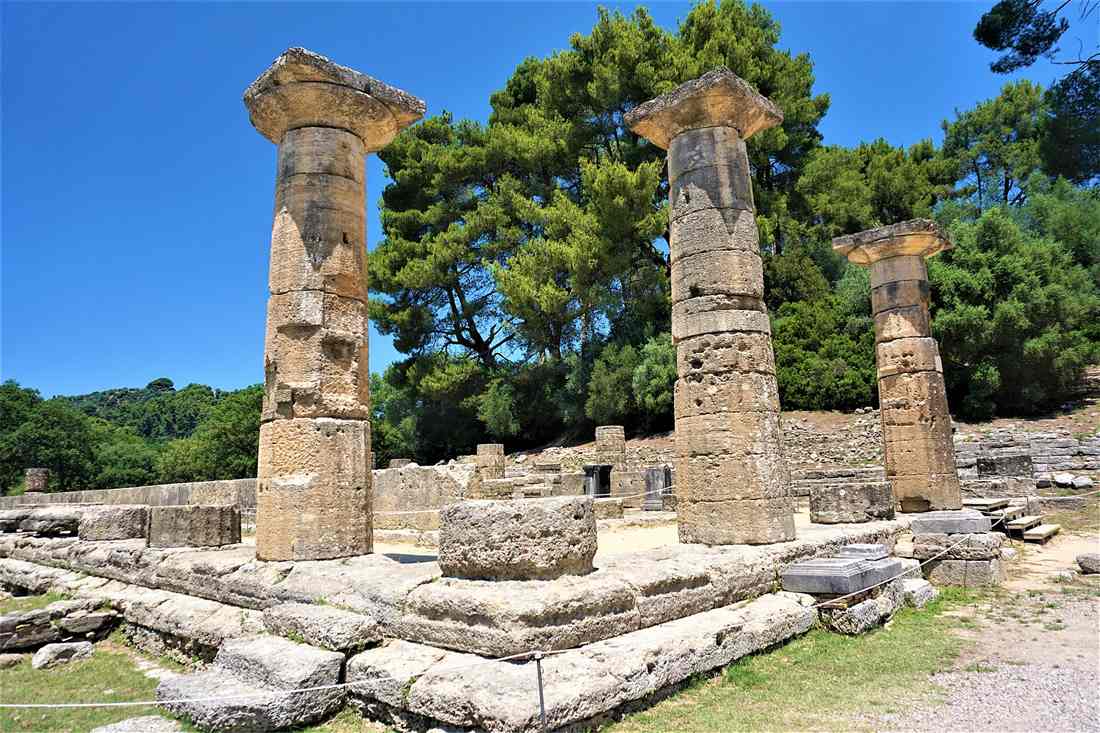
The Kladeos forms the western border of Ancient Olympia and empties into the Alfeios. The Alfeios runs 112 km from Arcadia to the Gulf of Kyparissia. Builders in antiquity diverted the Kladeos near the sanctuary to stop its winter floods. Both rivers frame the site visited on the 4-day Peloponnese, Delphi and Meteora tour.
- 3rd century AD: a series of earthquakes damages the sanctuary.
- 5th century AD: a Christian community settles among the ruins.
- 6th century AD: two earthquakes bring down the Temple of Zeus.
- Early 7th century AD: repeated floods drive out the last residents.
- 18th century: Richard Chandler identifies the buried site.
- 19th century: French and then German teams dig through the silt.
- 20th century: Emil Kunze and Alfred Mallwitz clear the north wall of the stadium.
- 21st century: radar surveys trace the lost hippodrome.
The quakes toppled the columns of the Temple of Zeus, and each one broke into its separate drums. Those drums still lie where they landed, in view on the 4-day Peloponnese, Delphi and Meteora tour. River mud later filled the gaps between the fallen blocks. Workers set one column upright again in the 21st century.
When digging began, a sediment layer 4 metres thick covered the core of the sanctuary. The layer hid the Altis, the sacred grove of Zeus, with its altars and treasuries. The hippodrome east of the Altis disappeared under silt from the Alfeios. This ground, seen on the 4-day Peloponnese, Delphi and Meteora tour, lay buried for about 12 centuries.
In the 21st century, geographer Andreas Vött of Mainz proposed another cause. His team found sea shells and marine fossils called foraminifera in the deposits. In their reading, repeated tsunami waves from the Ionian Sea pushed this sediment inland. The sea now lies about 18 km from the ruins on the 4-day Peloponnese, Delphi and Meteora tour.
Richard Chandler, an English antiquarian, found the sanctuary long forgotten under landslips and flood silt. He travelled for the Society of Dilettanti in London. Visitors such as Fauvel, Pouqueville, Gell, Cockerell and Leake followed him. Their reports drew scholars to the spot the 4-day Peloponnese, Delphi and Meteora tour reaches from Athens.
The French Scientific Expedition of the Morea spent six weeks at the site from late spring. Léon-Jean-Joseph Dubois and the architect Abel Blouet split the ground into a grid of squares. They identified the Temple of Zeus with certainty and shipped metope fragments to the Louvre. Painters Poirot, Trézel and Amaury-Duval also joined the team.
The German dig under Ernst Curtius followed and lasted six years. The German government paid for the work, and a treaty kept the finds in Greece. Diggers found the Hermes of Praxiteles inside the Temple of Hera at Olympia. The German Archaeological Institute still leads digs at this stop on the 4-day Peloponnese, Delphi and Meteora tour.
Why does Olympia keep the heart of Pierre de Coubertin?
Pierre de Coubertin, who revived the Olympic Games, asked for his heart to rest at Olympia. It lies in a stele at the International Olympic Academy, 1.2 km from the village. Olympia hosts the first night of the 4-day Peloponnese, Delphi and Meteora tour.
Coubertin, a French educator, called for a revival of the Games in the late 19th century. He co-founded the International Olympic Committee and served 29 years as its second president. The first Games under his committee took place in Athens. The modern Games revived contests once held at the site on the 4-day Peloponnese, Delphi and Meteora tour.
Coubertin died of a heart attack in Geneva in the 20th century, aged 74. His body was buried in the Bois-de-Vaux Cemetery in Lausanne, home of the IOC. His heart travelled on to Greece and reached Olympia one year after his death.
The Greek government had raised a commemorative stele at Olympia a decade before his death. It honoured his revival of the Games, and the government invited him to the unveiling. The heart went inside this stele, which stands in the Coubertin Grove. The grove sits within walking distance of the ruins on the 4-day Peloponnese, Delphi and Meteora tour.
The Olympic flame lighting ceremony begins inside the site on the 4-day Peloponnese, Delphi and Meteora tour. After the lighting, the flame is carried to the Coubertin Grove. There it lights an altar beside the resting place of his heart. Each academy session opens with wreaths at his stele and at a monument to its founders.
Greek official Ioannis Ketseas and German sports official Carl Diem drafted the academy plan in the 20th century. The IOC approved it at its 44th Session in Rome. The first session met under tents near the ruins. The academy keeps its headquarters in Athens, the starting city of the 4-day Peloponnese, Delphi and Meteora tour.
- Campus: rooms for up to 257 guests, including 6 VIP suites.
- Auditorium: the Dimitrios Vikelas hall seats 420, with translation into 8 languages.
- Library: the Nissiotis Library holds more than 16,000 book titles.
- Sport: a 250 m track, a 25 m outdoor pool and two tennis courts.
- Degree: a two-year master’s programme in Olympic Studies with the University of Peloponnese.
- Reach: more than 80,000 people at its congresses and seminars, 20,000 of them in official sessions.
The academy runs international sessions for educators, Olympic medallists and delegates of national Olympic bodies. Its seminar on Olympic Studies for postgraduate students has passed its 30th edition. The oldest programme, running since the first session, has reached its 66th edition. Sessions went online for the first time during the COVID-19 pandemic.
The academy works under the patronage of the IOC and the supervision of the Greek Ministry of Culture. It became a private legal entity with its own management in the 21st century. Funding comes from the Greek state and the IOC. The same ministry runs the archaeological site on the 4-day Peloponnese, Delphi and Meteora tour.

Who revived ancient drama at Delphi in the 20th century?
The poet Angelos Sikelianos and his American wife, Eva Palmer-Sikelianos, revived ancient drama at Delphi. Their Delphic Festivals staged Aeschylus in the ancient theatre. The Delphi stop on the 4-day Peloponnese, Delphi and Meteora tour keeps their story in a museum.
Sikelianos was born on Lefkada and wrote lyric poems on Greek history and faith. The Nobel committee received his nomination in each of his last six years. He married Eva Palmer, an American student of Greek music, dance and weaving, in the early 20th century.
The couple aimed to make Delphi a meeting place for peoples, an aim they called the Delphic Idea. The first festival opened in late spring between the two world wars. Critics came from abroad at the couple’s invitation. A second festival followed three years later, without state funding.
- Theatre: Prometheus Bound by Aeschylus, staged among the ruins of the ancient theatre
- Stadium: athletic contests on the ancient track above the sanctuary
- Village: an exhibition of local crafts and woven goods
- Costumes: robes woven by hand on a loom that Eva Palmer built
Eva Palmer-Sikelianos trained the chorus and shaped the dances herself. She studied Byzantine church chant under Konstantinos Psachos to build the music. Guests on the 4-day Peloponnese, Delphi and Meteora tour stay in the village where they lived.
The European Cultural Centre of Delphi bought and restored the couple’s house, now the Museum of Delphic Festivals. The centre itself opened in the late 20th century with support from the Council of Europe. The night in Delphi on the 4-day Peloponnese, Delphi and Meteora tour falls a short walk from both. The sanctuary is covered on the Delphi page.
How did fire, earthquakes and rockfalls reshape Delphi?
The temple of Apollo on the 4-day Peloponnese, Delphi and Meteora tour is the third stone version. A fire and an earthquake destroyed the first two. Rockfalls from the Phaedriades cliffs crushed the sanctuary of Athena Pronaia below.
Fire destroyed the first stone temple, built by Trophonius and Agamedes, in the 6th century BC. The Athenian Alcmaeonid family rebuilt it by the end of that century. They used Parian marble for its east front, though the contract asked only for limestone. That marble pediment, showing Apollo arriving by chariot, now stands in the Delphi Archaeological Museum.
An earthquake brought down the Alcmaeonid temple of Apollo at Delphi in the 4th century BC. A contract named Spintharus of Corinth as architect of its replacement. It rose as a Doric temple, 6 columns wide and 15 long. The foundations and column drums on the 4-day Peloponnese, Delphi and Meteora tour belong to this temple.
The Phaedriades, or Shining Ones, are 2 cliffs about 700 m high. The Castalian spring rises in the narrow gorge between them. Their faces loom over the temple terrace on the 4-day Peloponnese, Delphi and Meteora tour. Earthquakes along the Gulf of Corinth rift, an active fault zone, shake rock loose from them.
Persian troops marched on Delphi in the 5th century BC. Herodotus wrote that boulders broke from the cliffs and crushed them near Athena Pronaia. Those rocks still lay in Athena’s precinct in his day. That terrace sits east of the main ruins on the 4-day Peloponnese, Delphi and Meteora tour.
Athena’s porous-stone temple dates from the late 6th century BC. Fifteen of its columns still stood in the early 20th century. A rockfall from the Phaedriades then knocked all 15 down. Only foundations remain of the limestone temple built at the western end in the 4th century BC.
What did Pausanias record at Delphi, Olympia and Mycenae?
Pausanias wrote Description of Greece, a 10-book travel account, in the 2nd century AD. He walked through Mycenae, Olympia and Delphi and listed what stood there. All three are stops on the 4-day Peloponnese, Delphi and Meteora tour.
Pausanias was a Greek traveller under Roman rule, born in the early 2nd century AD. He toured mainland Greece from the middle of that century until his death. Book 2 covers Corinth and the Argolid, including Mycenae. Books 5 and 6 cover Elis and Olympia, and Book 10 covers Phocis and Delphi.
- At Mycenae, the gate crowned by two lions, in walls credited to the Cyclopes.
- At Mycenae, the graves of Atreus and Agamemnon, which he placed inside the walls.
- At Olympia, the gold-and-ivory statue of Zeus by Phidias, seated on a throne in the Temple of Zeus.
- At Olympia, the Zanes, bronze statues of Zeus paid for with fines on athletes who cheated.
- At Olympia, a marble Hermes by Praxiteles in the Temple of Hera.
- At Delphi, the paintings by Polygnotus of Troy’s fall and the underworld in the Lesche of the Knidians.
- At Delphi, older temples of Apollo said to be built of laurel, then beeswax and feathers, then bronze.
His note on the graves led Heinrich Schliemann to dig inside the walls in the 19th century. There he opened Grave Circle A and found gold death masks, among them the Mask of Agamemnon. Grave Circle A lies just inside the Lion Gate on the 4-day Peloponnese, Delphi and Meteora tour.
German excavators found that Hermes in the 19th century, where Pausanias had placed it. Ernst Curtius led those digs, using the Elis books of Pausanias as a site plan. Excavators later found the workshop of Phidias west of the Temple of Zeus. The Olympia ruins on the 4-day Peloponnese, Delphi and Meteora tour came out of that work.
At Delphi, Pausanias walked from the Athena terrace up through the sanctuary to the stadium. He noted that Herodes Atticus rebuilt it in Pentelic marble. Its seats sit at the top of the site on the 4-day Peloponnese, Delphi and Meteora tour. The climb from the temple to the stadium is part of judging whether Delphi is worth visiting.
Pausanias also told how Gauls under Brennus attacked Delphi in the 3rd century BC. He wrote that an earthquake, thunder and rocks falling from Parnassus drove them back. Captured Gallic shields hung on the temple of Apollo seen on the 4-day Peloponnese, Delphi and Meteora tour.
Which Meteora monasteries are run by nuns today?
Two of the six active Meteora monasteries are convents of nuns: Rousanou and St Stephen. The other four, Great Meteoron, Varlaam, Holy Trinity and St Nicholas Anapafsas, hold monks. On the 4-day Peloponnese, Delphi and Meteora tour, day four visits two of these six.
- Great Meteoron: run by monks, with a main church honouring the Transfiguration of the Saviour
- Varlaam: run by monks, in a house whose church is dedicated to All Saints
- Rousanou: run by nuns, in a convent dedicated to Saint Barbara, Agia Varvara in Greek
- St Nicholas Anapafsas: run by monks, with one monk in residence on the rock
- St Stephen: run by nuns, with 31 sisters, the largest community at Meteora
- Holy Trinity: run by monks, in a house about 570 metres above sea level
St Stephen has housed a women’s community for more than 60 years. The sisters keep workrooms for painting, embroidery, incense-making and needlework. The house dates to the 14th century. Its newer main church honours St Charalambos and went up late in the 18th century. The convent stands above Kalambaka, where the 4-day Peloponnese, Delphi and Meteora tour spends its night.
Rousanou turned into a convent late in the 20th century. The building dates to the 14th century and spread over three levels in the 16th. Painters decorated its main church in the first half of that century. More than 10 nuns live there. A stop here on the 4-day Peloponnese, Delphi and Meteora tour means a house run by women.
Great Meteoron is the oldest and largest of the six houses. Athanasios the Meteorite founded it in the middle of the 14th century. Only three monks lived in this large complex on the highest rock at the last count. Before day four of the 4-day Peloponnese, Delphi and Meteora tour, the Meteora monasteries page profiles each house.
Varlaam holds seven monks, more than double the brotherhood at Great Meteoron. It takes its name from Varlaam, a 14th-century monk. The brothers Theophanes and Nektarios Apsarades rebuilt it early in the 16th century. Its monk numbers have fallen since the 17th century. If the 4-day Peloponnese, Delphi and Meteora tour pairs these neighbours, both day-four stops are men’s houses.
Holy Trinity once held around 50 monks, but only five remained by the early 20th century. Local tradition names the monk Dometius as its 15th-century founder. The buildings rose late in that century, on a cliff over 400 metres high. The Holy Trinity monastery is one of six day-four options on the 4-day Peloponnese, Delphi and Meteora tour.
Dionysios, metropolitan of Larissa, led the rebuilding of St Nicholas Anapafsas early in the 16th century. About two decades later, the Cretan painter Theophanes Strelitzas covered its main church with frescoes. These frescoes rank among the key sets of post-Byzantine painting in Greece. Any stop here on the 4-day Peloponnese, Delphi and Meteora tour brings this painted church into view.
What happened to Meteora in the Second World War?
Axis troops held the Meteora area for three and a half years. Bombs and looters hit the monasteries, and Kalambaka and the village of Kastraki burned. All six houses open to the 4-day Peloponnese, Delphi and Meteora tour came through those war years.
- Greek forces held off the Axis invasion for six months before the occupation began in the spring.
- Thessaly, Meteora included, fell into the Italian zone under the III Army Corps of the Eleventh Army.
- After the Italian armistice in September, German troops took over the Italian zone and its garrisons.
- German and Bulgarian forces left mainland Greece in early October under Allied pressure.
- The Greek Civil War followed the occupation and brought fresh damage to the monasteries.
Men from the Meteora district fought on the Albanian front before the occupation. The 5th Infantry Regiment battalion at Hill 731 drew its men chiefly from Trikala and Karditsa. That battle lasted two weeks and one day. Kalambaka, the overnight town on the 4-day Peloponnese, Delphi and Meteora tour, belongs to the Trikala region.
The monasteries were bombed heavily and ransacked in the belief that the monks were sheltering refugees. Rousanou took serious damage in the war years. St Stephen was hit as well, then suffered again in the civil war. Both houses stand repaired today. Either one can fill a day-four stop on the 4-day Peloponnese, Delphi and Meteora tour.
German troops occupied Holy Trinity during the war and looted its treasures. The chapel of St John the Baptist lost its rich decoration and its precious manuscripts. One of the main buildings of the monastery also burned in those years. The listing for the 4-day Peloponnese, Delphi and Meteora tour names neither of its two Meteora stops.
St Nicholas of Badova, a defunct house, fell in the war. German bombs destroyed it in the middle of the occupation, and nothing of the monastery is preserved. By the end of the 15th century, Meteora held 24 monasteries, and only six function today. The 4-day Peloponnese, Delphi and Meteora tour stops at two of those six.
In the civil war, the national army fought the Democratic Army of Greece. The Communist Party of Greece founded that force, which fielded around 50,000 fighters at its height. Anti-communist bands under Sourlas and Kalabalikis operated in Thessaly. The war ended with a government victory in the Grammos and Vitsi mountains of northwestern Greece.
Kalambaka rose again after the war as a town built nearly entirely anew. Its census counted 3,482 residents before the war. The first post-war census counted 4,041, a gain of 559 people. Guests on the 4-day Peloponnese, Delphi and Meteora tour sleep in this rebuilt town before returning to Athens.


How long are the drives on each day of the tour?
The 4-day Peloponnese, Delphi and Meteora tour covers about 1,170 km of road from Athens and back. Day one carries the heaviest load at about 365 km over four legs. Each later day holds one long leg of 220 to 340 km.
Seven road legs make up the 4-day Peloponnese, Delphi and Meteora tour, listed here in driving order. Each figure is the approximate road distance in kilometres from one stop to the next. The loop starts and ends in Athens.
- Athens to the Corinth Canal: about 78 km
- Corinth Canal to Mycenae: about 47 km
- Mycenae to Epidaurus: about 46 km
- Epidaurus to Olympia: about 195 km
- Olympia to Delphi over the Rio-Antirrio Bridge: about 245 km
- Delphi to Kalambaka: about 220 km
- Kalambaka to Athens: about 340 km
The first three legs of the 4-day Peloponnese, Delphi and Meteora tour add up to about 170 km. The shortest road from Epidaurus to Olympia then crosses Arcadia through Tripoli and the mountain village of Vytina. Olympia lies at 60 m above sea level in the Alfeios valley.
Day two runs north from Olympia towards Patras, the largest city on the Peloponnese peninsula. The road skirts Patras on its ring road before reaching Rio on the city’s north-eastern edge. Rio anchors the southern end of the bridge over the Rion Strait. About 130 km of the 245 km leg falls on the Peloponnese side.
The crossing itself is the Rio-Antirrio Bridge, officially named the Charilaos Trikoupis Bridge. Its cable-stayed section spans 2,252 m between four pylons. The strait below links the Gulf of Patras with the Gulf of Corinth. From Antirrio, the 4-day Peloponnese, Delphi and Meteora tour continues on mainland Greece to Delphi.
Both northern legs use stretches of the E65 Central Greece Motorway and the A1 Athens–Thessaloniki motorway. Kalambaka lies in the Trikala regional unit of Thessaly, at the foot of the Meteora rocks. The shorter three-day tour to Corinth, Sparta and Mystras swaps Thessaly for Laconia.
Which season suits the Peloponnese, Delphi and Meteora tour?
April, late spring and October suit the 4-day Peloponnese, Delphi and Meteora tour. Daytime highs then sit between 20°C and 27°C at Argos near Mycenae and at Trikala near Kalambaka. All three periods fall inside the summer opening season of the state archaeological sites.
July and August bring the hottest days on the 4-day Peloponnese, Delphi and Meteora tour. Argos averages a July high of 34.0°C, and Trikala averages 34.5°C in August. Pyrgos, about 20 km from Olympia, averages 32.2°C in August with 10.8 mm of rain.
Summer also brings a theatre season to the route. The Athens Epidaurus Festival stages ancient drama in the Ancient Theatre of Epidaurus. Performances there run on Fridays and Saturdays in July and August. Day one of the 4-day Peloponnese, Delphi and Meteora tour stops at the same site.
January is the coldest month on the 4-day Peloponnese, Delphi and Meteora tour. Arachova, 8 km east of Delphi at 968 m, averages a January high of 5.9°C. Its January nights drop to an average low of 0.2°C. Trikala averages 10.7°C by day in the same month.
The summer season of the state sites runs from 1 April to 31 October. Winter hours, from 1 November to 31 March, close the gates earlier in the afternoon. State sites on the 4-day Peloponnese, Delphi and Meteora tour also shut on 25 March and Easter Sunday. They close on 1 January and on 25 and 26 December too.
The six active Meteora monasteries shorten their opening hours from November to March. Great Meteoron closes on Tuesdays, and Varlaam closes on Fridays. Roussanou closes on Wednesdays, and St Stephen on Mondays. Month-by-month conditions at the rocks appear on the page about when to visit Meteora.
What do travellers pack for four days of ruins and monasteries?
A 4-day Peloponnese, Delphi and Meteora tour calls for firm walking shoes, sun protection and modest clothes. The Meteora monasteries require long skirts for women, covered shoulders for all and long trousers for men. A refillable water bottle covers the open summer sites.
Stops on the 4-day Peloponnese, Delphi and Meteora tour span Corinthia, Argolis, Elis, Phocis and Trikala. They run from the sea-level Corinth Canal to Mount Parnassus and the Meteora rocks. Each item below matches a site surface, a season or a dress rule on that route.
- Walking shoes with firm soles for the 274 m citadel hill at Mycenae
- A wide-brimmed sun hat and high-factor sunscreen for the open stadium track at Olympia
- Sunglasses for the glare off the pale limestone at Delphi
- A 1-litre refillable water bottle for each site visit
- A long skirt below the knee for women at the monasteries
- A shawl or shirt that covers the shoulders for every visitor
- Long trousers for men, since shorts break the monastery dress code
- A fleece for cool evenings in Delphi and Kalambaka
- A compact umbrella for November to January, the wettest months at Pyrgos near Olympia
- A Type C or Type F plug adapter for the 230 V sockets at the three overnight stops
- A power bank for phone photos on the long road days
Footing changes at every stop of the 4-day Peloponnese, Delphi and Meteora tour. At Mycenae, a stepped ramp leads from the Lion Gate past Grave Circle A to the palace. At Delphi, the stadium sits at the top of the site, above the Temple of Apollo. At Meteora, staircases cut into the rock lead up to the monasteries.
The dress code applies at all six active monasteries, including Roussanou and St Stephen, which are convents. Guests on the 4-day Peloponnese, Delphi and Meteora tour dress for it before leaving Kalambaka on day four. The same rule holds on the four-day tour of Meteora and Ioannina.
In April, Trikala averages a high of 20.5°C and a low of 8.7°C. Argos near Mycenae swings from 21.3°C to 6.7°C in the same month. October follows the same pattern, with Trikala at 24.6°C by day and 12.1°C at night. Layers handle that gap of 12°C to 15°C between afternoon and night.
How do you book and cancel the Peloponnese, Delphi and Meteora tour?
Booking the 4-day Peloponnese, Delphi and Meteora tour runs through its GetYourGuide listing, tour 485059. Travellers pick a start date, set the group size and pay online in one sitting. The booking page lists the exact cancellation terms before any payment goes through.
Every booking for this trip goes through one listing, GetYourGuide tour 485059. The listing covers the full 4-day Peloponnese, Delphi and Meteora tour from Athens and back. It lists the stops, the hotel towns and the meal plan in its inclusions section. The six steps below follow the order of the booking page, from the calendar to the confirmation email.
- Open the GetYourGuide listing for tour 485059 from a phone or computer.
- Pick a start date from the calendar on the listing page.
- Choose the number of travellers who will join the group.
- Read the inclusions and the cancellation terms line by line before checkout.
- Pay online through the secure checkout to confirm the spots on that date.
- Keep the email confirmation until the group returns to Athens.
Free cancellation on GetYourGuide runs up to 24 hours before the start on listings that show that label. The 4-day Peloponnese, Delphi and Meteora tour shows its own cancellation terms on the booking page. Those terms decide the refund if plans change. Within 24 hours of the start, that label no longer covers a refund.
To cancel, a traveller opens the booking in the GetYourGuide account or through the confirmation email link. The cancel option follows the terms shown at the time of booking. The same email holds the booking reference for the 4-day Peloponnese, Delphi and Meteora tour. A screenshot of that reference on a phone keeps it at hand without mobile data.
The booking covers only the four days on the listing. Travellers who plan an extra night near the rock pillars can compare places to stay in Meteora. More time at the oracle site fits a separate tour of Delphi on another date. Any added hotel night or tour sits outside the tour 485059 booking and its cancellation terms.
Frequently Asked Questions
How long does the tour from Athens last?
The trip runs for four days and three nights. The 4-day Peloponnese, Delphi and Meteora tour sets one hotel night between each pair of travel days. Each day covers new stops, so no site appears twice. Any travel plan around it needs four clear days in a row.
Which places does the 4-day tour visit?
The route stops at the Corinth Canal, Mycenae, Epidaurus, Olympia and Delphi. Day four adds two monasteries at Meteora. Mycenae, Epidaurus and Olympia sit in the Peloponnese. Delphi and Meteora lie on the mainland to the north. That spread gives the 4-day Peloponnese, Delphi and Meteora tour its name.
Who leads the group on the tour?
History-loving guides lead the 4-day Peloponnese, Delphi and Meteora tour. Their interest in the past shapes the talks at each stop, from Mycenae to Olympia. Questions about any site go to them during the visits. That focus suits travellers who care more about the past than about beach time.
Where does the group spend the three nights?
The three nights are spent in hotels in Olympia, Delphi and Kalambaka. Kalambaka sits at the foot of the Meteora rocks, so day four starts close to the monasteries. Olympia and Delphi put the group beside their own ancient sites overnight. Each hotel stay is part of the booking.
Which meals come with the booking?
Breakfasts and dinners are included on the 4-day Peloponnese, Delphi and Meteora tour. Lunch is not on the inclusions list, so travellers pay for it at the stops along the route. Travellers with dietary needs can message the operator through the booking well before departure.
What is the dress code at the Meteora monasteries?
Men wear long trousers, and women wear skirts that cover the knees. Everyone covers the upper arms, so sleeveless tops need a shirt or scarf over them. Wrap skirts hang at the monastery entrances for visitors who arrive underdressed. The same rule holds at both monasteries on day four.
Where does the tour start and end?
Athens is both the start and the end point of the 4-day Peloponnese, Delphi and Meteora tour. The group leaves the city on day one and returns there after the Meteora visit on day four. The meeting point or pickup details appear on the listing and in the confirmation email.