
Is Delphi Worth Visiting?
Delphi is worth visiting. The sanctuary of the Oracle of Apollo climbs the slope of Mount Parnassus as a UNESCO World Heritage site, joining the most important oracle of the ancient Greek world to a mountain setting above an olive plain and the Gulf of Corinth. The monuments, the museum masterpieces, and the panorama together answer the question in one visit. Plan the whole trip with Greece Tours.
This guide sets out exactly why Delphi is worth visiting: who gains most from it, the temple, theatre and stadium of the sanctuary, the treasuries and the Tholos, the oracle and the Pythia, the Charioteer and the museum, the time and cost it takes, the downsides and how each is managed, and the way Arachova, Meteora and the coast lift the trip into a full mountain circuit.
Delphi has drawn travellers for more than two and a half thousand years, from the pilgrims who climbed the Sacred Way to consult Apollo to the visitors who reach it today by the mountain road from Athens. The sections below weigh the sanctuary against the crowds, the heat, the climb and the cost, name every monument and museum masterpiece worth the walk, set the site beside the Acropolis and Olympia, and map out how to plan a visit that earns the long drive north-west from the capital. By the end the verdict is plain: Delphi ranks among the essential sites of Greece, and this guide shows precisely why it belongs on any first journey through the mainland, and why so many travellers rank the day among the finest of their trip.
Is Delphi worth visiting?
Yes. Delphi is worth visiting because it holds the sanctuary of the Oracle of Apollo on the slope of Mount Parnassus, a UNESCO World Heritage site that unites the most important oracle of the ancient Greek world with a mountain setting suspended above an olive plain and the Gulf of Corinth.
The ancient Greeks named Delphi the omphalos, the navel of the earth, and treated it as the meeting point of two eagles Zeus released from opposite ends of the world. Kings, generals, and city-states climbed the Sacred Way to consult the Pythia, the priestess who delivered the god’s answers, before wars, colonies, and treaties. That authority makes the site a primary source for Greek religion, politics, and diplomacy rather than a single ruin.
The archaeological zone runs up the hillside in tiers: the Temple of Apollo where the oracle spoke, the well-preserved theatre above it, and the stadium that hosted the Pythian Games at the top of the climb. Below the road stand the Tholos of Athena Pronaia, the round marble rotunda that fronts the postcard of Delphi, and the Castalian Spring where pilgrims purified themselves. The adjacent Delphi Archaeological Museum guards the Charioteer of Delphi, the bronze twins Kleobis and Biton, and the reconstructed treasuries.
Setting carries the visit as much as stone. The ruins face south across a sea of silver olive trees toward the port of Itea and the water of the Corinthian Gulf, framed behind by the grey cliffs of the Phaedriades. The combination of a working ancient sanctuary and a dramatic Parnassus panorama gives Delphi a payoff that a level urban site on flat ground does not match. For deeper planning the Delphi hub guide maps every monument in walking order.
Who is Delphi most worth it for?
Delphi rewards four distinct visitors most: history and mythology lovers, first-time travellers to ancient Greece, photographers and scenery seekers, and walkers. Each group leaves with a different prize, and the site delivers all four rewards on a single hillside in one visit.
History and mythology lovers gain the richest return. Delphi is where myth and record overlap: Apollo slaying the serpent Python, the Pythia inhaling vapours over a chasm, and the treasuries built by Athens and Siphnos to display real war spoils. Reading the Temple of Apollo, the Sacred Way lined with victory monuments, and the museum’s Siphnian Treasury frieze turns the abstract idea of a Greek oracle into a physical sequence of stone, sculpture, and inscription.
- History and mythology lovers read the sanctuary as a source: the oracle, the treasuries, and the museum bronzes tie legend to evidence.
- First-time visitors to ancient Greece grasp a compact, self-contained sanctuary rather than a sprawling city, so the layout reads clearly in a single walk.
- Photographers and scenery seekers shoot the Tholos rotunda against the Parnassus cliffs and the olive plain running down to the Gulf of Corinth.
- Walkers earn the theatre and stadium by climbing a graded stone path that gains height across the full slope.
First-time visitors to ancient Greece find Delphi easier to read than a vast layered metropolis. The sanctuary follows one processional route uphill, so the sequence of monuments explains itself as the path rises. That clarity, paired with a small, focused museum, makes Delphi a strong second stop after the Acropolis for anyone building a first mental map of the ancient world.
Photographers and scenery seekers work the light: the round Tholos of Athena Pronaia in the foreground, the Phaedriades cliffs behind, and the olive plain falling toward Itea and the sea. Walkers treat the ascent from the entrance to the stadium as the reward itself, gaining elevation past the temple and theatre until the whole valley opens below the top terrace.
Is Delphi worth it as a day trip from Athens?
Yes. Delphi works as a day trip from Athens because the roughly 180-kilometre, near-three-hour mountain drive each way delivers the sanctuary, the museum, and the Parnassus panorama inside a single long day, and the scenic route through Boeotia and the olive plain forms part of the experience rather than dead time.
A standard day plan leaves Athens early, crosses the Boeotian plain past Thebes and Livadeia, and climbs the switchbacks to the mountain village of Arachova before reaching the site by mid-morning. Two to three hours cover the archaeological zone and the museum at a steady pace: the Sacred Way, the Temple of Apollo, the theatre, and the Charioteer, with the Athena Pronaia sanctuary and Castalian Spring beside the road. The return descends through the same terrain in afternoon light.
The case for the day trip rests on efficiency. One departure captures a UNESCO sanctuary, a nationally important museum, and a Parnassus mountainscape without an overnight, and organised coach and small-group tours fold the driving, the guide, and the timing into a fixed schedule. A guided Delphi day trip from Athens removes the navigation and parking entirely and adds context at each monument.
The trade with an overnight is real. Staying in Arachova or the modern town of Delphi opens the site at opening time before the coaches arrive, adds the option of a Parnassus hike or a meal above the gorge, and lets the museum and sanctuary breathe across two half-days instead of one compressed block. The day trip suits a tight Athens itinerary; the overnight suits travellers who want the mountain, the food, and an unhurried second pass through the ruins.
Where is Delphi and what is its setting?
Delphi sits in central Greece on the south-western slope of Mount Parnassus, about 180 kilometres and under three hours north-west of Athens, at roughly 600 metres altitude, on a natural terrace between the Pleistos gorge below and the twin Phaedriades cliffs above.
The drive from Athens runs west along the motorway to Livadeia, then climbs through the market town of Arachova before the road bends onto the mountainside and the sanctuary appears on the left. The ruins occupy a shelf of rock cut into the flank of Mount Parnassus, so the ancient buildings step down the slope in terraces rather than spreading across flat ground. Every path in the archaeological zone follows the fall of the hill, and the Sacred Way switchbacks upward from the entrance to the Temple of Apollo.
Two great limestone cliffs, the Phaedriades, rise directly behind the sanctuary. Their name means the Shining Ones, because the pale rock catches the morning and evening light. Between the cliffs a cleft carries the water of the Castalian Spring down toward the site. Above the theatre and stadium the mountain continues upward toward the summit ridge, and below the road the ground drops steeply into the Pleistos gorge, a deep ravine that separates Delphi from the hills opposite.
South and west of the gorge the land opens into the vast olive plain of Amfissa, a continuous sea of silver-green trees that runs down the valley to the coast. The plain ends at the small port of Itea on the Gulf of Corinth, and from the upper terraces of the sanctuary the eye follows the olives all the way to the blue line of the water. This combination of gorge, cliff, olive plain and gulf gives Delphi a setting that reaches from the mountain summit to the sea in a single view.
The modern village of Delphi lies a short walk west of the archaeological site along the same mountain road, and the town of Arachova sits a few kilometres east at a higher elevation. Both settlements cling to the slope in the same terraced pattern as the ruins, their houses stacked above one another with the plain spread out beneath. The altitude keeps the air cool and clear, and the position on the mountain gives the whole place the sense of a balcony hung between earth and sky.
What were the Pythian Games, and why did they matter?
The Pythian Games were one of the four great Panhellenic festivals of ancient Greece, held at Delphi every four years in honour of Apollo. They ranked beside the games at Olympia, Nemea and Isthmia, drew competitors from across the Greek world, and crowned each victor with a wreath of laurel from Apollo’s own tree.
Together these four festivals formed the periodos, the circuit that an ambitious athlete travelled to build a reputation across the whole Greek world. The Pythian Games stood second in prestige only to Olympia, and their four-year cycle fell in the third year of each Olympiad, so the calendar of Greek athletics turned on these gatherings. Cities sent official delegations, poets composed victory odes for the winners, and a triumph at Delphi carried honour home to the athlete’s birthplace.
What set the Pythian Games apart from the other three was the weight given to music and poetry alongside sport. The festival grew out of a contest of singers who praised Apollo to the lyre, and that musical core remained central even after athletic and equestrian events were added. The programme drew on the two great performance spaces of the sanctuary:
- The stadium, cut into the highest terrace above the theatre, hosted the foot races, wrestling, boxing and the pentathlon.
- The theatre, set on the slope below the stadium, hosted the musical and dramatic contests, the singing to the lyre and the playing of the aulos.
- A hippodrome on the plain near Itea, far below the sanctuary, hosted the chariot and horse races.
A sacred truce protected the games. Heralds carried the announcement of the festival across Greece, and for the period of the truce warfare against travellers bound for Delphi stopped, so that competitors and spectators crossed hostile territory in safety. This agreement, shared by the Panhellenic festivals, turned the games into a rare occasion when rival cities met on neutral religious ground and set their quarrels aside for the length of the celebration.
The prize itself carried the meaning of the whole festival. The victor received no money at Delphi but a crown of laurel cut from the sacred bay tree of Apollo, the plant tied to the god through the myth of Daphne. The laurel wreath marked the winner as favoured by Apollo, and the honour of that plain green crown outweighed any material reward, because it announced that the god of Delphi had recognised the athlete before the assembled Greek world.
What is the Corycian Cave and the Parnassus side of Delphi worth?
The Corycian Cave is a large cavern high on Mount Parnassus above the sanctuary, sacred in antiquity to the god Pan and the nymphs and reached on foot from Delphi. Together with the alpine meadows and the Parnassos ski centre, it extends a visit far beyond the ruins into the mountain itself.
The cave lies at around 1,400 metres, well above the archaeological site, and the classic approach climbs on foot from Delphi along a marked trail that leaves the upper edge of the sanctuary. The path passes through pine and fir before it breaks out onto the open upland, and the walk stands as a destination in its own right for visitors who want the mountain as well as the monuments. Pilgrims in antiquity made the same ascent to honour Pan, and the ancient dedications found inside the cave confirm that the climb formed part of the religious landscape of Delphi.
Inside, the Corycian Cave opens into a broad chamber hung with stalactites, its floor uneven and its far reaches sinking into darkness. The nymphs of Parnassus, spirits of the springs and mountain waters, shared the cave with Pan, the horned god of shepherds and wild places, and their joint worship marks the point where the ordered sanctuary of Apollo below gives way to the untamed mountain above. The cave joins the sanctuary to the summit as two ends of one sacred slope.
Beyond the cave the mountain spreads into high alpine meadows, grazed in summer and carpeted with wildflowers, crossed by walking routes that link Delphi to the villages and peaks of the Parnassus range. In winter the same heights carry the Parnassos ski centre above Arachova, with runs and lifts on the upper slopes that draw skiers from Athens across the cold months. The mountain therefore serves two seasons: green walking country in the warm months and a snow resort in the cold ones.
This upper country changes what a trip to Delphi means. The ruins occupy a single terrace and fill a compact zone, and a visitor who reaches the sanctuary and the museum sees the ancient core in a morning. The mountain adds a second dimension entirely, turning the destination from an archaeological stop into a place where the ancient sacred ground and the living landscape of Parnassus meet, and where the walk up to the Corycian Cave carries the visit from the marble of Apollo into the rock and forest above it.
What makes the Temple of Apollo worth seeing?
The Temple of Apollo is worth seeing because it housed the Delphic oracle, the most consulted voice in the ancient Greek world, and its six re-erected Doric columns still stand at the heart of the sanctuary, marking the exact spot where the Pythia delivered Apollo’s prophecies.
The temple is a Doric structure of local limestone, built on a massive polygonal terrace that raises it above the surrounding ruins. Its stepped platform and the surviving columns dominate the upper stretch of the Sacred Way, so every visitor climbing the site meets the temple as the visual climax of the ascent. The columns you see today were re-erected by archaeologists, giving the building a vertical presence that the scattered foundations around it lack.
Inside, at the rear of the cella, lay the adyton, the sunken inner chamber where the Pythia sat on a tripod to speak for the god. This is the room that made Delphi famous across the Mediterranean: kings, generals, and city delegations travelled here to put their questions to Apollo before founding colonies, waging wars, or changing their laws. Standing at the temple front and looking toward that inner sanctum connects the stone directly to the ritual that defined the site. Read the fuller account of the building on the Temple of Apollo Delphi guide.
The temple’s forecourt carried the inscribed Delphic maxims, the two most quoted being “know thyself” and “nothing in excess”. These short commands turned the sanctuary into a school of Greek ethics as much as a place of prophecy, and philosophers from Socrates onward cited them. The temple’s position, elevated above the Sacred Way and backed by the sheer Phaedriades cliffs, frames it as the meeting point of the human road below and the divine answer above.
Why is the ancient theatre of Delphi worth the climb?
The ancient theatre is worth the climb because it sits directly above the Temple of Apollo, delivers the finest single view over the whole sanctuary and the Pleistos valley, and hosted the musical and dramatic contests of the Pythian Games in a remarkably intact stone auditorium.
The theatre is cut into the hillside above the temple terrace, built of the same pale local limestone. Its seating fans out in 35 rows divided by stairways, holding an audience of around 5,000. Because the rows rise steeply, each higher tier looks straight over the roofline of the temple below toward the ravine and the olive-covered slopes beyond, so the monument doubles as the best viewpoint on the lower and middle site.
The theatre staged the artistic side of the Pythian Games, which balanced athletics with competition in music and poetry. Contests here included singers accompanied by the kithara and the aulos, and later dramatic performances, all held in honour of Apollo as patron of music. The god’s association with the lyre made these musical events the original core of the festival, predating the athletic program that the stadium above later hosted.
Reaching the theatre rewards the visitor on two counts at once: the structure itself, with its curved orchestra and tiered seats intact enough to read the plan at a glance, and the panorama that opens as you turn to sit. The climb from the temple is short and paved, and the elevation gain sharpens the sense of a sanctuary stacked up the mountainside. For the monument’s history and layout in detail, see the Delphi theatre page.
What is the stadium of Delphi, and is it worth reaching?
The stadium of Delphi is the best-preserved ancient stadium in Greece, set at the very top of the site above the theatre, and it is worth reaching for its intact stone starting line, its surviving spectator banks, and the highest, most commanding viewpoint over the entire sanctuary.
The stadium hosted the athletic events of the Pythian Games, the four-yearly festival that ranked alongside Olympia, Nemea, and Isthmia in the ancient Greek competitive calendar. The track runs level along a terrace carved and built into the slope, and its length was set for the foot races that formed the heart of the program. Athletes and their trainers gathered here after processing up through the sanctuary, competing before crowds drawn from across the Greek world.
What survives makes the function legible on the ground. The visitor reaching the top of the site meets:
- the stone starting line, with the grooves that held the runners’ feet still cut into the slabs;
- the tiered stone spectator banks along one long side, where the audience sat;
- the level running track between them, preserved along its full course;
- the remains of a monumental entrance arch at one end of the field.
The stadium sits above the theatre and the temple, so it is the last monument on the ascent and the payoff for the full climb. From this height the whole sanctuary drops away below in tiers, the treasuries, the temple, and the theatre reading as a single stacked composition against the valley. The combination of the most complete ancient stadium in the country and the highest vantage point on the site makes the final stretch the most rewarding part of the walk.
What are the treasuries along the Sacred Way?
The treasuries are small temple-like buildings that individual Greek cities built along the Sacred Way to hold the gold, bronze, and marble offerings they dedicated to Apollo. Each one advertised the wealth and piety of its home city to every pilgrim climbing toward the temple.
The Sacred Way is the paved path that zigzags up the steep slope from the main entrance to the Temple of Apollo. Pilgrims walked it on their way to consult the oracle, passing a dense corridor of monuments on both sides. Cities lined the route with votive statues, columns, and treasuries, turning the ascent into a display of Panhellenic rivalry rendered in stone and bronze.
The Treasury of the Athenians stands out because it has been re-erected. Athens built it in Parian marble, a fine white stone quarried on the island of Paros, and carved its metopes with the labors of Heracles and Theseus. Restorers rebuilt the small Doric structure from its scattered blocks, so visitors see a treasury standing at close to its full height rather than a bare foundation. Its walls still carry inscribed hymns to Apollo with musical notation, among the oldest surviving written music.
Other monuments crowd the lower Sacred Way. The Sphinx of Naxos once perched on a tall Ionic column more than ten meters high, a marble beast that watched over the sanctuary; the sphinx itself now sits in the Delphi Archaeological Museum. Foundations mark the treasuries of Siphnos, Sikyon, and Thebes, and rows of statue bases record the bronze and gold figures that crowded the path. The stones name the donors, the wars they commemorate, and the tithes that paid for them.
Why is the Tholos of Athena Pronaia the icon of Delphi?
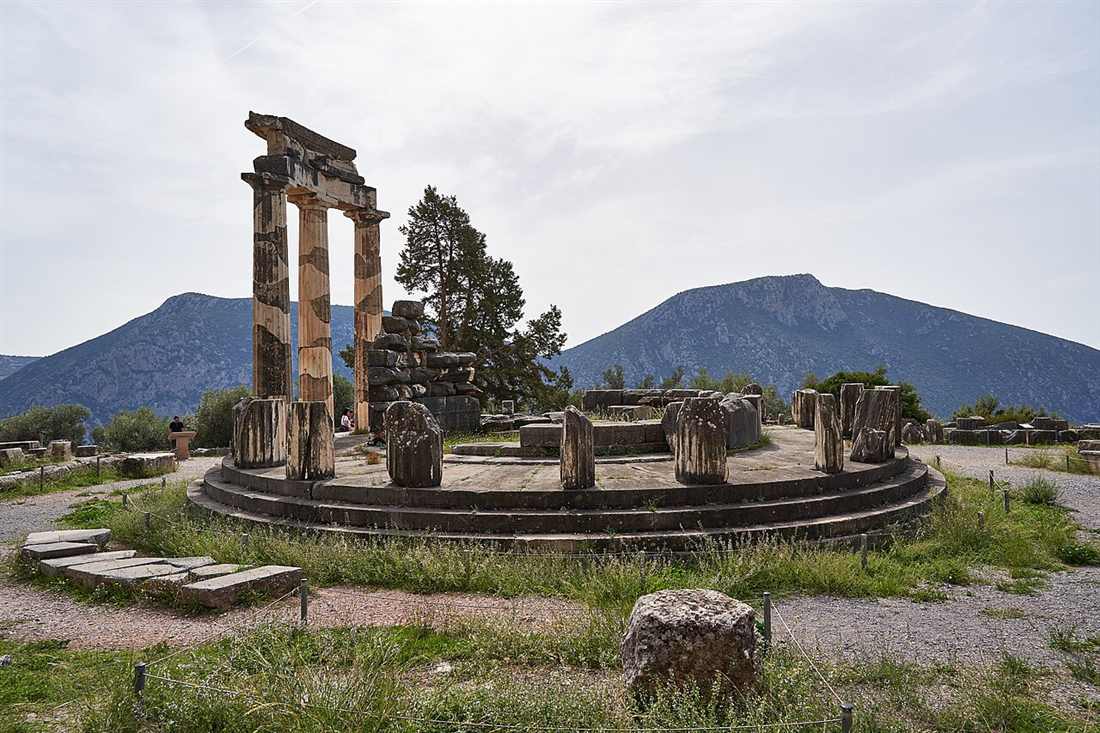
The Tholos of Athena Pronaia is the round temple with three re-erected columns in the lower Sanctuary of Athena Pronaia at Marmaria. Its circular form, white marble, and setting against the green valley make it the most photographed structure at Delphi and the image most people picture.
The Tholos sits below the main sanctuary, on a terrace called Marmaria, the first sacred ground pilgrims reached as they approached Delphi from the east. Athena Pronaia, meaning Athena “before the temple,” guarded this forecourt to Apollo’s oracle. The circular building stood among altars and two temples of Athena, its purpose tied to the goddess rather than a treasury or a shrine holding a cult statue on the standard rectangular plan.
The architect Theodoros of Phokaia designed the Tholos as a ring of twenty Doric columns around a marble wall, with a second ring of Corinthian half-columns inside. Restorers raised three of the outer columns and a section of the entablature, so the fragment reads instantly as a round temple against open sky. The white Pentelic marble and dark limestone base give it a sharp two-tone contrast that carries in a photograph.
The setting completes the effect. The Tholos stands on a shelf of hillside above a sea of olive trees that runs down the valley toward the Gulf of Corinth, with the Phaedriades cliffs rising behind. The round form frames the landscape through its gaps, and the low terrace lets a visitor photograph the whole structure with the valley beyond. Read the full account of the lower sanctuary in this guide to the Sanctuary of Athena Pronaia.
What is the Castalian Spring, and why did pilgrims stop there?
The Castalian Spring is the sacred spring in the ravine between the two Phaedriades cliffs at Delphi. Pilgrims and the Pythia washed in its water to purify themselves before entering the sanctuary and consulting the oracle, making it the first ritual stop on the pilgrim’s route.
The spring rises where the gorge splits the twin Phaedriades, the “Shining Rocks” that tower over the sanctuary and catch the sun. Water runs down the ravine from the heights of Mount Parnassus and gathers at rock-cut fountains beside the road between the Marmaria terrace and the main sanctuary. The site marks the boundary a pilgrim crossed to move from ordinary ground into sacred space.
Purification governed access to the oracle. Every pilgrim washed here before climbing the Sacred Way, and the Pythia bathed in the spring water before she took her seat over the chasm to deliver Apollo’s answers. Priests washed the sanctuary’s sacred vessels in the same water. The ritual set the terms of consultation: no one approached the god unclean.
Two fountain installations survive at the spring:
- An archaic fountain with a paved court and stone benches, fed through bronze spouts set in a low wall.
- A later fountain cut back into the living rock, with niches carved above the basin to hold votive offerings left by pilgrims.
The niches, the worn steps, and the channels that still carry water make the spring one of the clearest ritual sites at Delphi. Rockfall from the Phaedriades closed the modern road crossing for safety, so the fountains are viewed from the path rather than entered. Trace the water and the purification rite in this guide to the Castalian Spring.
What is the history of Delphi, from oracle to ruin?
Delphi began as an earth cult of Gaia guarded by the serpent Python, passed to Apollo, grew into the wealthiest sanctuary in Greece under the Amphictyonic League, drew Sacred Wars over its treasure, fell silent under Christian rule, and lay buried beneath a village until French excavators uncovered it.
The first worship on the slope honoured Gaia, the earth, and Themis, and a great serpent named Python coiled around the spring to guard the oracular site. Greek myth records that Apollo came from the north, killed Python with his arrows, and claimed the sanctuary as his own. The priestess who spoke Apollo’s words took the name Pythia from the slain serpent, and the site itself carried the older name Pytho before the name Delphi settled on it.
Government of the sanctuary rested with the Amphictyonic League, a council of twelve tribes drawn from central Greece and Thessaly. The council administered the treasury, ran the Pythian Games, judged disputes between member states, and controlled the sacred land in the plain below. Its authority made Delphi neutral ground, and cities across the Greek world sent envoys, dedications, and questions to the oracle. Kings and colonists consulted the Pythia before founding cities and before going to war.
That neutrality drew conflict. The Sacred Wars broke out when neighbouring powers seized the sanctuary or taxed the pilgrims crossing the sacred plain, and the League called member states to arms to punish the offenders. The wars carried Philip of Macedon into central Greece and gave him a seat on the council, extending Macedonian power south. Through these centuries the sanctuary filled with bronze and gold: statues, tripods, and whole treasuries built by cities to house their offerings lined the Sacred Way that climbed to the temple of Apollo.
Rome ended the sanctuary’s independence. Roman generals looted the dedications, and later emperors carried hundreds of bronze statues from Delphi to adorn the new capital at Constantinople, stripping the terraces of their monuments. The oracle spoke less and less as the old religion declined, and Christian emperors closed the pagan sanctuaries and silenced the Pythia for good. Over the abandoned ruins the medieval village of Kastri rose, its houses and church built directly on the buried temple terraces. French archaeologists negotiated the removal of the entire village to a new site nearby, dug through the debris, and brought the temple, the theatre, the stadium, and the treasuries back into the light.
What other monuments stand at Delphi beyond the temple?
Beyond the temple of Apollo, Delphi holds the Roman Agora at the entrance, the polygonal wall carved with thousands of inscriptions, the Halos where the Septerion rite was staged, the Stoa of the Athenians, the gymnasium and palaestra on the lower terrace, and the sacred rocks of the Sibyl and Leto.
The Roman Agora greets visitors at the entrance to the sanctuary, a paved marketplace framed by columns where pilgrims bought votive offerings and sacred objects before climbing the Sacred Way. Its arcades once sheltered stalls and statue bases, and the surviving colonnade marks the boundary between the ordinary world and the sacred precinct above it.
Higher up, the great polygonal retaining wall supports the terrace of the temple of Apollo. Masons fitted its irregular blocks together without mortar, and later officials carved the smooth outer face with public records: manumission decrees freeing slaves, treaties, and honours to benefactors. The wall carries a vast archive of inscriptions, one of the richest epigraphic surfaces in the Greek world, and it stands directly below the terrace that also holds the rebuilt Treasury of the Athenians.
Several monuments served the ritual life of the sanctuary rather than its worshippers alone:
- The Halos, a flat circular threshing floor where the Septerion rite re-enacted Apollo’s killing of Python and his flight to purification.
- The Stoa of the Athenians, a long colonnade built against the polygonal wall to display the naval trophies Athens captured from its enemies.
- The Sibyl rock, the outcrop where the earliest prophetess of Delphi delivered her verses before the Pythia’s rite began.
- The Rock of Leto, from which Apollo’s mother is said to have urged her son against the serpent.
Down the hill, on a lower terrace across the road from the main sanctuary, the gymnasium and palaestra trained the athletes who competed in the Pythian Games. The complex holds a covered running track, an open track beside it, wrestling grounds, and a round plunge bath fed by the mountain springs. Athletes prepared here for the footraces and combat events, and the terrace links the athletic grounds to the sanctuary of Athena Pronaia below, giving the site a full lower circuit distinct from the temple terraces above.
What myths and legends is Delphi known for?
Delphi is known for Apollo slaying the serpent Python, the dolphin form that gave the site its name, the prophecies of the Sibyl, the two eagles of Zeus that met at the omphalos to mark the world’s centre, and the ambiguous oracles delivered to Croesus of Lydia and to the Athenians before Salamis.
The founding legend has Apollo arrive at the spring, kill the earth-serpent Python that guarded the oracle, and seize the prophetic seat for himself. The god then purified himself of the killing and established his priestess, the Pythia, to speak his will. The Septerion rite on the Halos re-enacted this combat and flight at set intervals, keeping the myth alive in ritual for centuries.
The name Delphi itself carries a second myth. Seeking priests to serve his new temple, Apollo took the form of a dolphin, leapt aboard a Cretan ship, and steered the sailors to the harbour below the sanctuary, where he revealed himself and made them his first attendants. The Greek word for dolphin gave the sanctuary its name, and the story bound the mountain shrine to the sea traffic that brought pilgrims from across the Greek world.
Delphi held the centre of the earth in Greek belief. Zeus released two eagles from the opposite ends of the world, and they flew toward each other until they met above Delphi, marking the exact midpoint. A carved stone called the omphalos, the navel of the earth, stood in the sanctuary to record the spot, and the museum displays a Roman copy of it. Before the Pythia’s rite, the older Sibyl delivered her prophecies from her rock, and her verses fed the sanctuary’s reputation for foresight.
The oracle’s most famous pronouncements turned on their double meaning. Croesus of Lydia asked whether to march against Persia, and the Pythia answered that he was fated to destroy a great empire; he attacked, and the empire he destroyed was his own. Before the Persian invasion the Athenians were told that a wooden wall alone was their safety. Themistocles read the wooden wall as the Athenian fleet, persuaded the city to fight at sea, and won the battle of Salamis. Each oracle proved exact and each rewarded the questioner who read it correctly, fixing Delphi’s fame as the voice that shaped the course of Greek history.
What was the Oracle of Delphi?
The Oracle of Delphi was the supreme prophetic sanctuary of the ancient Greek world, where Apollo answered questions through his priestess. City-states, kings and generals travelled here to consult the god before founding colonies, waging wars and writing laws.
The oracle operated inside the Temple of Apollo on the slopes of Mount Parnassus, and its authority reached across the entire Mediterranean. Athens, Sparta, Corinth and Thebes each sent official envoys to pose state questions. Foreign rulers such as Croesus of Lydia and Gyges before him dispatched gold and silver offerings to secure a favourable hearing, and the treasuries lining the Sacred Way stored the wealth of grateful consultants.
Greek colonists carried the oracle’s word to the edges of the known world. No expedition to Sicily, southern Italy, the Black Sea or North Africa set out without first asking Apollo to approve the site and name the founder. The god’s endorsement gave a new city legitimacy, a sacred charter and a divine protector, which is why colonies from Cyrene to Syracuse traced their origin to a Delphic response.
The responses themselves earned a reputation for double meaning. When Croesus asked whether to attack Persia, the oracle told him that a great empire fell if he crossed the river Halys, and the empire that fell was his own. The famous “wooden wall” answer to Athens before the Persian invasion pointed the city toward its fleet, and the Athenians read it as their salvation at Salamis. This calculated ambiguity kept the oracle authoritative through victory and defeat, and its verdicts shaped Greek politics for centuries. Read the full history at the Oracle of Delphi guide.
Who was the Pythia, and how did she prophesy?
The Pythia was the high priestess of Apollo who delivered the oracle’s prophecies. She sat on a bronze tripod in the adyton, the inner sanctum of the temple, drank from a sacred spring, held laurel, and spoke Apollo’s answers over a cleft in the rock.
The priestess was a local woman of Delphi chosen to serve the god for life, and she prepared for each session with ritual purification. She bathed in the Castalian Spring, burned laurel and barley on the altar, and entered the temple only on prescribed consultation days. Priests received the questions, arranged the order of consultation, and stood ready to record and interpret the words she uttered from the depths of the sanctuary.
Ancient writers describe the setting in concrete terms. The Pythia took her seat on the tripod above a chasm in the temple floor, chewed or held sprigs of Apollo’s sacred laurel, and drank water drawn from the Cassotis spring that ran beneath the shrine. From this position she pronounced Apollo’s replies, and the attending priests shaped the utterances into the hexameter verses that consultants carried home.
The rituals of the priestess and the sanctuary ran on a fixed calendar:
- Consultation days fell on the seventh of the month, Apollo’s birth date, and later on a set schedule through the active season.
- The oracle fell silent through the three winter months, when Dionysus ruled Delphi in Apollo’s absence.
- Each consultant sacrificed a goat and paid the pelanos, the sacred cake, before approaching the temple.
- The Pythia purified herself at the Castalian Spring and burned laurel and barley meal before mounting the tripod.
A long-standing explanation attributes her trance to vapours rising from the chasm. Plutarch, himself a priest at Delphi, wrote of a sweet exhalation, a pneuma, seeping from the ground beneath the tripod. Modern geologists identify intersecting faults under the temple and traces of ethylene and other gases in the local rock, which matches the ancient account of a sacred vapour that filled the adyton and lifted the priestess into Apollo’s voice.
Why was Delphi called the navel of the world?
Delphi was called the navel of the world because the Greeks believed it marked the exact centre of the earth. A carved conical stone, the omphalos, stood in the sanctuary as that fixed point, and the myth of Zeus’s two eagles fixed the spot at Delphi itself.
The word omphalos means navel, and the Greeks placed this stone at the heart of Apollo’s sanctuary as the symbolic hub of the cosmos. Its presence declared Delphi the meeting point of gods and mortals, the axis around which the Greek world turned. Pilgrims who reached the temple understood that they stood at the centre of the earth, and that conviction gave the oracle a gravity no rival shrine matched.
The founding myth explains the claim. Zeus released two eagles from the opposite ends of the earth and let them fly toward each other. The birds met over Delphi, and the god marked the meeting point with the omphalos stone. From that moment Delphi held the title of the earth’s centre, and the eagles became a recurring emblem carved and painted throughout the sanctuary.
Visitors see the physical object today. The Delphi Archaeological Museum displays a carved marble omphalos, a rounded stone wrapped in a net-like pattern of woollen fillets rendered in relief. This surviving version, a Hellenistic or Roman copy of the sacred original, sits among the museum’s finest exhibits alongside the Charioteer and the twin kouroi. The stone anchors the site’s identity, and the athletic and musical contests that honoured Apollo drew crowds to the same sacred ground, a tradition detailed in the Pythian Games guide.
Is the Delphi Archaeological Museum worth visiting?
Yes. The Delphi Archaeological Museum ranks among the most important museums in Greece, holding the sculptures, bronzes, and offerings excavated from the sanctuary of Apollo. It stands beside the site entrance, and the combined ticket covers both, making the two a single continuous visit.
The museum sits at the edge of the archaeological zone, a two-minute walk from the ruins. One ticket admits visitors to the sanctuary, the gymnasium, the Sanctuary of Athena Pronaia, and the museum galleries, so the excavated fragments and the places they once stood read as one story. Guides route groups through the site first and finish in the cool halls, where the original statues that lined the Sacred Way now stand under controlled light.
The collection follows a clear chronological and topographical order across fourteen rooms, tracing the sanctuary from its early votive bronzes through the treasuries, the temple pediments, and the Roman-era portraits. Each gallery groups the finds by the monument they belonged to, so the reconstructed Siphnian Treasury frieze, the Athenian offerings, and the temple sculptures each occupy their own defined space. Full details of the layout appear in the dedicated Delphi Archaeological Museum guide.
The building doubles as a midday refuge. Summer heat bakes the open hillside, and the air-conditioned galleries give walkers a shaded pause between the climb to the stadium and the descent to the Castalian Spring. A cafe and shaded terrace outside the entrance frame views across the ravine toward the olive plain of Amfissa, so the museum works as both the intellectual centre of the visit and its physical rest point.
Why is the Charioteer of Delphi the museum’s masterpiece?
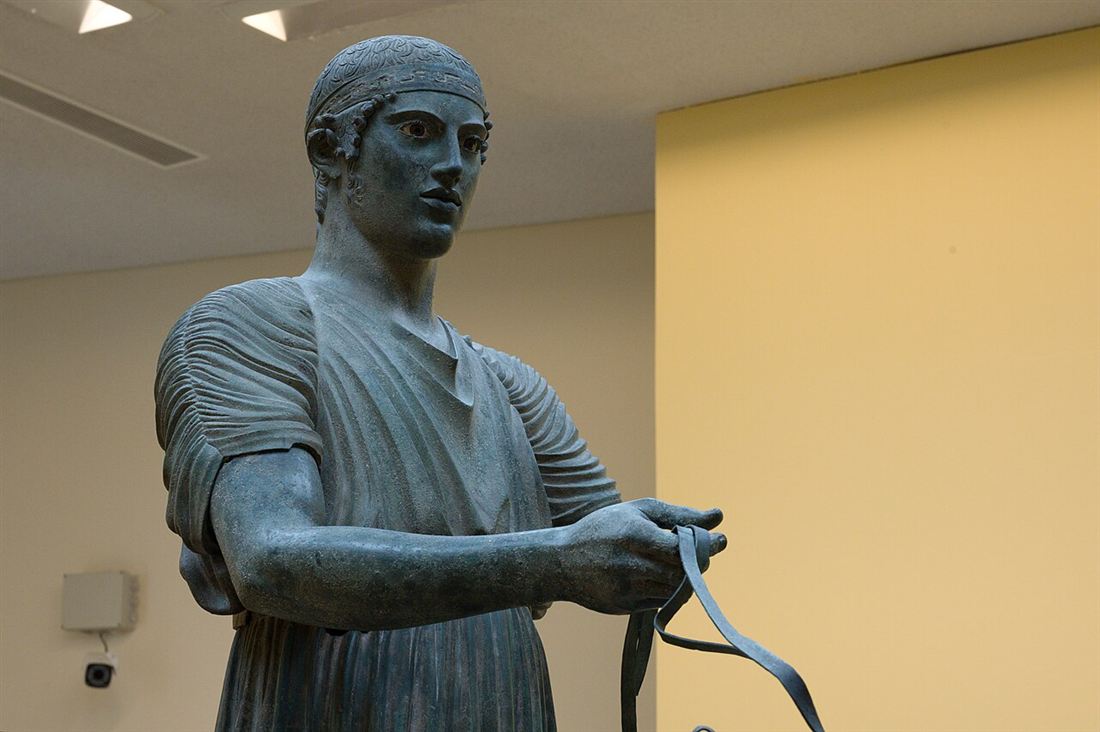
The Charioteer of Delphi is a life-size bronze statue of a chariot driver, cast by the lost-wax method with inlaid glass-and-stone eyes and copper lips. It survives near-complete from the Early Classical period and counts among the finest ancient bronzes preserved anywhere.
The figure stands upright in a long pleated tunic, the reins still gathered in his outstretched right hand. His inlaid eyes of white and brown stone hold a fixed, calm gaze, and fine copper lines the lashes and lips. Bronze rarely survives from antiquity because it was melted down and recast, so a statue of this scale and completeness is exceptional; a rockfall buried it, and the earth protected it until excavators lifted it from the sanctuary terrace.
The statue was made by the lost-wax casting technique, in which a wax model is coated in clay, then heated so the wax runs out and molten bronze fills the void. The charioteer was cast in separate sections and joined, and the sculptor rendered the arm muscles, the toenails, and the folds of the belted tunic with precise realism. The dedication once formed part of a larger group that included a bronze chariot, horses, and a groom, of which only the driver and fragments remain.
The monument commemorated a victory in the chariot race at the Pythian Games, the athletic and musical festival held at Delphi in honour of Apollo. An inscription on the base names Polyzalos, a tyrant of Gela in Sicily, as the man who dedicated the offering after his team won. The full account of the bronze, its casting, and its patron appears in the Charioteer of Delphi feature.
What other treasures fill the Delphi museum?
Beyond the Charioteer, the museum holds the Sphinx of Naxos, the twin kouroi Kleobis and Biton, the carved frieze of the Siphnian Treasury, a silver-and-gold bull, the omphalos stone that marked the world’s centre, and the Acanthus Column of Dancers.
The Sphinx of Naxos crowned a tall marble column that the island of Naxos set up along the Sacred Way. The winged creature, with a woman’s head and a lion’s body, sat atop a fluted Ionic shaft and watched over the sanctuary from height. Nearby stand Kleobis and Biton, the twin Archaic kouroi from Argos, broad-shouldered youths carved in stiff frontal stance who embody the brothers of the legend that yoked themselves to their mother’s cart.
The reconstructed frieze of the Siphnian Treasury lines an entire gallery. Carved in high relief, it shows a battle of gods and giants and a council of Olympian deities, work paid for by the silver wealth of the island of Siphnos. The chryselephantine finds fill another room: fragments of ivory faces and gold drapery from statues destroyed by fire, and a bull worked in silver plate over a wooden core, its horns and hooves sheathed in gold.
The signature pieces on display include:
- The omphalos stone, a carved conical marker that the Greeks named the navel of the world, set where two eagles released by Zeus met above Delphi.
- The Acanthus Column of Dancers, three young women in short tunics dancing around a shaft that rises from carved acanthus leaves.
- The bronze incense burner shaped as a standing woman holding a wide censer bowl above her head.
- The Roman statue of Antinous, the youthful favourite of the emperor Hadrian, carved in polished marble.
The final rooms carry the sanctuary into Roman times, with portrait heads, inscribed decrees, and the fragments of the temple’s later rebuilding. Together the galleries trace Delphi from its Archaic offerings to the day the oracle fell silent, and they give the ruins outside their voice: every base and platform on the Sacred Way connects to a sculpture standing here under glass.
Is Delphi worth visiting with kids?
Delphi is worth visiting with kids because the archaeological site is one large open-air trail where children walk past a real theatre and stadium, and the museum holds the bronze Charioteer and the winged Sphinx that fix young attention in minutes.
The Sacred Way climbs from the entrance in a single continuous path, so children follow a clear route rather than a maze of ruins. They pass the reconstructed Treasury of the Athenians, reach the Temple of Apollo terrace, and continue up to the theatre carved into the slope, where the stone seats invite them to sit and look out over the valley. Higher still, the stadium sits on the top terrace with its start line and spectator banks intact, and the flat track gives restless legs a place to move.
The Delphi Archaeological Museum turns the visit concrete. The Charioteer of Delphi stands at child eye level with his inlaid glass eyes and preserved bronze feet, and the Naxian Sphinx perches on its column with a lion body, bird wings, and a human face. The twin kouroi Kleobis and Biton, the silver bull, and the omphalos stone each carry a short story, and the myth of the Pythia breathing vapours and speaking for Apollo gives children a reason to connect object to place.
Manage the climb and the sun. The site rises steeply from gate to stadium, the marble is uneven, and midday heat on the exposed terraces tires small children fast. Bring water, sun hats, and closed shoes, start early in the cooler hours, and break the walk into stages with rests at the theatre and the museum. Families who pace the visit across a half day, and who read the best-time guidance on when to visit Delphi, keep children engaged through both the ruins and the galleries.
Is Delphi worth it for photographers and the scenery?
Delphi rewards photographers with a rare stack of subjects in one frame: ancient stone set against a plunging mountain valley, the round Tholos below the cliffs, and a sunset over the olive plain that turns the whole ridge gold from the village terrace.
The Tholos of Athena Pronaia is the signature shot. Its three standing Doric columns and circular base sit on a lower terrace with the green Pleistos valley falling away behind, and morning light rakes the fluted marble from the east. On the main site, the Temple of Apollo commands the middle terrace above the silver sweep of the olive plain that runs down toward the Gulf of Corinth, and the six re-erected columns frame the distance cleanly from the Sacred Way.
Climb for the wide views. The ancient theatre gives a panorama that takes in the temple, the terraces, and the valley in a single elevated frame, and the stadium above it opens the sky over the whole sanctuary. Behind and above everything rise the Phaedriades, the twin limestone cliffs that catch and throw light through the day, glowing pale at noon and warming to amber in late afternoon. The Castalian Spring gorge between them adds a shaded rock subject for photographers who want texture over panorama.
Work the light by the clock. Early morning throws long shadows across the Sacred Way and lifts the columns from the hillside; midday flattens the terraces but sharpens the cliff faces; late afternoon and sunset from the modern village of Delphi set the ridge and the olive plain alight over the gulf. Photographers who stay overnight catch both the dawn calm on the site and the evening colour from the village, and the lodging options on where to stay in Delphi put the sunset terrace within walking distance.
How much time do you need for Delphi to be worth it?
Delphi needs a half day at minimum to be worth it: about two hours to walk the archaeological site from gate to stadium, and one to two hours in the museum. A full day adds the Castalian Spring and Athena Pronaia, and an overnight buys the quiet early morning.
The main site takes roughly two hours at a steady pace. The Sacred Way, the Treasury of the Athenians, the Temple of Apollo, the theatre, and the stadium each earn a stop, and the steep climb from terrace to terrace slows the walk more than the distance suggests. The Delphi Archaeological Museum holds the Charioteer, the Sphinx, the twin kouroi, the frieze of the Siphnian Treasury, and the omphalos across its galleries, and it absorbs one to two hours depending on how closely you read the sculpture.
Plan the time to match the depth you want:
- Half day — the archaeological site and the museum, the core of any visit.
- Full day — add the Castalian Spring in the gorge and the Sanctuary of Athena Pronaia with the Tholos, plus lunch in the village.
- Overnight — reach the site gate at opening for empty terraces and soft light, and keep the village sunset the evening before.
A day trip from Athens covers the half day but spends four to five hours on the road round trip, which fixes the visit to the busiest midday window and drops the Castalian Spring and the Tholos from most schedules. Staying in the village removes the drive from the clock, opens the full-day route across both sanctuaries, and hands over the early morning when the tour coaches are still climbing the mountain. The longer the stay, the more of Delphi’s ground the visit actually covers, and the stronger the case that the trip is worth it.
How does a guided tour or audio guide add value at Delphi?
A guide or audio commentary turns Delphi’s scattered foundations into one story. The Sacred Way, the treasuries, the Temple of Apollo and the oracle chamber read as disconnected stone blocks without narration; a licensed guide or the official site audio links them into the single sequence a pilgrim once walked.
The problem the commentary solves is legibility. Delphi survives as terraces of foundation courses, half-standing columns and inscribed bases climbing the slope of Mount Parnassus. A visitor arriving cold sees rubble in a spectacular setting. The narration names each ruin as it appears: the marble Naxian Sphinx base, the reconstructed Athenian Treasury, the polygonal retaining wall carved with freed-slave inscriptions, the six re-erected columns of Apollo’s temple where the Pythia delivered her oracles. Each stop gains a function and a date-free history the eye alone does not supply.
The four ways to visit differ in depth, cost and pace:
- Guided day tour from Athens — a coach, a driver and a licensed archaeologist guide who walks the group up the Sacred Way and through the museum; the transport and the narration arrive as one booked package.
- Private licensed guide on site — a one-to-one or family walk paced to your questions, with the guide answering on mythology, excavation history and the geology of the sacred spring.
- Official site audio guide — a rented handset or app that plays numbered commentary at each monument, letting you set your own speed and repeat a stop.
- Self-guided visit — entry with a printed map and the on-site signage, the lowest cost and the fullest freedom, and the version that leaves the foundations hardest to read.
A licensed guide adds the layer that signage omits: the rivalry behind each treasury, the mechanics of how the Pythia sat over the chasm, the meaning of the athletic and civic inscriptions cut into the stone. The guide also controls the route, taking a family straight to the theatre viewpoint before the midday coaches crowd the upper terraces. The official audio guide delivers much of that context at a fraction of the price and frees you to pause, and it pairs well with a pre-booked entry so the queue does not eat the visit; secure that in advance through Delphi tickets.
The choice tracks your priorities. Travellers who want the archaeology explained in person and their questions answered take the private guide. Independent walkers who resent a fixed group pace take the site audio and keep control of the clock. Families combining Delphi with lunch in the neighbouring village lean on the packaged day tour, which removes the drive and the parking entirely. Every version reaches the same monuments; the narration is what converts the climb from a walk past ruins into a walk through the ancient sanctuary.
How accessible is Delphi for older visitors and those with limited mobility?
Delphi is partly accessible. The stepped climb from the entrance to the stadium at the top is steep and uneven, but the lower terraces, the museum and the parking beside the gate stay reachable, and the site rewards a slow, seated, well-paced visit rather than a full ascent.
The sanctuary is built on the terraced slope of Mount Parnassus, so the main path gains height continuously from the entrance. The Sacred Way rises on worn marble and stone underfoot, the gradient stiffens above the Temple of Apollo, and the final stretch to the stadium is the steepest and least even part of the whole site. Visitors with limited mobility, and older walkers who tire on gradients, get the strongest return from the lower and middle terraces, where the Athenian Treasury, the polygonal wall and the temple front all stand within a short, gentler climb of the gate.
Parking sits directly beside the entrance, which removes the long approach walk that burdens many hillside sites. From the car park the ticket gate and the first monuments are close and near-level, so a short visit is realistic even for someone who does not attempt the ascent. The adjacent museum is the anchor of an accessible day: it is air-conditioned, laid out across accessible floors with seating, and it holds the site’s greatest treasures, the bronze Charioteer, the twin kouroi and the Sphinx among them. A visitor who walks only the lower terraces and then spends unhurried time in the museum still sees Delphi’s finest objects in comfort.
Pacing carries the visit. Resting at the ancient theatre partway up gives a broad view over the temple and the valley of olive groves running to the sea, and it makes a natural turning point for anyone not continuing to the stadium. The Tholos, the circular temple at the Marmaria terrace below the main site, is visible from the roadside, so its famous three re-erected columns are seen without the descent to the enclosure itself. Cool morning hours ease the climb, and a flat water bottle and sturdy shoes steady the footing on the polished stone.
Basing the day in the neighbouring village shortens every journey and puts cafés, seating and shade minutes from the gate for rest between the site and the museum; the practicalities of staying close are set out in Delphi village. The honest position is that the upper reaches defeat wheelchairs and strain unsteady walkers, while the terraces holding the temple, the treasuries, the theatre view and the seated museum stay open to almost everyone who arrives. Delphi delivers its icons to a careful, patient visit, and the parts that demand strong legs are the parts a well-planned day sets aside.
How does Delphi compare with other ancient Greek sites?
Delphi outranks the Acropolis, Olympia, Mycenae, and Epidaurus on setting and on story. It clings to a cliff on Mount Parnassus above a sea of olive trees, and it housed the oracle every Greek city consulted before war, colony, or law. No rival pairs that landscape with that authority.
The Acropolis of Athens delivers a single crowning icon, the Parthenon, on a rock inside a modern capital. It rewards a visitor who wants marble architecture at its peak and a museum of Classical sculpture a short walk downhill. It sits in traffic, heat, and crowds, and the visit ends where the city resumes. Delphi trades the metropolis for a mountain, and it strings its monuments up a terraced slope so the walk itself becomes the experience.
Olympia, in the western Peloponnese, is the home of the games and the flat green ground of the Altis. Its draw is the running track, the workshop of Pheidias, and the story of athletic contest. The terrain is gentle and shaded, which suits families and slower walkers. Mycenae, further east, is the Bronze Age citadel of Agamemnon, the Lion Gate, and the beehive tombs, a starker and older layer of Greek history. Epidaurus centres on the finest ancient theatre in Greece, a bowl of stone acoustics that still carries a whisper to the top row.
Each site answers a different question a visitor asks. The comparison sorts cleanly by what a traveller wants from a day among ruins:
- Acropolis of Athens — the summit of Classical architecture inside the capital, reached on foot from the centre.
- Delphi — the oracle, the Charioteer, and a temple terrace hung over a mountain gorge.
- Olympia — the birthplace of the games on flat, shaded ground.
- Mycenae — the Bronze Age fortress of the Lion Gate and the beehive tombs.
- Epidaurus — the theatre with the perfect acoustics.
Delphi wins the choice for a visitor who wants scenery and mythology in one stop. The Sanctuary of Apollo, the Temple of Apollo where the Pythia gave her prophecies, the treasuries, the stadium at the top of the site, and the bronze Charioteer in the museum combine landscape, ritual, and masterpiece sculpture. No other single site in Greece assembles that range on one mountainside.
Is Delphi worth visiting compared with a second day in Athens?
A second day in Athens keeps a visitor inside a museum-and-monument routine of the National Archaeological Museum, the Agora, and the neighbourhoods. Delphi swaps that for a mountain sanctuary and a scenic drive through Boeotia. The trade favours Delphi for anyone who has already seen the Acropolis.
The case for staying in Athens is density and depth. A second capital day fills easily with the National Archaeological Museum and its bronzes, the Ancient Agora and the Temple of Hephaestus, the Roman Forum, and the tavernas of Plaka and Psyrri. Every stop sits within walking distance or a short metro ride, and the day carries no travel commitment. A traveller who values art collections, food, and a relaxed pace without a coach seat gains the most from a second Athens day.
The case for Delphi is contrast. The drive north crosses the Boeotian plain, climbs past the town of Arachova on the flank of Parnassus, and arrives at a sanctuary suspended between cliffs and the Gulf of Corinth. The change of air, altitude, and scale is the point. A visitor who has already climbed the Acropolis gains a fresh landscape and a different chapter of Greek religion rather than a second helping of the same city. The mountain setting alone justifies the hours on the road for travellers who want to see the country beyond the capital.
The decision turns on the traveller. Repeat visitors to Athens, walkers, photographers, and mythology enthusiasts take Delphi and treat the journey as part of the reward. First-time visitors with a single free day and a taste for museums and city streets stay put and go deep on the capital. Families with restless children weigh the round trip against the appeal of the mountain, since Delphi asks for a long day either self-driven or on a tour, while a second Athens day flexes hour by hour.
For travellers who commit to the trip, planning the route in advance removes the friction. The options for reaching the sanctuary from the capital, from the public coach to a rental car to a guided coach, are set out in the guide on how to get to Delphi, which sorts the day by budget and pace.
What does it cost to visit Delphi, and is it worth the price?
Delphi charges a single combined ticket that covers both the archaeological site and the museum, and it opens free on the winter Sundays. Against a bronze Charioteer, a temple terrace, and a mountain gorge, the entry price ranks among the strongest value of any major Greek site.
The entry structure is straightforward. A combined site-and-museum ticket admits a visitor to the Sanctuary of Apollo, the treasuries, the stadium, and the archaeological museum on one purchase, and a reduced rate applies to students and eligible categories. A separate single-monument ticket exists, yet the combined ticket carries the clear advantage because the museum holds the Charioteer and the site holds the temple, and neither stands complete without the other. Full ticket details and the current rate sit on the Delphi tickets page.
Free admission lands on the Sundays across the winter months, when the state opens the site and museum at no charge. A visitor who plans a shoulder-season trip and lands on one of those Sundays sees the entire sanctuary for the cost of getting there. The trade-off is cooler weather and shorter daylight, which suits walkers who prefer the site without summer heat and crowds.
Transport sets the larger part of the budget, not the entry. The public KTEL coach from Athens costs a modest one-way fare and asks for an early start and a fixed return. A rental car spreads across fuel, tolls, and the daily hire rate, and it buys the freedom to stop in Arachova and to time the light on the temple. A guided coach tour folds transport, a licensed guide, and the entry into one price, and it removes the driving and the timetable for travellers who want the day handled end to end.
The value verdict favours the visit. The combined ticket buys the Charioteer of Delphi, one of the finest surviving bronzes of the ancient world, plus a temple terrace and stadium set against Mount Parnassus and the Gulf of Corinth. Few sites in Greece return that much monument, sculpture, and landscape for a single modest entry, and the free winter Sundays sharpen the case further for travellers who time the trip to catch one.
What are the downsides of visiting Delphi?
Delphi’s drawbacks are the long mountain drive from Athens, the steep shadeless climb up the sanctuary, the midday summer heat with peak coach crowds, and ruins scattered across a slope that reward a guide. Each one is managed, not a reason to skip the site.
The drive covers 180 kilometres from Athens and takes two and a half to three hours each way. Travellers who set out at dawn reach the gates as they open, drive the empty road through Boeotia, and pass the crossroads at Livadeia and the fir slopes above Arachova before the coach fleet forms. Those who join an organised day tour hand the wheel and the parking to a driver and read the terrain instead of the map. The distance turns the visit into a full day, and a full day is what the sanctuary, the museum, and the mountain together demand.
The archaeological site climbs the flank of Mount Parnassus on a graded stone path that rises from the Roman agora past the Treasury of the Athenians and the Temple of Apollo to the theatre and the stadium above. The gradient is real and the marble underfoot is worn smooth. Sturdy shoes, a bottle of water filled at the entrance fountain, and a start in the cool of the morning turn the ascent into a steady walk rather than a scramble. Benches and terrace walls give the pace its pauses, and the view down the ravine to the olive sea widens with every step.
Summer middays bring the heat off the bare rock and the largest coach groups from Athens and the cruise ports at the same hour. Visitors who arrive at opening or in the last two hours before closing walk the terraces in shade and quiet, while the ranks of guided groups pass through between eleven and two. The ruins themselves read as fragments to an unguided eye: a column here, an inscribed base there, a foundation outline in the grass. A licensed guide or the site audio ties the stones back into the Sacred Way, the treasuries of the rival cities, and the oracle’s chamber, and the scattered field becomes a legible sanctuary.
Is Delphi worth visiting in combination with Arachova, Meteora, or the coast?
Delphi gains value paired with its neighbours: the stone town of Arachova minutes uphill, the cliff monasteries of Meteora to the north, and the harbour of Galaxidi with the Corinthian Gulf coast below. A one- or two-night loop turns a long day trip into a full mountain circuit.
Arachova sits eight kilometres east of the sanctuary on the same Parnassus slope, a town of grey stone houses stacked up the hillside around a clock tower. Its tavernas serve the formaela cheese grilled over coals, its shops weave the woollen rugs the region is known for, and its balconies face the same ravine that opens below Delphi. A night in Arachova places a traveller ten minutes from the site gates at opening and turns the evening into a mountain dinner rather than a drive back to Athens in the dark.
Meteora lies to the north, a cluster of Orthodox monasteries perched on sandstone pillars above the plain of Thessaly. The road links the two through the Parnassus passes and the towns of central Greece, and a two-night loop reaches both the oracle and the rock monasteries without doubling back. The pairing joins the two landscapes that define inland Greece: the sanctuary carved into a mountain flank and the cloisters raised on freestanding stone, each a place where the Greeks set the sacred above the everyday world.
The Corinthian Gulf coast opens twelve kilometres downhill from the sanctuary, where Galaxidi’s captains’ mansions ring a double harbour and Itea’s waterfront lines the bay. The road drops from the terraces of the Delphi stadium height through the largest olive grove in Greece to the sea, and a seaside dinner closes the day the ruins opened. A loop that adds the coast trades the single museum stop for a route that runs mountain, sanctuary, and gulf in one arc:
- Arachova — the Parnassus stone town, eight kilometres east, for the woollen rugs, grilled formaela, and a gate-side night.
- Meteora — the sandstone monasteries north across the passes, a two-night pairing of oracle and cloister.
- Galaxidi and Itea — the Corinthian Gulf harbours below the olive sea, twelve kilometres downhill for the seaside close.
What is the final verdict — what makes Delphi worth visiting?
Delphi is worth visiting. The oracle that steered the ancient world, the marble monuments climbing the Sacred Way, the museum masterpieces from the Charioteer to the Sphinx, and the Parnassus setting above the olive sea combine into one of Greece’s essential sites.
The oracle gives the place its weight. For centuries the Pythia spoke from the chamber beneath the Temple of Apollo, and cities, kings, and colonists crossed the Greek world to hear her. The Greeks called Delphi the navel of the earth and marked the spot with the omphalos stone now in the museum. No other Greek site carries that role as the meeting point where the whole ancient world came to ask its questions, and the ruins stand where those answers were given.
The monuments turn the story into stone underfoot. The Sacred Way climbs past the treasuries the rival city-states raised from the spoils of their wars, the reconstructed Treasury of the Athenians stands complete beside the path, and the six columns of the Temple of Apollo mark the oracle’s seat. Above them the theatre and the stadium cut into the mountain hold the crowds of the Pythian Games. The site reads as a single ascent from the Roman market to the running track, each terrace a chapter of the sanctuary’s history.
The museum holds the finds that crown the visit. The bronze Charioteer of Delphi stands with his inlaid eyes and reins intact, the twin kouroi of Kleobis and Biton flank the hall, the Sphinx of Naxos looks down from its column, and the omphalos marks the navel of the world. Set on the flank of Parnassus above the ravine and the largest olive grove in Greece, with the Corinthian Gulf glinting below, the sanctuary joins its masterpieces to a mountain view. Oracle, monuments, museum, and setting together place Delphi among the sites that define a journey through Greece.
Frequently Asked Questions
Is Delphi worth visiting for one day?
Yes. One day covers the archaeological site from the Sacred Way to the stadium, the museum with the Charioteer, and the Castalian Spring and Tholos beside the road. A day trip from Athens fits all of it, and an overnight adds the quiet opening hour and the sunset.
Is Delphi worth visiting compared with the Acropolis of Athens?
Both rank among Greece’s essential sites. The Acropolis crowns a city with the Parthenon; Delphi sets an oracle sanctuary against a mountain gorge and adds the Charioteer and the Tholos. Delphi’s edge is its setting and its museum, and the two complement rather than replace each other.
Is Delphi worth visiting in winter?
Yes. Winter empties the terraces to their quietest, delivers the cleanest air and snow on the Parnassus peaks, and adds free-admission Sundays. The trade is short opening hours, cold single-digit days, and the risk of rain or fog on the ridge.