
The Ultimate Andros Travel Guide: Private Tours and Island Secrets
If you are looking for an island that defies the typical dry, white-washed stereotype of the Cyclades, let me introduce you to Andros. Hi everyone, I am Yannis Divramis, your local Greek tour guy and guide. I was born in Greece and grew up on the islands of Milos and Santorini, but my passion for this country drives me to explore every corner, from the Acropolis in Athens to the lush trails of Andros.
Every summer, I spend at least a month island hopping, and Andros has secured a special place in my heart. It is noble, green, and full of hidden gems. Situated just two hours from the mainland, it offers a perfect blend of history, nature, and pristine beaches without the overwhelming crowds of its neighbors. Whether you are interested in Andros private tours, scenic hikes, or simply finding the best seaside taverna, this Andros travel guide is my personal roadmap to helping you experience the island like a local.
Discovering Andros: The Greenest Isle of the Cyclades
When I first set foot on Andros, the first thing that struck me was the water. Unlike the arid landscapes of Mykonos or Santorini, Andros Greece is abundant with natural springs, waterfalls, and lush vegetation. This is the second largest island in the Cyclades, yet it remains one of the least commercialized, preserving an authenticity that is hard to find elsewhere.
Andros tourism is different here. It attracts nature lovers, hikers, and those appreciating high culture. The island has a rich maritime history, which is evident in the grand neoclassical mansions of Chora, the capital. For me, visit Andros is not just a suggestion: it is a requirement if you want to see a different side of the Aegean. From the ancient sites to the modern art museums, Andros Greece attractions offer a sophisticated layer of travel that goes beyond just sun and sea. Whether you are planning Andros island travel for a weekend or a week, the diverse landscape promises that you will never get bored.
Getting There and Getting Around
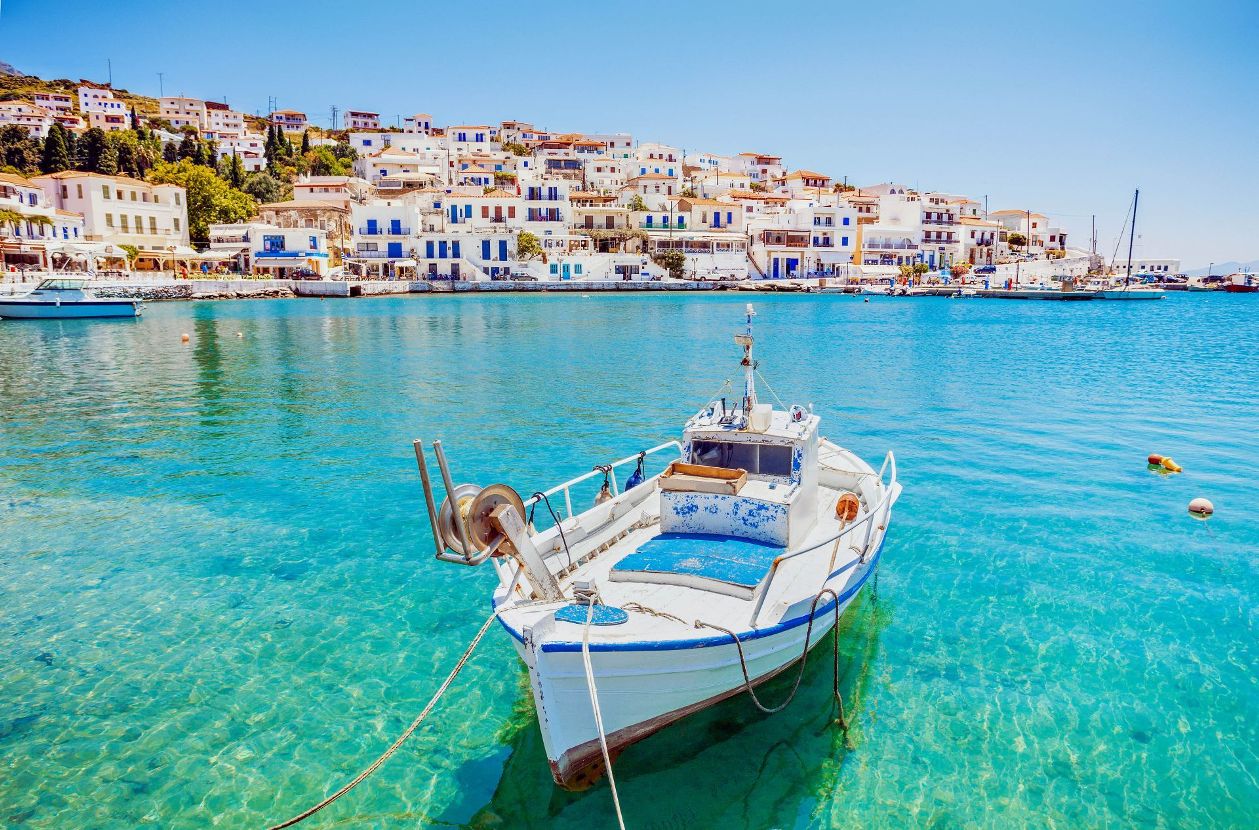
Logistics can make or break a trip, and how to get to Andros from Athens is the first thing you need to master. Unlike other islands that rely heavily on Piraeus, Andros is best accessed via a different route.
Ferry Connections from Rafina Port
The most important tip I give first-time visitors is this: do not go to the airport expecting a flight to Andros, and don’t head to Piraeus port. Andros from Rafina port is the standard route. Rafina is closer to the airport (about 20-30 minutes by taxi) and the ferries to Andros from Athens take only about two hours.
I always recommend checking Andros ferry schedules in advance, especially during July and August. You can easily handle your Andros ferry ticket booking online. The fast ferries can get you there in under two hours, while conventional ferries take a bit longer but offer a nice deck experience. As you approach the port of Gavrio, have your camera ready: the view of the island rising from the sea is my favorite welcome.
Navigating the Island: Car Rentals vs. Private Transfers
Once you arrive, you need a plan. Andros is large and mountainous. While there is a local bus service connecting Gavrio, Batsi, and Chora, the schedules can be limiting if you want to explore hidden beaches or remote villages. For Andros travel routes Cyclades exploration, I highly recommend renting a car. It gives you the freedom to stop whenever you see a beautiful view, and believe me, there are many.
But, the roads can be winding and narrow. If you want to relax and enjoy the scenery without the stress of driving, Andros private tours or transfer services are excellent alternatives. I often tell families that hiring a driver for a day can actually save you time and stress, ensuring you get to see the best things to do in Andros Greece safely.
Top Andros Tours and Excursions
To truly understand this island, you need to go beyond the main towns. Andros tours are diverse, catering to adventurers, foodies, and history buffs alike. Here is how I suggest you spend your time.
Private Sightseeing Tours for Personalized Itineraries
If you want to maximize your time, Andros private tours are the way to go. I love the flexibility of a private guide who can tailor the day to your interests. Want to see the monasteries in the morning and swim in a secluded bay in the afternoon? A private tour makes that happen. These Andros island tours often provide context you won’t get from a guidebook, sharing stories about the shipowner families of Chora or the legends behind the castles.
Guided Hiking Adventures on Andros Routes
Hiking in Andros Greece is world-class. The island has done an incredible job with “Andros Routes,” a network of over 180km (and growing) of signposted trails. Scenic hikes in Andros Greece take you along ancient kalderimia (stone-paved paths), through olive groves, and across stone bridges. One of my favorite routes is the walk from Chora to the village of Apikia. It’s not just a walk: it’s a journey through time. Andros travel packages increasingly focus on these trekking experiences, and for good reason.
Culinary Experiences and Local Food Tours
You cannot leave without diving into Andros food and local cuisine. I always tell my guests to try the Furtalia, a traditional omelet made with local sausage and potatoes. Andros tours and excursions often include stops at local producers where you can taste thyme honey, soft cheeses, and the famous almond sweets (amygdalota). A food tour here feels like visiting a Greek grandmother’s kitchen.
Boat Trips to Hidden Coves and Lighthouses
Some of the best viewpoints in Andros are seen from the water. Andros travel deals often include boat trips starting from Batsi or Chora. These excursions can take you to beaches that are impossible to reach by car, such as Achla (if you don’t have a 4×4) or the rugged northern coast. It is the perfect way to spend a lazy afternoon.
Must-Visit Villages and Settlements
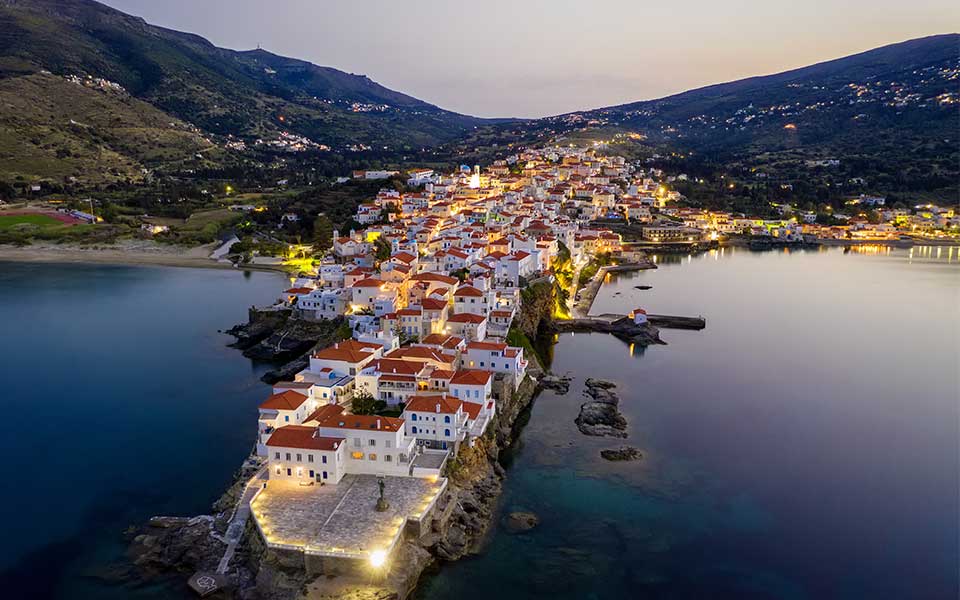
The villages here have distinct personalities. Andros beaches and villages go hand in hand, but the architecture changes as you move from the port to the capital.
Chora: Neoclassical Mansions and Art Museums
Andros Chora is the jewel of the island. It sits on a peninsula jutting out into the sea, lined with the mansions of wealthy shipowners. Walking through the marble-paved streets, I feel a sense of nobility that is rare in the Aegean. You must visit the Museum of Contemporary Art (Goulandris) and the Archaeological Museum. It’s a cultural hub that rivals big cities. Andros history and culture are most palpable here, where the statue of the Unknown Sailor looks out to sea.
Batsi: The Cosmopolitan Seaside Hub
If Chora is the noble grandmother, Batsi is the fun-loving cousin. This is the main tourist resort and where many Andros vacation rentals are located. It wraps around a charming bay with a marina full of yachts. Andros seaside dining is at its best here, with tables right on the water’s edge. It is lively, family-friendly, and a great base for Andros weekend trip ideas.
Gavrio, Korthi, and Traditional Mountain Villages
Gavrio is your entry point, a bustling port town with plenty of cafes. But don’t overlook Ormos Korthiou (Korthi Bay) in the south. It is quieter, more traditional, and very windy, perfect for surfing. Up in the mountains, villages like Stenies and Menites are absolute must-sees. Stenies is known as the village of captains, while Menites is famous for its lion-head springs. What to know before visiting Andros includes the fact that these mountain villages offer a cool respite from the summer heat.
Exploring Natural Landmarks and History
Nature here is dramatic. Andros waterfalls and trails are a huge draw for me personally.
Pythara Waterfalls and Menites Springs
Just a short hike from Apikia, you will find the Pythara Waterfalls. Locals call it “The Fairyland,” and when you see the dragonfly-filled pools and lush greenery, you will understand why. It is a sharp contrast to the dry rock of other Cyclades islands. Similarly, the Menites Springs feature water gushing from ancient marble lion heads, shaded by huge plane trees. It is one of the most refreshing spots on the island.
The Famous Tourlitis Lighthouse
Look out from Chora, and you will see the Tourlitis Lighthouse. It is built on a tiny rock spire in the middle of the sea and looks like something out of a fantasy novel. It is the only lighthouse in Greece built entirely on a rock in the sea. It’s a photographer’s dream and a symbol of Andros island travel.
Historic Monasteries and Venetian Castles
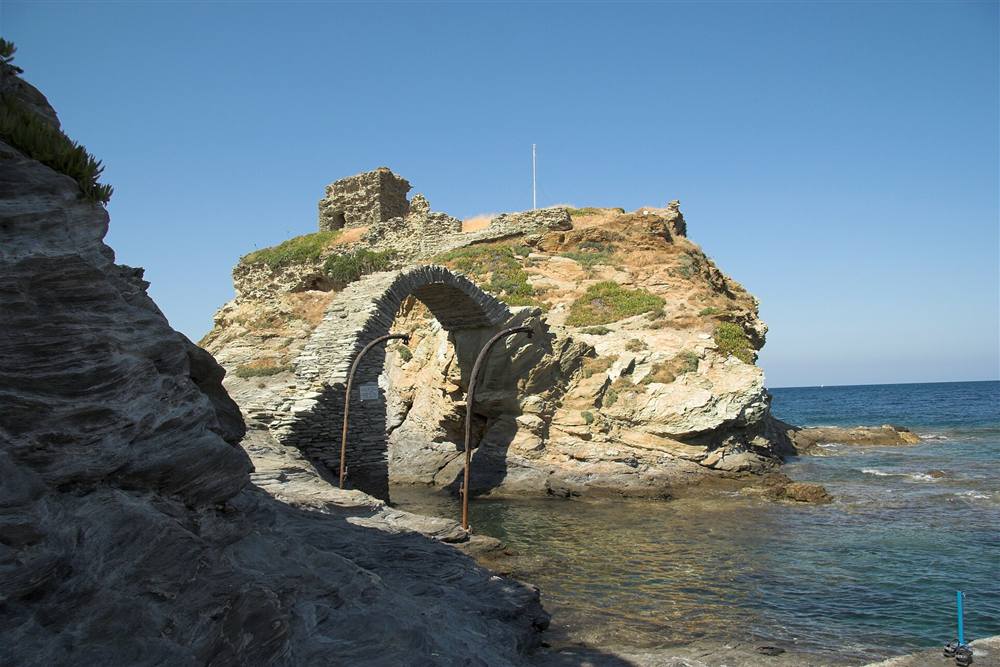
Cultural sites in Andros are plentiful. I highly recommend visiting the Panachrantou Monastery. It clings to the side of a mountain and offers arguably the best view of Chora. The monks are welcoming and often treat visitors to Turkish delight. In Chora, the ruins of the Venetian castle stand on the tip of the peninsula, connected by an arched stone bridge. Crossing it feels like stepping into history.
A Guide to the Best Beaches in Andros
You cannot have a Greek island guide without discussing beaches. Andros beaches are incredibly varied, ranging from organized sandy strips to wild, rocky coves.
Popular Sandy Shores for Families
For family vacations in Andros Greece, I suggest Agios Petros or Chryssi Ammos (Golden Sand). These beaches lie between Gavrio and Batsi. The water is shallow, the sand is soft, and there are beach bars and amenities. They are easily accessible by car, making them stress-free for parents.
Tis Grias to Pidima and Secluded Gems
The most famous beach, but, is “Tis Grias to Pidima” (The Old Lady’s Jump). Located near Korthi, it features a massive rock pillar rising from the sand. It is secluded and requires a short hike down, but the scenery is unmatched. For those seeking solitude, Zorkos and Vitali in the north are spectacular, though you might need a sturdy vehicle or an Andros travel guide with a jeep to get there comfortably.
Accommodation and Dining Recommendations
Deciding where to stay in Andros depends on your vibe. If you want nightlife and beach access, book a hotel in Batsi. If you prefer culture, museums, and evening strolls in a sophisticated setting, Chora is your place. There are excellent Andros boutique hotels in Chora, often housed in restored mansions. For a more rustic experience, Andros vacation rentals in the villages of Korthi or Gavrio offer peace and quiet.
When it comes to dining, Andros seaside dining is a highlight. In Batsi, you will find tavernas serving fresh fish caught that morning. In the mountain villages, the focus shifts to meat and local produce. Don’t be afraid to ask for the local wine: Andros has a small but growing winemaking tradition. Andros travel tips and itinerary planning should always revolve around where your next meal is coming from.
Where is Andros and why is it the greenest of the Cyclades?
Andros is the northernmost and second-largest island of the Cyclades, lying between Evia and Tinos. Fed by numerous springs and streams, it is the greenest and most fertile island in the group, with wooded valleys and running water rare in the Aegean.
Most Cycladic islands are famously bare and sun-baked, but Andros stands apart. Its mountains rise above 900 metres and gather enough moisture to feed springs, rivers and waterfalls, so the interior is green with plane trees, terraced fields, olive groves and cypress. This lushness, unusual for the Cyclades, has shaped the island’s character, its cuisine and its reputation as a walking destination, and it is the first thing that strikes visitors arriving from the barren neighbours.
The island covers roughly 380 square kilometres, making it one of the largest in the Aegean, yet it holds only around ten thousand permanent residents. That combination of size and low population is why Andros never feels crowded, even in August, and why it has kept an authentic, unhurried atmosphere a world away from the crowds of Mykonos and Santorini a short sail to the south.
How do you get to Andros from Athens?
Andros has no airport, so it is reached only by ferry from Rafina, the smaller port of Athens, in about two hours. Ferries dock at Gavrio on the north-west coast, and the crossing runs several times a day in season.
The gateway to Andros is Rafina, Athens’ second port, rather than the larger Piraeus, and it sits close to the city’s airport, which makes the connection convenient for travellers flying into Athens. The ferry crossing to the port of Gavrio takes around two hours, with several sailings a day through the summer and a reduced service in the quieter months, so checking the timetable in advance is worthwhile.
From Gavrio, Andros also connects onward to its Cycladic neighbours, with ferries linking it to Tinos, Mykonos, Syros, Paros and Naxos. This makes Andros an easy first or last stop on a Cyclades island-hopping route, combining the green, quiet north with the busier islands further south.
How do you get around Andros?
A hire car is the practical way to explore Andros, as the island is large and its beaches, villages and trailheads spread far apart. Buses link the main towns, and taxis and private transfers cover shorter trips.
Andros is a big, mountainous island, and its attractions are scattered across it, from the port of Gavrio and the resort of Batsi in the west to the capital, Chora, in the east and the bay of Korthi in the south-east. Distances and winding roads make a hire car or scooter the most flexible way to see it, and car-hire desks operate at Gavrio and in the main towns.
Public buses do run between Gavrio, Batsi, Chora and Korthi, timed loosely around the ferries, which suits travellers based in one town who want the odd outing. For reaching the remote beaches, the trailheads and the mountain villages, though, a car saves a great deal of time, and it turns the island’s size from a limitation into the freedom to explore both coasts.
What is the Andros hiking route?
Andros holds one of the finest trail networks in Greece, the Andros Route, a system of signposted paths totalling over a hundred kilometres. It has been certified as a Leading Quality Trail of Europe, crossing waterfalls, stone bridges and mountain villages.
Hiking is one of the island’s great draws, and the Andros Route is its centrepiece. This network of old stone paths, cleared and waymarked, links the villages, valleys and coasts across the island, and its main long-distance trail runs the length of Andros. The quality of the paths and the signposting earned it a European certification as one of the continent’s leading walking trails, a rare distinction for a Greek island.
The routes suit every level, from gentle valley walks past waterfalls and watermills to demanding mountain crossings with wide sea views. Old arched bridges, springs, chapels and terraced fields line the way, and the green interior makes walking here comfortable in spring and autumn when the rest of the Cyclades is parched. For many visitors the trails are the main reason to choose Andros.

What is the Tourlitis lighthouse?
The Tourlitis lighthouse stands on a lone rock pillar in the sea below the castle of Chora, and it is the only lighthouse in Europe built on a rock in the open sea. Its slender white tower is the emblem of Andros.
Rising from a weathered stone pinnacle just off the shore beneath the medieval castle of Chora, Tourlitis is the most photographed sight on the island. Originally built in the nineteenth century and later rebuilt, it holds the distinction of being the only lighthouse in Europe erected on a rock in the sea rather than on land or a harbour, and it now operates automatically.
The lighthouse is best seen from the ruined Venetian castle at the tip of the Chora peninsula, reached by an old arched stone bridge, from where it appears to rise straight out of the waves. At sunrise and sunset the white tower against the deep blue sea makes an unforgettable image, and it has become the symbol of Andros on postcards and guidebooks alike.

What is Chora, the capital of Andros, like?
Chora, the capital of Andros, is an elegant town set on a narrow peninsula between two bays, lined with the neoclassical mansions of nineteenth-century shipowners. It holds fine museums, a marble-paved main street and the ruined Venetian castle.
Andros town, known as Chora, is one of the most refined capitals in the Cyclades, its wealth built on a proud maritime and shipowning history. A pedestrian marble street runs the spine of the peninsula, lined with grand neoclassical mansions, churches and squares, and it ends at the Riva, where the bronze statue of the Unknown Sailor looks out to sea and an arched bridge crosses to the islet with the ruined medieval castle.
The town’s cultural life is unusually rich for its size. It is home to the Museum of Modern Art of the Goulandris Foundation, which draws visitors for major summer exhibitions, alongside an Archaeological Museum and a Maritime Museum that tell the story of the island’s seafaring past. Between the mansions, the museums, the sea views and the lighthouse below, Chora rewards an unhurried day of wandering.
What museums can you visit in Andros?
Andros has an exceptional cultural offering for a small island, led by the Museum of Modern Art of the Goulandris Foundation in Chora. The Archaeological Museum, the Maritime Museum and the Olive Museum of the Cyclades complete the picture.
The jewel is the Museum of Modern Art, founded by the Goulandris family, which stages important exhibitions of Greek and international artists each summer and has made Andros a cultural destination in its own right. Its permanent collection and its temporary shows draw art lovers from Athens and beyond, an unexpected pleasure on a green Cycladic island.
Nearby, the Archaeological Museum of Andros displays finds from the ancient sites of the island, most famously a Roman copy of the Hermes of Andros, while the Maritime Museum celebrates the island’s shipowning heritage. Inland at Pitrofos, the Olive Museum of the Cyclades explains the traditional oil-making that shaped the terraced landscape, rounding out a surprisingly deep cultural circuit.
What are the best beaches in Andros?
Andros has beaches for every taste, from the family sands of Golden Beach and Batsi in the west to the wild coves of Achla, Zorkos and Vitali in the north. Tis Grias to Pidima, with its iconic offshore rock, is the most photographed.
The west coast around Batsi and Gavrio holds the most accessible, organised beaches, including the shallow, family-friendly Golden Beach, also called Chrissi Ammos, and the sands of Agios Petros and Batsi itself. These offer sunbeds, tavernas and calm water, and they are the easiest bases for a straightforward beach holiday.
For wilder scenery, the north and east coasts reward the effort of reaching them. Achla is a celebrated cove of emerald water backed by a river and plane trees, Zorkos is a long golden strand, and Vitali and Apothikes offer clear, uncrowded swimming. The most iconic of all is Tis Grias to Pidima, where a tall rock pinnacle stands just offshore in turquoise water, a natural landmark that draws photographers from across the whole island.
What is Tis Grias to Pidima beach?
Tis Grias to Pidima, meaning the Old Lady’s Leap, is one of the most famous beaches of Andros, named for the tall rock pinnacle that rises from the turquoise sea just off its shore. It lies on the south-east coast near Korthi.
The beach takes its evocative name from a local legend, and its defining feature is the slender rock stack standing in the clear turquoise water a short distance from the sand, one of the most striking natural sights on the island. The contrast of the pale rock, the blue sea and the sandy cove makes it the single most photographed beach on Andros.
Set on the south-eastern coast near the bay of Korthi, the beach is reached by a short walk down and rewards visitors with clear water for swimming and snorkelling around the rock. Its relative seclusion and its dramatic setting keep it a highlight of any tour of the island’s coast, best visited in the calm of the morning.
Where can you see waterfalls and springs in Andros?
Andros is known for its running water, unusual in the Cyclades. The Pythara waterfalls near Apoikia flow through plane trees, while the village of Menites is famous for spring water pouring from carved marble lion heads.
The green interior of Andros hides waterfalls and springs that feel far from a typical Aegean island. The Pythara valley, near the village of Apoikia, is the best known, a shaded gorge of plane trees, pools and small waterfalls that comes alive after the spring rains and offers a cool walk in the heat of summer, complete with frogs and dragonflies.
At the village of Menites, spring water flows year-round from a row of carved marble lion-head spouts beneath a canopy of plane trees, a scene of greenery and running water that has made it one of the island’s most visited spots. Nearby Apoikia is the source of the well-known Sariza mineral water, and springs and streams feed the terraced valleys throughout the island’s fertile heart.
Which villages should you visit in Andros?
Beyond Chora, the villages of Menites, Apoikia, Stenies, Messaria and Korthi reward exploring. Each keeps its own springs, churches or captains’ mansions amid the green interior, linked by the island’s old stone footpaths.
The mountain villages of Andros are strung through green valleys and terraced slopes, and touring them is one of the pleasures of the island. Menites and Apoikia, with their springs and plane trees, sit close to Chora, while Stenies is famous for the grand mansions built by returning ship captains, set among gardens above the sea. Messaria holds the fine Byzantine church of the Taxiarchis.
Further afield, Pitrofos houses the Olive Museum, the highland villages of Arnas and Vourkoti sit amid the greenest scenery, and the bay village of Ormos Korthiou anchors the quieter south-east. Each village has its own character, its own churches and often its own spring, and the old footpaths that link them make the villages themselves a walking destination.
What is Batsi in Andros?
Batsi is the main resort of Andros, a lively seaside village on the west coast with a sandy beach, a curve of waterfront tavernas and the widest choice of accommodation. It is the most popular base for a beach holiday on the island.
Set around a sheltered bay a short drive south of the port of Gavrio, Batsi is the island’s most developed resort, though low-key by Cycladic standards. Its sandy beach shelves gently into calm water, and the waterfront is lined with tavernas, cafes and bars that give it the liveliest evening scene on Andros, while remaining relaxed and family-friendly.
Batsi makes the easiest base for visitors who want beaches, dining and a little life within walking distance, and it is well placed for the west-coast beaches and for boat trips along the coast. Its combination of a good beach, plentiful rooms and an easy atmosphere makes it the default choice for a first visit centred on the sea.
What is Gavrio, the port of Andros?
Gavrio is the main port of Andros on the north-west coast, where the ferries from Rafina dock. It is a working harbour town with tavernas, shops and nearby beaches, and the base for onward travel around the island.
Gavrio, the island’s gateway, is where most visitors first set foot on Andros, and its harbour front has the tavernas, cafes, shops and car-hire desks that serve arriving travellers. It is a practical, unpretentious port town rather than a resort, but it has its own beaches nearby and a relaxed, authentic feel.
From Gavrio the roads lead south to Batsi and on to Chora and Korthi, and the town is close to some of the island’s quieter north-western beaches, such as Fellos. For travellers arriving late or leaving early, Gavrio offers a convenient overnight, and its position makes it the natural hub for exploring the west of the island.
What is Palaiopolis in Andros?
Palaiopolis was the ancient capital of Andros, set on the west coast below a village of the same name. Its archaeological site, reached by a long flight of old stone steps, yielded the famous Hermes of Andros statue.
Long before Chora, the ancient city of Palaiopolis was the capital of Andros, occupying a dramatic position on the terraced west-coast slopes above the sea. Much of the ancient city now lies below the modern village and along the shore, and a long stone stairway of hundreds of steps descends through the site toward the water, past scattered ruins and terraces.
The site is famous for the Hermes of Andros, a classical statue found here and now among the treasures of the National Archaeological Museum in Athens, with a copy in the island’s own museum. For visitors with an interest in history and a willingness to tackle the steps, Palaiopolis combines ancient remains with one of the finest coastal views on the island.
What food is Andros known for?
Andros is known for fourtalia, a hearty omelette of potatoes, sausage and local herbs, and for amygdalota, soft almond sweets. Local cheeses, honey, olive oil and the Sariza spring water round out the island’s table.
The island’s fertile land gives it a richer cuisine than the average Cycladic island. The signature dish is fourtalia, a thick country omelette made with potatoes, local sausage or bacon and mint, filling and rustic, served in the village tavernas. Local cheeses such as the soft, tangy kopanisti and the fresh volaki appear on every menu, alongside wild greens, honey and olive oil pressed from the island’s groves.
For something sweet, the almond sweets called amygdalota are the island’s speciality, sold in the bakeries of Chora and the villages, while the Sariza mineral water from Apoikia is bottled and drunk across Greece. Eating on Andros means seeking out the mountain tavernas as much as the seafront ones, since the interior is the heart of its food culture.
What water sports and boat trips can you do in Andros?
Andros offers windsurfing in the breezy bays of Korthi and Chora, and boat trips from Batsi and Gavrio to hidden coves, sea caves and the Tourlitis lighthouse. The clear water also rewards snorkelling around the rocky shores.
The bay of Ormos Korthiou on the south-east coast and the open bay below Chora catch reliable summer wind, which has made them popular spots for windsurfing and other watersports, with the conditions to suit both beginners and improvers. The same coasts offer clear water for snorkelling, especially around the rocky headlands and the offshore rocks.
Boat trips run in season from Batsi and Gavrio along the coast, reaching beaches and coves that no road serves, sea caves, and the waters below the Tourlitis lighthouse. These excursions are the best way to see the wilder stretches of the island’s long coastline and to combine several remote swimming spots in a single relaxed day on the water.
When is the best time to visit Andros?
The best time to visit Andros is late May to early October for the beaches, and spring and autumn for hiking, when the trails are green and cool. Even in August the large island absorbs the crowds and rarely feels packed.
For a beach holiday, the warm, settled months of late May through September are ideal, with the sea comfortable for swimming into October. The shoulder weeks of late spring and early autumn bring the best balance of warm weather, thinner crowds and lower prices, and they are especially rewarding on an island where the sea is only half the appeal.
For walkers, spring, from March to May, is the finest season, when the island is at its greenest, the waterfalls flow and the wildflowers are out, with autumn a close second as the heat fades. Unusually for the Cyclades, Andros stays comfortable even in August, since its size and its lack of mass tourism mean the crowds spread thin across its many beaches and villages.
Is Andros good for families?
Andros suits families well, with shallow, calm beaches such as Golden Beach at Batsi, safe swimming, gentle valley walks to waterfalls, and an unhurried, uncrowded atmosphere. The island’s green interior offers plenty to explore beyond the sea.
Families find Andros an easy and rewarding destination. The west-coast beaches around Batsi, particularly the aptly named Golden Beach, have soft sand and shallow, calm water ideal for young children, with tavernas and facilities close to hand. The relaxed, low-key resorts lack the crowds and the nightlife pressure of the busier islands.
Beyond the beach, the island’s green valleys, waterfalls and springs give families gentle walks and cool retreats from the summer heat, and the villages, museums and boat trips add variety to a stay. The combination of safe beaches, space and things to do on land makes Andros a natural choice for a family holiday in the Cyclades.
How many days do you need in Andros?
Four to five days let you enjoy the beaches, walk a stretch of the Andros Route, explore Chora and its museums, and tour the villages and waterfalls of the green interior. A longer stay rewards keen hikers and beach lovers.
Andros is a large island with a lot to offer on both land and sea, so it repays more than a fleeting visit. A stay of four to five days allows time to relax on a few of the best beaches, spend a day in Chora among its mansions and museums, walk at least one section of the celebrated hiking trails, and tour the springs, waterfalls and villages of the interior.
Walkers drawn by the Andros Route can happily fill a week or more, tackling different sections of the trail network and combining them with swims at the remote coves along the way. For a first visit, though, four or five days captures the island’s distinctive mix of green landscapes, beaches and culture without rushing.
Why choose Andros over Mykonos or Santorini?
Andros offers a green, authentic and uncrowded alternative to Mykonos and Santorini, with hiking trails, waterfalls, elegant Chora and genuine village life. It is the closest Cyclades island to Athens yet the least touched by mass tourism.
Where Mykonos and Santorini are famous, crowded and expensive, Andros is their quiet opposite: green, fertile and largely undiscovered despite being the nearest Cycladic island to Athens. Its appeal lies in landscapes and culture rather than nightlife and glamour, from the hundred-kilometre trail network and the waterfalls to the neoclassical elegance of Chora and the running springs of the villages.
This makes Andros the ideal choice for travellers who want the beauty of the Cyclades without the crowds, and who value hiking, authenticity and a slower pace. It also pairs naturally with a wider island-hopping route through the region, offering a green, restful counterpoint to the busier islands and an easy two-hour escape from the mainland.
What is the bay of Korthi in Andros?
Ormos Korthiou is a quiet resort on a wide bay in the south-east of Andros, known for its calm waterfront, its windsurfing conditions and its closeness to the famous Tis Grias to Pidima beach. It offers an unhurried alternative to Batsi.
Wrapped around a broad, sheltered bay, Ormos Korthiou is the main settlement of the south-eastern corner of the island and a peaceful base far from any crowds. Its long waterfront of tavernas and cafes looks out over calm water, and the steady summer breeze that funnels into the bay has made it a favoured spot for windsurfing and sailing.
Korthi suits travellers seeking quiet, authenticity and easy access to some of the island’s finest coast, including the iconic Tis Grias to Pidima beach a short distance away and the ruined castle of Faneromeni in the hills above. It is a slower, more traditional counterpart to the busier west coast, and a rewarding base for exploring the south of Andros.
What caves can you explore in Andros?
The Foros cave near the village of Aladinos is the most impressive on Andros, a chamber of stalactites, stalagmites and coloured limestone formations sculpted over millions of years. It is reached by a short cobbled path from the Aladinou bridge.
Hidden in the green interior, the Foros cave, sometimes called the Aladinou cave, is a hidden world beneath the surface of the island. Its chambers hold stalactites, stalagmites and colourful limestone formations built up over vast spans of time, a striking contrast to the sunlit landscape above and a cool retreat on a hot day.
The cave is reached on foot by following a cobbled path of around three hundred metres from the old Aladinou bridge, near the village of Aladinos, one of the many stone bridges that lace the island’s valleys. For visitors curious about the geology beneath the green slopes, the cave adds another dimension to the natural riches of Andros.
What is the history of Andros?
Andros has a long history, from the ancient city of Palaiopolis and its classical sculpture through Venetian rule in the Middle Ages to a golden age of shipowning that built the mansions of Chora and Stenies. That maritime wealth shaped the island’s character.
Settled in antiquity, Andros centred on the ancient city of Palaiopolis, which produced the celebrated Hermes of Andros statue. In the Middle Ages the island passed under Venetian rule, and the Venetians left their mark in the ruined castles at Chora, Korthi and elsewhere, built to guard the coast against pirates.
The island’s defining era, though, was the age of sail and steam, when Andros became one of the great shipowning islands of Greece. The fortunes made at sea built the neoclassical mansions of Chora and the captains’ houses of Stenies, endowed the museums, and gave the island a refined, cosmopolitan character that sets it apart from its neighbours to this day.
Where can you stay in Andros?
The best bases in Andros are Batsi for beaches and life, Chora for culture and elegance, and Gavrio for the port. The villages and Stenies offer character and quiet, and a hire car makes any of them a practical choice.
Batsi on the west coast is the most popular base, with the widest choice of hotels and rooms, a good beach and a lively but relaxed waterfront, ideal for a first visit centred on the sea. Chora, the capital, suits travellers drawn to its mansions, museums and refined atmosphere, though it is quieter in the evenings and a short drive from the best beaches.
The port town of Gavrio offers convenience for arrivals and departures and access to the north-western beaches, while the mountain villages and the captains’ village of Stenies give a peaceful, authentic stay amid greenery for those with a car. With the island’s size, choosing a base near the beaches or the trails you most want, and hiring a car, is the practical approach.
What is the nightlife like in Andros?
Nightlife in Andros is low-key and centred on Batsi and Chora, with waterfront bars, cafes and tavernas rather than clubs. The island is about relaxed evenings by the sea, not the party scene of Mykonos.
Andros is not an island for wild nightlife, and that restraint is part of its appeal. What there is concentrates in Batsi, whose curve of waterfront bars and cafes stays lively into the night in summer, giving a sociable but easygoing scene, and in Chora, where the marble main street and its cafes fill on warm evenings.
Elsewhere the island winds down after dinner, with evenings built around a long taverna meal and a drink by the water rather than a night out. This suits couples, families and walkers, and travellers seeking a buzzing scene look elsewhere in the Cyclades, but for a relaxed evening under the stars Andros is hard to beat.
What are the northern beaches of Andros like?
The northern beaches of Andros, such as Zorkos, Vitali and Achla, are the wildest and most beautiful on the island. Reached by rough roads or on foot, they reward the effort with golden sand, emerald water and few crowds.
The north and north-east coasts hold the island’s most dramatic and unspoiled beaches, far from the organised resorts. Zorkos is a long strand of golden sand and clear water at the end of a rough road, while Vitali sits in a wild bay ringed by mountains, and Achla, backed by a river valley and plane trees, is often counted among the finest beaches in Greece.
Reaching these beaches takes some effort, whether a drive down an unpaved track or a walk on one of the coastal trails, and most have few or no facilities, so visitors come prepared with water and shade. That remoteness is exactly what keeps them pristine and quiet, and for many travellers these northern coves are the highlight of the island’s coast.
What day trips can you take from Andros?
From Andros you can take a ferry to neighbouring Tinos in under two hours, join a boat trip to the island’s own remote coves and the Tourlitis lighthouse, or explore the interior’s villages, waterfalls and trails on a day out by car.
The easiest island day trip is to Tinos, the next island south, reached by ferry from Gavrio and known for its great pilgrimage church and its marble villages, making a rewarding contrast to green Andros. The wider Cyclades ferry network also puts Mykonos and Syros within reach for longer excursions.
On the island itself, boat trips from Batsi and Gavrio reach the wild coves and sea caves of the coast and the waters below the Tourlitis lighthouse, while a day by car can string together the waterfalls of Pythara, the springs of Menites, the villages of the interior and a section of the Andros Route. The island’s size means there is always another valley, beach or trail to discover.
What is the weather and climate of Andros?
Andros has a mild Mediterranean climate, but its springs and higher mountains make it greener and a touch cooler and wetter than the other Cyclades. Summers are hot and dry, winters mild and rainy, and the meltemi wind blows in high summer.
The island shares the warm, dry summers and mild, wet winters of the Aegean, yet its topography sets it apart. Higher mountains catch more rain and hold more moisture than the low, barren neighbours, feeding the springs and streams that keep the interior green well into the summer, and the higher villages stay noticeably cooler than the coast on a hot day.
Through July and August the meltemi, the strong northerly wind of the Aegean, blows across Andros, tempering the heat but churning the exposed north-facing beaches, which is why the sheltered west coast around Batsi is the calmest choice on windy days. Spring brings the greenest landscapes and flowing waterfalls, while autumn holds warm sea and settled weather, making the shoulder seasons especially rewarding.
See more tours:
- Iraklia
- Ithaca Ithaki
- Kalymnos
- Karpathos
- Kasos
- Kastellorizo
- Kefalonia Tours and Excursions – Book Through the Locals for Unique Experiences
- Kimolos
- Kos Tours and Travel: Discover Kos Greece with the Best Tours
- Koufonisia
- Kythira Travel Guide: Discover Kythera’s Beautiful Island
Is Andros good for couples?
Andros suits couples who want romance without the crowds, with the elegant streets of Chora, secluded coves for quiet swims, sunset walks on the coastal trails, and long dinners in mountain tavernas. It is a peaceful, scenic alternative to the party islands.
For a couple, the island’s calm and beauty are its great attractions. Chora offers refined evenings among its neoclassical mansions and seafront cafes, the remote northern coves give quiet, scenic swims away from any crowd, and the green trails and villages make for romantic days of walking to waterfalls and springs, ending with a taverna dinner under the plane trees.
Unlike the busier Cyclades, Andros trades nightlife and glamour for scenery, authenticity and space, which suits couples seeking a restful, intimate escape rather than a scene. The combination of the elegant capital, the wild coast and the green interior makes it a rewarding and unhurried destination for a romantic break or a quiet honeymoon within easy reach of Athens, yet a world away from its pace.
Conclusion
So, why visit Andros Greece? Because it offers a complete experience. It is not just a backdrop for a photo: it is a living, breathing island with a proud history and incredible nature. From the Andros ferry ticket booking to your final sunset at the lighthouse, the island rewards those who explore it deeply.
Whether you are looking for Andros travel deals, planning family vacations in Andros Greece, or seeking the thrill of Andros private tours, this island delivers. As a local guide who has seen it all, I can tell you that Andros is one of the few places that keeps calling me back. I hope this Andros travel guide helps you plan an unforgettable trip. Pack your hiking boots, bring your appetite, and get ready to fall in love with the greenest gem of the Cyclades.
Key Takeaways
- Access the island easily by taking a direct two-hour ferry from Rafina port rather than departing from Piraeus.
- Navigate the mountainous terrain efficiently by renting a car or booking Andros private tours for a customized itinerary.
- Explore the “Andros Routes” hiking network to discover lush waterfalls, ancient stone paths, and the island’s unique green landscape.
- Visit the neoclassical capital of Chora for high culture and museums, or stay in Batsi for a cosmopolitan seaside atmosphere.
- Sample local culinary specialties like Furtalia and almond sweets to truly experience authentic Andros culture.
Which Andros tours can you book, and how long do they last?
Andros tours include a best-of-Andros full day, river trekking in the Achla valley, a five-hour monasteries tour, a half day at the Menites springs and the Foros cave, a five-hour off-road trip to Vitali beach, private boat tours, a sunset cruise, and day trips to Syros and Mykonos.
The best-of-Andros day and the Achla trek leave from Chora. The monasteries tour and the off-road trip leave from Batsi.
The private boat tour lasts three hours, and the sunset cruise fills the evening. Day trips to Syros and Mykonos take a full day, with ferry crossings at both ends.
The self-guided Andros Trail walking holiday lasts nine days. Day walks on the island run from three to six and a half hours.
What does the Best of Andros full-day tour include?
The Best of Andros full-day tour starts in Chora and combines waterfalls, a monastery and a mountain village. It shows the green interior of Andros in one day to visitors without a hire car.
The interior holds villages at up to 1,000 metres, fed by springs and streams, with a mountain feel closer to northern Greece than to the Cyclades.
The cultural sites of the interior lie on narrow mountain roads, and a guided day is the practical way to see them without driving.
Visitors on car-free holidays combine guided days, taxis and hikes.
How does the Achla river trek on Andros work?
The Achla river trek parks at the Agios Nikolaos monastery, walks down to the Achla river on marked Route 6, then follows the riverbed with a guide to the Gerolimni waterfall, where the group swims in a pool of cold spring water.
Past the point where the marked trail turns away, the guide leads the group over boulders and fallen trunks. After about half an hour, the valley opens onto the pool.
The spring at the mountain village of Vourkoti feeds the pool. The group returns by the same route.
Achla beach, a wild sandy beach at the river mouth, lies an hour further down Route 6 or a boat ride from Chora. Our Andros waterfalls page covers the falls and pools.
What do the monastery tours of Andros include?
The monasteries tour runs five hours from Batsi, and a half-day version from Chora visits three houses. Panachrantou, clinging to Mount Gerakonas at 590 metres above Chora, is one of the largest, with battlements that make it look like a castle.
By tradition, two monks founded Panachrantou after seeing lights in a cave and finding an icon of the Virgin inside. A monk opens the chapel to show the icons.
Agios Nikolaos is known for an icon that streams fragrant myrrh. Zoodochos Pigi, between Batsi and Gavrio, looks like a fortress, and Tromarchion stands high on a cliff above the west coast.
Visitors cover legs and shoulders; some monasteries lend wraps at the gate. Photography is not allowed in the chapels, and monks sometimes offer a loukoumi sweet at the end of a visit.
What does the off-road trip to Vitali beach include?
The guided off-road trip leaves Batsi for five hours on the dirt roads of the north of Andros and ends at Vitali, a broad beach of sand and pebbles below the northern hills, with clear water and striking rock formations.
Vitali is reached by a partly gravel road from the Gavrio area. Zorkos and Lefka are other sandy coves of the north reached by mountain roads.
These beaches face north, so the summer meltemi reaches them in full. They are best on calm days.
Standard hire cars are not insured on dirt tracks, so the guided trip suits visitors without a four-wheel-drive vehicle. Our Andros beaches page covers the coves.
What does the Andros wine tour include?
The Andros wine tour is a half day at an organic wine estate in the hills above Chora, near the village of Stenies, with transport and a stop at the Pythara waterfalls. The estate makes wine from local Cycladic grape varieties.
Tastings take place in restored stone buildings overlooking the vineyard, with local cheese, charcuterie and the estate’s own olive oil.
The winery takes visitors by appointment, so guests book the tasting ahead.
Other wineries on the island also receive guests on bespoke wine days arranged in Chora.
What are the Andros Routes?
The Andros Routes are a network of old walled mule paths, restored and signposted by volunteers. They cover about 240 kilometres of marked trails, including the 100-kilometre Andros Route that crosses the island from south to north.
The volunteers cleared about 160 historic footpaths, and the upkeep continues as a community project.
The network holds the European certification Leading Quality Trails – Best of Europe. The Andros Route was the first island trail in Europe to receive it.
The nine-day Andros Trail holiday walks the route in stages between four bases, from Ormos Korthiou in the south to Gavrio in the north, from April to October. Our Andros hiking page covers the trails.
What stands at Strofilas and Zagora on Andros?
Strofilas is a fortified Final Neolithic village on a plateau of the west coast, the largest organised Neolithic settlement in the Cyclades. Zagora, about a kilometre to the south-east, is an excavated town of the Geometric period.
Strofilas covers about 30 acres and was one of the earliest fortified sites in Greece, with a gate and bastions. Rock carvings on its walls show animals, dolphins and a flotilla of ships.
Zagora was enclosed by a strong wall. Its stone streets, houses and sanctuary give a rare picture of an early Greek town.
Zagora has little shade, so visits suit cooler weather. Finds from the site are in the Archaeological Museum in Chora.
Which towers and castles stand on Andros?
Andros holds the Lower Castle on its islet at the tip of Chora, reached by a narrow stone arch, the Upper Fort at Kochylos above Korthi, the Hellenistic tower in the valley of Agios Petros near Gavrio, and the Bitsis tower house below Apikia.
The Venetians built forts and towers across the island. The Lower Castle in Chora was the most important of them.
The Square of the Unknown Sailor stands beside the castle, with a statue for the sailors of Andros who never returned.
The stone bridge to the castle is precarious, so the crossing is best in calm weather. Our Andros Chora page covers the town.
Who was Theophilos Kairis?
Theophilos Kairis was a priest, philosopher and revolutionary born on Andros. He raised the Greek flag at the Church of Saint George to declare the island’s part in the War of Independence.
His speech that day moved shipowners and merchants to fund a Greek navy against the Ottomans.
Kairis studied at Smyrna, Kydonies, Pisa and Paris and spoke six languages.
He founded the Orphanotropheio, a progressive school, and catalogued the plants of Andros with their medicinal uses.
How did shipping make Andros rich?
After independence, Andros became a major centre of Greek shipping. Before the First World War, its fleet ranked second in Greece by capacity. Sea captains built the mansions of Chora, and shipping families founded its museums.
Andrian merchants traded grain from the Danube estuary. Their ships were first built on Andros and later on Syros, as steam took over.
Between the two world wars, the fleet registered on the island grew from 25 ships to 80.
Because the island’s wealth came from the sea rather than mass tourism, Andros kept an authentic character. The Maritime Museum in Chora marks that past.
Which sweets is Andros known for?
Andros is known for amygdalota, balls of almond paste dusted with icing sugar; kaltsounia of walnuts and honey; small almond cookies; and spoon sweets of orange peel, sour cherry or walnut. Pastry shops line the main street of Chora.
The island’s pastry tradition draws on Constantinople and Alexandria, where Andrian families traded.
Spoon sweets are fruit preserved in syrup, served on a small spoon with Greek coffee when guests visit a home.
The pastry shops of Chora compete with one another, and each has its own recipe.
Which village festivals does Andros hold?
Andros holds panegyria, village feasts on patron-saint days, in village squares and church courtyards. Notable dates include 15 August at Ammoloxos, 23 August at Varidi, Easter Monday at Tromarchia and 27 July at Katakilos.
In the past, each feast was followed by a greeting round, when guests were welcomed into homes for a full meal.
Ammoloxos lies 9 kilometres from Gavrio and Varidi 13 kilometres.
On the fifth Friday of Lent, the Akathist hymn is sung at the church of Theoskepasti in Chora.
How do you see Andros without a car?
To see Andros without a car, base yourself in Chora and combine buses, taxis, guided tours and the marked trails. Buses link Batsi, Chora, Korthi and Gavrio a couple of times a day on each route.
A day trip by bus works with a morning bus out and an afternoon bus back. Taxis carry walkers to a trailhead, and the walk ends back in town.
Taxi ranks stand in Chora near the bus station, in Batsi by the harbour and in Gavrio by the port.
Guided tours reach the cultural sites and remote places that buses do not serve.
How does the meltemi affect Andros?
In July and August, the meltemi, a strong north wind, roughens the sea around Andros, hits the north-facing beaches and makes boat trips difficult. On windy days, swims and tours move to the sheltered south.
Zorkos, Vitali and Lefka on the north are best on calm days.
Batsi has one of the most sheltered beaches on the island, and the bay of Korthi, ringed by mountains, is another.
Boat tours are the ones most affected, so confirm conditions before the day.
What is Andros like in low season?
In low season, Andros centres on Chora, where more places stay open all year, and on hiking, since the trails suit cool, sunny days. Ferries from Rafina sail every day except Christmas Day and Easter Sunday.
Korthi and Batsi are very quiet outside summer.
The Foros cave takes bookings by phone, and the olive oil museum at Ano Pitrofos closes when the season ends.
Off-season visits suit walkers and visitors who want the towns and museums without the summer crowds.
Frequently Asked Questions about Andros Travel
How do I get to Andros from Athens?
To reach Andros, you must take a ferry from Rafina Port, which is a 30-minute taxi ride from Athens Airport. Unlike other islands, ferries to Andros do not usually depart from Piraeus. The journey takes approximately two hours, and booking tickets online in advance is recommended.
Why should I choose Andros private tours over renting a car?
Driving in Andros can be challenging due to narrow, winding mountain roads. Andros private tours allow you to explore stress-free while enjoying the scenery. A private guide also provides cultural context, access to hidden spots, and a personalized itinerary that you won’t get with a standard rental.
What is the best time of year to visit Andros, Greece?
For swimming and vibrant nightlife, July and August are ideal but busy. However, if you are interested in hiking and exploring the island’s lush nature, the shoulder seasons of May, June, and September offer cooler weather, lower prices, and fewer crowds.
What unique attractions make Andros different from other Cyclades islands?
Andros is distinct because it is the greenest island in the Cyclades, featuring natural springs, the Pythara Waterfalls, and lush vegetation. Beyond nature, it is a cultural hub with neoclassical mansions in Chora, world-class art museums, and the extensive “Andros Routes” hiking network.
How many days do I need for a complete Andros travel guide experience?
To fully experience the island’s diverse offerings, a stay of 3 to 5 days is recommended. This allows enough time to visit the museums in Chora, relax on beaches like Tis Grias to Pidima, and explore traditional mountain villages like Menites without rushing.
What local foods should I try while visiting Andros?
You should try Furtalia, a traditional omelet made with local sausage and potatoes. For sweets, taste the famous amygdalota (almond sweets) and spoon sweets made from local fruits. Dining at a seaside taverna in Batsi or a mountain village offers the most authentic culinary experience.
Book more tours in My Greece Tours: