
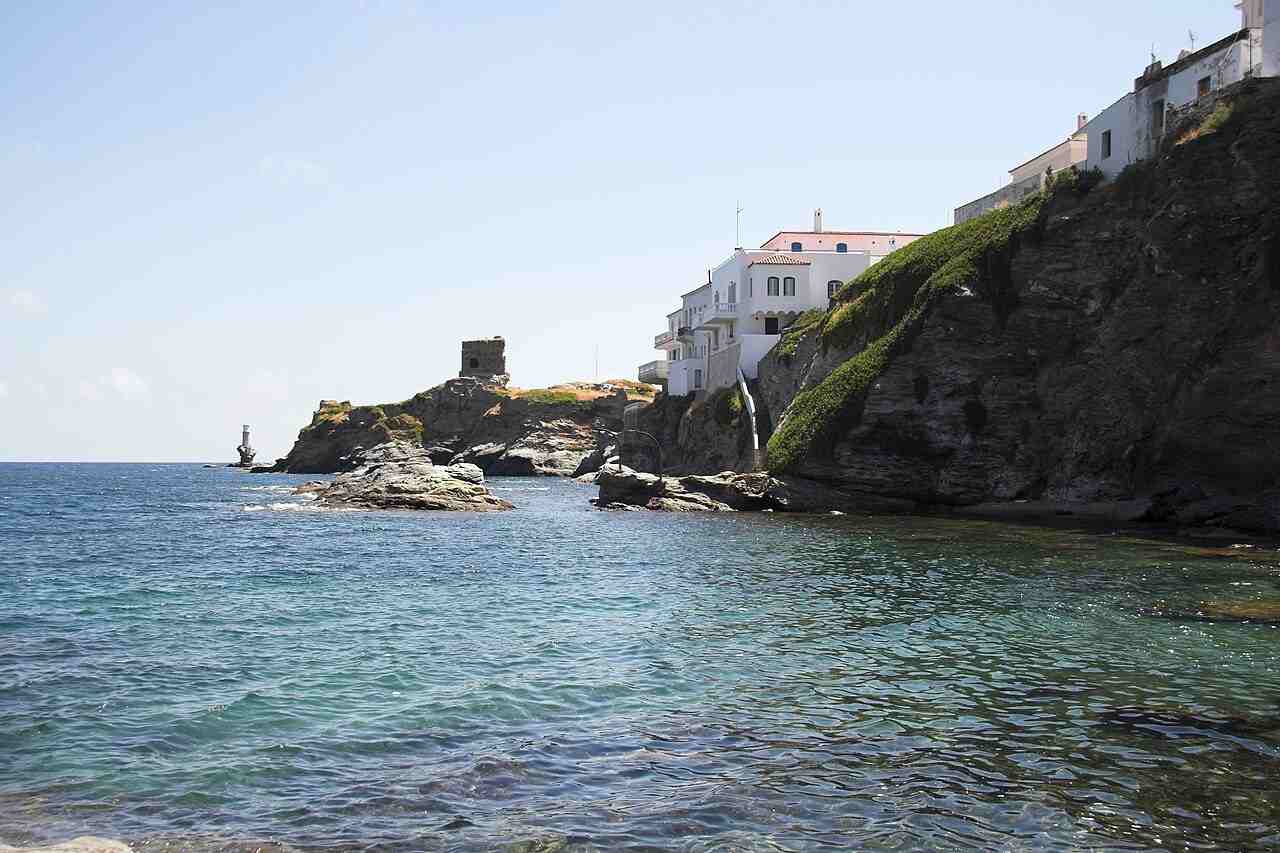
Chora, the capital of Andros, is one of the most elegant towns in the Cyclades, set on a narrow peninsula between two bays on the island’s east coast. A marble-paved main street runs between the neoclassical mansions of nineteenth-century shipowners, past squares and churches. To the ruined Venetian castle and the emblematic Tourlitis lighthouse rising from the sea beyond. Plan the whole trip with Greece Tours.
This guide covers Chora in full: what to see along its marble street, the castle and the lighthouse, its exceptional museums, its town beaches, and where to eat and stay. Read it beside the guides to things to do in Andros and the wider Andros travel guide to fit the capital into a trip.
What is Chora, the capital of Andros?
Chora, also called Andros town, is the capital of Andros, an aristocratic town on a narrow peninsula on the east coast. Built on the wealth of the island’s shipowners, it is known for its neoclassical mansions, marble streets and museums.
Chora occupies a dramatic position on a slender peninsula jutting into the Aegean on the east coast of Andros, with a bay on either side. Its character is refined and aristocratic, quite unlike the whitewashed simplicity of most Cycladic towns. A legacy of the great shipowning families who made their fortunes at sea and built grand houses here in the golden age of Greek shipping.
The town blends Cycladic and neoclassical architecture, with marble-paved streets, elegant mansions, churches and squares, and an unmistakable air of cultured, old-money calm. It is quieter and more genteel than the resort of Batsi across the island. Its appeal lies in wandering its streets. Visiting its museums, and taking in the setting of castle, lighthouse and sea.
Chora holds the museums, the finest architecture and the most history on Andros. It makes a rewarding day out or a refined base. The sections below cover what to see, from the marble street to the castle, the lighthouse and the galleries.
What is there to see in Chora, Andros?
Chora’s highlights are the marble-paved main street of shipowners’ mansions, the square of the Unknown Sailor with its bronze statue at the Riva, the ruined Venetian castle on its islet, and the Tourlitis lighthouse offshore.
The heart of a visit is the pedestrian marble street, Embirikou Street, that runs the spine of the peninsula, lined with grand neoclassical mansions, shops, cafes and pastry shops. Strolling it from end to end takes you past the town’s finest architecture and its squares, and it is the natural axis around which Chora is explored on foot.
The street ends at the open terrace of the Riva, overlooking the sea, where the bronze statue of the Unknown Sailor. The Afanis Naftis, stands as a memorial to the island’s lost seamen, one of Chora’s best-loved landmarks. From here the view opens over the ruined castle on its islet and the Tourlitis lighthouse rising from the waves beyond.
Beyond these set pieces, Chora rewards wandering its narrow, whitewashed back lanes with their colourful shutters and flower-filled balconies, its churches and its small squares. The combination of grand mansions, marble street, sea views and historic monuments makes it one of the most rewarding and elegant town walks anywhere in the Cyclades.
What is the Venetian castle in Chora, Andros?
The Venetian castle of Chora, the Kato Kastro, stands in ruins on a small islet off the tip of the peninsula, reached by an old arched stone bridge.
At the very tip of the Chora peninsula, a small rocky islet carries the crumbling ruins of the medieval castle. Known as the Kato Kastro or Lower Castle, built during the period of Venetian rule that followed the Fourth Crusade. It once guarded the town and the bay against pirates, and though little remains but walls and an arch, its setting is superb.
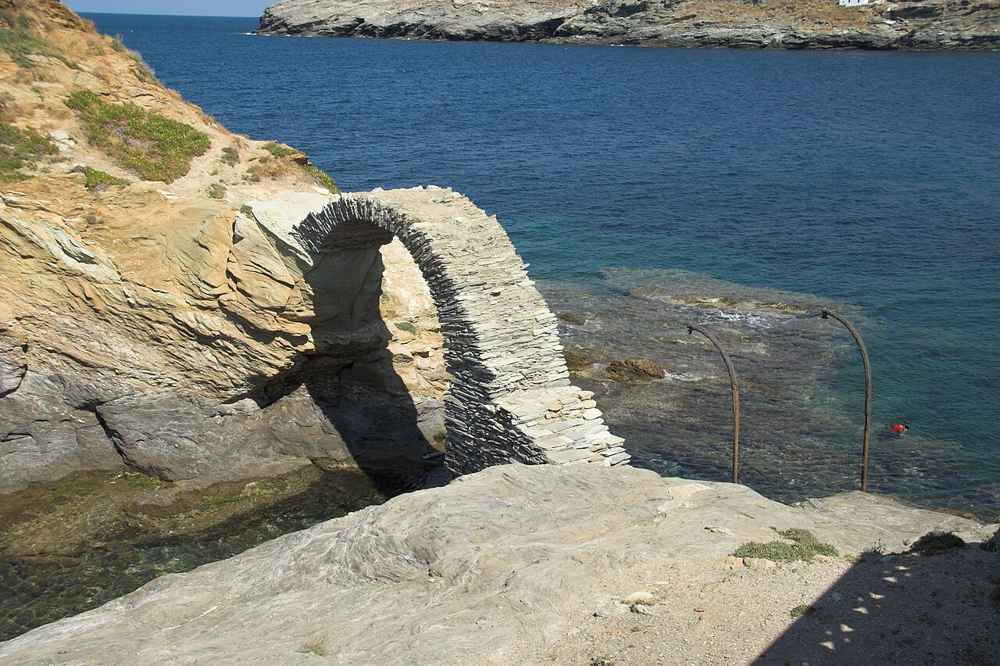
The islet is reached from the town by an old, narrow arched stone bridge that crosses the sea channel, a short and atmospheric walk from the Riva. Standing among the ruins, with the waves below and the open Aegean around, gives a vivid. Atmospheric sense of the island’s long medieval past and one of the very finest viewpoints anywhere in Chora.
From the castle islet, the view back over the town and out to the Tourlitis lighthouse is the classic image of Chora. The walk out across the bridge is a highlight of any visit. The castle, the bridge and the lighthouse together form the emblematic scene of the capital and of Andros as a whole.
Should you see the Tourlitis lighthouse from Chora?
Yes. The Tourlitis lighthouse rises from a lone rock in the sea just off the Chora castle, and it is the only lighthouse in Europe built on a sea rock.
Just beyond the castle islet, the Tourlitis lighthouse stands on a weathered rock pinnacle rising straight from the sea, the emblem of Andros and its most photographed sight. Originally built in the nineteenth century and later rebuilt. It is the only lighthouse in Europe erected on a rock in the open sea rather than on land or a harbour. It now operates automatically.
The best views are from the Riva and the old bridge out to the castle. From where the white tower appears to rise from the waves against the deep blue Aegean. Sunrise and sunset are the finest times, when the low light gilds the tower and the sea. The short walk out to the castle for the view is an essential part of a visit to Chora.
Tourlitis appears on every postcard and guidebook of Andros. Seeing it in person, framed by the castle ruins and the open sea, is one of the highlights of the capital. It is inseparable from Chora, and the two are best experienced together.
What museums are in Chora, Andros?
Chora has four museums: the renowned Museum of Contemporary Art of the Goulandris Foundation, the Archaeological Museum, the Maritime Museum, and a Folklore museum. For its size, the town has exceptional cultural depth.
The jewel is the Museum of Contemporary Art of the Basil and Elise Goulandris Foundation. Which stages major exhibitions of Greek and international artists each summer alongside its permanent collection of sculpture and painting. It has made Chora, and Andros, a cultural destination in its own right, drawing art lovers from Athens and abroad to the island’s quiet capital.
The Archaeological Museum of Andros displays finds from the island’s ancient sites, most famously a celebrated statue of Hermes from the ancient capital of Palaiopolis, while the Maritime Museum, near the Unknown Sailor’s square, tells the story of the island’s shipowning history from ancient times to the present, the source of the town’s wealth and mansions.
A Folklore and modern art collection completes the circuit, giving Chora four museums within a short walk, remarkable for a small island town. Together they add a rich cultural dimension to a visit, and they give the capital a rainy-day and rest-day appeal that the beach-focused Cyclades largely lack.
What is the Museum of Contemporary Art in Chora?
The Museum of Contemporary Art of the Goulandris Foundation in Chora is one of the most important art museums in the Greek islands. It holds sculpture and painting by leading Greek artists and stages acclaimed international exhibitions each summer.
Founded by the shipowning Goulandris family, the Museum of Contemporary Art is the cultural highlight of Andros and one of the finest art museums outside Athens. Its permanent collection gathers works by major twentieth-century Greek sculptors and painters, displayed across two buildings in the heart of Chora, a serious collection in a small island town.
The museum is best known, though, for the ambitious temporary exhibitions it stages each summer, bringing the work of world-renowned Greek and international artists to Andros. These shows draw visitors specifically to the island and have earned the museum an international reputation. Making a summer visit to Chora a cultural event as much as a sightseeing one.
For visitors interested in art, the museum alone justifies a day in Chora, and it is a large part of what gives Andros its cultured, aristocratic character. Checking the summer exhibition programme in advance is worthwhile, as the shows change each year and are a highlight of the island’s calendar.
What beaches are near Chora, Andros?
Chora has two town beaches on either side of its peninsula: the sheltered, organised Nimborio to the west and the longer, more open Paraporti to the east. Both are within walking distance of the town centre.
The peninsula on which Chora sits has a beach on each side, both an easy walk from the centre. Nimborio, on the sheltered western side by the harbour, is the more organised. A sandy town beach with facilities close to the cafes and tavernas, ideal for a relaxed swim between exploring the town and its museums.
On the eastern side, Paraporti is longer and more open, a sweep of sand exposed to the wind but quieter, with the ruined castle and the lighthouse in view. It catches the meltemi more than sheltered Nimborio. It is calmest in the morning or on still days. But it offers space and a fine outlook over the emblematic scene of the town.
The Chora beaches mean a day in the capital need not be beach-free, letting you combine culture and a swim. For the full range of the island’s coast, see the guide to Andros beaches.
Where can you eat and shop in Chora, Andros?
Chora’s marble main street, Embirikou Street, is lined with cafes, tavernas, pastry shops and boutiques, while the waterfront has seafood tavernas. The town is known for its amygdalota almond sweets and its refined dining.
The pedestrian Embirikou Street is the hub of Chora’s life, lined with cafes, restaurants, pastry shops and boutiques where you can browse, take a coffee or eat between sightseeing. The town’s pastry shops are famous for amygdalota. The soft almond sweets that are an island speciality. Picking up a box of them to take home is a long-standing Chora tradition.
For a meal, the tavernas along the street and the squares serve traditional Greek and Andriot dishes. Including the island’s hearty fourtalia omelette and local cheeses, while the waterfront and the beaches nearby offer seafood tavernas with a sea view. Dining in Chora is more refined and less resort-driven than in Batsi, in keeping with the town’s genteel character.
The evenings in Chora are relaxed, centred on a stroll along the marble street, a coffee or a drink in a square, and an unhurried dinner. It is a place to slow down and enjoy the atmosphere of an elegant island town rather than a lively nightlife scene. Which for visitors, especially couples and culture lovers, is exactly its appeal.
Is Chora a good base on Andros?
Chora suits travellers drawn to culture, elegance and atmosphere, with its museums, mansions and refined dining. It is quieter in the evenings than Batsi and a short drive from the best beaches, so a hire car helps.
Chora offers the island’s richest culture and its most elegant setting, ideal for visitors who want museums, architecture and a genteel atmosphere over beach-resort life and nightlife. Staying in the capital means the marble street, the castle, the lighthouse and the galleries are on your doorstep, and the town beaches within walking distance.
The trade-offs are that Chora is quieter in the evenings than the resort of Batsi. That the island’s finest beaches lie on the west and north coasts. A drive away, so a hire car is useful for a stay based here. For a first, beach-focused visit many prefer Batsi, but for culture and character Chora is the more rewarding base.
For a comparison of the bases and the island’s accommodation, see the wider Andros travel guide. Chora suits couples, culture lovers and returning visitors who want to experience the refined, aristocratic side of the island at its source.
What is the history of Chora, Andros?
Chora rose to prominence in the golden age of Greek shipping, when the island’s shipowning families built its neoclassical mansions and endowed its museums. Earlier, the Venetians ruled from the castle, and the town replaced ancient Palaiopolis as capital.
The refined character of Chora is the direct legacy of the sea. From the eighteenth century into the twentieth, Andros produced some of the most successful shipowning families in Greek maritime history. The fortunes they made built the grand neoclassical mansions that line the marble street. Endowed the town’s museums, and gave the capital its cultured, cosmopolitan air.
The town’s story reached back through the Venetian period, when the island was ruled from the castle on the islet at the tip of the peninsula, built to guard against pirates after the Fourth Crusade. Chora had by then succeeded the ancient city of Palaiopolis, on the west coast, as the capital of the island.
This layered past, from the ancient capital through Venetian rule to the shipowning heyday. Is written into the fabric of Chora: the ruined castle, the churches, the mansions and the maritime museum all tell parts of the story. Understanding it deepens a visit, explaining why this small island town is so unexpectedly grand and cultured.
When is the best time to visit Chora, Andros?
The best time to visit Chora is late spring to early autumn, when the weather is warm and the Museum of Contemporary Art stages its summer exhibitions.
Chora is rewarding from late spring through to early autumn, when the weather is warm, the seafront and the marble street are at their liveliest. The town beaches are inviting. A particular draw is the summer exhibition season at the Museum of Contemporary Art. Which brings major shows to the town from early summer, making it a cultural highlight of the island’s calendar.
The shoulder months of late spring and early autumn offer the best balance of warm weather, open museums and tavernas, and a quieter, more relaxed atmosphere. Even in the peak of August, Chora stays calmer and more genteel than the resort of Batsi, so it rarely feels crowded, in keeping with its refined character.
For culture lovers, timing a visit to catch the summer exhibition at the Goulandris museum is worthwhile, while those seeking quiet will prefer the shoulder weeks. Whenever you come, the marble street, the castle, the lighthouse and the four museums make a visit to Chora a rewarding and cultured day out. See the wider Andros travel guide for the island’s seasons.
How do you get to Chora, Andros?
Chora lies on the east coast about 30 kilometres from the port of Gavrio, where the ferries from Rafina arrive. It is reached by hire car, taxi or the local bus, a drive of around 40 minutes across the island.
The ferries from Rafina dock at Gavrio on the north-west coast. Chora sits on the opposite, eastern side of the island. About 30 kilometres and a drive of roughly 40 minutes away across the mountainous interior. Reaching the capital means crossing the island, a scenic drive in itself past villages and green slopes.
A hire car is the most flexible way to reach Chora and to explore from it, given the island’s size and the spread of its beaches and trailheads. The local bus service also runs from Gavrio and Batsi to Chora, timed loosely around the ferries, which suits travellers without a car, and taxis are available for the transfer.
Once in Chora, the town itself is compact and best explored on foot, with its marble street, museums and monuments all within walking distance. For the full picture of ferries and getting around the island, see the guide to things to do in Andros and the wider travel guide.
Frequently Asked Questions
What is Chora in Andros known for?
Chora, the capital of Andros, is known for its aristocratic character: a marble-paved main street lined with the neoclassical mansions of nineteenth-century shipowners. The ruined Venetian castle on its islet, the emblematic Tourlitis lighthouse rising from the sea. Its four museums, led by the renowned Museum of Contemporary Art of the Goulandris Foundation.
Is Chora Andros worth visiting?
Yes. Chora is one of the most elegant and cultured towns in the Cyclades, with its marble street of shipowners’ mansions. The castle and lighthouse. Exceptional museums, all in a dramatic setting on a peninsula between two bays. It rewards a day of wandering and is a highlight of any visit to Andros, especially for those interested in art and architecture.
Does Chora Andros have a beach?
Yes. Chora has two town beaches on either side of its peninsula, both within walking distance of the centre: the sheltered. Organised Nimborio to the west by the harbour. The longer, more open Paraporti to the east. While the island’s finest beaches are on the west and north coasts, the Chora beaches allow an easy swim close to the town.
How far is Chora from the Andros ferry port?
Chora lies on the east coast of Andros, about 30 kilometres from the ferry port of Gavrio on the north-west coast, a drive of roughly 40 minutes across the island. It is reached by hire car, taxi or the local bus, which runs from Gavrio and Batsi to the capital timed loosely around the ferry arrivals.