
Explore Thassos Island with our tour guide featuring top beaches, villages, hikes, and 1- to 7-day itineraries for an authentic, relaxed Greek island experience.
Thassos Tour Guide: Discover Greece’s Emerald Island — Best Beaches, Day Trips, and Local Tips
Thassos has a way of surprising visitors who expect another Santorini postcard: emerald-green pines tumbling to glittering Aegean waters, tiny marble-quarried villages, and beaches that can feel yours privately even in July. In this tour guide we’ll walk you through why Thassos belongs on every Greek island’s itinerary, which beaches and villages are unmissable, the best ways to get around and plan day trips, plus sample 1-, 3-, and 7-day itineraries so you can turn sightseeing into a relaxed, unforgettable trip.
Thassos sits off the coast of Kavala in the northern Aegean, and Greece Tours covers it with tours, beaches and village pages.
Whether you’re considering a day trip from nearby Kavala or planning a week-long island-hopping route, our tips are based on months of on-the-ground experience, conversations with local guides, and testing routes to help you avoid wasting time on guesswork. Let’s get started, and yes, we’ll tell you where to swim at sunset, which taverna serves the best grilled fish, and how to squeeze in a mountain hike without missing the beaches.
Why Visit Thassos? Fast Facts, Highlights, and Who It’s Best For
Thassos is the northernmost of the major Greek islands in the Aegean, often called Greece’s “Emerald Island” for its dense pine forests and the vivid colors of its bays. Fast facts to orient you: the island is roughly 90 km2, population about 13,000 year-round, and its highest point, Ypsario, tops out at 1,204 meters, making Thassos one of the few Greek islands with both real mountains and classic sandy beaches.
Highlights at a glance
- Beaches: Golden sand at Golden Beach (Chrisi Ammoudia), turquoise coves at Marble Beach (Saliara), and family-friendly shallow bays at Alyki.
- Ancient sites: Thassos Archaeological Museum and the ruins near Aliki and Limenas (the island’s main port town) show a continuous history from classical antiquity through Byzantine times.
- Villages: Picturesque alpine-like villages such as Theologos (with stone mansions and cobbled lanes), Panagia, and Skala Marion offer authentic island life away from the coast.
- Outdoor variety: Hikes up to Ypsario, sea kayaking around isolated coves, and short drives through pine-scented mountain roads.
Who suits Thassos best?
- Families and slow travelers: Beaches are safe, water is clear, and the pace is relaxed. You can blend beach days with easy cultural stops.
- Nature lovers and hikers: The island’s trails and mountainous interior are surprisingly wild for its size.
- People who want “real Greece” without the heavy crowds of Santorini or Mykonos: Thassos keeps prices reasonable and experiences authentic.
- Day-trippers and island-hoppers: Thassos works well as a quieter stop on an island-hopping route that includes nearby Samothrace or as a base for exploring the North Aegean coast.
When not to choose Thassos
If you want a nightlife-heavy trip with upscale clubs and celebrity sightings, Thassos isn’t it. Likewise, travelers after volcanic landscapes or dramatic calderas (think Santorini) will find a different character here, green mountains, marble quarries, and gentle bays instead.
How we recommend using Thassos
Treat Thassos as a restorative island: plan at least 3 days if you want a relaxed taste, and a week if you plan to explore beaches, villages, and day trips without rushing. Its variety, beaches, mountains, ruins, and local food make it easy to build an itinerary that feels both restful and genuinely adventurous.
Where is Thassos, and how is the island shaped?
Thassos lies in the northern Aegean, 6 nautical miles from Keramoti and 18 nautical miles from Kavala. The island covers 380 square kilometres, has a 115-kilometre coastline and a round outline, and counted 13,104 residents at the 2021 census.
Thassos forms its own regional unit inside East Macedonia and Thrace, and one municipality covers the whole of it, with its seat in Limenas. The unit was created in the 2011 Kallikratis reform out of the former Kavala Prefecture. The islets of Thasopoula and Kinyra belong to the same municipality.
The coast has no deep bays and no large peninsulas, and the land rises step by step towards the centre. Mount Ipsarion, called Psario by local people, bends in an arc across the north-centre of Thassos. Besides its summit, two more peaks pass 1,100 metres: Toumba at 1,135 metres and Profitis Ilias at 1,109 metres. Brutia pine, known in Greek as the Thassos pine, and Macedonian fir grow on the mountain, and Mount Ipsarion is listed as an Important Bird Area. The mountaineering club of Thassos runs the Giannis Panagiotou refuge at Koukla, 910 metres up.
The old villages stand inland, and each one has a partner on the shore whose name begins with Skala, the Greek word for ladder. Maries pairs with Skala Marion, and Rachoni with Skala Rachoniou. Families moved down to these coastal settlements from the late 19th century.
- Limenas: the capital and main port on the north-east corner, with 3,331 residents at the 2021 census.
- Limenaria: the second town of the island, on the south coast, with 2,351 residents.
- Potamia: the village at the foot of Mount Ipsarion, with 1,274 residents.
- Prinos: the north-west village with 1,160 residents and the health centre of the island.
- Skala Prinou: the second largest ferry port, with sailings to Kavala.
Ferries cross from Keramoti to Limenas on the shortest route and from Kavala to Skala Prinou. Travel details are on the page on how to get to Thassos. The climate is Mediterranean, with mild winters and hot summers. Hippocrates lived on Thassos for three years in the 5th century BC and wrote in Epidemics I that, as a rule, winter there was like spring.
What made ancient Thassos rich?
Ancient Thassos grew rich from gold and silver mines on the island and on the mainland coast opposite, which brought in 200 to 300 Attic talents a year, from a wine trade governed by law, and from silver coins struck in its own mints.
Settlers from Paros reached the island around 650 BC. The oracle at Delphi had sent them under Telesicles, with the order to build a city seen from every side. His son Archilochus, an iambic poet, joined the colony and fought the Thracian Saians, and in one poem he admits that he threw away his shield. He pictured Thassos as the spine of a donkey covered in wild forest.
The colony soon reached the mainland. It founded Neapolis, today Kavala, and Krenides, later Philippi, and its coastal towns, known as the Peraia of Thassos, included Datos and Oisyme. The gold mines of this coast earned more than the mines of the island itself. When Thassos built warships and stronger walls after Histiaeus failed to take the city, Darius I of Persia forced it to hand over the ships and pull down the walls.
- Mining belt: ancient lead and silver workings run from Cape Salonikios in the south to Cape Pachys in the north, at Vouves, Koumaria and Sotiras.
- Wine law: the oldest known law on wine quality and trade, dated 480 to 470 BC, is shown in the Archaeological Museum.
- Vineyards: place names and ruined treading vats for grapes mark Astris, on the south coast, as the vineyard of ancient Thassos.
- Staters: silver coins showing a satyr carrying off a nymph, 20 to 21 millimetres across.
- Tetradrachms: silver coins of the 2nd century BC with the head of Dionysus and Heracles leaning on his club.
After a second revolt against Athens in 389 to 388 BC, Thassos moved to a drachma system and began to strike gold and bronze coins next to silver. Excavations by the French School at Athens have recovered more than 10,000 coins minted on the island. The vines that fed this trade are followed on the page on Thassos wine.
Which festivals and customs does Thassos keep?
Thassos keeps saints’ day feasts such as Saint Athanasius in Kastro on 18 January and Saint Daniel on Krambousa islet on 12 September, a wedding re-enactment in Theologos, the Philippi and Thassos Festival in the ancient theatre, and a Monday market in Prinos.
In Kastro, the church of Saint Athanasius went up in 1804 within forty days, with every villager helping and with stones taken from the ruined castle. Its outer wall carries the Gattilusio coat of arms, set upside down. Each 18 January people gather at the church for the feast of the saint.
Off Skala Potamia, the islet of Krambousa holds a church to Saint Daniel, built in 1991 on the initiative of the Potamia parish priest. Tradition says the saint lived on the islet, and a large panigyri in his memory takes place each 12 September. The islet is also known for a wild green called krambi.
In Theologos, villagers stage the old local wedding. The groom goes with his best man to the house of the bride, the bride and her dowry ride on pack animals, and the procession ends at the church of Panagouda, built in 1633, where the wedding feast begins.
- 18 January: the feast of Saint Athanasius at the church of Kastro.
- 12 September: the panigyri of Saint Daniel on Krambousa islet.
- Theologos wedding: a re-enactment of the village marriage procession.
- Festival: performances in the ancient theatre of Limenas, a programme that began in 1961.
- 30 November: the lighting of a Christmas tree and a boat on the Limenas beach.
The ancient theatre had its marble seats secured to join the Philippi and Thassos Festival at its start in 1961. Saint Panteleimon Monastery, built in 1843 and a monastery since 1987, keeps a local legend: builders found their work torn down day after day until footprints led them to their missing tools beside a spring, and the monastery rose on that spot. Prinos holds its market each Monday. More feast days of Thassos are gathered on the page on Thassos festivals.
Top Attractions, Beaches, and Must-See Villages
Beaches (our favorites)
- Golden Beach (Chrisi Ammoudia): The island’s most famous sandy stretch, ideal for families and wind-sports beginners. Long shoreline, shallow water, and facilities close by make it an easy first stop.
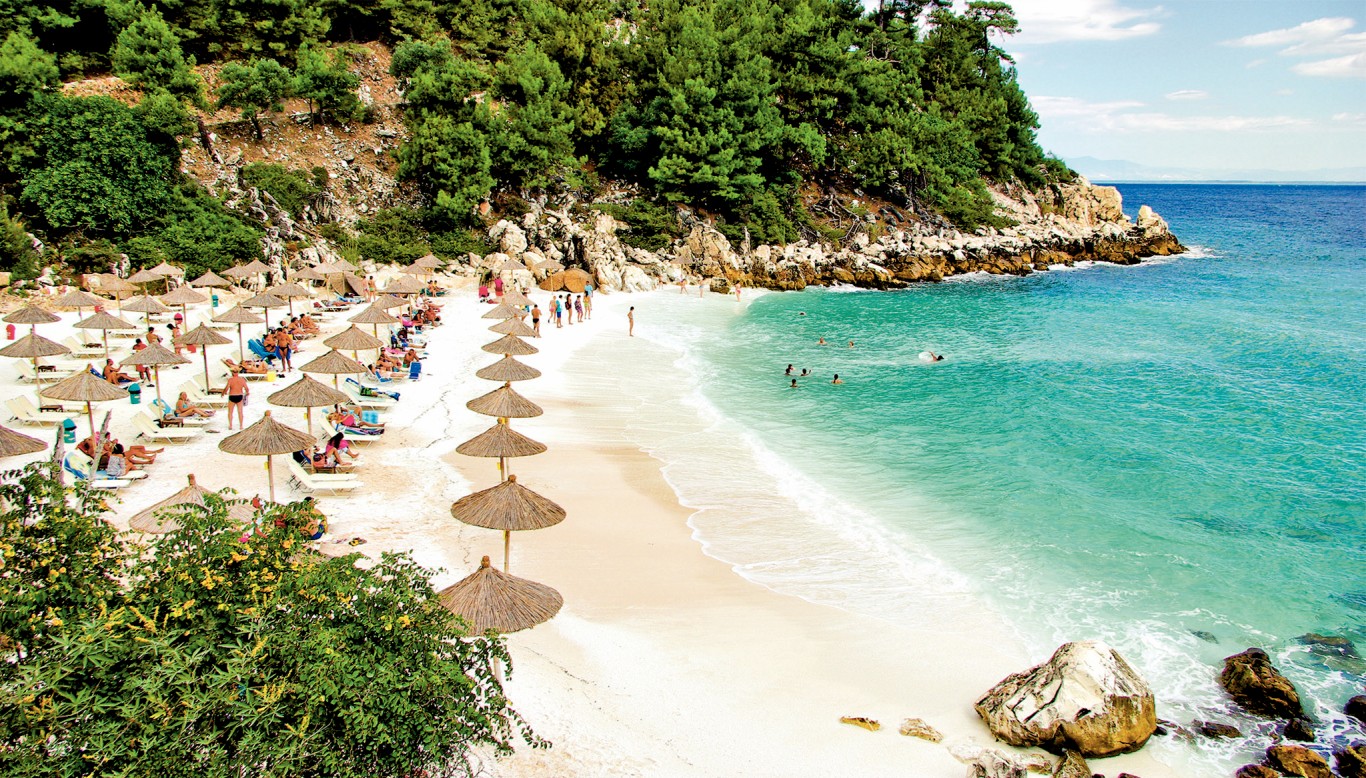
- Marble Beach (Saliara): A show-stopper, tiny white marble pebbles polished by the sea make the water shimmer in an extraordinary turquoise. Bring water shoes: the pebbles are beautiful but can be sharp.
- Aliki Beach: Near archaeological ruins, this beach combines history and swimming. The water here is calm and excellent for snorkeling.
- Psili Ammos: For those who want a quieter, more remote beach with soft sand and crystalline water, there’s a small hike or a rough road to reach it, which keeps crowds down.
- Skala Potamia: A long beach with family-friendly amenities, beach bars, and gentle waves. Perfect for lazy afternoons and easy access from Potamia village.
Must-see villages and towns
- Limenas (Thassos Town): The island capital is compact and lively, with an archeological museum, harbor cafes, a small castle wall, and good nightlife by local standards. It’s our go-to for provisioning and for an easy evening stroll.
- Theologos: A mountain village with mansions, narrow stone streets, and a weaver’s tradition. The annual cultural events here give a glimpse into Thassian folklore.
- Panagia: Traditional and photogenic, Panagia has steep alleys and terraces with panoramic views. It’s quieter than Limenas and perfect for a leisurely lunch stop.
- Skala Marion: Near the archaeological site of ancient Marion, the village has a relaxed harbor and is a short drive to Marble Beach.
Historic and cultural highlights
- Thassos Archaeological Museum (Limenas): Displays from prehistoric to Roman times, with a few striking sculptures and sarcophagi. It’s compact but informative, allowing 45–60 minutes.
- Ancient Agora & Acropolis of Aliki: Scattered ruins in a breathtaking setting by the sea: combine swimming at Aliki Beach with a quick ruins visit.
- Marble quarries: The island’s ancient and modern marble industry shaped its economy and landscape. Visiting a quarry road or a small exhibition is eye-opening if you appreciate geology and industrial history.
Hidden gems
- Kritika Beach: Smaller and often overlooked, great for a quiet morning swim.
- Panagia’s backyard plateia (main square): Join locals at a kafeneio (coffee shop) for a slower slice of island life: you’ll likely be offered a small plate of homemade sweets or raki during festivities.
Practical tip
Start beaches early (before 11 AM) in high season: parking fills fast and morning light makes the colors pop for photos. If you want empty coves, aim for late afternoon swims around 5–7 PM when day boats return to port.
Activities, Experiences, and Best Day Trips From Thassos
 Outdoor activities we love
- Hiking Ypsario: The highest peak rewards you with sweeping views across the northern Aegean and into Bulgaria on clear days. Trails vary from moderate to strenuous: we recommend early starts and water.
- Sea kayaking and SUP: Rent from Limenas or local operators and paddle along the north coast’s hidden bays. Kayaking past marble cliffs and isolated caves feels like discovering the island anew.
- Snorkeling and diving: The clear Aegean around Aliki and Psili Ammos offers good snorkeling; certified dive centers run short dives to inspect rocky reefs and small wrecks.
- Mountain biking: Gravel roads and coastal stretches make for varied rides; local shops will point out routes by difficulty.
Culinary experiences
- Taverna hopping: We look for places where locals eat, simple grilled fish, moussaka, and fresh salads dressed with local olive oil. Ask for the day’s catch: grilled sardines (sardeles) are a classic.
- Olive oil and honey tasting: Small producers offer samples. Thassos honey is floral and distinct. If you have time, visit a family-run press to learn about olive harvests and pressing.
Cultural events and workshops
- Folk festivals (Panigiria): If you visit in summer, local villages host panigiria with live music, dancing, and regional food, a great way to experience authentic culture.
- Craft workshops: Learn basic weaving in Theologos or pottery with a local artisan for a hands-on cultural connection.
Best day trips from Thassos
- Kavala and Philippi (mainland): A 45–90 minute ferry or drive plus short ferry option will get you to Kavala, whose Ottoman-era aqueduct and lovely harbor make a good mainland city break. From Kavala, Philippi’s archaeological site (UNESCO nomination candidate) is an easy day trip for history buffs.
- Samothrace: A longer ferry ride, but for those chasing waterfalls and dramatic landscapes, Samothrace’s Gavratos and Fonias gorges are spectacular, best for active travelers with at least a full day.
- Kavala to Thassos boat cruises: Short coastal cruises offer views of cliffs and remote beaches not reachable by road, perfect for sunbathing and quick swims in secluded coves.
Special interest ideas
- Birdwatching: The island and adjacent wetlands attract migratory species; spring and autumn bring the most variety.
- Photography tour: Marble Beach at dawn, Theologos with its atmospheric alleys, and sunset from Ypsario provide postcard-ready frames. We often recommend hiring a local photographer for at least an hour to capture family moments without the self-timer hustle.
Booking and guide tips
We prefer booking guided hikes and cultural tours with local operators; they’re affordable, knowledgeable, and they often include transport. For specialty experiences (diving certification dives, private boat trips), reserve at least a week in advance during July–August.
Practical Travel Information: Getting There, Getting Around, When To Go, and Where To Stay
Getting there
- By ferry: Regular ferries connect Thassos with Kavala (the most common mainland gateway) and Keramoti. From Kavala, crossings take about 40–60 minutes depending on the service. Ferries vary by season: summer has the most frequent sailings.
- By plane: The nearest airport is Kavala International (KVA) with seasonal international flights and reliable connections through Athens. From the airport, you can take a shuttle or taxi to the ferry port.
- Island hopping: If you’re island-hopping, slower local ferries and private boats can link Thassos with nearby islands like Samothrace. Fast boats are sporadic: check timetables and leave flexibility in your plans.
Getting around Thassos
- Car rental: We recommend renting a car if you want to explore beaches and mountain villages at your own pace; distances are short, but public transport is limited. Roads are generally good, though some beach and mountain accesses are rough.
- Motorbike/scooter: A fun option for solo travelers or couples comfortable on two wheels: remember helmets and caution on narrow, winding roads.
- Public bus: There’s a decent bus network connecting major towns and beaches in high season. Schedules thin out in shoulder months, so check times for your dates.
- Taxis: Readily available in Limenas and larger villages. For remote beaches, you may need to pre-book transfers.
When to go
- Best months: May–June and September–early October. The weather is reliably warm, the water is comfortable, and crowds thin out.
- High season: July–August brings warm sea temperatures and lively tavernas, but also higher prices and more visitors. If you travel in peak season, we recommend early starts to beat the sun and crowds.
- Winter: Thassos is quiet and many tourist services close; it’s a good time for off-season exploration if you don’t need beach facilities.
Where to stay (by travel style)
- Families & beach lovers: Golden Beach, Skala Potamia, and Alyki have family-friendly hotels, apartments, and amenities close to shoreline services.
- Couples & slower travelers: Limenas offers a mix of boutique guesthouses and seaside rooms with excellent dining options and a lively evening atmosphere.
- Nature & hiking fans: Potamia and mountain villages like Theologos or Panagia provide quieter lodging and easy access to trails.
- Luxury travelers: Small boutique hotels and a handful of high-end villas offer privacy and concierge services; these tend to be near the nicest beaches and provide private transfers.
Budget tips
- Self-cater some meals from local markets, fresh bread, cheese, olives, and fruit are excellent value.
- Book ferries early for best prices and consider morning crossings to maximize daylight on arrival days.
- If you rent a car, compare full-to-full fuel policies and CDW (collision damage waiver) options: local insurers are sometimes more flexible than international ones.
Safety and health
Thassos is generally safe and traveler-friendly. Bring reef shoes for marble-pebble beaches, sunscreen, and a small first-aid kit for hikes. Tap water is drinkable in many parts, but locals often prefer bottled water: if you’re staying in small mountain villages, check with hosts.
Sample Itineraries: 1-Day, 3-Day, and 7-Day Plans To Make The Most Of Thassos
1-Day Thassos: Best-of-the-island express
Morning
- Arrive early at Limenas. Quick coffee at the harbor and a 30–45 minute visit to the Thassos Archaeological Museum to orient yourself to the island’s history.
- Drive 20 minutes to Marble Beach (Saliara) for morning light and a snorkel among marble sands.
Afternoon
- Head to Aliki for lunch at a seaside taverna, then visit the nearby ancient ruins and swim at Aliki Beach.
- If time permits, stop at Golden Beach for a late-afternoon walk on the sand or a quick dip.
Evening
- Return to Limenas for a sunset promenade, a seafood dinner, and a relaxed night. This itinerary is tight but gives a satisfying variety for day-trippers or ferry-only visitors.
3-Day Thassos: A balanced short break
Day 1, Coast and culture
- Morning: Explore Limenas and the archaeological museum.
- Afternoon: Swim at Skala Potamia and stroll in Potamia village.
- Evening: Dinner in Limenas or a beachside taverna.
Day 2, Beaches and marble
- Morning: Marble Beach at sunrise, then the quiet Kritika cove for a second swim.
- Afternoon: Lunch near Aliki, quick visit to the ruins, and an afternoon kayak or SUP.
- Evening: Drive up to Theologos for a mountain village dinner.
Day 3, Mountain and views
- Morning: Hike part of the Ypsario trail, choose a half-day loop for panoramic views.
- Afternoon: Return via Panagia village for coffee and shopping for local honey/olive oil.
- Evening: Relaxed farewell dinner in Limenas.
7-Day Thassos: Deep dive with a day trip
Days 1–2, Coastal immersion
- Spend two days rotating between Golden Beach, Skala Potamia, and Aliki. Balance long beach sessions with short cultural stops.
Days 3–4, Villages and mountains
- Dedicate a day to Theologos and Panagia, including a craft workshop and village feast if available.
- Use another day for a full hike up Ypsario with a packed lunch, or explore lesser-known coves by rented car.
Day 5, Boat day or Samothrace excursion
- Choose a private boat trip to remote coves or a day ferry to Samothrace (allow for a long day, ideally earlier in the week when ferries are less crowded).
Day 6, Kavala and mainland
- Drive or ferry to Kavala for a city afternoon: walk the old town, climb to the aqueduct, and sample regional cuisine.
Day 7, Slow last day
- Spend your final day doing what you loved most: a long swim, souvenir shopping, or a final village lunch before catching the ferry.
Pacing tips
- We like a “beach first, explore later” structure: use mornings for quiet beach time, afternoons for cultural visits when light is softer, and evenings for leisurely dinners in villages.
- Keep a buffer for ferry schedules and slower local roads; island travel should feel relaxed, not rushed.
What do Thassos tours see in ancient Limenas?
Thassos tours in Limenas see the ancient city under the modern capital: the agora beside the old harbour, the theatre on the pine-covered hill, the acropolis with its sanctuaries of Apollo, Athena and Pan, the city walls with carved gates, and the archaeological museum with its giant kouros carrying a ram.
Thassos was one of the richest cities of the northern Aegean, and its remains spread through the streets and hills of Limenas. The agora, with its stoas and altars, lies a few steps from the fishing harbour, and a path climbs through the pines to the theatre, where Thassos tours in summer watch performances of the Thassos festival under the stars.
Higher up, the acropolis holds the foundations of the temples and a rock relief of Pan playing his pipes, with views over the harbour to the mountains of Kavala. The walls that ran around the ancient city keep their gates, carved with gods and heroes, among them Heracles and Dionysus.
The archaeological museum shows the finds of the city, and its best-known piece is the Kriophoros, an unfinished archaic kouros about 3.5 m tall carrying a ram on his shoulders. Thassos tours on foot cover the agora, the museum and the theatre in a morning.
- Ancient agora – the market square beside the harbour.
- Ancient theatre – the stage of the summer festival.
- Acropolis – the sanctuaries of Apollo, Athena and Pan.
- City gates – the carved gates of the ancient walls.
- Kriophoros – the kouros carrying a ram in the museum.
- Old harbour – the fishing port on the ancient quay.
Our ancient agora and archaeological museum pages cover the sites. Thassos tours start in Limenas, where the ferries from Keramoti arrive, and the ancient city fills the first morning of the stay.
What do Thassos tours see at Aliki and the ancient marble quarries?
Thassos tours at Aliki see a small peninsula on the south-east coast with two bays of clear water, the ancient marble quarry cut into the rock at the sea’s edge, the ruins of a sanctuary and of early Christian basilicas, and the white marble that made Thassos famous across the ancient world.
Thassian marble, pure white and fine-grained, was shipped across the Greek and Roman world for statues, temples and columns, and the island still quarries it today. At Aliki the ancient workers cut the stone right at the waterline, leaving flat steps and walls of marble that now shelve into the sea, where Thassos tours swim among the old quarry cuts.
A path from the bays leads over the headland past the quarry, the foundations of a sanctuary and two early Christian basilicas, with the sea on both sides. The water around Aliki is some of the clearest on the island, and Thassos tours by boat stop here for snorkelling.
- Aliki bays – the two coves of the peninsula.
- Marble quarry – the ancient cuttings at the waterline.
- Thassian marble – the white stone of ancient temples.
- Early Christian basilicas – the ruins on the headland.
- Headland path – the walk around the peninsula.
- Snorkelling – the clear water over the quarry steps.
Our Aliki and Thassos marble pages cover the peninsula. Thassos tours on the round-island road stop at Aliki for a swim on the way to the south coast.
What do Thassos tours see on the south coast, from the Archangel Michael monastery to Giola?
Thassos tours on the south coast see the monastery of the Archangel Michael on a cliff high above the sea, which keeps a relic said to be a nail of the Cross, the natural rock pool of Giola, filled by the waves near Astris, the fishing village of Potos and the mining town of Limenaria with its Palataki mansion.
The monastery, now a convent, stands on the edge of a cliff near Aliki, with a terrace over the open sea and a church that pilgrims visit for its relic. Visitors dress modestly, and the nuns offer a quiet place above the coast road.
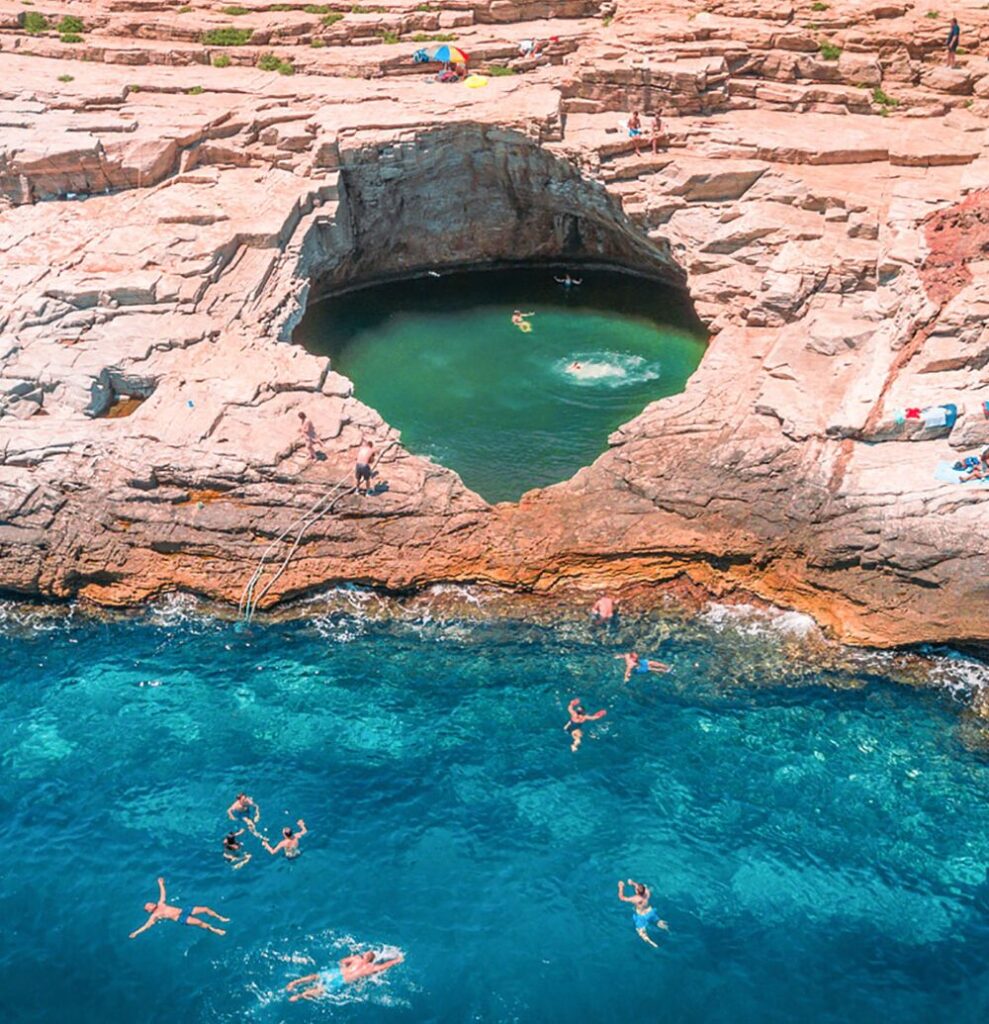
Giola is a pool of green water cut into the rocks at the edge of the sea, reached by a path from the road, where swimmers jump from the rocks into the deep water. Further west, Limenaria grew around the mines of a German company in the early 20th century, and the Palataki, the mansion of its director, stands on the hill above the harbour.
- Archangel Michael monastery – the convent on the cliff.
- Holy nail – the relic kept in the church.
- Giola – the natural rock pool by the sea.
- Astris – the bay near the rock pool.
- Potos – the fishing village of the south-west.
- Limenaria Palataki – the mansion of the mining company.
Our Archangel Michael monastery and Giola pages cover the south. Thassos tours to Giola arrive early in summer, since the rock pool fills with swimmers by midday.
What do Thassos tours see in Theologos and the old village of Kastro?
Thassos tours in the interior see Theologos, the old capital of the island, with stone houses roofed in grey slate, a folklore museum and tavernas that roast lamb on the spit, and Kastro, a village high in the mountains that the islanders built as a refuge from pirates and that now fills only in summer.
Theologos lies in a green valley inland from Potos and was the seat of the island’s Ottoman governors. Its main street runs past houses with wooden balconies and slate roofs, a church with a carved screen and a small museum of island life, and its tavernas are the classic lunch stop of Thassos tours of the interior.
Kastro sits on a plateau in the mountains above Limenaria, reached by a long forest road. Its stone houses, church and cemetery stand among meadows and pine, and a few families return each summer to open a café and a taverna for visitors.
- Theologos – the old capital of the island.
- Slate roofs – the grey stone roofs of the village.
- Folklore museum – the island life of Theologos.
- Spit-roast lamb – the tavernas of the main street.
- Kastro – the mountain refuge from pirates.
- Forest road – the drive through the pines to Kastro.
Our Theologos and Kastro pages cover the villages. Thassos tours by jeep link Theologos and Kastro with the forest roads of the interior in one day.
What history do Thassos tours discover?
Thassos tours discover an island settled by colonists from Paros in the 7th century BC, rich from gold mines, marble and wine, that rose against Athens in 465 BC, and that the Ottoman sultan later gave to Muhammad Ali, the Kavala-born ruler of Egypt, whose family governed it until the early 20th century before Thassos joined Greece in 1912.
The Parians who founded the city worked the gold mines of the island and of the mainland opposite, and Herodotus wrote of mines on Thassos that the Phoenicians had opened before them. Thassian wine was one of the most famous of antiquity, and stamped amphora handles from the island are found across the Aegean and the Black Sea.
In 465 BC Thassos revolted against Athens over the mines of the mainland and held out for two years under siege before its surrender. Much later, in the 19th century, the island became the property of Muhammad Ali and his heirs, who ruled it with light taxes, which is why Thassos tours still hear stories of the Egyptian years in the villages.
- Parian colonists – the founders of the ancient city.
- Gold mines – the wealth of the island and the mainland.
- Thassian wine – the famous wine of antiquity.
- Revolt of 465 BC – the siege by Athens.
- Muhammad Ali – the ruler of Egypt who held the island.
- Union with Greece – 1912.
Our Thassos history page covers the story in full. Thassos tours with a guide tell this history on the walk through the agora and the museum of Limenas.
What food and drink do Thassos tours taste?
Thassos tours taste the island’s pine honey, the wrinkled black throumba olives and their oil, walnut and fig spoon sweets, fresh fish in the harbour tavernas, spit-roast lamb in the mountain villages, local tsipouro, and wines that carry on an island tradition going back to antiquity.
Pine forests cover much of Thassos, and the bees that feed on them make a dark, rich pine honey sold in every village along the road. The throumba olives ripen and wrinkle on the tree, and they are eaten as they are or pressed into oil, and the villages make spoon sweets from green walnuts and figs.
The harbours of Limenas, Skala Prinos and Potos serve grilled fish, octopus and mussels, and the mountain villages of Theologos and Panagia serve lamb and goat. Cooking classes and farm visits on Thassos tours show how the island’s pies, sweets and olive dishes are made.
- Pine honey – the dark honey of the island forests.
- Throumba olives – the wrinkled black olives.
- Walnut spoon sweet – the green walnut preserve of the villages.
- Harbour seafood – fish and octopus in Limenas and Potos.
- Spit-roast lamb – the mountain tavernas of Theologos.
- Tsipouro and wine – the spirits and wines of the island.
Our Thassos honey and Thassos food pages cover the tastings. Thassos tours with a cooking class end the day at a village table with the dishes the group made.
The island’s food can also be learned hands-on: a Thassos cooking class teaches filo pies, dips and a five-course Greek feast with local honey and olive oil, or pairs a class and lunch with a drive through the mountain villages.
Which walks and outdoor activities do Thassos tours offer?
Thassos tours on foot and by bike include the hike to the summit of Ipsario, at about 1,200 m the highest peak of the island, forest walks from Potamia and Panagia, e-bike rides through the pine forests and villages, jeep safaris on the mountain roads, and kayaking and snorkelling along the rocky coast.
Ipsario rises above Golden Beach and Potamia, and the path to the top climbs through pine and plane forest to bare rock with views over the whole island and across the sea to Mount Athos on clear days. Guided hiking tours start from Potamia and follow the old paths between the springs and chapels.
E-bike tours make the hills of the interior easy, and jeep safaris reach the high forest roads, the abandoned villages and viewpoints that ordinary cars avoid. On the coast, sea kayaks and snorkelling trips explore the coves between Aliki, Giola and the north-east beaches.
- Ipsario summit – the highest peak of Thassos.
- Potamia paths – the forest walks of the east.
- E-bike rides – the pine hills made easy.
- Jeep safaris – the high forest roads.
- Sea kayaking – the coves of the south-east.
- Mount Athos views – the peninsula seen from the summit.
Our Mount Ipsarion and Thassos hiking pages cover the trails. Thassos tours plan the Ipsario hike for spring and autumn, when the forest is cool and the views are clear.
Conclusion
Thassos is the kind of place you return to because it rewards both slow days and active ones; you can nap on a sandbank in the morning and hike to a ridge with far-reaching views by late afternoon. For travelers building a Greece tour package or planning island-hopping through the Aegean, Thassos adds green mountains, marble-sparkling bays, and affordable, authentic food experiences to the more famous Cycladic postcards.
We recommend at least three days to get a meaningful taste, a car to move freely, and leaving room in your itinerary for unplanned discoveries: a seaside taverna you weren’t expecting, a local festival, or a quiet cove where the water is impossibly clear. Pack reef shoes, a good sunhat, and a sense of curiosity, Thassos will do the rest.
Thassos Island Travel FAQs
What makes Thassos Island a unique destination in Greece?
Thassos is known as Greece’s Emerald Island for its dense pine forests, golden beaches, and marble villages. It offers a blend of mountains and sandy beaches, ancient ruins, and authentic local culture without the crowds of more famous islands.
Which beaches should I not miss when visiting Thassos?
Top beaches include Golden Beach for families and wind sports, Marble Beach with its shimmering white pebbles, Aliki Beach near archaeological sites, and quieter spots like Psili Ammos and Skala Potamia for relaxed afternoons.
How can I best get around Thassos during my trip?
Renting a car is recommended to explore beaches, mountain villages, and hidden coves at your own pace. Motorbikes are also an option, and public buses connect major towns in high season, though schedules are limited in shoulder months.
What are the best times of year to visit Thassos for good weather and fewer crowds?
The ideal periods are May to June and September to early October when temperatures are warm, water is comfortable, and tourist numbers are lower. July and August are the busiest, with higher prices and more visitors.
Are there recommended day trips from Thassos Island?
Yes, popular day trips include visiting Kavala and its Ottoman-era aqueduct and harbor, exploring the archaeological site of Philippi, taking boat cruises to remote coves, or ferrying to the nearby island of Samothrace for hiking and waterfalls.
What cultural experiences can visitors enjoy on Thassos Island?
Visitors can attend summer folk festivals featuring live music and dancing, participate in craft workshops like weaving in Theologos or pottery, and sample local specialties such as grilled sardines, olive oil, and distinctive Thassos honey.
Find more experiences in My Greece Tours: